
Nehemiah 8:15

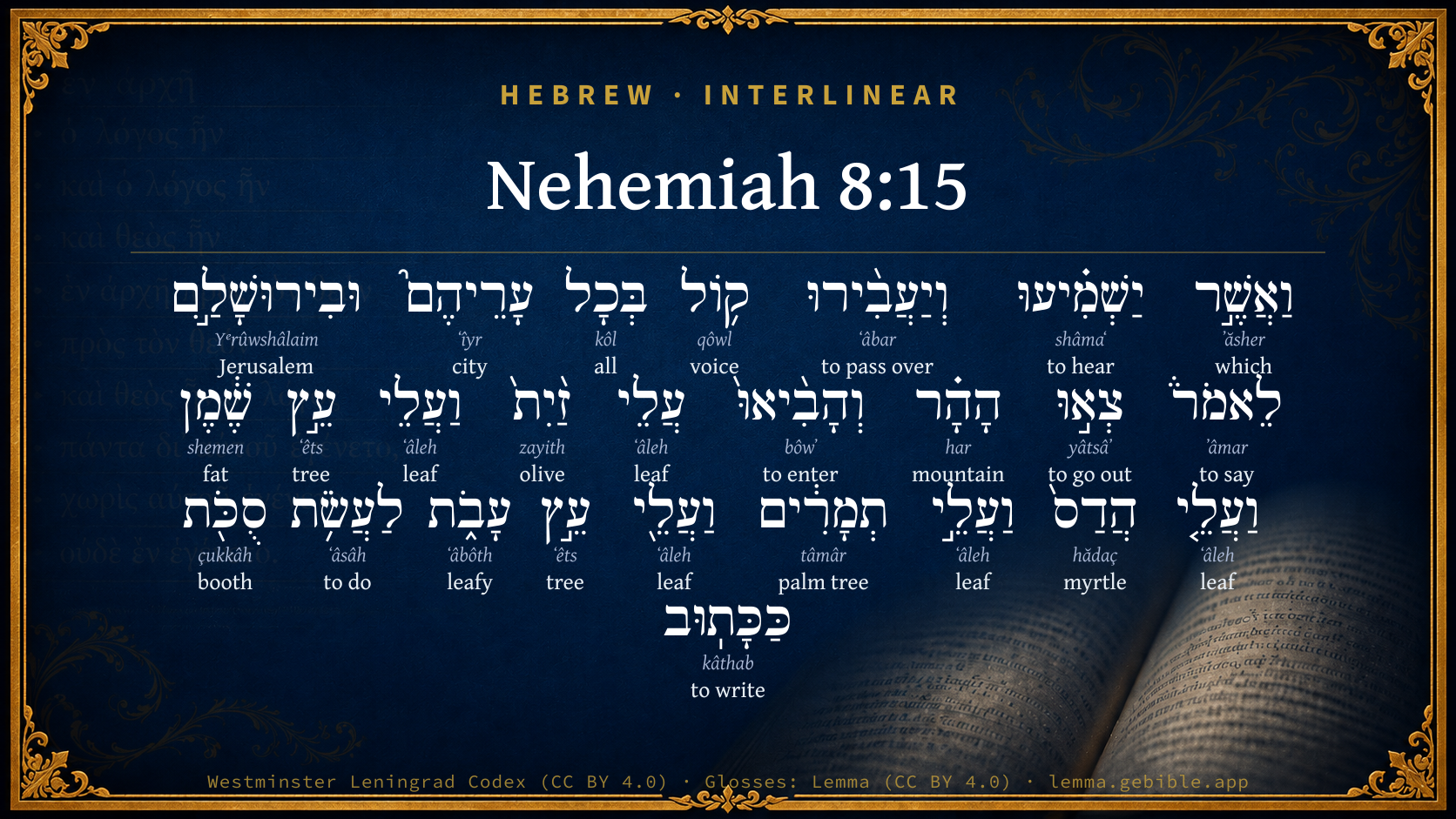
Hebrew (Westminster Leningrad Codex) Nehemiah 8:15 appears in the Hebrew Old Testament. The text above is from the Westminster Leningrad Codex. Each word links to its Strong’s number, a concise gloss, and parsing drawn from the Open Scriptures Hebrew Bible morphology. Click any word for its full Brown-Driver-Briggs (BDB) entry.
Download image
Cite this verse

Nehemiah 8:15 (World English Bible). Public Domain. Lemma interlinear Bible study tool, https://lemma.gebible.app/v/nehemiah/8/15.

Show BibTeX & RIS
BibTeX
RIS
English Translation
and that they should publish and proclaim in all their cities, and in Jerusalem, saying, Go forth to the mountain, and get olive branches, and branches of wild olive, and myrtle branches, and palm branches, and branches of thick trees, to make booths, as it is written.
World English Bible · Public Domain
Highlights
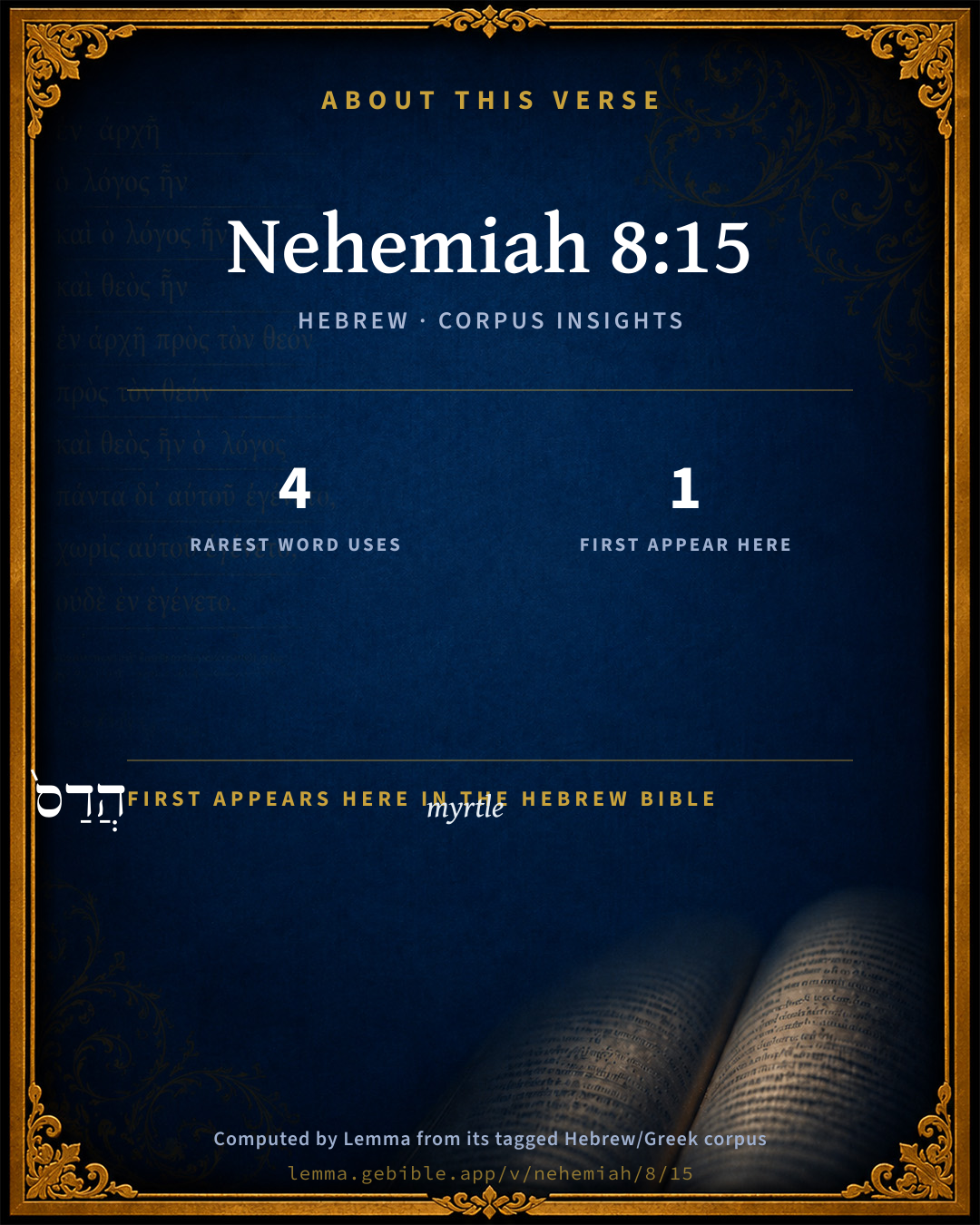
  • 1 first appearance in the Hebrew Bible
Full analysis ↓
Download a study sheet

One document with this verse’s original text, its word-by-word gloss line, the meaning frame, cross-references with their text, attributed commentary, and full source and license credits — printable, and it pastes into notes with its structure intact.

This verse Autodidact and up

Study sheet (.html) Plain text (.txt)

A passage Seminary Student

Up to 50 verses in one chapter. A passage sheet keeps up to 6 commentary sources and 12 cross-references per verse, in the order this page ranks them, and says so on the sheet whenever that leaves anything out. Ask for a single verse and you get the Autodidact verse sheet above.

Everything on this page stays free to read, with no account — the sheet is a download of what is already on screen, not access to it.

Want to remove ads? Support Godless Engineer
Compare translations 3

The same verse in 3 English versions, stacked beneath the original-language interlinear above. Click any original word for its lexicon entry.

Each is an independent rendering of the whole verse — the interlinear is not word-aligned to these translations.

Highlighted words mark where these versions differ — a whole-verse word diff, not a word-by-word alignment.

  • World English Bible Public Domain
    and that they should publish and proclaim in all their cities, and in Jerusalem, saying, Go forth to the mountain, and get olive branches, and branches of wild olive, and myrtle branches, and palm branches, and branches of thick trees, to make booths, as it is written.
  • King James Version Public Domain
    And that they should publish and proclaim in all their cities, and in Jerusalem, saying, Go forth unto the mount, and fetch olive branches, and pine branches, and myrtle branches, and palm branches, and branches of thick trees, to make booths, as it is written.
  • unfoldingWord Literal Text CC BY-SA 4.0
    and that they should cause others to hear and cause a sound to pass throughout all their cities and in Jerusalem, saying, “Go out to the mountain, and bring branches of olive, and branches of oil trees, and branches of myrtle, and branches of palms, and branches of leafy trees, to make huts, as it is written.”

unfoldingWord Literal Text — © unfoldingWord, licensed CC BY-SA 4.0. Word-aligned USFM3 via Door43 (git.door43.org/unfoldingWord/en_ult).

Versions to compare (up to 4)

3 of 4 selected

Show all 18 translations

Every available English version of this verse, each an independent rendering of the whole verse.

  • World English Bible Public Domain
    and that they should publish and proclaim in all their cities, and in Jerusalem, saying, Go forth to the mountain, and get olive branches, and branches of wild olive, and myrtle branches, and palm branches, and branches of thick trees, to make booths, as it is written.
  • Berean Standard Bible Public Domain
    So they proclaimed this message and spread it throughout their towns and in Jerusalem, saying, “Go out to the hill country and bring back branches of olive, wild olive, myrtle, palm, and other leafy trees, to make booths, as it is written.”
  • Majority Standard Bible Public Domain
    and that they should proclaim this message and spread it throughout their towns and in Jerusalem, saying, “Go out to the hill country and bring back branches of olive, wild olive, myrtle, palm, and other leafy trees, to make booths, as it is written.”
  • King James Version Public Domain
    And that they should publish and proclaim in all their cities, and in Jerusalem, saying, Go forth unto the mount, and fetch olive branches, and pine branches, and myrtle branches, and palm branches, and branches of thick trees, to make booths, as it is written.
  • American Standard Version (1901) Public Domain
    and that they should publish and proclaim in all their cities, and in Jerusalem, saying, Go forth unto the mount, and fetch olive branches, and branches of wild olive, and myrtle branches, and palm branches, and branches of thick trees, to make booths, as it is written.
  • Revised Version (1885) Public Domain
    and that they should publish and proclaim in all their cities, and in Jerusalem, saying, Go forth unto the mount, and fetch olive branches, and branches of wild olive, and myrtle branches, and palm branches, and branches of thick trees, to make booths, as it is written.
  • Geneva Bible (1599) Public Domain
    And that they shoulde cause it to bee declared and proclaimed in all their cities, and in Ierusalem, saying, Go forth vnto the mount, and bring oliue branches, and pine branches, and branches of myrtus, and palme branches, and branches of thicke trees, to make boothes, as it is written.
  • Douay-Rheims (1899) Public Domain
    And that they should proclaim and publish the word in all their cities, and in Jerusalem, saying: Go forth to the mount, and fetch branches of olive, and branches of beautiful wood, branches of myrtle, and branches of palm, and branches of thick trees, to make tabernacles, as it is written.
  • Young's Literal Translation Public Domain
    and that they proclaim and cause to pass over all their cities, (and in Jerusalem,) saying, `Go ye out to the mount, and bring leaves of the olive, and leaves of the oil tree, and leaves of the myrtle, and leaves of the palms, and leaves of thick trees, to make booths as it is written.'
  • Literal Standard Version CC BY-SA 4.0
    and that they proclaim and cause to pass over all their cities (and in Jerusalem), saying, “Go out to the mountain, and bring leaves of the olive, and leaves of the oil tree, and leaves of the myrtle, and leaves of the palms, and leaves of thick trees, to make shelters as it is written.”
  • Unlocked Literal Bible CC BY-SA 4.0
    They should make a proclamation in all their cities, and in Jerusalem, saying, “Go out into the hill country, and bring back branches from olive and wild olive trees, and from myrtle, palms and shade trees, to make shelters, as it is written.”
  • unfoldingWord Literal Text CC BY-SA 4.0
    and that they should cause others to hear and cause a sound to pass throughout all their cities and in Jerusalem, saying, “Go out to the mountain, and bring branches of olive, and branches of oil trees, and branches of myrtle, and branches of palms, and branches of leafy trees, to make huts, as it is written.”
  • Darby Bible Public Domain
    and that they should publish and proclaim through all their cities, and at Jerusalem, saying, Go forth to the mount, and fetch olive-branches, and wild olive-branches, and myrtle-branches, and palm-branches, and branches of thick trees, to make booths, as it is written.
  • World Messianic Bible Public Domain
    and that they should publish and proclaim in all their cities and in Jerusalem, saying, “Go out to the mountain, and get olive branches, branches of wild olive, myrtle branches, palm branches, and branches of thick trees, to make temporary shelters, as it is written.”
  • Webster's Bible Public Domain
    And that they should publish and proclaim in all their cities, and in Jerusalem, saying, Go forth to the mount, and fetch olive branches, and pine branches, and myrtle branches, and palm branches, and branches of thick trees, to make booths, as it is written.
  • Free Bible Version CC BY-SA 4.0
    They were to make an announcement in all their towns and in Jerusalem, saying, “Go into the hills and bring back branches of olive, wild olive, myrtle, palm, and other leafy trees, to make shelters to live in, as the Law requires.”
  • Bible in Basic English Public Domain
    And that they were to give out an order, and make it public in all their towns and in Jerusalem, saying, Go out to the mountain and get olive branches and branches of field olives and of myrtle, and palm branches and branches of thick trees, to make tents, as it says in the book.
  • JPS Tanakh (1917) Public Domain
    and that they should publish and proclaim in all their cities, and in Jerusalem, saying: 'Go forth unto the mount, and fetch olive branches, and branches of wild olive, and myrtle branches, and palm branches, and branches of thick trees, to make booths, as it is written.'

Literal Standard Version (2020), Covenant Press — licensed CC BY-SA 4.0. Text via the HelloAO Bible API (eBible.org). Unlocked Literal Bible (unfoldingWord) — licensed CC BY-SA 4.0. Text via the HelloAO Bible API (eBible.org). unfoldingWord Literal Text — © unfoldingWord, licensed CC BY-SA 4.0. Word-aligned USFM3 via Door43 (git.door43.org/unfoldingWord/en_ult). Free Bible Version, Dr. Jonathan Gallagher — licensed CC BY-SA 4.0. Text via the HelloAO Bible API (eBible.org).

Word by word

More ways to search: Search by grammar → Find every occurrence → Compare this word →

Practice this passage: Drill this verse → Learn its vocabulary →

עָבֹ֑ת
ʻâbôth
H5687
“leafy”
Adjective, Adjective, Masculine, Singular, Absolute
Part of Speech
Adjective
Type
Adjective
Gender
Masculine
Number
Singular
State
Absolute
Full BDB Definition

Origin: from H5686

TWOT: 1558a

having interwoven foliage, leafy, dense with foliage
  1. וַאֲשֶׁ֣ר ʼăsher H834 “and · which” Conjunction + Particle, Relative
  2. יַשְׁמִ֗יעוּ shâmaʻ H8085 “to hear” Verb, Hiphil, Imperfect, 3rd Person, Masculine, Plural
  3. וְיַעֲבִ֨ירוּ ʻâbar H5674 “and · to pass over” Conjunction + Verb, Hiphil, Imperfect, 3rd Person, Masculine, Plural
  4. ק֥וֹל qôwl H6963 “voice” Noun, Common, Masculine, Singular, Absolute
  5. בְּכָל kôl H3605 “in/at · all of” Preposition + Noun, Common, Masculine, Singular, Construct
  6. עָרֵיהֶם֮ ʻîyr H5892 “cities · their” Noun, Common, Feminine, Plural, Construct + Suffix, Personal, 3rd Person, Masculine, Plural
  7. וּבִירוּשָׁלִַ֣ם Yᵉrûwshâlaim H3389 “and · in/at · Jerusalem” Conjunction + Preposition + Noun, Proper
  8. לֵאמֹר֒ ʼâmar H559 “to say” Preposition + Verb, Qal, Infinitive Construct
  9. צְא֣וּ yâtsâʼ H3318 “go out” Verb, Qal, Imperative, 2nd Person, Masculine, Plural
  10. הָהָ֗ר har H2022 “the · mountain” Particle, Definite Article + Noun, Common, Masculine, Singular, Absolute
  11. וְהָבִ֨יאוּ֙ bôwʼ H935 “and · enter” Conjunction + Verb, Hiphil, Imperative, 2nd Person, Masculine, Plural
  12. עֲלֵי ʻâleh H5929 “leaves of” Noun, Common, Masculine, Plural, Construct
  13. זַ֨יִת֙ zayith H2132 “olive” Noun, Common, Masculine, Singular, Absolute
  14. וַעֲלֵי ʻâleh H5929 “and · leaves of” Conjunction + Noun, Common, Masculine, Plural, Construct
  15. עֵ֣ץ ʻêts H6086 “tree of” Noun, Common, Masculine, Singular, Construct
  16. שֶׁ֔מֶן shemen H8081 “fat” Noun, Common, Masculine, Singular, Absolute
  17. וַעֲלֵ֤י ʻâleh H5929 “and · leaves of” Conjunction + Noun, Common, Masculine, Plural, Construct
  18. הֲדַס֙ hădaç H1918 “myrtle” Noun, Common, Masculine, Singular, Absolute
  19. וַעֲלֵ֣י ʻâleh H5929 “and · leaves of” Conjunction + Noun, Common, Masculine, Plural, Construct
  20. תְמָרִ֔ים tâmâr H8558 “palm trees” Noun, Common, Masculine, Plural, Absolute
  21. וַעֲלֵ֖י ʻâleh H5929 “and · leaves of” Conjunction + Noun, Common, Masculine, Plural, Construct
  22. עֵ֣ץ ʻêts H6086 “tree of” Noun, Common, Masculine, Singular, Construct
  23. לַעֲשֹׂ֥ת ʻâsâh H6213 “to do” Preposition + Verb, Qal, Infinitive Construct
  24. סֻכֹּ֖ת çukkâh H5521 “booths” Noun, Common, Feminine, Plural, Absolute
  25. כַּכָּתֽוּב kâthab H3789 “like/as the · written” Preposition, Determined + Verb, Qal, Participle Passive, Masculine, Singular, Absolute

About this verse

These counts appear in no published source. They are computed here, from the morphology-tagged text and Lemma’s own curated glosses. What Lemma adds →

26
words
21
distinct lemmas
Historical
section

Notable vocabulary

The rarest word here is עָבֹ֑ת leafy H5687 — appearing just 4 times in the whole Hebrew Bible.

First appearance in Scripture

This word makes its first canonical appearance in the Hebrew Bible here:

  • הֲדַס֙ myrtle H1918

Shared distinctive vocabulary

עָבֹ֑ת leafy H5687 occurs in 4 verses of the Hebrew Bible. Also found in:

Grammatical profile

  • 7 verbs
  • 17 nouns
  • 1 adjective
  • 1 particle

Verb forms

  • יַשְׁמִ֗יעוּ Hiphil · Imperfect
  • וְיַעֲבִ֨ירוּ Hiphil · Imperfect
  • לֵאמֹר֒ Qal · Infinitive Construct
  • צְא֣וּ Qal · Imperative
  • וְהָבִ֨יאוּ֙ Hiphil · Imperative
  • לַעֲשֹׂ֥ת Qal · Infinitive Construct
  • כַּכָּתֽוּב Qal · Participle Passive

Repetition

Words recur within this verse — often emphatic in Hebrew:

  • עֲלֵי leaf H5929 ×5
  • עֵ֣ץ tree H6086 ×2

Cross-references

8

Topical passages linked to Nehemiah 8:15 in the Treasury of Scripture Knowledge — connected by theme and wording, ordered by reader-vote popularity; previews shown in the World English Bible.

  • Leviticus 23:40 You shall take on the first day the fruit of goodly trees, branches of palm trees, and boughs of thick trees, and willows of the brook; and you shall rejoice before Yahweh your God seven days.
  • Leviticus 23:4 "'These are the set feasts of Yahweh, even holy convocations, which you shall proclaim in their appointed season.
  • Deuteronomy 16:16 Three times in a year shall all your males appear before Yahweh your God in the place which he shall choose: in the feast of unleavened bread, and in the feast of weeks, and in the feast of tents; and they shall not appear before Yahweh empty:
  • Genesis 8:11 The dove came back to him at evening, and, behold, in her mouth was an olive leaf plucked off. So Noah knew that the waters were abated from off the earth.
  • Judges 9:48–49 Abimelech got him up to Mount Zalmon, he and all the people who were with him; and Abimelech took an axe in his hand, and cut down a bough from the trees, and took it up, and laid it on his shoulder: and he said to the people who were with him, What you have seen me do, make haste, and do as I have done.
  • Matthew 21:1 When they drew near to Jerusalem, and came to Bethsphage, to the Mount of Olives, then Jesus sent two disciples,
  • John 12:13 they took the branches of the palm trees, and went out to meet him, and cried out, "Hosanna! Blessed is he who comes in the name of the Lord, the King of Israel!"
  • Revelation 7:9 After these things I looked, and behold, a great multitude, which no man could number, out of every nation and of all tribes, peoples, and languages, standing before the throne and before the Lamb, dressed in white robes, with palm branches in their hands.

Cross-references courtesy of OpenBible.info (CC BY 4.0).

Hebrew and Greek witnesses Masoretic Hebrew ↔ Greek Septuagint

The same verse in the two great witnesses to the Old Testament, shown verse-for-verse.

These are two independent witnesses, not word-aligned to each other, and the Septuagint is shown in lemma (dictionary) form.

Hebrew Nehemiah 8:15 Masoretic · Westminster Leningrad Codex

וַאֲשֶׁ֣ר יַשְׁמִ֗יעוּ וְיַעֲבִ֨ירוּ ק֥וֹל בְּכָל עָרֵיהֶם֮ וּבִירוּשָׁלִַ֣ם לֵאמֹר֒ צְא֣וּ הָהָ֗ר וְהָבִ֨יאוּ֙ עֲלֵי זַ֨יִת֙ וַעֲלֵי עֵ֣ץ שֶׁ֔מֶן וַעֲלֵ֤י הֲדַס֙ וַעֲלֵ֣י תְמָרִ֔ים וַעֲלֵ֖י עֵ֣ץ עָבֹ֑ת לַעֲשֹׂ֥ת סֻכֹּ֖ת כַּכָּתֽוּב

and that they should publish and proclaim in all their cities, and in Jerusalem, saying, Go forth to the mountain, and get olive branches, and branches of wild olive, and myrtle branches, and palm branches, and branches of thick trees, to make booths, as it is written.

World English Bible · Public Domain

Greek LXX Structure differs

The Septuagint has no separate book of Nehemiah. Its Greek text is the second half of Esdras B (2 Esdras), chapters 11–23; Ezra is the first half (1–10).

A verse-for-verse comparison isn’t shown here because the chapters and verses don’t line up. Switch to the LXX edition with the MT / LXX toggle above to read the Greek directly.

On this verse, Ellicott's Commentary for English Readers discusses the Septuagint’s reading. Read the note in Commentary ↓

Hebrew: Westminster Leningrad Codex (CC BY 4.0). Greek: Septuagint (public domain); English from a public-domain English Septuagint. How the Septuagint differs from the Hebrew →

Commentary

Notes on Nehemiah 8:15 from classic Christian and Jewish commentators (each source and its license shown beneath its notes). The classic Christian expositions comment on the surrounding passage and are grouped to its opening verse, so a note may address several verses; the Jewish commentaries on the Tanakh (Rashi and others) are per-verse, so they appear only where the commentator wrote on this verse.

Lemma curates 59 commentaries, every one of them public domain or Creative Commons licensed, each selected and text-cleaned for this edition rather than reprinted as found. About our sources →

Trapp's Complete Commentary

John Trapp

Neh 8:15 And that they should publish and proclaim in all their cities, and in Jerusalem, saying, Go forth unto the mount, and fetch olive branches, and pine branches, and myrtle branches, and palm branches, and branches of thick trees, to make booths, as [it is] written.

Ver. 15. And that they should publish and proclaim] Heb. Make a voice to pass, viz. for better preparation and greater solemnity. God will not take up with a careless and slubbered service; he is a great King, and stands greatly upon his seniority, Mal 1:14.

Go forth unto the mount] Which is covered with all sorts of trees; and nothing like the country Axylus, which is so called, because no trees grow in it, no, not so much as thorns, or any kind of fuel. Through this country marched Manlius, the Roman general, when he went against the Gallograeci (Liv. lib. 38).

And fetch olive branches, and pine branches, &c.] Fit for shelter and shadow against the weather. That is very strange that yet is reported by authors of good note, concerning certain trees in Brazil of that size that whole families live in an arm of one of them, every tree being as populous as many of our villages.

And branches of thick trees] Tied together with willows of the brook, Lev 23:40.

John Trapp, A Commentary or Exposition upon All the Books of the Old and New Testament (1647–1656) — public domain. Text from a community e-Sword module.

The Biblical Illustrator

Joseph S. Exell

Neh_8:15-18

So the people went forth, and brought them, and made themselves booths

The celebration of the Feast of Tabernacles

I.

We are reminded here that there is such a thing as buried truth. True reformations and revivals of religion have always consisted in peoples minds being directed to some portion of truth which, though contained in the Word of God, has for a time been lost sight of.

II. We observe that in this instance the Jews dared to follow God, apart prom and in spite of the traditions of a thousand years. It is not a valid argument against a view of truth that it has found no acceptance for long, or even that the testimony of successive generations is against it.

III. Weak and despised instrumentality is often used of God to recover lost truth. It was reserved for the feeble remnant that returned from the Babylonish captivity to do what had not been done even in the bright days of Solomon. The Waldenses bearing dogged testimony against Rome for centuries. The Gospellers of Wycliffes and other days in our own land. George Fox and his noble band of Friends.

IV. It was after bitter chastisement of captivity that the nation was thus made willing and obedient. (W. P. Lockhart.)

Religion in booths

It is a grand festival. It is the Feast of Tabernacles. The people celebrate the deliverance of their fathers from desert travel, where they lived in tents. And it is also typical of our march to heaven--pilgrims in a temporary booth on the way to Canaan. So that I say to you in a figurative sense what was said to the Jews in a literal sense, Go forth into the mount, and fetch olive branches, and pine branches, and myrtle branches, and palm branches, and branches of thick trees, to make booths.

I. The olive branch is always used as a sign of peace. The olive-tree grows in warm climates to the height of about twenty-five feet, has an upright stem, and many out-shooting branches which can easily be stripped off. If a twig of this tree, in time of war, is handed from one general to another, it means the unsaddling of cavalry horses and the hanging up of the war knapsacks. After hostilities have ceased, these branches are placed over doorways, and they are built into triumphal arches, and they are waved in processions. They spell out in verdurous letters that heaven-born word of Peace! Now in this gospel arbour which God sends us to build we must have two of these olive branches.

1. Peace with God.

2. Peace with each other.

II. My text, in the next place, suggests that in this arbour for our soul, on the way toward glory, we ought to have a good many pine branches. Now, pine is healthful, aromatic, and an evergreen. It has often been the case that invalids have been sent into the regions where the pine grows, and they have come back thoroughly well. It is a frequent prescription, on the part of physicians, to say, Go for a few weeks amid the pines, and you will be better. Now we want in this gospel arbour pine branches. We want something that means health, aroma, and evergreen. This is a very healthy religion. I have known an old Christian, with no capital of physical health, and carrying about him all the respectable diseases that one can carry, and yet kept alive by nothing at all but his religion. But this gospel is evergreen. What does the pine forest care for the snow on its brow? It merely considers it a crown of glory. You cannot freeze out the pine forest, and this grace of God is just as good in the winter of trouble as it is in the summer of prosperity. It is the religion you want--not dependent upon weather or upon change.

III. My text suggests still further that this arbour of Christian grace ought to have in it a good many palm branches. You know that it is a favourite tree at the East. The ancients used to make it into three hundred and sixty uses. The fruit is conserved. The sap becomes a beverage. The stones are ground up as food for camels. The base of the leaves is twisted into rope. Baskets and mats are made out of it, and from the root to the tip-top of the palm it is all usefulness. It grows eighty-five feet in height, is columnar, its fringed leaves sometimes four or five yards long, and the ancients used to carry it in processions as a symbol of victory. Oh, for more palm branches in our gospel arbour! Usefulness and victory! Head, heart, tongue, pen, money, social position--all employed for God. Counsel is often given on worldly matters--about investments--that you must not put all the eggs in one basket; but in this matter of religion I wish that we might give all to God, and get in ourselves. Oh, says some man, my business is to sell silks and calicoes. Then sell silks and calicoes for the glory of God. Says another man, My business is to edit a newspaper. Then edit a newspaper for the glory of God. Anything that a man cannot do for the glory of God he has no right to do. The vast majority of professed Christians in this day do not amount to anything. You have to shovel them off the track before the chariot of Gods grace can advance. What we want in the Church now is not weeping willows, sighing and weeping by the Water-courses, admiring their long fringes in the glass of the stream; not hickories full of knots; not wild cherry, dropping bitter fruits; but palm-trees, adapted to three hundred and sixty purposes--root, trunk, branch, leaf, producing something for God and man and angels.

IV. My text demands that in the making of this gospel arbour we shall get branches of thick trees. You know that a booth or arbour is of little worth unless there be stout poles at the corners, or the wind will upset the booth; and you will be worse off than without shelter unless you have strong branches of thick trees. A gospel that is all mellowness and sweetness will have no strength to withstand the blast of temptation and trial and trouble. We want a brawny Christianity. We want a gospel with warnings as well as with invitations. While olive branches are good in their places, and the palm branches, and the myrtle branches, we want the stout branches of thick trees. The tempest of temptation will come down after a while; the hurricane of death will blow; and alas! for that man who has not his soul sheltered under the stout branches of the thick trees. (T. De Witt Talmage.)

Also day by day . . . he read in the book of the law of God.

Daily Bible-reading

I. Why?

1. Because of its infinite preciousness and value.

2. Because of its tendency to build up the inner and spiritual life.

3. Because all great revivals of the power of religion have been associated with high reverence for the written Word.

4. Because by this Word you must be judged.

II. How?

1. With reverence.

2. With special affection and prayerfulness.

3. Take time.

4. Keep the end in view. (S. Thodey.)

.

The Biblical Illustrator, edited by Joseph S. Exell (c. 1880s–1900s) — public domain. Text from a community e-Sword module.

Tyndale Open Study Notes

Tyndale Open Resources

8:15 make shelters in which they would live during the festival: The Festival of Shelters commemorated that the people of Israel had lived in tents during their wilderness journey (Lev 23:33-43; see also Num 29:12-39; Deut 16:13-15).

Tyndale Open Study Notes — © Tyndale Open Resources, licensed CC BY-SA 4.0. Text via the HelloAO Bible API.

Geneva Bible (1599)

Geneva Bible translators

Or, goodly branches, as Lev. 3:40.

Geneva Bible (1599) marginal notes — public domain. Text via Bolls.life.

Adam Clarke's Commentary

Verse 15. Fetch olive branches] For every thing concerning this feast of tabernacles, see the notes on Lev. xxiii., and the other places there referred to.

Adam Clarke's Commentary on the Bible (1810–1826) — public domain. Text from a community e-Sword/MySword module.

Ellicott's Commentary for English Readers

(15) Saying.—There is no such command in Leviticus; the Septuagint inserts, “And Ezra spake.” But it is better to adopt Houbigant’s slight emendation of the text, which thus runs: “And when they heard it, they proclaimed,” &c. The command, then, is to go out to the Mount of Olives, and gather, not precisely the branches which the ancient law required, but such as circumstances allowed.

A Bible Commentary for English Readers, edited by Charles John Ellicott (1878–1897) — public domain. Text from a community e-Sword module.

The Cambridge Bible for Schools and Colleges

gen. ed. J. J. S. Perowne

15. and that they should publish and proclaim … saying] In Lev_23:1; Lev_23:4 the children of Israel are commanded to ‘proclaim the set feasts of the Lord.’ The actual words of this verse are nowhere to be found in the Pentateuch. But there is no reason on that account to suppose a corruption in the text, and to read as Houbigant, whom Rawlinson follows, ‘And when they heard it, they proclaimed &c.,’ a text for which only a slight emendation is necessary. The LXX. puts a full stop at ‘Jerusalem,’ and begins a new sentence, ‘And Ezra said, Go forth.’ The fact is that the writer only refers in a general way to the substance of the passage in Leviticus 23 relating to ‘the feast of tabernacles.’ The mention of ‘Jerusalem’ is alone sufficient to show the spirit of free adaptation in which the reference to ‘the law’ is made. Possibly Jerusalem is mentioned as embodying the Deuteronomic phrase ‘the place which the Lord shall choose’ in Deu_16:15.

the mount] i.e. the mountain region or hill country of Judah. Not to be restricted to the Mt of Olives.

pine branches] R.V. branches of wild olive. Cf. Isa_41:19, ‘the oil tree’ (Marg. Or, oleaster). Both the olive (ἐλαία) and the wild olive (ἀγριέλαιος) were conspicuous for their thick foliage; cf. Rom_11:17. For ‘palms’ near Jerusalem cf. Mar_11:8, and Jericho ‘the city of palms’ (Jdg_1:16; Jdg_3:13; 2Ch_28:15).

as it is written] The reference is evidently to Lev_23:40, ‘And ye shall take you on the first day the fruit of goodly trees, branches of palm trees, and boughs of thick trees, and willows of the brook.’ But the quotation only agrees in the general sense. The only words which are found in both passages are ‘palm’ and ‘thick trees’ (Eze_20:28). The ‘goodly trees’ (‘ec̣ hadar) possibly include ‘the branches of myrtle’ (‘eley hédas). The myrtle (cf. Isa_55:13; Zec_1:8; Zec_1:10-11) is mentioned with ‘the wild olive’ in Isa_41:19.

The Cambridge Bible for Schools and Colleges (gen. ed. J. J. S. Perowne; Cambridge University Press, 1878–1918) — public domain. Text from a community e-Sword module.

John Gill's Exposition

And that they should publish and proclaim in all their cities, and in Jerusalem,.... That is, as Jarchi interprets it, by supplying it thus:

and they commanded that they should publish, &c. Ezra and those with him gave orders that heralds should proclaim in all cities where the Jews dwelt that the feast of tabernacles would be kept, and they should prepare for it; and which seems to be the true sense, since it is not written in the law that such a proclamation should be made; but this was an order of their own, thereby to give notice of it, that all might be provided:

go forth unto the mount, and fetch olive branches, and pine branches, and myrtle branches, and palm branches, and branches of thick trees, to make booths, as it is written; in Lev 23:40, where the first three of these seem to be called boughs of goodly trees; though the Jews (r) commonly understand them of pomecitrons, of which the Syriac version here interprets the myrtle branches; and by them are meant the citron branches, with the leaves and fruit, and which the Jews make absolutely necessary to the keeping of the feast, and for beautiful ones will give a large price; some of them go every year to Spain, and buy as many as they can, and dispose of them wherever Jews live (s): and those branches were to be fetched, not properly speaking to make the booths of, which were made of boards and planks, but for the decoration of them; and it was not necessary, according to Aben Ezra, that some of each of these should be gathered for that purpose, but of any sort of them; for he interprets the words disjunctively olive branches, or pine branches, or myrtle branches, &c. these, according to the common notion of the Jews, were tied up in little bundles, and carried in the hand, which they call "lulabs"; and they observe (t), the thick branches were for them, which included the rest; now these they were to fetch from the mount of Olives, and other mountains about Jerusalem; near to which also there was a place called Motza (u); whither they went, and gathered the willows of the brook mentioned in Lev 23:39.

(r) T. Bab. Succah, fol. 35. 1. (s) Buxtorf. Synagog. Jud. c. 21. p. 454. (t) Succah, fol. 12. 1. (u) Misn. Saccah, c. 4. sect. 5.

John Gill's Exposition of the Whole Bible (1746–1763) — public domain (CC PDM 1.0). Text via the HelloAO Bible API.

Albert Barnes' Notes on the Bible

The mount - The “mount of Olives” is probably intended.

Pine branches - Rather, “branches of the wild olive.” The actual trees named by the Law may have become scarce. It was probably considered that the spirit of the command was kept if branches of trees similar in general character to those named in Leviticus were employed.

Albert Barnes' Notes on the Bible (1834–1885) — public domain. Text from a community e-Sword/MySword module.

Haydock's Catholic Bible Commentary

And that. This is not expressed in the law, though it was probably practised. (Calmet) --- Some translate, "And they proclaimed," &c. (Vatable) --- Beautiful. Literally, "very or most beautiful." (Haydock) --- Hebrew, "of oily wood." Septuagint, "cypress." Syriac, "nut-tree." Others understand the pine, (Pagnin) balm, (Mariana) citron, (Haydock) or any other species of branches, which might then be used. (Calmet) (Tirinus)

George Leo Haydock (1774–1849), Haydock's Catholic Family Bible and Commentary, 1859 edition — public domain. Excludes Psalms (Douay-Rheims chapter numbering differs from Protestant) and Deuterocanonical books (Catholic canon only).

Matthew Poole's English Annotations

And that they should publish, i.e. and they found this also written, which is to be supplied out of the former verse, that they should, &c., which, though it be not particularly required, so as is expressed in the words here following, yet in the general is required by virtue of that precept, Lev 23:4; Num 10:10. And according to this translation, it must be understood in the close of this verse, that they did accordingly publish and proclaim, &c. But these words may be rendered, which (as this Hebrew word is rendered here, Neh 8:14, and most commonly) also (so the particle vau is used, Isa 6:1; Jer 1:3) they did publish, &c. For so they did, as is evident and acknowledged; and it seems fit that so much should be expressed; and these words being particular and proper to this special occasion, seem to intimate that this is rather an historical relation of what they now did, than a declaration of that which the law required them to do, which was but in very general terms, and not so exact and particular as this following precept is said to be. Unto the mount; the Mount of Olives, which was next Jerusalem, and stored with olive branches, and probably with the rest here mentioned; for these trees may seem to have been planted hereabouts principally for the use of this capital city in this very feast, which, though long neglected, should have been celebrated once every year. And therefore this place seems to be here designed as the most eminent place, but with a usual synecdoche, this place being put for any place nearest to the several cities of Judah, where these branches were to be procured.

Branches of thick trees; of which See Poole "Lev 23:34"; See Poole "Deu 16:13".

Matthew Poole's English Annotations on the Holy Bible (1683–1685) — public domain. Text from a community e-Sword/MySword module.

Whedon's Commentary on the Bible

Daniel D. Whedon

15. Unto the mount — Where the branches of trees would be naturally sought.

Olive… pine… myrtle… palm… thick trees — Leviticus xxiii, 40, mentions only palms, thick trees, and willows. No special stress seems to have been laid on the kind of trees, but any and all kinds of trees, whose boughs would serve for making booths, might be sought. The word for pine is literally tree of fatness, and is usually understood of the wild olive, or oleaster, but this is far from certain. The Hebrew word occurs but twice elsewhere; in 1Ki_6:23, where it is rendered olive tree, and in Isa_41:19, where it is rendered oil tree. The myrtle is here first mentioned in the Bible. Royle (in Kitto’s Cyclopaedia) speaks of its ancient and modern celebrity as “justly due to the rich colouring of its dark green and shining leaves, contrasted with the white starlike clusters of its flowers, affording in hot countries a pleasant shade under its branches, and diffusing an agreeable odour from its flowers or bruised leaves.” Thick trees denote any trees of thick foliage.

Daniel D. Whedon (gen. ed.), Commentary on the Old and New Testaments (1874–1909) — public domain. Text from a community e-Sword module.

The Pulpit Commentary

And that they should publish. See Lev_23:4. Saying, Go forth, etc. These words are not found in any existing Scripture, and some corruption of the present text may therefore be suspected. The Septuagint interposes, between "Jerusalem" and "Go forth," the words "And Esdras said," which would remove the difficulty; but it is difficult to understand how Ezra"s name should have fallen out. Perhaps Houbigant is right in his suggestion of an emendation, by which the verse would run thus: when they heard it, they proclaimed in all their cities, and in Jerusalem, saying, Go forth," etc. Into the mountain. i.e. the neighbouring mountain, the Mount of Olives. Pine branches. Rather oleaster branches." Branches of thick trees. The same expression is used in Lev_23:40, the meaning in each place being uncertain. Perhaps trees with thick, viscous leaves are intended. It is remarkable that two of the trees commanded in Leviticus are omitted, viz., the hadar and the "willow of the brook," while three not mentioned in Leviticus the olive, oleaster, and myrtle are added.

The Pulpit Commentary (1880–1919), ed. H.D.M. Spence-Jones & Joseph S. Exell — public domain. Text from a community e-Sword module.

John Wesley's Explanatory Notes

Mount - The Mount of Olives, which was next Jerusalem, and stored with olive-branches, and probably with the rest: for these trees seem to have been planted hereabouts principally, for the use of the city in this very feast, which, though, long neglected, should have been celebrated every year. And this place seems to be here designed as the most eminent place, being put for any place near to the several cities of Judah, where these branches were to be procured.

John Wesley, Explanatory Notes Upon the Whole Bible (1754–1765) — public domain. Text via the GEBible commentary corpus.

Rashi

Rabbi Shlomo Yitzchaki (Rashi)

And that they should announce And they commanded that they announce that they celebrate the Festival of Sukkoth, and so it is customary for Scripture to speak in this manner, like (I Sam. 9: 27): “Tell the servant and he will go ahead of us.”

myrtle leaves It is explained in Tractate Succah (12a) that this is a wild myrtle which is unfit for the lulav and only fit to make a sukkah.

date palm leaves for a lulav.

and leaves of plaited trees This is the myrtle that is fit for the lulav as is explained in Tractate Succah (ad loc.).

Rashi on the Tanakh — English translations: “The Judaica Press complete Tanach with Rashi, translated by A. J. Rosenberg” (CC BY 4.0); “Pentateuch with Rashi's commentary by M. Rosenbaum and A.M. Silbermann, 1929-1934” (public domain); “The Metsudah Tanach series, Lakewood, N.J” (CC BY 4.0); and “The Book of Joshua, Metsudah Publications, 1997” (CC BY 4.0). Text via Sefaria.

Lesson kit

Teaching starters — assembled from the data on this page, not authored interpretation. Every prompt links to the verse data it draws on. Edit before teaching.

Nehemiah, in the Historical, opens this verse with 26 words (21 distinct Hebrew lemmas). Its most distinctive word is ʻâbôth (“leafy”). A historical commentator’s framing appears above. Read the whole chapter for the surrounding context.

Discussion questions

  1. How does “leafy” (ʻâbôth) shape what this verse is saying?
  2. This is the first place “myrtle” appears in Scripture (first appears here). What does its debut here establish?
  3. How does Leviticus 23:40, which shares the word «leafy», read alongside this verse?
  4. What does the repetition of “leaf” (5× in this one verse) do in this verse?
  5. These translations render this verse differently. What is at stake in choosing one wording over another?
  6. «יַשְׁמִ֗יעוּ» is a Hiphil Imperfect verb. How does that grammatical form shape the action described?
  7. Compare how Trapp's Complete Commentary and The Biblical Illustrator read this verse. Where do they agree or differ?

Things to notice

  • 1 word makes its first canonical appearance in Scripture here.
  • These translations choose different wording for 24 words in this verse.
  • “leaf” occurs 5× in this single verse.
  • 21 distinct Hebrew lemmas span 26 words in this verse.

Reading settings

Reading text

Shown beneath each verse's original-language words.

Old Testament
Old Testament edition

Read the OT as the Masoretic Hebrew (MT) or the Greek Septuagint (LXX).

English shown for the Greek Septuagint (in the Hebrew ↔ Greek comparison).

Comparing translations? Open the Compare panel on any verse page to stack up to four side by side.