Ezra 10:7

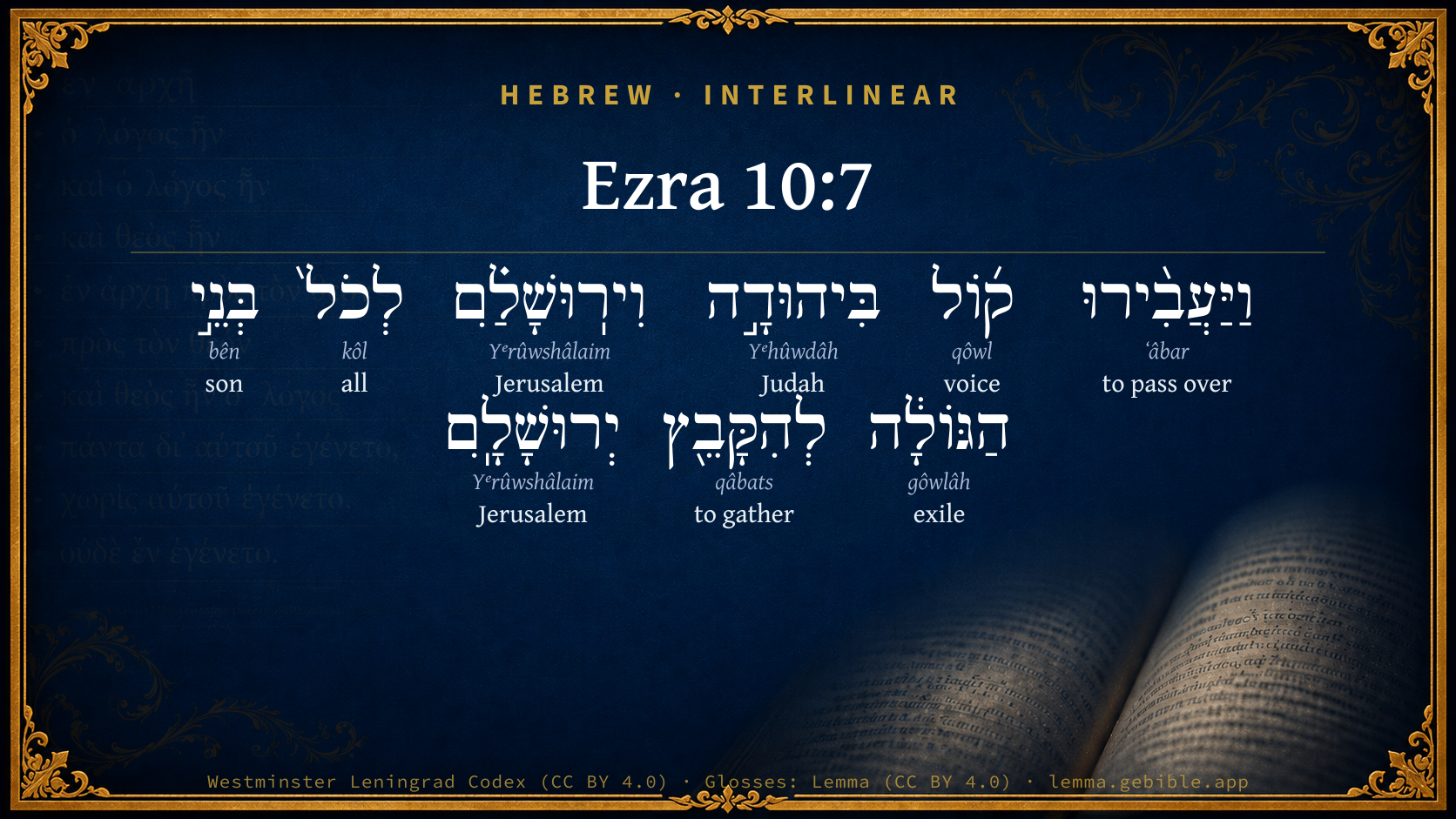
Hebrew (Westminster Leningrad Codex) Ezra 10:7 appears in the Hebrew Old Testament. The text above is from the Westminster Leningrad Codex. Each word links to its Strong’s number, a concise gloss, and parsing drawn from the Open Scriptures Hebrew Bible morphology. Click any word for its full Brown-Driver-Briggs (BDB) entry.
Download image
Cite this verse

Ezra 10:7 (World English Bible). Public Domain. Lemma interlinear Bible study tool, https://lemma.gebible.app/v/ezra/10/7.

Show BibTeX & RIS
BibTeX
RIS
English Translation
They made proclamation throughout Judah and Jerusalem to all the children of the captivity, that they should gather themselves together to Jerusalem;
World English Bible · Public Domain
Download a study sheet

One document with this verse’s original text, its word-by-word gloss line, the meaning frame, cross-references with their text, attributed commentary, and full source and license credits — printable, and it pastes into notes with its structure intact.

This verse Autodidact and up

Study sheet (.html) Plain text (.txt)

A passage Seminary Student

Up to 50 verses in one chapter. A passage sheet keeps up to 6 commentary sources and 12 cross-references per verse, in the order this page ranks them, and says so on the sheet whenever that leaves anything out. Ask for a single verse and you get the Autodidact verse sheet above.

Everything on this page stays free to read, with no account — the sheet is a download of what is already on screen, not access to it.

Want to remove ads? Support Godless Engineer
Compare translations 3

The same verse in 3 English versions, stacked beneath the original-language interlinear above. Click any original word for its lexicon entry.

Each is an independent rendering of the whole verse — the interlinear is not word-aligned to these translations.

Highlighted words mark where these versions differ — a whole-verse word diff, not a word-by-word alignment.

  • World English Bible Public Domain
    They made proclamation throughout Judah and Jerusalem to all the children of the captivity, that they should gather themselves together to Jerusalem;
  • King James Version Public Domain
    And they made proclamation throughout Judah and Jerusalem unto all the children of the captivity, that they should gather themselves together unto Jerusalem;
  • unfoldingWord Literal Text CC BY-SA 4.0
    And they caused a sound to pass throughout Judah and Jerusalem for all the sons of the exile to gather to Jerusalem.

unfoldingWord Literal Text — © unfoldingWord, licensed CC BY-SA 4.0. Word-aligned USFM3 via Door43 (git.door43.org/unfoldingWord/en_ult).

Versions to compare (up to 4)

3 of 4 selected

Show all 18 translations

Every available English version of this verse, each an independent rendering of the whole verse.

  • World English Bible Public Domain
    They made proclamation throughout Judah and Jerusalem to all the children of the captivity, that they should gather themselves together to Jerusalem;
  • Berean Standard Bible Public Domain
    And a proclamation was issued throughout Judah and Jerusalem that all the exiles should gather at Jerusalem.
  • Majority Standard Bible Public Domain
    And a proclamation was issued throughout Judah and Jerusalem that all the exiles should gather at Jerusalem.
  • King James Version Public Domain
    And they made proclamation throughout Judah and Jerusalem unto all the children of the captivity, that they should gather themselves together unto Jerusalem;
  • American Standard Version (1901) Public Domain
    And they made proclamation throughout Judah and Jerusalem unto all the children of the captivity, that they should gather themselves together unto Jerusalem;
  • Revised Version (1885) Public Domain
    And they made proclamation throughout Judah and Jerusalem unto all the children of the captivity, that they should gather themselves together unto Jerusalem;
  • Geneva Bible (1599) Public Domain
    And they caused a proclamation to goe throughout Iudah and Ierusalem, vnto all them of the captiuitie, that they should assemble themselues vnto Ierusalem.
  • Douay-Rheims (1899) Public Domain
    And proclamation was made in Juda and Jerusalem to all the children of the captivity, that they should assemble together into Jerusalem.
  • Young's Literal Translation Public Domain
    And they cause a voice to pass over into Judah and Jerusalem, to all sons of the removal, to be gathered to Jerusalem,
  • Literal Standard Version CC BY-SA 4.0
    And they cause a voice to pass over into Judah and Jerusalem, to all sons of the expulsion, to be gathered to Jerusalem,
  • Unlocked Literal Bible CC BY-SA 4.0
    So they sent word in Judah and Jerusalem to all the people back from exile to assemble in Jerusalem.
  • unfoldingWord Literal Text CC BY-SA 4.0
    And they caused a sound to pass throughout Judah and Jerusalem for all the sons of the exile to gather to Jerusalem.
  • Darby Bible Public Domain
    And they made proclamation in Judah and Jerusalem to all the children of the captivity, that they should gather themselves together unto Jerusalem;
  • World Messianic Bible Public Domain
    They made a proclamation throughout Judah and Jerusalem to all the children of the captivity, that they should gather themselves together to Jerusalem;
  • Webster's Bible Public Domain
    And they made proclamation throughout Judah and Jerusalem to all the children of the captivity, that they should assemble at Jerusalem;
  • Free Bible Version CC BY-SA 4.0
    Then a proclamation was issued throughout Judah and Jerusalem that all the exiles should assemble in Jerusalem.
  • Bible in Basic English Public Domain
    And they made a public statement through all Judah and Jerusalem, to all those who had come back, that they were to come together to Jerusalem;
  • JPS Tanakh (1917) Public Domain
    And they made proclamation throughout Judah and Jerusalem unto all the children of the captivity, that they should gather themselves together unto Jerusalem;

Literal Standard Version (2020), Covenant Press — licensed CC BY-SA 4.0. Text via the HelloAO Bible API (eBible.org). Unlocked Literal Bible (unfoldingWord) — licensed CC BY-SA 4.0. Text via the HelloAO Bible API (eBible.org). unfoldingWord Literal Text — © unfoldingWord, licensed CC BY-SA 4.0. Word-aligned USFM3 via Door43 (git.door43.org/unfoldingWord/en_ult). Free Bible Version, Dr. Jonathan Gallagher — licensed CC BY-SA 4.0. Text via the HelloAO Bible API (eBible.org).

Word by word

More ways to search: Search by grammar → Find every occurrence → Compare this word →

Practice this passage: Drill this verse → Learn its vocabulary →

הַגּוֹלָ֔ה
gôwlâh
H1473
“the · exile”
Particle, Definite Article + Noun, Common, Feminine, Singular, Absolute
Part of Speech
Particle + Noun
Type
Common
Gender
Feminine
Number
Singular
State
Absolute
Full BDB Definition

Origin: active participle of H1540

TWOT: 350a

exiles, exile, captivity - exiles (collective) - exile, captivity (abstract)
  1. וַיַּעֲבִ֨ירוּ ʻâbar H5674 “and · to pass over” Conjunction + Verb, Hiphil, Sequential Imperfect, 3rd Person, Masculine, Plural
  2. ק֜וֹל qôwl H6963 “voice” Noun, Common, Masculine, Singular, Absolute
  3. בִּיהוּדָ֣ה Yᵉhûwdâh H3063 “in/at · Judah” Preposition + Noun, Proper
  4. וִירֽוּשָׁלִַ֗ם Yᵉrûwshâlaim H3389 “and · Jerusalem” Conjunction + Noun, Proper
  5. לְכֹל֙ kôl H3605 “to/for · all of” Preposition + Noun, Common, Masculine, Singular, Construct
  6. בְּנֵ֣י bên H1121 “sons of” Noun, Common, Masculine, Plural, Construct
  7. לְהִקָּבֵ֖ץ qâbats H6908 “to gather” Preposition + Verb, Niphal, Infinitive Construct
  8. יְרוּשָׁלִָֽם Yᵉrûwshâlaim H3389 “Jerusalem” Noun, Proper

About this verse

These counts appear in no published source. They are computed here, from the morphology-tagged text and Lemma’s own curated glosses. What Lemma adds →

9
words
8
distinct lemmas
Historical
section

Shared distinctive vocabulary

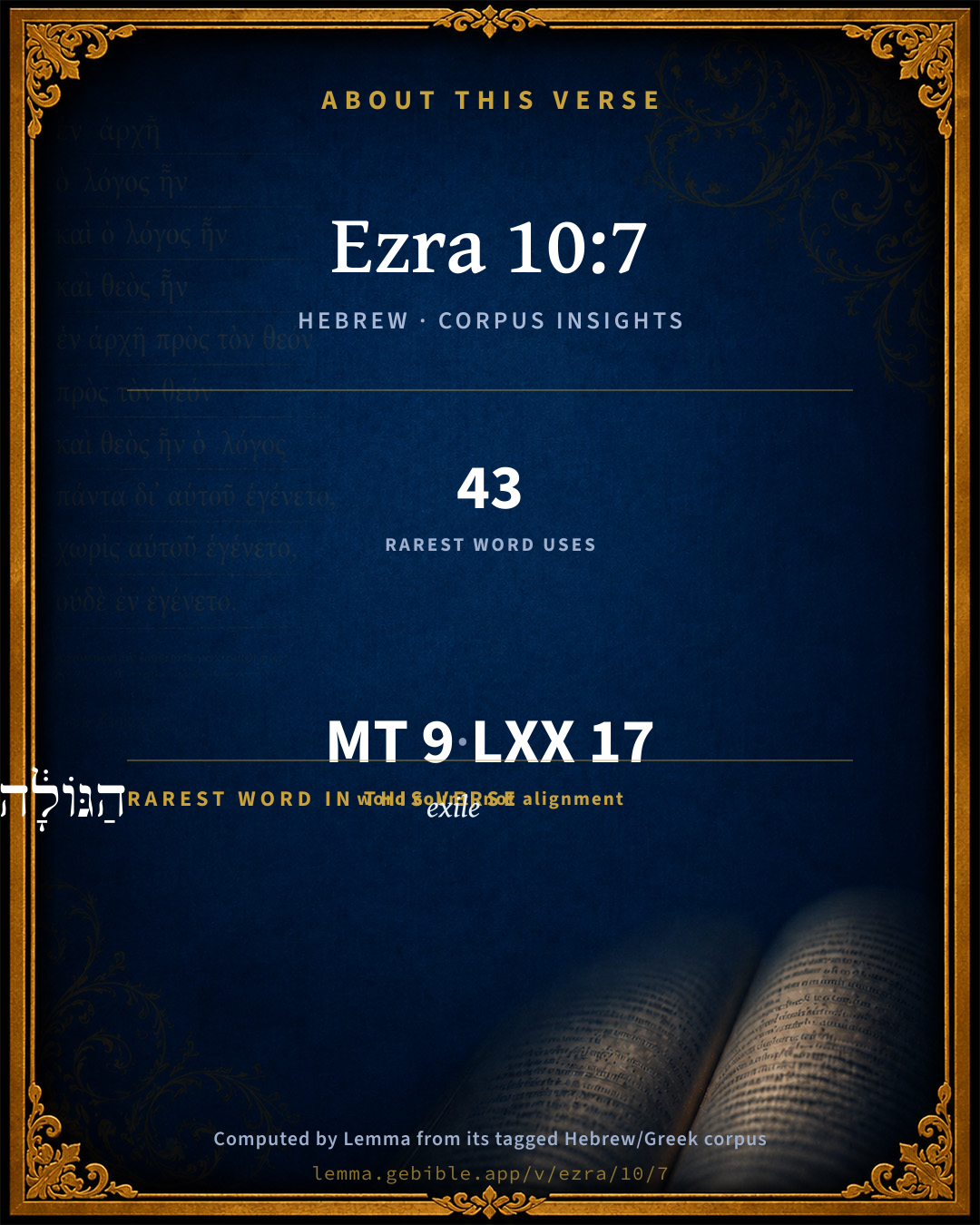
הַגּוֹלָ֔ה exile H1473 occurs in 42 verses of the Hebrew Bible. Also found in:

Grammatical profile

  • 2 verbs
  • 7 nouns

Verb forms

  • וַיַּעֲבִ֨ירוּ Hiphil · Sequential Imperfect
  • לְהִקָּבֵ֖ץ Niphal · Infinitive Construct

Repetition

A word recurs within this verse — often emphatic in Hebrew:

  • וִירֽוּשָׁלִַ֗ם Jerusalem H3389 ×2

Hebrew & Septuagint length

In English translation the verse runs 22 words from the Hebrew and 22 from the Septuagint (LXX English) — the same length.

A rough comparison of the two English renderings, which tokenize alike — not a word-level alignment.

Word counts can differ between the Hebrew and the Greek without any difference in meaning — e.g. the Hebrew direct-object marker אֵת has no separate Greek word, and Greek often adds the article ὁ.

In the original languages it is 9 Hebrew tokens and 17 Greek tokens — but the two are counted differently (Hebrew bundles its prefixes and suffixes into one token; the Greek is in lemma form), so that isn’t a like-for-like length.

Cross-references

2

Topical passages linked to Ezra 10:7 in the Treasury of Scripture Knowledge — connected by theme and wording, ordered by reader-vote popularity; previews shown in the World English Bible.

  • 2 Chronicles 30:5 So they established a decree to make proclamation throughout all Israel, from Beersheba even to Dan, that they should come to keep the Passover to Yahweh, the God of Israel, at Jerusalem: for they had not kept it in great numbers in such sort as it is written.
  • Ezra 1:1 Now in the first year of Cyrus king of Persia, that the word of Yahweh by the mouth of Jeremiah might be accomplished, Yahweh stirred up the spirit of Cyrus king of Persia, so that he made a proclamation throughout all his kingdom, and [put it] also in writing, saying,

Cross-references courtesy of OpenBible.info (CC BY 4.0).

Hebrew and Greek witnesses Masoretic Hebrew ↔ Greek Septuagint

The same verse in the two great witnesses to the Old Testament, shown verse-for-verse.

These are two independent witnesses, not word-aligned to each other, and the Septuagint is shown in lemma (dictionary) form.

Hebrew Ezra 10:7 Masoretic · Westminster Leningrad Codex

וַיַּעֲבִ֨ירוּ ק֜וֹל בִּיהוּדָ֣ה וִירֽוּשָׁלִַ֗ם לְכֹל֙ בְּנֵ֣י הַגּוֹלָ֔ה לְהִקָּבֵ֖ץ יְרוּשָׁלִָֽם

They made proclamation throughout Judah and Jerusalem to all the children of the captivity, that they should gather themselves together to Jerusalem;

World English Bible · Public Domain

Greek LXX Ezra 10:7 Septuagint · lemma form

καί παραφέρω φωνή ἐν ἰουδά καί ἐν ἰερουσαλήμ πᾶς ὁ υἱός ὁ ἀποικία ὁ συνἀθροίζω εἰς ἰερουσαλήμ

And they made proclamation throughout Juda and Jerusalem to all the children of the captivity, that they should assemble at Jerusalem, saying,

LXX2012 (modern English Septuagint) · Public Domain

In the Septuagint this is one book — Esdras B (2 Esdras): Ezra is chapters 1–10, Nehemiah 11–23.

On this verse, The Pulpit Commentary discusses the Septuagint’s reading. Read the note in Commentary ↓

Hebrew: Westminster Leningrad Codex (CC BY 4.0). Greek: Septuagint (public domain); English from LXX2012 (modern English Septuagint) (Public Domain). How the Septuagint differs from the Hebrew →

Commentary

Notes on Ezra 10:7 from classic Christian and Jewish commentators (each source and its license shown beneath its notes). The classic Christian expositions comment on the surrounding passage and are grouped to its opening verse, so a note may address several verses; the Jewish commentaries on the Tanakh (Rashi and others) are per-verse, so they appear only where the commentator wrote on this verse.

Lemma curates 59 commentaries, every one of them public domain or Creative Commons licensed, each selected and text-cleaned for this edition rather than reprinted as found. About our sources →

Trapp's Complete Commentary

John Trapp

Ezr 10:7 And they made proclamation throughout Judah and Jerusalem unto all the children of the captivity, that they should gather themselves together unto Jerusalem;

Ver. 7. And they made proclamation] Heb. They caused a voice to pass, viz. by a herald or crier.

That they should gather themselves together] And so the guilty might be brought to their answer, in that general assembly.

John Trapp, A Commentary or Exposition upon All the Books of the Old and New Testament (1647–1656) — public domain. Text from a community e-Sword module.

Keil & Delitzsch

C. F. Keil & F. Delitzsch

The resolution carried into execution. - Ezr 10:7, Ezr 10:8. A proclamation was sent forth throughout Judah and Jerusalem (קול העביר, comp. Ezr 1:1) to all the children of the captivity to assemble at Jerusalem under pain of the punishment, that whoever should not come within three days, all his substance should be forfeited and himself excluded from the congregation, according to the decision of the princes and elders, who, as the heads of the community, had taken the matter in hand, and made this announcement. The forfeiture of substance is not its destruction, as prescribed Deu 13:13-17 in the case of a city fallen into idolatry, but its appropriation to the benefit of the temple, after the analogy of Lev 27:28.

Keil & Delitzsch — Biblical Commentary on the Old Testament (1861–1891) — public domain (CC PDM 1.0). Text via the HelloAO Bible API. (Old Testament only.)

Geneva Bible (1599)

Geneva Bible translators

Hebrew, the sons of the captivity.

Geneva Bible (1599) marginal notes — public domain. Text via Bolls.life.

Ellicott's Commentary for English Readers

(7-17) Conference of the people and commission to try individual cases.

(8) Forfeited.—This, as also what precedes and what follows, again recalls the express commission of Ezra 7. But “according to the counsel” removes all appearance of arbitrariness on the part of Ezra.

(9) Within three days.—From the time of hearing the summons. No town was more than forty miles distant; and of course only those would come that were able, and who came within the scope of the proclamation, the precise terms of which are not given. They were not more than could assemble “in the street,” or open court of the Temple. The minute specifications of date, and the two reasons for the trembling of the people, and the whole strain of the narrative, bear witness to the veracity of an eye-witness.

It was the ninth month.—Chisleu, our December, the rainy month in Palestine.

(10) Ezra the priest.—He stood up, not as the commissioner of Artaxerxes, not at this moment as the scribe, but as the representative of God.

(11) Do his pleasure.—This procedure, humanly severe, is connected with the Divine will.

From the people of the land, and from the strange wives.—The marriages were but a subordinate branch, though a very important one, of the wider sin: that of confederacy with idolators.

(13) We are many.—Better, we have greatly offended in this thing. The greatness of the offence of course implied the number of the offenders.

(14) Stand.—As a representative body in session.

Until the fierce wrath of our God for this matter be turned from us.—A difficult verse, owing to a slight peculiarity in the original. The meaning seems to be: until the fierce wrath of our God—fierce while this matter lasts—be turned away from us.

(15) Were employed about.—Rather, stood against. Nothing is said as to the reason for opposition on the part of these and the two who abetted them. But the reason is obvious enough. Some modern expositors are of their mind, and regard the act of Ezra as remedying one sin by another still greater. They bring Malachi (Ezr_2:15) to their support; but nothing in his prediction about “the wife of thy youth,” rightly understood, tends to condemn the conduct here described.

(16) By their names.—As in Ezr_8:20, the names were before the writer, but are not given.

And sat down.—That is, held a session. This was ten days after the general assembly.

(17) And they made an end.—Though the number of transgressors was only one hundred and thirteen, two months were occupied, which shows the care taken to do justice, especially to the claims of the women put away.

A Bible Commentary for English Readers, edited by Charles John Ellicott (1878–1897) — public domain. Text from a community e-Sword module.

The Cambridge Bible for Schools and Colleges

gen. ed. J. J. S. Perowne

7. And they made proclamation &c.] The phrase for making a proclamation is peculiar; it occurs also in chap. Ezr_1:1, where see note.

The authors of this proclamation are not mentioned. But we are evidently intended to understand the princes and the chiefs of the people (Ezr_10:5) who had taken the oath administered by Ezra. That some little interval of time elapsed between the events just narrated and the issue of this proclamation is a natural supposition. The policy advocated by Shecaniah (Ezr_10:2-3) had been approved. But time and deliberation were needed to determine upon the best method of putting it into execution (see note on Ezr_9:1).

throughout Judah and Jerusalem] That is to say, in every district in southern Palestine and in every quarter of the capital. Cf. ‘Jerusalem and Judah’ (Ezr_2:1), ‘Judah and Jerusalem’ (Ezr_4:6, Ezr_5:1, Ezr_9:9).

unto all the children of the captivity] Cf. notes on this phrase Ezr_2:1, Ezr_4:1, Ezr_6:16; Ezr_6:19, Ezr_8:35.

The Cambridge Bible for Schools and Colleges (gen. ed. J. J. S. Perowne; Cambridge University Press, 1878–1918) — public domain. Text from a community e-Sword module.

John Gill's Exposition

And they made proclamation,.... By the voice of an herald:

throughout Judah and Jerusalem, unto all the children of the captivity; who were returned from it:

that they should gather themselves together unto Jerusalem; within a time after mentioned.

John Gill's Exposition of the Whole Bible (1746–1763) — public domain (CC PDM 1.0). Text via the HelloAO Bible API.

Whedon's Commentary on the Bible

Daniel D. Whedon

7. They made proclamation — Namely, the princes and elders. See next verse. Literally, They made a voice pass in Judah, etc. See note on Ezr_1:1.

Daniel D. Whedon (gen. ed.), Commentary on the Old and New Testaments (1874–1909) — public domain. Text from a community e-Sword module.

The Pulpit Commentary

PROCLAMATION MADE, SUMMONING ALL THE JEWS TO JERUSALEM (vers. 7- 9). After due deliberation between Ezra, the princes, and the elders (ver. 8), it was resolved, as a first step, to summon all Jews or, rather, all those who had returned from the captivity, whether they were Jews or Israelites to Jerusalem, in order that the decision come to with respect to the mixed marriages might be communicated to them. The limit of three days was fixed as the latest date at which any one might make his appearance, and absentees were threatened with the heavy penalties of excommunication and forfeiture of all their possessions. Proclamation having been made to this effect "throughout Judah" (ver. 7), there was a gathering of all the males of full age to Jerusalem within the prescribed time. The place of meeting was the great court of the temple (ver. 9). According to Hecataeus of Abdera (Fr. 14), this was "a stone-walled enclosure, about 500 feet long and 150 feet wide," which might perhaps afford sitting room for 20, 000 men. Deducting the aged and infirm, the sick, and those between twelve and twenty years of age, the country Jews would scarcely have reached this number.

They made proclamation. Literally, "they made to pass a voice" (parhneg kan fwnhn LXX). They sent criers to make the matter known. To all the children of the captivity. i.e. to all those who, having returned from the captivity, were now in the land. The expression is a favourite one with Ezra. (see Ezr_2:1 Ezr_4:1 Ezr_6:16, 19 8:35, etc.)

The Pulpit Commentary (1880–1919), ed. H.D.M. Spence-Jones & Joseph S. Exell — public domain. Text from a community e-Sword module.

unfoldingWord translationNotes

Door43 World Missions Community

Anyone who did not come ... forfeited all of his possessions and would be excluded

"The officials would take all the possessions away from anyone who did not come ... and would excuse them" or "The people of Judah and Jerusalem would take all the possessions away from anyone who did not come ... and would exclude them"

three days

3 days (See: Numbers)

translationWords

Judah

Jerusalem

people group

exile

elder

possess

unfoldingWord translationNotes — © Distant Shores Media and the Door43 World Missions Community, licensed CC BY-SA 4.0. Source: git.door43.org/Door43/en_tn.

Rashi

Rabbi Shlomo Yitzchaki (Rashi)

a proclamation Heb. קוֹל, lit. a voice, an announcement.

Rashi on the Tanakh — English translations: “The Judaica Press complete Tanach with Rashi, translated by A. J. Rosenberg” (CC BY 4.0); “Pentateuch with Rashi's commentary by M. Rosenbaum and A.M. Silbermann, 1929-1934” (public domain); “The Metsudah Tanach series, Lakewood, N.J” (CC BY 4.0); and “The Book of Joshua, Metsudah Publications, 1997” (CC BY 4.0). Text via Sefaria.

Lesson kit

Teaching starters — assembled from the data on this page, not authored interpretation. Every prompt links to the verse data it draws on. Edit before teaching.

Ezra, in the Historical, opens this verse with 9 words (8 distinct Hebrew lemmas). Its most distinctive word is gôwlâh (“exile”). A historical commentator’s framing appears above. Read the whole chapter for the surrounding context.

Discussion questions

  1. The word gôwlâh carries the sense “exile.” How does it shape the verse?
  2. 2 Kings 24:14 shares the word «exile» with this verse. How do the two illuminate each other?
  3. “Jerusalem” occurs 2× in this one verse. What is the effect of the repetition?
  4. The translations on this page render this verse differently — a whole-verse word diff, not a word-by-word alignment. What might account for the different wordings?
  5. The verb «וַיַּעֲבִ֨ירוּ» is Hiphil Sequential Imperfect. How does its form color the action?
  6. Reading how Trapp's Complete Commentary and Keil & Delitzsch read this verse, where do the two commentators agree and where do they part?

Things to notice

Reading settings

Reading text

Shown beneath each verse's original-language words.

Old Testament
Old Testament edition

Read the OT as the Masoretic Hebrew (MT) or the Greek Septuagint (LXX).

English shown for the Greek Septuagint (in the Hebrew ↔ Greek comparison).

Comparing translations? Open the Compare panel on any verse page to stack up to four side by side.