
Ezekiel 23:4

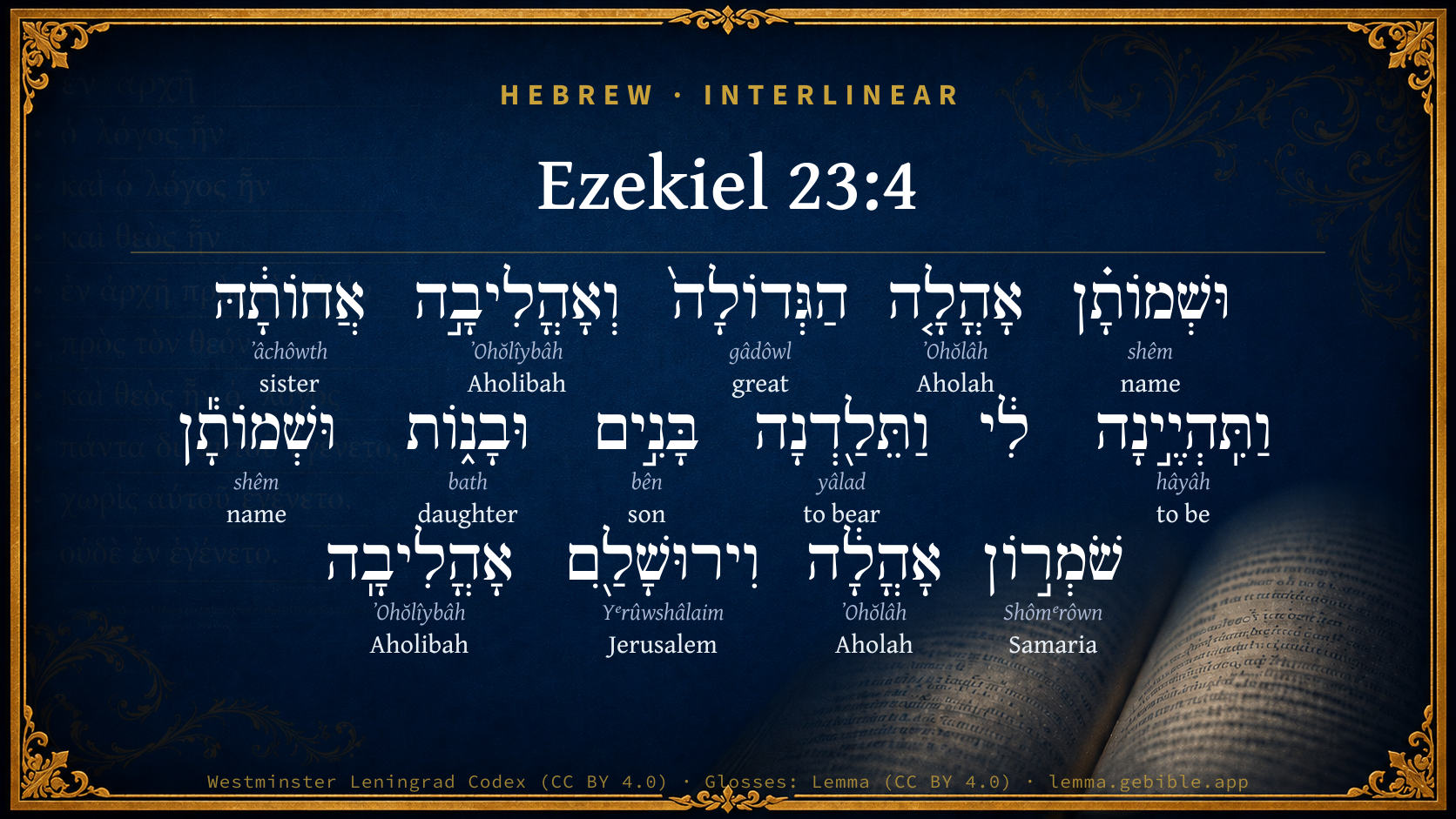
Hebrew (Westminster Leningrad Codex) Ezekiel 23:4 appears in the Hebrew Old Testament. The text above is from the Westminster Leningrad Codex. Each word links to its Strong’s number, a concise gloss, and parsing drawn from the Open Scriptures Hebrew Bible morphology. Click any word for its full Brown-Driver-Briggs (BDB) entry.
Download image
Cite this verse

Ezekiel 23:4 (World English Bible). Public Domain. Lemma interlinear Bible study tool, https://lemma.gebible.app/v/ezekiel/23/4.

Show BibTeX & RIS
BibTeX
RIS
English Translation
The names of them were Oholah the elder, and Oholibah her sister: and they became mine, and they bore sons and daughters. As for their names, Samaria is Oholah, and Jerusalem Oholibah.
World English Bible · Public Domain
Highlights
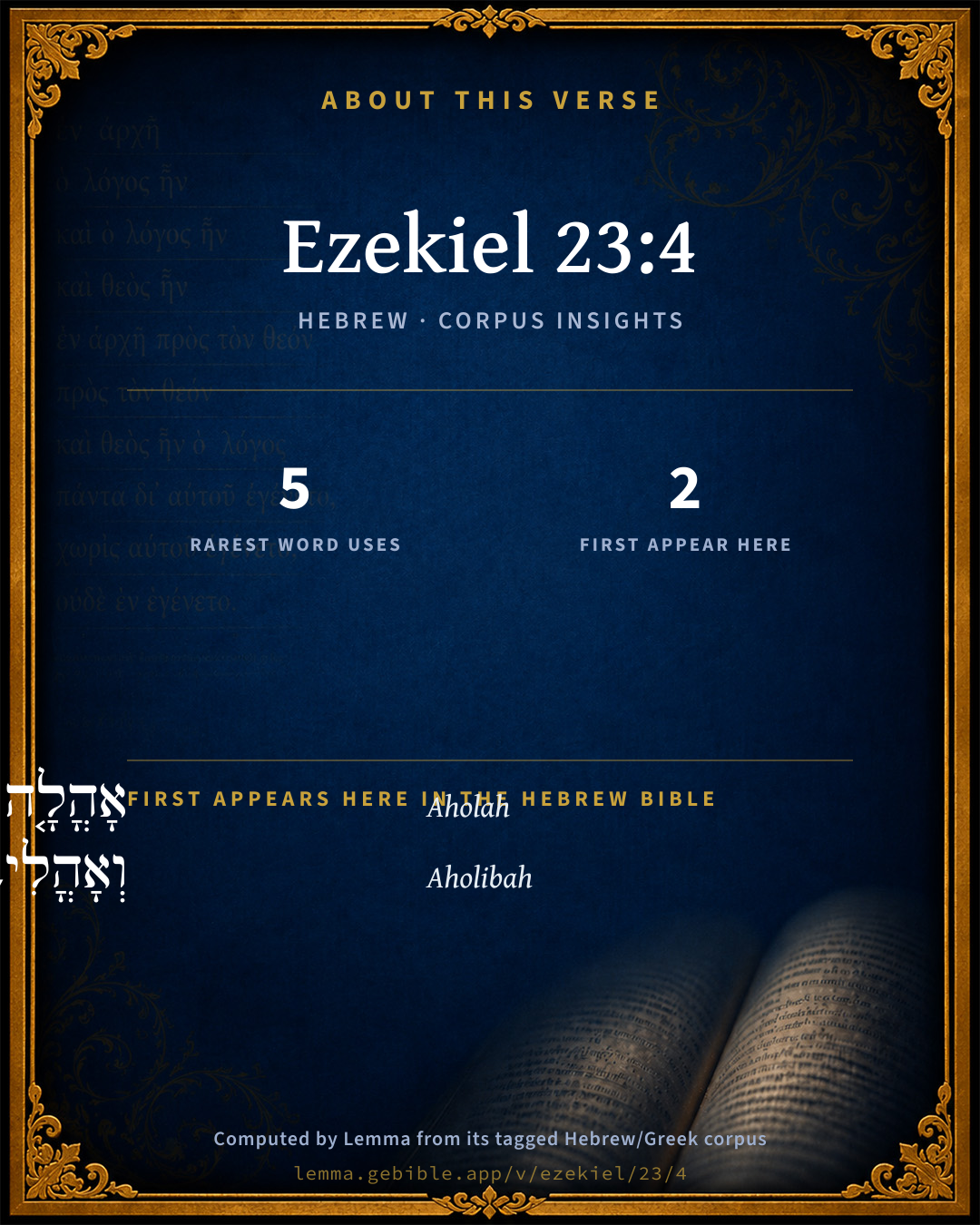
  • 2 first appearances in the Hebrew Bible
Full analysis ↓
Download a study sheet

One document with this verse’s original text, its word-by-word gloss line, the meaning frame, cross-references with their text, attributed commentary, and full source and license credits — printable, and it pastes into notes with its structure intact.

This verse Autodidact and up

Study sheet (.html) Plain text (.txt)

A passage Seminary Student

Up to 50 verses in one chapter. A passage sheet keeps up to 6 commentary sources and 12 cross-references per verse, in the order this page ranks them, and says so on the sheet whenever that leaves anything out. Ask for a single verse and you get the Autodidact verse sheet above.

Everything on this page stays free to read, with no account — the sheet is a download of what is already on screen, not access to it.

Want to remove ads? Support Godless Engineer
Compare translations 3

The same verse in 3 English versions, stacked beneath the original-language interlinear above. Click any original word for its lexicon entry.

Each is an independent rendering of the whole verse — the interlinear is not word-aligned to these translations.

Highlighted words mark where these versions differ — a whole-verse word diff, not a word-by-word alignment.

  • World English Bible Public Domain
    The names of them were Oholah the elder, and Oholibah her sister: and they became mine, and they bore sons and daughters. As for their names, Samaria is Oholah, and Jerusalem Oholibah.
  • King James Version Public Domain
    And the names of them were Aholah the elder, and Aholibah her sister: and they were mine, and they bare sons and daughters. Thus were their names; Samaria is Aholah, and Jerusalem Aholibah.
  • unfoldingWord Literal Text CC BY-SA 4.0
    Their names were Oholah—the older sister—and Oholibah—her younger sister. Then they became mine and bore sons and daughters. Their names mean this: Oholah means Samaria, and Oholibah means Jerusalem.

unfoldingWord Literal Text — © unfoldingWord, licensed CC BY-SA 4.0. Word-aligned USFM3 via Door43 (git.door43.org/unfoldingWord/en_ult).

Versions to compare (up to 4)

3 of 4 selected

Show all 18 translations

Every available English version of this verse, each an independent rendering of the whole verse.

  • World English Bible Public Domain
    The names of them were Oholah the elder, and Oholibah her sister: and they became mine, and they bore sons and daughters. As for their names, Samaria is Oholah, and Jerusalem Oholibah.
  • Berean Standard Bible Public Domain
    The older was named Oholah, and her sister was named Oholibah. They became Mine and gave birth to sons and daughters. As for their identities, Oholah is Samaria, and Oholibah is Jerusalem.
  • Majority Standard Bible Public Domain
    The older was named Oholah, and her sister was named Oholibah. They became Mine and gave birth to sons and daughters. As for their identities, Oholah is Samaria, and Oholibah is Jerusalem.
  • King James Version Public Domain
    And the names of them were Aholah the elder, and Aholibah her sister: and they were mine, and they bare sons and daughters. Thus were their names; Samaria is Aholah, and Jerusalem Aholibah.
  • American Standard Version (1901) Public Domain
    And the names of them were Oholah the elder, and Oholibah her sister: and they became mine, and they bare sons and daughters. And as for their names, Samaria is Oholah, and Jerusalem Oholibah.
  • Revised Version (1885) Public Domain
    And the names of them were Oholah the elder, and Oholibah her sister: and they became mine, and they bare sons and daughters. And as for their names, Samaria is Oholah, and Jerusalem Oholibah.
  • Geneva Bible (1599) Public Domain
    And the names of them were Aholah the elder, and Aholibah her sister: and they were mine, and they bare sonnes and daughters: thus were their names. Samaria is Aholah, and Ierusalem Aholibah.
  • Douay-Rheims (1899) Public Domain
    And their names were Oolla the elder, and Ooliba her younger sister: and I took them, and they bore sons and daughters. Now for their names, Samaria is Oolla, and Jerusalem is Ooliba.
  • Young's Literal Translation Public Domain
    And their names `are' Aholah the elder, And Aholibah her sister, And they are Mine, and bear sons and daughters. As to their names -- Samaria `is' Aholah, And Jerusalem `is' Aholibah.
  • Literal Standard Version CC BY-SA 4.0
    And their names [are] Aholah the older, || And Aholibah her sister, || And they are Mine, and bear sons and daughters. As for their names—Samaria [is] Aholah, || And Jerusalem [is] Aholibah.
  • Unlocked Literal Bible CC BY-SA 4.0
    Their names were Oholah—the older sister—and Oholibah—her younger sister. Then they became mine and bore sons and daughters. Their names mean this: Oholah means Samaria, and Oholibah means Jerusalem.
  • unfoldingWord Literal Text CC BY-SA 4.0
    Their names were Oholah—the older sister—and Oholibah—her younger sister. Then they became mine and bore sons and daughters. Their names mean this: Oholah means Samaria, and Oholibah means Jerusalem.
  • Darby Bible Public Domain
    And their names were Oholah the elder, and Oholibah her sister; and they were mine, and they bore sons and daughters. As for their names: Samaria is Oholah, and Jerusalem Oholibah.
  • World Messianic Bible Public Domain
    Their names were Oholah the elder, and Oholibah her sister. They became mine, and they bore sons and daughters. As for their names, Samaria is Oholah, and Jerusalem Oholibah.
  • Webster's Bible Public Domain
    And the names of them were Aholah the elder, and Aholibah her sister: and they were mine, and they bore sons and daughters. Thus were their names; Samaria is Aholah, and Jerusalem Aholibah.
  • Free Bible Version CC BY-SA 4.0
    The older girl was called Oholah, and her sister Oholibah. I married them both and they had sons and daughters. Oholah represents Samaria, and Oholibah represents Jerusalem.
  • Bible in Basic English Public Domain
    Their names were Oholah, the older, and Oholibah, her sister: and they became mine, and gave birth to sons and daughters. As for their names, Samaria is Oholah, and Jerusalem, Oholibah.
  • JPS Tanakh (1917) Public Domain
    And the names of them were Oholah the elder, and Oholibah her sister; and they became Mine, and they bore sons and daughters. And as for their names, Samaria is Oholah, and Jerusalem Oholibah.

Literal Standard Version (2020), Covenant Press — licensed CC BY-SA 4.0. Text via the HelloAO Bible API (eBible.org). Unlocked Literal Bible (unfoldingWord) — licensed CC BY-SA 4.0. Text via the HelloAO Bible API (eBible.org). unfoldingWord Literal Text — © unfoldingWord, licensed CC BY-SA 4.0. Word-aligned USFM3 via Door43 (git.door43.org/unfoldingWord/en_ult). Free Bible Version, Dr. Jonathan Gallagher — licensed CC BY-SA 4.0. Text via the HelloAO Bible API (eBible.org).

Word by word

More ways to search: Search by grammar → Find every occurrence → Compare this word →

Practice this passage: Drill this verse → Learn its vocabulary →

אָהֳלָ֤ה
ʼOhŏlâh
H170
“Aholah”
Noun, Proper
Part of Speech
Noun
Type
Proper
Full BDB Definition

Origin: in form a f of H168 , but in fact for 'Oholahh o-hol-aw'

TWOT: 32b

Aholah = "her own tent" - Samaria as an adulteress with Assyria (metaphorically)
  1. וּשְׁמוֹתָ֗ן shêm H8034 “and · names · their” Conjunction + Noun, Common, Masculine, Plural, Construct + Suffix, Personal, 3rd Person, Feminine, Plural
  2. הַגְּדוֹלָה֙ gâdôwl H1419 “the · great” Particle, Definite Article + Adjective, Adjective, Feminine, Singular, Absolute
  3. וְאָהֳלִיבָ֣ה ʼOhŏlîybâh H172 “and · Aholibah” Conjunction + Noun, Proper
  4. אֲחוֹתָ֔הּ ʼâchôwth H269 “sister · her” Noun, Common, Feminine, Singular, Construct + Suffix, Personal, 3rd Person, Feminine, Singular
  5. וַתִּֽהְיֶ֣ינָה hâyâh H1961 “and · to be” Conjunction + Verb, Qal, Sequential Imperfect, 3rd Person, Feminine, Plural
  6. וַתֵּלַ֖דְנָה yâlad H3205 “and · to bear” Conjunction + Verb, Qal, Sequential Imperfect, 3rd Person, Feminine, Plural
  7. בָּנִ֣ים bên H1121 “sons” Noun, Common, Masculine, Plural, Absolute
  8. וּבָנ֑וֹת bath H1323 “and · daughters” Conjunction + Noun, Common, Feminine, Plural, Absolute
  9. וּשְׁמוֹתָ֕ן shêm H8034 “and · names · their” Conjunction + Noun, Common, Masculine, Plural, Construct + Suffix, Personal, 3rd Person, Feminine, Plural
  10. שֹׁמְר֣וֹן Shômᵉrôwn H8111 “Samaria” Noun, Proper
  11. אָהֳלָ֔ה ʼOhŏlâh H170 “Aholah” Noun, Proper
  12. וִירוּשָׁלִַ֖ם Yᵉrûwshâlaim H3389 “and · Jerusalem” Conjunction + Noun, Proper
  13. אָהֳלִיבָֽה ʼOhŏlîybâh H172 “Aholibah” Noun, Proper

About this verse

These counts appear in no published source. They are computed here, from the morphology-tagged text and Lemma’s own curated glosses. What Lemma adds →

15
words
11
distinct lemmas
Prophets
section

Notable vocabulary

The rarest word here is אָהֳלָ֤ה Aholah H170 — appearing just 5 times in the whole Hebrew Bible.

First appearance in Scripture

These words make their first canonical appearance in the Hebrew Bible here:

  • אָהֳלָ֤ה Aholah H170
  • וְאָהֳלִיבָ֣ה Aholibah H172

Shared distinctive vocabulary

אָהֳלָ֤ה Aholah H170 occurs in 4 verses of the Hebrew Bible. Also found in:

Grammatical profile

  • 2 verbs
  • 11 nouns
  • 1 adjective
  • 1 preposition

Verb forms

  • וַתִּֽהְיֶ֣ינָה Qal · Sequential Imperfect
  • וַתֵּלַ֖דְנָה Qal · Sequential Imperfect

Repetition

Words recur within this verse — often emphatic in Hebrew:

  • וּשְׁמוֹתָ֗ן name H8034 ×2
  • אָהֳלָ֤ה Aholah H170 ×2
  • וְאָהֳלִיבָ֣ה Aholibah H172 ×2

Hebrew & Septuagint length

In English translation the verse runs 32 words from the Hebrew and 32 from the Septuagint (LXX English) — the same length.

A rough comparison of the two English renderings, which tokenize alike — not a word-level alignment.

Word counts can differ between the Hebrew and the Greek without any difference in meaning — e.g. the Hebrew direct-object marker אֵת has no separate Greek word, and Greek often adds the article ὁ.

Cross-references

13

Topical passages linked to Ezekiel 23:4 in the Treasury of Scripture Knowledge — connected by theme and wording, ordered by reader-vote popularity; previews shown in the World English Bible.

  • Ezekiel 16:8 Now when I passed by you, and looked at you, behold, your time was the time of love; and I spread my skirt over you, and covered your nakedness: yes, I swore to you, and entered into a covenant with you, says the Lord Yahweh, and you became mine.
  • Exodus 19:5–6 Now therefore, if you will indeed obey my voice, and keep my covenant, then you shall be my own possession from among all peoples; for all the earth is mine;
  • 1 Kings 8:29 that your eyes may be open toward this house night and day, even toward the place of which you have said, My name shall be there; to listen to the prayer which your servant shall pray toward this place.
  • 1 Kings 12:20 It happened, when all Israel heard that Jeroboam was returned, that they sent and called him to the congregation, and made him king over all Israel: there was none who followed the house of David, but the tribe of Judah only.
  • 1 Kings 12:26–33 Jeroboam said in his heart, Now will the kingdom return to the house of David:
  • Psalms 45:11–16 So the king will desire your beauty, Honor him, for he is your lord.
  • Psalms 76:2 His tent is also in Salem; His dwelling place in Zion.
  • Psalms 132:13–14 For Yahweh has chosen Zion. He has desired it for his habitation.
  • Jeremiah 2:2–3 Go, and cry in the ears of Jerusalem, saying, Thus says Yahweh, I remember for you the kindness of your youth, the love of your weddings; how you went after me in the wilderness, in a land that was not sown.
  • Ezekiel 16:20 Moreover you have taken your sons and your daughters, whom you have borne to me, and these have you sacrificed to them to be devoured. Were your prostitution a small matter,
  • Ezekiel 16:40 They shall also bring up a company against you, and they shall stone you with stones, and thrust you through with their swords.
  • John 4:22 You worship that which you don't know. We worship that which we know; for salvation is from the Jews.
  • Romans 7:4 Therefore, my brothers, you also were made dead to the law through the body of Christ, that you would be joined to another, to him who was raised from the dead, that we might bring forth fruit to God.

Cross-references courtesy of OpenBible.info (CC BY 4.0).

Hebrew and Greek witnesses Masoretic Hebrew ↔ Greek Septuagint

The same verse in the two great witnesses to the Old Testament, shown verse-for-verse.

These are two independent witnesses, not word-aligned to each other, and the Septuagint is shown in lemma (dictionary) form.

Hebrew Ezekiel 23:4 Masoretic · Westminster Leningrad Codex

וּשְׁמוֹתָ֗ן אָהֳלָ֤ה הַגְּדוֹלָה֙ וְאָהֳלִיבָ֣ה אֲחוֹתָ֔הּ וַתִּֽהְיֶ֣ינָה לִ֔י וַתֵּלַ֖דְנָה בָּנִ֣ים וּבָנ֑וֹת וּשְׁמוֹתָ֕ן שֹׁמְר֣וֹן אָהֳלָ֔ה וִירוּשָׁלִַ֖ם אָהֳלִיבָֽה

The names of them were Oholah the elder, and Oholibah her sister: and they became mine, and they bore sons and daughters. As for their names, Samaria is Oholah, and Jerusalem Oholibah.

World English Bible · Public Domain

Greek LXX Ezekiel 23:4 Septuagint · lemma form

καί ὁ ὄνομα αὐτός εἰμί οολα ὁ πρεσβύτερος καί οολιβα ὁ ἀδελφή αὐτός καί γίγνομαι ἐγώ καί τίκτω υἱός καί θυγάτηρ καί ὁ ὄνομα αὐτός σαμαρεία ὁ οολα καί ἰερουσαλήμ ὁ οολιβα

And their names were Oola the elder, and Ooliba her sister: and they were mine, and bore sons and daughters: and as for their names, Samaria was Oola, and Jerusalem was Ooliba.

LXX2012 (modern English Septuagint) · Public Domain

Hebrew: Westminster Leningrad Codex (CC BY 4.0). Greek: Septuagint (public domain); English from LXX2012 (modern English Septuagint) (Public Domain). How the Septuagint differs from the Hebrew →

Targum (Aramaic paraphrase)

1

The Targum is the ancient Jewish Aramaic paraphrase of the Hebrew Scriptures — an interpretive translation, not the Hebrew text itself. Onkelos (literal) and Pseudo-Jonathan (expansive) render the Torah, and Jonathan the Prophets. Coverage is partial: where no permissively-licensed English translation exists for a verse, only the Aramaic is shown. This is verse-level text, not a word-by-word alignment to the Hebrew.

  1. Targum Jonathan Prophets (Joshua–Malachi)
    וּשְׁמָהָתְהֶן אָהֳלָה רַבְּתָא וְאָהָלִיבָה אֲחָתָהּ וַהֲוָאָה מְשַׁמְשָׁן קָדָמַי וְאַצְלְחָא בִּבְנִין וּבְנָן וּשְׁמָהָתְהֶן שׁוֹמְרוֹן אָהֳלָה וִירוּשְׁלֵם אָהֳלִיבָה:

    (no public-domain English translation for this verse)

    Targum Jonathan — Aramaic: “Mikraot Gedolot” (public domain). English: “Sefaria Community Translation” (CC0 1.0 (public-domain dedication)); “London "Chaldee Paraphrase," 1871” (public domain). Text via Sefaria.

Commentary

Notes on Ezekiel 23:4 from classic Christian and Jewish commentators (each source and its license shown beneath its notes). The classic Christian expositions comment on the surrounding passage and are grouped to its opening verse, so a note may address several verses; the Jewish commentaries on the Tanakh (Rashi and others) are per-verse, so they appear only where the commentator wrote on this verse.

Lemma curates 59 commentaries, every one of them public domain or Creative Commons licensed, each selected and text-cleaned for this edition rather than reprinted as found. About our sources →

Trapp's Complete Commentary

John Trapp

Eze 23:4 And the names of them [were] Aholah the elder, and Aholibah her sister: and they were mine, and they bare sons and daughters. Thus [were] their names; Samaria [is] Aholah, and Jerusalem Aholibah.

Ver. 4. And the names of them were Aholah,] i.e., Her tent, not mine (so he calleth Samaria, or the ten tribes). What have I to do with it or her Compare 1Ki 12:16; 1Ki 12:28; 1Ki 12:31. She is gone to her tent, and hath set her up tabernacles, where to worship her golden idols.

The elder.] So called because more numerous and potent than the other two tribes. She was also first in the defection.

And Aholibah.] That is, my tent is in her. So Jerusalem is called, because the temple and testimonies of God’s special presence were there, as King Abijah well pleadeth it. {2Ch 13:10-11}

Samaria is Aholah.] In figure she is; though some have held that these were the names of two notorious strumpets in Egypt.

John Trapp, A Commentary or Exposition upon All the Books of the Old and New Testament (1647–1656) — public domain. Text from a community e-Sword module.

Joseph Benson's Commentary

Eze 23:4. The names of them were Aholah and Aholibah — “The word Aholah signifies, Her tent, or tabernacle: Aholibah denotes, My tent, or tabernacle, is in her. These two different appellations imply that Samaria had indeed a tabernacle, or place for public worship, but of her own devising; namely, the cities of Dan and Bethel, where the golden calves were set up; whereas God’s tabernacle first, and afterward his temple, was placed in Jerusalem. He placed his name there, or chose it for the place of his peculiar residence,” 1Ki 8:29. Aholah, or Samaria, is here called the elder sister, as having the greatest dominion, power, wealth, and number of people belonging to her, ten tribes out of twelve being under her jurisdiction. And they were mine — By a solemn marriage covenant. And they bare sons and daughters — Were fruitful, and brought forth children to me: they increased in number of people, and among these there were some that were my spiritual children by adoption and grace, by faith, love, and obedience.

Joseph Benson's Commentary on the Old and New Testaments (1811–1818) — public domain. Text from a community e-Sword module.

Tyndale Open Study Notes

Tyndale Open Resources

23:4 Marriage is commonly used in the Bible as a symbol for the covenant relationship between God and his people (e.g., Isa 54:1-8; Eph 5:22-33). Adultery symbolizes Israel’s spiritual unfaithfulness (e.g., Hos 1–3). God makes his covenants in spite of, not because of, his people’s character (Rom 5:6-11).

Tyndale Open Study Notes — © Tyndale Open Resources, licensed CC BY-SA 4.0. Text via the HelloAO Bible API.

Geneva Bible (1599)

Geneva Bible translators

Oholah signifieth a mansion or dwelling in herself, meaning Samaria, which was the royal city of Israel and Oholibah signifieth my mansion in her, whereby is meant Jerusalem, where God’s Temple was.

Geneva Bible (1599) marginal notes — public domain. Text via Bolls.life.

Jamieson, Fausset & Brown

Robert Jamieson, A. R. Fausset & David Brown

Aholah--that is, "Her tent" (put for worship, as the first worship of God in Israel was in a tent or tabernacle), as contrasted with Aholibah, that is, "My tent in her." The Beth-el worship of Samaria was of her own devising, not of God's appointment; the temple-worship of Jerusalem was expressly appointed by Jehovah, who "dwelt" there, "setting up His tabernacle among the people as His" (Exo 25:8; Lev 26:11-12; Jos 22:19; Psa 76:2).

the elder--Samaria is called "the elder" because she preceded Judah in her apostasy and its punishment.

they were mine--Previous to apostasy under Jeroboam, Samaria (Israel, or the ten tribes), equally with Judah, worshipped the true God. God therefore never renounced the right over Israel, but sent prophets, as Elijah and Elisha, to declare His will to them.

Jamieson, Fausset & Brown — Commentary Critical and Explanatory on the Whole Bible (1871) — public domain (CC PDM 1.0). Text via the HelloAO Bible API.

Ellicott's Commentary for English Readers

(4) Samaria is Aholah, and Jerusalem Aholibah.—Samaria, as the capital, is put for the northern kingdom, and is called Aholah = her own tabernacle, because she set up her own worship instead of resorting to the Temple; while the southern kingdom, represented by Jerusalem, is called Aholibah = my tabernacle is in her, because she still contained the sanctuary of the Lord. The word “elder” should be translated greater, as in Eze_16:46. (See Note there.)

A Bible Commentary for English Readers, edited by Charles John Ellicott (1878–1897) — public domain. Text from a community e-Sword module.

The Cambridge Bible for Schools and Colleges

gen. ed. J. J. S. Perowne

4. The name Oholah may mean “her tent,” though not so pointed, and Oholibah “my tent in her.” Possibly the words mean “tent” (or, tents) and “tent in her;” and the reference may be to the worship practised on the high places in both kingdoms, cf. Eze_16:16. It is doubtful if the prophet means that Samaria had “her tent,” i.e. a sanctuary or worship of her own devising, while Jerusalem had Jehovah’s tent or true sanctuary in her. Cf. the names Hephzi-bah, Isa_62:4, and Oholibamah (high-place tent), Gen_36:2. It was common in the east to give sisters or brothers names almost the same, as Hasan and Husein (little Hasan), the two sons of ‘Ali, the son-in-law of Muhammed.

they were mine] became mine, my wives, cf. Eze_16:8; Eze_16:20. It is curious that Jehovah is represented as the husband of two sisters, a thing which the law disallows, Lev_18:18.

The Cambridge Bible for Schools and Colleges (gen. ed. J. J. S. Perowne; Cambridge University Press, 1878–1918) — public domain. Text from a community e-Sword module.

John Gill's Exposition

And the names of them were Aholah the elder,.... Or, "the greater" (m) meaning the ten tribes of Israel, which were more in number than Judah, and greater in power and riches; their name, Aholah, signifies "her tent or tabernacle", which was entirely their own, and not the Lord's: their worship, and places of worship, were of their own appointing, namely, their calves at Dan and Bethel; God had nothing to do with them, there he did not dwell; his tabernacle was not there, that was at Salem, Psa 76:1,

and Aholibah her sister; which name signifies "my tent or tabernacle is in her": this is the name of Judah or the two tribes, in which stood the temple of the Lord, where he was worshipped, and where he dwelt: some think these were proper names of two Egyptian harlots; others think there is allusion to the wife of Esau, Gen 36:2,

and they were mine; or, "I had them (n)"; when they were together; they were originally espoused unto him; he avouched them to be his people, and they avouched him to be their God; he chose them for himself above all other people, and they professed themselves to be his, and promised to serve and worship him; and for a while did continue in his service and worship: and they bare sons and daughters; to the Lord, whom they brought up in the fear of God, and taught them to serve him: the phrase is expressive of their increase, and of their happiness and prosperity, while they adhered to the pure worship of God:

thus were their names; this is the application of them: "Samaria is Aholah"; or Aholah signifies Samaria, which was the metropolis of Ephraim, and belonged to the ten tribes, and is put for the whole, Isa 7:9, "and Jerusalem Aholibah"; or Aholibah designs Jerusalem, the head city of Judah, and stands for the two tribes of Judah and Benjamin.

(m) "major", Junius and Tremellius, Polanus, Starckius. (n) "et habui eos", V. L. Heb.; "facte sunt mihi", Piscator; "sub uxores", Grotius.

John Gill's Exposition of the Whole Bible (1746–1763) — public domain (CC PDM 1.0). Text via the HelloAO Bible API.

Albert Barnes' Notes on the Bible

Aholah ... and Aholibah - More correctly “Oholah” (“her own tent or tabernacle”) and “Oholibah” (“My tent or tabernacle is in her”): names chosen to express that after the division Israel set up her own tabernacle in the place of the temple in which God dwelt 1Ki 12:32, while with Judah the Temple of God still remained. The presence of God aggravated Judah’s sins. In the times of the captivity it was customary among the Jews to give their children names connected with the temple or tabernacle.

Albert Barnes' Notes on the Bible (1834–1885) — public domain. Text from a community e-Sword/MySword module.

Haydock's Catholic Bible Commentary

Oolla and Ooliba. God calls the kingdom of Israel Oolla, which signifies their own habitation, because they separated themselves from his temple; and the kingdom of Juda Ooliba, which signifies his habitation in her, because of his temple among them in Jerusalem. (Challoner) --- The ten tribes first gave way to idolatry, and were more numerous. (Calmet) -- In Egypt the people were united, yet abandoned to idolatry in their youth, when they were only beginning to increase. Afterwards the ten tribes set up altars for themselves, at Dan and Bethel. (Worthington)

George Leo Haydock (1774–1849), Haydock's Catholic Family Bible and Commentary, 1859 edition — public domain. Excludes Psalms (Douay-Rheims chapter numbering differs from Protestant) and Deuterocanonical books (Catholic canon only).

Matthew Poole's English Annotations

That we might know them, they are described.

Aholah; which, rendered in English, is, His own tabernacle; for Israel, falling off from the house of David, also fell off from the tabernacle or temple of God, so that all the temple and worship they had amongst them was of their own making.

The elder; greater for number of tribes, being ten of twelve; and greater for power, wealth, and multitudes of people.

Aholibah: this, rendered in English, is, My tabernacle in her: the two tribes had the temple and worship of God with them; God’s own tent was pitched there, and his solemn services.

They were mine, by solemn marriage covenant, Eze 16:18.

They bare sons and daughters; were fruitful, and brought forth children to me, saith God; they increased in numbers of people, and among these, some there were that were children of God by faith, love, and obedience.

Samaria; the chief city of the apostate ten tribes.

Jerusalem; the chief city of the two tribes.

Matthew Poole's English Annotations on the Holy Bible (1683–1685) — public domain. Text from a community e-Sword/MySword module.

Whedon's Commentary on the Bible

Daniel D. Whedon

4. Aholah… and Aholibah — Rather, Oholah… and Oholibah. These sisters have symbolic names, meaning “her tent” and “my tent in her”; probably signifying that Samaria dwelt apart, in a sanctuary of her own devising, while Jehovah dwelt with Judah. This special privilege would magnify the guilt of Oholibah’s apostasy. It is possible, however, that the reference may only be to the worship on high places common to both divisions of the kingdom. (Compare chap. xvi, where Jerusalem is represented as a harlot having two sisters, Samaria and Sodom.) For the sake of the allegory Ezekiel pictures both of these sisters as wives of the same husband, though he well knew this was contrary to the law (Lev_18:18).

Daniel D. Whedon (gen. ed.), Commentary on the Old and New Testaments (1874–1909) — public domain. Text from a community e-Sword module.

The Pulpit Commentary

The occurrence of proper names is almost unique in the parables of the Bible, the Lazarus of Luk_16:20 being the only other instance. Their meaning is sufficiently clear. Aholah (but both names should begin with O rather than A) means "Her tent;" Aholibah, "My tent is in her." A parallel, which may have suggested the names, is found in the Aholibamah (equivalent to "My tent is in the high place") of Gen_36:2, and another in the use of Ohel as a proper name in 1Ch_3:20. The common element of the two names is the word that is commonly used for the sacred tent or tabernacle in the Pentateuch and elsewhere. The distinctive element of each points to the fact that the worship in Samaria was unauthorized. Her "tent" was hers, not Jehovah"s. Of Jerusalem with its temple Jehovah could say, "My tent is in her," and this, as magnifying her privilege, also aggravated her guilt. Keil and others take the adjective here, as in Eze_16:46, as meaning "greater" rather than "older." The former adjective is, of course, applicable to the greater power of the kingdom of the Ten Tribes, and, even if we retain the renderings of the Authorized Version, is probably the explanation of Samaria being named as the elder of the two.

Ver. 4. Aholah and Aholibah.

tent" and "My tent is in her." These names stand respectively for Israel and Judah. Israel, the northern kingdom, had her own tent, i.e. she was independent after secession from Judah, like a woman who has left her mother"s tent and has one of her own. Judah retained the temple, the representative of the tabernacle of the wilderness; therefore God"s tent was in her. These prosaic facts were suggestive of deeper traits of national character, which the symbolical names suggested.

I INDEPENDENCE. Israel is named Aholah. She has her own tent; she is independent. This national independence has its counterpart in individual independence. Jacob leaves his home and fights his own battle with the world. Joseph is sent away from his family, and cast in his youth among the grand opportunities of a great nation and the direful temptations of a dissolute society. The young man going out into the world enters on the exhilarating but trying career of independent life. There are special opportunities, duties, and dangers in having one"s own tent.

1. Opportunities. The independent position is not hampered with restrictions. Freedom means a wide range for individual activity. Now is the time to realize the long-cherished dreams of earlier days.

2. Duties. Duty dogs the footsteps of opportunity. As our scope for choice and individual activity is enlarged, the obligations of service are correspondingly increased. The slave has few duties; the free man great obligations. The liberty of manhood brings the burden of a man"s duty. Christian liberty increases the obligations of Christian service.

3. Dangers. Israel gained in freedom by her rebellion against the petty tyranny of Rehoboam; but the liberty which was got by separation brought its own great dangers. Cut off from the temple-worship, excluded from the national festivals, deprived of the highest religious ministrations, the freed people were tempted to fall into the idolatry of their ancestors and their neighbors. This temptation was too great for them, and they apostatized earlier than Judah. It is dangerous to be separated from religious ordinances. The young man who leaves the Christian home of his childhood for new scenes of worldly life is entering on a path of peril. A self-contained life is open to temptation. To seek to be independent of God is to court ruin.

II DIVINE FELLOWSHIP. Judah is named Aholibah. God"s tent is in her. She has the outward means and symbols, at least, of the Divine presence. This fact represents high privileges, with corresponding guilt when God is forsaken.

1. High privileges.

(1) Prosperity. God"s presence brings joy and true welfare.

(2) Protection. If God"s tent is in our midst, the Captain of salvation is with us, and though a host should encamp around us, we need fear no evil.

(3) Spiritual grace. The temple was not a mere meeting-place, sanctuary, and fortress. Its services were "means of grace." God is with us to enlighten, purify, quicken.

2. Heavy guilt. Aholibah apostatized. Her guilt was all the greater that she bore such a name, and could claim the symbol of God"s presence as peculiarly her own. The greatest guilt is that of men who know God and have enjoyed his presence and grace in the past, and who, sinning openly against light, have spurned those privileges and willfully rebelled against their chosen God. No sinners are so guilty as apostatized Christians. Mark: it is possible to be Aholibah and to enjoy God"s presence, and yet to turn against him, fall, and be ruined.

The Pulpit Commentary (1880–1919), ed. H.D.M. Spence-Jones & Joseph S. Exell — public domain. Text from a community e-Sword module.

John Wesley's Explanatory Notes

Aholah - That is, his own tabernacle; for Israel falling off from the house of David, fell off from the tabernacle, or temple of God; so that all the temple they had was of their own making. The elder - Greater for number of tribes, and for power, wealth, and for multitudes of people. Aholibah - That is, my tabernacle in her: the two tribes had the temple of God with them. Mine - By solemn marriage-covenant. Bare sons - Were fruitful and brought forth children to me; they increased in numbers of people; and among these, some there were that were children of God by faith, love, and obedience.

John Wesley, Explanatory Notes Upon the Whole Bible (1754–1765) — public domain. Text via the GEBible commentary corpus.

Rashi

Rabbi Shlomo Yitzchaki (Rashi)

And their names i.e., their nicknames were Oholah and Oholibah.

and their names The original ones. Samaria is the one I nickname Oholah, for from the beginning she became a tent (אֹהֶל) for the calves of Jeroboam and for Ahab’s temple of Baal. Although Samaria was not built until the days of Omri, He calls the kings of Israel by its name, because as soon as it was built, it became the capital.

Oholibah Because My tent (אֹהֹלִי) was in her (בָה), and My sanctuary.

Rashi on the Tanakh — English translations: “The Judaica Press complete Tanach with Rashi, translated by A. J. Rosenberg” (CC BY 4.0); “Pentateuch with Rashi's commentary by M. Rosenbaum and A.M. Silbermann, 1929-1934” (public domain); “The Metsudah Tanach series, Lakewood, N.J” (CC BY 4.0); and “The Book of Joshua, Metsudah Publications, 1997” (CC BY 4.0). Text via Sefaria.

Lesson kit

Teaching starters — assembled from the data on this page, not authored interpretation. Every prompt links to the verse data it draws on. Edit before teaching.

Ezekiel, in the Prophets, opens this verse with 15 words (11 distinct Hebrew lemmas). Its most distinctive word is ʼOhŏlâh (“Aholah”). A historical commentator’s framing appears above. Read the whole chapter for the surrounding context.

Discussion questions

  1. The word ʼOhŏlâh carries the sense “Aholah.” How does it shape the verse?
  2. 2 words here appear for the first time in Scripture. What is being introduced at this debut?
  3. Ezekiel 23:5 shares the word «Aholah» with this verse. How do the two illuminate each other?
  4. “name” occurs 2× in this one verse. What is the effect of the repetition?
  5. These translations render this verse differently; the difference is in the English rendering, not the original. What questions does that raise?
  6. The verb «וַתִּֽהְיֶ֣ינָה» is Qal Sequential Imperfect. How does its form color the action?
  7. Reading how Trapp's Complete Commentary and Joseph Benson's Commentary read this verse, where do the two commentators agree and where do they part?

Things to notice

  • 2 words make their first canonical appearance in Scripture here.
  • These translations choose different wording for 16 words in this verse.
  • “name” occurs 2× in this single verse.
  • 11 distinct Hebrew lemmas span 15 words in this verse.

Reading settings

Reading text

Shown beneath each verse's original-language words.

Old Testament
Old Testament edition

Read the OT as the Masoretic Hebrew (MT) or the Greek Septuagint (LXX).

English shown for the Greek Septuagint (in the Hebrew ↔ Greek comparison).

Comparing translations? Open the Compare panel on any verse page to stack up to four side by side.