
2 Chronicles 30:3

Hebrew (Westminster Leningrad Codex) 2 Chronicles 30:3 appears in the Hebrew Old Testament. The text above is from the Westminster Leningrad Codex. Each word links to its Strong’s number, a concise gloss, and parsing drawn from the Open Scriptures Hebrew Bible morphology. Click any word for its full Brown-Driver-Briggs (BDB) entry.
Download image
Cite this verse

2 Chronicles 30:3 (World English Bible). Public Domain. Lemma interlinear Bible study tool, https://lemma.gebible.app/v/2-chronicles/30/3.

Show BibTeX & RIS
BibTeX
RIS
English Translation
For they could not keep it at that time, because the priests had not sanctified themselves in sufficient number, neither had the people gathered themselves together to Jerusalem.
World English Bible · Public Domain
Download a study sheet

One document with this verse’s original text, its word-by-word gloss line, the meaning frame, cross-references with their text, attributed commentary, and full source and license credits — printable, and it pastes into notes with its structure intact.

This verse Autodidact and up

Study sheet (.html) Plain text (.txt)

A passage Seminary Student

Up to 50 verses in one chapter. A passage sheet keeps up to 6 commentary sources and 12 cross-references per verse, in the order this page ranks them, and says so on the sheet whenever that leaves anything out. Ask for a single verse and you get the Autodidact verse sheet above.

Everything on this page stays free to read, with no account — the sheet is a download of what is already on screen, not access to it.

Want to remove ads? Support Godless Engineer
Compare translations 3

The same verse in 3 English versions, stacked beneath the original-language interlinear above. Click any original word for its lexicon entry.

Each is an independent rendering of the whole verse — the interlinear is not word-aligned to these translations.

Highlighted words mark where these versions differ — a whole-verse word diff, not a word-by-word alignment.

  • World English Bible Public Domain
    For they could not keep it at that time, because the priests had not sanctified themselves in sufficient number, neither had the people gathered themselves together to Jerusalem.
  • King James Version Public Domain
    For they could not keep it at that time, because the priests had not sanctified themselves sufficiently, neither had the people gathered themselves together to Jerusalem.
  • unfoldingWord Literal Text CC BY-SA 4.0
    For they were not able to do it at that time because the priests had not consecrated themselves sufficiently, and the people had not assembled to Jerusalem.

unfoldingWord Literal Text — © unfoldingWord, licensed CC BY-SA 4.0. Word-aligned USFM3 via Door43 (git.door43.org/unfoldingWord/en_ult).

Versions to compare (up to 4)

3 of 4 selected

Show all 17 translations

Every available English version of this verse, each an independent rendering of the whole verse.

  • World English Bible Public Domain
    For they could not keep it at that time, because the priests had not sanctified themselves in sufficient number, neither had the people gathered themselves together to Jerusalem.
  • Berean Standard Bible Public Domain
    since they had been unable to observe it at the regular time, because not enough priests had consecrated themselves and the people had not been gathered in Jerusalem.
  • Majority Standard Bible Public Domain
    since they had been unable to keep it at the regular time, because not enough priests had consecrated themselves and the people had not been gathered in Jerusalem.
  • King James Version Public Domain
    For they could not keep it at that time, because the priests had not sanctified themselves sufficiently, neither had the people gathered themselves together to Jerusalem.
  • American Standard Version (1901) Public Domain
    For they could not keep it at that time, because the priests had not sanctified themselves in sufficient number, neither had the people gathered themselves together to Jerusalem.
  • Revised Version (1885) Public Domain
    For they could not keep it at that time, because the priests had not sanctified themselves in sufficient number, neither had the people gathered themselves together to Jerusalem.
  • Geneva Bible (1599) Public Domain
    For they could not keepe it at this time, because there were not Priests enow sanctified, neither was the people gathered to Ierusalem.
  • Young's Literal Translation Public Domain
    for they have not been able to make it at that time, for the priests have not sanctified themselves sufficiently, and the people have not been gathered to Jerusalem.
  • Literal Standard Version CC BY-SA 4.0
    for they have not been able to make it at that time, for the priests have not sanctified themselves sufficiently, and the people have not been gathered to Jerusalem.
  • Unlocked Literal Bible CC BY-SA 4.0
    They could not celebrate at the regular time, because not enough priests had consecrated themselves for the celebration and the people had not gathered together in Jerusalem.
  • unfoldingWord Literal Text CC BY-SA 4.0
    For they were not able to do it at that time because the priests had not consecrated themselves sufficiently, and the people had not assembled to Jerusalem.
  • Darby Bible Public Domain
    For they could not keep it at that time, because the priests had not hallowed themselves in sufficient number, neither had the people been gathered together to Jerusalem.
  • World Messianic Bible Public Domain
    For they could not keep it at that time, because the priests had not sanctified themselves in sufficient number, and the people had not gathered themselves together to Jerusalem.
  • Webster's Bible Public Domain
    For they could not keep it at that time, because the priests had not sanctified themselves sufficiently, neither had the people assembled themselves at Jerusalem.
  • Free Bible Version CC BY-SA 4.0
    because they hadn't been able to observe it at the usual time since not enough priests had purified themselves and the people hadn't had time to get to Jerusalem.
  • Bible in Basic English Public Domain
    It was not possible to keep it at that time, because not enough priests had made themselves holy, and the people had not come together in Jerusalem.
  • JPS Tanakh (1917) Public Domain
    For they could not keep it at that time, because the priests had not sanctified themselves in sufficient number, neither had the people gathered themselves together to Jerusalem.

Literal Standard Version (2020), Covenant Press — licensed CC BY-SA 4.0. Text via the HelloAO Bible API (eBible.org). Unlocked Literal Bible (unfoldingWord) — licensed CC BY-SA 4.0. Text via the HelloAO Bible API (eBible.org). unfoldingWord Literal Text — © unfoldingWord, licensed CC BY-SA 4.0. Word-aligned USFM3 via Door43 (git.door43.org/unfoldingWord/en_ult). Free Bible Version, Dr. Jonathan Gallagher — licensed CC BY-SA 4.0. Text via the HelloAO Bible API (eBible.org).

Word by word

More ways to search: Search by grammar → Find every occurrence → Compare this word →

Practice this passage: Drill this verse → Learn its vocabulary →

דַּ֔י
day
H1767
“enough”
Noun, Common, Masculine, Singular, Absolute
Part of Speech
Noun
Type
Common
Gender
Masculine
Number
Singular
State
Absolute
Full BDB Definition

Origin: of uncertain derivation

TWOT: 425

sufficiency, enough - enough - for, according to the abundance of, out of the abundance of, as often as
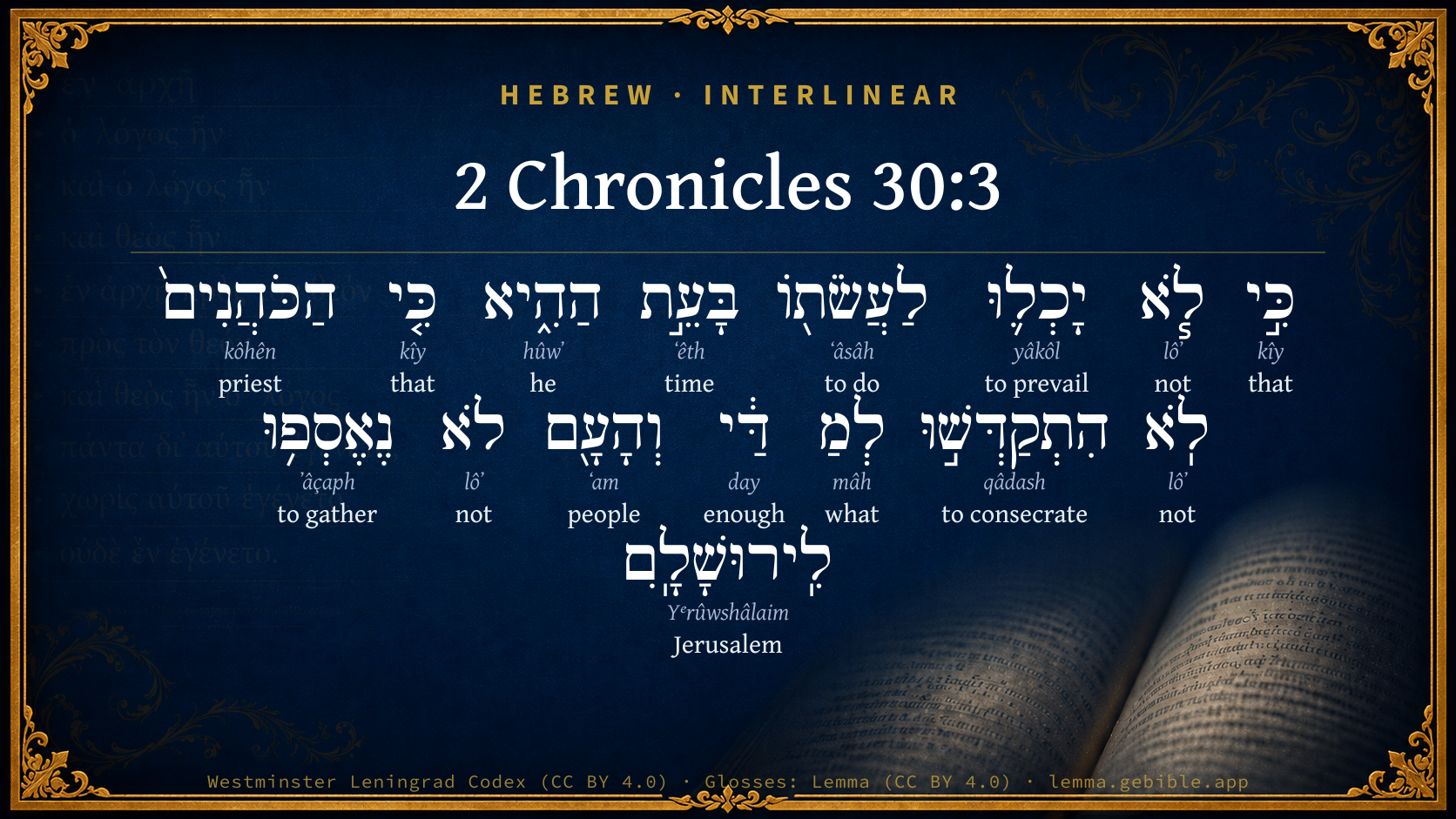
  1. כִּ֣י kîy H3588 “that” Conjunction
  2. לֹ֧א lôʼ H3808 “not” Particle, Negative
  3. יָכְל֛וּ yâkôl H3201 “to prevail” Verb, Qal, Perfect, 3rd Person, Common, Plural
  4. לַעֲשֹׂת֖וֹ ʻâsâh H6213 “to do · him” Preposition + Verb, Qal, Infinitive Construct + Suffix, Personal, 3rd Person, Masculine, Singular
  5. בָּעֵ֣ת ʻêth H6256 “in/at the · time” Preposition, Determined + Noun, Common, Both, Singular, Absolute
  6. הַהִ֑יא hûwʼ H1931 “the · he” Particle, Definite Article + Pronoun, Personal, 3rd Person, Feminine, Singular
  7. כִּ֤י kîy H3588 “that” Conjunction
  8. הַכֹּהֲנִים֙ kôhên H3548 “the · priests” Particle, Definite Article + Noun, Common, Masculine, Plural, Absolute
  9. לֹֽא lôʼ H3808 “not” Particle, Negative
  10. הִתְקַדְּשׁ֣וּ qâdash H6942 “to consecrate” Verb, Hithpael, Perfect, 3rd Person, Common, Plural
  11. לְמַ mâh H4100 “to/for · what” Preposition + Pronoun, Relative
  12. וְהָעָ֖ם ʻam H5971 “and · the · people” Conjunction + Particle, Definite Article + Noun, Common, Masculine, Singular, Absolute
  13. לֹא lôʼ H3808 “not” Particle, Negative
  14. נֶאֶסְפ֥וּ ʼâçaph H622 “to gather” Verb, Niphal, Perfect, 3rd Person, Common, Plural
  15. לִֽירוּשָׁלִָֽם Yᵉrûwshâlaim H3389 “to/for · Jerusalem” Preposition + Noun, Proper

About this verse

These counts appear in no published source. They are computed here, from the morphology-tagged text and Lemma’s own curated glosses. What Lemma adds →

16
words
13
distinct lemmas
Historical
section

Shared distinctive vocabulary

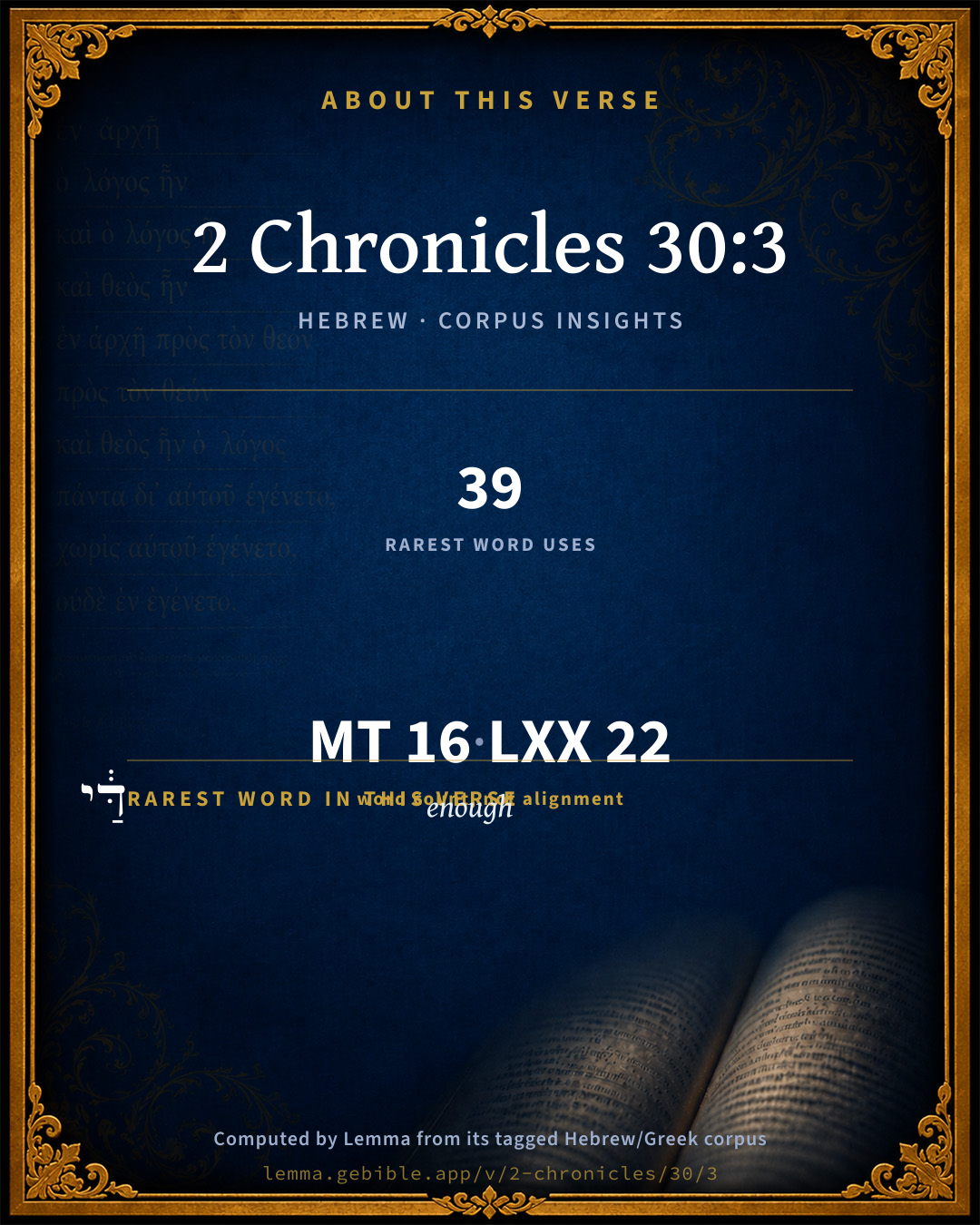
דַּ֔י enough H1767 occurs in 35 verses of the Hebrew Bible. Also found in:

Grammatical profile

  • 4 verbs
  • 5 nouns
  • 2 pronouns
  • 2 conjunctions
  • 3 particles

Verb forms

  • יָכְל֛וּ Qal · Perfect
  • לַעֲשֹׂת֖וֹ Qal · Infinitive Construct
  • הִתְקַדְּשׁ֣וּ Hithpael · Perfect
  • נֶאֶסְפ֥וּ Niphal · Perfect

Repetition

Words recur within this verse — often emphatic in Hebrew:

  • לֹ֧א not H3808 ×3
  • כִּ֣י that H3588 ×2

Hebrew & Septuagint length

In English translation the verse runs 28 words from the Hebrew and 27 from the Septuagint (LXX English) — closely comparable.

A rough comparison of the two English renderings, which tokenize alike — not a word-level alignment.

Word counts can differ between the Hebrew and the Greek without any difference in meaning — e.g. the Hebrew direct-object marker אֵת has no separate Greek word, and Greek often adds the article ὁ.

In the original languages it is 16 Hebrew tokens and 22 Greek tokens — but the two are counted differently (Hebrew bundles its prefixes and suffixes into one token; the Greek is in lemma form), so that isn’t a like-for-like length.

Cross-references

4

Topical passages linked to 2 Chronicles 30:3 in the Treasury of Scripture Knowledge — connected by theme and wording, ordered by reader-vote popularity; previews shown in the World English Bible.

  • 2 Chronicles 29:34 But the priests were too few, so that they could not flay all the burnt offerings: therefore their brothers the Levites helped them, until the work was ended, and until the priests had sanctified themselves; for the Levites were more upright in heart to sanctify themselves than the priests.
  • Exodus 12:6 and you shall keep it until the fourteenth day of the same month; and the whole assembly of the congregation of Israel shall kill it at evening.
  • Exodus 12:18 In the first month, on the fourteenth day of the month at evening, you shall eat unleavened bread, until the twenty first day of the month at evening.
  • 2 Chronicles 29:17 Now they began on the first [day] of the first month to sanctify, and on the eighth day of the month came they to the porch of Yahweh; and they sanctified the house of Yahweh in eight days: and on the sixteenth day of the first month they made an end.

Cross-references courtesy of OpenBible.info (CC BY 4.0).

Hebrew and Greek witnesses Masoretic Hebrew ↔ Greek Septuagint

The same verse in the two great witnesses to the Old Testament, shown verse-for-verse.

These are two independent witnesses, not word-aligned to each other, and the Septuagint is shown in lemma (dictionary) form.

Hebrew 2 Chronicles 30:3 Masoretic · Westminster Leningrad Codex

כִּ֣י לֹ֧א יָכְל֛וּ לַעֲשֹׂת֖וֹ בָּעֵ֣ת הַהִ֑יא כִּ֤י הַכֹּהֲנִים֙ לֹֽא הִתְקַדְּשׁ֣וּ לְמַ דַּ֔י וְהָעָ֖ם לֹא נֶאֶסְפ֥וּ לִֽירוּשָׁלִָֽם

For they could not keep it at that time, because the priests had not sanctified themselves in sufficient number, neither had the people gathered themselves together to Jerusalem.

World English Bible · Public Domain

Greek LXX 2 Chronicles 30:3 Septuagint · lemma form

οὐ γάρ δύναμαι αὐτός ποιέω ἐν ὁ καιρός ἐκεῖνος ὅτι ὁ ἱερεύς οὐ ἁγνίζω ἱκανός καί ὁ λαός οὐ συνἄγω εἰς ἰερουσαλήμ

For they could not keep it at that time, because a sufficient number of priest had not purified themselves, and the people was not gathered to Jerusalem.

LXX2012 (modern English Septuagint) · Public Domain

Hebrew: Westminster Leningrad Codex (CC BY 4.0). Greek: Septuagint (public domain); English from LXX2012 (modern English Septuagint) (Public Domain). How the Septuagint differs from the Hebrew →

Commentary

Notes on 2 Chronicles 30:3 from classic Christian and Jewish commentators (each source and its license shown beneath its notes). The classic Christian expositions comment on the surrounding passage and are grouped to its opening verse, so a note may address several verses; the Jewish commentaries on the Tanakh (Rashi and others) are per-verse, so they appear only where the commentator wrote on this verse.

Lemma curates 59 commentaries, every one of them public domain or Creative Commons licensed, each selected and text-cleaned for this edition rather than reprinted as found. About our sources →

Trapp's Complete Commentary

John Trapp

2Ch 30:3 For they could not keep it at that time, because the priests had not sanctified themselves sufficiently, neither had the people gathered themselves together to Jerusalem.

Ver. 3. For they could not keep it at that time.] Namely, On the fourteenth day of the first month, for the two following reasons. See the like, Num 9:10-11.

John Trapp, A Commentary or Exposition upon All the Books of the Old and New Testament (1647–1656) — public domain. Text from a community e-Sword module.

Joseph Benson's Commentary

2Ch 30:3. For they could not keep it at that time — Which God had appointed for it, both because the temple was not then purified and prepared, and also for two other reasons, which he here adds. The priests had not sanctified themselves sufficiently — To wit, in such a manner as was fit, nor in such numbers as were necessary for the slaying and offering of so many thousands of paschal-offerings, as appears, because they were not sufficient for those offerings, which were comparatively few, 2Ch 29:32-34. Neither had the people gathered themselves together, &c. — As they used, and ought to do, at that time, from all places: which now they could not do, because neither was the matter agreed upon, nor were the people summoned thither, till the proper time was past.

Joseph Benson's Commentary on the Old and New Testaments (1811–1818) — public domain. Text from a community e-Sword module.

Ellicott's Commentary for English Readers

(3) At that time.—The time when the Temple had just been reopened (2Ch_29:8), in the first month of Hezekiah’s first year. The Purification of the Temple was not completed until the 16th of Nisan (2Ch_29:17); but perhaps the Passover would have been held, had not the hindrances here mentioned prevented it. (See 2Ch_29:34).

Sufficiently.—Lĕmaddày. Literally, unto what was enough (lĕ-mah-dày), an expression only met with here. (Comp. a similar formation, 1Ch_15:13.) The meaning is that a sufficient number of priests had not observed the legal ceremonies of self-purification in time to hold Passover in Nisan.

A Bible Commentary for English Readers, edited by Charles John Ellicott (1878–1897) — public domain. Text from a community e-Sword module.

The Cambridge Bible for Schools and Colleges

gen. ed. J. J. S. Perowne

3. at that time] In the first month.

sufficiently] R.V. in sufficient number.

The Cambridge Bible for Schools and Colleges (gen. ed. J. J. S. Perowne; Cambridge University Press, 1878–1918) — public domain. Text from a community e-Sword module.

John Gill's Exposition

For they could not keep it at the time,.... In the month Nisan, as the Targum adds, on the fourteenth day of the month, as the law enjoined, because the cleansing of the temple was not finished until the sixteenth day, see Ch2 29:17 and, besides this, two other reasons follow:

because the priests had not sanctified themselves sufficiently; that is, a sufficient number of them were not sanctified, to slay all the passover lambs the people that came to the feast would want:

neither had the people gathered themselves together to Jerusalem; they had no notice of it, nor summons for it; and it was required that, at such a time, all the males in the land should appear at Jerusalem; but this custom having been long disused, it required time to acquaint them of the revival of it.

John Gill's Exposition of the Whole Bible (1746–1763) — public domain (CC PDM 1.0). Text via the HelloAO Bible API.

Albert Barnes' Notes on the Bible

At that time - i. e. in the first month, at the time of the events mentioned in 2 Chr. 29.

Albert Barnes' Notes on the Bible (1834–1885) — public domain. Text from a community e-Sword/MySword module.

Matthew Poole's English Annotations

They could not keep it at that time, which God had appointed for it, Exo 12:6; one reason whereof was evident in itself, because the temple was not then purified and prepared; to which he adds two other reasons.

The priests had not sanctified themselves sufficiently, to wit, in such manner and degree as was fit, nor in such numbers as were necessary for the flaying and offering of so many thousands of paschal offerings, as appears, because they were not sufficient for those offerings, which were comparatively few, 2Ch 29:32-34.

Neither had the people gathered themselves together to Jerusalem; as they used and ought to do at that time from all places; which now they could not do, because neither the thing was agreed upon, nor the people summoned thither, till the proper time was past.

Matthew Poole's English Annotations on the Holy Bible (1683–1685) — public domain. Text from a community e-Sword/MySword module.

The Pulpit Commentary

At that time. The words seem like a reminiscence of the "at that day," twice occurring in ver. 6 of Numbers 9. But anyway the meaning is plain "at the appointed season. "

The Pulpit Commentary (1880–1919), ed. H.D.M. Spence-Jones & Joseph S. Exell — public domain. Text from a community e-Sword module.

John Wesley's Explanatory Notes

They kept - Not in the same manner as they had done the former, V. 3. Sufficiently - In such manner as was fit, nor in such numbers as but in the solemn worship of God, by sacrifices, and prayers, and praise, were necessary for the slaying and offering of so many thousands of and publick instruction of that great congregation in the good knowledge paschal-offerings, as appears, because they were not sufficient for of the Lord; which was most necessary for the people after so long and those offerings, which were comparatively few, chap. xxix, 32, 33, 34. dismal a night of ignorance, superstition and idolatry.

John Wesley, Explanatory Notes Upon the Whole Bible (1754–1765) — public domain. Text via the GEBible commentary corpus.

Rashi

Rabbi Shlomo Yitzchaki (Rashi)

For they could not perform it at that time in the first month, in Nissan.

for the priests had not consecrated themselves sufficiently They had not consecrated themselves sufficiently for Israel to offer their Passover sacrifices, and it goes without saying that they could not perform it in Nissan, for they did not finish consecrating the Temple until the sixteenth of Nissan, but this is its meaning: For they could not perform it at that time; i.e., even if they had not delayed the purification of the Temple, which they did not complete until the sixteenth of Nissan, they would not have been able to perform it now [the offering of the Passover sacrifice] because not enough priests had consecrated themselves.

and the people had not gathered all of them [had not] yet [gathered] to Jerusalem.

Rashi on the Tanakh — English translations: “The Judaica Press complete Tanach with Rashi, translated by A. J. Rosenberg” (CC BY 4.0); “Pentateuch with Rashi's commentary by M. Rosenbaum and A.M. Silbermann, 1929-1934” (public domain); “The Metsudah Tanach series, Lakewood, N.J” (CC BY 4.0); and “The Book of Joshua, Metsudah Publications, 1997” (CC BY 4.0). Text via Sefaria.

Lesson kit

Teaching starters — assembled from the data on this page, not authored interpretation. Every prompt links to the verse data it draws on. Edit before teaching.

2 Chronicles, in the Historical, opens this verse with 16 words (13 distinct Hebrew lemmas). Its most distinctive word is day (“enough”). A historical commentator’s framing appears above. Read the whole chapter for the surrounding context.

Discussion questions

  1. The word day carries the sense “enough.” How does it shape the verse?
  2. Exodus 36:5 shares the word «enough» with this verse. How do the two illuminate each other?
  3. “not” occurs 3× in this one verse. What is the effect of the repetition?
  4. These translations render this verse differently; the difference is in the English rendering, not the original. What questions does that raise?
  5. The verb «יָכְל֛וּ» is Qal Perfect. How does its form color the action?
  6. Reading how Trapp's Complete Commentary and Joseph Benson's Commentary read this verse, where do the two commentators agree and where do they part?

Things to notice

Reading settings

Reading text

Shown beneath each verse's original-language words.

Old Testament
Old Testament edition

Read the OT as the Masoretic Hebrew (MT) or the Greek Septuagint (LXX).

English shown for the Greek Septuagint (in the Hebrew ↔ Greek comparison).

Comparing translations? Open the Compare panel on any verse page to stack up to four side by side.