
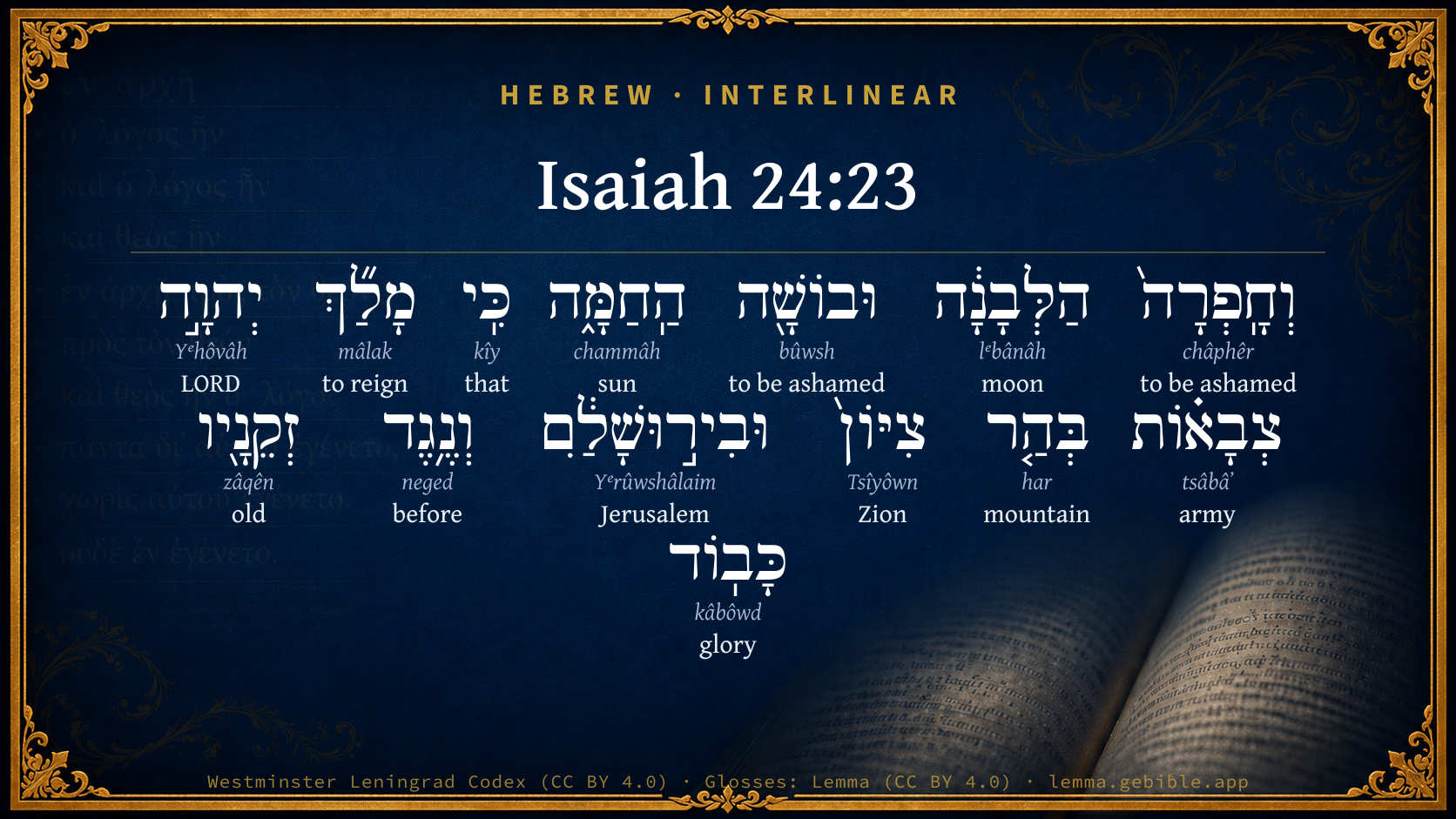
Isaiah 24:23

Hebrew (Westminster Leningrad Codex) Isaiah 24:23 appears in the Hebrew Old Testament. The text above is from the Westminster Leningrad Codex. Each word links to its Strong’s number, a concise gloss, and parsing drawn from the Open Scriptures Hebrew Bible morphology. Click any word for its full Brown-Driver-Briggs (BDB) entry.
Download image
Cite this verse

Isaiah 24:23 (World English Bible). Public Domain. Lemma interlinear Bible study tool, https://lemma.gebible.app/v/isaiah/24/23.

Show BibTeX & RIS
BibTeX
RIS
English Translation
Then the moon shall be confounded, and the sun ashamed; for Yahweh of Hosts will reign on Mount Zion, and in Jerusalem; and before his elders shall be glory.
World English Bible · Public Domain
Download a study sheet

One document with this verse’s original text, its word-by-word gloss line, the meaning frame, cross-references with their text, attributed commentary, and full source and license credits — printable, and it pastes into notes with its structure intact.

This verse Autodidact and up

Study sheet (.html) Plain text (.txt)

A passage Seminary Student

Up to 50 verses in one chapter. A passage sheet keeps up to 6 commentary sources and 12 cross-references per verse, in the order this page ranks them, and says so on the sheet whenever that leaves anything out. Ask for a single verse and you get the Autodidact verse sheet above.

Everything on this page stays free to read, with no account — the sheet is a download of what is already on screen, not access to it.

Want to remove ads? Support Godless Engineer
Compare translations 3

The same verse in 3 English versions, stacked beneath the original-language interlinear above. Click any original word for its lexicon entry.

Each is an independent rendering of the whole verse — the interlinear is not word-aligned to these translations.

Highlighted words mark where these versions differ — a whole-verse word diff, not a word-by-word alignment.

  • World English Bible Public Domain
    Then the moon shall be confounded, and the sun ashamed; for Yahweh of Hosts will reign on Mount Zion, and in Jerusalem; and before his elders shall be glory.
  • King James Version Public Domain
    Then the moon shall be confounded, and the sun ashamed, when the LORD of hosts shall reign in mount Zion, and in Jerusalem, and before his ancients gloriously.
  • unfoldingWord Literal Text CC BY-SA 4.0
    And the moon will have disgrace, and the sun will have shame, for Yahweh of Armies will reign on Mount Zion and in Jerusalem, and glory before his elders.

unfoldingWord Literal Text — © unfoldingWord, licensed CC BY-SA 4.0. Word-aligned USFM3 via Door43 (git.door43.org/unfoldingWord/en_ult).

Versions to compare (up to 4)

3 of 4 selected

Show all 18 translations

Every available English version of this verse, each an independent rendering of the whole verse.

  • World English Bible Public Domain
    Then the moon shall be confounded, and the sun ashamed; for Yahweh of Hosts will reign on Mount Zion, and in Jerusalem; and before his elders shall be glory.
  • Berean Standard Bible Public Domain
    The moon will be confounded and the sun will be ashamed; for the LORD of Hosts will reign on Mount Zion and in Jerusalem, and before His elders with great glory.
  • Majority Standard Bible Public Domain
    The moon will be confounded and the sun will be ashamed; for the LORD of Hosts will reign on Mount Zion and in Jerusalem, and before His elders with great glory.
  • King James Version Public Domain
    Then the moon shall be confounded, and the sun ashamed, when the LORD of hosts shall reign in mount Zion, and in Jerusalem, and before his ancients gloriously.
  • American Standard Version (1901) Public Domain
    Then the moon shall be confounded, and the sun ashamed; for Jehovah of hosts will reign in mount Zion, and in Jerusalem; and before his elders shall be glory.
  • Revised Version (1885) Public Domain
    Then the moon shall be confounded, and the sun ashamed; for the LORD of hosts shall reign in mount Zion, and in Jerusalem, and before his ancients gloriously.
  • Geneva Bible (1599) Public Domain
    Then the moone shall be abashed, and the sunne ashamed, when the Lord of hostes shall reigne in mount Zion and in Ierusalem: and glory shalbe before his ancient men.
  • Douay-Rheims (1899) Public Domain
    fend the moon shall blush, and the sun shall be ashamed, when the Lord of hosts shall reign in mount Sion, and in Jerusalem, and shall be glorified in the sight of his ancients.
  • Young's Literal Translation Public Domain
    And confounded hath been the moon, And ashamed hath been the sun, For reigned hath Jehovah of Hosts In mount Zion, and in Jerusalem, And over-against His elders -- honour!
  • Literal Standard Version CC BY-SA 4.0
    And the moon has been confounded, || And the sun has been ashamed, || For YHWH of Hosts has reigned || In Mount Zion, and in Jerusalem, || And before His elderly—glory!
  • Unlocked Literal Bible CC BY-SA 4.0
    Then the moon will be ashamed, and the sun disgraced, for Yahweh of hosts will reign on Mount Zion and in Jerusalem, and before his elders in glory.
  • unfoldingWord Literal Text CC BY-SA 4.0
    And the moon will have disgrace, and the sun will have shame, for Yahweh of Armies will reign on Mount Zion and in Jerusalem, and glory before his elders.
  • Darby Bible Public Domain
    And the moon shall be confounded, and the sun ashamed; for Jehovah of hosts shall reign on mount Zion, and in Jerusalem, and before his ancients in glory.
  • World Messianic Bible Public Domain
    Then the moon will be confounded, and the sun ashamed; for the LORD of Hosts will reign on Mount Zion and in Jerusalem; and glory will be before his elders.
  • Webster's Bible Public Domain
    Then the moon shall be confounded, and the sun ashamed, when the LORD of hosts shall reign on mount Zion, and in Jerusalem, and before his ancients gloriously.
  • Free Bible Version CC BY-SA 4.0
    The moon will be embarrassed and the sun will be ashamed, for the Lord Almighty will reign in glory on Mount Zion and in Jerusalem in the presence of its leaders.
  • Bible in Basic English Public Domain
    Then the moon will be veiled, and the sun put to shame; for the Lord of armies will be ruling in Mount Zion and in Jerusalem, and before his judges he will let his glory be seen.
  • JPS Tanakh (1917) Public Domain
    Then the moon shall be confounded, and the sun ashamed; for the LORD of hosts will reign in mount Zion, and in Jerusalem, and before His elders shall be Glory.

Literal Standard Version (2020), Covenant Press — licensed CC BY-SA 4.0. Text via the HelloAO Bible API (eBible.org). Unlocked Literal Bible (unfoldingWord) — licensed CC BY-SA 4.0. Text via the HelloAO Bible API (eBible.org). unfoldingWord Literal Text — © unfoldingWord, licensed CC BY-SA 4.0. Word-aligned USFM3 via Door43 (git.door43.org/unfoldingWord/en_ult). Free Bible Version, Dr. Jonathan Gallagher — licensed CC BY-SA 4.0. Text via the HelloAO Bible API (eBible.org).

Word by word

More ways to search: Search by grammar → Find every occurrence → Compare this word →

Practice this passage: Drill this verse → Learn its vocabulary →

הַלְּבָנָ֔ה
lᵉbânâh
H3842
“the · moon”
Particle, Definite Article + Noun, Common, Feminine, Singular, Absolute
Part of Speech
Particle + Noun
Type
Common
Gender
Feminine
Number
Singular
State
Absolute
Full BDB Definition

Origin: from H3835

TWOT: 1074c

moon (as white)
  1. וְחָֽפְרָה֙ châphêr H2659 “and · to be ashamed” Conjunction + Verb, Qal, Sequential Perfect, 3rd Person, Feminine, Singular
  2. וּבוֹשָׁ֖ה bûwsh H954 “and · to be ashamed” Conjunction + Verb, Qal, Sequential Perfect, 3rd Person, Feminine, Singular
  3. הַֽחַמָּ֑ה chammâh H2535 “the · sun” Particle, Definite Article + Noun, Common, Feminine, Singular, Absolute
  4. כִּֽי kîy H3588 “that” Conjunction
  5. מָלַ֞ךְ mâlak H4427 “to reign” Verb, Qal, Perfect, 3rd Person, Masculine, Singular
  6. יְהוָ֣ה Yᵉhôvâh H3068 “LORD” Noun, Proper
  7. צְבָא֗וֹת tsâbâʼ H6635 “armies” Noun, Common, Both, Plural, Absolute
  8. בְּהַ֤ר har H2022 “in/at · mountain of” Preposition + Noun, Common, Masculine, Singular, Construct
  9. צִיּוֹן֙ Tsîyôwn H6726 “Zion” Noun, Proper
  10. וּבִיר֣וּשָׁלִַ֔ם Yᵉrûwshâlaim H3389 “and · in/at · Jerusalem” Conjunction + Preposition + Noun, Proper
  11. וְנֶ֥גֶד neged H5048 “and · before” Conjunction + Preposition
  12. זְקֵנָ֖יו zâqên H2205 “old · his” Adjective, Adjective, Masculine, Plural, Construct + Suffix, Personal, 3rd Person, Masculine, Singular
  13. כָּבֽוֹד kâbôwd H3519 “glory” Noun, Common, Both, Singular, Absolute

About this verse

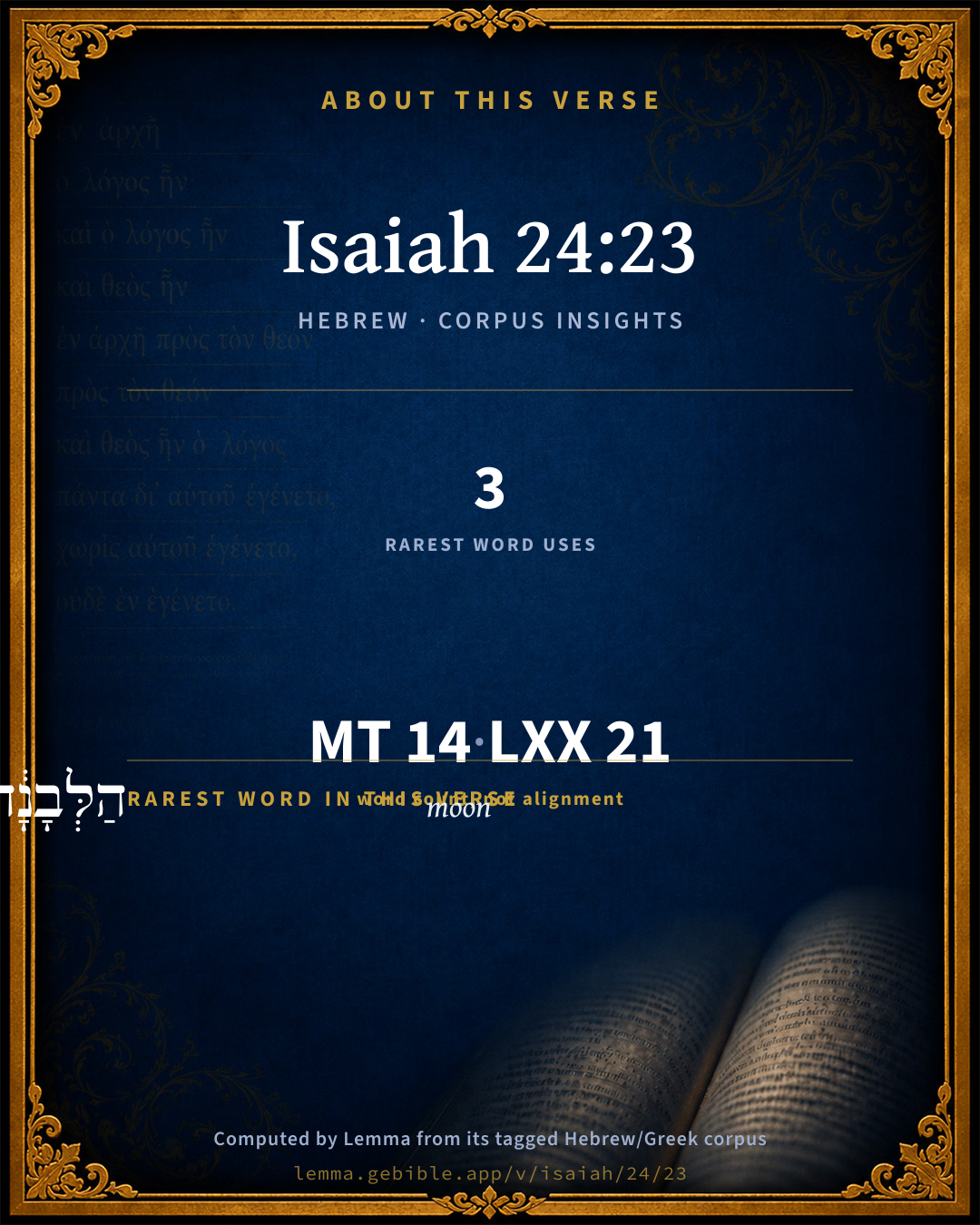
These counts appear in no published source. They are computed here, from the morphology-tagged text and Lemma’s own curated glosses. What Lemma adds →

14
words
14
distinct lemmas
Prophets
section

Notable vocabulary

The rarest word here is הַלְּבָנָ֔ה moon H3842 — appearing just 3 times in the whole Hebrew Bible.

Shared distinctive vocabulary

הַלְּבָנָ֔ה moon H3842 occurs in 3 verses of the Hebrew Bible. Also found in:

Grammatical profile

  • 3 verbs
  • 8 nouns
  • 1 adjective
  • 1 preposition
  • 1 conjunction

Verb forms

  • וְחָֽפְרָה֙ Qal · Sequential Perfect
  • וּבוֹשָׁ֖ה Qal · Sequential Perfect
  • מָלַ֞ךְ Qal · Perfect

Hebrew & Septuagint length

In English translation the verse runs 29 words from the Hebrew and 30 from the Septuagint (LXX English) — closely comparable.

A rough comparison of the two English renderings, which tokenize alike — not a word-level alignment.

Word counts can differ between the Hebrew and the Greek without any difference in meaning — e.g. the Hebrew direct-object marker אֵת has no separate Greek word, and Greek often adds the article ὁ.

In the original languages it is 14 Hebrew tokens and 21 Greek tokens — but the two are counted differently (Hebrew bundles its prefixes and suffixes into one token; the Greek is in lemma form), so that isn’t a like-for-like length.

Cross-references

26

Topical passages linked to Isaiah 24:23 in the Treasury of Scripture Knowledge — connected by theme and wording, ordered by reader-vote popularity; previews shown in the World English Bible.

  • Isaiah 60:19 The sun shall be no more your light by day; neither for brightness shall the moon give light to you: but Yahweh will be to you an everlasting light, and your God your glory.
  • Isaiah 13:10 For the stars of the sky and the constellations of it shall not give their light; the sun shall be darkened in its going forth, and the moon shall not cause its light to shine.
  • Revelation 21:23 The city has no need for the sun, neither of the moon, to shine, for the very glory of God illuminated it, and its lamp is the Lamb.
  • Revelation 22:5 There will be no night, and they need no lamp light; for the Lord God will illuminate them. They will reign forever and ever.
  • Hebrews 12:22 But you have come to Mount Zion, and to the city of the living God, the heavenly Jerusalem, and to innumerable hosts of angels,
  • Isaiah 12:6 Cry aloud and shout, you inhabitant of Zion; for great in the midst of you is the Holy One of Israel!"
  • Isaiah 30:26 Moreover the light of the moon shall be as the light of the sun, and the light of the sun shall be sevenfold, as the light of seven days, in the day that Yahweh binds up the hurt of his people, and heals the stroke of their wound.
  • Micah 4:7 And I will make that which was lame a remnant, And that which was cast far off a strong nation: And Yahweh will reign over them on Mount Zion from then on, even forever.
  • Revelation 6:12–14 I saw when he opened the sixth seal, and there was a great earthquake. The sun became black as sackcloth made of hair, and the whole moon became as blood.
  • Exodus 15:21 Miriam answered them, "Sing to Yahweh, for he has triumphed gloriously: The horse and his rider he has thrown into the sea."
  • Job 38:4–7 "Where were you when I laid the foundations of the earth? Declare, if you have understanding.
  • Psalms 97:1 Yahweh reigns! Let the earth rejoice! Let the multitude of islands be glad!
  • Isaiah 52:7 How beautiful on the mountains are the feet of him who brings good news, who publishes peace, who brings good news of good, who publishes salvation, who says to Zion, Your God reigns!
  • Ezekiel 32:7–8 When I shall extinguish you, I will cover the heavens, and make the stars of it dark; I will cover the sun with a cloud, and the moon shall not give its light.
  • Daniel 7:9–10 I saw until thrones were placed, and one who was ancient of days sat: his clothing was white as snow, and the hair of his head like pure wool; his throne was fiery flames, [and] the wheels of it burning fire.
  • Daniel 7:18 But the saints of the Most High shall receive the kingdom, and possess the kingdom forever, even forever and ever.
  • Daniel 7:27 The kingdom and the dominion, and the greatness of the kingdoms under the whole the sky, shall be given to the people of the saints of the Most High: his kingdom is an everlasting kingdom, and all dominions shall serve and obey him.
  • Joel 2:31 The sun will be turned into darkness, And the moon into blood, Before the great and terrible day of Yahweh comes.
  • Joel 3:15 The sun and the moon are darkened, And the stars withdraw their shining."
  • Zechariah 9:9 Rejoice greatly, daughter of Zion! Shout, daughter of Jerusalem! Behold, your king comes to you! He is righteous, and having salvation; Lowly, and riding on a donkey, Even on a colt, the foal of a donkey.
  • Mark 13:24–26 But in those days, after that oppression, the sun will be darkened, the moon will not give its light,
  • Revelation 11:15 The seventh angel sounded, and great voices in heaven followed, saying, "The kingdom of the world has become the Kingdom of our Lord, and of his Christ. He will reign forever and ever!"
  • Revelation 14:1 I saw, and behold, the Lamb standing on Mount Zion, and with him a number, one hundred forty-four thousand, having his name, and the name of his Father, written on their foreheads.
  • Revelation 19:4 The twenty-four elders and the four living creatures fell down and worshiped God who sits on the throne, saying, "Amen! Hallelujah!"
  • Revelation 19:6 I heard something like the voice of a great multitude, and like the voice of many waters, and like the voice of mighty thunders, saying, "Hallelujah! For the Lord our God, the Almighty, reigns!
  • Matthew 6:10 Let your Kingdom come. Let your will be done, as in heaven, so on earth.

Cross-references courtesy of OpenBible.info (CC BY 4.0).

Hebrew and Greek witnesses Masoretic Hebrew ↔ Greek Septuagint

The same verse in the two great witnesses to the Old Testament, shown verse-for-verse.

These are two independent witnesses, not word-aligned to each other, and the Septuagint is shown in lemma (dictionary) form.

Hebrew Isaiah 24:23 Masoretic · Westminster Leningrad Codex

וְחָֽפְרָה֙ הַלְּבָנָ֔ה וּבוֹשָׁ֖ה הַֽחַמָּ֑ה כִּֽי מָלַ֞ךְ יְהוָ֣ה צְבָא֗וֹת בְּהַ֤ר צִיּוֹן֙ וּבִיר֣וּשָׁלִַ֔ם וְנֶ֥גֶד זְקֵנָ֖יו כָּבֽוֹד

Then the moon shall be confounded, and the sun ashamed; for Yahweh of Hosts will reign on Mount Zion, and in Jerusalem; and before his elders shall be glory.

World English Bible · Public Domain

Greek LXX Isaiah 24:23 Septuagint · lemma form

καί τήκω ὁ πλίνθος καί πίπτω ὁ τεῖχος ὅτι βασιλεύω κύριος ἐν σιων καί ἐν ἰερουσαλήμ καί ἐνώπιον ὁ πρεσβύτερος δοξάζω

And the brick shall decay, and the wall shall fall; for the Lord shall reign from out of Sion, and out of Jerusalem, and shall be glorified before his elders.

LXX2012 (modern English Septuagint) · Public Domain

Hebrew: Westminster Leningrad Codex (CC BY 4.0). Greek: Septuagint (public domain); English from LXX2012 (modern English Septuagint) (Public Domain). How the Septuagint differs from the Hebrew →

Targum (Aramaic paraphrase)

1

The Targum is the ancient Jewish Aramaic paraphrase of the Hebrew Scriptures — an interpretive translation, not the Hebrew text itself. Onkelos (literal) and Pseudo-Jonathan (expansive) render the Torah, and Jonathan the Prophets. Coverage is partial: where no permissively-licensed English translation exists for a verse, only the Aramaic is shown. This is verse-level text, not a word-by-word alignment to the Hebrew.

  1. Targum Jonathan Prophets (Joshua–Malachi)
    וְיִבְהֲתוּן דְפָלְחִין לְסִיהֲרָא וְיִתְכַּנְעוּן דְסָגְדִין לְשִׁמְשָׁא אֲרֵי תִתְגְלֵי גְבוּרְתָּא דַייָ צְבָאוֹת בְּטוּרָא דְצִיוֹן וּבִירוּשְׁלֶם וּקְדָם סָבֵי עַמֵהּ בִּיקָר:

    And they shall be confounded that worship the moon, and they shall be ashamed that worship the sun; because the power of the Lord of hosts shall be revealed in mount Sion, and before the elders of his people in glory.

    Targum Jonathan — Aramaic: “Mikraot Gedolot” (public domain). English: “Sefaria Community Translation” (CC0 1.0 (public-domain dedication)); “London "Chaldee Paraphrase," 1871” (public domain). Text via Sefaria.

Commentary

Notes on Isaiah 24:23 from classic Christian and Jewish commentators (each source and its license shown beneath its notes). The classic Christian expositions comment on the surrounding passage and are grouped to its opening verse, so a note may address several verses; the Jewish commentaries on the Tanakh (Rashi and others) are per-verse, so they appear only where the commentator wrote on this verse.

Lemma curates 59 commentaries, every one of them public domain or Creative Commons licensed, each selected and text-cleaned for this edition rather than reprinted as found. About our sources →

Trapp's Complete Commentary

John Trapp

Isa 24:23 Then the moon shall be confounded, and the sun ashamed, when the LORD of hosts shall reign in mount Zion, and in Jerusalem, and before his ancients gloriously.

Ver. 23. Then the moon shall be confounded.] The glory of Christ’s kingdom shall be so great, that in comparison to it the sun and moon shall cast no light. See Isa 24:23; Isa 60:19.

When the Lord of hosts.] The Lord Christ, summus caelitum Imperator.

And before his ancients.] The whole Church and especially her officers, which are the glory of Christ. {2Co 8:23}

John Trapp, A Commentary or Exposition upon All the Books of the Old and New Testament (1647–1656) — public domain. Text from a community e-Sword module.

Joseph Benson's Commentary

Isa 24:23. Then the moon shall be confounded — The shadowy, typical, temporary, and imperfect dispensation of Moses, which afforded only a dim and uncertain light, like that of the moon, shall be eclipsed and vanish; and the sun ashamed — The glory of the civil government, also even of the kingdom of David itself, shall be obscured by the far greater splendour of the kingdom of Christ, the King of kings, at whose feet the kings of the earth shall fall down and worship. When the Lord of hosts — The Messiah, who, though man, is yet also God, and the Lord of hosts; shall reign in mount Zion, &c. — Shall come in the flesh, and set up his kingdom, first in Jerusalem, and afterward in all other nations; before his ancients — His ministers, who are, in some sort, the courtiers of this King of glory, as being continually attendant upon him, enjoying his presence, and executing the offices intrusted to them; and especially before his apostles, who were the witnesses of his divine words and works, and particularly of his resurrection and ascension, by which he entered upon his kingdom; and of the exercise of his royal power in subduing both Jews and Gentiles to himself. The word ancient, or elder, is not a name of age, but of office. And the ancients here represent, and are put for, the whole church, in whose name, and for whose service, they act.

Some think that, at the twenty-first verse, a transition is made from the ruin of the Jewish nation for opposing the gospel, to the destruction of the anti- christian powers, which is to introduce the general prevalence of true religion, and the glory of Christ’s millennial reign; and that the twenty-first and twenty-second verses are intended of that destruction. There is, however, this objection to that interpretation: it is not reconcileable with the last clause of Isa 24:22, namely, after many days they shall be visited. For surely these antichristian powers are not to be visited and restored. This clause indeed, considering the connection in which it stands, does not seem to be applicable to any event predicted in Scripture, but the conversion and restoration of the Jewish nation after the many ages of their dereliction and depression. Then, however, when the fulness of the Gentiles shall be brought in, and all Israel shall be saved, the twenty-third verse shall receive a far more complete accomplishment. The Messiah’s kingdom shall then appear in its greatest glory on earth; and the moon shall be confounded, and the sun ashamed. Not only the borrowed light of inferior and subordinate states, but the splendour of the mightiest empires shall be eclipsed and put to shame by it.

Joseph Benson's Commentary on the Old and New Testaments (1811–1818) — public domain. Text from a community e-Sword module.

Geneva Bible (1599)

Geneva Bible translators

When God shall restore his Church, the glory thereof shall so shine, and his ministers (which are called his ancient men) that the sun and the moon shall be dark in comparison thereof.

Geneva Bible (1599) marginal notes — public domain. Text via Bolls.life.

Jamieson, Fausset & Brown

Robert Jamieson, A. R. Fausset & David Brown

(Jer 3:17). Still future: of which Jesus' triumphal entry into Jerusalem amidst hosannas was a pledge.

his ancients--the elders of His people; or in general, His ancient people, the Jews. After the overthrow of the world kingdoms. Jehovah's shall be set up with a splendor exceeding the light of the sun and moon under the previous order of things (Isa 60:19-20).

The restoration from Babylon and re-establishment of the theocracy was a type and pledge of this.

Next: Isaiah Chapter 25

Jamieson, Fausset & Brown — Commentary Critical and Explanatory on the Whole Bible (1871) — public domain (CC PDM 1.0). Text via the HelloAO Bible API.

Adam Clarke's Commentary

Verse 23. Before his ancients gloriously] In the sigt of their olde men he schal ben glorified. Old MS. BIBLE.

"The figurative language of the prophets is taken from the analogy between the world natural and an empire or kingdom considered as a world politic. Accordingly the whole world natural, consisting of heaven and earth, signifies the whole world politic, consisting of thrones and people; or so much of it as is considered in prophecy: and the things in that world signify the analogous things in this. For the heavens and the things therein signify thrones and dignities, and those who enjoy them; and the earth with the things thereon, the inferior people; and the lowest parts of the earth, called hades or hell, the lowest or most miserable part of them. Great earthquakes, and the shaking of heaven and earth, are put for the shaking of kingdoms, so as to distract and overthrow them; the creating a new heaven and earth, and the passing away of an old one, or the beginning and end of a world, for the rise and ruin of a body politic signified thereby. The sun, for the whole species and race of kings, in the kingdoms of the world politic; the moon, for the body of the common people, considered as the king's wife; the stars, for subordinate princes and great men; or for bishops and rulers of the people of God, when the sun is Christ: setting of the sun, moon, and stars, darkening the sun, turning the moon into blood, and falling of the stars, for the ceasing of a kingdom." Sir I. Newton's Observations on the Prophecies, Part I., chap. 2.

These observations are of great consequence and use, in explaining the phraseology of the prophets.

Adam Clarke's Commentary on the Bible (1810–1826) — public domain. Text from a community e-Sword/MySword module.

Ellicott's Commentary for English Readers

(23) The moon shall be confounded . . .—The thought implied is that the most glorious forms of created light will become dim, the moon red as with the blush of shame, the sun turning pale, before the glory of Jehovah’s presence.

The Lord of hosts shall reign . . .—Better, hath become king, the phrase being that used as in 2Sa_5:4; 1Ki_15:1, for a king’s accession to his throne.

And before his ancients gloriously.—Better, and before his elders shall he glory. The “elders” are, like the seventy of Exo_24:9, like the twenty-four of Rev_4:4, the chosen ones of the new Jerusalem, to whom it shall be given, as the counsellors of the great King, to see His glory, that glory resting on them as in old time it rested upon Moses.

A Bible Commentary for English Readers, edited by Charles John Ellicott (1878–1897) — public domain. Text from a community e-Sword module.

The Cambridge Bible for Schools and Colleges

gen. ed. J. J. S. Perowne

23. the moon shall be confounded … ashamed] i.e. shall “pale their ineffectual fires” before the light of Jehovah’s presence (see ch. Isa_60:19). A punishment of the sun and moon, as representatives of the “host of heaven,” is not to be thought of. The words “moon” and “sun” are poetic, signifying respectively “the white” and “the hot.” (Cf. ch. Isa_30:26)

the lord of hosts shall reign] Lit. “hath proclaimed Himself king.”

before his ancients gloriously] Render with R.V. marg. before his ancients (elders) shall be glory. There is an allusion to the Theophany seen by the seventy elders of Israel at Mount Sinai, recorded in Exo_24:9-10. It is significant that the representatives of the redeemed community who stand nearest to Jehovah are not a king and princes, as in ch. Isa_32:1, nor priests, as in Ezekiel’s Temple-vision, but a council of elders.

The Cambridge Bible for Schools and Colleges (gen. ed. J. J. S. Perowne; Cambridge University Press, 1878–1918) — public domain. Text from a community e-Sword module.

Albert Barnes' Notes on the Bible

Then the moon shall be confounded - The heavenly bodies are often employed in the sacred writings to denote the princes and kings of the earth. These expressions are not to be pressed ad unguem as if the sun denoted one thing and the moon another; but they are general poetic expressions designed to represent rulers, princes, and magistrates of all kinds (compare Eze 32:7; Joe 2:30-31).

Shall be confounded - Shall be covered with shame. That is, shall appear to shine with diminished beauty, as if it were ashamed in the superior glory that would shine around it. The sense is, that when the people should be returned to their land, the theocracy would be restored, and the magnificence of the kings and other civil rulers would be dimmed in the superior splendor of the reign of God. Probably there is reference here to the time when Yahweh would reign in Jerusalem through, or by means of, the messiah.

In Mount Zion - (see the note at Isa 1:8). This would take place subsequently to the captivity, and pre-eminently under the reign of the messiah.

And before his ancients - That is, before the elders of the people; in the presence of those entrusted with authority and rule.

Gloriously - He would reign gloriously when his laws should be respected and obeyed; when his character as King and Ruler should be developed; and when, under his scepter, his kingdom should be augmented and extended. On this glad prospect the eye of the prophet was fixed; and this was the bright and splendid object in the ‘vision’ that served to relieve the darkness that was coming upon the nation. Present calamities may be borne, with the hope that Yahweh will reign more gloriously hereafter; and when the effect of all shall be such as to exalt Yahweh in the view of the nations. It may be added that when Yahweh, by the Messiah, shall reign over all the earth, all the glory of princes and monarchs shall be dimmed; the celebrity of their wisdom and power and plans shall be obscured in the superior splendor of the wisdom of God, in reigning through his Son over the human race. Come that blessed day; and speedily let the glory of the moon be confounded, and the sun be ashamed, and all inferior magnificence t fade away before the splendor of the Sun of righteousness!

Albert Barnes' Notes on the Bible (1834–1885) — public domain. Text from a community e-Sword/MySword module.

Haydock's Catholic Bible Commentary

Blush: he[be] turned into blood, Joel ii. 10. Dreadful calamities shall ensue, to usher in the great day of judgment. (Calmet)

George Leo Haydock (1774–1849), Haydock's Catholic Family Bible and Commentary, 1859 edition — public domain. Excludes Psalms (Douay-Rheims chapter numbering differs from Protestant) and Deuterocanonical books (Catholic canon only).

Matthew Poole's English Annotations

The moon shall be confounded, and the sun ashamed. The sun and moon are here considered either,

1. As they were abused to idolatry; for these two were most eminent idols, and most generally worshipped, especially in those Eastern countries, Deu 4:19; 17:3; Job 31:26, &c., and so may be put for all idols, which were confounded by Christ at his coming, as was foretold in Scripture, and verified by the testimony of ancient, yea, even of heathen historians. Or,

2. As they were the most eminent and glorious lights of the world, and were oft used, both in Scripture and other authors, to signify the great kings, and potentates, and glories of the world, as hath been formerly noted, and we shall have further occasion to remember. So the sense is, that all earthly powers and glories should be obscured with the far greater splendour of Christ, the King of kings, at whose feet even the kings of the earth shall fall down and worship, as we shall see in other parts of this prophecy. The Lord of hosts; the Messiah, who, though man, yet is also God, and the Lord of hosts, and is so called, Zec 2:8,11.

Shall reign in Mount Zion, and in Jerusalem; shall come in the flesh, and set up his kingdom, first in Jerusalem, and afterward in all other nations.

Before his ancients; before his ministers, who are in some sort the courtiers of this King of glory, as being continually attending upon him, and enjoying his presence, and executing the powers and offices of his kingdom; and especially before his apostles, who were the witnesses of his Divine words and works, and particularly of his resurrection and ascension, by which he entered upon his kingdom; and of this exercise of his royal power, in subduing both Jews and Gentiles to himself. The word ancient or elder is not a name of age, but of office, as it is in very many texts of Scripture. And the ancients are here put synecdochically for the whole church, in whose name and for whose service they act.

Gloriously, Heb. in glory, for that preposition is very frequently understood.

Matthew Poole's English Annotations on the Holy Bible (1683–1685) — public domain. Text from a community e-Sword/MySword module.

The Pulpit Commentary

The moon shall be confounded, and the sun ashamed. Some interpret this in the light of Joe_2:31 Joe_3:15 Mat_24:29 Rev_6:12, as pointing to that physical change, real or phenomenal, in the shining of the sun and moon, which is to be one of the antecedent signs of Christ"s coming at the last day. But the expressions used suggest rather a contrast between the dazzling splendor of Christ"s actual appearance and the normal brightness of sunlight and moonlight. The greater and lesser lights will "pale their ineffectual fires" before the incomparable brightness of the "Sun of Righteousness". (Mal_4:2) When the Lord of hosts shall reign in Mount Zion, and in Jerusalem. The spiritual Zion and the heavenly Jerusalem can alone be meant, since the earth is no more (ver. 20). (On these, see Re 21,re 22) Before his ancients; or, his elders. Four and twenty elders, clothed in white raiment, with crowns of gold upon their heads, are represented in the Apocalypse as sitting round about the throne of God perpetually, (Rev_4:4) and worshipping God and the Lamb. (Rev_4:10 Rev_5:8, Rev_5:14)

The Lord"s kingdom is the doing of the Lord"s will.

"For the Lord of hosts shall reign.

I A KINGDOM IS SIMPLY THE REIGN AND RULE OF A WILL. That is the proper meaning of the word "kingdom;" it is the "dom" or rule of a king. There are several ways in which men may be gathered together into ordered communities. The form of the kingdom is the most common. We only in part realize what a kingdom is in our own land and times, because the relation between the will of our sovereign and the people is not direct, but is maintained through a constitution, which involves representative and responsible government. For the scriptural idea of a kingdom we must refer to the kingdoms established in those Eastern climes, where Bible heroes lived and the Bible itself was written. There a kingdom is the rule of one man"s will. The judgments, wishes, and commands of one man influence the spirit, conduct, and even choices of a whole people. Properly a kingdom is a number of persons agreeing to accept the will of one of their number as their rule and guide. The kingdom grows out of the family idea; and the family rule is the fatherly will. So the kingdom of God is no merely outward thing; it is the reign of God"s will. The subjects of it are precisely those who choose his will, obey him, recognize his kingly rights.

II IF WE KNOW THE WILL OF GOD, WE KNOW THE SPIRIT OF HIS KINGDOM. We can judge of any kingdom fairly if we can gain a fair knowledge of its king. Of God we know this his will is that of a Father, a heavenly Father, a Holy Father. God might have put forth his power and forced the obedience of his creatures. He does not. He appeals to our motives and feelings as reasonable moral beings. He wants no kingdom of slaves; he wants the love and allegiance of free men. His is a spiritual kingdom. To accept the will of some men is hard; but God touches our feelings, wakens our confidence, commands our reverence, and so to us his will seems most beautiful, ever right, ever wise, ever gracious. And we know the spirit of his kingdom it is the obedience which love renders.

III IF WE CHEERFULLY ACCEPT THE WILL OF GOD, WE REALIZE THE COMING OF HIS KINGDOM. Prophecy indeed makes pictures of the setting up of a king in Jerusalem in the latter days; but prophecy is fulfilled, over and over again, when hearts yield to God; when families, communities, and nations accept his will and reign. God wants to secure the voluntary choice of his will as the rule of life. Wherever that is gained his kingdom is set up. R.T.

The Pulpit Commentary (1880–1919), ed. H.D.M. Spence-Jones & Joseph S. Exell — public domain. Text from a community e-Sword module.

John Wesley's Explanatory Notes

The sun - All earthly powers and glories shall be obscured with the far greater splendour of Christ, the king of kings, at whose feet even the kings of the earth shall fall down and worship. The Lord - The Messiah, who, tho' man, yet is also God, and the Lord of hosts. Shall reign - Shall come in the flesh, and set up his kingdom, first in Jerusalem, and afterward in all other nations. Before - Before his ministers, who are in some sort the courtiers of the King of Glory. But the ancients are here put for the whole church, in whose name and for whose service they act.

John Wesley, Explanatory Notes Upon the Whole Bible (1754–1765) — public domain. Text via the GEBible commentary corpus.

J. A. Alexander on Isaiah

Joseph Addison Alexander

“And the moon shall be confounded and the sun ashamed, for Jehovah of Hosts is king in Mount Zion and in Jerusalem, and before his elders there is glory.” Before the splendor of Jehovah’s reign all lesser principalities and powers shall fade away. The elders are the rulers of Israel as the church. The simple meaning of the verse appears to be that Jehovah’s reign over His people shall be more august than that of any created sovereign. This is true of the church in various periods of history, but more especially in those when the presence and power of God are peculiarly manifested. The affinity between this verse and the last of the preceding chapter seems to show that their juxtaposition is by no means fortuitous.

Joseph Addison Alexander, The Prophecies of Isaiah (1846–1847; New York: Scribner, 1870–1878) — public domain. Text from a community e-Sword module.

Rashi

Rabbi Shlomo Yitzchaki (Rashi)

And the moon shall be ashamed, etc. Jonathan paraphrases: And the worshippers of the moon shall be ashamed, and the worshippers of the sun shall be humbled.

Rashi on the Tanakh — English translations: “The Judaica Press complete Tanach with Rashi, translated by A. J. Rosenberg” (CC BY 4.0); “Pentateuch with Rashi's commentary by M. Rosenbaum and A.M. Silbermann, 1929-1934” (public domain); “The Metsudah Tanach series, Lakewood, N.J” (CC BY 4.0); and “The Book of Joshua, Metsudah Publications, 1997” (CC BY 4.0). Text via Sefaria.

Ibn Ezra

Rabbi Abraham ibn Ezra

Then the moon, etc. Sun and moon, the rulers of heaven, are used here in a figurative sense for the kings of the earth, who will be ashamed; but it is also possible that an eclipse of sun and moon is meant by the prophet. The kingdom of God will then appear on the mount of Zion, and honour will be given to those that remain faithful to God. According to others this passage refers to the worshippers of the heavenly bodies; but this explanation is at variance with the context.

Ibn Ezra on the Tanakh — English translations: “Sefaria Community Translation” (CC0 1.0 (public-domain dedication)); “Yalkut, Sifsei Chachomim Chumash, Metsudah Publications, 2009” (CC BY 4.0); and “Commentary of Ibn Ezra on Isaiah - trans. by M. Friedlander, 1873” (public domain). Text via Sefaria.

Lesson kit

Teaching starters — assembled from the data on this page, not authored interpretation. Every prompt links to the verse data it draws on. Edit before teaching.

Isaiah, in the Prophets, opens this verse with 14 words (14 distinct Hebrew lemmas). Its most distinctive word is lᵉbânâh (“moon”). A historical commentator’s framing appears above. Read the whole chapter for the surrounding context.

Discussion questions

  1. What does “moon” (lᵉbânâh) contribute to the verse as a whole?
  2. Song of Solomon 6:10 shares the word «moon» with this verse. How do the two illuminate each other?
  3. These translations render this verse differently. What is at stake in choosing one wording over another?
  4. The verb «וְחָֽפְרָה֙» is Qal Sequential Perfect. How does its form color the action?
  5. Reading how Trapp's Complete Commentary and Joseph Benson's Commentary read this verse, where do the two commentators agree and where do they part?

Things to notice

Reading settings

Reading text

Shown beneath each verse's original-language words.

Old Testament
Old Testament edition

Read the OT as the Masoretic Hebrew (MT) or the Greek Septuagint (LXX).

English shown for the Greek Septuagint (in the Hebrew ↔ Greek comparison).

Comparing translations? Open the Compare panel on any verse page to stack up to four side by side.