
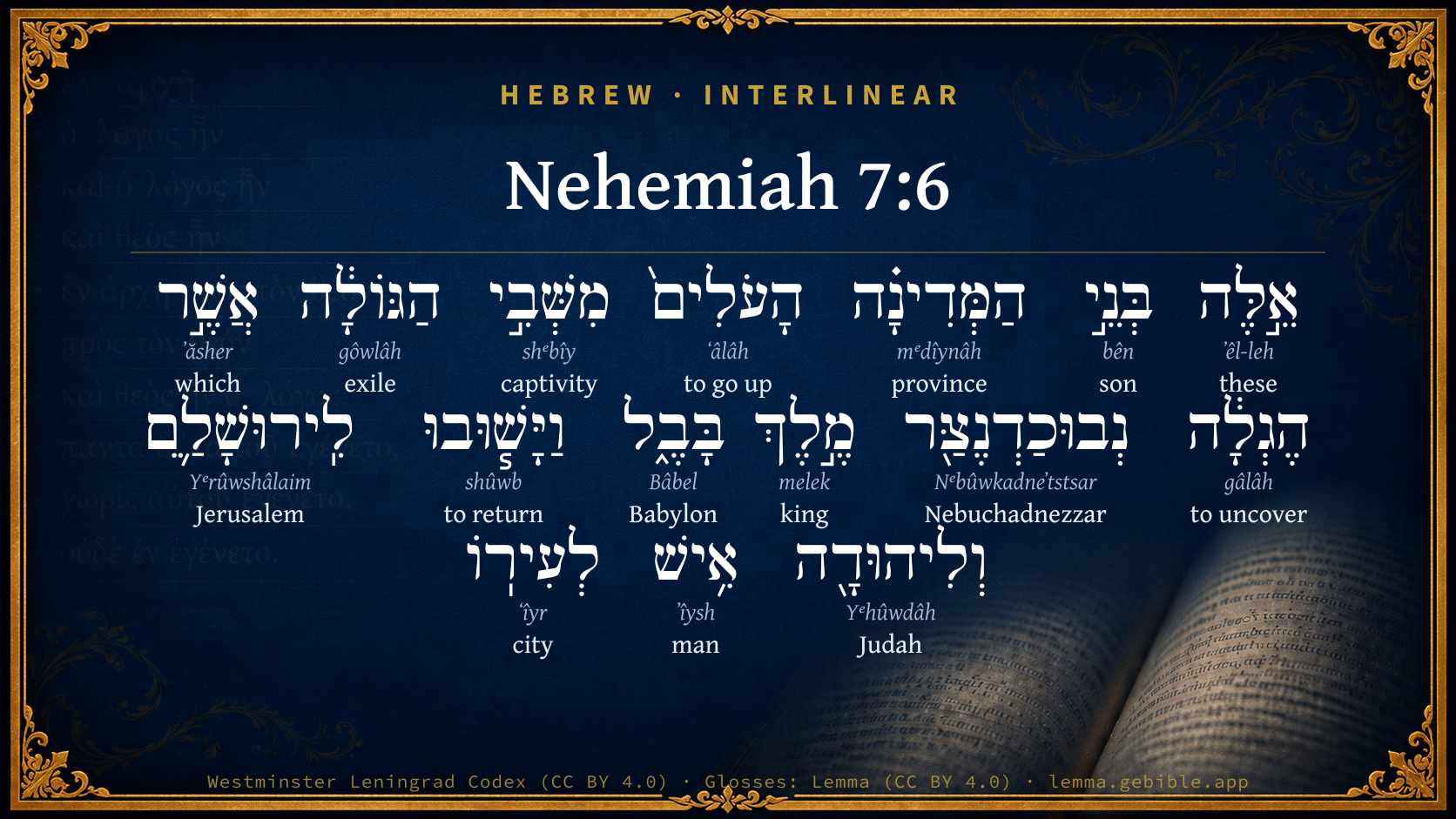
Nehemiah 7:6

Hebrew (Westminster Leningrad Codex) Nehemiah 7:6 appears in the Hebrew Old Testament. The text above is from the Westminster Leningrad Codex. Each word links to its Strong’s number, a concise gloss, and parsing drawn from the Open Scriptures Hebrew Bible morphology. Click any word for its full Brown-Driver-Briggs (BDB) entry.
Download image
Cite this verse

Nehemiah 7:6 (World English Bible). Public Domain. Lemma interlinear Bible study tool, https://lemma.gebible.app/v/nehemiah/7/6.

Show BibTeX & RIS
BibTeX
RIS
English Translation
These are the children of the province, who went up out of the captivity of those who had been carried away, whom Nebuchadnezzar the king of Babylon had carried away, and who returned to Jerusalem and to Judah, everyone to his city;
World English Bible · Public Domain
Download a study sheet

One document with this verse’s original text, its word-by-word gloss line, the meaning frame, cross-references with their text, attributed commentary, and full source and license credits — printable, and it pastes into notes with its structure intact.

This verse Autodidact and up

Study sheet (.html) Plain text (.txt)

A passage Seminary Student

Up to 50 verses in one chapter. A passage sheet keeps up to 6 commentary sources and 12 cross-references per verse, in the order this page ranks them, and says so on the sheet whenever that leaves anything out. Ask for a single verse and you get the Autodidact verse sheet above.

Everything on this page stays free to read, with no account — the sheet is a download of what is already on screen, not access to it.

Want to remove ads? Support Godless Engineer
Compare translations 3

The same verse in 3 English versions, stacked beneath the original-language interlinear above. Click any original word for its lexicon entry.

Each is an independent rendering of the whole verse — the interlinear is not word-aligned to these translations.

Highlighted words mark where these versions differ — a whole-verse word diff, not a word-by-word alignment.

  • World English Bible Public Domain
    These are the children of the province, who went up out of the captivity of those who had been carried away, whom Nebuchadnezzar the king of Babylon had carried away, and who returned to Jerusalem and to Judah, everyone to his city;
  • King James Version Public Domain
    These are the children of the province, that went up out of the captivity, of those that had been carried away, whom Nebuchadnezzar the king of Babylon had carried away, and came again to Jerusalem and to Judah, every one unto his city;
  • unfoldingWord Literal Text CC BY-SA 4.0
    “These are the sons of the province, the ones who went up from the captivity of the exiles, whom Nebuchadnezzar the king of Babylon exiled. And they returned to Jerusalem and to Judah, a man to his city,

unfoldingWord Literal Text — © unfoldingWord, licensed CC BY-SA 4.0. Word-aligned USFM3 via Door43 (git.door43.org/unfoldingWord/en_ult).

Versions to compare (up to 4)

3 of 4 selected

Show all 18 translations

Every available English version of this verse, each an independent rendering of the whole verse.

  • World English Bible Public Domain
    These are the children of the province, who went up out of the captivity of those who had been carried away, whom Nebuchadnezzar the king of Babylon had carried away, and who returned to Jerusalem and to Judah, everyone to his city;
  • Berean Standard Bible Public Domain
    These are the people of the province who came up from the captivity of the exiles carried away to Babylon by Nebuchadnezzar its king. They returned to Jerusalem and Judah, each to his own town,
  • Majority Standard Bible Public Domain
    These are the people of the province who came up from the captivity of the exiles carried away to Babylon by Nebuchadnezzar its king. They returned to Jerusalem and Judah, each to his own town,
  • King James Version Public Domain
    These are the children of the province, that went up out of the captivity, of those that had been carried away, whom Nebuchadnezzar the king of Babylon had carried away, and came again to Jerusalem and to Judah, every one unto his city;
  • American Standard Version (1901) Public Domain
    These are the children of the province, that went up out of the captivity of those that had been carried away, whom Nebuchadnezzar the king of Babylon had carried away, and that returned unto Jerusalem and to Judah, every one unto his city;
  • Revised Version (1885) Public Domain
    These are the children of the province, that went up out of the captivity of those that had been carried away, whom Nebuchadnezzar the king of Babylon had carried away, and that returned unto Jerusalem and to Judah, every one unto his city;
  • Geneva Bible (1599) Public Domain
    These are the sonnes of the prouince that came vp from the captiuitie that was caried away (whome Nebuchadnezzar King of Babel had caryed away) and they returned to Ierusalem and to Iudah, euery one vnto his citie.
  • Douay-Rheims (1899) Public Domain
    These are the children of the province, who came up from the captivity of them that had been carried away, whom Nabuchodonosor the king of Babylon had carried away, and who returned into Judea, every one into his own city.
  • Young's Literal Translation Public Domain
    These `are' sons of the province, those coming up of the captives of the removal that Nebuchadnezzar king of Babylon removed -- and they turn back to Jerusalem and to Judah, each to his city --
  • Literal Standard Version CC BY-SA 4.0
    These [are] sons of the province, those coming up of the captives of the expulsion that Nebuchadnezzar king of Babylon removed—and they return to Jerusalem and to Judah, each to his city—
  • Unlocked Literal Bible CC BY-SA 4.0
    “These are the people of the province who went up out of the captivity of those exiles whom Nebuchadnezzar the king of Babylon took into exile. They returned to Jerusalem and to Judah, each to his city.
  • unfoldingWord Literal Text CC BY-SA 4.0
    “These are the sons of the province, the ones who went up from the captivity of the exiles, whom Nebuchadnezzar the king of Babylon exiled. And they returned to Jerusalem and to Judah, a man to his city,
  • Darby Bible Public Domain
    These are the children of the province that went up out of the captivity of those that had been carried away, whom Nebuchadnezzar the king of Babylon had carried away, and who came again to Jerusalem and to Judah, every one to his city;
  • World Messianic Bible Public Domain
    These are the children of the province who went up out of the captivity of those who had been carried away, whom Nebuchadnezzar the king of Babylon had carried away, and who returned to Jerusalem and to Judah, everyone to his city,
  • Webster's Bible Public Domain
    These are the children of the province, that went up out of the captivity, of those that had been carried away, whom Nebuchadnezzar the king of Babylon had carried away, and came again to Jerusalem and to Judah, every one to his city;
  • Free Bible Version CC BY-SA 4.0
    This is a list of the people of the province who returned from the captivity. These were the exiles who had been taken away to Babylon by King Nebuchadnezzar. They returned to Jerusalem and Judah, to their home towns.
  • Bible in Basic English Public Domain
    These are the people of the divisions of the kingdom, among those who had been made prisoners by Nebuchadnezzar, the king of Babylon, and taken away by him, who went back to Jerusalem and Judah, every one to his town;
  • JPS Tanakh (1917) Public Domain
    These are the children of the province, that went up out of the captivity of those that had been carried away, whom Nebuchadnezzar the king of Babylon had carried away, and that returned unto Jerusalem and to Judah, every one unto his city;

Literal Standard Version (2020), Covenant Press — licensed CC BY-SA 4.0. Text via the HelloAO Bible API (eBible.org). Unlocked Literal Bible (unfoldingWord) — licensed CC BY-SA 4.0. Text via the HelloAO Bible API (eBible.org). unfoldingWord Literal Text — © unfoldingWord, licensed CC BY-SA 4.0. Word-aligned USFM3 via Door43 (git.door43.org/unfoldingWord/en_ult). Free Bible Version, Dr. Jonathan Gallagher — licensed CC BY-SA 4.0. Text via the HelloAO Bible API (eBible.org).

Word by word

More ways to search: Search by grammar → Find every occurrence → Compare this word →

Practice this passage: Drill this verse → Learn its vocabulary →

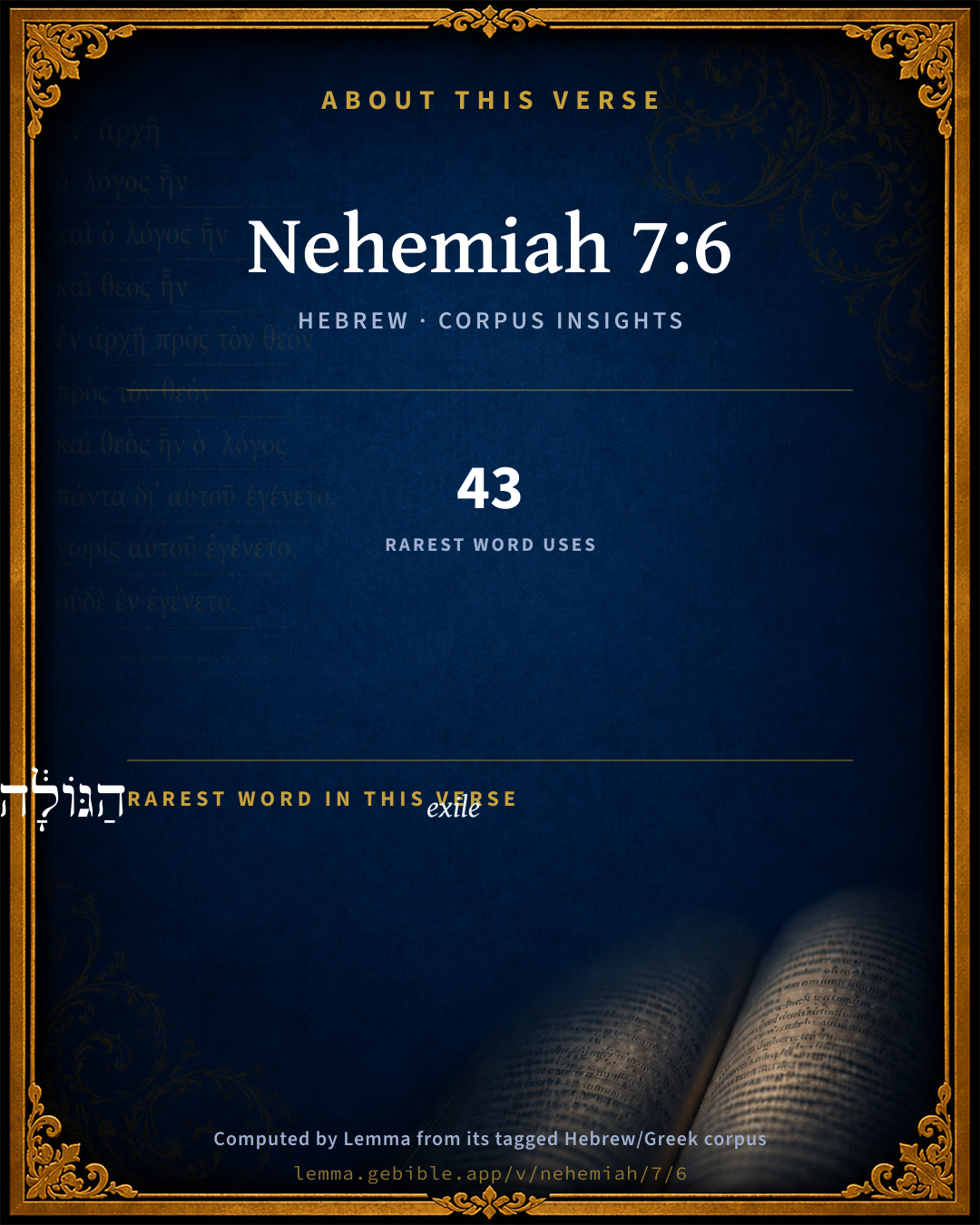
הַגּוֹלָ֔ה
gôwlâh
H1473
“the · exile”
Particle, Definite Article + Noun, Common, Feminine, Singular, Absolute
Part of Speech
Particle + Noun
Type
Common
Gender
Feminine
Number
Singular
State
Absolute
Full BDB Definition

Origin: active participle of H1540

TWOT: 350a

exiles, exile, captivity - exiles (collective) - exile, captivity (abstract)
  1. אֵ֣לֶּה ʼêl-leh H428 “these” Pronoun, Demonstrative, Common, Plural
  2. בְּנֵ֣י bên H1121 “sons of” Noun, Common, Masculine, Plural, Construct
  3. הַמְּדִינָ֗ה mᵉdîynâh H4082 “the · province” Particle, Definite Article + Noun, Common, Feminine, Singular, Absolute
  4. הָעֹלִים֙ ʻâlâh H5927 “the · going up” Particle, Definite Article + Verb, Qal, Participle Active, Masculine, Plural, Absolute
  5. מִשְּׁבִ֣י shᵉbîy H7628 “from · captivity of” Preposition + Noun, Common, Both, Singular, Construct
  6. אֲשֶׁ֣ר ʼăsher H834 “which” Particle, Relative
  7. הֶגְלָ֔ה gâlâh H1540 “to uncover” Verb, Hiphil, Perfect, 3rd Person, Masculine, Singular
  8. נְבוּכַדְנֶצַּ֖ר Nᵉbûwkadneʼtstsar H5019 “Nebuchadnezzar” Noun, Proper
  9. מֶ֣לֶךְ melek H4428 “king of” Noun, Common, Masculine, Singular, Construct
  10. בָּבֶ֑ל Bâbel H894 “Babylon” Noun, Proper
  11. וַיָּשׁ֧וּבוּ shûwb H7725 “and · to return” Conjunction + Verb, Qal, Sequential Imperfect, 3rd Person, Masculine, Plural
  12. לִֽירוּשָׁלִַ֛ם Yᵉrûwshâlaim H3389 “to/for · Jerusalem” Preposition + Noun, Proper
  13. וְלִיהוּדָ֖ה Yᵉhûwdâh H3063 “and · to/for · Judah” Conjunction + Preposition + Noun, Proper
  14. אִ֥ישׁ ʼîysh H376 “man” Noun, Common, Masculine, Singular, Absolute
  15. לְעִירֽוֹ ʻîyr H5892 “to/for · city · his” Preposition + Noun, Common, Feminine, Singular, Construct + Suffix, Personal, 3rd Person, Masculine, Singular

About this verse

These counts appear in no published source. They are computed here, from the morphology-tagged text and Lemma’s own curated glosses. What Lemma adds →

16
words
16
distinct lemmas
Historical
section

Shared distinctive vocabulary

הַגּוֹלָ֔ה exile H1473 occurs in 42 verses of the Hebrew Bible. Also found in:

Grammatical profile

  • 3 verbs
  • 11 nouns
  • 1 pronoun
  • 1 particle

Verb forms

  • הָעֹלִים֙ Qal · Participle Active
  • הֶגְלָ֔ה Hiphil · Perfect
  • וַיָּשׁ֧וּבוּ Qal · Sequential Imperfect

Cross-references

8

Topical passages linked to Nehemiah 7:6 in the Treasury of Scripture Knowledge — connected by theme and wording, ordered by reader-vote popularity; previews shown in the World English Bible.

  • Ezra 2:1–70 Now these are the children of the province, who went up out of the captivity of those who had been carried away, whom Nebuchadnezzar the king of Babylon had carried away to Babylon, and who returned to Jerusalem and Judah, everyone to his city;
  • Ezra 5:8 Be it known to the king, that we went into the province of Judah, to the house of the great God, which is built with great stones, and timber is laid in the walls; and this work goes on with diligence and prospers in their hands.
  • Jeremiah 52:1–34 Zedekiah was twenty-one years old when he began to reign; and he reigned eleven years in Jerusalem: and his mother's name was Hamutal the daughter of Jeremiah of Libnah.
  • Jeremiah 39:1–18 It happened when Jerusalem was taken, (in the ninth year of Zedekiah king of Judah, in the tenth month, came Nebuchadrezzar king of Babylon and all his army against Jerusalem, and besieged it;
  • 2 Kings 24:14–16 He carried away all Jerusalem, and all the princes, and all the mighty men of valor, even ten thousand captives, and all the craftsmen and the smiths; none remained, save the poorest sort of the people of the land.
  • 2 Kings 25:11 The residue of the people who were left in the city, and those who fell away, who fell to the king of Babylon, and the residue of the multitude, did Nebuzaradan the captain of the guard carry away captive.
  • 2 Chronicles 36:1–23 Then the people of the land took Jehoahaz the son of Josiah, and made him king in his father's place in Jerusalem.
  • Ezra 6:2 There was found at Achmetha, in the palace that is in the province of Media, a scroll, and therein was thus written for a record:

Cross-references courtesy of OpenBible.info (CC BY 4.0).

Hebrew and Greek witnesses Masoretic Hebrew ↔ Greek Septuagint

The same verse in the two great witnesses to the Old Testament, shown verse-for-verse.

These are two independent witnesses, not word-aligned to each other, and the Septuagint is shown in lemma (dictionary) form.

Hebrew Nehemiah 7:6 Masoretic · Westminster Leningrad Codex

אֵ֣לֶּה בְּנֵ֣י הַמְּדִינָ֗ה הָעֹלִים֙ מִשְּׁבִ֣י הַגּוֹלָ֔ה אֲשֶׁ֣ר הֶגְלָ֔ה נְבוּכַדְנֶצַּ֖ר מֶ֣לֶךְ בָּבֶ֑ל וַיָּשׁ֧וּבוּ לִֽירוּשָׁלִַ֛ם וְלִיהוּדָ֖ה אִ֥ישׁ לְעִירֽוֹ

These are the children of the province, who went up out of the captivity of those who had been carried away, whom Nebuchadnezzar the king of Babylon had carried away, and who returned to Jerusalem and to Judah, everyone to his city;

World English Bible · Public Domain

Greek LXX Structure differs

The Septuagint has no separate book of Nehemiah. Its Greek text is the second half of Esdras B (2 Esdras), chapters 11–23; Ezra is the first half (1–10).

A verse-for-verse comparison isn’t shown here because the chapters and verses don’t line up. Switch to the LXX edition with the MT / LXX toggle above to read the Greek directly.

Hebrew: Westminster Leningrad Codex (CC BY 4.0). Greek: Septuagint (public domain); English from a public-domain English Septuagint. How the Septuagint differs from the Hebrew →

Commentary

Notes on Nehemiah 7:6 from classic Christian and Jewish commentators (each source and its license shown beneath its notes). The classic Christian expositions comment on the surrounding passage and are grouped to its opening verse, so a note may address several verses; the Jewish commentaries on the Tanakh (Rashi and others) are per-verse, so they appear only where the commentator wrote on this verse.

Lemma curates 59 commentaries, every one of them public domain or Creative Commons licensed, each selected and text-cleaned for this edition rather than reprinted as found. About our sources →

Trapp's Complete Commentary

John Trapp

Neh 7:6 These [are] the children of the province, that went up out of the captivity, of those that had been carried away, whom Nebuchadnezzar the king of Babylon had carried away, and came again to Jerusalem and to Judah, every one unto his city;

Ver. 6. These are the children, &c.] See Ezr 2:1-3, &c., with the notes. Some small differences there are in names and numbers between this catalogue and that; not by the negligence of the scribes who wrote out this register, as Pellican would have it, but by other means, as is above noted.

John Trapp, A Commentary or Exposition upon All the Books of the Old and New Testament (1647–1656) — public domain. Text from a community e-Sword module.

The Pulpit Commentary

THE REGISTER OF THOSE WHO RETURNED UNDER ZERUBBABEL, WITH THE NUMBER OF THEIR SLAVES, BEASTS, AND OBLATIONS. (Neh_7:6-73) It is no doubt a curious circumstance that this list should occur twice, with no important differences, in the two Books of Ezra and Nehemiah. Perhaps it was not in the original Ezra, that writer not having had the good fortune to find" the document; but Nehemiah having "found" it and inserted it here, in connection with its discovery, a later arranger (Malachi?) removed it to the early part of Ezra, because it belonged to that portion of the Jewish history chronologically. The double record enables us to make out a more perfect catalogue than we could have obtained from either separately,-since there are corruptions in each which may be corrected by means of the other. See the comment which follows.

HOMILIES BY R.A. REDFORD. Vers. 6-73. The true method of prosperity.

Here are the three great aims of God"s people distinguished. The walls of the city are built. The place of habitation is prepared. The doors are fixed. Then the true citizens of Zion will see to it; God will put it in their hearts.

I TO PROVIDE FOR THE SAFETY Of the city. There must always be the possibility of attack from without. Watch the walls and the gates.

1. The leading men of the Church should be faithful, and fearers of God above many. It is a terrible danger when prominent men are not examples of piety. Those who have a great charge should be above suspicion.

2. The gates must be specially watched, and their shutting and opening special matter of anxious care. When Churches are indifferent as to the admission of members they are doing incalculable harm to the cause of their religion. Wide and unwatched gates mean an unsafe city, an approaching ruin.

3. Let every one take part in the guardianship of Jerusalem. "Every one over against his own house." There are eminent men who occupy prominent posts, but the humblest believer has his part in the work of defending truth and guarding the spiritual prosperity of Zion. It was a good regulation which Nehemiah made: "Let not the gates be opened till the sun be hot." Do nothing in the dark. See the men who ask for admission in the clear daylight; know who they are, and what they mean. It is the multitudinousness of the Church which endangers it. If there be no light at the gates there will soon be enemies within the walls, traitors in the camp, and the safety of the Church will be undermined.

II Those who seek the welfare of Zion will desire INCREASE OF NUMBERS. The large city and the great walls are no honour to God without many people therein. "The houses not built" represent the lack of individual and family life. It is the living souls that are the city"s glory.

III The TRUE METHOD OF ESTABLISHING THE PROSPERITY OF JERUSALEM IS TO LOOK WELL TO THE PURITY of its inhabitants. God put it into Nehemiah"s heart to search for the genealogy, to distinguish the true Israel from the false.

1. The variety of office and degrees of honour quite consistent with unity of origin and community of spirit. It is better to have a place in the genealogy of God"s people than to be high in this world"s rank.

2. The preservation of the record was a help to subsequent generations to maintain the cause of Zion, and to tread in the footsteps of. the fathers.

3. The position of absolute, uncompromising purity and faithfulness to God is the only ground upon which discipline can be maintained. In the case of the priests, if the register could not be found "they were, as polluted, put from the priesthood.

4. The mere external purity of ritual is insufficient; the great requisite is direct intercourse with God. In all difficult cases the Urim and Thummim of immediate revelation must be sought. What is the mind of God? How little would the Church have erred if it had followed this rule: to suffer no caprice, no departure from principle, no compromise, but depend upon the word of God. R.

The Pulpit Commentary (1880–1919), ed. H.D.M. Spence-Jones & Joseph S. Exell — public domain. Text from a community e-Sword module.

Tyndale Open Study Notes

Tyndale Open Resources

7:6 Jewish exiles . . . returned to Jerusalem and the other towns: These lists were not complete (the individual numbers do not add up to the total number in 7:66), but they were the best records available to verify who truly was a Jew.

Tyndale Open Study Notes — © Tyndale Open Resources, licensed CC BY-SA 4.0. Text via the HelloAO Bible API.

Geneva Bible (1599)

Geneva Bible translators

That is, the inhabitants of Judah.

Geneva Bible (1599) marginal notes — public domain. Text via Bolls.life.

The Cambridge Bible for Schools and Colleges

gen. ed. J. J. S. Perowne

6. came again to] R.V. returned unto. Ezr_2:1 has ‘carried away unto Babylon’; the words ‘unto Babylon’ have probably been accidentally omitted in transcription.

The Cambridge Bible for Schools and Colleges (gen. ed. J. J. S. Perowne; Cambridge University Press, 1878–1918) — public domain. Text from a community e-Sword module.

John Gill's Exposition

These are the children of the province that went up out of the captivity,.... Who were of the province of Judea, as it was now reduced, and came up out of the captivity of Babylon through the edict of Cyrus; see Ezr 2:1, where the same preface is given to the list of names as here; and from hence to the end of Neh 7:69 the same account is given of persons and families as there, with some little difference of numbers and names; in some instances there are more in this list, in others fewer, which may be thus accounted for; that list was made in Babylon, when, upon the edict of Cyrus, the Jews, who intended to go up with Zerubbabel, gave in their names, and they were registered; but this was made when they came to Jerusalem; now some of those that gave in their names changed their minds, and tarried in Babylon, and some might die by the way, which makes the numbers fewer in some instances; and others who did not give in their names at first, but, being better disposed towards their own country, followed after and joined those which were returning, and increased the number of others; to which may be added what Abendana observes, that in Ezra an account is given of those that came out of the captivity by the companies, in which they came not genealogized, and had a mixture of persons of other families in them, and some that had no genealogy; but afterwards, when they were genealogized according to their families, a register of their genealogies was made, and is what Nehemiah now found, and here gives; and, as for difference of names, that may be owing to the carelessness of copiers, or to the different pronunciation of names, or some men might have two names; the matter is of no great moment.

the same account is given of persons and families as there, with some little difference of numbers and names; in some instances there are more in this list, in others fewer, which may be thus accounted for; that list was made in Babylon, when, upon the edict of Cyrus, the Jews, who intended to go up with Zerubbabel, gave in their names, and they were registered; but this was made when they came to Jerusalem; now some of those that gave in their names changed their minds, and tarried in Babylon, and some might die by the way, which makes the numbers fewer in some instances; and others who did not give in their names at first, but, being better disposed towards their own country, followed after and joined those which were returning, and increased the number of others; to which may be added what Abendana observes, that in Ezra an account is given of those that came out of the captivity by the companies, in which they came not genealogized, and had a mixture of persons of other families in them, and some that had no genealogy; but afterwards, when they were genealogized according to their families, a register of their genealogies was made, and is what Nehemiah now found, and here gives; and, as for difference of names, that may be owing to the carelessness of copiers, or to the different pronunciation of names, or some men might have two names; the matter is of no great moment.

Nehemiah 7:70

neh 7:70

neh 7:70

neh 7:70And some of the chief of the fathers gave unto the work,.... Of building the city and the temple, and for that service, Ezr 2:68,

the Tirshatha gave to the treasure a thousand drachms of gold; each of which was one pound sterling, and so amounted to so many pounds: of these "dracmons", or "darics", a Persian coin, mention is made in Ezr 2:69, they were golden staters, or shekels and had their name as is said, not from Darius, the father of Xerxes, though it is certain, from Herodotus (d), that he coined golden money; but from some other king of the same name, more ancient (e), which must be Darius the Mede; and if they are the same with the Adarcon in Ezr 8:27 as they seem to be, then those in Ch1 29:7 were pieces of money not so called in the times of David, but of Ezra, the writer of that book: whether this Tirshatha was Zerubbabel, or Nehemiah, is not easy to say, since this donation is not the same with that in Ezra, not made at the same time nor are the gifts the same, nor the persons that gave them. Zerubbabel was Tirshatha when the Jews came out of Babylon, and Nehemiah now:

fifty basins; which were vessels, in the which the blood of the sacrifices was received and out of which it was sprinkled:

five hundred and thirty priests' garments; which were laid up in the wardrobe, and used on occasion.

(d) Melpomene, sive, l. 4. c. 166. (e) Scholiast. in Aristoph. Eccles. p. 741, 742. So Harpocration. Lexic. in voce and Suidas on the same word.

John Gill's Exposition of the Whole Bible (1746–1763) — public domain (CC PDM 1.0). Text via the HelloAO Bible API.

unfoldingWord translationNotes

Door43 World Missions Community

These are the people of the province

"These are the descendants of this region"

went up out of

"returned from" or "came back from"

went up

This is an idiom that refers to traveling toward Jerusalem, which was on higher ground than the surrounding area. (See: Idiom)

whom Nebuchadnezzar the king of Babylon took into exile

"whom Nebuchadnezzar, ruler of Babylon, took away from their home country." The army of Babylon did this under the command of Nebuchadnezzar. (See: Metonymy)

Zerubbabel ... Jeshua ... Nehemiah ... Azariah ... Raamiah ... Nahamani ... Mordecai ... Bilshan ... Mispereth ... Bigvai ... Nehum ... Baanah

These are the names of men. (See: How to Translate Names)

The number of the men

A census had been taken when the Israelites first returned to Jerusalem after the exile. The numbers represent how many men belonged to each family group. This sentence introduces the information in the following verses.

translationWords

captive

exile

Nebuchadnezzar

king

Babylon

Jerusalem

kingdom of Judah

Nehemiah

unfoldingWord translationNotes — © Distant Shores Media and the Door43 World Missions Community, licensed CC BY-SA 4.0. Source: git.door43.org/Door43/en_tn.

Rashi

Rabbi Shlomo Yitzchaki (Rashi)

These are the people of the province, etc. until (10:35): “And we cast lots for the wood sacrifice.”

and to Judea to the province of Judea.

each one to his city lit. a man to his city.

Rashi on the Tanakh — English translations: “The Judaica Press complete Tanach with Rashi, translated by A. J. Rosenberg” (CC BY 4.0); “Pentateuch with Rashi's commentary by M. Rosenbaum and A.M. Silbermann, 1929-1934” (public domain); “The Metsudah Tanach series, Lakewood, N.J” (CC BY 4.0); and “The Book of Joshua, Metsudah Publications, 1997” (CC BY 4.0). Text via Sefaria.

Lesson kit

Teaching starters — assembled from the data on this page, not authored interpretation. Every prompt links to the verse data it draws on. Edit before teaching.

Nehemiah, in the Historical, opens this verse with 16 words (16 distinct Hebrew lemmas). Its most distinctive word is gôwlâh (“exile”). A historical commentator’s framing appears above. Read the whole chapter for the surrounding context.

Discussion questions

  1. What does “exile” (gôwlâh) contribute to the verse as a whole?
  2. 2 Kings 24:14 shares the word «exile» with this verse. How do the two illuminate each other?
  3. These translations render this verse differently; the difference is in the English rendering, not the original. What questions does that raise?
  4. The verb «הָעֹלִים֙» is Qal Participle Active. How does its form color the action?
  5. Reading how Trapp's Complete Commentary and The Pulpit Commentary read this verse, where do the two commentators agree and where do they part?

Things to notice

Reading settings

Reading text

Shown beneath each verse's original-language words.

Old Testament
Old Testament edition

Read the OT as the Masoretic Hebrew (MT) or the Greek Septuagint (LXX).

English shown for the Greek Septuagint (in the Hebrew ↔ Greek comparison).

Comparing translations? Open the Compare panel on any verse page to stack up to four side by side.