
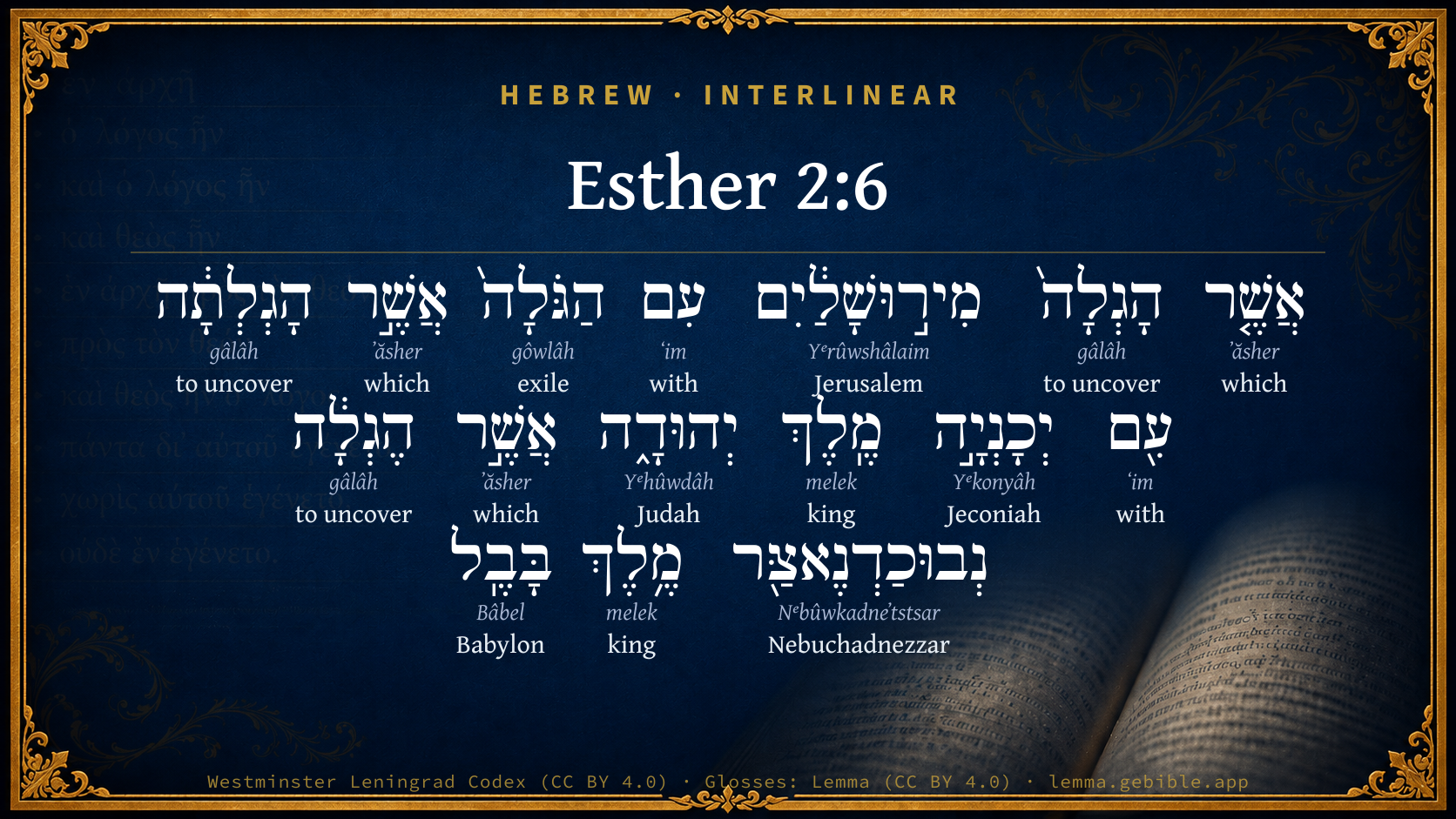
Esther 2:6

Hebrew (Westminster Leningrad Codex) Esther 2:6 appears in the Hebrew Old Testament. The text above is from the Westminster Leningrad Codex. Each word links to its Strong’s number, a concise gloss, and parsing drawn from the Open Scriptures Hebrew Bible morphology. Click any word for its full Brown-Driver-Briggs (BDB) entry.
Download image
Cite this verse

Esther 2:6 (World English Bible). Public Domain. Lemma interlinear Bible study tool, https://lemma.gebible.app/v/esther/2/6.

Show BibTeX & RIS
BibTeX
RIS
English Translation
who had been carried away from Jerusalem with the captives who had been carried away with Jeconiah king of Judah, whom Nebuchadnezzar the king of Babylon had carried away.
World English Bible · Public Domain
Download a study sheet

One document with this verse’s original text, its word-by-word gloss line, the meaning frame, cross-references with their text, attributed commentary, and full source and license credits — printable, and it pastes into notes with its structure intact.

This verse Autodidact and up

Study sheet (.html) Plain text (.txt)

A passage Seminary Student

Up to 50 verses in one chapter. A passage sheet keeps up to 6 commentary sources and 12 cross-references per verse, in the order this page ranks them, and says so on the sheet whenever that leaves anything out. Ask for a single verse and you get the Autodidact verse sheet above.

Everything on this page stays free to read, with no account — the sheet is a download of what is already on screen, not access to it.

Want to remove ads? Support Godless Engineer
Compare translations 3

The same verse in 3 English versions, stacked beneath the original-language interlinear above. Click any original word for its lexicon entry.

Each is an independent rendering of the whole verse — the interlinear is not word-aligned to these translations.

Highlighted words mark where these versions differ — a whole-verse word diff, not a word-by-word alignment.

  • World English Bible Public Domain
    who had been carried away from Jerusalem with the captives who had been carried away with Jeconiah king of Judah, whom Nebuchadnezzar the king of Babylon had carried away.
  • King James Version Public Domain
    Who had been carried away from Jerusalem with the captivity which had been carried away with Jeconiah king of Judah, whom Nebuchadnezzar the king of Babylon had carried away.
  • unfoldingWord Literal Text CC BY-SA 4.0
    who had been exiled from Jerusalem with the exiles who had been exiled along with Jeconiah, the king of Judah, who Nebuchadnezzar the king of Babylon had exiled).

unfoldingWord Literal Text — © unfoldingWord, licensed CC BY-SA 4.0. Word-aligned USFM3 via Door43 (git.door43.org/unfoldingWord/en_ult).

Versions to compare (up to 4)

3 of 4 selected

Show all 18 translations

Every available English version of this verse, each an independent rendering of the whole verse.

  • World English Bible Public Domain
    who had been carried away from Jerusalem with the captives who had been carried away with Jeconiah king of Judah, whom Nebuchadnezzar the king of Babylon had carried away.
  • Berean Standard Bible Public Domain
    He had been carried into exile from Jerusalem by Nebuchadnezzar king of Babylon among those taken captive with Jeconiah king of Judah.
  • Majority Standard Bible Public Domain
    He had been carried into exile from Jerusalem by Nebuchadnezzar king of Babylon among those taken captive with Jeconiah king of Judah.
  • King James Version Public Domain
    Who had been carried away from Jerusalem with the captivity which had been carried away with Jeconiah king of Judah, whom Nebuchadnezzar the king of Babylon had carried away.
  • American Standard Version (1901) Public Domain
    who had been carried away from Jerusalem with the captives that had been carried away with Jeconiah king of Judah, whom Nebuchadnezzar the king of Babylon had carried away.
  • Revised Version (1885) Public Domain
    who had been carried away from Jerusalem with the captives which had been carried away with Jeconiah king of Judah, whom Nebuchadnezzar he king of Babylon had carried away.
  • Geneva Bible (1599) Public Domain
    Which had bene caryed away from Ierusalem with the captiuitie that was caryed away with Ieconiah King of Iudah (whom Nebuchad-nezzar King of Babel had caryed away)
  • Douay-Rheims (1899) Public Domain
    Who had been carried away from Jerusalem at the time that Nabuchodonosor king of Babylon carried away Jechonias king of Juda,
  • Young's Literal Translation Public Domain
    who had been removed from Jerusalem with the removal that was removed with Jeconiah king of Judah, whom Nebuchadnezzar king of Babylon removed --
  • Literal Standard Version CC BY-SA 4.0
    who had been removed from Jerusalem with the expulsion that was removed with Jeconiah king of Judah, whom Nebuchadnezzar king of Babylon removed—
  • Unlocked Literal Bible CC BY-SA 4.0
    He had been taken away from Jerusalem with the exiles along with those taken with Jehoiachin, king of Judah, whom Nebuchadnezzar king of Babylonia carried away.
  • unfoldingWord Literal Text CC BY-SA 4.0
    who had been exiled from Jerusalem with the exiles who had been exiled along with Jeconiah, the king of Judah, who Nebuchadnezzar the king of Babylon had exiled).
  • Darby Bible Public Domain
    who had been carried away from Jerusalem with the captives who had been carried away with Jeconiah king of Judah, whom Nebuchadnezzar the king of Babylon had carried away.
  • World Messianic Bible Public Domain
    who had been carried away from Jerusalem with the captives who had been carried away with Jeconiah king of Judah, whom Nebuchadnezzar the king of Babylon had carried away.
  • Webster's Bible Public Domain
    Who had been carried away from Jerusalem with the captivity which had been carried away with Jeconiah king of Judah, whom Nebuchadnezzar the king of Babylon had carried away.
  • Free Bible Version CC BY-SA 4.0
    who was among those taken prisoner with King Jehoiachin of Judah and carried into exile from Jerusalem by King Nebuchadnezzar of Babylon.
  • Bible in Basic English Public Domain
    Who had been taken away from Jerusalem among those who had been made prisoner with Jeconiah, king of Judah, when Nebuchadnezzar, king of Babylon, had taken him away.
  • JPS Tanakh (1917) Public Domain
    who had been carried away from Jerusalem with the captives that had been carried away with Jeconiah king of Judah, whom Nebuchadnezzar the king of Babylon had carried away.

Literal Standard Version (2020), Covenant Press — licensed CC BY-SA 4.0. Text via the HelloAO Bible API (eBible.org). Unlocked Literal Bible (unfoldingWord) — licensed CC BY-SA 4.0. Text via the HelloAO Bible API (eBible.org). unfoldingWord Literal Text — © unfoldingWord, licensed CC BY-SA 4.0. Word-aligned USFM3 via Door43 (git.door43.org/unfoldingWord/en_ult). Free Bible Version, Dr. Jonathan Gallagher — licensed CC BY-SA 4.0. Text via the HelloAO Bible API (eBible.org).

Word by word

More ways to search: Search by grammar → Find every occurrence → Compare this word →

Practice this passage: Drill this verse → Learn its vocabulary →

יְכָנְיָ֣ה
Yᵉkonyâh
H3204
“Jeconiah”
Noun, Proper
Part of Speech
Noun
Type
Proper
Full BDB Definition

Origin: from H3559 and H3050

TWOT: None

Jeconiah = "Jehovah will establish" - son of king Jehoiakim of Judah and king of Judah for 3 months and 10 days before he surrendered to Nebuchadnezzar and was taken captive to Babylon where he was imprisoned for the next 36 years; released at the death of Nebuchadnezzar and lived in Babylon until his death - primary spelling 'Jehoiachin'
  1. אֲשֶׁ֤ר ʼăsher H834 “which” Particle, Relative
  2. הָגְלָה֙ gâlâh H1540 “to uncover” Verb, Hophal, Perfect, 3rd Person, Masculine, Singular
  3. מִיר֣וּשָׁלַ֔יִם Yᵉrûwshâlaim H3389 “from · Jerusalem” Preposition + Noun, Proper
  4. עִם ʻim H5973 “with” Preposition
  5. הַגֹּלָה֙ gôwlâh H1473 “the · exile” Particle, Definite Article + Noun, Common, Feminine, Singular, Absolute
  6. אֲשֶׁ֣ר ʼăsher H834 “which” Particle, Relative
  7. הָגְלְתָ֔ה gâlâh H1540 “to uncover” Verb, Hophal, Perfect, 3rd Person, Feminine, Singular
  8. עִ֖ם ʻim H5973 “with” Preposition
  9. מֶֽלֶךְ melek H4428 “king of” Noun, Common, Masculine, Singular, Construct
  10. יְהוּדָ֑ה Yᵉhûwdâh H3063 “Judah” Noun, Proper
  11. אֲשֶׁ֣ר ʼăsher H834 “which” Particle, Relative
  12. הֶגְלָ֔ה gâlâh H1540 “to uncover” Verb, Hiphil, Perfect, 3rd Person, Masculine, Singular
  13. נְבוּכַדְנֶאצַּ֖ר Nᵉbûwkadneʼtstsar H5019 “Nebuchadnezzar” Noun, Proper
  14. מֶ֥לֶךְ melek H4428 “king of” Noun, Common, Masculine, Singular, Construct
  15. בָּבֶֽל Bâbel H894 “Babylon” Noun, Proper

About this verse

These counts appear in no published source. They are computed here, from the morphology-tagged text and Lemma’s own curated glosses. What Lemma adds →

16
words
10
distinct lemmas
Historical
section

Notable vocabulary

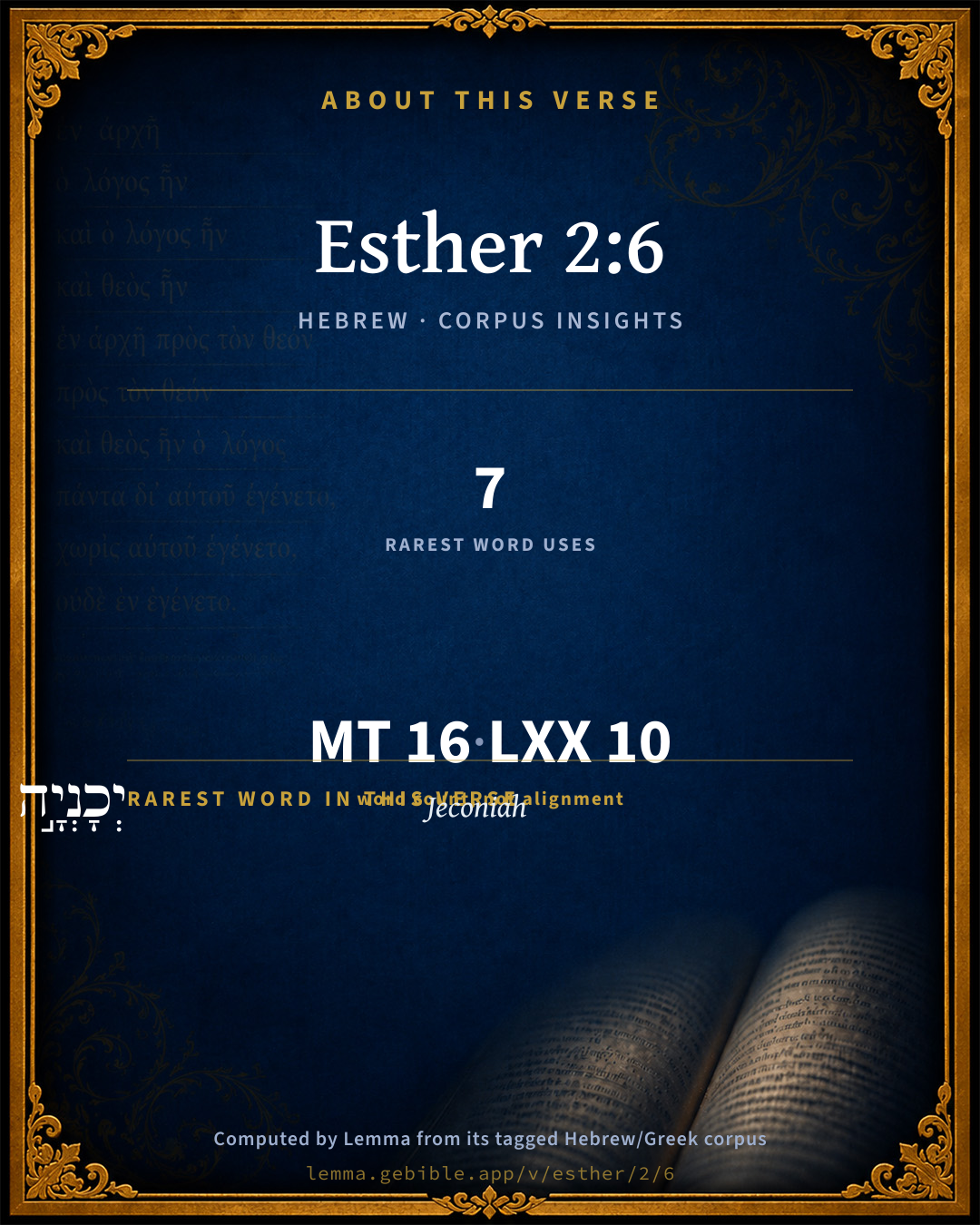
The rarest word here is יְכָנְיָ֣ה Jeconiah H3204 — appearing just 7 times in the whole Hebrew Bible.

Shared distinctive vocabulary

יְכָנְיָ֣ה Jeconiah H3204 occurs in 7 verses of the Hebrew Bible. Also found in:

Grammatical profile

  • 3 verbs
  • 8 nouns
  • 2 prepositions
  • 3 particles

Verb forms

  • הָגְלָה֙ Hophal · Perfect
  • הָגְלְתָ֔ה Hophal · Perfect
  • הֶגְלָ֔ה Hiphil · Perfect

Repetition

Words recur within this verse — often emphatic in Hebrew:

  • הָגְלָה֙ to uncover H1540 ×3
  • מֶֽלֶךְ king H4428 ×2
  • אֲשֶׁ֤ר which H834 ×3
  • עִם with H5973 ×2

Hebrew & Septuagint length

In English translation the verse runs 29 words from the Hebrew and 17 from the Septuagint (LXX English) — the Septuagint runs noticeably shorter here. See the side-by-side →

A rough comparison of the two English renderings, which tokenize alike — not a word-level alignment.

Word counts can differ between the Hebrew and the Greek without any difference in meaning — e.g. the Hebrew direct-object marker אֵת has no separate Greek word, and Greek often adds the article ὁ.

In the original languages it is 16 Hebrew tokens and 10 Greek tokens — but the two are counted differently (Hebrew bundles its prefixes and suffixes into one token; the Greek is in lemma form), so that isn’t a like-for-like length.

Cross-references

7

Topical passages linked to Esther 2:6 in the Treasury of Scripture Knowledge — connected by theme and wording, ordered by reader-vote popularity; previews shown in the World English Bible.

  • 2 Kings 24:14–15 He carried away all Jerusalem, and all the princes, and all the mighty men of valor, even ten thousand captives, and all the craftsmen and the smiths; none remained, save the poorest sort of the people of the land.
  • 2 Chronicles 36:20 Those who had escaped from the sword carried he away to Babylon; and they were servants to him and his sons until the reign of the kingdom of Persia:
  • Jeremiah 24:1 Yahweh shown me, and, behold, two baskets of figs set before the temple of Yahweh, after that Nebuchadrezzar king of Babylon had carried away captive Jeconiah the son of Jehoiakim, king of Judah, and the princes of Judah, with the craftsmen and smiths, from Jerusalem, and had brought them to Babylon.
  • 2 Kings 24:6 So Jehoiakim slept with his fathers; and Jehoiachin his son reigned in his place.
  • 2 Chronicles 36:9–10 Jehoiachin was eight years old when he began to reign; and he reigned three months and ten days in Jerusalem: and he did that which was evil in the sight of Yahweh.
  • Jeremiah 22:24 As I live, says Yahweh, though Coniah the son of Jehoiakim king of Judah were the signet on my right hand, yet would I pluck you there;
  • Jeremiah 22:28 Is this man Coniah a despised broken vessel? is he a vessel in which none delights? why are they cast out, he and his seed, and are cast into the land which they don't know?

Cross-references courtesy of OpenBible.info (CC BY 4.0).

Hebrew and Greek witnesses Masoretic Hebrew ↔ Greek Septuagint

The same verse in the two great witnesses to the Old Testament, shown verse-for-verse.

Here the Septuagint runs noticeably shorter than the Hebrew — LXX2012 (modern English Septuagint) 17 words vs World English Bible 29. A rough length comparison of the two English translations, not a word-level alignment — read both below.

These are two independent witnesses, not word-aligned to each other, and the Septuagint is shown in lemma (dictionary) form.

Hebrew Esther 2:6 Masoretic · Westminster Leningrad Codex

אֲשֶׁ֤ר הָגְלָה֙ מִיר֣וּשָׁלַ֔יִם עִם הַגֹּלָה֙ אֲשֶׁ֣ר הָגְלְתָ֔ה עִ֖ם יְכָנְיָ֣ה מֶֽלֶךְ יְהוּדָ֑ה אֲשֶׁ֣ר הֶגְלָ֔ה נְבוּכַדְנֶאצַּ֖ר מֶ֥לֶךְ בָּבֶֽל

who had been carried away from Jerusalem with the captives who had been carried away with Jeconiah king of Judah, whom Nebuchadnezzar the king of Babylon had carried away.

World English Bible · Public Domain

Greek LXX Esther 2:6 Septuagint · lemma form

ὅς εἰμί αἰχμάλωτος ἐκ ἰερουσαλήμ ὅς αἰχμαλωτεύω ναβουχοδονοσορ βασιλεύς βαβυλών

who had been brought a prisoner from Jerusalem, which Nabuchodonosor king of Babylon had carried into captivity.

LXX2012 (modern English Septuagint) · Public Domain

Hebrew: Westminster Leningrad Codex (CC BY 4.0). Greek: Septuagint (public domain); English from LXX2012 (modern English Septuagint) (Public Domain). How the Septuagint differs from the Hebrew →

Commentary

Notes on Esther 2:6 from classic Christian and Jewish commentators (each source and its license shown beneath its notes). The classic Christian expositions comment on the surrounding passage and are grouped to its opening verse, so a note may address several verses; the Jewish commentaries on the Tanakh (Rashi and others) are per-verse, so they appear only where the commentator wrote on this verse.

Lemma curates 59 commentaries, every one of them public domain or Creative Commons licensed, each selected and text-cleaned for this edition rather than reprinted as found. About our sources →

Trapp's Complete Commentary

John Trapp

Est 2:6 Who had been carried away from Jerusalem with the captivity which had been carried away with Jeconiah king of Judah, whom Nebuchadnezzar the king of Babylon had carried away.

Ver. 6. Who had been carried away from Jerusalem] Kish had, not Mordecai; unless it were in the loins of his great grandfather. Kish and his posterity were of those good figs mentioned in Jeremiah; but goodness is no target against affliction.

- nec te tua plurima Pentheu

Labentem texit pietas (Virg.).

With the captivity which had been carried away with Jeconiah] The good figs were carried away at the same time with the bad, but in several baskets, Jer 34:1. Kish, and others like him, as Daniel, Ezekiel, Shadrach, Meshach, and Abednego, &c., were not only good men, but very good, like the figs that are first ripe, Jer 24:2, such as God’s soul desireth, Mic 7:1, and yet they were carried away with Jeconiah and the rest that were nought, stark nought, Jer 24:2. The best may have their share in a common calamity; but God will not fail even then to set his eyes upon them for good, Jer 24:6. The husbandman cutteth down his corn and weeds together, but for different purpose. Excellently Austin, Una eademque vis irruens bonos probat, purificat, eliquat; malos damnat, vastat, exterminat: One and the same common calamity proveth, melteth, purifieth the good; damneth, wasteth, destroyeth the evil (De Civit. Dei, lib. 1, cap. 8): these have an evil, an only evil, Eze 6:5, without mixture of mercy; and that because they are nought, very nought, figs that cannot be eaten, they are so nought, Jer 24:2.

Whom Nebuchadnezzar, king of Babylon, had carried away] Lo, here the rod in God’s hand for the chastisement of his children; that, being chastened of the Lord, they may not be condemned with the world, 1Co 11:32. This rod, when he had worn to the stumps, he cast into the fire.

John Trapp, A Commentary or Exposition upon All the Books of the Old and New Testament (1647–1656) — public domain. Text from a community e-Sword module.

Joseph Benson's Commentary

Est 2:6. Who had been carried away from Jerusalem — This may refer either to Kish, Mordecai’s grandfather, last mentioned, or to Mordecai himself, which, however, is not probable, as in that case he must have been a very old man, not less than a hundred and forty years of age.

Joseph Benson's Commentary on the Old and New Testaments (1811–1818) — public domain. Text from a community e-Sword module.

Tyndale Open Study Notes

Tyndale Open Resources

2:6 His family (literally He): Since King Jehoiachin was exiled in 597 BC (2 Kgs 24:6-16), over 100 years earlier, it was probably one of Mordecai’s ancestors who was part of the group taken into Babylonian captivity.

Tyndale Open Study Notes — © Tyndale Open Resources, licensed CC BY-SA 4.0. Text via the HelloAO Bible API.

Ellicott's Commentary for English Readers

(6) Who had been . . .—The antecedent is obviously Kish, though as far as the mere grammar goes it might have been Mordecai.

Jeconiah.—That is, Jehoiachin. (See 2Ki_24:12-16.)

Nebuchadnezzar . . . had carried away.—This was in 598 B.C., 117 years before this time, so that the four generations are readily accounted for.

A Bible Commentary for English Readers, edited by Charles John Ellicott (1878–1897) — public domain. Text from a community e-Sword module.

The Cambridge Bible for Schools and Colleges

gen. ed. J. J. S. Perowne

6. who had been carried away] According to Heb. grammar, the relative pronoun should refer to Mordecai. If, however, he was even as a boy one of the captives in the time of Jeconiah (Jehoiachin, 2Ki_24:6), b.c. 598, and if, as we have seen, Ahasuerus is to be identified with Xerxes, Mordecai’s age would be something like 120 years, while his cousin Esther must also have been much too old. To get rid of this difficulty (which would only be diminished, not removed, if we were to adopt the otherwise very improbable view that an earlier ruler than Xerxes is intended), it has been sought, in contravention of the grammatical usage of the original, to make the antecedent to be not Mordecai but Kish, taken as the name of the great-grandfather of the former, and as otherwise unknown. But the true explanation doubtless is that the chronological difficulty never occurred to the framer of the story, nor, probably, to his earliest readers, and that he simply meant to represent Mordecai as one of the Jews in exile.

whom Nebuchadnezzar etc.] See 2Ki_24:10 ff.

The Cambridge Bible for Schools and Colleges (gen. ed. J. J. S. Perowne; Cambridge University Press, 1878–1918) — public domain. Text from a community e-Sword module.

John Gill's Exposition

Who had been carried away from Jerusalem,.... Which, according to some (f), is to be connected, not with Mordecai, but with Kish, his great-grandfather; and indeed otherwise Mordecai must be now a very old man, and Esther his first cousin, they being brothers' children, must be at an age, one would think, not to be reckoned among young virgins, and not be so amiable as she is represented; and indeed, according to the former Targum, she was seventy five years of age, which is not credible; and yet this, and more she must be, to be equal to Mordecai, if he was carried captive, as follows:

with the captivity which had been carried away with Jeconiah king of Judah, whom Nebuchadnezzar the king of Babylon had carried away; which was eleven years before the destruction of Jerusalem, for so long Zedekiah reigned after that captivity of Jeconiah: hence Sir John Marsham (g) makes this affair of Esther to be within the time of the Babylonish captivity, and places Ahasuerus her husband between Darius the Mede and Cyrus, contrary to history and Scripture, see Dan 6:28.

(f) Vid. Rainold. de Lib. Apocryph. Praelect. 113, 117, 146. (g) Chronicon. see. 18. p. 609, 621.

John Gill's Exposition of the Whole Bible (1746–1763) — public domain (CC PDM 1.0). Text via the HelloAO Bible API.

Haydock's Catholic Bible Commentary

Who. This may refer to Cis, the great-grandfather of Mardochai, if we postpone this history till the latter end of the Persian monarchy. (Du Hamel) --- But it more naturally applies to Mardochai himself, who (chap. xi. 4.; Tirinus) was led captive 80 years before, being then perhaps 10 years old, so that he would now be only 90; an age when many are fit for great things. (Calmet) (Cicero, de Senect.) --- He might even have been an infant when taken, and of course would not be much above 80 when he came into such favour. (Haydock)

George Leo Haydock (1774–1849), Haydock's Catholic Family Bible and Commentary, 1859 edition — public domain. Excludes Psalms (Douay-Rheims chapter numbering differs from Protestant) and Deuterocanonical books (Catholic canon only).

Matthew Poole's English Annotations

Who had been carried away: this may be referred either,

1. To Kish, Mordecai’s grandfather last mentioned; or,

2. To Mordecai, who was then carried away, either,

1. In the loins of his parents, in which sense Levi is said to be tithed in Abraham, Heb 7; and as those persons named Ezr 2 are said to have been carried away by Nebuchadnezzar, Ezr 2:1, which is not true of the most of them in their own persons, but only as in their fathers’ loins. Or,

2. In his own person; and then indeed he was a man of more than ordinary years. But of that See Poole "Est 1:1".

Matthew Poole's English Annotations on the Holy Bible (1683–1685) — public domain. Text from a community e-Sword/MySword module.

Whedon's Commentary on the Bible

Daniel D. Whedon

6. Who had been carried away — The relative who, here, must refer to Kish, not to Mordecai; for it is scarcely possible that a captive of Nebuchadnezzar should have been an officer of the Persian court in the time of Xerxes. Daniel was taken captive by Nebuchadnezzar, and continued till the reign of Cyrus, (Dan_1:1; Dan_1:21,) and the fact is mentioned as worthy of special remark. Had Mordecai been his contemporary, and yet have lived on to the time of Xerxes, the fact would no doubt have received special notice. But the attempt of Tyrwhitt (Esther and Ahasuerus) to show that a great-grandson of a captive taken by Nebuchadnezzar could not have been contemporary with Xerxes, is every way futile. Kish may have been a mere child when taken captive, and Shimei and Jair may not have been the first born. Arguments based on parallel lines of descent are often misleading, for, of the great-grandchildren of two contemporaries, some may be mere infants when others are of mature age.

Jeconiah — Another form of the name Jehoiachin. Comp. 2Ki_24:12, with Jer_24:1.

Daniel D. Whedon (gen. ed.), Commentary on the Old and New Testaments (1874–1909) — public domain. Text from a community e-Sword module.

The Pulpit Commentary

Who had been carried away. The word "who" may have either Kish or Mordecai for its antecedent. It is simplest, however, and most grammatical (see "Dictionary of the Bible," vol. 2. p. 419), to refer it to Kish. Chronological considerations also lead to the same result; and indeed, if we suppose Mordecai to be intended, we must give up the identification of Ahasuerus with Xerxes. The captivity which had been carried away with Jeconiah. There were at least three captivities of Judah the first when Daniel was carried away, in the third year of Jehoiakim, (Dan_1:1) which was B.C. 605; the second that here referred to, when Jehoiachin, or Jeconiah, was made prisoner, eight years later, or B.C. 597; and the third when Zedekiah was taken and Jerusalem burnt, in B.C. 586. Kish belonged to the second captivity. Whom Nebuchadnezzar carried away. See 2Ki_24:15; 2Ch_36:10; Jer_24:1.

The Pulpit Commentary (1880–1919), ed. H.D.M. Spence-Jones & Joseph S. Exell — public domain. Text from a community e-Sword module.

Scofield Reference Notes

C. I. Scofield

Jeconiah

Or, Jehoiachin; 2Ki 24:6.

The Scofield Reference Bible (1917 edition), notes by C. I. Scofield — public domain. Text from a community e-Sword module.

Lesson kit

Teaching starters — assembled from the data on this page, not authored interpretation. Every prompt links to the verse data it draws on. Edit before teaching.

Esther, in the Historical, opens this verse with 16 words (10 distinct Hebrew lemmas). Its most distinctive word is Yᵉkonyâh (“Jeconiah”). The Greek Septuagint runs shorter here. A historical commentator’s framing appears above. Read the whole chapter for the surrounding context.

Discussion questions

  1. What does “Jeconiah” (Yᵉkonyâh) contribute to the verse as a whole?
  2. How does 1 Chronicles 3:16, which shares the word «Jeconiah», read alongside this verse?
  3. What does the repetition of “to uncover” (3× in this one verse) do in this verse?
  4. The Septuagint runs shorter here than the Hebrew. What might account for the difference?
  5. These translations render this verse differently. What is at stake in choosing one wording over another?
  6. «הָגְלָה֙» is a Hophal Perfect verb. How does that grammatical form shape the action described?
  7. Compare how Trapp's Complete Commentary and Joseph Benson's Commentary read this verse. Where do they agree or differ?

Things to notice

Reading settings

Reading text

Shown beneath each verse's original-language words.

Old Testament
Old Testament edition

Read the OT as the Masoretic Hebrew (MT) or the Greek Septuagint (LXX).

English shown for the Greek Septuagint (in the Hebrew ↔ Greek comparison).

Comparing translations? Open the Compare panel on any verse page to stack up to four side by side.