
Isaiah 37:22

Hebrew (Westminster Leningrad Codex) Isaiah 37:22 appears in the Hebrew Old Testament. The text above is from the Westminster Leningrad Codex. Each word links to its Strong’s number, a concise gloss, and parsing drawn from the Open Scriptures Hebrew Bible morphology. Click any word for its full Brown-Driver-Briggs (BDB) entry.
Download image
Cite this verse

Isaiah 37:22 (World English Bible). Public Domain. Lemma interlinear Bible study tool, https://lemma.gebible.app/v/isaiah/37/22.

Show BibTeX & RIS
BibTeX
RIS
English Translation
this is the word which Yahweh has spoken concerning him: The virgin daughter of Zion has despised you and ridiculed you; the daughter of Jerusalem has shaken her head at you.
World English Bible · Public Domain
Download a study sheet

One document with this verse’s original text, its word-by-word gloss line, the meaning frame, cross-references with their text, attributed commentary, and full source and license credits — printable, and it pastes into notes with its structure intact.

This verse Autodidact and up

Study sheet (.html) Plain text (.txt)

A passage Seminary Student

Up to 50 verses in one chapter. A passage sheet keeps up to 6 commentary sources and 12 cross-references per verse, in the order this page ranks them, and says so on the sheet whenever that leaves anything out. Ask for a single verse and you get the Autodidact verse sheet above.

Everything on this page stays free to read, with no account — the sheet is a download of what is already on screen, not access to it.

Want to remove ads? Support Godless Engineer
Compare translations 3

The same verse in 3 English versions, stacked beneath the original-language interlinear above. Click any original word for its lexicon entry.

Each is an independent rendering of the whole verse — the interlinear is not word-aligned to these translations.

Highlighted words mark where these versions differ — a whole-verse word diff, not a word-by-word alignment.

  • World English Bible Public Domain
    this is the word which Yahweh has spoken concerning him: The virgin daughter of Zion has despised you and ridiculed you; the daughter of Jerusalem has shaken her head at you.
  • King James Version Public Domain
    This is the word which the LORD hath spoken concerning him; The virgin, the daughter of Zion, hath despised thee, and laughed thee to scorn; the daughter of Jerusalem hath shaken her head at thee.
  • unfoldingWord Literal Text CC BY-SA 4.0
    this the word that Yahweh has spoken about him. The virgin, the daughter of Zion, despises you, she derides you. The daughter of Jerusalem shakes a head after you.

unfoldingWord Literal Text — © unfoldingWord, licensed CC BY-SA 4.0. Word-aligned USFM3 via Door43 (git.door43.org/unfoldingWord/en_ult).

Versions to compare (up to 4)

3 of 4 selected

Show all 18 translations

Every available English version of this verse, each an independent rendering of the whole verse.

  • World English Bible Public Domain
    this is the word which Yahweh has spoken concerning him: The virgin daughter of Zion has despised you and ridiculed you; the daughter of Jerusalem has shaken her head at you.
  • Berean Standard Bible Public Domain
    this is the word that the LORD has spoken against him: ‘The Virgin Daughter of Zion despises you and mocks you; the Daughter of Jerusalem shakes her head behind you.
  • Majority Standard Bible Public Domain
    this is the word that the LORD has spoken against him: ‘The Virgin Daughter of Zion despises you and mocks you; the Daughter of Jerusalem shakes her head behind you.
  • King James Version Public Domain
    This is the word which the LORD hath spoken concerning him; The virgin, the daughter of Zion, hath despised thee, and laughed thee to scorn; the daughter of Jerusalem hath shaken her head at thee.
  • American Standard Version (1901) Public Domain
    this is the word which Jehovah hath spoken concerning him: The virgin daughter of Zion hath despised thee and laughed thee to scorn; the daughter of Jerusalem hath shaken her head at thee.
  • Revised Version (1885) Public Domain
    this is the word which the LORD hath spoken concerning him: The virgin daughter of Zion hath despised thee and laughed thee to scorn; the daughter of Jerusalem hath shaken her head at thee.
  • Geneva Bible (1599) Public Domain
    This is the worde that the Lord hath spoken against him, the virgine, the daughter of Zion, hath despised thee, and laughed thee to scorne: the daughter of Ierusalem, hath shaken her head at thee.
  • Douay-Rheims (1899) Public Domain
    This is the word which the Lord hath spoken of him: The virgin the daughter of Sion hath despised thee, and laughed thee to scorn: the daughter of Jerusalem hath wagged the head after thee.
  • Young's Literal Translation Public Domain
    this `is' the word that Jehovah spake concerning him: Trampled on thee, laughed at thee, Hath the virgin daughter of Zion, Behind thee shaken the head hath the daughter of Jerusalem.
  • Literal Standard Version CC BY-SA 4.0
    this [is] the word that YHWH spoke concerning him: Trampled on you, laughed at you, || Has the virgin daughter of Zion, || The daughter of Jerusalem has shaken the head behind you.
  • Unlocked Literal Bible CC BY-SA 4.0
    this is the word that Yahweh has spoken about him: “The virgin daughter of Zion despises you and laughs you to scorn; the daughter of Jerusalem shakes her head at you.
  • unfoldingWord Literal Text CC BY-SA 4.0
    this the word that Yahweh has spoken about him. The virgin, the daughter of Zion, despises you, she derides you. The daughter of Jerusalem shakes a head after you.
  • Darby Bible Public Domain
    this is the word which Jehovah hath spoken against him: The virgin-daughter of Zion despiseth thee, laugheth thee to scorn; the daughter of Jerusalem shaketh her head at thee.
  • World Messianic Bible Public Domain
    this is the word which the LORD has spoken concerning him: The virgin daughter of Zion has despised you and ridiculed you. The daughter of Jerusalem has shaken her head at you.
  • Webster's Bible Public Domain
    This is the word which the LORD hath spoken concerning him; The virgin, the daughter of Zion, hath despised thee, and derided thee; the daughter of Jerusalem hath shaken her head at thee.
  • Free Bible Version CC BY-SA 4.0
    this is the word of the Lord condemning him: The virgin daughter of Zion scorns you and mocks you; the daughter of Jerusalem shakes her head as you run away.
  • Bible in Basic English Public Domain
    This is the word which the Lord has said about him: In the eyes of the virgin daughter of Zion you are shamed and laughed at; the daughter of Jerusalem has made sport of you.
  • JPS Tanakh (1917) Public Domain
    this is the word which the LORD hath spoken concerning him: The virgin daughter of Zion hath despised thee and laughed thee to scorn; the daughter of Jerusalem hath shaken her head at thee.

Literal Standard Version (2020), Covenant Press — licensed CC BY-SA 4.0. Text via the HelloAO Bible API (eBible.org). Unlocked Literal Bible (unfoldingWord) — licensed CC BY-SA 4.0. Text via the HelloAO Bible API (eBible.org). unfoldingWord Literal Text — © unfoldingWord, licensed CC BY-SA 4.0. Word-aligned USFM3 via Door43 (git.door43.org/unfoldingWord/en_ult). Free Bible Version, Dr. Jonathan Gallagher — licensed CC BY-SA 4.0. Text via the HelloAO Bible API (eBible.org).

Word by word

More ways to search: Search by grammar → Find every occurrence → Compare this word →

Practice this passage: Drill this verse → Learn its vocabulary →

לָעֲגָ֣ה
lâʻag
H3932
“to mock”
Verb, Qal, Perfect, 3rd Person, Feminine, Singular
Part of Speech
Verb
Stem
Qal
Form
Perfect
Person
3rd Person
Gender
Feminine
Number
Singular
Full BDB Definition

Origin: a primitive root

TWOT: 1118

to mock, deride, ridicule - (Qal) to mock, deride, have in derision - (Niphal) to stammer - (Hiphil) to mock, deride
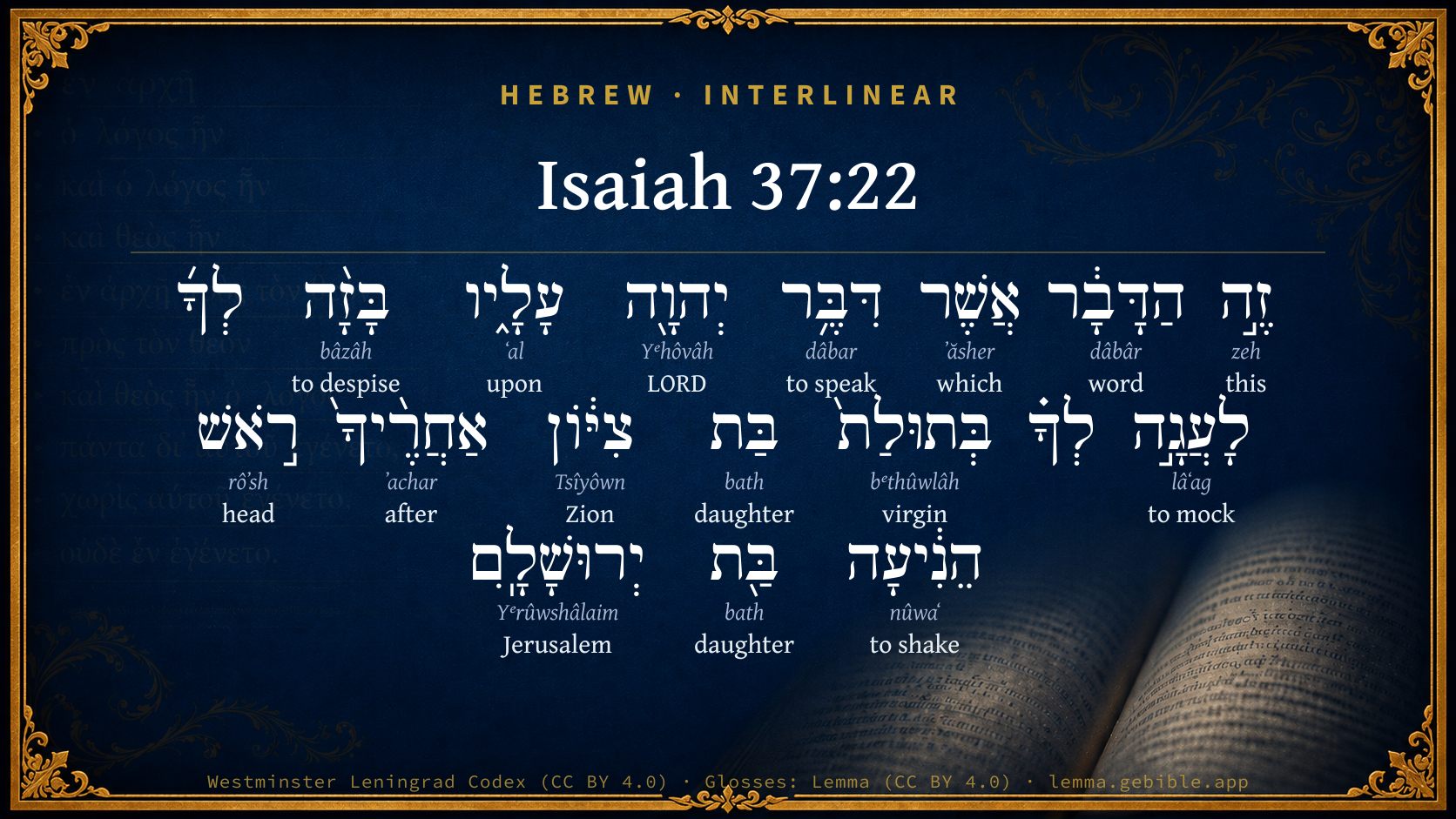
  1. זֶ֣ה zeh H2088 “this” Pronoun, Demonstrative, Masculine, Singular
  2. הַדָּבָ֔ר dâbâr H1697 “the · word” Particle, Definite Article + Noun, Common, Masculine, Singular, Absolute
  3. אֲשֶׁר ʼăsher H834 “which” Particle, Relative
  4. דִּבֶּ֥ר dâbar H1696 “to speak” Verb, Piel, Perfect, 3rd Person, Masculine, Singular
  5. יְהוָ֖ה Yᵉhôvâh H3068 “LORD” Noun, Proper
  6. עָלָ֑יו ʻal H5921 “upon · him” Preposition + Suffix, Personal, 3rd Person, Masculine, Singular
  7. בָּזָ֨ה bâzâh H959 “to despise” Verb, Qal, Perfect, 3rd Person, Feminine, Singular
  8. בְּתוּלַת֙ bᵉthûwlâh H1330 “virgin of” Noun, Common, Feminine, Singular, Construct
  9. בַּת bath H1323 “daughter of” Noun, Common, Feminine, Singular, Construct
  10. צִיּ֔וֹן Tsîyôwn H6726 “Zion” Noun, Proper
  11. אַחֲרֶ֨יךָ֙ ʼachar H310 “after · you” Preposition + Suffix, Personal, 2nd Person, Masculine, Singular
  12. רֹ֣אשׁ rôʼsh H7218 “head” Noun, Common, Masculine, Singular, Absolute
  13. הֵנִ֔יעָה nûwaʻ H5128 “to shake” Verb, Hiphil, Perfect, 3rd Person, Feminine, Singular
  14. בַּ֖ת bath H1323 “daughter of” Noun, Common, Feminine, Singular, Construct
  15. יְרוּשָׁלִָֽם Yᵉrûwshâlaim H3389 “Jerusalem” Noun, Proper

About this verse

These counts appear in no published source. They are computed here, from the morphology-tagged text and Lemma’s own curated glosses. What Lemma adds →

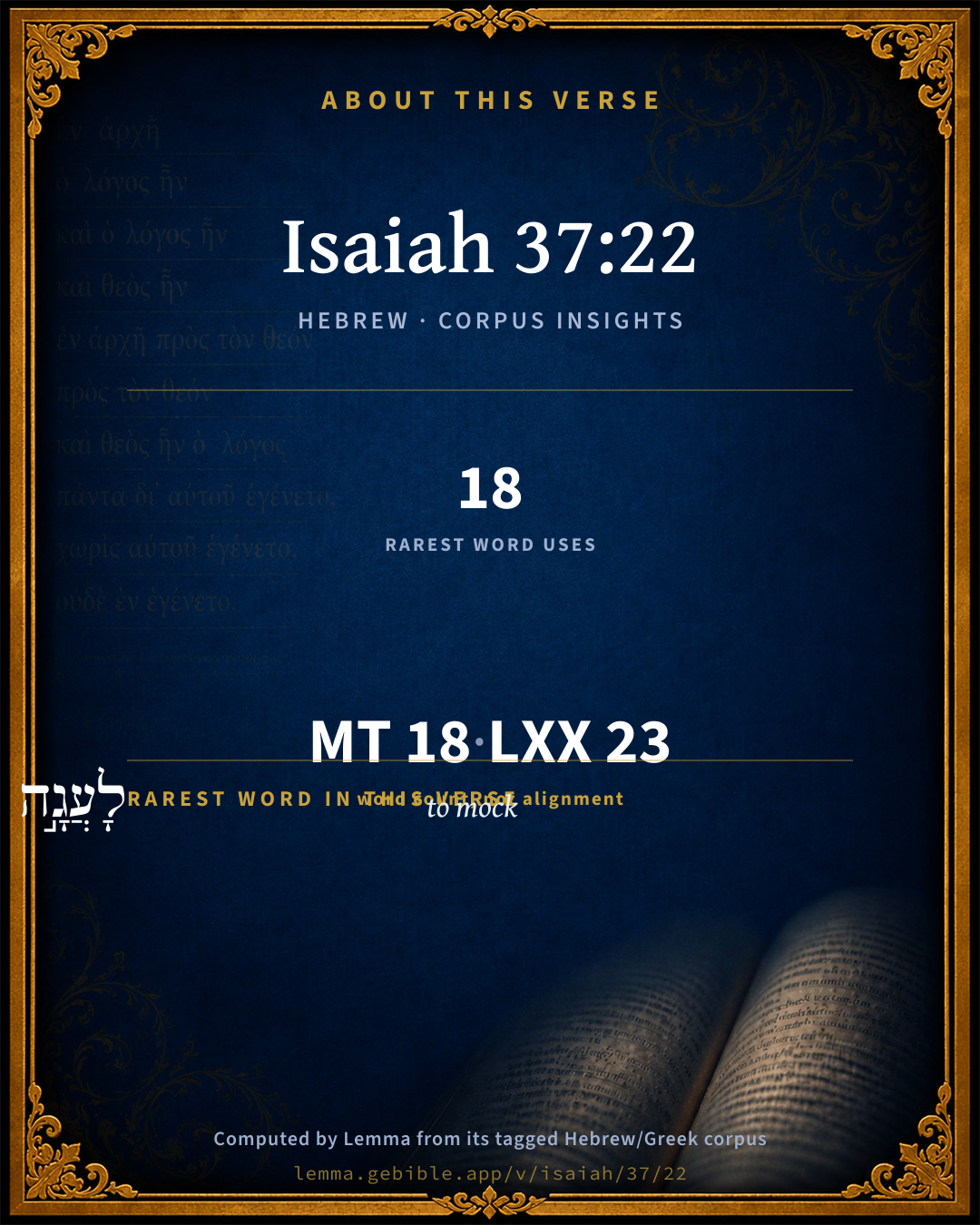
18
words
15
distinct lemmas
Prophets
section

Notable vocabulary

The rarest word here is לָעֲגָ֣ה to mock H3932 — appearing just 18 times in the whole Hebrew Bible.

Shared distinctive vocabulary

לָעֲגָ֣ה to mock H3932 occurs in 18 verses of the Hebrew Bible. Also found in:

Grammatical profile

  • 4 verbs
  • 8 nouns
  • 1 pronoun
  • 4 prepositions
  • 1 particle

Verb forms

  • דִּבֶּ֥ר Piel · Perfect
  • בָּזָ֨ה Qal · Perfect
  • לָעֲגָ֣ה Qal · Perfect
  • הֵנִ֔יעָה Hiphil · Perfect

Repetition

A word recurs within this verse — often emphatic in Hebrew:

  • בַּת daughter H1323 ×2

Hebrew & Septuagint length

In English translation the verse runs 31 words from the Hebrew and 31 from the Septuagint (LXX English) — the same length.

A rough comparison of the two English renderings, which tokenize alike — not a word-level alignment.

Word counts can differ between the Hebrew and the Greek without any difference in meaning — e.g. the Hebrew direct-object marker אֵת has no separate Greek word, and Greek often adds the article ὁ.

In the original languages it is 18 Hebrew tokens and 23 Greek tokens — but the two are counted differently (Hebrew bundles its prefixes and suffixes into one token; the Greek is in lemma form), so that isn’t a like-for-like length.

Cross-references

24

Topical passages linked to Isaiah 37:22 in the Treasury of Scripture Knowledge — connected by theme and wording, ordered by reader-vote popularity; previews shown in the World English Bible.

  • Job 16:4 I also could speak as you do. If your soul were in my soul's place, I could join words together against you, And shake my head at you.
  • Psalms 9:14 That I may show forth all your praise. In the gates of the daughter of Zion, I will rejoice in your salvation.
  • Psalms 22:7–8 All those who see me mock me. They insult me with their lips. They shake their heads, saying,
  • Isaiah 1:8 The daughter of Zion is left like a shelter in a vineyard, Like a hut in a field of melons, Like a besieged city.
  • Jeremiah 14:17 You shall say this word to them, Let my eyes run down with tears night and day, and let them not cease; for the virgin daughter of my people is broken with a great breach, with a very grievous wound.
  • Lamentations 2:13 What shall I testify to you? what shall I liken to you, daughter of Jerusalem? What shall I compare to you, that I may comfort you, virgin daughter of Zion? For your breach is great like the sea: who can heal you?
  • Zephaniah 3:14 Sing, daughter of Zion! Shout, Israel! Be glad and rejoice with all your heart, daughter of Jerusalem.
  • Zechariah 2:10 Sing and rejoice, daughter of Zion; for, behold, I come, and I will dwell in the midst of you,' says Yahweh.
  • 1 Samuel 17:36 Your servant struck both the lion and the bear: and this uncircumcised Philistine shall be as one of them, seeing he has defied the armies of the living God.
  • 1 Samuel 17:44–47 The Philistine said to David, Come to me, and I will give your flesh to the birds of the sky, and to the animals of the field.
  • Psalms 2:2–4 The kings of the earth take a stand, And the rulers take counsel together, Against Yahweh, and against his anointed, saying,
  • Psalms 27:1–3 Yahweh is my light and my salvation. Whom shall I fear? Yahweh is the strength of my life. Of whom shall I be afraid?
  • Psalms 31:18 Let the lying lips be mute, Which speak against the righteous insolently, with pride and contempt.
  • Psalms 46:1–7 God is our refuge and strength, A very present help in trouble.
  • Isaiah 8:9–10 Make an uproar, O you peoples, and be broken in pieces! And give ear, all you of far countries: gird yourselves, and be broken in pieces! Gird yourselves, and be broken in pieces!
  • Isaiah 10:32 This very day shall he halt at Nob: he shakes his hand at the mountain of the daughter of Zion, the hill of Jerusalem.
  • Isaiah 62:11 Behold, Yahweh has proclaimed to the end of the earth, Say you to the daughter of Zion, Behold, your salvation comes; behold, his reward is with him, and his recompense before him.
  • Lamentations 1:15 The Lord has set at nothing all my mighty men in the midst of me; He has called a solemn assembly against me to crush my young men: The Lord has trodden as in a winepress the virgin daughter of Judah.
  • Joel 3:9–12 Proclaim this among the nations: Prepare war. Stir up the mighty men. Let all the warriors draw near. Let them come up.
  • Amos 5:2 "The virgin of Israel has fallen; She shall rise no more. She is cast down on her land; There is no one to raise her up."
  • Zechariah 9:9 Rejoice greatly, daughter of Zion! Shout, daughter of Jerusalem! Behold, your king comes to you! He is righteous, and having salvation; Lowly, and riding on a donkey, Even on a colt, the foal of a donkey.
  • Matthew 21:5 "Tell the daughter of Zion, Behold, your King comes to you, Humble, and riding on a donkey, On a colt, the foal of a donkey."
  • Matthew 27:39 Those who passed by blasphemed him, wagging their heads,
  • Isaiah 23:12 He said, You shall no more rejoice, you oppressed virgin daughter of Sidon: arise, pass over to Kittim; even there shall you have no rest.

Cross-references courtesy of OpenBible.info (CC BY 4.0).

Hebrew and Greek witnesses Masoretic Hebrew ↔ Greek Septuagint

The same verse in the two great witnesses to the Old Testament, shown verse-for-verse.

These are two independent witnesses, not word-aligned to each other, and the Septuagint is shown in lemma (dictionary) form.

Hebrew Isaiah 37:22 Masoretic · Westminster Leningrad Codex

זֶ֣ה הַדָּבָ֔ר אֲשֶׁר דִּבֶּ֥ר יְהוָ֖ה עָלָ֑יו בָּזָ֨ה לְךָ֜ לָעֲגָ֣ה לְךָ֗ בְּתוּלַת֙ בַּת צִיּ֔וֹן אַחֲרֶ֨יךָ֙ רֹ֣אשׁ הֵנִ֔יעָה בַּ֖ת יְרוּשָׁלִָֽם

this is the word which Yahweh has spoken concerning him: The virgin daughter of Zion has despised you and ridiculed you; the daughter of Jerusalem has shaken her head at you.

World English Bible · Public Domain

Greek LXX Isaiah 37:22 Septuagint · lemma form

οὗτος ὁ λόγος ὅς λαλέω περί αὐτός ὁ θεός φαυλίζω σύ καί μυκτηρίζω σύ παρθένος θυγάτηρ σιων ἐπί σύ κεφαλή κινέω θυγάτηρ ἰερουσαλήμ

This is the word which God has spoken concerning him; The virgin daughter of Sion has despised you, and mocked you; the daughter of Jerusalem has shaken her head at you.

LXX2012 (modern English Septuagint) · Public Domain

Hebrew: Westminster Leningrad Codex (CC BY 4.0). Greek: Septuagint (public domain); English from LXX2012 (modern English Septuagint) (Public Domain). How the Septuagint differs from the Hebrew →

Targum (Aramaic paraphrase)

1

The Targum is the ancient Jewish Aramaic paraphrase of the Hebrew Scriptures — an interpretive translation, not the Hebrew text itself. Onkelos (literal) and Pseudo-Jonathan (expansive) render the Torah, and Jonathan the Prophets. Coverage is partial: where no permissively-licensed English translation exists for a verse, only the Aramaic is shown. This is verse-level text, not a word-by-word alignment to the Hebrew.

  1. Targum Jonathan Prophets (Joshua–Malachi)
    דֵין פִּתְגָמָא דִי מַלֵיל יְיָ עֲלוֹהִי מְבַסְרָא עֲלָךְ מְמִיקָא עֲלָךְ מַלְכוּת כְּנִשְׁתָּא דְצִיוֹן בַּתְרָךְ רֵישֵׁיהוֹן מְנִידִין עַמָא דְבִירוּשְׁלֵם:

    This is the word which the Lord hath spoken concerning him. The kingdom of the congregation of Zion despises thee, abhors thee; the people which are in Jerusalem shake their head behind thee.

    Targum Jonathan — Aramaic: “Mikraot Gedolot” (public domain). English: “Sefaria Community Translation” (CC0 1.0 (public-domain dedication)); “London "Chaldee Paraphrase," 1871” (public domain). Text via Sefaria.

Commentary

Notes on Isaiah 37:22 from classic Christian and Jewish commentators (each source and its license shown beneath its notes). The classic Christian expositions comment on the surrounding passage and are grouped to its opening verse, so a note may address several verses; the Jewish commentaries on the Tanakh (Rashi and others) are per-verse, so they appear only where the commentator wrote on this verse.

Lemma curates 59 commentaries, every one of them public domain or Creative Commons licensed, each selected and text-cleaned for this edition rather than reprinted as found. About our sources →

The Cambridge Bible for Schools and Colleges

gen. ed. J. J. S. Perowne

22–29. The poem on Sennacherib is in substance a Taunt-song; but in form an elegy, written in the measure characteristic of the qînâh. The first two lines (Isa_37:22) read:

She hath despised thee, hath mocked thee—the virgin daughter of Zion;

Behind thee hath shaken the head—the daughter of Jerusalem.

The prophet anticipates the ignominious retreat of the Assyrian king (“behind thee”), leaving Jerusalem still a “virgin” fortress. To “shake the head” is in the O.T. a gesture of contempt (Psa_22:7; Jer_18:16; Lam_2:15, &c.).

The Cambridge Bible for Schools and Colleges (gen. ed. J. J. S. Perowne; Cambridge University Press, 1878–1918) — public domain. Text from a community e-Sword module.

Tyndale Open Study Notes

Tyndale Open Resources

37:22 The virgin daughter of Zion: Jerusalem is personified as a young woman who mocks the Assyrian king (see also 3:26).

Tyndale Open Study Notes — © Tyndale Open Resources, licensed CC BY-SA 4.0. Text via the HelloAO Bible API.

Geneva Bible (1599)

Geneva Bible translators

Whom God had chosen to himself as a chaste virgin, and over whom he had care to preserve her from the lusts of the tyrant, as a father would have over his daughter.

Geneva Bible (1599) marginal notes — public domain. Text via Bolls.life.

Jamieson, Fausset & Brown

Robert Jamieson, A. R. Fausset & David Brown

Transition to poetry: in parallelism.

virgin . . . daughter--honorable terms. "Virgin" implies that the city is, as yet, inviolate. "Daughter" is an abstract collective feminine personification of the population, the child of the place denoted (see on Isa 23:10; Isa 1:8). Zion and her inhabitants.

shaken . . . head--in scorn (Psa 22:7; Psa 109:25; Mat 27:39). With us to shake the head is a sign of denial or displeasure; but gestures have different meanings in different countries (Isa 58:9; Eze 25:6; Zep 2:15).

Jamieson, Fausset & Brown — Commentary Critical and Explanatory on the Whole Bible (1871) — public domain (CC PDM 1.0). Text via the HelloAO Bible API.

Ellicott's Commentary for English Readers

(22) The virgin, the daughter of Zion.—The same phrase had been used in Isa_23:12 of Zidon. There the virgin had been “oppressed,” i.e., “ravished” by the invaders, but Zion was to escape the ravisher, and laugh his lust to scorn.

A Bible Commentary for English Readers, edited by Charles John Ellicott (1878–1897) — public domain. Text from a community e-Sword module.

John Gill's Exposition

By thy servants hast thou reproached the Lord,.... Particularly by Rabshakeh, and the other two that were with him, who, no doubt, assented to what he said; not content to reproach him himself, he set his servants to do it likewise; he made use of them as instruments, and even set them, as well as himself, above the Lord:

and hast said, by the multitude of my chariots am I come up to the height of the mountains; not only with his foot soldiers, but with his chariots, and a great number of them, he had travelled over hills and mountains, as Hannibal over the Alps, and was now upon the high mountains which were round about Jerusalem, and very near the mountain of the Lord's house; of which Jarchi interprets the words:

to the sides of Lebanon; meaning either the mountain of Lebanon, which was on the borders of the land of Israel, famous for cedars and fir trees, later mentioned; or, the temple made of the wood of Lebanon, near which his army now lay; so the Targum and Jarchi understand it:

and I will cut down the tall cedars thereof, and the choice fir trees thereof; to make way for his army, and to support himself with materials for the siege; to make tents with for his soldiers to lie in, or wooden fortresses from whence to annoy the city. The cedars of Lebanon were very large and tall. Mr. Maundrell (p) says he measured one of the largest, and

"found it six and thirty feet and six inches thick; its branches spread a hundred and eleven feet; its trunk from the ground was about fifteen or sixteen feet, and then divided into five branches, each of which would make a large tree.''

Monsieur Thevenot (q) says, now there are no more nor less that, twenty three cedars on Mount Lebanon, great and small: or it may be, these metaphorically intend the princes, and nobles, and chief men of the Jewish nation, he threatens to destroy; so the Targum,

"and I will kill the most beautiful of their mighty ones, and the choicest of their princes:''

and I will enter into the height of his border; some think the tower of Lebanon, which stood on the east part of it towards Syria, is meant; but it seems rather to design Jerusalem, the metropolis of the nation, which he thought himself sure of entering into, and taking possession of; and this was what his heart was set upon; so the Targum,

and I will subdue the city of their strength; their strong city Jerusalem, in which they placed their strength:

and the forest of his Carmel: or "the forest and his fruitful field" (r); the same city, which, for the number of its houses and inhabitants, was like a forest, and was Hezekiah's fruitful field, where all his riches and treasure were. The Targum interprets it of his army,

"and I will consume the multitude of their army.''

(p) Journey from Aleppo to Jerusalem, p. 179. (q) Travels, part 1. B. 2. ch. 60. p. 221. (r) "sylvas, arva ejus", Junius & Tremellius; "sylvas et arva ejus", Piscator.

John Gill's Exposition of the Whole Bible (1746–1763) — public domain (CC PDM 1.0). Text via the HelloAO Bible API.

Albert Barnes' Notes on the Bible

The virgin, the daughter of Zion - Jerusalem (see the note at Isa 1:8; compare the note at Isa 23:12). The parallelism in this and the following verses shows that the poetic form of speech is here introduced.

Hast despised thee - That is, it is secure from thy contemplated attack. The idea is, that Jerusalem would exult over the ineffectual attempts of Sennacherib to take it, and over his complete overthrow.

Hath laughed thee to scorn - Will make thee an object of derision.

Hath shaken her head at thee - This is an indication of contempt and scorn (compare Psa 22:7; Psa 109:25; Jer 18:16; Zep 2:15; Mat 27:39).

Albert Barnes' Notes on the Bible (1834–1885) — public domain. Text from a community e-Sword/MySword module.

The Pulpit Commentary

The virgin the daughter of Zion; i.e. Jerusalem. (comp. Isa_1:8 Isa_10:32 Isa_16:1 Isa_52:2 Isa_62:11) The expression, "virgin daughter," is used also by Isaiah of Zidon (Isa_23:12) and of Babylon. (Isa_47:1) The personification here is very effective. since it represents Jerusalem as a tender maiden, weak and delicate, yet still bold enough to stand up against Sennacherib and all his host, and bid him defiance. Confident in Jehovah, her Protector, she despises him, and laughs him to scorn; nay, "shakes her head at him," or rather. "after him," pursuing him with scornful gestures as In. retreats before her. (On shaking the head as a gesture of scorn, see Psa_22:7 Psa_109:25 Mat_27:39)

The Pulpit Commentary (1880–1919), ed. H.D.M. Spence-Jones & Joseph S. Exell — public domain. Text from a community e-Sword module.

J. A. Alexander on Isaiah

Joseph Addison Alexander

“This is the word which Jehovah hath spoken concerning (or against) him. The virgin daughter of Zion hath despised thee, she hath laughed thee to scorn, the daughter of Jerusalem hath shaken her head after thee.” The simple meaning is that what follows is a revelation from God in answer to the vaunting of Sennacherib and the prayers of Hezekiah. For the meaning of the phrase daughter of Zion, see the note on Isa 1:8; for the construction of virgin, that on Isa 23:12. The virgin daughter Zion, (i.e., Zion considered as a daughter and a virgin). It may be a personification either of the whole church and nation, or of the city of Jerusalem, which last seems more appropriate in this connection. Not merely ‘at thee’, but ‘after thee as thou fleest’. Some understand by shaking a derisive nodding or vertical motion of the head accompanied by laughter. Others suppose that a wagging or lateral motion of the head, although not used by us for such a purpose, may have been common as a gesture of derision in the east, the rather as such signs are to a great extent conventional, and as other derisive gestures mentioned in the Scriptures are equally foreign from our habits and associations. Others again suppose that the shaking of the head, with the Hebrews as with us, was a gesture of negation, and that the expression of scorn consisted in a tacit denial that Sennacherib had been able to effect his purpose. Thus understood, the action is equivalent to saying in words, no, no! (i.e., he could not do it. See my note on Psa 22:8.) The meaning of the whole verse, divested of its figurative dress, is that the people of God might regard the threats of the Assyrian with contempt.

Joseph Addison Alexander, The Prophecies of Isaiah (1846–1847; New York: Scribner, 1870–1878) — public domain. Text from a community e-Sword module.

Lesson kit

Teaching starters — assembled from the data on this page, not authored interpretation. Every prompt links to the verse data it draws on. Edit before teaching.

Isaiah, in the Prophets, opens this verse with 18 words (15 distinct Hebrew lemmas). Its most distinctive word is lâʻag (“to mock”). A historical commentator’s framing appears above. Read the whole chapter for the surrounding context.

Discussion questions

  1. The word lâʻag carries the sense “to mock.” How does it shape the verse?
  2. How does 2 Kings 19:21, which shares the word «to mock», read alongside this verse?
  3. What does the repetition of “daughter” (2× in this one verse) do in this verse?
  4. These translations render this verse differently; the difference is in the English rendering, not the original. What questions does that raise?
  5. «דִּבֶּ֥ר» is a Piel Perfect verb. How does that grammatical form shape the action described?
  6. Compare how The Cambridge Bible for Schools and Colleges and Tyndale Open Study Notes read this verse. Where do they agree or differ?

Things to notice

Reading settings

Reading text

Shown beneath each verse's original-language words.

Old Testament
Old Testament edition

Read the OT as the Masoretic Hebrew (MT) or the Greek Septuagint (LXX).

English shown for the Greek Septuagint (in the Hebrew ↔ Greek comparison).

Comparing translations? Open the Compare panel on any verse page to stack up to four side by side.