
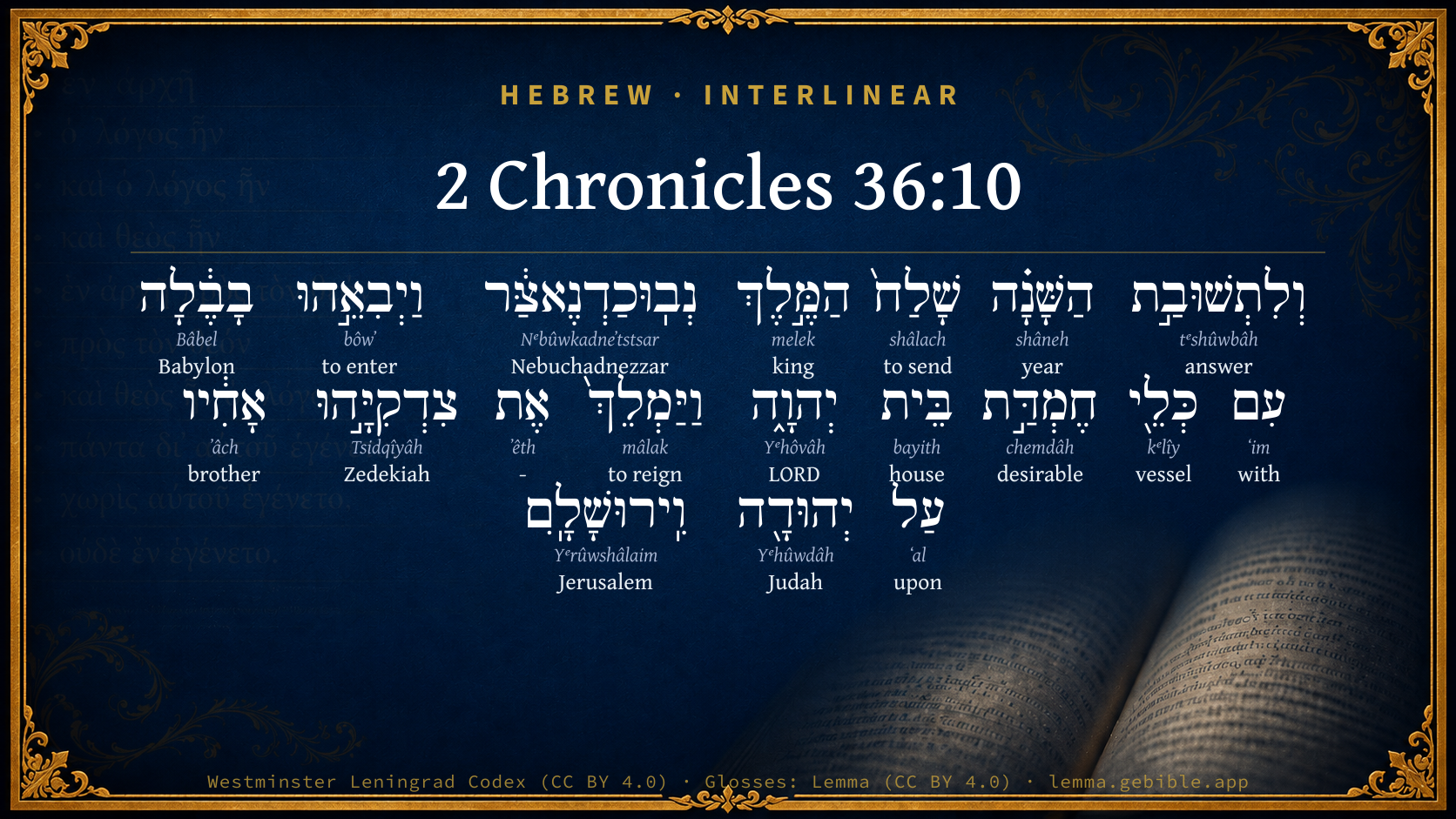
2 Chronicles 36:10

Hebrew (Westminster Leningrad Codex) 2 Chronicles 36:10 appears in the Hebrew Old Testament. The text above is from the Westminster Leningrad Codex. Each word links to its Strong’s number, a concise gloss, and parsing drawn from the Open Scriptures Hebrew Bible morphology. Click any word for its full Brown-Driver-Briggs (BDB) entry.
Download image
Cite this verse

2 Chronicles 36:10 (World English Bible). Public Domain. Lemma interlinear Bible study tool, https://lemma.gebible.app/v/2-chronicles/36/10.

Show BibTeX & RIS
BibTeX
RIS
English Translation
At the return of the year king Nebuchadnezzar sent, and brought him to Babylon, with the goodly vessels of the house of Yahweh, and made Zedekiah his brother king over Judah and Jerusalem.
World English Bible · Public Domain
Download a study sheet

One document with this verse’s original text, its word-by-word gloss line, the meaning frame, cross-references with their text, attributed commentary, and full source and license credits — printable, and it pastes into notes with its structure intact.

This verse Autodidact and up

Study sheet (.html) Plain text (.txt)

A passage Seminary Student

Up to 50 verses in one chapter. A passage sheet keeps up to 6 commentary sources and 12 cross-references per verse, in the order this page ranks them, and says so on the sheet whenever that leaves anything out. Ask for a single verse and you get the Autodidact verse sheet above.

Everything on this page stays free to read, with no account — the sheet is a download of what is already on screen, not access to it.

Want to remove ads? Support Godless Engineer
Compare translations 3

The same verse in 3 English versions, stacked beneath the original-language interlinear above. Click any original word for its lexicon entry.

Each is an independent rendering of the whole verse — the interlinear is not word-aligned to these translations.

Highlighted words mark where these versions differ — a whole-verse word diff, not a word-by-word alignment.

  • World English Bible Public Domain
    At the return of the year king Nebuchadnezzar sent, and brought him to Babylon, with the goodly vessels of the house of Yahweh, and made Zedekiah his brother king over Judah and Jerusalem.
  • King James Version Public Domain
    And when the year was expired, king Nebuchadnezzar sent, and brought him to Babylon, with the goodly vessels of the house of the LORD, and made Zedekiah his brother king over Judah and Jerusalem.
  • unfoldingWord Literal Text CC BY-SA 4.0
    And in the return of the year, King Nebuchadnezzar sent and he brought him to Babylon, with the desirable items of the house of Yahweh And he made Zedekiah, his brother, king over Judah and Jerusalem.

unfoldingWord Literal Text — © unfoldingWord, licensed CC BY-SA 4.0. Word-aligned USFM3 via Door43 (git.door43.org/unfoldingWord/en_ult).

Versions to compare (up to 4)

3 of 4 selected

Show all 18 translations

Every available English version of this verse, each an independent rendering of the whole verse.

  • World English Bible Public Domain
    At the return of the year king Nebuchadnezzar sent, and brought him to Babylon, with the goodly vessels of the house of Yahweh, and made Zedekiah his brother king over Judah and Jerusalem.
  • Berean Standard Bible Public Domain
    In the spring, King Nebuchadnezzar summoned Jehoiachin and brought him to Babylon, along with the articles of value from the house of the LORD. And he made Jehoiachin’s relative Zedekiah king over Judah and Jerusalem.
  • Majority Standard Bible Public Domain
    In the spring, King Nebuchadnezzar summoned Jehoiachin and brought him to Babylon, along with the articles of value from the house of the LORD. And he made Jehoiachin’s relative Zedekiah king over Judah and Jerusalem.
  • King James Version Public Domain
    And when the year was expired, king Nebuchadnezzar sent, and brought him to Babylon, with the goodly vessels of the house of the LORD, and made Zedekiah his brother king over Judah and Jerusalem.
  • American Standard Version (1901) Public Domain
    And at the return of the year king Nebuchadnezzar sent, and brought him to Babylon, with the goodly vessels of the house of Jehovah, and made Zedekiah his brother king over Judah and Jerusalem.
  • Revised Version (1885) Public Domain
    And at the return of the year king Nebuchadnezzar sent, and brought him to Babylon, with the goodly vessels of the house of the LORD, and made Zedekiah his brother king over Judah and Jerusalem.
  • Geneva Bible (1599) Public Domain
    And when the yeere was out, King Nebuchadnezzar sent and brought him to Babel with the precious vessels of the house of the Lord, and he made Zedekiah his brother King ouer Iudah and Ierusalem.
  • Douay-Rheims (1899) Public Domain
    And at the return of the year, king Nabuchodonosor sent, and brought him to Babylon, carrying away at the same time the most precious vessels of the house of the Lord: and he made Sedecias his uncle king over Juda and Jerusalem.
  • Young's Literal Translation Public Domain
    and at the turn of the year hath king Nebuchadnezzar sent and bringeth him in to Babylon, with the desirable vessels of the house of Jehovah, and causeth Zedekiah his brother to reign over Judah and Jerusalem.
  • Literal Standard Version CC BY-SA 4.0
    and at the turn of the year King Nebuchadnezzar has sent and brings him to Babylon with the desirable vessels of the house of YHWH, and causes his brother Zedekiah to reign over Judah and Jerusalem.
  • Unlocked Literal Bible CC BY-SA 4.0
    In the spring, King Nebuchadnezzar sent men and brought him to Babylon, with the valuable things from the house of Yahweh, and made Zedekiah, his relative, king over Judah and Jerusalem.
  • unfoldingWord Literal Text CC BY-SA 4.0
    And in the return of the year, King Nebuchadnezzar sent and he brought him to Babylon, with the desirable items of the house of Yahweh And he made Zedekiah, his brother, king over Judah and Jerusalem.
  • Darby Bible Public Domain
    And at the turn of the year king Nebuchadnezzar sent and had him brought to Babylon, with the precious vessels of the house of Jehovah; and he made Zedekiah his brother king over Judah and Jerusalem.
  • World Messianic Bible Public Domain
    At the return of the year, King Nebuchadnezzar sent and brought him to Babylon, with the valuable vessels of the LORD’s house, and made Zedekiah his brother king over Judah and Jerusalem.
  • Webster's Bible Public Domain
    And when the year had expired, king Nebuchadnezzar sent, and brought him to Babylon, with the goodly vessels of the house of the LORD, and made Zedekiah his brother king over Judah and Jerusalem.
  • Free Bible Version CC BY-SA 4.0
    In the spring of the year, King Nebuchadnezzar summoned him and brought him to Babylon, along with valuable items from the Lord's Temple, and he made Jehoiachin's uncle Zedekiah king over Judah and Jerusalem.
  • Bible in Basic English Public Domain
    In the spring of the year King Nebuchadnezzar sent and took him away to Babylon, with the beautiful vessels of the house of the Lord, and made Zedekiah, his father's brother, king over Judah and Jerusalem.
  • JPS Tanakh (1917) Public Domain
    And at the return of the year king Nebuchadnezzar sent, and brought him to Babylon, with the goodly vessels of the house of the LORD, and made Zedekiah his brother king over Judah and Jerusalem.

Literal Standard Version (2020), Covenant Press — licensed CC BY-SA 4.0. Text via the HelloAO Bible API (eBible.org). Unlocked Literal Bible (unfoldingWord) — licensed CC BY-SA 4.0. Text via the HelloAO Bible API (eBible.org). unfoldingWord Literal Text — © unfoldingWord, licensed CC BY-SA 4.0. Word-aligned USFM3 via Door43 (git.door43.org/unfoldingWord/en_ult). Free Bible Version, Dr. Jonathan Gallagher — licensed CC BY-SA 4.0. Text via the HelloAO Bible API (eBible.org).

Word by word

More ways to search: Search by grammar → Find every occurrence → Compare this word →

Practice this passage: Drill this verse → Learn its vocabulary →

וְלִתְשׁוּבַ֣ת
tᵉshûwbâh
H8666
“and · to/for · answer of”
Conjunction + Preposition + Noun, Common, Feminine, Singular, Construct
Part of Speech
Conjunction + Preposition + Noun
Type
Common
Gender
Feminine
Number
Singular
State
Construct
Full BDB Definition

Origin: from H7725

TWOT: 2340f

a recurrence, an answer, return - return - completion of a year, return of a year - at the return (construct) - answer, reply
  1. הַשָּׁנָ֗ה shâneh H8141 “the · year” Particle, Definite Article + Noun, Common, Feminine, Singular, Absolute
  2. שָׁלַח֙ shâlach H7971 “to send” Verb, Qal, Perfect, 3rd Person, Masculine, Singular
  3. הַמֶּ֣לֶךְ melek H4428 “the · king” Particle, Definite Article + Noun, Common, Masculine, Singular, Absolute
  4. נְבֽוּכַדְנֶאצַּ֔ר Nᵉbûwkadneʼtstsar H5019 “Nebuchadnezzar” Noun, Proper
  5. וַיְבִאֵ֣הוּ bôwʼ H935 “and · to enter · him” Conjunction + Verb, Hiphil, Sequential Imperfect, 3rd Person, Masculine, Singular + Suffix, Personal, 3rd Person, Masculine, Singular
  6. בָבֶ֔לָה Bâbel H894 “Babylon · toward” Noun, Proper + Suffix, Demonstrative
  7. עִם ʻim H5973 “with” Preposition
  8. כְּלֵ֖י kᵉlîy H3627 “vessels of” Noun, Common, Masculine, Plural, Construct
  9. חֶמְדַּ֣ת chemdâh H2532 “desirable of” Noun, Common, Feminine, Singular, Construct
  10. בֵּית bayith H1004 “house of” Noun, Common, Masculine, Singular, Construct
  11. יְהוָ֑ה Yᵉhôvâh H3068 “LORD” Noun, Proper
  12. וַיַּמְלֵךְ֙ mâlak H4427 “and · to reign” Conjunction + Verb, Hiphil, Sequential Imperfect, 3rd Person, Masculine, Singular
  13. אֶת ʼêth H853 “-” Particle, Direct Object
  14. צִדְקִיָּ֣הוּ Tsidqîyâh H6667 “Zedekiah” Noun, Proper
  15. אָחִ֔יו ʼâch H251 “brother · his” Noun, Common, Masculine, Singular, Construct + Suffix, Personal, 3rd Person, Masculine, Singular
  16. עַל ʻal H5921 “upon” Preposition
  17. יְהוּדָ֖ה Yᵉhûwdâh H3063 “Judah” Noun, Proper
  18. וִֽירוּשָׁלִָֽם Yᵉrûwshâlaim H3389 “and · Jerusalem” Conjunction + Noun, Proper

About this verse

These counts appear in no published source. They are computed here, from the morphology-tagged text and Lemma’s own curated glosses. What Lemma adds →

19
words
19
distinct lemmas
Historical
section

Notable vocabulary

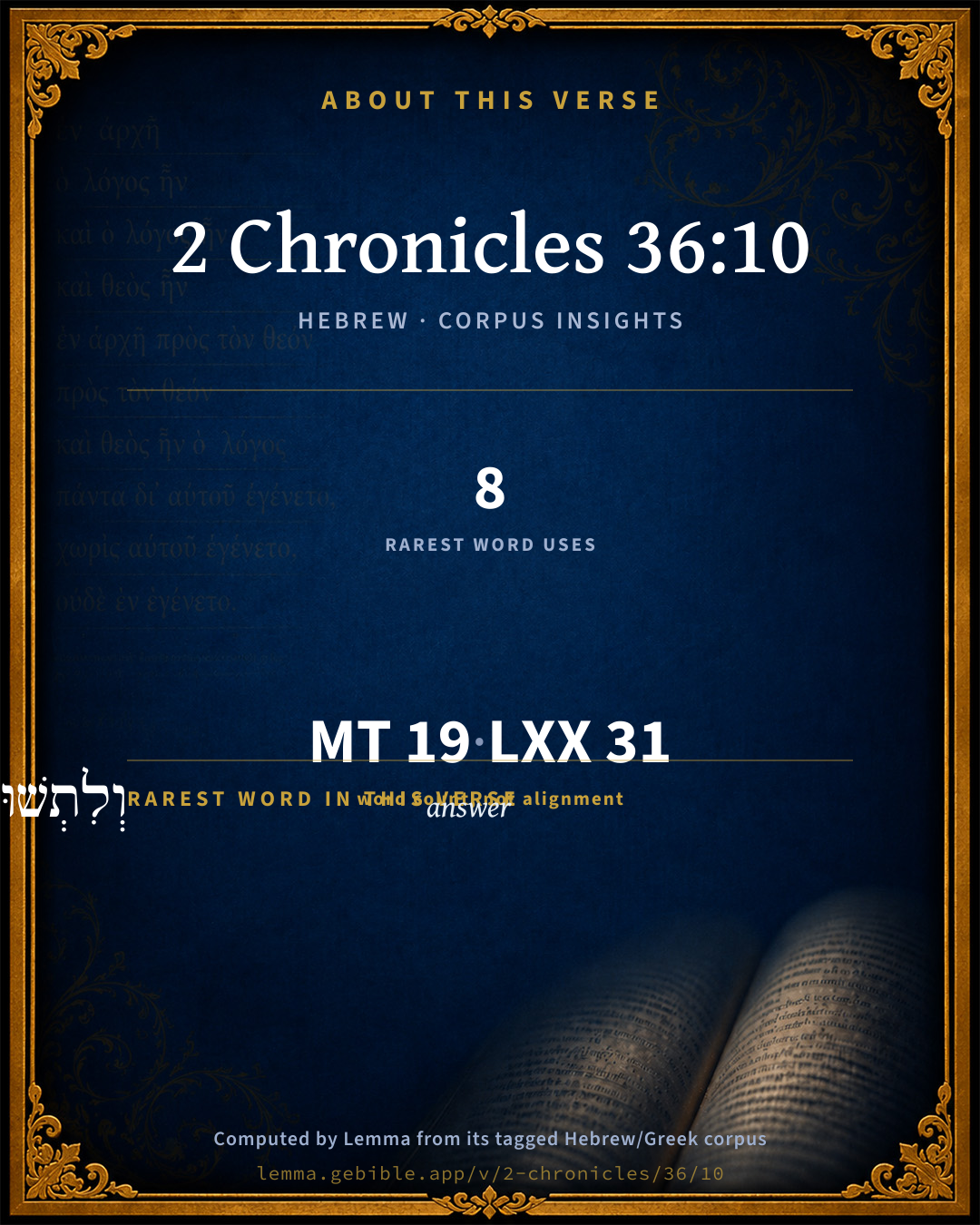
The rarest word here is וְלִתְשׁוּבַ֣ת answer H8666 — appearing just 8 times in the whole Hebrew Bible.

Shared distinctive vocabulary

וְלִתְשׁוּבַ֣ת answer H8666 occurs in 8 verses of the Hebrew Bible. Also found in:

Grammatical profile

  • 3 verbs
  • 13 nouns
  • 2 prepositions
  • 1 particle

Verb forms

  • שָׁלַח֙ Qal · Perfect
  • וַיְבִאֵ֣הוּ Hiphil · Sequential Imperfect
  • וַיַּמְלֵךְ֙ Hiphil · Sequential Imperfect

Hebrew & Septuagint length

In English translation the verse runs 33 words from the Hebrew and 36 from the Septuagint (LXX English) — closely comparable.

A rough comparison of the two English renderings, which tokenize alike — not a word-level alignment.

Word counts can differ between the Hebrew and the Greek without any difference in meaning — e.g. the Hebrew direct-object marker אֵת has no separate Greek word, and Greek often adds the article ὁ.

In the original languages it is 19 Hebrew tokens and 31 Greek tokens — but the two are counted differently (Hebrew bundles its prefixes and suffixes into one token; the Greek is in lemma form), so that isn’t a like-for-like length.

Cross-references

16

Topical passages linked to 2 Chronicles 36:10 in the Treasury of Scripture Knowledge — connected by theme and wording, ordered by reader-vote popularity; previews shown in the World English Bible.

  • Jeremiah 37:1 Zedekiah the son of Josiah reigned as king, instead of Coniah the son of Jehoiakim, whom Nebuchadrezzar king of Babylon made king in the land of Judah.
  • 2 Chronicles 36:7 Nebuchadnezzar also carried of the vessels of the house of Yahweh to Babylon, and put them in his temple at Babylon.
  • 2 Samuel 11:1 It happened, at the return of the year, at the time when kings go out [to battle], that David sent Joab, and his servants with him, and all Israel; and they destroyed the children of Ammon, and besieged Rabbah. But David stayed at Jerusalem.
  • 2 Kings 24:10–17 At that time the servants of Nebuchadnezzar king of Babylon came up to Jerusalem, and the city was besieged.
  • 2 Kings 25:27–30 It happened in the seven and thirtieth year of the captivity of Jehoiachin king of Judah, in the twelfth month, on the seven and twentieth day of the month, that Evilmerodach king of Babylon, in the year that he began to reign, did lift up the head of Jehoiachin king of Judah out of prison;
  • 1 Chronicles 3:15–16 The sons of Josiah: the firstborn Johanan, the second Jehoiakim, the third Zedekiah, the fourth Shallum.
  • 2 Chronicles 36:18 All the vessels of the house of God, great and small, and the treasures of the house of Yahweh, and the treasures of the king, and of his princes, all these he brought to Babylon.
  • Jeremiah 22:25 and I will give you into the hand of those who seek your life, and into the hand of them of whom you are afraid, even into the hand of Nebuchadrezzar king of Babylon, and into the hand of the Chaldeans.
  • Jeremiah 24:1 Yahweh shown me, and, behold, two baskets of figs set before the temple of Yahweh, after that Nebuchadrezzar king of Babylon had carried away captive Jeconiah the son of Jehoiakim, king of Judah, and the princes of Judah, with the craftsmen and smiths, from Jerusalem, and had brought them to Babylon.
  • Jeremiah 27:18–22 But if they be prophets, and if the word of Yahweh be with them, let them now make intercession to Yahweh of Hosts, that the vessels which are left in the house of Yahweh, and in the house of the king of Judah, and at Jerusalem, don't go to Babylon.
  • Jeremiah 29:1–2 Now these are the words of the letter that Jeremiah the prophet sent from Jerusalem to the residue of the elders of the captivity, and to the priests, and to the prophets, and to all the people, whom Nebuchadnezzar had carried away captive from Jerusalem to Babylon,
  • Ezekiel 1:2 In the fifth [day] of the month, which was the fifth year of king Jehoiachin's captivity,
  • Ezekiel 17:12 Say now to the rebellious house, Don't you know what these things mean? tell them, Behold, the king of Babylon came to Jerusalem, and took the king of it, and the princes of it, and brought them to him to Babylon:
  • Daniel 1:1–2 In the third year of the reign of Jehoiakim king of Judah came Nebuchadnezzar king of Babylon to Jerusalem, and besieged it.
  • Daniel 5:2 Belshazzar, while he tasted the wine, commanded to bring the golden and silver vessels which Nebuchadnezzar his father had taken out of the temple which was in Jerusalem; that the king and his lords, his wives and his concubines, might drink from it.
  • Daniel 5:23 but have lifted up yourself against the Lord of heaven; and they have brought the vessels of his house before you, and you and your lords, your wives and your concubines, have drunk wine from them; and you have praised the gods of silver and gold, of brass, iron, wood, and stone, which don't see, nor hear, nor know; and the God in whose hand your breath is, and whose are all your ways, you have not glorified.

Cross-references courtesy of OpenBible.info (CC BY 4.0).

Hebrew and Greek witnesses Masoretic Hebrew ↔ Greek Septuagint

The same verse in the two great witnesses to the Old Testament, shown verse-for-verse.

These are two independent witnesses, not word-aligned to each other, and the Septuagint is shown in lemma (dictionary) form.

Hebrew 2 Chronicles 36:10 Masoretic · Westminster Leningrad Codex

וְלִתְשׁוּבַ֣ת הַשָּׁנָ֗ה שָׁלַח֙ הַמֶּ֣לֶךְ נְבֽוּכַדְנֶאצַּ֔ר וַיְבִאֵ֣הוּ בָבֶ֔לָה עִם כְּלֵ֖י חֶמְדַּ֣ת בֵּית יְהוָ֑ה וַיַּמְלֵךְ֙ אֶת צִדְקִיָּ֣הוּ אָחִ֔יו עַל יְהוּדָ֖ה וִֽירוּשָׁלִָֽם

At the return of the year king Nebuchadnezzar sent, and brought him to Babylon, with the goodly vessels of the house of Yahweh, and made Zedekiah his brother king over Judah and Jerusalem.

World English Bible · Public Domain

Greek LXX 2 Chronicles 36:10 Septuagint · lemma form

καί ἐπιστρέφω ὁ ἐνιαυτός ἀποστέλλω ὁ βασιλεύς ναβουχοδονοσορ καί εἰςφέρω αὐτός εἰς βαβυλών μετά ὁ σκεῦος ὁ ἐπιθυμητός οἶκος κύριος καί βασιλεύω σεδεκιας ἀδελφός ὁ πατήρ αὐτός ἐπί ἰούδας καί ἰερουσαλήμ

And at the turn of the year, king Nabuchodonosor sent, and brought him to Babylon, with the precious vessels of the house of the Lord, and made Sedekias his father's brother king over Juda and Jerusalem.

LXX2012 (modern English Septuagint) · Public Domain

Hebrew: Westminster Leningrad Codex (CC BY 4.0). Greek: Septuagint (public domain); English from LXX2012 (modern English Septuagint) (Public Domain). How the Septuagint differs from the Hebrew →

Commentary

Notes on 2 Chronicles 36:10 from classic Christian and Jewish commentators (each source and its license shown beneath its notes). The classic Christian expositions comment on the surrounding passage and are grouped to its opening verse, so a note may address several verses; the Jewish commentaries on the Tanakh (Rashi and others) are per-verse, so they appear only where the commentator wrote on this verse.

Lemma curates 59 commentaries, every one of them public domain or Creative Commons licensed, each selected and text-cleaned for this edition rather than reprinted as found. About our sources →

Trapp's Complete Commentary

John Trapp

2Ch 36:10 And when the year was expired, king Nebuchadnezzar sent, and brought him to Babylon, with the goodly vessels of the house of the LORD, and made Zedekiah his brother king over Judah and Jerusalem.

Ver. 10. And when the year was expired.] Heb., At the return of the year; that is, in the spring. {2Ki 24:10-11}

“ Namque in se sua per vestigia volvitur annum. ”

John Trapp, A Commentary or Exposition upon All the Books of the Old and New Testament (1647–1656) — public domain. Text from a community e-Sword module.

Joseph Benson's Commentary

2Ch 36:10. When the year was expired — Hebrew, At the return of the year. At the beginning of the next year, according to the sacred account of the Hebrews, at the spring of the year, the time when kings go forth to battle, as is elsewhere said, when Nebuchadnezzar, among others, went forth to settle and enlarge his conquests. His brother — Largely so called, for this was his uncle, or his father’s brother, being the son of Josiah.

Joseph Benson's Commentary on the Old and New Testaments (1811–1818) — public domain. Text from a community e-Sword module.

Geneva Bible (1599)

Geneva Bible translators

Or, uncle.

Geneva Bible (1599) marginal notes — public domain. Text via Bolls.life.

Adam Clarke's Commentary

Verse 10. Made Zedekiah - king] His name was at first Mattaniah, but the king of Babylon changed it to Zedekiah. See 2Kg 24:17, and the notes there.

Adam Clarke's Commentary on the Bible (1810–1826) — public domain. Text from a community e-Sword/MySword module.

Ellicott's Commentary for English Readers

(10) And when the year was expired.—See margin. “At the return of the year” means in spring, when kings usually went forth to war. (2Sa_11:1; 1Ki_20:22.) Kings gives a full account of the siege and surrender of Jerusalem, and the deportation to Babylon of the king and all his princes and men of war, by “the servants of Nebuchadnezzar.”

With the goodly vessels.—2Ch_32:27. “Some of the vessels” had already been carried off (2Ch_36:7). (See 2Ki_24:13 and Jer_27:18-22.)

Zedekiah his brother.—Zedekiah was uncle of Jehoiachin, being a son of Josiah, and brother of Jehoiakim. Perhaps “brother” is equivalent to “kinsman” here, as elsewhere. (Comp. 1Ch_3:15, where Zedekiah appears as a son of Josiah; and 2Ki_24:17.) The versions read “his father’s brother”—a correction. Thenius thinks the word for “uncle” had become illegible in the MS. here used by the chronicler.

A Bible Commentary for English Readers, edited by Charles John Ellicott (1878–1897) — public domain. Text from a community e-Sword module.

The Cambridge Bible for Schools and Colleges

gen. ed. J. J. S. Perowne

10. when the year was expired] R.V. at the return of the year; cp. 2Sa_11:1 = 1Ch_20:1, “at the return of the year, at the time when kings go out to battle,” R.V. This would be in the spring.

brought him to Babylon] It was not the king only, but also all the best of the people, “the princes, … men of valour, the craftsmen and the smiths” who went into captivity; 2Ki_24:14; Jer_24:1; Jer_24:5; Eze_17:12-14.

Zedekiah] A covenant-name like “Jehoiakim” (2Ch_36:4, note); it seems to mean “Righteousness of Jehovah”; cp. the significant title in Jer_23:6, “The Lord is our Righteousness.” Zedekiah’s original name was “Mattaniah”; 2Ki_24:17.

his brother] In 2 Kin. (more accurately) “his father’s brother”; cp. 1Ch_3:15-16, notes.

The Cambridge Bible for Schools and Colleges (gen. ed. J. J. S. Perowne; Cambridge University Press, 1878–1918) — public domain. Text from a community e-Sword module.

Albert Barnes' Notes on the Bible

When the year was expired - literally, as in the margin, i. e. at the return of the season for military expeditions. The expedition against Jehoiakim took place probably late in the autumn of one year, that against Jehoiachin early in the spring of the next.

Strictly speaking, Zedekiah was uncle to Jehoiachin, being the youngest of the sons of Josiah (marginal note and reference). He was nearly of the same age with Jehoiachin, and is called here his “brother” (compare Gen 14:14).

Albert Barnes' Notes on the Bible (1834–1885) — public domain. Text from a community e-Sword/MySword module.

Haydock's Catholic Bible Commentary

Year, in spring, when kings go out to war. C. --- Uncle. Sept. "brother of his father," which comes to the same sense, and was certainly the case. Heb. "his brother." Abraham indeed gives the title to his nephew, Gen. xiii. 8. C.

George Leo Haydock (1774–1849), Haydock's Catholic Family Bible and Commentary, 1859 edition — public domain. Excludes Psalms (Douay-Rheims chapter numbering differs from Protestant) and Deuterocanonical books (Catholic canon only).

Matthew Poole's English Annotations

When the year was expired, Heb. at the return of the year, i.e. at the beginning of the next year, according to the sacred account of the Hebrews, at the spring of the year, the time when kings go forth to battle, as is elsewhere said, when Nebuchadnezzar, among others, went forth to settle and enlarge his conquests.

Zedekiah his brother; largely so called, for this was his uncle, or his father’s brother, as he is called, 2Ki 24:17, being the son of Josiah. See 1Ch 3:15; Jer 1:3.

Matthew Poole's English Annotations on the Holy Bible (1683–1685) — public domain. Text from a community e-Sword/MySword module.

The Pulpit Commentary

When the year was expired; i.e. at the beginning of the new year, in spring. (2Ch_24:23) It appears, from 2Ki_25:27-30, that the captivity of Jehoia-chin, which thus began, lasted thirty-seven years, till B.C. 561, past the end of Nebuchadnezzar"s reign, and that he was thenceforward kindly treated by Evil-Merodach. Compare particularly with this verse the parallel in its vers. 10-16. Zedekiah his brother; i.e. not adopting the very generic usage of the terms of relationship, so common in Old Testament language, his uncle. His mother (Hamutal, ver. 18 of parallel) was the same with the mother of Jehoahaz. Ten years old evidently when Jehoiakim began his reign, he must have been thirteen years younger than his whole brother Je-hoahaz. Zedekiah"s name was before Mat-taniah. The account of Zedekiah in the parallel (which see) is very much more full.

The Pulpit Commentary (1880–1919), ed. H.D.M. Spence-Jones & Joseph S. Exell — public domain. Text from a community e-Sword module.

John Wesley's Explanatory Notes

Expired - Hebrew. at the return of the year: at the beginning of the next year, according to the sacred account of the Hebrew, at the spring of the year, the time when kings go forth to battle, as is elsewhere said, when Nebuchadnezzar, among others, went forth to settle and enlarge his conquests. His brother - Largely so called, for this was his uncle, or his father's brother, being the son of Josiah.

John Wesley, Explanatory Notes Upon the Whole Bible (1754–1765) — public domain. Text via the GEBible commentary corpus.

Rashi

Rabbi Shlomo Yitzchaki (Rashi)

And at the return of the year that Jehoiakim was exiled.

with the precious vessels of the House of the Lord the desirable things. Those he took, and the rest he left until the exile of Zedekiah. Then he took everything with him. And in II Kings (24:12), it is explained that “Jehoiachin, the king of Judah, came out to the king of Babylonia, etc.”

and he made Zedekiah his brother king Jehoiakim’s brother, and so in II Kings (24:17), “And the king of Babylonia crowned Mattaniah his uncle in his stead and changed his name to Zedekiah,” Jehoiachin’s uncle.

Rashi on the Tanakh — English translations: “The Judaica Press complete Tanach with Rashi, translated by A. J. Rosenberg” (CC BY 4.0); “Pentateuch with Rashi's commentary by M. Rosenbaum and A.M. Silbermann, 1929-1934” (public domain); “The Metsudah Tanach series, Lakewood, N.J” (CC BY 4.0); and “The Book of Joshua, Metsudah Publications, 1997” (CC BY 4.0). Text via Sefaria.

Lesson kit

Teaching starters — assembled from the data on this page, not authored interpretation. Every prompt links to the verse data it draws on. Edit before teaching.

2 Chronicles, in the Historical, opens this verse with 19 words (19 distinct Hebrew lemmas). Its most distinctive word is tᵉshûwbâh (“answer”). A historical commentator’s framing appears above. Read the whole chapter for the surrounding context.

Discussion questions

  1. The word tᵉshûwbâh carries the sense “answer.” How does it shape the verse?
  2. 1 Samuel 7:17 shares the word «answer» with this verse. How do the two illuminate each other?
  3. These translations render this verse differently. What is at stake in choosing one wording over another?
  4. The verb «שָׁלַח֙» is Qal Perfect. How does its form color the action?
  5. Reading how Trapp's Complete Commentary and Joseph Benson's Commentary read this verse, where do the two commentators agree and where do they part?

Things to notice

Reading settings

Reading text

Shown beneath each verse's original-language words.

Old Testament
Old Testament edition

Read the OT as the Masoretic Hebrew (MT) or the Greek Septuagint (LXX).

English shown for the Greek Septuagint (in the Hebrew ↔ Greek comparison).

Comparing translations? Open the Compare panel on any verse page to stack up to four side by side.