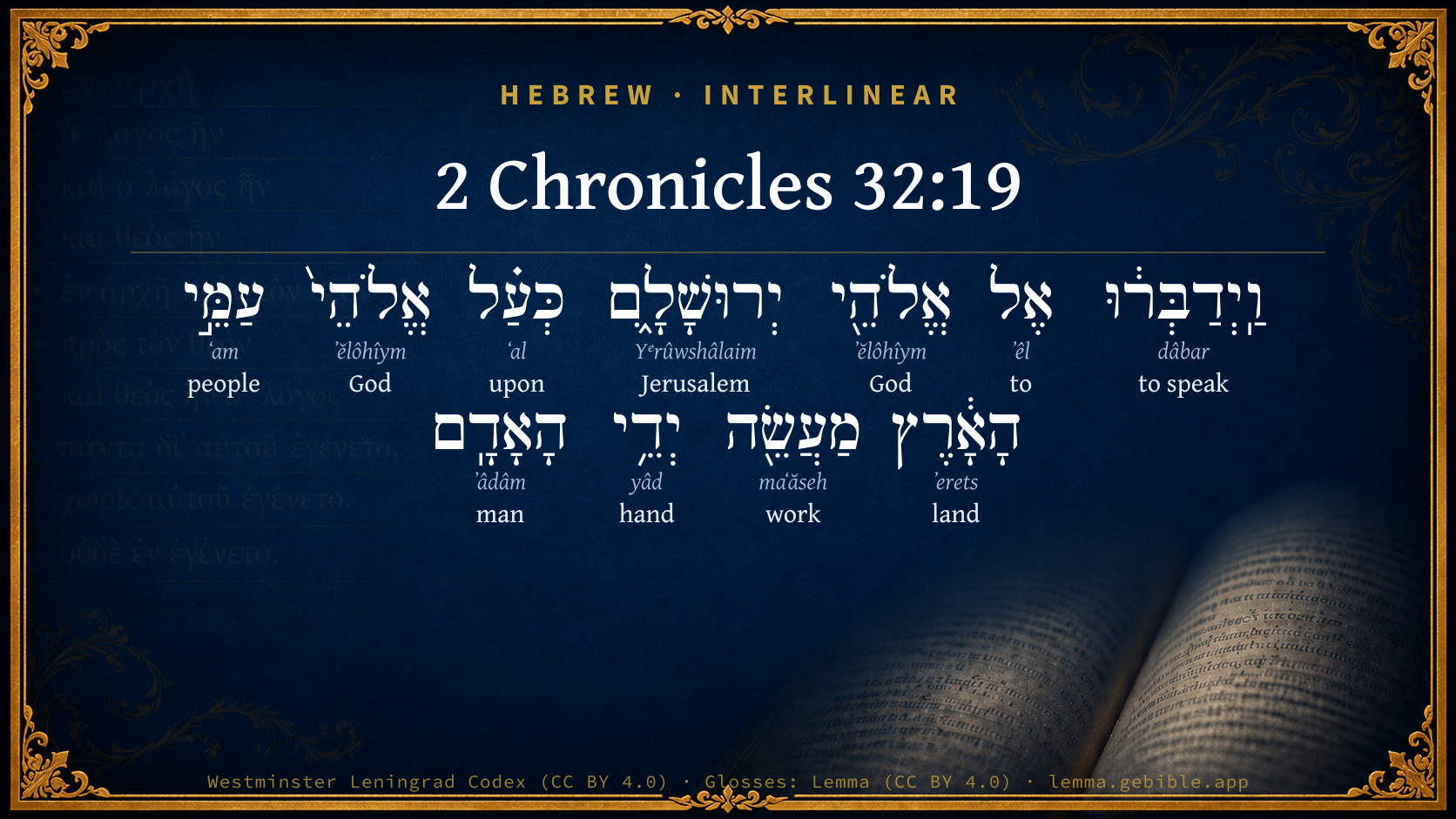
2 Chronicles 32:19

Hebrew (Westminster Leningrad Codex) 2 Chronicles 32:19 appears in the Hebrew Old Testament. The text above is from the Westminster Leningrad Codex. Each word links to its Strong’s number, a concise gloss, and parsing drawn from the Open Scriptures Hebrew Bible morphology. Click any word for its full Brown-Driver-Briggs (BDB) entry.
Download image
Cite this verse

2 Chronicles 32:19 (World English Bible). Public Domain. Lemma interlinear Bible study tool, https://lemma.gebible.app/v/2-chronicles/32/19.

Show BibTeX & RIS
BibTeX
RIS
English Translation
They spoke of the God of Jerusalem, as of the gods of the peoples of the earth, which are the work of men's hands.
World English Bible · Public Domain
Download a study sheet

One document with this verse’s original text, its word-by-word gloss line, the meaning frame, cross-references with their text, attributed commentary, and full source and license credits — printable, and it pastes into notes with its structure intact.

This verse Autodidact and up

Study sheet (.html) Plain text (.txt)

A passage Seminary Student

Up to 50 verses in one chapter. A passage sheet keeps up to 6 commentary sources and 12 cross-references per verse, in the order this page ranks them, and says so on the sheet whenever that leaves anything out. Ask for a single verse and you get the Autodidact verse sheet above.

Everything on this page stays free to read, with no account — the sheet is a download of what is already on screen, not access to it.

Want to remove ads? Support Godless Engineer
Compare translations 3

The same verse in 3 English versions, stacked beneath the original-language interlinear above. Click any original word for its lexicon entry.

Each is an independent rendering of the whole verse — the interlinear is not word-aligned to these translations.

Highlighted words mark where these versions differ — a whole-verse word diff, not a word-by-word alignment.

  • World English Bible Public Domain
    They spoke of the God of Jerusalem, as of the gods of the peoples of the earth, which are the work of men's hands.
  • King James Version Public Domain
    And they spake against the God of Jerusalem, as against the gods of the people of the earth, which were the work of the hands of man.
  • unfoldingWord Literal Text CC BY-SA 4.0
    And they spoke about the God of Jerusalem as against the gods of the peoples of the land, the work of the hands of man.

unfoldingWord Literal Text — © unfoldingWord, licensed CC BY-SA 4.0. Word-aligned USFM3 via Door43 (git.door43.org/unfoldingWord/en_ult).

Versions to compare (up to 4)

3 of 4 selected

Show all 18 translations

Every available English version of this verse, each an independent rendering of the whole verse.

  • World English Bible Public Domain
    They spoke of the God of Jerusalem, as of the gods of the peoples of the earth, which are the work of men's hands.
  • Berean Standard Bible Public Domain
    They spoke against the God of Jerusalem as they had spoken against the gods of the peoples of the earth—the work of human hands.
  • Majority Standard Bible Public Domain
    They spoke against the God of Jerusalem as they had spoken against the gods of the peoples of the earth—the work of human hands.
  • King James Version Public Domain
    And they spake against the God of Jerusalem, as against the gods of the people of the earth, which were the work of the hands of man.
  • American Standard Version (1901) Public Domain
    And they spake of the God of Jerusalem, as of the gods of the peoples of the earth, which are the work of men's hands.
  • Revised Version (1885) Public Domain
    And they spake of the God of Jerusalem, as of the gods of the peoples of the earth, which are the work of men’s hands.
  • Geneva Bible (1599) Public Domain
    Thus they spake against the God of Ierusalem, as against the gods of the people of the earth, euen the workes of mans hands,
  • Douay-Rheims (1899) Public Domain
    And he spoke against the God of Jerusalem, as against the gods of the people of the earth, the works of the hands of men.
  • Young's Literal Translation Public Domain
    and they speak against the God of Jerusalem as against the gods of the peoples of the land -- work of the hands of man.
  • Literal Standard Version CC BY-SA 4.0
    and they speak against the God of Jerusalem as against the gods of the peoples of the land—work of the hands of man.
  • Unlocked Literal Bible CC BY-SA 4.0
    They spoke of the God of Jerusalem as they had spoken of the gods of the other peoples of the earth, which are merely the work of men's hands.
  • unfoldingWord Literal Text CC BY-SA 4.0
    And they spoke about the God of Jerusalem as against the gods of the peoples of the land, the work of the hands of man.
  • Darby Bible Public Domain
    And they spoke of the God of Jerusalem as of the gods of the peoples of the earth, the work of man's hand.
  • World Messianic Bible Public Domain
    They spoke of the God of Jerusalem as of the gods of the peoples of the earth, which are the work of men’s hands.
  • Webster's Bible Public Domain
    And they spoke against the God of Jerusalem, as against the gods of the people of the earth, the work of the hands of man.
  • Free Bible Version CC BY-SA 4.0
    They talked about the God of Jerusalem like they did about the gods of the other nations, gods made by human beings.
  • Bible in Basic English Public Domain
    Talking of the God of Jerusalem as if he was like the gods of the peoples of the earth, the work of men's hands.
  • JPS Tanakh (1917) Public Domain
    And they spoke of the God of Jerusalem, as of the gods of the peoples of the earth, which are the work of men's hands.

Literal Standard Version (2020), Covenant Press — licensed CC BY-SA 4.0. Text via the HelloAO Bible API (eBible.org). Unlocked Literal Bible (unfoldingWord) — licensed CC BY-SA 4.0. Text via the HelloAO Bible API (eBible.org). unfoldingWord Literal Text — © unfoldingWord, licensed CC BY-SA 4.0. Word-aligned USFM3 via Door43 (git.door43.org/unfoldingWord/en_ult). Free Bible Version, Dr. Jonathan Gallagher — licensed CC BY-SA 4.0. Text via the HelloAO Bible API (eBible.org).

Word by word

More ways to search: Search by grammar → Find every occurrence → Compare this word →

Practice this passage: Drill this verse → Learn its vocabulary →

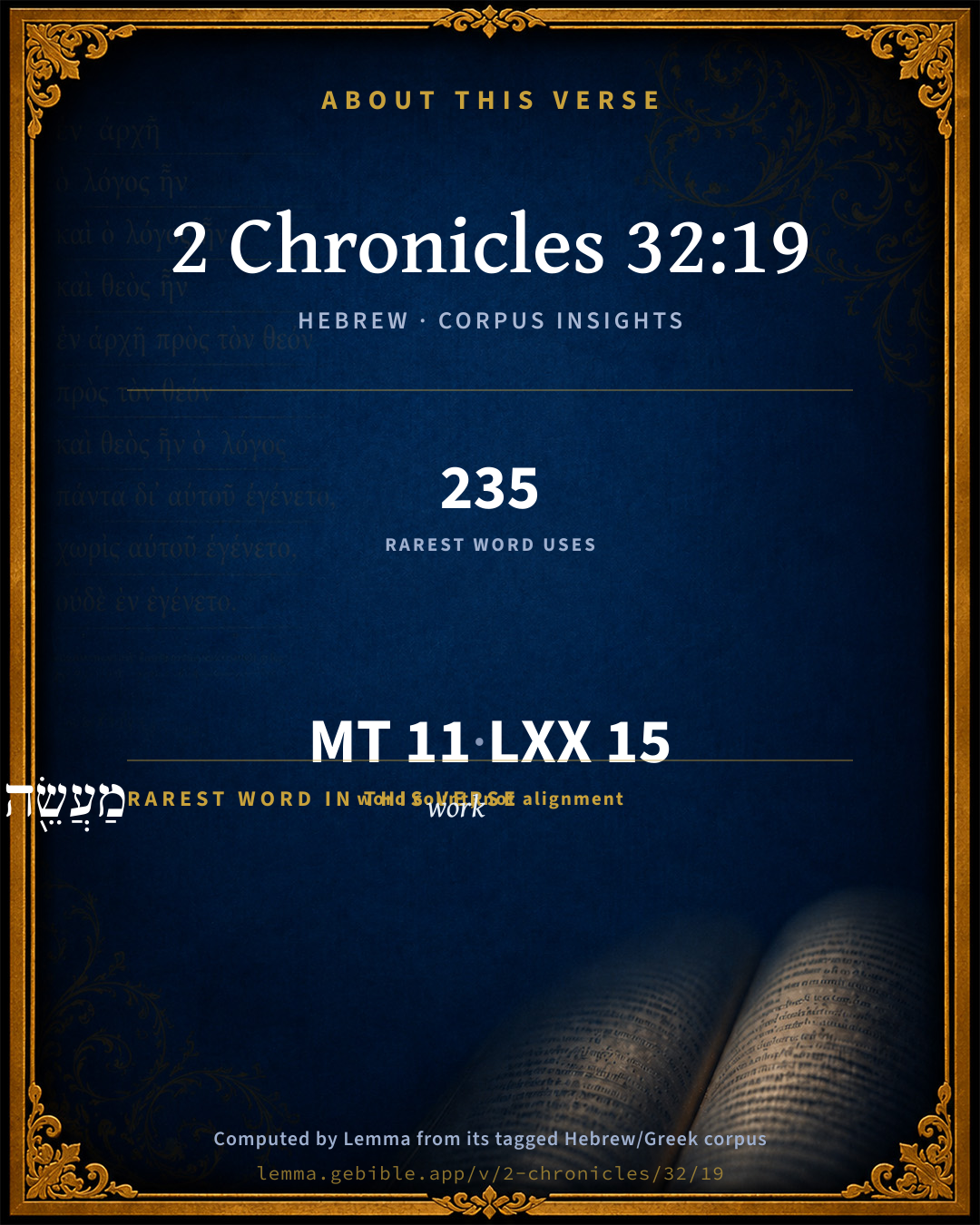
מַעֲשֵׂ֖ה
maʻăseh
H4639
“work of”
Noun, Common, Masculine, Singular, Construct
Part of Speech
Noun
Type
Common
Gender
Masculine
Number
Singular
State
Construct
Full BDB Definition

Origin: from H6213

TWOT: 1708a

deed, work - deed, thing done, act - work, labour - business, pursuit - undertaking, enterprise - achievement - deeds, works (of deliverance and judgment) - work, thing made - work (of God) - product
  1. וַֽיְדַבְּר֔וּ dâbar H1696 “and · to speak” Conjunction + Verb, Piel, Sequential Imperfect, 3rd Person, Masculine, Plural
  2. אֶל ʼêl H413 “to” Preposition
  3. אֱלֹהֵ֖י ʼĕlôhîym H430 “God(s) of” Noun, Common, Masculine, Plural, Construct
  4. יְרוּשָׁלִָ֑ם Yᵉrûwshâlaim H3389 “Jerusalem” Noun, Proper
  5. כְּעַ֗ל ʻal H5921 “like/as · upon” Preposition + Preposition
  6. אֱלֹהֵי֙ ʼĕlôhîym H430 “God(s) of” Noun, Common, Masculine, Plural, Construct
  7. עַמֵּ֣י ʻam H5971 “peoples of” Noun, Common, Masculine, Plural, Construct
  8. הָאָ֔רֶץ ʼerets H776 “the · land” Particle, Definite Article + Noun, Common, Both, Singular, Absolute
  9. יְדֵ֥י yâd H3027 “hands of” Noun, Common, Both, Dual, Construct
  10. הָאָדָֽם ʼâdâm H120 “the · man” Particle, Definite Article + Noun, Common, Masculine, Singular, Absolute

About this verse

These counts appear in no published source. They are computed here, from the morphology-tagged text and Lemma’s own curated glosses. What Lemma adds →

11
words
10
distinct lemmas
Historical
section

Grammatical profile

  • 1 verb
  • 8 nouns
  • 2 prepositions

Verb forms

  • וַֽיְדַבְּר֔וּ Piel · Sequential Imperfect

Repetition

A word recurs within this verse — often emphatic in Hebrew:

  • אֱלֹהֵ֖י God H430 ×2

Hebrew & Septuagint length

In English translation the verse runs 24 words from the Hebrew and 26 from the Septuagint (LXX English) — closely comparable.

A rough comparison of the two English renderings, which tokenize alike — not a word-level alignment.

Word counts can differ between the Hebrew and the Greek without any difference in meaning — e.g. the Hebrew direct-object marker אֵת has no separate Greek word, and Greek often adds the article ὁ.

In the original languages it is 11 Hebrew tokens and 15 Greek tokens — but the two are counted differently (Hebrew bundles its prefixes and suffixes into one token; the Greek is in lemma form), so that isn’t a like-for-like length.

Cross-references

26

Topical passages linked to 2 Chronicles 32:19 in the Treasury of Scripture Knowledge — connected by theme and wording, ordered by reader-vote popularity; previews shown in the World English Bible.

  • 2 Kings 19:18 and have cast their gods into the fire; for they were no gods, but the work of men's hands, wood and stone; therefore they have destroyed them.
  • Isaiah 2:8 Their land also is full of idols. They worship the work of their own hands, That which their own fingers have made.
  • Deuteronomy 4:28 There you shall serve gods, the work of men's hands, wood and stone, which neither see, nor hear, nor eat, nor smell.
  • Deuteronomy 27:15 Cursed be the man who makes an engraved or molten image, an abomination to Yahweh, the work of the hands of the craftsman, and sets it up in secret. All the people shall answer and say, Amen.
  • 1 Samuel 17:36 Your servant struck both the lion and the bear: and this uncircumcised Philistine shall be as one of them, seeing he has defied the armies of the living God.
  • 2 Chronicles 6:6 but I have chosen Jerusalem, that my name might be there; and have chosen David to be over my people Israel.
  • 2 Chronicles 32:13–17 Don't you know what I and my fathers have done to all the peoples of the lands? Were the gods of the nations of the lands in any wise able to deliver their land out of my hand?
  • Job 15:25–26 Because he has stretched out his hand against God, And behaves himself proudly against the Almighty;
  • Psalms 10:13–14 Why does the wicked person condemn God, And say in his heart, "God won't call me into account?"
  • Psalms 73:8–11 They scoff and speak with malice. In arrogance, they threaten oppression.
  • Psalms 76:1–2 In Judah, God is known. His name is great in Israel.
  • Psalms 78:68 But chose the tribe of Judah, Mount Zion which he loved.
  • Psalms 87:1–3 His foundation is in the holy mountains.
  • Psalms 115:4–8 Their idols are silver and gold, The work of men's hands.
  • Psalms 132:13–14 For Yahweh has chosen Zion. He has desired it for his habitation.
  • Psalms 135:15–18 The idols of the nations are silver and gold, The work of men's hands.
  • Psalms 139:19–20 If only you, God, would kill the wicked. Get away from me, you bloodthirsty men!
  • Isaiah 14:32 What then shall one answer the messengers of the nation? That Yahweh has founded Zion, and in her shall the afflicted of his people take refuge.
  • Isaiah 37:19 and have cast their gods into the fire: for they were no gods, but the work of men's hands, wood and stone; therefore they have destroyed them.
  • Isaiah 44:16–20 He burns part of it in the fire; with part of it he eats flesh; he roasts roast, and is satisfied; yes, he warms himself, and says, Aha, I am warm, I have seen the fire.
  • Jeremiah 1:16 I will utter my judgments against them touching all their wickedness, in that they have forsaken me, and have burned incense to other gods, and worshiped the works of their own hands.
  • Jeremiah 10:3 For the customs of the peoples are vanity; for one cuts a tree out of the forest, the work of the hands of the workman with the axe.
  • Jeremiah 10:9 There is silver beaten into plates, which is brought from Tarshish, and gold from Uphaz, the work of the artificer and of the hands of the goldsmith; blue and purple for their clothing; they are all the work of skillful men.
  • Jeremiah 32:30 For the children of Israel and the children of Judah have done only that which was evil in my sight from their youth; for the children of Israel have only provoked me to anger with the work of their hands, says Yahweh.
  • Hosea 8:5–6 Let Samaria throw out his calf-idol! My anger burns against them! How long will it be before the are capable of purity?
  • Hebrews 12:22 But you have come to Mount Zion, and to the city of the living God, the heavenly Jerusalem, and to innumerable hosts of angels,

Cross-references courtesy of OpenBible.info (CC BY 4.0).

Hebrew and Greek witnesses Masoretic Hebrew ↔ Greek Septuagint

The same verse in the two great witnesses to the Old Testament, shown verse-for-verse.

These are two independent witnesses, not word-aligned to each other, and the Septuagint is shown in lemma (dictionary) form.

Hebrew 2 Chronicles 32:19 Masoretic · Westminster Leningrad Codex

וַֽיְדַבְּר֔וּ אֶל אֱלֹהֵ֖י יְרוּשָׁלִָ֑ם כְּעַ֗ל אֱלֹהֵי֙ עַמֵּ֣י הָאָ֔רֶץ מַעֲשֵׂ֖ה יְדֵ֥י הָאָדָֽם

They spoke of the God of Jerusalem, as of the gods of the peoples of the earth, which are the work of men's hands.

World English Bible · Public Domain

Greek LXX 2 Chronicles 32:19 Septuagint · lemma form

καί λαλέω ἐπί θεός ἰερουσαλήμ ὡς καί ἐπί θεός λαός ὁ γῆ ἔργον χείρ ἄνθρωπος

And he spoke against the God of Jerusalem, even as against the gods of the nations of the earth, the works of the hands of men.

LXX2012 (modern English Septuagint) · Public Domain

Hebrew: Westminster Leningrad Codex (CC BY 4.0). Greek: Septuagint (public domain); English from LXX2012 (modern English Septuagint) (Public Domain). How the Septuagint differs from the Hebrew →

Commentary

Notes on 2 Chronicles 32:19 from classic Christian and Jewish commentators (each source and its license shown beneath its notes). The classic Christian expositions comment on the surrounding passage and are grouped to its opening verse, so a note may address several verses; the Jewish commentaries on the Tanakh (Rashi and others) are per-verse, so they appear only where the commentator wrote on this verse.

Lemma curates 59 commentaries, every one of them public domain or Creative Commons licensed, each selected and text-cleaned for this edition rather than reprinted as found. About our sources →

Trapp's Complete Commentary

John Trapp

2Ch 32:19 And they spake against the God of Jerusalem, as against the gods of the people of the earth, [which were] the work of the hands of man.

Ver. 19. As against the gods of the people of the earth.] This was high blasphemy. See on 2Ch 32:15 2Ki 17:30; 2Ki 17:33-41.

John Trapp, A Commentary or Exposition upon All the Books of the Old and New Testament (1647–1656) — public domain. Text from a community e-Sword module.

Geneva Bible (1599)

Geneva Bible translators

Which were invented, made and authorized by man.

Geneva Bible (1599) marginal notes — public domain. Text via Bolls.life.

Ellicott's Commentary for English Readers

(19) They spake against.—Or, spake of Literally, unto. (Comp. Psa_2:7; Psa_3:2.)

People.—Peoples.

The work.—The versions have “works.” Instead of repeating the offers which the Assyrian envoys made to the people of Jerusalem, to induce them to submit, the chronicler dwells on that blasphemy against the God of Israel which was the cause of the Assyrian overthrow.

The work of the hands of man.—A reminiscence of 2Ki_19:18 : “And they put their gods into the fire; for they were no gods, but the work of human hands, wood and stone” (part of Hezekiah’s prayer).

A Bible Commentary for English Readers, edited by Charles John Ellicott (1878–1897) — public domain. Text from a community e-Sword module.

The Cambridge Bible for Schools and Colleges

gen. ed. J. J. S. Perowne

19. against the God of Jerusalem] R.V. of the God of Jerusalem. For this designation cp. Psa_135:21.

as against the gods of the people] R.V. as of the gods of the peoples.

which were the work of the hands of man] R.V. which are the work of men’s hands. Cp. Psa_135:15-18.

The Cambridge Bible for Schools and Colleges (gen. ed. J. J. S. Perowne; Cambridge University Press, 1878–1918) — public domain. Text from a community e-Sword module.

John Gill's Exposition

And many brought gifts unto the Lord to Jerusalem,.... Even out of neighbouring nations, things which they devoted to the service of God in the temple, being convinced that this wonderful deliverance was wrought by the Lord God of Israel, and by him only:

and presents to Hezekiah king of Judah; being desirous of living in friendship with him, who appeared to be the favourite of the God of heaven:

so that he was magnified in the sight of all nations from thenceforth; from the time of the destruction of the Assyrian army in such a wonderful manner, he was highly esteemed, and his name and fame spread abroad among all the neighbouring nations round about him.

John Gill's Exposition of the Whole Bible (1746–1763) — public domain (CC PDM 1.0). Text via the HelloAO Bible API.

The Pulpit Commentary

As against the gods of the people of the earth, the work of the hands of men. Our compiler, at all events, signalizes the difference, which Sennacherib worse than minimizes, between the God of Israel and the so-called gods of the surrounding heathen nations.

The Pulpit Commentary (1880–1919), ed. H.D.M. Spence-Jones & Joseph S. Exell — public domain. Text from a community e-Sword module.

Rashi

Rabbi Shlomo Yitzchaki (Rashi)

And they spoke of the God of Jerusalem The author of this Book complains about the villain Sennacherib, who blasphemed the living God.

as of the gods of the peoples of the land which are the handiwork of man, and they compared the God, our Maker, Who formed everything, to the gods of the peoples, who are their own handiwork, as is written above (v. 14): “Who is it among all the gods of, etc. that your God should be able to save you from my hand?”

Rashi on the Tanakh — English translations: “The Judaica Press complete Tanach with Rashi, translated by A. J. Rosenberg” (CC BY 4.0); “Pentateuch with Rashi's commentary by M. Rosenbaum and A.M. Silbermann, 1929-1934” (public domain); “The Metsudah Tanach series, Lakewood, N.J” (CC BY 4.0); and “The Book of Joshua, Metsudah Publications, 1997” (CC BY 4.0). Text via Sefaria.

Lesson kit

Teaching starters — assembled from the data on this page, not authored interpretation. Every prompt links to the verse data it draws on. Edit before teaching.

2 Chronicles, in the Historical, opens this verse with 11 words (10 distinct Hebrew lemmas). Its most distinctive word is maʻăseh (“work”). A historical commentator’s framing appears above. Read the whole chapter for the surrounding context.

Discussion questions

  1. How does “work” (maʻăseh) shape what this verse is saying?
  2. How does 2 Kings 19:18, which shares this passage’s theme, read alongside this verse?
  3. What does the repetition of “God” (2× in this one verse) do in this verse?
  4. These translations render this verse differently; the difference is in the English rendering, not the original. What questions does that raise?
  5. «וַֽיְדַבְּר֔וּ» is a Piel Sequential Imperfect verb. How does that grammatical form shape the action described?
  6. Compare how Trapp's Complete Commentary and Geneva Bible (1599) read this verse. Where do they agree or differ?

Things to notice

Reading settings

Reading text

Shown beneath each verse's original-language words.

Old Testament
Old Testament edition

Read the OT as the Masoretic Hebrew (MT) or the Greek Septuagint (LXX).

English shown for the Greek Septuagint (in the Hebrew ↔ Greek comparison).

Comparing translations? Open the Compare panel on any verse page to stack up to four side by side.