Isaiah 65:18

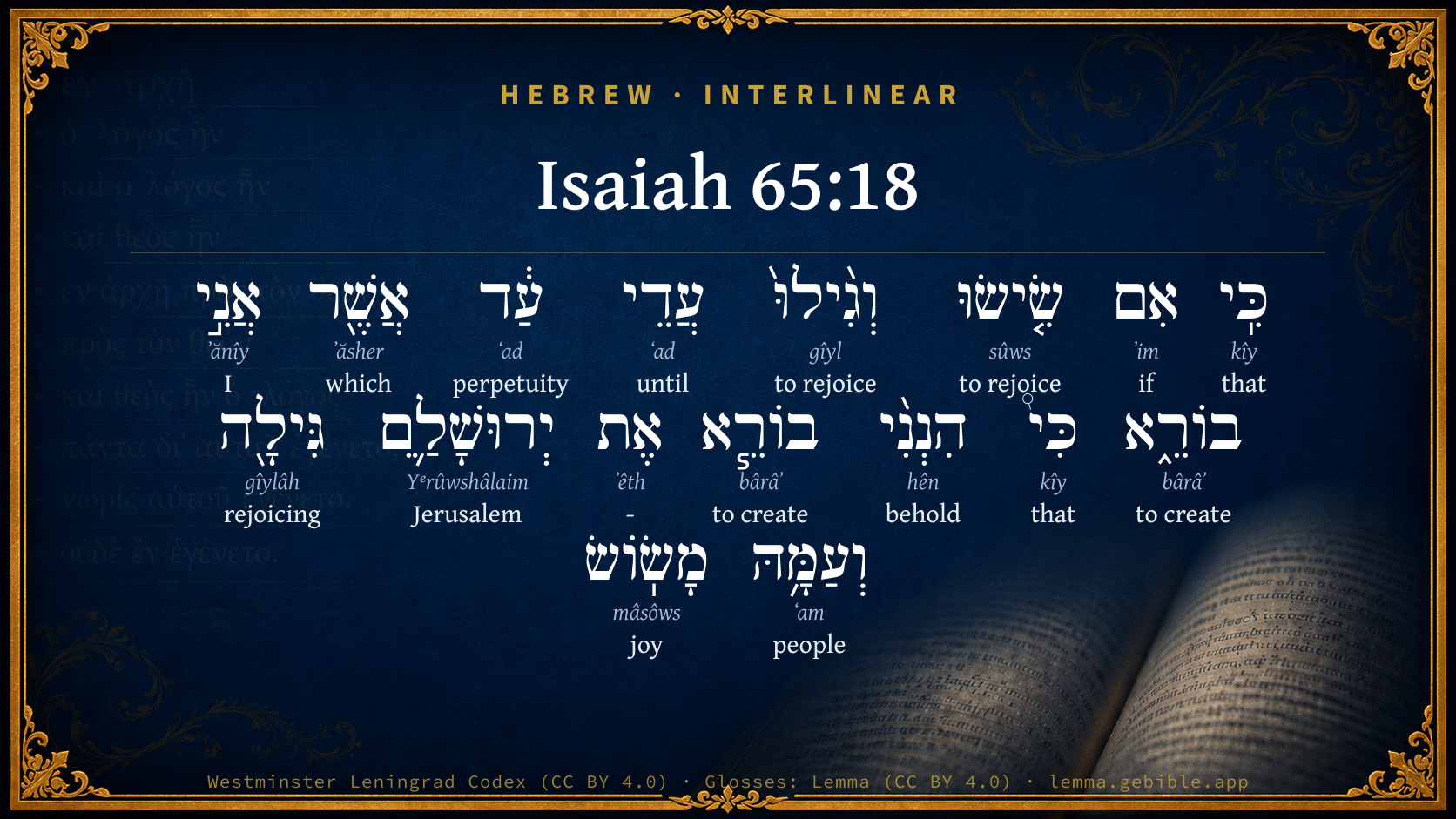
Hebrew (Westminster Leningrad Codex) Isaiah 65:18 appears in the Hebrew Old Testament. The text above is from the Westminster Leningrad Codex. Each word links to its Strong’s number, a concise gloss, and parsing drawn from the Open Scriptures Hebrew Bible morphology. Click any word for its full Brown-Driver-Briggs (BDB) entry.
Download image
Cite this verse

Isaiah 65:18 (World English Bible). Public Domain. Lemma interlinear Bible study tool, https://lemma.gebible.app/v/isaiah/65/18.

Show BibTeX & RIS
BibTeX
RIS
English Translation
But be you glad and rejoice forever in that which I create; for, behold, I create Jerusalem a rejoicing, and her people a joy.
World English Bible · Public Domain
Download a study sheet

One document with this verse’s original text, its word-by-word gloss line, the meaning frame, cross-references with their text, attributed commentary, and full source and license credits — printable, and it pastes into notes with its structure intact.

This verse Autodidact and up

Study sheet (.html) Plain text (.txt)

A passage Seminary Student

Up to 50 verses in one chapter. A passage sheet keeps up to 6 commentary sources and 12 cross-references per verse, in the order this page ranks them, and says so on the sheet whenever that leaves anything out. Ask for a single verse and you get the Autodidact verse sheet above.

Everything on this page stays free to read, with no account — the sheet is a download of what is already on screen, not access to it.

Want to remove ads? Support Godless Engineer
Compare translations 3

The same verse in 3 English versions, stacked beneath the original-language interlinear above. Click any original word for its lexicon entry.

Each is an independent rendering of the whole verse — the interlinear is not word-aligned to these translations.

Highlighted words mark where these versions differ — a whole-verse word diff, not a word-by-word alignment.

  • World English Bible Public Domain
    But be you glad and rejoice forever in that which I create; for, behold, I create Jerusalem a rejoicing, and her people a joy.
  • King James Version Public Domain
    But be ye glad and rejoice for ever in that which I create: for, behold, I create Jerusalem a rejoicing, and her people a joy.
  • unfoldingWord Literal Text CC BY-SA 4.0
    But rejoice and be glad until forever what I am creating, for behold me, creating Jerusalem a rejoicing, and its people a joy.

unfoldingWord Literal Text — © unfoldingWord, licensed CC BY-SA 4.0. Word-aligned USFM3 via Door43 (git.door43.org/unfoldingWord/en_ult).

Versions to compare (up to 4)

3 of 4 selected

Show all 18 translations

Every available English version of this verse, each an independent rendering of the whole verse.

  • World English Bible Public Domain
    But be you glad and rejoice forever in that which I create; for, behold, I create Jerusalem a rejoicing, and her people a joy.
  • Berean Standard Bible Public Domain
    But be glad and rejoice forever in what I create; for I will create Jerusalem to be a joy and its people to be a delight.
  • Majority Standard Bible Public Domain
    But be glad and rejoice forever in what I create; for I will create Jerusalem to be a joy and its people to be a delight.
  • King James Version Public Domain
    But be ye glad and rejoice for ever in that which I create: for, behold, I create Jerusalem a rejoicing, and her people a joy.
  • American Standard Version (1901) Public Domain
    But be ye glad and rejoice for ever in that which I create; for, behold, I create Jerusalem a rejoicing, and her people a joy.
  • Revised Version (1885) Public Domain
    But be ye glad and rejoice for ever in that which I create: for, behold, I create Jerusalem a rejoicing, and her people a joy.
  • Geneva Bible (1599) Public Domain
    But be you glad and reioyce for euer in the things that I shall create: for beholde, I will create Ierusalem, as a reioycing and her people as a ioye,
  • Douay-Rheims (1899) Public Domain
    But you shall be glad and rejoice for ever in these things, which I create: for behold I create Jerusalem a rejoicing, end the people thereof joy.
  • Young's Literal Translation Public Domain
    But joy ye, and rejoice for ever, that I `am' Creator, For, lo, I am creating Jerusalem a rejoicing, And her people a joy.
  • Literal Standard Version CC BY-SA 4.0
    But rejoice, and rejoice forever, that I [am] Creator, || For behold, I am creating Jerusalem [to be] a rejoicing, || And her people a joy.
  • Unlocked Literal Bible CC BY-SA 4.0
    But you will be glad and rejoice forever in what I am about to create. See, I am about to create Jerusalem as a joy, and her people as a delight.
  • unfoldingWord Literal Text CC BY-SA 4.0
    But rejoice and be glad until forever what I am creating, for behold me, creating Jerusalem a rejoicing, and its people a joy.
  • Darby Bible Public Domain
    But be glad and rejoice for ever in that which I create. For behold, I create Jerusalem a rejoicing, and her people a joy.
  • World Messianic Bible Public Domain
    But be glad and rejoice forever in that which I create; for, behold, I create Jerusalem to be a delight, and her people a joy.
  • Webster's Bible Public Domain
    But be ye glad and rejoice for ever in that which I create: for behold, I create Jerusalem a rejoicing, and her people a joy.
  • Free Bible Version CC BY-SA 4.0
    Be glad, and be happy forever and ever in what I'm going to create, for I will make Jerusalem a delightful place, and its people a real joy.
  • Bible in Basic English Public Domain
    But men will be glad and have joy for ever in what I am making; for I am making Jerusalem a delight, and her people a joy.
  • JPS Tanakh (1917) Public Domain
    But be ye glad and rejoice for ever in that which I create; for, behold, I create Jerusalem a rejoicing, and her people a joy.

Literal Standard Version (2020), Covenant Press — licensed CC BY-SA 4.0. Text via the HelloAO Bible API (eBible.org). Unlocked Literal Bible (unfoldingWord) — licensed CC BY-SA 4.0. Text via the HelloAO Bible API (eBible.org). unfoldingWord Literal Text — © unfoldingWord, licensed CC BY-SA 4.0. Word-aligned USFM3 via Door43 (git.door43.org/unfoldingWord/en_ult). Free Bible Version, Dr. Jonathan Gallagher — licensed CC BY-SA 4.0. Text via the HelloAO Bible API (eBible.org).

Word by word

More ways to search: Search by grammar → Find every occurrence → Compare this word →

Practice this passage: Drill this verse → Learn its vocabulary →

גִּילָ֖ה
gîylâh
H1525
“rejoicing”
Noun, Common, Feminine, Singular, Absolute
Part of Speech
Noun
Type
Common
Gender
Feminine
Number
Singular
State
Absolute
Full BDB Definition

Origin: from H1524

TWOT: 346c

rejoicing
  1. כִּֽי kîy H3588 “that” Conjunction
  2. אִם ʼim H518 “if” Conjunction
  3. שִׂ֤ישׂוּ sûws H7797 “rejoice” Verb, Qal, Imperative, 2nd Person, Masculine, Plural
  4. וְגִ֨ילוּ֙ gîyl H1523 “and · rejoice” Conjunction + Verb, Qal, Imperative, 2nd Person, Masculine, Plural
  5. עֲדֵי ʻad H5704 “until” Preposition
  6. עַ֔ד ʻad H5703 “perpetuity” Noun, Common, Masculine, Singular, Absolute
  7. אֲשֶׁ֖ר ʼăsher H834 “which” Particle, Relative
  8. אֲנִ֣י ʼănîy H589 “I” Pronoun, Personal, 1st Person, Common, Singular
  9. בוֹרֵ֑א bârâʼ H1254 “creating” Verb, Qal, Participle Active, Masculine, Singular, Absolute
  10. כִּי֩ kîy H3588 “that” Conjunction
  11. הִנְנִ֨י hên H2005 “behold · me” Particle, Demonstrative + Suffix, Personal, 1st Person, Common, Singular
  12. בוֹרֵ֧א bârâʼ H1254 “creating” Verb, Qal, Participle Active, Masculine, Singular, Absolute
  13. אֶת ʼêth H853 “-” Particle, Direct Object
  14. יְרוּשָׁלִַ֛ם Yᵉrûwshâlaim H3389 “Jerusalem” Noun, Proper
  15. וְעַמָּ֥הּ ʻam H5971 “and · people · her” Conjunction + Noun, Common, Masculine, Singular, Construct + Suffix, Personal, 3rd Person, Feminine, Singular
  16. מָשֽׂוֹשׂ mâsôws H4885 “joy” Noun, Common, Masculine, Singular, Absolute

About this verse

These counts appear in no published source. They are computed here, from the morphology-tagged text and Lemma’s own curated glosses. What Lemma adds →

17
words
15
distinct lemmas
Prophets
section

Notable vocabulary

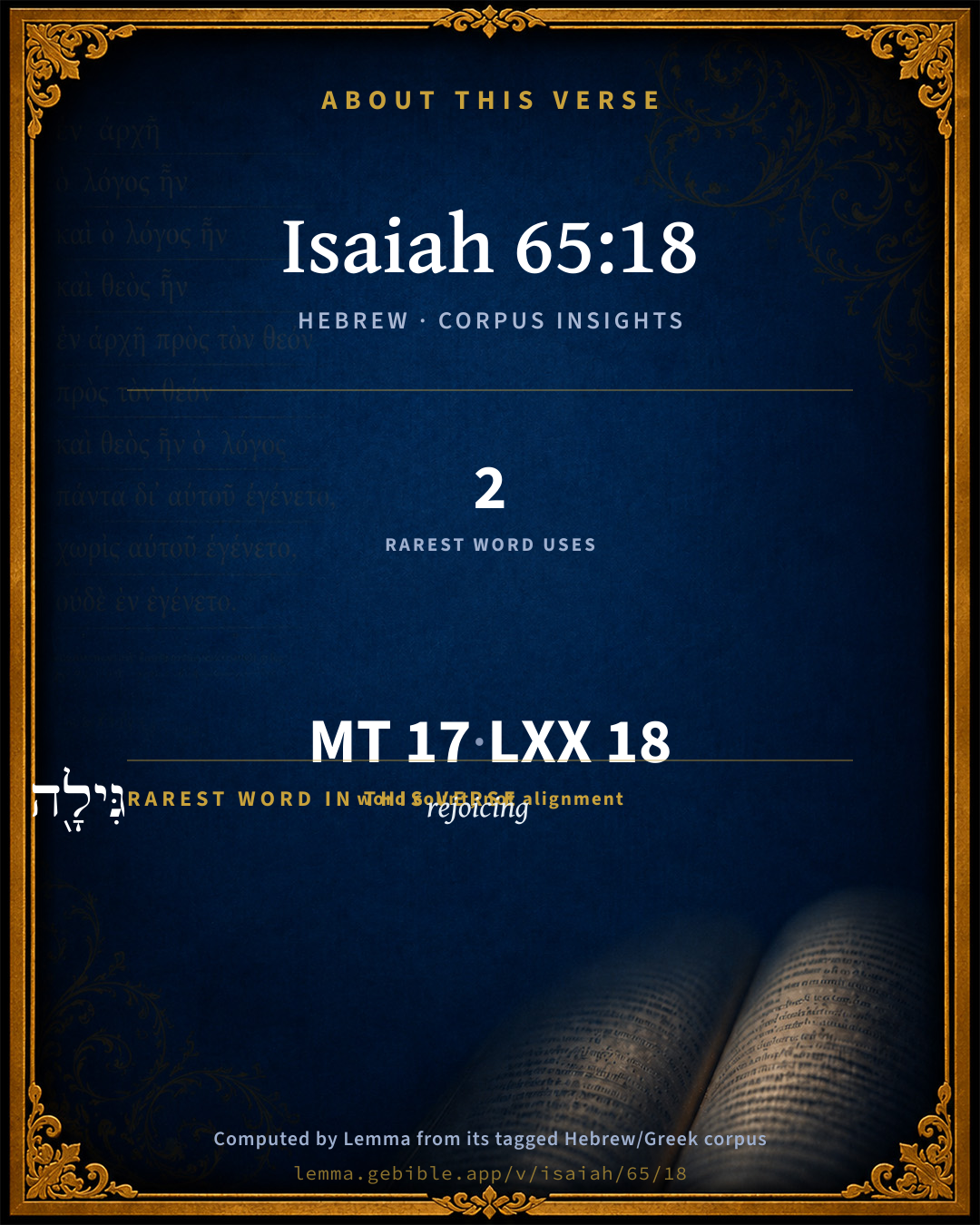
The rarest word here is גִּילָ֖ה rejoicing H1525 — appearing just 2 times in the whole Hebrew Bible.

Shared distinctive vocabulary

גִּילָ֖ה rejoicing H1525 occurs in 2 verses of the Hebrew Bible. Also found in:

Grammatical profile

  • 4 verbs
  • 5 nouns
  • 1 pronoun
  • 1 preposition
  • 3 conjunctions
  • 3 particles

Verb forms

  • שִׂ֤ישׂוּ Qal · Imperative
  • וְגִ֨ילוּ֙ Qal · Imperative
  • בוֹרֵ֑א Qal · Participle Active
  • בוֹרֵ֧א Qal · Participle Active

Repetition

Words recur within this verse — often emphatic in Hebrew:

  • בוֹרֵ֑א to create H1254 ×2
  • כִּֽי that H3588 ×2

Hebrew & Septuagint length

In English translation the verse runs 24 words from the Hebrew and 21 from the Septuagint (LXX English) — closely comparable.

A rough comparison of the two English renderings, which tokenize alike — not a word-level alignment.

Word counts can differ between the Hebrew and the Greek without any difference in meaning — e.g. the Hebrew direct-object marker אֵת has no separate Greek word, and Greek often adds the article ὁ.

In the original languages it is 17 Hebrew tokens and 18 Greek tokens — but the two are counted differently (Hebrew bundles its prefixes and suffixes into one token; the Greek is in lemma form), so that isn’t a like-for-like length.

Cross-references

16

Topical passages linked to Isaiah 65:18 in the Treasury of Scripture Knowledge — connected by theme and wording, ordered by reader-vote popularity; previews shown in the World English Bible.

  • Psalms 98:1–9 Sing to Yahweh a new song, For he has done marvelous things! His right hand, and his holy arm, have worked salvation for him.
  • Isaiah 66:10–14 Rejoice you with Jerusalem, and be glad for her, all you who love her: rejoice for joy with her, all you who mourn over her;
  • Revelation 11:15–18 The seventh angel sounded, and great voices in heaven followed, saying, "The kingdom of the world has become the Kingdom of our Lord, and of his Christ. He will reign forever and ever!"
  • Revelation 19:1–6 After these things I heard something like a loud voice of a great multitude in heaven, saying, "Hallelujah! Salvation, power, and glory belong to our God:
  • Psalms 67:3–5 Let the peoples praise you, God. Let all the peoples praise you.
  • Psalms 96:10–13 Say among the nations, "Yahweh reigns." The world is also established. It can't be moved. He will judge the peoples with equity.
  • Isaiah 12:4–6 In that day you will say, "Give thanks to Yahweh! Call on his name. Declare his doings among the peoples. Proclaim that his name is exalted!
  • Isaiah 25:9 It shall be said in that day, Behold, this is our God; we have waited for him, and he will save us: this is Yahweh; we have waited for him, we will be glad and rejoice in his salvation.
  • Isaiah 44:23 Sing, you heavens, for Yahweh has done it; shout, you lower parts of the earth; break forth into singing, you mountains, O forest, and every tree therein: for Yahweh has redeemed Jacob, and will glorify himself in Israel.
  • Isaiah 49:13 Sing, heavens; and be joyful, earth; and break forth into singing, mountains: for Yahweh has comforted his people, and will have compassion on his afflicted.
  • Isaiah 52:7–10 How beautiful on the mountains are the feet of him who brings good news, who publishes peace, who brings good news of good, who publishes salvation, who says to Zion, Your God reigns!
  • Zechariah 9:9 Rejoice greatly, daughter of Zion! Shout, daughter of Jerusalem! Behold, your king comes to you! He is righteous, and having salvation; Lowly, and riding on a donkey, Even on a colt, the foal of a donkey.
  • 1 Thessalonians 5:16 Rejoice always.
  • Isaiah 42:10–12 Sing to Yahweh a new song, and his praise from the end of the earth; you who go down to the sea, and all that is therein, the isles, and the inhabitants of it.
  • Isaiah 51:11 The ransomed of Yahweh shall return, and come with singing to Zion; and everlasting joy shall be on their heads: they shall obtain gladness and joy; [and] sorrow and sighing shall flee away.
  • Zephaniah 3:14 Sing, daughter of Zion! Shout, Israel! Be glad and rejoice with all your heart, daughter of Jerusalem.

Cross-references courtesy of OpenBible.info (CC BY 4.0).

Hebrew and Greek witnesses Masoretic Hebrew ↔ Greek Septuagint

The same verse in the two great witnesses to the Old Testament, shown verse-for-verse.

These are two independent witnesses, not word-aligned to each other, and the Septuagint is shown in lemma (dictionary) form.

Hebrew Isaiah 65:18 Masoretic · Westminster Leningrad Codex

כִּֽי אִם שִׂ֤ישׂוּ וְגִ֨ילוּ֙ עֲדֵי עַ֔ד אֲשֶׁ֖ר אֲנִ֣י בוֹרֵ֑א כִּי֩ הִנְנִ֨י בוֹרֵ֧א אֶת יְרוּשָׁלִַ֛ם גִּילָ֖ה וְעַמָּ֥הּ מָשֽׂוֹשׂ

But be you glad and rejoice forever in that which I create; for, behold, I create Jerusalem a rejoicing, and her people a joy.

World English Bible · Public Domain

Greek LXX Isaiah 65:18 Septuagint · lemma form

ἀλλά εὐφροσύνη καί ἀγαλλίαμα εὑρίσκω ἐν αὐτός ὅτι ἰδού ἐγώ ποιέω ἰερουσαλήμ ἀγαλλίαμα καί ὁ λαός ἐγώ εὐφροσύνη

But they shall find in her joy and exultation; for, behold, I make Jerusalem a rejoicing, and my people a joy.

LXX2012 (modern English Septuagint) · Public Domain

On this verse, John Gill's Exposition discusses the Septuagint’s reading. Read the note in Commentary ↓

Hebrew: Westminster Leningrad Codex (CC BY 4.0). Greek: Septuagint (public domain); English from LXX2012 (modern English Septuagint) (Public Domain). How the Septuagint differs from the Hebrew →

Targum (Aramaic paraphrase)

1

The Targum is the ancient Jewish Aramaic paraphrase of the Hebrew Scriptures — an interpretive translation, not the Hebrew text itself. Onkelos (literal) and Pseudo-Jonathan (expansive) render the Torah, and Jonathan the Prophets. Coverage is partial: where no permissively-licensed English translation exists for a verse, only the Aramaic is shown. This is verse-level text, not a word-by-word alignment to the Hebrew.

  1. Targum Jonathan Prophets (Joshua–Malachi)
    אֱלָהֵין יֶחְדוּן וִיבוּעוּן בַּעֲלַם עָלְמַיָא דַאֲנָא בָרֵי אֲרֵי הָא אֲנָא בָרֵי יַת יְרוּשְׁלֵם בִּיעָא וְעַמָהּ חָדֵי:

    But be ye glad and rejoice in the world of worlds, which I create; for behold, I create Jerusalem a rejoicing, and her people a joy.

    Targum Jonathan — Aramaic: “Mikraot Gedolot” (public domain). English: “Sefaria Community Translation” (CC0 1.0 (public-domain dedication)); “London "Chaldee Paraphrase," 1871” (public domain). Text via Sefaria.

Commentary

Notes on Isaiah 65:18 from classic Christian and Jewish commentators (each source and its license shown beneath its notes). The classic Christian expositions comment on the surrounding passage and are grouped to its opening verse, so a note may address several verses; the Jewish commentaries on the Tanakh (Rashi and others) are per-verse, so they appear only where the commentator wrote on this verse.

Lemma curates 59 commentaries, every one of them public domain or Creative Commons licensed, each selected and text-cleaned for this edition rather than reprinted as found. About our sources →

Trapp's Complete Commentary

John Trapp

Isa 65:18 But be ye glad and rejoice for ever [in that] which I create: for, behold, I create Jerusalem a rejoicing, and her people a joy.

Ver. 18. But be glad and rejoice for ever.] What can ye be less than everlastingly merry when you consider your gospel privileges, which are such as may well swallow up all discontents, and make you "more than conquerors," and that is triumphers?

For, behold, I create Jerusalem a rejoicing.] Creo talem Ierusalem ut sit ei nomen tripudium, et populus eius vocetur gaudium. {a} Hence it appeareth that these things are not to be taken according to the letter, but of "Jerusalem which is above, that mother of us all."

{a} Oecolamp.

John Trapp, A Commentary or Exposition upon All the Books of the Old and New Testament (1647–1656) — public domain. Text from a community e-Sword module.

Tyndale Open Study Notes

Tyndale Open Resources

65:18-19 Jerusalem here symbolizes God’s eternal kingdom (Rev 21:1-4).

Tyndale Open Study Notes — © Tyndale Open Resources, licensed CC BY-SA 4.0. Text via the HelloAO Bible API.

Jamieson, Fausset & Brown

Robert Jamieson, A. R. Fausset & David Brown

rejoice for ever . . . Jerusalem-- (Isa 51:11). "Everlasting joy . . . Zion." Spiritually (Th1 5:16).

Jamieson, Fausset & Brown — Commentary Critical and Explanatory on the Whole Bible (1871) — public domain (CC PDM 1.0). Text via the HelloAO Bible API.

Adam Clarke's Commentary

Verse 18. Rejoice for ever in that which I create - "Exult in the age to come which I create"] So in Isa 9:6 אבי עד abi ad, πατηρ του μελλοντος αιωνος, "the father of the age to come," Sept. See Bishop Chandler, Defence of Christianity, p. 136.

Adam Clarke's Commentary on the Bible (1810–1826) — public domain. Text from a community e-Sword/MySword module.

Ellicott's Commentary for English Readers

(18) I create Jerusalem . . .—From the prophet’s stand-point, as elsewhere, both in 1 and 2 Isaiah, the earthly city, transformed and transfigured, occupies the central place in the new creation. In the New Testament we note the transfer of the promise to the unseen eternal city, the Jerusalem which is above (Gal_4:26; Rev_21:10).

A Bible Commentary for English Readers, edited by Charles John Ellicott (1878–1897) — public domain. Text from a community e-Sword module.

The Cambridge Bible for Schools and Colleges

gen. ed. J. J. S. Perowne

18. I create Jerusalem a rejoicing &c.] i.e. either an object in which one may rejoice (Isa_65:19, ch. Isa_60:15) or an abode of joy (ch. Isa_51:3, Isa_61:7).

The Cambridge Bible for Schools and Colleges (gen. ed. J. J. S. Perowne; Cambridge University Press, 1878–1918) — public domain. Text from a community e-Sword module.

John Gill's Exposition

But be you glad, and rejoice for ever in that which I create,.... This may refer either to persons converted, both at the beginning of the Gospel, and in the latter day, whether Jews or Gentiles; who are the Lord's creation, or new creatures, being made new men; having new hearts and spirits given them, or created within them; new principles of life, light, grace, and holiness, wrought in them, which are the produce of almighty and creating power; and all such instances are matter of joy, as to the angels in heaven, so to the saints on earth, and especially to the ministers of the Gospel; because of the grace bestowed on men, the glory brought to God, and their own ministry blessed and succeeded, and so their hands and hearts strengthened: or else this refers to the state of things under the Gospel dispensation, in every age of it, and especially in some periods of it, particularly the first and last; and the whole indeed is a new world or state of God's creating, and is matter of joy to all the people of God. The Targum renders it,

"rejoice in the world of worlds, which I create:''

agreeably to which is the version of Bishop Chandler (g),

"rejoice for the age to come, that I create;''

the world to come, Heb 2:5, which Christ is said to be the father of, in the Septuagint version of Isa 9:6, the Gospel dispensation, the Messiah's future world, as opposed to the legal dispensation.

For, behold, I create Jerusalem a rejoicing, and her people a joy; that is, do that for them, through the mighty power of his grace, as will justly occasion joy to them, and to all others well affected to them; the conversion of the Jews will be matter of joy to the Gentiles; and that, and the bringing in of the fulness of the Gentiles, as well as the destruction of antichrist, which will occasion a new face of things in the world, will be matter of joy to the whole church; see Rev 18:20.

(g) Defence of Christianity, c. 2. sect. 2.

John Gill's Exposition of the Whole Bible (1746–1763) — public domain (CC PDM 1.0). Text via the HelloAO Bible API.

Albert Barnes' Notes on the Bible

But be ye glad and rejoice - (See the notes at Isa 51:11).

Forever - It is not to be momentary happiness - like a bright morning that is soon overcast with clouds. The joy of God’s people is to endure for ever, and they shall have ceaseless cause of praise and thanksgiving.

I create Jerusalem a rejoicing - A source of rejoicing; or a place of rejoicing.

And her people a joy - That is, in themselves joyful, and a source of joy to all others. The idea is, that the church would be a place of the highest happiness, and that they who were redeemed would have occasion of perpetual joy. The Saviour did not come to minister gloom, nor is the true effect of religion to make his people melancholy. Religion produces seriousness; but seriousness is not inconsistent with permanent happiness. Religion produces deep thought and soberness of deportment and conversation; but this is not inconsistent with a heart at ease, or with a good conscience, or with permanent joy. Religion fills the mind with hope of eternal life; and the highest happiness which the soul can know must be in connection with the prospect of unchanging blessedness beyond the grave.

Albert Barnes' Notes on the Bible (1834–1885) — public domain. Text from a community e-Sword/MySword module.

Matthew Poole's English Annotations

You that are my people, though you cannot rejoice with that degree of joy that attendeth a present fruition of good; yet be glad, and rejoice with the

rejoicing of hope, for the thing is certain what I am already doing. Nor let your present state, or the discouragements you have from seeming improbabilities, spoil your joy; for it is not a work to be produced in an ordinary course, or by an ordinary power, but by the power of me, who bring something out of nothing, or out of what hath no fittedness to such a production; and I will create

Jerusalem a rejoicing, and her people a joy: by Jerusalem here must be meant the church, as well under the gospel as under the law (because the gospel church is grafted into that olive); or else this prophecy must be understood as fulfilled in the coming of Christ, Luk 2:10; or else it referreth to a more full calling of the Jews than we have yet seen or heard of.

Matthew Poole's English Annotations on the Holy Bible (1683–1685) — public domain. Text from a community e-Sword/MySword module.

The Pulpit Commentary

I create Jerusalem. (comp. Rev_21:2, "I, John, saw the holy city, new Jerusalem, coming down from God out of heaven, prepared as a bride adorned for her husband The description which follows in vers. 11, 12 is quite unlike that of the old Jerusalem. A rejoicing. The "new Jerusalem" was to be from the first all joy and rejoicing a scene of perpetual gladness. Her people also was to be "a joy" or "a delight," since God would delight in them (ver. 19).

The Pulpit Commentary (1880–1919), ed. H.D.M. Spence-Jones & Joseph S. Exell — public domain. Text from a community e-Sword module.

John Wesley's Explanatory Notes

You - The church, as well under the gospel, as under the law.

John Wesley, Explanatory Notes Upon the Whole Bible (1754–1765) — public domain. Text via the GEBible commentary corpus.

J. A. Alexander on Isaiah

Joseph Addison Alexander

“But rejoice and be glad into eternity (in) that which I (am) creating, for lo I (am) creating Jerusalem a joy, and her people a rejoicing,” (i.e., a subject or occasion of it). It would be highly arbitrary to explain ‘what I create’ in this place, as different from the creation in the verse preceding. It is there said that a creation shall take place. It is here enjoined upon God’s people to rejoice in it. But here the creation is declared to be the making of Jerusalem a joy and Israel a rejoicing. Now the whole analogy of the foregoing prophecies leads to the conclusion that this means the exaltation of the church or chosen people; and the same analogy admits of that exaltation being represented as a revolution in the frame of nature. On the other hand, a literal prediction of new heavens and new earth would scarcely have been followed by a reference merely to the church; and if Jerusalem and Zion be explained to mean the literal Jerusalem and the restored Jews, the only alternative is then to conclude that as soon as they return to Palestine, it and the whole earth are to be renewed, or else that what relates to Jerusalem and Israel is literal, and what relates to the heavens and the earth metaphorical, although, as we have just seen, the connection of the verses renders it necessary to regard the two events as one. From all these incongruities we are relieved by understanding the whole passage as a poetical description of a complete and glorious change.

Joseph Addison Alexander, The Prophecies of Isaiah (1846–1847; New York: Scribner, 1870–1878) — public domain. Text from a community e-Sword module.

Ibn Ezra

Rabbi Abraham ibn Ezra

עדי עד Long years. For at last man dies (comp. vers. 20). הנני בורא את ירושלים Behold, I make Jerusalem. From this passage it can be proved that the word ברא does not mean to create (to produce from non-existence into existence) but to form, to renew.

Ibn Ezra on the Tanakh — English translations: “Sefaria Community Translation” (CC0 1.0 (public-domain dedication)); “Yalkut, Sifsei Chachomim Chumash, Metsudah Publications, 2009” (CC BY 4.0); and “Commentary of Ibn Ezra on Isaiah - trans. by M. Friedlander, 1873” (public domain). Text via Sefaria.

Lesson kit

Teaching starters — assembled from the data on this page, not authored interpretation. Every prompt links to the verse data it draws on. Edit before teaching.

Isaiah, in the Prophets, opens this verse with 17 words (15 distinct Hebrew lemmas). Its most distinctive word is gîylâh (“rejoicing”). A historical commentator’s framing appears above. Read the whole chapter for the surrounding context.

Discussion questions

  1. How does “rejoicing” (gîylâh) shape what this verse is saying?
  2. How does Isaiah 35:2, which shares the word «rejoicing», read alongside this verse?
  3. What does the repetition of “to create” (2× in this one verse) do in this verse?
  4. These translations render this verse differently. What is at stake in choosing one wording over another?
  5. «שִׂ֤ישׂוּ» is a Qal Imperative verb. How does that grammatical form shape the action described?
  6. Compare how Trapp's Complete Commentary and Tyndale Open Study Notes read this verse. Where do they agree or differ?

Things to notice

Reading settings

Reading text

Shown beneath each verse's original-language words.

Old Testament
Old Testament edition

Read the OT as the Masoretic Hebrew (MT) or the Greek Septuagint (LXX).

English shown for the Greek Septuagint (in the Hebrew ↔ Greek comparison).

Comparing translations? Open the Compare panel on any verse page to stack up to four side by side.