
Isaiah 22:21

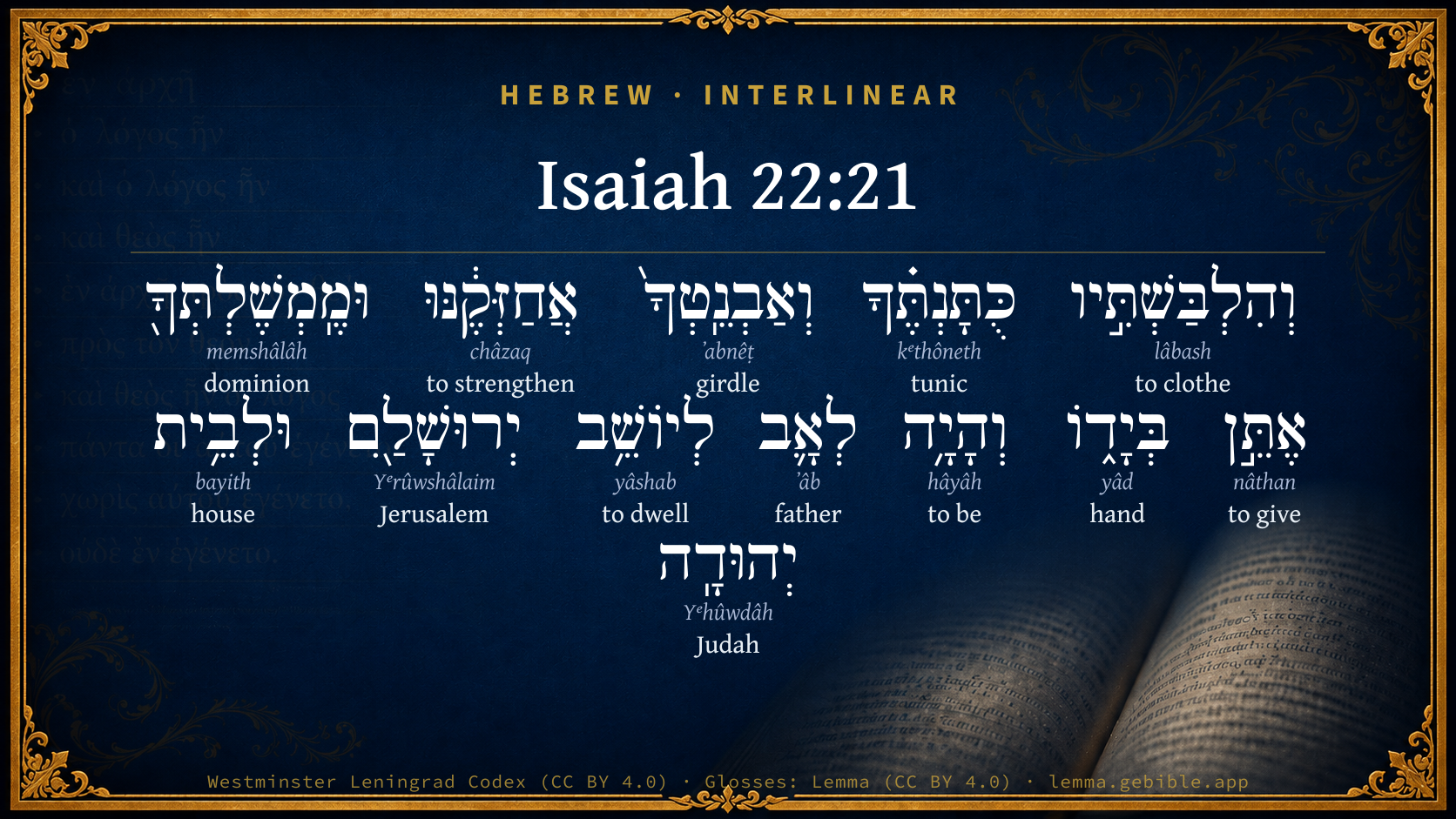
Hebrew (Westminster Leningrad Codex) Isaiah 22:21 appears in the Hebrew Old Testament. The text above is from the Westminster Leningrad Codex. Each word links to its Strong’s number, a concise gloss, and parsing drawn from the Open Scriptures Hebrew Bible morphology. Click any word for its full Brown-Driver-Briggs (BDB) entry.
Download image
Cite this verse

Isaiah 22:21 (World English Bible). Public Domain. Lemma interlinear Bible study tool, https://lemma.gebible.app/v/isaiah/22/21.

Show BibTeX & RIS
BibTeX
RIS
English Translation
and I will cloth him with your robe, and strengthen him with your belt, and I will commit your government into his hand; and he shall be a father to the inhabitants of Jerusalem, and to the house of Judah.
World English Bible · Public Domain
Download a study sheet

One document with this verse’s original text, its word-by-word gloss line, the meaning frame, cross-references with their text, attributed commentary, and full source and license credits — printable, and it pastes into notes with its structure intact.

This verse Autodidact and up

Study sheet (.html) Plain text (.txt)

A passage Seminary Student

Up to 50 verses in one chapter. A passage sheet keeps up to 6 commentary sources and 12 cross-references per verse, in the order this page ranks them, and says so on the sheet whenever that leaves anything out. Ask for a single verse and you get the Autodidact verse sheet above.

Everything on this page stays free to read, with no account — the sheet is a download of what is already on screen, not access to it.

Want to remove ads? Support Godless Engineer
Compare translations 3

The same verse in 3 English versions, stacked beneath the original-language interlinear above. Click any original word for its lexicon entry.

Each is an independent rendering of the whole verse — the interlinear is not word-aligned to these translations.

Highlighted words mark where these versions differ — a whole-verse word diff, not a word-by-word alignment.

  • World English Bible Public Domain
    and I will cloth him with your robe, and strengthen him with your belt, and I will commit your government into his hand; and he shall be a father to the inhabitants of Jerusalem, and to the house of Judah.
  • King James Version Public Domain
    And I will clothe him with thy robe, and strengthen him with thy girdle, and I will commit thy government into his hand: and he shall be a father to the inhabitants of Jerusalem, and to the house of Judah.
  • unfoldingWord Literal Text CC BY-SA 4.0
    And I will clothe him your tunic, and I will fasten him your sash, and I will give your dominion into his hand. And he will be for a father to the dweller of Jerusalem and to the house of Judah.

unfoldingWord Literal Text — © unfoldingWord, licensed CC BY-SA 4.0. Word-aligned USFM3 via Door43 (git.door43.org/unfoldingWord/en_ult).

Versions to compare (up to 4)

3 of 4 selected

Show all 18 translations

Every available English version of this verse, each an independent rendering of the whole verse.

  • World English Bible Public Domain
    and I will cloth him with your robe, and strengthen him with your belt, and I will commit your government into his hand; and he shall be a father to the inhabitants of Jerusalem, and to the house of Judah.
  • Berean Standard Bible Public Domain
    I will clothe him with your robe and tie your sash around him. I will put your authority in his hand, and he will be a father to the dwellers of Jerusalem and to the house of Judah.
  • Majority Standard Bible Public Domain
    I will clothe him with your robe and tie your sash around him. I will put your authority in his hand, and he will be a father to the dwellers of Jerusalem and to the house of Judah.
  • King James Version Public Domain
    And I will clothe him with thy robe, and strengthen him with thy girdle, and I will commit thy government into his hand: and he shall be a father to the inhabitants of Jerusalem, and to the house of Judah.
  • American Standard Version (1901) Public Domain
    and I will cloth him with thy robe, and strengthen him with thy girdle, and I will commit thy government into his hand; and he shall be a father to the inhabitants of Jerusalem, and to the house of Judah.
  • Revised Version (1885) Public Domain
    and I will clothe him with thy robe, and strengthen him with thy girdle, and I will commit thy government into his hand: and he shall be a father to the inhabitants of Jerusalem, and to the house of Judah.
  • Geneva Bible (1599) Public Domain
    And with thy garments will I clothe him, and with thy girdle will I strengthen him: thy power also will I commit into his hande, and hee shalbe a father of the inhabitats of Ierusalem, and of the house of Iudah.
  • Douay-Rheims (1899) Public Domain
    And I will clothe him with thy robe, and will strengthen him with thy girdle, and will give thy power into his hand: and he shall be as a father to the inhabitants of Jerusalem, and to the house of Juda.
  • Young's Literal Translation Public Domain
    And I have clothed him with thy coat, And with thy girdle I strengthen him, And thy garment I give into his hand, And he hath been for a father to the inhabitant of Jerusalem, And to the house of Judah.
  • Literal Standard Version CC BY-SA 4.0
    And I have clothed him with your coat, || And I strengthen him with your girdle, || And I give your garment into his hand, || And he has been for a father to the inhabitant of Jerusalem, || And to the house of Judah.
  • Unlocked Literal Bible CC BY-SA 4.0
    I will clothe him with your tunic and put on him your sash, and I will transfer your authority into his hand. He will be a father to the inhabitants of Jerusalem and to the house of Judah.
  • unfoldingWord Literal Text CC BY-SA 4.0
    And I will clothe him your tunic, and I will fasten him your sash, and I will give your dominion into his hand. And he will be for a father to the dweller of Jerusalem and to the house of Judah.
  • Darby Bible Public Domain
    and I will clothe him with thy robe, and strengthen him with thy girdle, and I will commit thy government into his hand; and he shall be a father to the inhabitants of Jerusalem, and to the house of Judah.
  • World Messianic Bible Public Domain
    and I will clothe him with your robe, and strengthen him with your belt. I will commit your government into his hand; and he will be a father to the inhabitants of Jerusalem, and to the house of Judah.
  • Webster's Bible Public Domain
    And I will clothe him with thy robe, and strengthen him with thy girdle, and I will commit thy government into his hand: and he shall be a father to the inhabitants of Jerusalem, and to the house of Judah.
  • Free Bible Version CC BY-SA 4.0
    I will put your robe and place your sash around him, and I will give your authority to him. He will be a father to the people living in Jerusalem and Judah.
  • Bible in Basic English Public Domain
    And I will put your robe on him, and put your band about him, and I will give your authority into his hand: and he will be a father to the men of Jerusalem, and to the family of Judah.
  • JPS Tanakh (1917) Public Domain
    And I will clothe him with thy robe, and bind him with thy girdle, and I will commit thy government into his hand; and he shall be a father to the inhabitants of Jerusalem, and to the house of Judah.

Literal Standard Version (2020), Covenant Press — licensed CC BY-SA 4.0. Text via the HelloAO Bible API (eBible.org). Unlocked Literal Bible (unfoldingWord) — licensed CC BY-SA 4.0. Text via the HelloAO Bible API (eBible.org). unfoldingWord Literal Text — © unfoldingWord, licensed CC BY-SA 4.0. Word-aligned USFM3 via Door43 (git.door43.org/unfoldingWord/en_ult). Free Bible Version, Dr. Jonathan Gallagher — licensed CC BY-SA 4.0. Text via the HelloAO Bible API (eBible.org).

Word by word

More ways to search: Search by grammar → Find every occurrence → Compare this word →

Practice this passage: Drill this verse → Learn its vocabulary →

וְאַבְנֵֽטְךָ֙
ʼabnêṭ
H73
“and · girdle · your”
Conjunction + Noun, Common, Masculine, Singular, Construct + Suffix, Personal, 2nd Person, Masculine, Singular
Part of Speech
Conjunction + Noun
Type
Common
Gender
Masculine
Number
Singular
State
Construct
Full BDB Definition

Origin: of uncertain derivation

TWOT: 256a

girdle, sash, waistband - of high priest - of other priests - of high official
  1. וְהִלְבַּשְׁתִּ֣יו lâbash H3847 “and · to clothe · him” Conjunction + Verb, Hiphil, Sequential Perfect, 1st Person, Common, Singular + Suffix, Personal, 3rd Person, Masculine, Singular
  2. כֻּתָּנְתֶּ֗ךָ kᵉthôneth H3801 “tunic · your” Noun, Common, Feminine, Singular, Construct + Suffix, Personal, 2nd Person, Masculine, Singular
  3. אֲחַזְּקֶ֔נּוּ châzaq H2388 “to strengthen · him” Verb, Piel, Imperfect, 1st Person, Common, Singular + Suffix, Personal, 3rd Person, Masculine, Singular
  4. וּמֶֽמְשֶׁלְתְּךָ֖ memshâlâh H4475 “and · dominion · your” Conjunction + Noun, Common, Both, Singular, Construct + Suffix, Personal, 2nd Person, Masculine, Singular
  5. אֶתֵּ֣ן nâthan H5414 “to give” Verb, Qal, Imperfect, 1st Person, Common, Singular
  6. בְּיָד֑וֹ yâd H3027 “in/at · hand · his” Preposition + Noun, Common, Both, Singular, Construct + Suffix, Personal, 3rd Person, Masculine, Singular
  7. וְהָיָ֥ה hâyâh H1961 “and · to be” Conjunction + Verb, Qal, Sequential Perfect, 3rd Person, Masculine, Singular
  8. לְאָ֛ב ʼâb H1 “to/for · father” Preposition + Noun, Common, Masculine, Singular, Absolute
  9. לְיוֹשֵׁ֥ב yâshab H3427 “to/for · dwelling” Preposition + Verb, Qal, Participle Active, Masculine, Singular, Construct
  10. יְרוּשָׁלִַ֖ם Yᵉrûwshâlaim H3389 “Jerusalem” Noun, Proper
  11. וּלְבֵ֥ית bayith H1004 “and · to/for · house of” Conjunction + Preposition + Noun, Common, Masculine, Singular, Construct
  12. יְהוּדָֽה Yᵉhûwdâh H3063 “Judah” Noun, Proper

About this verse

These counts appear in no published source. They are computed here, from the morphology-tagged text and Lemma’s own curated glosses. What Lemma adds →

13
words
13
distinct lemmas
Prophets
section

Notable vocabulary

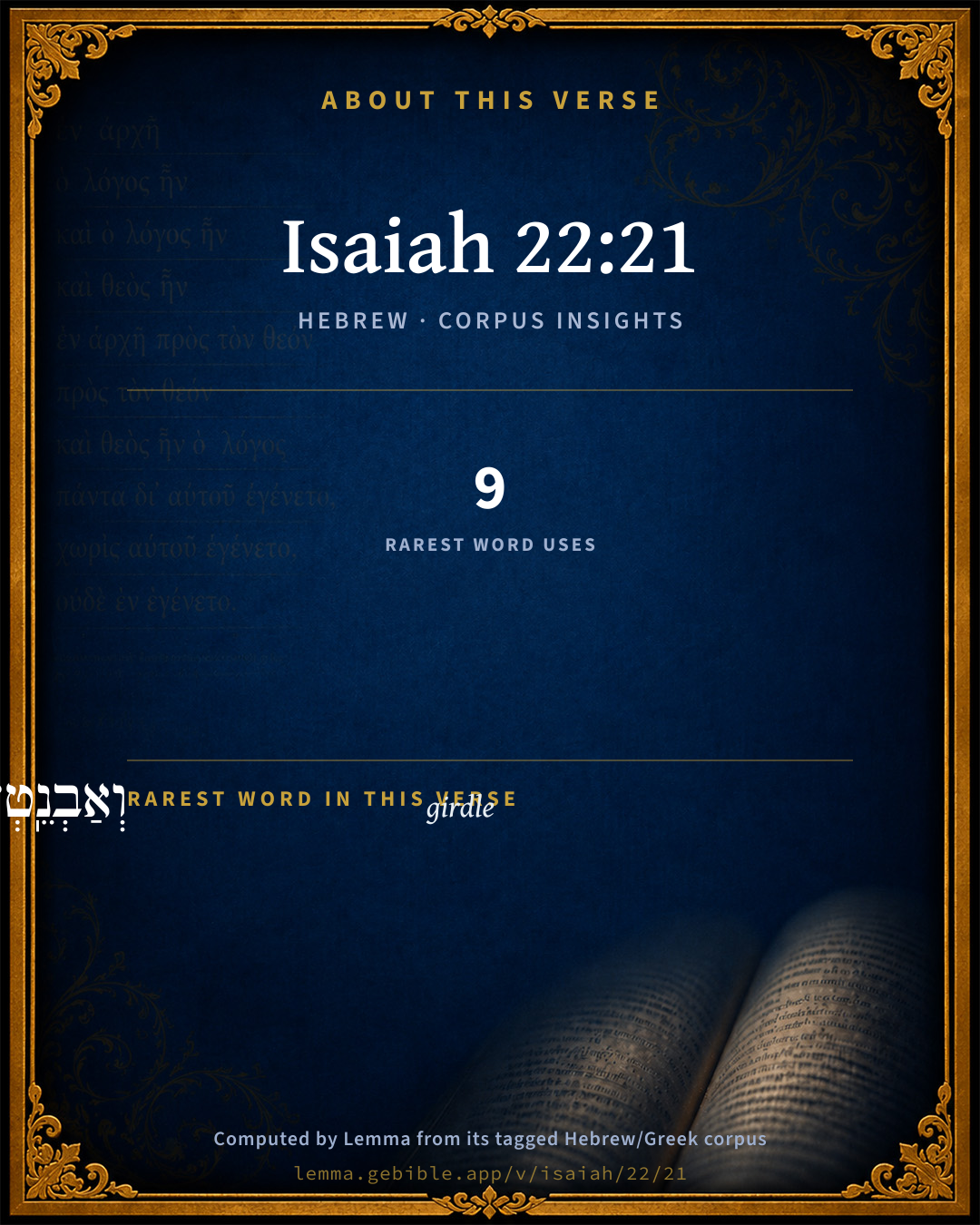
The rarest word here is וְאַבְנֵֽטְךָ֙ girdle H73 — appearing just 9 times in the whole Hebrew Bible.

Shared distinctive vocabulary

וְאַבְנֵֽטְךָ֙ girdle H73 occurs in 9 verses of the Hebrew Bible. Also found in:

Grammatical profile

  • 5 verbs
  • 8 nouns

Verb forms

  • וְהִלְבַּשְׁתִּ֣יו Hiphil · Sequential Perfect
  • אֲחַזְּקֶ֔נּוּ Piel · Imperfect
  • אֶתֵּ֣ן Qal · Imperfect
  • וְהָיָ֥ה Qal · Sequential Perfect
  • לְיוֹשֵׁ֥ב Qal · Participle Active

Hebrew & Septuagint length

In English translation the verse runs 40 words from the Hebrew and 46 from the Septuagint (LXX English) — closely comparable.

A rough comparison of the two English renderings, which tokenize alike — not a word-level alignment.

Word counts can differ between the Hebrew and the Greek without any difference in meaning — e.g. the Hebrew direct-object marker אֵת has no separate Greek word, and Greek often adds the article ὁ.

Cross-references

6

Topical passages linked to Isaiah 22:21 in the Treasury of Scripture Knowledge — connected by theme and wording, ordered by reader-vote popularity; previews shown in the World English Bible.

  • Genesis 45:8 So now it wasn't you who sent me here, but God, and he has made me a father to Pharaoh, lord of all his house, and ruler over all the land of Egypt.
  • Genesis 41:42–43 Pharaoh took off his signet ring from his hand, and put it on Joseph's hand, and arrayed him in robes of fine linen, and put a gold chain about his neck,
  • 1 Samuel 18:4 Jonathan stripped himself of the robe that was on him, and gave it to David, and his clothing, even to his sword, and to his bow, and to his sash.
  • Esther 8:2 The king took off his ring, which he had taken from Haman, and gave it to Mordecai. Esther set Mordecai over the house of Haman.
  • Esther 8:15 Mordecai went forth from the presence of the king in royal clothing of blue and white, and with a great crown of gold, and with a robe of fine linen and purple: and the city of Shushan shouted and was glad.
  • Isaiah 9:6–7 For to us a child is born, to us a son is given; and the government shall be on his shoulder: and his name shall be called Wonderful, Counselor, Mighty God, Everlasting Father, Prince of Peace.

Cross-references courtesy of OpenBible.info (CC BY 4.0).

Hebrew and Greek witnesses Masoretic Hebrew ↔ Greek Septuagint

The same verse in the two great witnesses to the Old Testament, shown verse-for-verse.

These are two independent witnesses, not word-aligned to each other, and the Septuagint is shown in lemma (dictionary) form.

Hebrew Isaiah 22:21 Masoretic · Westminster Leningrad Codex

וְהִלְבַּשְׁתִּ֣יו כֻּתָּנְתֶּ֗ךָ וְאַבְנֵֽטְךָ֙ אֲחַזְּקֶ֔נּוּ וּמֶֽמְשֶׁלְתְּךָ֖ אֶתֵּ֣ן בְּיָד֑וֹ וְהָיָ֥ה לְאָ֛ב לְיוֹשֵׁ֥ב יְרוּשָׁלִַ֖ם וּלְבֵ֥ית יְהוּדָֽה

and I will cloth him with your robe, and strengthen him with your belt, and I will commit your government into his hand; and he shall be a father to the inhabitants of Jerusalem, and to the house of Judah.

World English Bible · Public Domain

Greek LXX Isaiah 22:21 Septuagint · lemma form

καί ἐνδύω αὐτός ὁ στολή σύ καί ὁ στέφανος σύ δίδωμι αὐτός καί ὁ κράτος καί ὁ οἰκονομία σύ δίδωμι εἰς ὁ χείρ αὐτός καί εἰμί ὡς πατήρ ὁ ἐνοἰκέω ἐν ἰερουσαλήμ καί ὁ ἐνοἰκέω ἐν ιουδα

and I will put on him your robe, and I will grant him your crown with power, and I will give your stewardship into his hands: and he shall be as a father to them that dwell in Jerusalem, and to them that dwell in Juda.

LXX2012 (modern English Septuagint) · Public Domain

On this verse, Adam Clarke's Commentary discusses the Septuagint’s reading. Read the note in Commentary ↓

Hebrew: Westminster Leningrad Codex (CC BY 4.0). Greek: Septuagint (public domain); English from LXX2012 (modern English Septuagint) (Public Domain). How the Septuagint differs from the Hebrew →

Targum (Aramaic paraphrase)

1

The Targum is the ancient Jewish Aramaic paraphrase of the Hebrew Scriptures — an interpretive translation, not the Hebrew text itself. Onkelos (literal) and Pseudo-Jonathan (expansive) render the Torah, and Jonathan the Prophets. Coverage is partial: where no permissively-licensed English translation exists for a verse, only the Aramaic is shown. This is verse-level text, not a word-by-word alignment to the Hebrew.

  1. Targum Jonathan Prophets (Joshua–Malachi)
    וְאַלְבְּשִׁנֵיהּ כִּתּוּנָךְ וְהֶמְיָנָךְ אֲזַרְזִנֵהּ וְשׁוּלְטָנָךְ אֶתֵּן בִּידֵהּ וִיהֵי לְאַב לְיַתְבֵי יְרוּשְׁלֵם וּלְבֵית יְהוּדָה:

    And I will clothe him with thy robe, and with thy girdle I will gird him, and I will commit thy government into his hand, and he shall be a prince to the inhabitants of Jerusalem, and to the house of Judah.

    Targum Jonathan — Aramaic: “Mikraot Gedolot” (public domain). English: “Sefaria Community Translation” (CC0 1.0 (public-domain dedication)); “London "Chaldee Paraphrase," 1871” (public domain). Text via Sefaria.

Commentary

Notes on Isaiah 22:21 from classic Christian and Jewish commentators (each source and its license shown beneath its notes). The classic Christian expositions comment on the surrounding passage and are grouped to its opening verse, so a note may address several verses; the Jewish commentaries on the Tanakh (Rashi and others) are per-verse, so they appear only where the commentator wrote on this verse.

Lemma curates 59 commentaries, every one of them public domain or Creative Commons licensed, each selected and text-cleaned for this edition rather than reprinted as found. About our sources →

Trapp's Complete Commentary

John Trapp

Isa 22:21 And I will clothe him with thy robe, and strengthen him with thy girdle, and I will commit thy government into his hand: and he shall be a father to the inhabitants of Jerusalem, and to the house of Judah.

Ver. 21. And I will clothe him with thy robe,] i.e., Vest him in thine honours and offices, thyself being laid by, and looked upon as an officiperda.

And he shall be a father.] A fit title for a ruler, as this text is a fit looking glass for a good counsellor.

John Trapp, A Commentary or Exposition upon All the Books of the Old and New Testament (1647–1656) — public domain. Text from a community e-Sword module.

Tyndale Open Study Notes

Tyndale Open Resources

22:21 A leader is like a father to the people when he truly cares for them and addresses their needs. In contrast, Shebna was concerned only for himself.

Tyndale Open Study Notes — © Tyndale Open Resources, licensed CC BY-SA 4.0. Text via the HelloAO Bible API.

Jamieson, Fausset & Brown

Robert Jamieson, A. R. Fausset & David Brown

thy robe--of office.

girdle--in which the purse was carried, and to it was attached the sword; often adorned with gold and jewels.

father--that is, a counsellor and friend.

Jamieson, Fausset & Brown — Commentary Critical and Explanatory on the Whole Bible (1871) — public domain (CC PDM 1.0). Text via the HelloAO Bible API.

Adam Clarke's Commentary

Verse 21. To the inhabitants] ליושבי leyoshebey, in the plural number, four of Dr. Kennicott's MSS., (two ancient,) and two of De Rossi's, with the Septuagint, Syriac, and Vulgate.

Adam Clarke's Commentary on the Bible (1810–1826) — public domain. Text from a community e-Sword/MySword module.

Ellicott's Commentary for English Readers

(21) I will clothe him with thy robe . . .—The words point to an actual transfer of the robe and girdle which were Shebna’s insignia of office. There was to be, in this case, a literal investiture.

He shall be a father . . .—The words were, perhaps, an official title given to the king’s vizier or chamberlain. (Comp. 2Ki_5:13.) Here, however, the words indicate that the idea of the title should be fulfilled, and that the government of Eliakim should be, in the truest sense, paternal.

A Bible Commentary for English Readers, edited by Charles John Ellicott (1878–1897) — public domain. Text from a community e-Sword module.

The Cambridge Bible for Schools and Colleges

gen. ed. J. J. S. Perowne

21. robe (“tunic”) … girdle] The palace officials seem to have worn distinctive liveries (1Ki_10:5); the uniform of the vizier was apparently a tunic and a girdle of special pattern. The word for “girdle” is used elsewhere only of the priestly girdle (see Exo_39:29, &c.). For strengthen, translate gird.

he shall be a father]—a beneficent administrator, as Shebna had not been. How much in the East the welfare of the people depends on the character of the vizier is known from the legends of Haroun-al-Rashid. For the expression cf. Gen_45:8; 1Ma_11:32.

The Cambridge Bible for Schools and Colleges (gen. ed. J. J. S. Perowne; Cambridge University Press, 1878–1918) — public domain. Text from a community e-Sword module.

John Gill's Exposition

And I will clothe him with thy robe,.... The same he wore, or rather one like unto it, which was a badge and token of his office. If he was a priest, as the Jews say, this was his priestly robe, by which the high priest was distinguished from others; but he rather seems to be a civil officer, who wore a garment suitable to it, and distinctive of it; in which he was a type of Christ, invested with the priestly, or rather with the kingly office, crowned with glory and honour; and who is seen among his churches, clothed with a garment down to the feet, Rev 1:13,

and strengthen him with thy girdle: which was a symbol both of power and of strength; both priests and princes had their girdles. Christ's girdle, in the administration of his office, is faithfulness and righteousness, Isa 11:5;

and I will commit thy government into his hand; the government of the king's house, typical of the government of the church, put into the hands of Christ by his Father, Isa 9:6,

and he shall be a father to the inhabitants of Jerusalem, and to the house of Judah; have a fatherly care over them, and affection for them; and such an one is Christ, who stands in the relation of the everlasting Father to his church and people, and of whom the whole family in heaven and earth is named; he provides for them, takes care of them, is tenderly affected towards them, pities and sympathizes with them, and affords them all supply and support. Kimchi interprets it of a faithful counsellor, and a good leader. So Ben Melech.

John Gill's Exposition of the Whole Bible (1746–1763) — public domain (CC PDM 1.0). Text via the HelloAO Bible API.

Albert Barnes' Notes on the Bible

And I will clothe him with thy robe - He shall succeed thee in the office, and wear the garments which are appropriate to it.

And strengthen him with thy girdle - That is, he shall wear the same girdle that thou didst (see the note at Isa 3:24). In that girdle was usually the purse, and to it was attached the sword. Often, among the Orientals, the girdle was adorned with gold and precious stones, and was regarded as the principal embellishment of the dress.

And he shall be a father ... - A counselor; a guide; one who can be trusted in time of danger and difficulty. We use, the word “father” in the same sense, when we speak of the ‘father of his country.’

Albert Barnes' Notes on the Bible (1834–1885) — public domain. Text from a community e-Sword/MySword module.

Haydock's Catholic Bible Commentary

Girdle, the badge of power, Job xii. 18.

George Leo Haydock (1774–1849), Haydock's Catholic Family Bible and Commentary, 1859 edition — public domain. Excludes Psalms (Douay-Rheims chapter numbering differs from Protestant) and Deuterocanonical books (Catholic canon only).

Matthew Poole's English Annotations

I will clothe him with thy robe, and strengthen him with thy girdle: there was a peculiar sort of robe and girdle which was the badge of his office, which should be taken from him, and given to Eliakim.

He shall be a father; he shall not only have the authority of a father, which thou now hast, in which respect all rulers are called fathers, as Exo 20:12; Num 36:1; but shall also govern them with fatherly care and affection, and not with rigour and cruelty, as thou dost.

Matthew Poole's English Annotations on the Holy Bible (1683–1685) — public domain. Text from a community e-Sword/MySword module.

The Pulpit Commentary

With thy robe... with thy girdle. The dress of office worn by Shebna would be taken from him, and Eliakim would be invested therewith. The "robe" is the long-sleeved cloak or tunic worn commonly by persons of rank; the "girdle" is probably an ornamental one, like those of the priests, (Exo_28:39) worn over the inner tunic. He shall be a father; i.e. a protector, counselor, guide. (comp. Job_29:16, "I was a father to the poor: and the cause which I knew not I searched out It is, perhaps, implied that Shebna had not conducted himself as a "father."

The Pulpit Commentary (1880–1919), ed. H.D.M. Spence-Jones & Joseph S. Exell — public domain. Text from a community e-Sword module.

John Wesley's Explanatory Notes

Girdle - There was a peculiar sort of robe and girdle which was the badge of his office. A father - He shall govern them with fatherly care and affection.

John Wesley, Explanatory Notes Upon the Whole Bible (1754–1765) — public domain. Text via the GEBible commentary corpus.

J. A. Alexander on Isaiah

Joseph Addison Alexander

“And I will clothe him with thy dress, and with thy girdle will I strengthen him, and thy power will I give into his hand, and he shall be for a father (or become a father) to the dweller in Jerusalem and to the house of Judah.” We may either suppose a reference to an official dress, or a metaphor analogous to that of filling another’s shoes in colloquial English. Father is not a mere oriental synonym of ruler, but an emphatic designation of a wise and benevolent ruler. It seems therefore to imply that Shebna’s administration was of an opposite character. The inhabitants of Jerusalem and the family of Judah comprehended the whole nation.

Joseph Addison Alexander, The Prophecies of Isaiah (1846–1847; New York: Scribner, 1870–1878) — public domain. Text from a community e-Sword module.

Ibn Ezra

Rabbi Abraham ibn Ezra

Thy robe and thy girdle. Every officer has a certain robe and girdle, as e.g., the wise men of Athens wore a certain distinctive girdle.

A father. A good teacher and a friend, like a father.

Ibn Ezra on the Tanakh — English translations: “Sefaria Community Translation” (CC0 1.0 (public-domain dedication)); “Yalkut, Sifsei Chachomim Chumash, Metsudah Publications, 2009” (CC BY 4.0); and “Commentary of Ibn Ezra on Isaiah - trans. by M. Friedlander, 1873” (public domain). Text via Sefaria.

Lesson kit

Teaching starters — assembled from the data on this page, not authored interpretation. Every prompt links to the verse data it draws on. Edit before teaching.

Isaiah, in the Prophets, opens this verse with 13 words (13 distinct Hebrew lemmas). Its most distinctive word is ʼabnêṭ (“girdle”). A historical commentator’s framing appears above. Read the whole chapter for the surrounding context.

Discussion questions

  1. How does “girdle” (ʼabnêṭ) shape what this verse is saying?
  2. Exodus 28:4 shares the word «girdle» with this verse. How do the two illuminate each other?
  3. These translations render this verse differently; the difference is in the English rendering, not the original. What questions does that raise?
  4. The verb «וְהִלְבַּשְׁתִּ֣יו» is Hiphil Sequential Perfect. How does its form color the action?
  5. Reading how Trapp's Complete Commentary and Tyndale Open Study Notes read this verse, where do the two commentators agree and where do they part?

Things to notice

Reading settings

Reading text

Shown beneath each verse's original-language words.

Old Testament
Old Testament edition

Read the OT as the Masoretic Hebrew (MT) or the Greek Septuagint (LXX).

English shown for the Greek Septuagint (in the Hebrew ↔ Greek comparison).

Comparing translations? Open the Compare panel on any verse page to stack up to four side by side.