
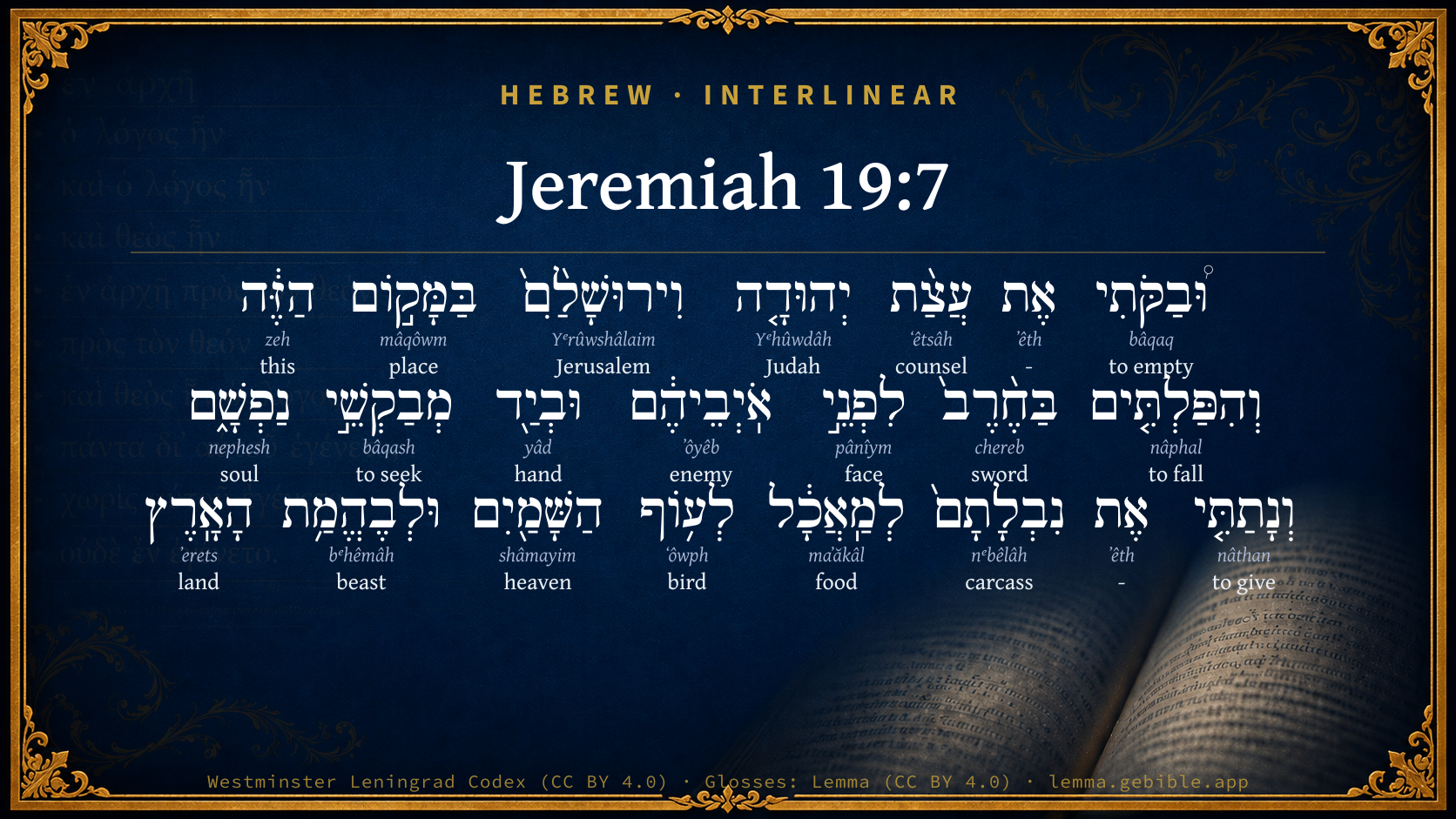
Jeremiah 19:7

Hebrew (Westminster Leningrad Codex) Jeremiah 19:7 appears in the Hebrew Old Testament. The text above is from the Westminster Leningrad Codex. Each word links to its Strong’s number, a concise gloss, and parsing drawn from the Open Scriptures Hebrew Bible morphology. Click any word for its full Brown-Driver-Briggs (BDB) entry.
Download image
Cite this verse

Jeremiah 19:7 (World English Bible). Public Domain. Lemma interlinear Bible study tool, https://lemma.gebible.app/v/jeremiah/19/7.

Show BibTeX & RIS
BibTeX
RIS
English Translation
I will make void the counsel of Judah and Jerusalem in this place; and I will cause them to fall by the sword before their enemies, and by the hand of those who seek their life: and their dead bodies will I give to be food for the birds of the sky, and for the animals of the earth.
World English Bible · Public Domain
Download a study sheet

One document with this verse’s original text, its word-by-word gloss line, the meaning frame, cross-references with their text, attributed commentary, and full source and license credits — printable, and it pastes into notes with its structure intact.

This verse Autodidact and up

Study sheet (.html) Plain text (.txt)

A passage Seminary Student

Up to 50 verses in one chapter. A passage sheet keeps up to 6 commentary sources and 12 cross-references per verse, in the order this page ranks them, and says so on the sheet whenever that leaves anything out. Ask for a single verse and you get the Autodidact verse sheet above.

Everything on this page stays free to read, with no account — the sheet is a download of what is already on screen, not access to it.

Want to remove ads? Support Godless Engineer
Compare translations 3

The same verse in 3 English versions, stacked beneath the original-language interlinear above. Click any original word for its lexicon entry.

Each is an independent rendering of the whole verse — the interlinear is not word-aligned to these translations.

Highlighted words mark where these versions differ — a whole-verse word diff, not a word-by-word alignment.

  • World English Bible Public Domain
    I will make void the counsel of Judah and Jerusalem in this place; and I will cause them to fall by the sword before their enemies, and by the hand of those who seek their life: and their dead bodies will I give to be food for the birds of the sky, and for the animals of the earth.
  • King James Version Public Domain
    And I will make void the counsel of Judah and Jerusalem in this place; and I will cause them to fall by the sword before their enemies, and by the hands of them that seek their lives: and their carcases will I give to be meat for the fowls of the heaven, and for the beasts of the earth.
  • unfoldingWord Literal Text CC BY-SA 4.0
    And I will empty the counsel of Judah and Jerusalem in this place, and I will cause them to fall by the sword to the face of their enemies, and by the hand of those who seek their life. And I will give their corpses as food to the birds of the heavens and to the beast of the earth.

unfoldingWord Literal Text — © unfoldingWord, licensed CC BY-SA 4.0. Word-aligned USFM3 via Door43 (git.door43.org/unfoldingWord/en_ult).

Versions to compare (up to 4)

3 of 4 selected

Show all 18 translations

Every available English version of this verse, each an independent rendering of the whole verse.

  • World English Bible Public Domain
    I will make void the counsel of Judah and Jerusalem in this place; and I will cause them to fall by the sword before their enemies, and by the hand of those who seek their life: and their dead bodies will I give to be food for the birds of the sky, and for the animals of the earth.
  • Berean Standard Bible Public Domain
    And in this place I will ruin the plans of Judah and Jerusalem. I will make them fall by the sword before their enemies, by the hands of those who seek their lives, and I will give their carcasses as food to the birds of the air and the beasts of the earth.
  • Majority Standard Bible Public Domain
    And in this place I will ruin the plans of Judah and Jerusalem. I will make them fall by the sword before their enemies, by the hands of those who seek their lives, and I will give their carcasses as food to the birds of the air and the beasts of the earth.
  • King James Version Public Domain
    And I will make void the counsel of Judah and Jerusalem in this place; and I will cause them to fall by the sword before their enemies, and by the hands of them that seek their lives: and their carcases will I give to be meat for the fowls of the heaven, and for the beasts of the earth.
  • American Standard Version (1901) Public Domain
    And I will make void the counsel of Judah and Jerusalem in this place; and I will cause them to fall by the sword before their enemies, and by the hand of them that seek their life: and their dead bodies will I give to be food for the birds of the heavens, and for the beasts of the earth.
  • Revised Version (1885) Public Domain
    And I will make void the counsel of Judah and Jerusalem in this place; and I will cause them to fall by the sword before their enemies, and by the hand of them that seek their life: and their carcases will I give to be meat for the fowls of the heaven, and for the beasts of the earth.
  • Geneva Bible (1599) Public Domain
    And I will bring the counsell of Iudah and Ierusalem to nought in this place, and I will cause them to fall by the sword before their enemies, and by the hand of them that seeke their liues: and their carkeises will I giue to be meate for ye foules of the heauen, and to the beastes of the fielde.
  • Douay-Rheims (1899) Public Domain
    And I will defeat the counsel of Juda and of Jerusalem in this place: and I will destroy them with the sword in the sight of their enemies, and by the hands of them that seek their lives: and I will give their carcasses to be meat for the fowls of the air, and for the beasts of the earth.
  • Young's Literal Translation Public Domain
    And I have made void the counsel of Judah and Jerusalem in this place, and have caused them to fall by the sword before their enemies, and by the hand of those seeking their life, and I have given their carcase for food to the fowl of the heavens, and to the beast of the earth,
  • Literal Standard Version CC BY-SA 4.0
    And I have made void the counsel of Judah and Jerusalem in this place, and have caused them to fall by the sword before their enemies, and by the hand of those seeking their life, and I have given their carcass for food to the bird of the heavens, and to the beast of the earth,
  • Unlocked Literal Bible CC BY-SA 4.0
    In this place I will make the plans of Judah and Jerusalem useless. I will make them to fall by the sword before their enemies and by the hand of the ones seeking their lives. Then I will give their corpses as food to the birds of the heavens and the beasts of the earth.
  • unfoldingWord Literal Text CC BY-SA 4.0
    And I will empty the counsel of Judah and Jerusalem in this place, and I will cause them to fall by the sword to the face of their enemies, and by the hand of those who seek their life. And I will give their corpses as food to the birds of the heavens and to the beast of the earth.
  • Darby Bible Public Domain
    And I will make void the counsel of Judah and Jerusalem in this place; and I will cause them to fall by the sword before their enemies, and by the hand of them that seek their life, and their carcases will I give as food to the fowl of the heavens and to the beasts of the earth.
  • World Messianic Bible Public Domain
    “‘“I will make the counsel of Judah and Jerusalem void in this place. I will cause them to fall by the sword before their enemies, and by the hand of those who seek their life. I will give their dead bodies to be food for the birds of the sky and for the animals of the earth.
  • Webster's Bible Public Domain
    And I will make void the counsel of Judah and Jerusalem in this place; and I will cause them to fall by the sword before their enemies, and by the hands of them that seek their lives: and their carcasses will I give to be food for the fowls of the heaven, and for the beasts of the earth.
  • Free Bible Version CC BY-SA 4.0
    Right here in this place I'm going to spoil the plans of Judah and Jerusalem. I will let their enemies who want to kill them come and do exactly that. Their dead bodies will be food for birds of prey and wild animals.
  • Bible in Basic English Public Domain
    I will make the purpose of Judah and Jerusalem come to nothing in this place; I will have them put to the sword by their haters, and by the hands of those who have designs on their life; and their dead bodies I will give to be food for the birds of heaven and the beasts of the earth.
  • JPS Tanakh (1917) Public Domain
    and I will make void the counsel of Judah and Jerusalem in this place; and I will cause them to fall by the sword before their enemies, and by the hand of them that seek their life; and their carcasses will I give to be food for the fowls of the heaven, and for the beasts of the earth;

Literal Standard Version (2020), Covenant Press — licensed CC BY-SA 4.0. Text via the HelloAO Bible API (eBible.org). Unlocked Literal Bible (unfoldingWord) — licensed CC BY-SA 4.0. Text via the HelloAO Bible API (eBible.org). unfoldingWord Literal Text — © unfoldingWord, licensed CC BY-SA 4.0. Word-aligned USFM3 via Door43 (git.door43.org/unfoldingWord/en_ult). Free Bible Version, Dr. Jonathan Gallagher — licensed CC BY-SA 4.0. Text via the HelloAO Bible API (eBible.org).

Word by word

More ways to search: Search by grammar → Find every occurrence → Compare this word →

Practice this passage: Drill this verse → Learn its vocabulary →

וּ֠בַקֹּתִי
bâqaq
H1238
“and · to empty”
Conjunction + Verb, Qal, Sequential Perfect, 1st Person, Common, Singular
Part of Speech
Conjunction + Verb
Stem
Qal
Form
Sequential Perfect
Person
1st Person
Gender
Common
Number
Singular
Full BDB Definition

Origin: a primitive root

TWOT: 273

to empty - (Qal) - to empty, lay waste - to make void (figuratively) - (Niphal) to be emptied - (Polel) to empty out, devastate
  1. אֶת ʼêth H853 “-” Particle, Direct Object
  2. עֲצַ֨ת ʻêtsâh H6098 “counsel of” Noun, Common, Feminine, Singular, Construct
  3. יְהוּדָ֤ה Yᵉhûwdâh H3063 “Judah” Noun, Proper
  4. וִירוּשָׁלִַ֨ם֙ Yᵉrûwshâlaim H3389 “and · Jerusalem” Conjunction + Noun, Proper
  5. בַּמָּק֣וֹם mâqôwm H4725 “in/at the · place” Preposition, Determined + Noun, Common, Masculine, Singular, Absolute
  6. הַזֶּ֔ה zeh H2088 “the · this” Particle, Definite Article + Pronoun, Demonstrative, Masculine, Singular
  7. וְהִפַּלְתִּ֤ים nâphal H5307 “and · to fall · them” Conjunction + Verb, Hiphil, Sequential Perfect, 1st Person, Common, Singular + Suffix, Personal, 3rd Person, Masculine, Plural
  8. בַּחֶ֨רֶב֙ chereb H2719 “in/at the · sword” Preposition, Determined + Noun, Common, Feminine, Singular, Absolute
  9. לִפְנֵ֣י pânîym H6440 “to/for · face(s) of” Preposition + Noun, Common, Both, Plural, Construct
  10. אֹֽיְבֵיהֶ֔ם ʼôyêb H341 “enemy · them” Verb, Qal, Participle Active, Masculine, Plural, Construct + Suffix, Personal, 3rd Person, Masculine, Plural
  11. וּבְיַ֖ד yâd H3027 “and · in/at · hand of” Conjunction + Preposition + Noun, Common, Both, Singular, Construct
  12. מְבַקְשֵׁ֣י bâqash H1245 “seeking” Verb, Piel, Participle Active, Masculine, Plural, Construct
  13. נַפְשָׁ֑ם nephesh H5315 “soul · their” Noun, Common, Both, Singular, Construct + Suffix, Personal, 3rd Person, Masculine, Plural
  14. וְנָתַתִּ֤י nâthan H5414 “and · to give” Conjunction + Verb, Qal, Sequential Perfect, 1st Person, Common, Singular
  15. אֶת ʼêth H853 “-” Particle, Direct Object
  16. נִבְלָתָם֙ nᵉbêlâh H5038 “carcass · their” Noun, Common, Feminine, Singular, Construct + Suffix, Personal, 3rd Person, Masculine, Plural
  17. לְמַֽאֲכָ֔ל maʼăkâl H3978 “to/for · food” Preposition + Noun, Common, Masculine, Singular, Absolute
  18. לְע֥וֹף ʻôwph H5775 “to/for · bird of” Preposition + Noun, Common, Masculine, Singular, Construct
  19. הַשָּׁמַ֖יִם shâmayim H8064 “the · heaven(s)” Particle, Definite Article + Noun, Common, Masculine, Plural, Absolute
  20. וּלְבֶהֱמַ֥ת bᵉhêmâh H929 “and · to/for · beast of” Conjunction + Preposition + Noun, Common, Feminine, Singular, Construct
  21. הָאָֽרֶץ ʼerets H776 “the · land” Particle, Definite Article + Noun, Common, Both, Singular, Absolute

About this verse

These counts appear in no published source. They are computed here, from the morphology-tagged text and Lemma’s own curated glosses. What Lemma adds →

22
words
21
distinct lemmas
Prophets
section

Notable vocabulary

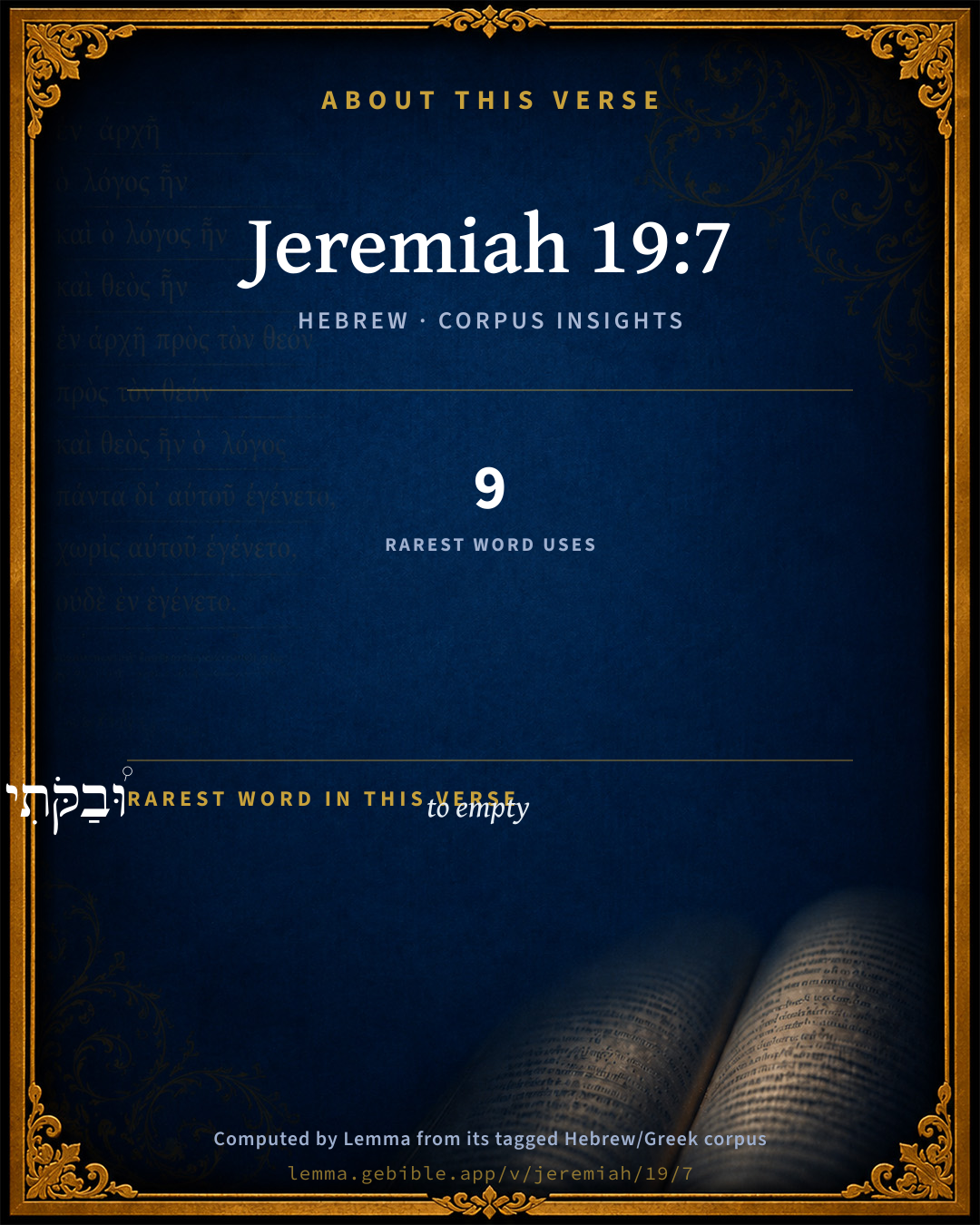
The rarest word here is וּ֠בַקֹּתִי to empty H1238 — appearing just 9 times in the whole Hebrew Bible.

Shared distinctive vocabulary

וּ֠בַקֹּתִי to empty H1238 occurs in 7 verses of the Hebrew Bible. Also found in:

Grammatical profile

  • 5 verbs
  • 14 nouns
  • 1 pronoun
  • 2 particles

Verb forms

  • וּ֠בַקֹּתִי Qal · Sequential Perfect
  • וְהִפַּלְתִּ֤ים Hiphil · Sequential Perfect
  • אֹֽיְבֵיהֶ֔ם Qal · Participle Active
  • מְבַקְשֵׁ֣י Piel · Participle Active
  • וְנָתַתִּ֤י Qal · Sequential Perfect

Cross-references

24

Topical passages linked to Jeremiah 19:7 in the Treasury of Scripture Knowledge — connected by theme and wording, ordered by reader-vote popularity; previews shown in the World English Bible.

  • Leviticus 26:17 I will set my face against you, and you will be struck before your enemies. Those who hate you will rule over you; and you will flee when no one pursues you.
  • Jeremiah 16:4 They shall die grievous deaths: they shall not be lamented, neither shall they be buried; they shall be as dung on the surface of the ground; and they shall be consumed by the sword, and by famine; and their dead bodies shall be food for the birds of the sky, and for the animals of the earth.
  • Deuteronomy 28:25–26 Yahweh will cause you to be struck before your enemies; you shall go out one way against them, and shall flee seven ways before them: and you shall be tossed back and forth among all the kingdoms of the earth.
  • Psalms 33:10–11 Yahweh brings the counsel of the nations to nothing. He makes the thoughts of the peoples to be of no effect.
  • Psalms 79:2–3 They have given the dead bodies of your servants to be food for the birds of the sky, The flesh of your saints to the animals of the earth.
  • Isaiah 28:17–18 I will make justice the line, and righteousness the plummet; and the hail shall sweep away the refuge of lies, and the waters shall overflow the hiding-place.
  • Jeremiah 7:33 The dead bodies of this people shall be food for the birds of the sky, and for the animals of the earth; and none shall frighten them away.
  • Jeremiah 15:2 It shall happen, when they tell you, Where shall we go forth? then you shall tell them, Thus says Yahweh: Such as are for death, to death; and such as are for the sword, to the sword; and such as are for the famine, to the famine; and such as are for captivity, to captivity.
  • Jeremiah 15:9 She who has borne seven languishes; she has given up the spirit; her sun is gone down while it was yet day; she has been disappointed and confounded: and the residue of them will I deliver to the sword before their enemies, says Yahweh.
  • Jeremiah 34:20 I will even give them into the hand of their enemies, and into the hand of those who seek their life; and their dead bodies shall be for food to the birds of the sky, and to the animals of the earth.
  • Job 5:12–13 He frustrates the devices of the crafty, So that their hands can't perform their enterprise.
  • Proverbs 21:30 There is no wisdom nor understanding Nor counsel against Yahweh.
  • Isaiah 8:10 Take counsel together, and it shall be brought to nothing; speak the word, and it shall not stand: for God is with us.
  • Isaiah 30:1–3 Woe to the rebellious children, says Yahweh, who take counsel, but not of me; and who make a league, but not of my Spirit, that they may add sin to sin,
  • Jeremiah 8:2 and they shall spread them before the sun, and the moon, and all the host of the sky, which they have loved, and which they have served, and after which they have walked, and which they have sought, and which they have worshiped: they shall not be gathered, nor be buried, they shall be for dung on the surface of the earth.
  • Jeremiah 9:21–22 For death is come up into our windows, it is entered into our palaces; to cut off the children from outside, [and] the young men from the streets.
  • Jeremiah 18:21 Therefore deliver up their children to the famine, and give them over to the power of the sword; and let their wives become childless, and widows; and let their men be slain of death, [and] their young men struck of the sword in battle.
  • Jeremiah 22:19 He shall be buried with the burial of a donkey, drawn and cast forth beyond the gates of Jerusalem.
  • Jeremiah 22:25 and I will give you into the hand of those who seek your life, and into the hand of them of whom you are afraid, even into the hand of Nebuchadrezzar king of Babylon, and into the hand of the Chaldeans.
  • Jeremiah 46:26 and I will deliver them into the hand of those who seek their lives, and into the hand of Nebuchadrezzar king of Babylon, and into the hand of his servants; and afterwards it shall be inhabited, as in the days of old, says Yahweh.
  • Lamentations 3:37 Who is he who says, and it comes to pass, when the Lord doesn't command it?
  • Romans 3:31 Do we then nullify the law through faith? May it never be! No, we establish the law.
  • Romans 4:14 For if those who are of the law are heirs, faith is made void, and the promise is made of no effect.
  • Revelation 19:18–21 that you may eat the flesh of kings, the flesh of captains, the flesh of mighty men, and the flesh of horses and of those who sit on them, and the flesh of all men, both free and slave, and small and great."

Cross-references courtesy of OpenBible.info (CC BY 4.0).

Hebrew and Greek witnesses Masoretic Hebrew ↔ Greek Septuagint

The same verse in the two great witnesses to the Old Testament, shown verse-for-verse.

These are two independent witnesses, not word-aligned to each other, and the Septuagint is shown in lemma (dictionary) form.

Hebrew Jeremiah 19:7 Masoretic · Westminster Leningrad Codex

וּ֠בַקֹּתִי אֶת עֲצַ֨ת יְהוּדָ֤ה וִירוּשָׁלִַ֨ם֙ בַּמָּק֣וֹם הַזֶּ֔ה וְהִפַּלְתִּ֤ים בַּחֶ֨רֶב֙ לִפְנֵ֣י אֹֽיְבֵיהֶ֔ם וּבְיַ֖ד מְבַקְשֵׁ֣י נַפְשָׁ֑ם וְנָתַתִּ֤י אֶת נִבְלָתָם֙ לְמַֽאֲכָ֔ל לְע֥וֹף הַשָּׁמַ֖יִם וּלְבֶהֱמַ֥ת הָאָֽרֶץ

I will make void the counsel of Judah and Jerusalem in this place; and I will cause them to fall by the sword before their enemies, and by the hand of those who seek their life: and their dead bodies will I give to be food for the birds of the sky, and for the animals of the earth.

World English Bible · Public Domain

Greek LXX Structure differs

In the Septuagint, Jeremiah is about an eighth shorter than the Hebrew and arranges its material differently — the Oracles Against the Nations (Hebrew chapters 46–51) appear in the middle of the Greek book, after 25:13. Because the chapter and verse boundaries do not line up, a verse-for-verse comparison with the Hebrew is not shown.

A verse-for-verse comparison isn’t shown here because the chapters and verses don’t line up. Switch to the LXX edition with the MT / LXX toggle above to read the Greek directly.

Hebrew: Westminster Leningrad Codex (CC BY 4.0). Greek: Septuagint (public domain); English from a public-domain English Septuagint. How the Septuagint differs from the Hebrew →

Targum (Aramaic paraphrase)

1

The Targum is the ancient Jewish Aramaic paraphrase of the Hebrew Scriptures — an interpretive translation, not the Hebrew text itself. Onkelos (literal) and Pseudo-Jonathan (expansive) render the Torah, and Jonathan the Prophets. Coverage is partial: where no permissively-licensed English translation exists for a verse, only the Aramaic is shown. This is verse-level text, not a word-by-word alignment to the Hebrew.

  1. Targum Jonathan Prophets (Joshua–Malachi)
    וֶאֱקַלְקֵיל יַת מְלַךְ אֱנַשׁ יְהוּדָה וְיַתְבֵי יְרוּשְׁלֵם בְּאַתְרָא הָדֵין וְאַרְמִינוּן בְּחַרְבָּא קֳדָם בַּעֲלֵי דְבָבֵיהוֹן וּבְיַד דְבָעָן לְמִקְטַלְהוֹן וְאֶתֵּן יַת נְבֵלְתְּהוֹן מְשַׁגְרָא לְמֵיכַל לְעוֹפָא דִשְׁמַיָא וְלִבְעִירָא דְאַרְעָא:

    (no public-domain English translation for this verse)

    Targum Jonathan — Aramaic: “Mikraot Gedolot” (public domain). English: “Sefaria Community Translation” (CC0 1.0 (public-domain dedication)); “London "Chaldee Paraphrase," 1871” (public domain). Text via Sefaria.

Commentary

Notes on Jeremiah 19:7 from classic Christian and Jewish commentators (each source and its license shown beneath its notes). The classic Christian expositions comment on the surrounding passage and are grouped to its opening verse, so a note may address several verses; the Jewish commentaries on the Tanakh (Rashi and others) are per-verse, so they appear only where the commentator wrote on this verse.

Lemma curates 59 commentaries, every one of them public domain or Creative Commons licensed, each selected and text-cleaned for this edition rather than reprinted as found. About our sources →

Trapp's Complete Commentary

John Trapp

Jer 19:7 And I will make void the counsel of Judah and Jerusalem in this place; and I will cause them to fall by the sword before their enemies, and by the hands of them that seek their lives: and their carcases will I give to be meat for the fowls of the heaven, and for the beasts of the earth.

Ver. 7. And I will make void the counsel of Judah.] As vain and empty as this earthen bottle now is. See on Jer 19:1, and take notice of an elegant alliteration in the original.

And their carcases will I give.] See Jer 7:33; Jer 16:4.

John Trapp, A Commentary or Exposition upon All the Books of the Old and New Testament (1647–1656) — public domain. Text from a community e-Sword module.

Jamieson, Fausset & Brown

Robert Jamieson, A. R. Fausset & David Brown

make void the counsel--defeat their plans for repelling the enemy (Ch2 32:1-4; Isa 19:3; Isa 22:9, Isa 22:11). Or their schemes of getting help by having recourse to idols [CALVIN].

in this place--The valley of Hinnom was to be the place of the Chaldean encampment; the very place where they looked for help from idols was to be the scene of their own slaughter.

Jamieson, Fausset & Brown — Commentary Critical and Explanatory on the Whole Bible (1871) — public domain (CC PDM 1.0). Text via the HelloAO Bible API.

Adam Clarke's Commentary

Verse 7. I will make void the counsel of Judah] Probably this refers to some determination made to proclaim themselves independent, and pay no more tribute to the Chaldeans.

To be meat for the fowls] See Clarke on Jer 7:33.

Adam Clarke's Commentary on the Bible (1810–1826) — public domain. Text from a community e-Sword/MySword module.

John Calvin's Commentaries

This amplification further exasperated the minds of the people, — that they in vain trusted that this place would be to them a fortress. For, as we have already stated, they had persuaded themselves that it was abundantly sufficient to reconcile them with God, when they spared not their own children, and so zealously performed tlheir acts of worship. And hypocrites are commonly inflated with this presumption, for they prefer what pleases them to what pleases God; they regard not what the law bids, what God approves, but they adore their own inventions. Since then almost all the superstitious are filled with such a presumption, God here rightly declares, that he would make void their counsels

It is indeed certain that there is neither wisdom nor counsel in deluded men, while they thus devise new and frivolous modes of worship, for these are sheer mummeries. But we ought to observe what Paul says in Colossians 2:23, that all the fictions which men devise for themselves have in them some appearance of wisdom; for we know that wherever our imagination may carry us, we think ourselves wise, and that whatever God prescribes becomes insipid to us. Then the Prophet concedes “counsel,” though improperly, to frivolous and vain inventions, but not without reason, for experience teaches us sufficiently, that men ever take great delight in their superstitions, for they wish to subject God as it were to their own will. He then says, by way of concession, that the counsels of the whole people, especially of the city Jerusalem, would be made void, which was above others the teacher of errors, while yet the doctrine of the law ought especially to have prevailed there. And it may be also that there is an allusion to that word בקבק bekbek, which we have before seen, and which the Prophet will repeat again, for it means to make void or empty, though some think it to be a factitious word, because the sound, bekbek, is produced while the bottle is emptied. However this may be, the allusion is still sufficiently striking.

He afterwards adds, And I will lay them prostrate by the sword before their enemies, and by the hand of those who seek their life. In this second part, the Prophet intimates that the hatred entertained by their enemies towards the Jews would not be common. Wars are carried on sometimes in such a way, that the conquerors are satisfied with the spoils; but the Prophet intimates, that the cruelty of their enemies would be such, that they would seek the life of the whole people, and delight in slaughter; as though he had said, that they would be deadly enemies and altogether implacable. He will again repeat these words, and in the same sense.

He then adds, I will give your carcase to be meat to the birds of heaven, and to the beasts of the field We have said elsewhere that it is deemed a punishment inflicted by heaven when the carcases of the dead remain unburied; for it is the last office of humanity to bury the dead. And this is a distinction which God would have to be between men and brute animals, for animals have not the honor of a burial. It has also been ever granted as a singular privilege to men to be buried, in order to set forth the hope of resurrection. When, therefore, a burial is denied, it is a proof of extreme dishonor. It has indeed often happened that the saints have been without a burial; but temporal punishment is ever turned to salvation to God’s children. As to the reprobate it must be deemed a judgment from God, when he casts away their carcases, as then there is no difference between them and animals. But I have treated this subject more fully elsewhere, and I shall not proceed with it now. It follows —

John Calvin's Commentaries (1540-1563) — public domain. Text from the Calvin Translation Society English edition (1840s-50s) via the Christian Classics Ethereal Library (ccel.org). Calvin's coverage is partial (roughly two-thirds of the Bible); uncommented books and verses are honest gaps, never fabricated. The 19th-century editor's footnotes and remarks are omitted so the notes are faithfully Calvin's own voice.

Ellicott's Commentary for English Readers

(7) I will make void.—The Hebrew verb (bakak) is onomatopoetic, as representing the gurgling sound of water flowing from the mouth of a jar, and contains, as stated in the note on Jer_19:1, the root of the word rendered “bottle,” and was obviously chosen with an allusive reference to it. Such a play upon the sound and sense of words is quite in accordance with the genius of Hebrew prophecy, but it is obviously in most cases impossible to reproduce it in another language. The primary meaning is “to pour out, to spill,” and so “to waste, or bring to nought.” (Comp. Isa_19:3.) Some interpreters have supposed that the words were accompanied by corresponding acts, and that the earthen bottle, which the prophet had brought filled with water, was now emptied in the sight of the people, with a symbolism like that of 1Sa_7:6; 2Sa_14:14.

A Bible Commentary for English Readers, edited by Charles John Ellicott (1878–1897) — public domain. Text from a community e-Sword module.

The Cambridge Bible for Schools and Colleges

gen. ed. J. J. S. Perowne

7. make void] lit. as mg. empty out. The Hebrew verb is that from which is derived the word for “bottle” in Jer_19:1. It has been thought that Jeremiah here suited the action to the word, and poured out the contents on the ground, as he spoke. The latter part of the v. is taken from Jer_7:33.

The Cambridge Bible for Schools and Colleges (gen. ed. J. J. S. Perowne; Cambridge University Press, 1878–1918) — public domain. Text from a community e-Sword module.

John Gill's Exposition

And I will make void the counsel of Judah and Jerusalem in this place,.... The counsel which they took in this place and agreed to, in offering their sons and daughters to idols; and which they took with these idols and their priests, from whom they expected assistance and relief; and all their schemes and projects for their deliverance; these were all made to spear to be mere empty things, as empty as the earthen bottle he had in his hand, to which there is an allusion; there being an elegant paronomasia between the word (p) here used and that:

and I will cause them to fall by the sword before their enemies: such as sallied out from the city, or attempted to make their escape:

and by the hands of them that seek their lives; and so would not spare them, when they fell into them:

and their carcasses will I give to be meat for the fowls of the heaven, and for the beasts of the earth: signifying that they should have no burial, but their slain bodies should lie upon the earth, and be fed upon by fowls and beasts.

(p) &

John Gill's Exposition of the Whole Bible (1746–1763) — public domain (CC PDM 1.0). Text via the HelloAO Bible API.

Albert Barnes' Notes on the Bible

Make void - The verb used here is that from which “bottle” Jer 19:1 is derived, and as it represents the sound made by the water running out, it would be better translated, “pour out.” Jeremiah perhaps carried the bottle to Tophet full of water, the symbol in the East of life Isa 35:6; Isa 41:18, and at these words emptied it before the assembled elders.

Albert Barnes' Notes on the Bible (1834–1885) — public domain. Text from a community e-Sword/MySword module.

Matthew Poole's English Annotations

In this place, amongst others, I will make void all the counsels that the men of Judah and the inhabitants of Jerusalem have taken to escape my righteous judgments; I will frustrate all their little arts and designs to avoid the dint of my judgments; I will cause them to fall by the sword before their enemies, so as there shall be no way of escape for them.

Matthew Poole's English Annotations on the Holy Bible (1683–1685) — public domain. Text from a community e-Sword/MySword module.

Whedon's Commentary on the Bible

Daniel D. Whedon

7. Make void — The root of this word is the same with that of the word for “bottle.” It would be better to translate, I will pour out; that is, bring to nothing.

Daniel D. Whedon (gen. ed.), Commentary on the Old and New Testaments (1874–1909) — public domain. Text from a community e-Sword module.

The Pulpit Commentary

I will make void; literally, I will pour out, alluding to the etymology of the word rendered "bottle" in ver. 1.

The Pulpit Commentary (1880–1919), ed. H.D.M. Spence-Jones & Joseph S. Exell — public domain. Text from a community e-Sword module.

John Wesley's Explanatory Notes

In this place - In this place, among others, I will make void all the counsels that the men of Judah and the inhabitants of Jerusalem, have taken to escape my righteous judgments.

John Wesley, Explanatory Notes Upon the Whole Bible (1754–1765) — public domain. Text via the GEBible commentary corpus.

Rashi

Rabbi Shlomo Yitzchaki (Rashi)

And I will frustrate and I will empty, an expression similar to (Nahum 2:11), “She is empty and void (בּוּקָה וּמְבוּקָה),” and because of the jug (בַּקְבֻּק) about which he is speaking, he adopted this expression.

Rashi on the Tanakh — English translations: “The Judaica Press complete Tanach with Rashi, translated by A. J. Rosenberg” (CC BY 4.0); “Pentateuch with Rashi's commentary by M. Rosenbaum and A.M. Silbermann, 1929-1934” (public domain); “The Metsudah Tanach series, Lakewood, N.J” (CC BY 4.0); and “The Book of Joshua, Metsudah Publications, 1997” (CC BY 4.0). Text via Sefaria.

Lesson kit

Teaching starters — assembled from the data on this page, not authored interpretation. Every prompt links to the verse data it draws on. Edit before teaching.

Jeremiah, in the Prophets, opens this verse with 22 words (21 distinct Hebrew lemmas). Its most distinctive word is bâqaq (“to empty”). A historical commentator’s framing appears above. Read the whole chapter for the surrounding context.

Discussion questions

  1. How does “to empty” (bâqaq) shape what this verse is saying?
  2. Isaiah 19:3 shares the word «to empty» with this verse. How do the two illuminate each other?
  3. These translations render this verse differently; the difference is in the English rendering, not the original. What questions does that raise?
  4. The verb «וּ֠בַקֹּתִי» is Qal Sequential Perfect. How does its form color the action?
  5. Reading how Trapp's Complete Commentary and Jamieson, Fausset & Brown read this verse, where do the two commentators agree and where do they part?

Things to notice

Reading settings

Reading text

Shown beneath each verse's original-language words.

Old Testament
Old Testament edition

Read the OT as the Masoretic Hebrew (MT) or the Greek Septuagint (LXX).

English shown for the Greek Septuagint (in the Hebrew ↔ Greek comparison).

Comparing translations? Open the Compare panel on any verse page to stack up to four side by side.