
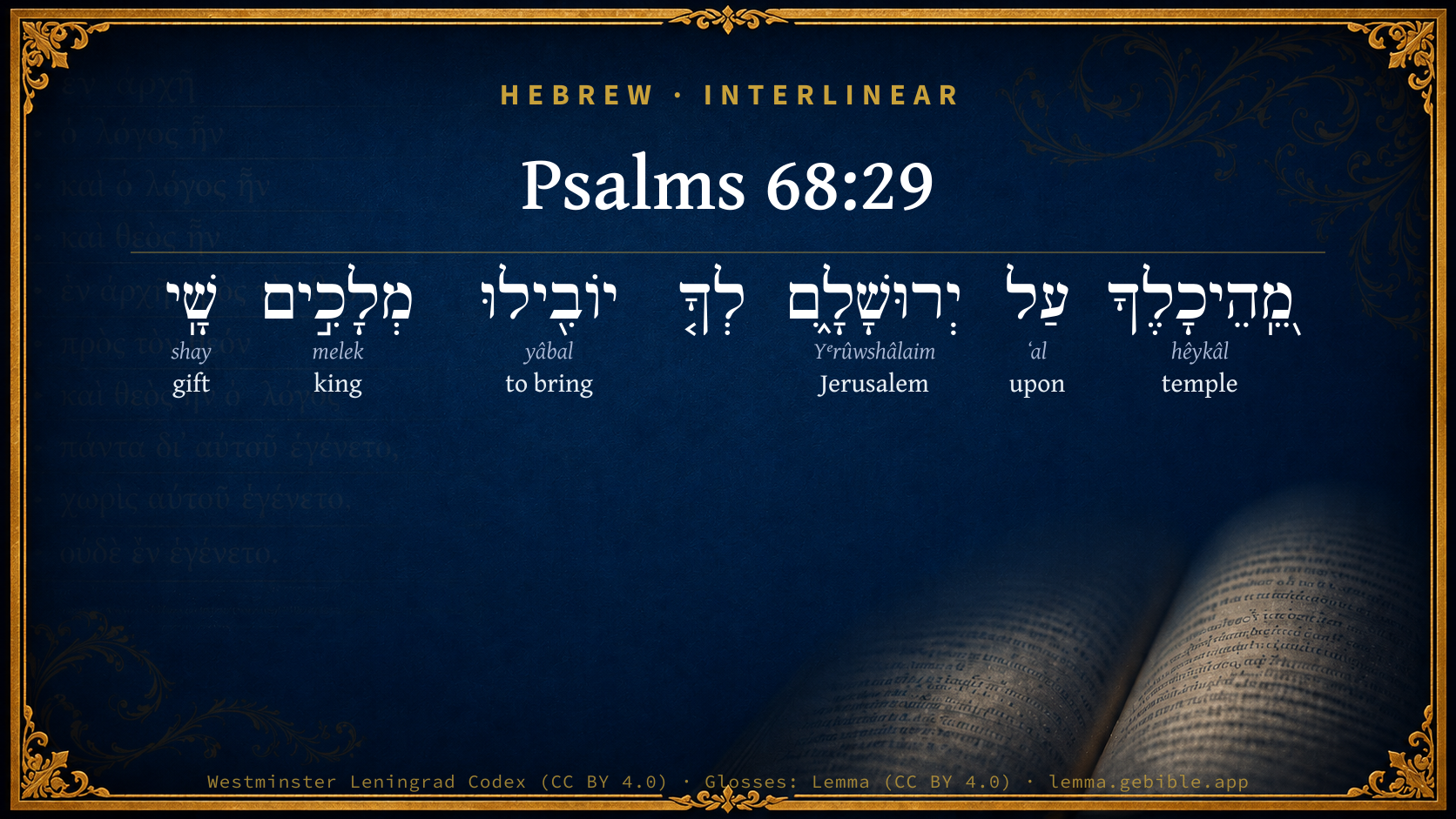
Psalms 68:29

Hebrew (Westminster Leningrad Codex) Psalms 68:29 appears in the Hebrew Old Testament. The text above is from the Westminster Leningrad Codex. Each word links to its Strong’s number, a concise gloss, and parsing drawn from the Open Scriptures Hebrew Bible morphology. Click any word for its full Brown-Driver-Briggs (BDB) entry.
Download image
Cite this verse

Psalms 68:29 (World English Bible). Public Domain. Lemma interlinear Bible study tool, https://lemma.gebible.app/v/psalms/68/29.

Show BibTeX & RIS
BibTeX
RIS
English Translation
Because of your temple at Jerusalem, Kings shall bring presents to you.
World English Bible · Public Domain
Highlights
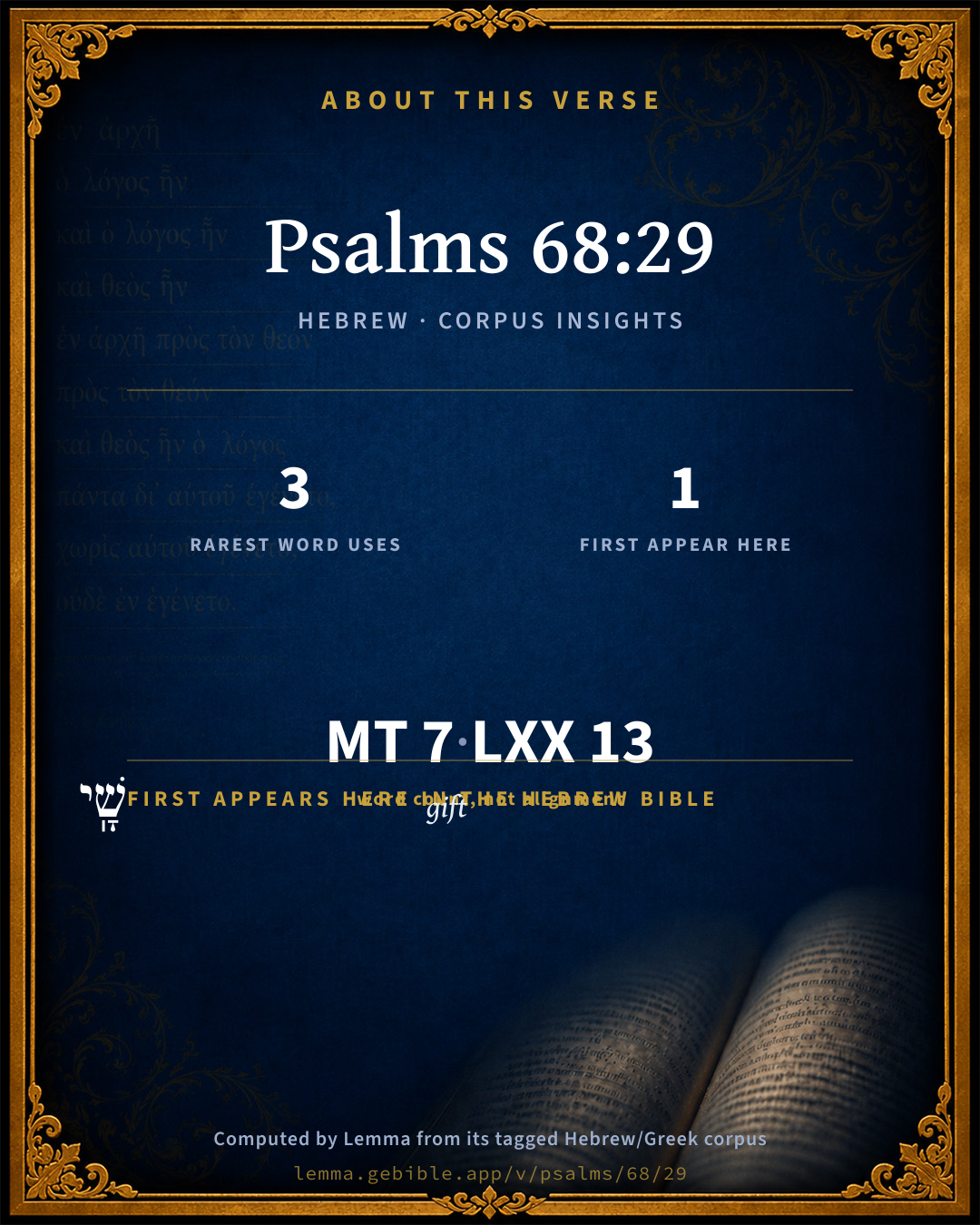
  • 1 first appearance in the Hebrew Bible
Full analysis ↓
Download a study sheet

One document with this verse’s original text, its word-by-word gloss line, the meaning frame, cross-references with their text, attributed commentary, and full source and license credits — printable, and it pastes into notes with its structure intact.

This verse Autodidact and up

Study sheet (.html) Plain text (.txt)

A passage Seminary Student

Up to 50 verses in one chapter. A passage sheet keeps up to 6 commentary sources and 12 cross-references per verse, in the order this page ranks them, and says so on the sheet whenever that leaves anything out. Ask for a single verse and you get the Autodidact verse sheet above.

Everything on this page stays free to read, with no account — the sheet is a download of what is already on screen, not access to it.

Want to remove ads? Support Godless Engineer
Compare translations 3

The same verse in 3 English versions, stacked beneath the original-language interlinear above. Click any original word for its lexicon entry.

Each is an independent rendering of the whole verse — the interlinear is not word-aligned to these translations.

Highlighted words mark where these versions differ — a whole-verse word diff, not a word-by-word alignment.

  • World English Bible Public Domain
    Because of your temple at Jerusalem, Kings shall bring presents to you.
  • King James Version Public Domain
    Because of thy temple at Jerusalem shall kings bring presents unto thee.
  • unfoldingWord Literal Text CC BY-SA 4.0
    Because of your temple over Jerusalem, kings will bring a gift to you.

unfoldingWord Literal Text — © unfoldingWord, licensed CC BY-SA 4.0. Word-aligned USFM3 via Door43 (git.door43.org/unfoldingWord/en_ult).

Versions to compare (up to 4)

3 of 4 selected

Show all 18 translations

Every available English version of this verse, each an independent rendering of the whole verse.

  • World English Bible Public Domain
    Because of your temple at Jerusalem, Kings shall bring presents to you.
  • Berean Standard Bible Public Domain
    Because of Your temple at Jerusalem kings will bring You gifts.
  • Majority Standard Bible Public Domain
    Because of Your temple at Jerusalem kings will bring You gifts.
  • King James Version Public Domain
    Because of thy temple at Jerusalem shall kings bring presents unto thee.
  • American Standard Version (1901) Public Domain
    Because of thy temple at Jerusalem Kings shall bring presents unto thee.
  • Revised Version (1885) Public Domain
    Because of thy temple at Jerusalem kings shall bring presents unto thee.
  • Geneva Bible (1599) Public Domain
    Out of thy Temple vpon Ierusalem: and Kings shall bring presents vnto thee.
  • Douay-Rheims (1899) Public Domain
    Command thy strength, O God: confirm, O God, what thou hast wrought in us.
  • Young's Literal Translation Public Domain
    Because of Thy temple at Jerusalem, To Thee do kings bring a present.
  • Literal Standard Version CC BY-SA 4.0
    Because of Your temple at Jerusalem, || Kings bring a present to You.
  • Unlocked Literal Bible CC BY-SA 4.0
    Reveal your power to us from your temple at Jerusalem, where kings bring gifts to you.
  • unfoldingWord Literal Text CC BY-SA 4.0
    Because of your temple over Jerusalem, kings will bring a gift to you.
  • Darby Bible Public Domain
    Because of thy temple at Jerusalem shall kings bring presents unto thee.
  • World Messianic Bible Public Domain
    Because of your temple at Jerusalem, kings shall bring presents to you.
  • Webster's Bible Public Domain
    \\68:28\\Thy God hath commanded thy strength: strengthen, O God, that which thou hast wrought for us.
  • Free Bible Version CC BY-SA 4.0
    Because of your Temple in Jerusalem, kings bring tribute to you.
  • Bible in Basic English Public Domain
    Out of your Temple in Jerusalem.
  • JPS Tanakh (1917) Public Domain
    (68-30) Out of Thy temple at Jerusalem, whither kings shall bring presents unto Thee.

Literal Standard Version (2020), Covenant Press — licensed CC BY-SA 4.0. Text via the HelloAO Bible API (eBible.org). Unlocked Literal Bible (unfoldingWord) — licensed CC BY-SA 4.0. Text via the HelloAO Bible API (eBible.org). unfoldingWord Literal Text — © unfoldingWord, licensed CC BY-SA 4.0. Word-aligned USFM3 via Door43 (git.door43.org/unfoldingWord/en_ult). Free Bible Version, Dr. Jonathan Gallagher — licensed CC BY-SA 4.0. Text via the HelloAO Bible API (eBible.org).

Word by word

More ways to search: Search by grammar → Find every occurrence → Compare this word →

Practice this passage: Drill this verse → Learn its vocabulary →

About this verse

These counts appear in no published source. They are computed here, from the morphology-tagged text and Lemma’s own curated glosses. What Lemma adds →

7
words
6
distinct lemmas
Wisdom
section

Notable vocabulary

The rarest word here is שָֽׁי gift H7862 — appearing just 3 times in the whole Hebrew Bible.

First appearance in Scripture

This word makes its first canonical appearance in the Hebrew Bible here:

Shared distinctive vocabulary

שָֽׁי gift H7862 occurs in 3 verses of the Hebrew Bible. Also found in:

Grammatical profile

  • 1 verb
  • 4 nouns
  • 2 prepositions

Verb forms

  • יוֹבִ֖ילוּ Hiphil · Imperfect

Hebrew & Septuagint length

In English translation the verse runs 12 words from the Hebrew and 12 from the Septuagint (LXX English) — the same length.

A rough comparison of the two English renderings, which tokenize alike — not a word-level alignment.

Word counts can differ between the Hebrew and the Greek without any difference in meaning — e.g. the Hebrew direct-object marker אֵת has no separate Greek word, and Greek often adds the article ὁ.

In the original languages it is 7 Hebrew tokens and 13 Greek tokens — but the two are counted differently (Hebrew bundles its prefixes and suffixes into one token; the Greek is in lemma form), so that isn’t a like-for-like length.

Cross-references

18

Topical passages linked to Psalms 68:29 in the Treasury of Scripture Knowledge — connected by theme and wording, ordered by reader-vote popularity; previews shown in the World English Bible.

  • 1 Kings 10:10 She gave the king one hundred twenty talents of gold, and of spices very great store, and precious stones: there came no more such abundance of spices as these which the queen of Sheba gave to king Solomon.
  • 1 Chronicles 29:3 In addition, because I have set my affection on the house of my God, seeing that I have a treasure of my own of gold and silver, I give it to the house of my God, over and above all that I have prepared for the holy house,
  • Psalms 76:11 Make vows to Yahweh your God, and fulfill them! Let all of his neighbors bring presents to him who is to be feared.
  • Psalms 45:12 The daughter of Tyre comes with a gift. The rich among the people entreat your favor.
  • Isaiah 18:7 In that time shall a present be brought to Yahweh of Hosts [from] a people tall and smooth, even from a people awesome from their beginning onward, a nation that measures out and treads down, whose land the rivers divide, to the place of the name of Yahweh of Hosts, Mount Zion.
  • Isaiah 60:6–11 The multitude of camels shall cover you, the dromedaries of Midian and Ephah; all they from Sheba shall come; they shall bring gold and frankincense, and shall proclaim the praises of Yahweh.
  • Isaiah 60:16–17 You shall also suck the milk of the nations, and shall suck the breast of kings; and you shall know that I, Yahweh, am your Savior, and your Redeemer, the Mighty One of Jacob.
  • 1 Kings 10:24–25 All the earth sought the presence of Solomon, to hear his wisdom, which God had put in his heart.
  • Ezra 7:13–28 I make a decree, that all those of the people of Israel, and their priests and the Levites, in my realm, who are minded of their own free will to go to Jerusalem, go with you.
  • Psalms 72:10–11 The kings of Tarshish and of the isles will bring tribute. The kings of Sheba and Seba shall offer gifts.
  • 1 Chronicles 22:7–11 David said to Solomon his son, As for me, it was in my heart to build a house to the name of Yahweh my God.
  • 1 Chronicles 28:10–21 Take heed now; for Yahweh has chosen you to build a house for the sanctuary: be strong, and do it.
  • 2 Chronicles 2:5–6 The house which I build is great; for great is our God above all gods.
  • 2 Chronicles 6:8–9 But Yahweh said to David my father, Whereas it was in your heart to build a house for my name, you did well that it was in your heart:
  • 2 Chronicles 32:23 Many brought gifts to Yahweh to Jerusalem, and precious things to Hezekiah king of Judah; so that he was exalted in the sight of all nations from thenceforth.
  • 2 Chronicles 32:33 Hezekiah slept with his fathers, and they buried him in the ascent of the tombs of the sons of David: and all Judah and the inhabitants of Jerusalem did him honor at his death. Manasseh his son reigned in his place.
  • Nehemiah 2:8 and a letter to Asaph the keeper of the king's forest, that he may give me timber to make beams for the gates of the castle which appertains to the house, and for the wall of the city, and for the house that I shall enter into. The king granted me, according to the good hand of my God on me.
  • 1 Chronicles 17:4–12 Go and tell David my servant, Thus says Yahweh, You shall not build me a house to dwell in:

Cross-references courtesy of OpenBible.info (CC BY 4.0).

Hebrew and Greek witnesses Masoretic Hebrew ↔ Greek Septuagint

The same verse in the two great witnesses to the Old Testament, shown verse-for-verse.

You’re reading Greek Psalm 67 (Hebrew Psalm 68). The Septuagint counts the superscription, so verse numbers can differ from the Hebrew — chapter-level alignment, not verse-by-verse. Numbering follows Rahlfs.

These are two independent witnesses, not word-aligned to each other, and the Septuagint is shown in lemma (dictionary) form.

Hebrew Psalms 68:29 Masoretic · Westminster Leningrad Codex

מֵֽ֭הֵיכָלֶךָ עַל יְרוּשָׁלִָ֑ם לְךָ֤ יוֹבִ֖ילוּ מְלָכִ֣ים שָֽׁי

Because of your temple at Jerusalem, Kings shall bring presents to you.

World English Bible · Public Domain

Greek LXX Greek Psalm 67:29 Septuagint · lemma form

ἐντέλλομαι ὁ θεός ὁ δύναμις σύ δυναμόω ὁ θεός οὗτος ὅς καταἐργάζομαι ἐγώ

Because of your temple at Jerusalem shall kings bring presents to you.

LXX2012 (modern English Septuagint) · Public Domain

Hebrew: Westminster Leningrad Codex (CC BY 4.0). Greek: Septuagint (public domain); English from LXX2012 (modern English Septuagint) (Public Domain). How the Septuagint differs from the Hebrew →

Commentary

Notes on Psalms 68:29 from classic Christian and Jewish commentators (each source and its license shown beneath its notes). The classic Christian expositions comment on the surrounding passage and are grouped to its opening verse, so a note may address several verses; the Jewish commentaries on the Tanakh (Rashi and others) are per-verse, so they appear only where the commentator wrote on this verse.

Lemma curates 59 commentaries, every one of them public domain or Creative Commons licensed, each selected and text-cleaned for this edition rather than reprinted as found. About our sources →

Trapp's Complete Commentary

John Trapp

Psa 68:29 Because of thy temple at Jerusalem shall kings bring presents unto thee.

Ver. 29. Because of thy temple] Or, out of thy temple at Jerusalem, q.d. strengthen us out of thy temple, out of the fulness that is in thy Son, thereby typified.

Shall kings bring presents unto thee] {See Trapp on "Psa 68:22"}

John Trapp, A Commentary or Exposition upon All the Books of the Old and New Testament (1647–1656) — public domain. Text from a community e-Sword module.

Joseph Benson's Commentary

Psa 68:29. Because of thy temple at Jerusalem — The tabernacle erected there by David, in which the ark was now placed; or rather, the temple which he foresaw would be built, and which he knew would be very magnificent, and of fame and glory throughout all countries, as he says, 1Ch 22:5; and such as would command esteem and reverence, even from the heathen princes and people, and that, not only for its most splendid and glorious structure, but especially for the wonderful works which the God of that temple would work in behalf of his people, and in answer to the prayers that should be made in that temple; of which see 1Ki 8:41-43. Shall kings bring presents unto thee — Which was done in part in the times of Solomon and Hezekiah, and afterward by others; but more fully when the Lord Christ was come into his temple, according to Mal 3:1, and had built a better temple instead of it, even the Christian Church, to which it was foretold, in many prophecies of the Old Testament, that the kings and nations of the earth would flow in great abundance.

Joseph Benson's Commentary on the Old and New Testaments (1811–1818) — public domain. Text from a community e-Sword module.

J. A. Alexander on Psalms

Joseph Addison Alexander

30. (Psa 68:29). Because of thy temple above Jerusalem, to thee shall kings bring tribute. The first word properly means from; but as the local sense would here be inadmissible, from may be understood as in the phrase arising from, proceeding from, in which the idea is that of an effect or consequence. As the word translated temple originally means a palace, it is applicable both to the Mosaic sanctuary and to Solomon's temple which succeeded it. See above, on Psa 5:7; Psa 48:9; Psa 65:4. Above Jerusalem, both in a physical and moral sense, as Zion and Moriah overhung the city, and as the presence of the sanctuary was at once its protection and its crowning glory. The last word in Hebrew occurs only here and in passages founded upon this. See below, Psa 76:11, and compare Isa 18:7.

Joseph Addison Alexander, The Psalms Translated and Explained (1850) — public domain. Text from a community e-Sword module.

Tyndale Open Study Notes

Tyndale Open Resources

68:29 The conquered kings will bring gifts to the Lord.

Tyndale Open Study Notes — © Tyndale Open Resources, licensed CC BY-SA 4.0. Text via the HelloAO Bible API.

Geneva Bible (1599)

Geneva Bible translators

Declare out of thine holy palace thy power for the defense of thy Church Jerusalem.

Geneva Bible (1599) marginal notes — public domain. Text via Bolls.life.

Jamieson, Fausset & Brown

Robert Jamieson, A. R. Fausset & David Brown

thy temple--literally, "over"

Jerusalem--His palace or residence (Psa 5:7) symbolized His protecting presence among His people, and hence is the object of homage on the part of others.

Jamieson, Fausset & Brown — Commentary Critical and Explanatory on the Whole Bible (1871) — public domain (CC PDM 1.0). Text via the HelloAO Bible API.

Ellicott's Commentary for English Readers

(29) Kings.—This verse is a strong argument for referring the psalm either to the time of the rebuilding of the Temple, or its re-dedication after the pollution by Antiochus Epiphanes.

A Bible Commentary for English Readers, edited by Charles John Ellicott (1878–1897) — public domain. Text from a community e-Sword module.

The Cambridge Bible for Schools and Colleges

gen. ed. J. J. S. Perowne

29. Because of thy temple at Jerusalem] To the age of the Return the restored Temple was the visible symbol and proof that Jehovah had come back to His ancient dwelling-place (Psa_122:9). It was to be the occasion and the centre of fresh homage. Cp. Isa_60:7 ff; Isa_66:20; Hag_2:7; Zec_2:11 ff; Zec_6:15; Zec_8:21 ff.

From thy temple however is a more natural rendering than because of thy temple; and it is possible that the words should be joined with the preceding verse—either thus, thou that hast wrought for us out of thy temple; or better still, shew thyself strong, thou who hast wrought for us, out of My temple[32]; cp. Psa_110:2. The next line will then begin: Up to Jerusalem shall kings &c.

[32] The pausal form of the word מֵהֵיכָלֶךָ out of thy temple, looks like the trace of a tradition that the verses were once so divided.

bring presents] A phrase used only in Psa_76:11; Isa_18:7, of bringing solemn tribute to God.

The Cambridge Bible for Schools and Colleges (gen. ed. J. J. S. Perowne; Cambridge University Press, 1878–1918) — public domain. Text from a community e-Sword module.

John Gill's Exposition

Because of thy temple at Jerusalem,.... Not the material temple there, which was not in being in David's time, but was built by his son, and destroyed by Nebuchadnezzar; and though it was rebuilt by Zerubbabel, repaired by Herod, and was the Messiah's temple, into which he entered as the Lord and proprietor of it, Mal 3:1; yet was quickly after his time demolished, and will never be rebuilt more; but the Messiah's spiritual temple, of which he is the builder, foundation, and cornerstone; the materials of which are believers in him, and it is for his service, worship, and glory: and "because of Jerusalem" (b), as it may be translated: by which also the church of Christ is meant, which is the heavenly Jerusalem, the Jerusalem which is above, and free, the mother of us all, the city of the great King, the place of divine worship, and well fortified by the power and grace of God. The words may be rendered "above Jerusalem" (c), and connected either with Psa 68:28, and so point at the place, heaven, the temple and palace of the Messiah; from whence spiritual health and strength are desired, and may be expected; or with the following words, and the sense be, "from", or "out of thy temple in Jerusalem": even out of the material temple, the Gospel should be preached, as it was by the apostles on the day of Pentecost; and so the word of the Lord went out from thence, and from Jerusalem into Judea, and so into the Gentile world, where it is continued, and will be until the kings of the earth shall be converted, as follows;

shall kings bring presents unto thee: that is, such as should become Christians, as Constantine, and others, in the earlier ages of Christianity; who brought their riches and wealth to Christ, and into his church, with a design for the good and welfare of it, though it proved otherwise; and as many will in the latter day, who, being converted, will bring presents to the King Messiah, join his churches, and be their nursing fathers; see Psa 72:10; and who will bring their glory and honour, and that of the nations, into the New Jerusalem church state, Rev 21:24; and it will be because of his church and people, and for their good and welfare, as well as for the glory and honour of Christ, that those presents will be brought; and which will not only be theirs, their good things, but themselves, whom they will present to the Lord, as living and acceptable sacrifices, Rom 12:1; the Targum is,

"out of thy temple thou shalt receive offerings; upon Jerusalem thy Shechinah dwells; out of their palaces kings shall bring unto thee sacrifices.''

(b) "propter Jeruschalaima", Junius & Tremellius. (c) "Super Jerusalaim", Pagninus, Montanus, Vatablus.

John Gill's Exposition of the Whole Bible (1746–1763) — public domain (CC PDM 1.0). Text via the HelloAO Bible API.

Albert Barnes' Notes on the Bible

Because of thy temple at Jerusalem - The word rendered “temple” here properly means a palace; then, the abode of God considered as a king, or his residence as a king. It might, therefore, be applied either to the tabernacle or to the temple, erected as the special dwelling-place of God. As the word has so general a meaning, the passage here does not prove that the psalm was composed after Solomon’s temple was reared, for it may refer to the tabernacle that David set up for the ark on Mount Zion. See Psa 5:7, note; Psa 65:4, note.

At Jerusalem - literally, “upon,” or “above” Jerusalem. Perhaps the idea is, that as the place of worship was built on Mount Zion, it was “above,” or seemed to “overhang” the city. The city was built mostly in the valleys that lay between the different hills or eminences - Mount Zion, Mount Moriah, Mount Ophel.

Shall kings bring presents unto thee - In honor of God and his religion. Compare Psa 72:10. See also the notes at Isa 49:7, notes at Isa 49:23; notes at Isa 60:5, notes at Isa 60:16.

Albert Barnes' Notes on the Bible (1834–1885) — public domain. Text from a community e-Sword/MySword module.

Matthew Poole's English Annotations

Thy temple; either,

1. The old tabernacle which then was; which is oft called by this name. But that was now at Gibeon, not at Jerusalem. Or rather,

2. The temple which Solomon should build, which David knew should be very magnifical, of fame and of glory throughout all countries, as he saith, 1Ch 22:5; and such as would command esteem and reverence even from heathenish princes and people, and that not only for its most splendid and glorious structure, but especially for the wonderful works of the God of that temple wrought by him on the behalf of his people, and in answer to the prayers made in the temple; of which see 1Ki 8:41-43.

Kings; kings of the Gentiles; which was done in part in the times of Solomon and Hezekiah, 1Ki 10:11,24,25; 2Ch 32:23, and afterwards by others; but more fully when the Lord Christ was come into his temple, according to that prophecy, Mal 3:1, and had built a better temple instead of it, even the Christian church, to which the kings and nations of the earth were to flow in great abundance, according to the tenor of many prophecies in the Old Testament.

Matthew Poole's English Annotations on the Holy Bible (1683–1685) — public domain. Text from a community e-Sword/MySword module.

The Treasury of David

Charles H. Spurgeon

Ver. 29. Because of thy temple at Jerusalem shall kings bring presents unto thee. The palace of God, which towered above Jerusalem, is prophesied as becoming a wonder to all lands, and when it grew from the tabernacle of David to the temple of Solomon, it was so. So splendid was that edifice that the queen of far off Sheba came with her gifts; and many neighbouring princes, overawed by the wealth and power therein displayed, came with tribute to Israel's God. The church of God, when truly spiritual, wins for her God the homage of the nations. In the latter day glory this truth shall be far more literally and largely verified.

None.

None.

Psalms 68:30*

Charles H. Spurgeon's The Treasury of David (1869–1885) — public domain. Psalms only. Text from a community e-Sword/MySword module.

Whedon's Commentary on the Bible

Daniel D. Whedon

29. From this to Psa_68:31 the effect upon the nations produced by this display of the majesty and grace of God in Israel is recorded, (comp. Psa_66:3,) but its full realization is only in the Redeemer and the triumphs of his gospel.

Thy temple at Jerusalem— “Temple,” here, is to be understood of the tabernacle, as 1Sa_1:9; 2Sa_22:7; and note on Psa_65:4

Daniel D. Whedon (gen. ed.), Commentary on the Old and New Testaments (1874–1909) — public domain. Text from a community e-Sword module.

The Pulpit Commentary

Because of thy temple at Jerusalem shall kings bring presents unto thee. So Ewald, Kay, and the Revised Version, though critics generally doubt whether min can have this meaning. If min has its usual sense of "from," we must regard the kings as having entered the temple courts, and from thence stretching out their hands, and offering their gifts, to God, who is in the holy of holies. (On the offering of gifts by heathen kings, see Isa_49:23 Isa_60:16; and comp. Psa_72:10)

The Pulpit Commentary (1880–1919), ed. H.D.M. Spence-Jones & Joseph S. Exell — public domain. Text from a community e-Sword module.

John Wesley's Explanatory Notes

thy temple - The temple which Solomon shall build. Kings - Kings of the Gentiles: which was done in part, in the times of Solomon and Hezekiah, but more fully when the Lord was come into his temple.

John Wesley, Explanatory Notes Upon the Whole Bible (1754–1765) — public domain. Text via the GEBible commentary corpus.

Rashi

Rabbi Shlomo Yitzchaki (Rashi)

show this strength, O God, etc. Now the Psalmist returns to his prayer that he prayed, “Let God rise, and let His enemies scatter.” Show Your strength, O God, and strengthen Yourself, for You have wrought all these for us.

Rashi on the Tanakh — English translations: “The Judaica Press complete Tanach with Rashi, translated by A. J. Rosenberg” (CC BY 4.0); “Pentateuch with Rashi's commentary by M. Rosenbaum and A.M. Silbermann, 1929-1934” (public domain); “The Metsudah Tanach series, Lakewood, N.J” (CC BY 4.0); and “The Book of Joshua, Metsudah Publications, 1997” (CC BY 4.0). Text via Sefaria.

Lesson kit

Teaching starters — assembled from the data on this page, not authored interpretation. Every prompt links to the verse data it draws on. Edit before teaching.

Psalms, in the Wisdom, opens this verse with 7 words (6 distinct Hebrew lemmas). Its most distinctive word is shay (“gift”). A historical commentator’s framing appears above. Read the whole chapter for the surrounding context.

Discussion questions

  1. How does “gift” (shay) shape what this verse is saying?
  2. This is the first place “gift” appears in Scripture (first appears here). What does its debut here establish?
  3. How does Psalms 76:11, which shares the word «gift», read alongside this verse?
  4. The translations on this page render this verse differently — a whole-verse word diff, not a word-by-word alignment. What might account for the different wordings?
  5. «יוֹבִ֖ילוּ» is a Hiphil Imperfect verb. How does that grammatical form shape the action described?
  6. Compare how Trapp's Complete Commentary and Joseph Benson's Commentary read this verse. Where do they agree or differ?

Things to notice

Reading settings

Reading text

Shown beneath each verse's original-language words.

Old Testament
Old Testament edition

Read the OT as the Masoretic Hebrew (MT) or the Greek Septuagint (LXX).

English shown for the Greek Septuagint (in the Hebrew ↔ Greek comparison).

Comparing translations? Open the Compare panel on any verse page to stack up to four side by side.