
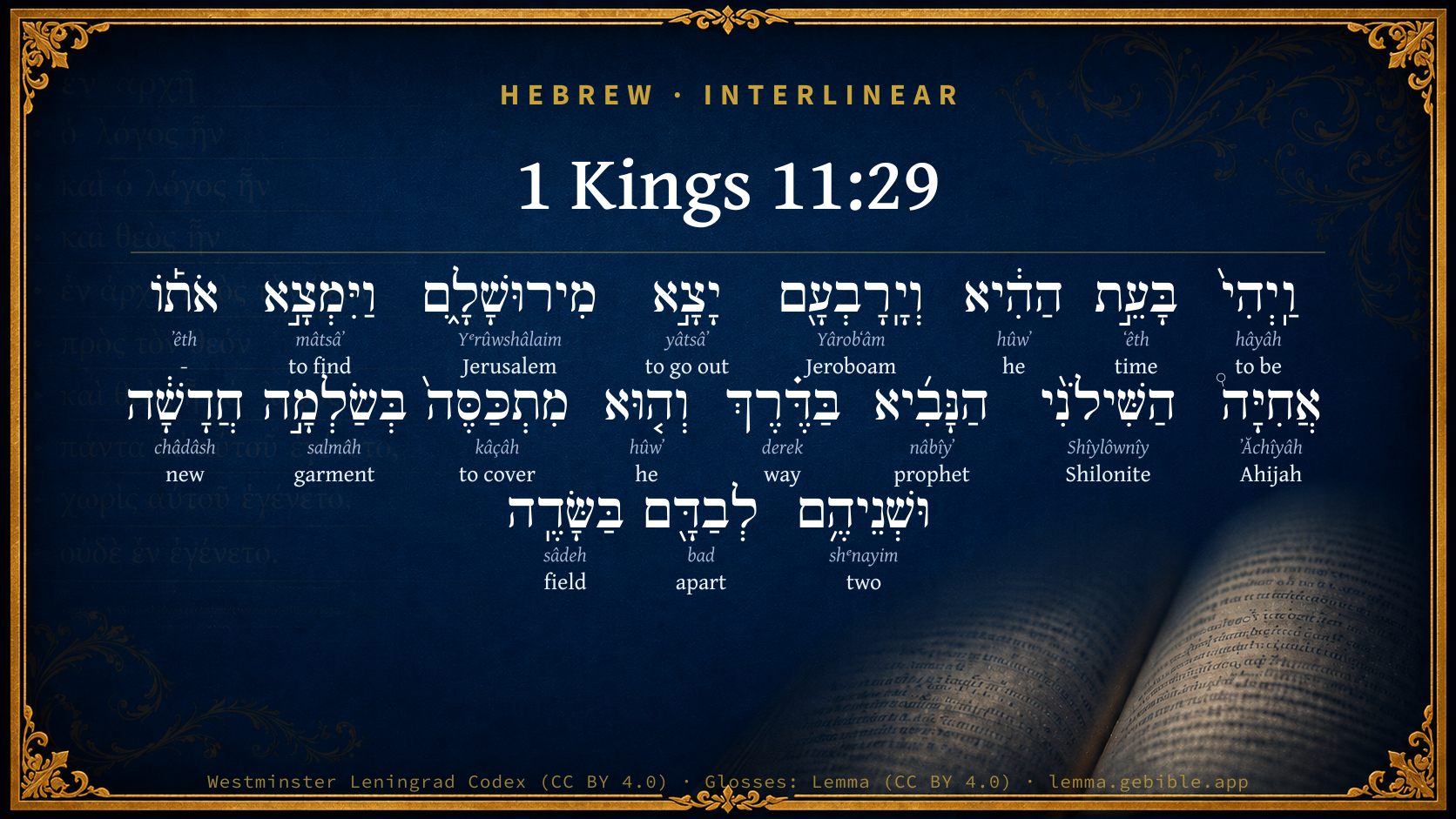
1 Kings 11:29

Hebrew (Westminster Leningrad Codex) 1 Kings 11:29 appears in the Hebrew Old Testament. The text above is from the Westminster Leningrad Codex. Each word links to its Strong’s number, a concise gloss, and parsing drawn from the Open Scriptures Hebrew Bible morphology. Click any word for its full Brown-Driver-Briggs (BDB) entry.
Download image
Cite this verse

1 Kings 11:29 (World English Bible). Public Domain. Lemma interlinear Bible study tool, https://lemma.gebible.app/v/1-kings/11/29.

Show BibTeX & RIS
BibTeX
RIS
English Translation
It happened at that time, when Jeroboam went out of Jerusalem, that the prophet Ahijah the Shilonite found him in the way; now [Ahijah] had clad himself with a new garment; and they two were alone in the field.
World English Bible · Public Domain
Highlights
  • 1 first appearance in the Hebrew Bible
Full analysis ↓
Download a study sheet

One document with this verse’s original text, its word-by-word gloss line, the meaning frame, cross-references with their text, attributed commentary, and full source and license credits — printable, and it pastes into notes with its structure intact.

This verse Autodidact and up

Study sheet (.html) Plain text (.txt)

A passage Seminary Student

Up to 50 verses in one chapter. A passage sheet keeps up to 6 commentary sources and 12 cross-references per verse, in the order this page ranks them, and says so on the sheet whenever that leaves anything out. Ask for a single verse and you get the Autodidact verse sheet above.

Everything on this page stays free to read, with no account — the sheet is a download of what is already on screen, not access to it.

Want to remove ads? Support Godless Engineer
Compare translations 3

The same verse in 3 English versions, stacked beneath the original-language interlinear above. Click any original word for its lexicon entry.

Each is an independent rendering of the whole verse — the interlinear is not word-aligned to these translations.

Highlighted words mark where these versions differ — a whole-verse word diff, not a word-by-word alignment.

  • World English Bible Public Domain
    It happened at that time, when Jeroboam went out of Jerusalem, that the prophet Ahijah the Shilonite found him in the way; now [Ahijah] had clad himself with a new garment; and they two were alone in the field.
  • King James Version Public Domain
    And it came to pass at that time when Jeroboam went out of Jerusalem, that the prophet Ahijah the Shilonite found him in the way; and he had clad himself with a new garment; and they two were alone in the field:
  • unfoldingWord Literal Text CC BY-SA 4.0
    And it happened at that time that Jeroboam went out from Jerusalem, and the prophet Ahijah the Shilonite found him in the road. And he was covering himself with a new cloak, and the two of them by themselves in the field.

unfoldingWord Literal Text — © unfoldingWord, licensed CC BY-SA 4.0. Word-aligned USFM3 via Door43 (git.door43.org/unfoldingWord/en_ult).

Versions to compare (up to 4)

3 of 4 selected

Show all 18 translations

Every available English version of this verse, each an independent rendering of the whole verse.

  • World English Bible Public Domain
    It happened at that time, when Jeroboam went out of Jerusalem, that the prophet Ahijah the Shilonite found him in the way; now [Ahijah] had clad himself with a new garment; and they two were alone in the field.
  • Berean Standard Bible Public Domain
    During that time, the prophet Ahijah the Shilonite met Jeroboam on the road as he was going out of Jerusalem. Now Ahijah had wrapped himself in a new cloak, and the two of them were alone in the open field.
  • Majority Standard Bible Public Domain
    During that time, the prophet Ahijah the Shilonite met Jeroboam on the road as he was going out of Jerusalem. Now Ahijah had wrapped himself in a new cloak, and the two of them were alone in the open field.
  • King James Version Public Domain
    And it came to pass at that time when Jeroboam went out of Jerusalem, that the prophet Ahijah the Shilonite found him in the way; and he had clad himself with a new garment; and they two were alone in the field:
  • American Standard Version (1901) Public Domain
    And it came to pass at that time, when Jeroboam went out of Jerusalem, that the prophet Ahijah the Shilonite found him in the way; now `Ahijah' had clad himself with a new garment; and they two were alone in the field.
  • Revised Version (1885) Public Domain
    And it came to pass at that time, when Jeroboam went out of Jerusalem, that the prophet Ahijah the Shilonite found him in the way; now Ahijah had clad himself with a new garment; and they two were alone in the field.
  • Geneva Bible (1599) Public Domain
    And at that time, when Ieroboam went out of Ierusalem, the Prophet Ahiiah the Shilonite founde him in the way, hauing a newe garment on him, and they two were alone in ye field.
  • Douay-Rheims (1899) Public Domain
    So it came to paste at that time, that Jeroboam went out of Jerusalem, and the prophet Ahias the Silonite, clad with a new garment, found him in the way: and they two were alone in the held.
  • Young's Literal Translation Public Domain
    And it cometh to pass, at that time, that Jeroboam hath gone out from Jerusalem, and Ahijah the Shilonite, the prophet, findeth him in the way, and he is covering himself with a new garment; and both of them `are' by themselves in a field,
  • Literal Standard Version CC BY-SA 4.0
    And it comes to pass, at that time, that Jeroboam has gone out from Jerusalem, and Ahijah the Shilonite, the prophet, finds him in the way, and he is covering himself with a new garment; and both of them [are] by themselves in a field,
  • Unlocked Literal Bible CC BY-SA 4.0
    At that time, when Jeroboam went out of Jerusalem, the prophet Ahijah the Shilonite found him on the road. Now Ahijah had dressed in a new garment and the two men were alone in the field.
  • unfoldingWord Literal Text CC BY-SA 4.0
    And it happened at that time that Jeroboam went out from Jerusalem, and the prophet Ahijah the Shilonite found him in the road. And he was covering himself with a new cloak, and the two of them by themselves in the field.
  • Darby Bible Public Domain
    And it came to pass at that time that Jeroboam went out of Jerusalem, and the prophet Ahijah the Shilonite found him in the way; and he had clad himself with a new garment; and they two were alone in the field.
  • World Messianic Bible Public Domain
    At that time, when Jeroboam went out of Jerusalem, the prophet Ahijah the Shilonite found him on the way. Now Ahijah had clad himself with a new garment; and the two of them were alone in the field.
  • Webster's Bible Public Domain
    And it came to pass at that time when Jeroboam went out of Jerusalem, that the prophet Ahijah the Shilonite found him in the way; and he had clad himself with a new garment; and they two were alone in the field:
  • Free Bible Version CC BY-SA 4.0
    Around that time the prophet Ahijah the Shilonite met Jeroboam on the road as he was leaving Jerusalem.
  • Bible in Basic English Public Domain
    Now at that time, when Jeroboam was going out of Jerusalem, the prophet Ahijah the Shilonite came across him on the road; now Ahijah had put on a new robe; and the two of them were by themselves in the open country.
  • JPS Tanakh (1917) Public Domain
    And it came to pass at that time, when Jeroboam went out of Jerusalem, that the prophet Ahijah the Shilonite found him in the way; now Ahijah had clad himself with a new garment; and they two were alone in the field.

Literal Standard Version (2020), Covenant Press — licensed CC BY-SA 4.0. Text via the HelloAO Bible API (eBible.org). Unlocked Literal Bible (unfoldingWord) — licensed CC BY-SA 4.0. Text via the HelloAO Bible API (eBible.org). unfoldingWord Literal Text — © unfoldingWord, licensed CC BY-SA 4.0. Word-aligned USFM3 via Door43 (git.door43.org/unfoldingWord/en_ult). Free Bible Version, Dr. Jonathan Gallagher — licensed CC BY-SA 4.0. Text via the HelloAO Bible API (eBible.org).

Word by word

More ways to search: Search by grammar → Find every occurrence → Compare this word →

Practice this passage: Drill this verse → Learn its vocabulary →

הַשִּׁילֹנִ֨י
Shîylôwnîy
H7888
“the · Shilonite”
Particle, Definite Article + Noun, Gentilic, Masculine, Singular, Absolute
Part of Speech
Particle + Noun
Type
Gentilic
Gender
Masculine
Number
Singular
State
Absolute
Full BDB Definition

Origin: from H7887

TWOT: None

Shilonite = see Shiloh " place of rest" - an inhabitant of Shiloh
  1. וַֽיְהִי֙ hâyâh H1961 “and · to be” Conjunction + Verb, Qal, Sequential Imperfect, 3rd Person, Masculine, Singular
  2. בָּעֵ֣ת ʻêth H6256 “in/at the · time” Preposition, Determined + Noun, Common, Both, Singular, Absolute
  3. הַהִ֔יא hûwʼ H1931 “the · he” Particle, Definite Article + Pronoun, Personal, 3rd Person, Feminine, Singular
  4. וְיָֽרָבְעָ֖ם Yârobʻâm H3379 “and · Jeroboam” Conjunction + Noun, Proper
  5. יָצָ֣א yâtsâʼ H3318 “to go out” Verb, Qal, Perfect, 3rd Person, Masculine, Singular
  6. מִירוּשָׁלִָ֑ם Yᵉrûwshâlaim H3389 “from · Jerusalem” Preposition + Noun, Proper
  7. וַיִּמְצָ֣א mâtsâʼ H4672 “and · to find” Conjunction + Verb, Qal, Sequential Imperfect, 3rd Person, Masculine, Singular
  8. אֹת֡וֹ ʼêth H853 “- · him” Particle, Direct Object + Suffix, Personal, 3rd Person, Masculine, Singular
  9. אֲחִיָּה֩ ʼĂchîyâh H281 “Ahijah” Noun, Proper
  10. הַנָּבִ֜יא nâbîyʼ H5030 “the · prophet” Particle, Definite Article + Noun, Common, Masculine, Singular, Absolute
  11. בַּדֶּ֗רֶךְ derek H1870 “in/at the · way” Preposition, Determined + Noun, Common, Both, Singular, Absolute
  12. וְה֤וּא hûwʼ H1931 “and · he” Conjunction + Pronoun, Personal, 3rd Person, Masculine, Singular
  13. מִתְכַּסֶּה֙ kâçâh H3680 “covering” Verb, Hithpael, Participle Active, Masculine, Singular, Absolute
  14. בְּשַׂלְמָ֣ה salmâh H8008 “in/at · garment” Preposition + Noun, Common, Feminine, Singular, Absolute
  15. חֲדָשָׁ֔ה châdâsh H2319 “new” Adjective, Adjective, Feminine, Singular, Absolute
  16. וּשְׁנֵיהֶ֥ם shᵉnayim H8147 “and · two · their” Conjunction + Adjective, Cardinal number, Masculine, Dual, Construct + Suffix, Personal, 3rd Person, Masculine, Plural
  17. לְבַדָּ֖ם bad H905 “to/for · apart · their” Preposition + Noun, Common, Masculine, Singular, Construct + Suffix, Personal, 3rd Person, Masculine, Plural
  18. בַּשָּׂדֶֽה sâdeh H7704 “in/at the · field” Preposition, Determined + Noun, Common, Masculine, Singular, Absolute

About this verse

These counts appear in no published source. They are computed here, from the morphology-tagged text and Lemma’s own curated glosses. What Lemma adds →

19
words
18
distinct lemmas
Historical
section

Notable vocabulary

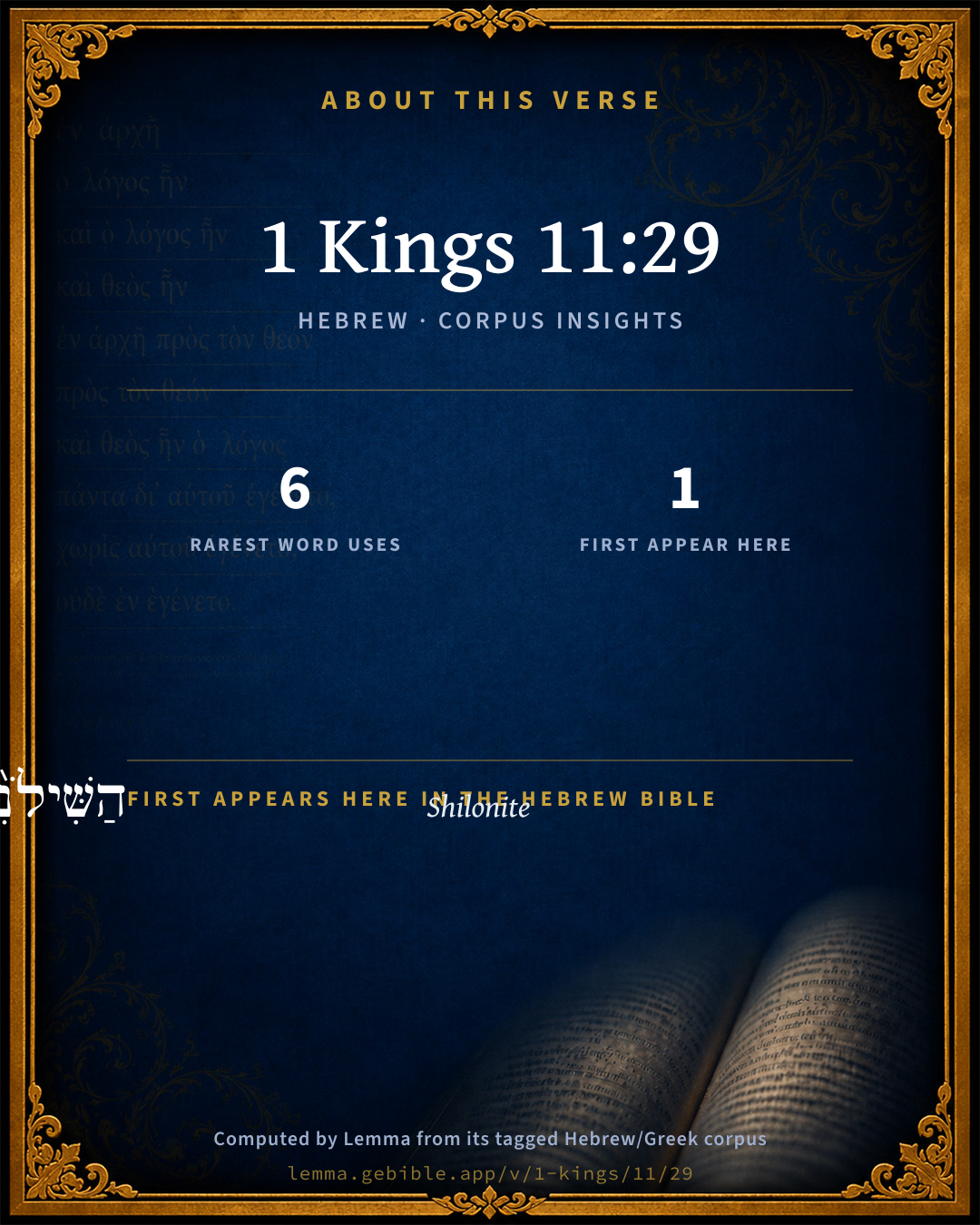
The rarest word here is הַשִּׁילֹנִ֨י Shilonite H7888 — appearing just 6 times in the whole Hebrew Bible.

First appearance in Scripture

This word makes its first canonical appearance in the Hebrew Bible here:

  • הַשִּׁילֹנִ֨י Shilonite H7888

Shared distinctive vocabulary

הַשִּׁילֹנִ֨י Shilonite H7888 occurs in 6 verses of the Hebrew Bible. Also found in:

Grammatical profile

  • 4 verbs
  • 10 nouns
  • 2 adjectives
  • 2 pronouns
  • 1 particle

Verb forms

  • וַֽיְהִי֙ Qal · Sequential Imperfect
  • יָצָ֣א Qal · Perfect
  • וַיִּמְצָ֣א Qal · Sequential Imperfect
  • מִתְכַּסֶּה֙ Hithpael · Participle Active

Repetition

A word recurs within this verse — often emphatic in Hebrew:

  • הַהִ֔יא he H1931 ×2

Hebrew & Septuagint length

In English translation the verse runs 39 words from the Hebrew and 51 from the Septuagint (LXX English) — closely comparable.

A rough comparison of the two English renderings, which tokenize alike — not a word-level alignment.

Word counts can differ between the Hebrew and the Greek without any difference in meaning — e.g. the Hebrew direct-object marker אֵת has no separate Greek word, and Greek often adds the article ὁ.

Cross-references

6

Topical passages linked to 1 Kings 11:29 in the Treasury of Scripture Knowledge — connected by theme and wording, ordered by reader-vote popularity; previews shown in the World English Bible.

  • 1 Kings 12:15 So the king didn't listen to the people; for it was a thing brought about of Yahweh, that he might establish his word, which Yahweh spoke by Ahijah the Shilonite to Jeroboam the son of Nebat.
  • 1 Kings 14:2 Jeroboam said to his wife, Please get up and disguise yourself, that you not be known to be the wife of Jeroboam; and get you to Shiloh: behold, there is Ahijah the prophet, who spoke concerning me that I should be king over this people.
  • 2 Chronicles 9:29 Now the rest of the acts of Solomon, first and last, aren't they written in the history of Nathan the prophet, and in the prophecy of Ahijah the Shilonite, and in the visions of Iddo the seer concerning Jeroboam the son of Nebat?
  • Genesis 4:8 Cain said to Abel, his brother, "Let's go into the field." It happened, when they were in the field, that Cain rose up against Abel, his brother, and killed him.
  • Joshua 18:1 The whole congregation of the children of Israel assembled themselves together at Shiloh, and set up the tent of meeting there: and the land was subdued before them.
  • 2 Samuel 14:6 Your handmaid had two sons, and they two strove together in the field, and there was none to part them, but the one struck the other, and killed him.

Cross-references courtesy of OpenBible.info (CC BY 4.0).

Hebrew and Greek witnesses Masoretic Hebrew ↔ Greek Septuagint

The same verse in the two great witnesses to the Old Testament, shown verse-for-verse.

These are two independent witnesses, not word-aligned to each other, and the Septuagint is shown in lemma (dictionary) form.

Hebrew 1 Kings 11:29 Masoretic · Westminster Leningrad Codex

וַֽיְהִי֙ בָּעֵ֣ת הַהִ֔יא וְיָֽרָבְעָ֖ם יָצָ֣א מִירוּשָׁלִָ֑ם וַיִּמְצָ֣א אֹת֡וֹ אֲחִיָּה֩ הַשִּׁילֹנִ֨י הַנָּבִ֜יא בַּדֶּ֗רֶךְ וְה֤וּא מִתְכַּסֶּה֙ בְּשַׂלְמָ֣ה חֲדָשָׁ֔ה וּשְׁנֵיהֶ֥ם לְבַדָּ֖ם בַּשָּׂדֶֽה

It happened at that time, when Jeroboam went out of Jerusalem, that the prophet Ahijah the Shilonite found him in the way; now [Ahijah] had clad himself with a new garment; and they two were alone in the field.

World English Bible · Public Domain

Greek LXX 1 Kings 11:29 Septuagint · lemma form

καί γίγνομαι ἐν ὁ καιρός ἐκεῖνος καί ιεροβοαμ ἐκἔρχομαι ἐκ ἰερουσαλήμ καί εὑρίσκω αὐτός αχιας ὁ σηλωνίτης ὁ προφήτης ἐν ὁ ὁδός καί ἀποἵστημι αὐτός ἐκ ὁ ὁδός καί ὁ αχιας περιβάλλω ἱμάτιον καινός καί ἀμφότεροι ἐν ὁ πεδίον

And it came to pass at that time, that Jeroboam went forth from Jerusalem, and Achia the Selonite the prophet found him in the way, and caused him to turn aside out of the way: and Achia was clad with a new garment, and they two were alone in the field.

LXX2012 (modern English Septuagint) · Public Domain

On this verse, The Cambridge Bible for Schools and Colleges discusses the Septuagint’s reading. Read the note in Commentary ↓

Hebrew: Westminster Leningrad Codex (CC BY 4.0). Greek: Septuagint (public domain); English from LXX2012 (modern English Septuagint) (Public Domain). How the Septuagint differs from the Hebrew →

Targum (Aramaic paraphrase)

1

The Targum is the ancient Jewish Aramaic paraphrase of the Hebrew Scriptures — an interpretive translation, not the Hebrew text itself. Onkelos (literal) and Pseudo-Jonathan (expansive) render the Torah, and Jonathan the Prophets. Coverage is partial: where no permissively-licensed English translation exists for a verse, only the Aramaic is shown. This is verse-level text, not a word-by-word alignment to the Hebrew.

  1. Targum Jonathan Prophets (Joshua–Malachi)
    וַהֲוָה בְּעִידָנָא הַהִיא וִיָרָבְעָם נְפַק מִירוּשְׁלֵם וְאַשְׁכַּח יָתֵיהּ אֲחִיָה שִׁלוֹנָאָה נְבִיאָה בְּאוֹרְחָא וְהוּא מִתְכַּסֵי בִּכְסוּתָא חַדְתָּא וְתַרְוֵיהוֹן אִינוּן בִּלְחוֹדֵיהוֹן בְּחַקְלָא:

    (no public-domain English translation for this verse)

    Targum Jonathan — Aramaic: “Mikraot Gedolot” (public domain). English: “Sefaria Community Translation” (CC0 1.0 (public-domain dedication)); “London "Chaldee Paraphrase," 1871” (public domain). Text via Sefaria.

Commentary

Notes on 1 Kings 11:29 from classic Christian and Jewish commentators (each source and its license shown beneath its notes). The classic Christian expositions comment on the surrounding passage and are grouped to its opening verse, so a note may address several verses; the Jewish commentaries on the Tanakh (Rashi and others) are per-verse, so they appear only where the commentator wrote on this verse.

Lemma curates 59 commentaries, every one of them public domain or Creative Commons licensed, each selected and text-cleaned for this edition rather than reprinted as found. About our sources →

Trapp's Complete Commentary

John Trapp

1Ki 11:29 And it came to pass at that time when Jeroboam went out of Jerusalem, that the prophet Ahijah the Shilonite found him in the way; and he had clad himself with a new garment; and they two [were] alone in the field:

Ver. 29. When Jeroboam went out of Jerusalem,] sc, To take this prefectureship or principality upon him, which was not the cause, but some occasion of his rebellion.

And he had clad himself with a new garment.] Ahijah had; and he might well make bold with his own.

John Trapp, A Commentary or Exposition upon All the Books of the Old and New Testament (1647–1656) — public domain. Text from a community e-Sword module.

Joseph Benson's Commentary

1Ki 11:29. When Jeroboam went out of Jerusalem — Probably to execute his charge. The Prophet Ahijah found him — Met with him as he was going along. “Ahijah was a native of Shiloh, and one of those who wrote the annals of King Solomon’s reign, 2Ch 9:29. And he is thought to have been the person who spake twice to Solomon from God, once while he was building the temple, (1Ki 6:12,) and again when he fell into his irregularities,” 1Ki 11:11. They two were alone in the field — Having gone aside for private conference; for otherwise Jeroboam’s servants, (it being most likely he had servants attending him,) if they heard not the words, might have seen the action of rending his coat, and thus the matter might have come to Solomon’s ears.

Joseph Benson's Commentary on the Old and New Testaments (1811–1818) — public domain. Text from a community e-Sword module.

Whedon's Commentary on the Bible

Daniel D. Whedon

29. At that time — While he had charge of the Ephraimite labourers at Jerusalem.

The prophet Ahijah — Here we meet with another representative of that interesting order of men, divine messengers, who appear so often and so prominently during the time of the Hebrew monarchy. Ahijah seems to have been to Jeroboam very much what Samuel was to Saul, and Nathan was to David. He too, probably, announced to Solomon the word of the Lord as recorded in 1Ki_11:11-13. His two genuine and authentic prophecies, each of great importance to the kingdom of Israel, are recorded here, 1Ki_11:29-39, and 1Ki_14:6-16.

The Shilonite — So called because he dwelt at Shiloh. 1Ki_14:2; 1Ki_14:4. It is, perhaps, significant that this prophet dwelt at Shiloh, the ancient seat, and up to the time of Samuel the centre, of the national worship. Thence the ark had been taken to its capture, “and the Philistines destroyed Shiloh with such hideous barbarity, that centuries afterwards the heart of the people shuddered at the very mention of the name. They never restored the place. Even Jeroboam, though of the tribe of Ephraim, never ventured to use, as a rival to Jerusalem, a site consecrated by so many centuries of worship.” — SMITH, Prophecy a Preparation for Christ. Ahijah’s oracles seem like a voice from that olden sacred past — the voice of the God of Joshua and of Eli — still proclaiming blessings on the obedient, and penal woes on them that forget his name.

He… clad himself — That is, Ahijah, not Jeroboam, had clad himself.

A new garment — Probably a mantle thrown over the shoulder, similar to that which Samuel used to wear, and which was once used in a like symbolical action, 1Sa_15:27. Some interpreters see in the newness of the garment a symbol of the Hebrew monarchy, as yet young and undivided. “Here,” observes Rawlinson, “we find the first instance of that mode of delivering a divine message which became so common in later times, and which has been called ‘acted parable.’”

Daniel D. Whedon (gen. ed.), Commentary on the Old and New Testaments (1874–1909) — public domain. Text from a community e-Sword module.

Tyndale Open Study Notes

Tyndale Open Resources

11:29-39 The meeting between Jeroboam and the prophet Ahijah set in motion God’s judgment on the dynasty of Solomon. Ahijah reappears in the account of Jeroboam’s sick son (14:1-18). He authored an unpreserved work containing information about Solomon’s deeds (2 Chr 9:29).

11:29-32 Ahijah’s symbolic tearing of his cloak into twelve pieces and giving ten of these pieces to Jeroboam symbolized God’s plans for Jeroboam and Israel following Solomon’s death (see “Prophetic Sign Acts” Theme Note). Ten of the tribes would defect; one tribe (Judah) would remain with Solomon’s heir. The twelfth tribe was probably Benjamin (see 1 Kgs 12:21). Benjamin consistently acted in tandem with Judah (see 2 Chr 11:3, 23; 14:8; 15:2-9; 17:17). Simeon, the other southern tribe, seems to have allied with the north (2 Chr 15:9; 34:6).

Tyndale Open Study Notes — © Tyndale Open Resources, licensed CC BY-SA 4.0. Text via the HelloAO Bible API.

Jamieson, Fausset & Brown

Robert Jamieson, A. R. Fausset & David Brown

clad--rather, "wrapped up." The meaning is, "Ahijah, the Shilonite, the prophet, went and took a fit station in the way; and, in order that he might not be known, he wrapped himself up, so as closely to conceal himself, in a new garment, a surtout, which he afterwards tore in twelve pieces." Notwithstanding this privacy, the story, and the prediction connected with it [Kg1 11:30-39], probably reached the king's ears; and Jeroboam became a marked man [Kg1 11:40]. His aspiring ambition, impatient for the death of Solomon, led him to form plots and conspiracies, in consequence of which he was compelled to flee to Egypt. Though chosen of God, he would not wait the course of God's providence, and therefore incurred the penalty of death by his criminal rebellion. The heavy exactions and compulsory labor (Kg1 11:28) which Solomon latterly imposed upon his subjects, when his foreign resources began to fail, had prepared the greater part of the kingdom for a revolt under so popular a demagogue as Jeroboam.

Jamieson, Fausset & Brown — Commentary Critical and Explanatory on the Whole Bible (1871) — public domain (CC PDM 1.0). Text via the HelloAO Bible API.

Adam Clarke's Commentary

Verse 29. When Jeroboam went out of Jerusalem] On what errand he was going out of Jerusalem, we know not.

Ahijah the Shilonite] He was one of those who wrote the history of the reign of Solomon, as we find from 2Ch 9:29, and it is supposed that it was by him God spake twice to Solomon; and particularly delivered the message which we find in this chapter, 1Kg 11:11-13.

Adam Clarke's Commentary on the Bible (1810–1826) — public domain. Text from a community e-Sword/MySword module.

The Cambridge Bible for Schools and Colleges

gen. ed. J. J. S. Perowne

29. at that time] i.e. While the building-works at the Millo and the completion of the wall was in progress.

Ahijah the Shilonite] This prophet, whose home was in Shiloh (see 1Ki_14:2), is mentioned in connexion with this prophecy to Jeroboam and again when Jeroboam has become king, and sends his wife to inquire of the prophet about the issue of his child’s sickness. A writing of his is spoken of in 2Ch_9:29 as ‘the prophecy of Ahijah the Shilonite’. This may have contained other prophecies beside those which have been preserved to us. He was evidently a person of much importance and influence during this and the following reign.

found him in the way] Here the LXX. adds ‘and he drew him aside out of the way’: an addition which may have been made to explain how it came to pass, as is said immediately, that ‘they two were alone in the field.’

and he had clad himself] i.e. Ahijah had done so. The R.V. following the LXX. inserts the proper name in italics to make the sense clearer in the English.

The Cambridge Bible for Schools and Colleges (gen. ed. J. J. S. Perowne; Cambridge University Press, 1878–1918) — public domain. Text from a community e-Sword module.

John Gill's Exposition

And Ahijah caught the new garment that was on him,.... This looks as if it was Jeroboam's garment, having got a new one to appear before the king in; though the sense may be this, that the prophet took hold of his own garment that was upon himself:

and rent it in twelve pieces; as symbolical of the twelve tribes of Israel.

John Gill's Exposition of the Whole Bible (1746–1763) — public domain (CC PDM 1.0). Text via the HelloAO Bible API.

Albert Barnes' Notes on the Bible

At that time - Probably after Jeroboam’s return from Egypt (see 1Ki 11:40).

The Shilonite - An inhabitant of Shiloh in Mount Ephraim, the earliest and most sacred of the Hebrew sanctuaries (Jos 18:10; Jdg 18:31; 1Sa 4:3, etc.)

Albert Barnes' Notes on the Bible (1834–1885) — public domain. Text from a community e-Sword/MySword module.

Haydock's Catholic Bible Commentary

CHAPTER XI.

Garment. Salma occurs 16 times in this sense, and simlee 27. The latter, we may presume, is the true reading, as it is in the Samaritan Pentateuch invariably; Exodus xxii. 26, 27, both words are printed in the Hebrew Bible. But it is not probable that Moses should have written them so; no more than a Latin author would use both vestinentum and vestimentum. Shamal, in Arabic, signifies "he clothed himself all over." (Kennicott) --- Way leading to Ephraim, (Menochius) his department. (Calmet) --- Field. Septuagint, "he drew him aside out of the road: and Ahias had on a new cloak, and both were in the field." (Haydock) --- Jeroboam would not probably go unattended; (Menochius) and it seems this transaction soon transpired, and came to the ears of Solomon. (Haydock)

George Leo Haydock (1774–1849), Haydock's Catholic Family Bible and Commentary, 1859 edition — public domain. Excludes Psalms (Douay-Rheims chapter numbering differs from Protestant) and Deuterocanonical books (Catholic canon only).

Matthew Poole's English Annotations

When Jeroboam went out of Jerusalem; upon some occasion, possibly to execute his charge.

They two were alone in the field; having gone aside thither for some private conference; for otherwise it is most likely that he had servants attending upon him, who, though they heard not the words, yet might see the action, and the rending of Jeroboam’s coat; and thus it came to Solomon’s ears, who being so acute and wise, could easily understand the thing by what he heard of the action, especially when a prophet did it.

Matthew Poole's English Annotations on the Holy Bible (1683–1685) — public domain. Text from a community e-Sword/MySword module.

The Pulpit Commentary

And it came to pass at that time a general expression= "when he was thus employed" when Heb. that Jeroboam went out of Jerusalem that Heb. and, the prophet Ahijah the Shilonite i.e., of Shiloh, as is expressed 1Ki_14:2-4, where see notes. He too, therefore, was an Ephraimite. (Jos_16:5) This portion of the history is probably derived from his writings. (2Ch_9:29) We may be pretty sure that Nathan was now dead found him in the way; and he i.e., Ahijah. Ewald understands Jeroboam to be meant, and would see in the new garment his "splendid robe of office" had clad himself with a new garment hmlc same word as hlmc such transpositions of letters being common. The simlah was the outer garment (Gen_9:23; 1Sa_21:10, etc.) which served at night as a covering. (Deu_22:17) It was probably identical in shape, etc., with the camel"s-hair burnous, or abba, worn by the Arabs at the present day (cf. Conder, pp. 318, 342), and being almost a square would lend itself well to division into twelve parts; and they two were alone in the field i.e., open country.

Vers. 29-39.

The Message of Ahijah.

As Jeroboam went out of Jerusalem with his commission from Solomon to rule as his lieutenant over the house of Joseph, meditating how he might use his fortune to construct a throne, he was met by Ahijah the Shilonite, who accosted him in a manner agreeable to his ambition. In the message of Ahijah we have

I A PROPHECY.

1. This was expressed in sign.

(1) The Shilonite provided himself with a new garment. This was intended to symbolize the kingdom. The same sign had been similarly used before. (1Sa_15:27 1Sa_24:5) Note: His people are the honourable clothing of a prince. (see Pro_14:28)

(2) The garment was new. The kingdom of Israel was as yet young. Solomon was but the third monarch in succession. The garment was whole. So was the kingdom, as yet, unbroken. Note: The robe of Christ was seamless and woven throughout, which suggests the perfect unity which will appear in the subjects of His heavenly kingdom. Note further: That in His transfiguration, which symbolized His kingdom, (see Mat_16:28 Mat_17:1) His raiment shined "as no fuller on earth could white it," suggesting the purity and glory in which the subjects of that kingdom are to shine. (Mat_13:43)

(3) But the robe in the hands of the prophet, the messenger and representative of God, is now rent into twelve pieces, according to the number of tribes composing the kingdom, ten of which were given into the hand of Jeroboam. Note: God disposes. In its militant state the kingdom of Christ is subject to revolutions, but not so in its triumphant and heavenly state.

2. The prophecy also is expressed in words (vers. 31-39).

(1) Thus the testimony is twofold. It appeals to the eye, also to the ear.

(2) History verified the predictions to the letter. What a testimony to the truth of God is the harmony and correspondence of prophecy and history!

II ITS REASONS. These are expressed and implied.

1. The sin of Solomon is specified (vers. 31, 33).

(1) Solomon forsook the Lord. God never forsakes us unless we first forsake Him. Let us be admonished.

(2) He worshipped idols. Ashtoreth, the impure Venus of the Zidonians; Chemosh, the abomination of the Moabites; and Milcom, or Molech, the devil of the Ammonites,are put into competition with the God of Israel! Whoever is so foolish as to forsake God will surely become the dupe of devils.

(3) We notice the plural pronoun, "they have forsaken Me," etc. Not Solomon and his wives, for these heathen women had never known God but Solomon and the Israelites drawn away by his influence and example. Men seldom sin alone. Accomplices are involved with their leaders in a common retribution.

(4) He forgat the good example of his father David. This is mentioned to his discredit. We are accountable to God for our advantages. For godly parents, godly ministers, opportunities.

2. The piety of David is remembered.

(1) It is remembered in the mind of God. Let sincere Christians who are apt to be discouraged at their failures take comfort from the fact that God is more willing to remember our good endeavours than our failures. David in glory would know the blessedness of this.

(2) It is remembered to the advantage of his offspring on the earth. The temporal judgments upon Solomon"s sins were mitigated in consequence of David"s piety. Would not David, in glory, have satisfaction in this?

3. The Scriptures must be fulfilled.

(1) David was to have a light always before God in Jerusalem. (Psa_132:16, Psa_132:17) The family of David mast be preserved until Messiah comes to be the Light of the Gentiles.

(2) As David was a type of Christ, so was Jerusalem, with its temple and shekinah, a type of His Church. Of this Church, Christ is the everlasting Light (see Isa_24:23 Isa_60:19, Isa_60:20; Rev_21:23)

4. No mention is made of any goodness in Jeroboam.

(1) This omission is significant. It suggests that the Ephrathite was used only as the instrument of Providence for the punishment of sinners; and for this service had the reward of his ambition. Therefore the success of our desires in this world is no certain proof either of our goodness or of God"s favour.

(2) But in respect to his service God gave Jeroboam a glorious opportunity by goodness to make himself great like David (see ver. 38). What opportunities does God graciously vouchsafe to us! Let us utilize them to the best possible account. M.

HOMILIES BY E. DE PRESSENSE Vers. 29-36; chs. 14:21-81; Jam_1:15) This is true also in the history of individuals; and we have in this fact one of the strongest evidences that we are under the government of a holy God. Let us never forget that His holiness is at the same time love, and that through all the dark and sorrowful vicissitudes of our life He is carrying out His plan of mercy. In spite of all its falls, its wanderings, and its woes, Israel did fulfil its preparatory mission. If in the end the theocracy tottered to its fall, this failure also entered into the conditions of the Divine plan. Israel was never treated by God, however, as a mere passive instrument. God gave it repeated warnings, as, for example, by the mouth of the unknown prophet who was sent to Jeroboam to declare to him the judgments of God (ch. 13.) E. de P.

The Pulpit Commentary (1880–1919), ed. H.D.M. Spence-Jones & Joseph S. Exell — public domain. Text from a community e-Sword module.

John Wesley's Explanatory Notes

Went - Probably to execute his charge. Were alone - Having gone aside for private conference; for otherwise it is most likely that he had servants attending him, who, though they hear not the words, yet might see the action, and the rending of Jeroboam's coat; and thus it came to Solomon's ears, who being so wise, could easily understand the thing by what he heard of the action, especially when a prophet did it.

John Wesley, Explanatory Notes Upon the Whole Bible (1754–1765) — public domain. Text via the GEBible commentary corpus.

Lesson kit

Teaching starters — assembled from the data on this page, not authored interpretation. Every prompt links to the verse data it draws on. Edit before teaching.

1 Kings, in the Historical, opens this verse with 19 words (18 distinct Hebrew lemmas). Its most distinctive word is Shîylôwnîy (“Shilonite”). A historical commentator’s framing appears above. Read the whole chapter for the surrounding context.

Discussion questions

  1. How does “Shilonite” (Shîylôwnîy) shape what this verse is saying?
  2. The word “Shilonite” first appears here in Scripture. What is being introduced at this debut?
  3. 1 Kings 12:15 shares the word «Shilonite» with this verse. How do the two illuminate each other?
  4. “he” occurs 2× in this one verse. What is the effect of the repetition?
  5. These translations render this verse differently. What is at stake in choosing one wording over another?
  6. The verb «וַֽיְהִי֙» is Qal Sequential Imperfect. How does its form color the action?
  7. Reading how Trapp's Complete Commentary and Joseph Benson's Commentary read this verse, where do the two commentators agree and where do they part?

Things to notice

  • 1 word makes its first canonical appearance in Scripture here.
  • These translations choose different wording for 14 words in this verse.
  • “he” occurs 2× in this single verse.
  • 18 distinct Hebrew lemmas span 19 words in this verse.

Reading settings

Reading text

Shown beneath each verse's original-language words.

Old Testament
Old Testament edition

Read the OT as the Masoretic Hebrew (MT) or the Greek Septuagint (LXX).

English shown for the Greek Septuagint (in the Hebrew ↔ Greek comparison).

Comparing translations? Open the Compare panel on any verse page to stack up to four side by side.