
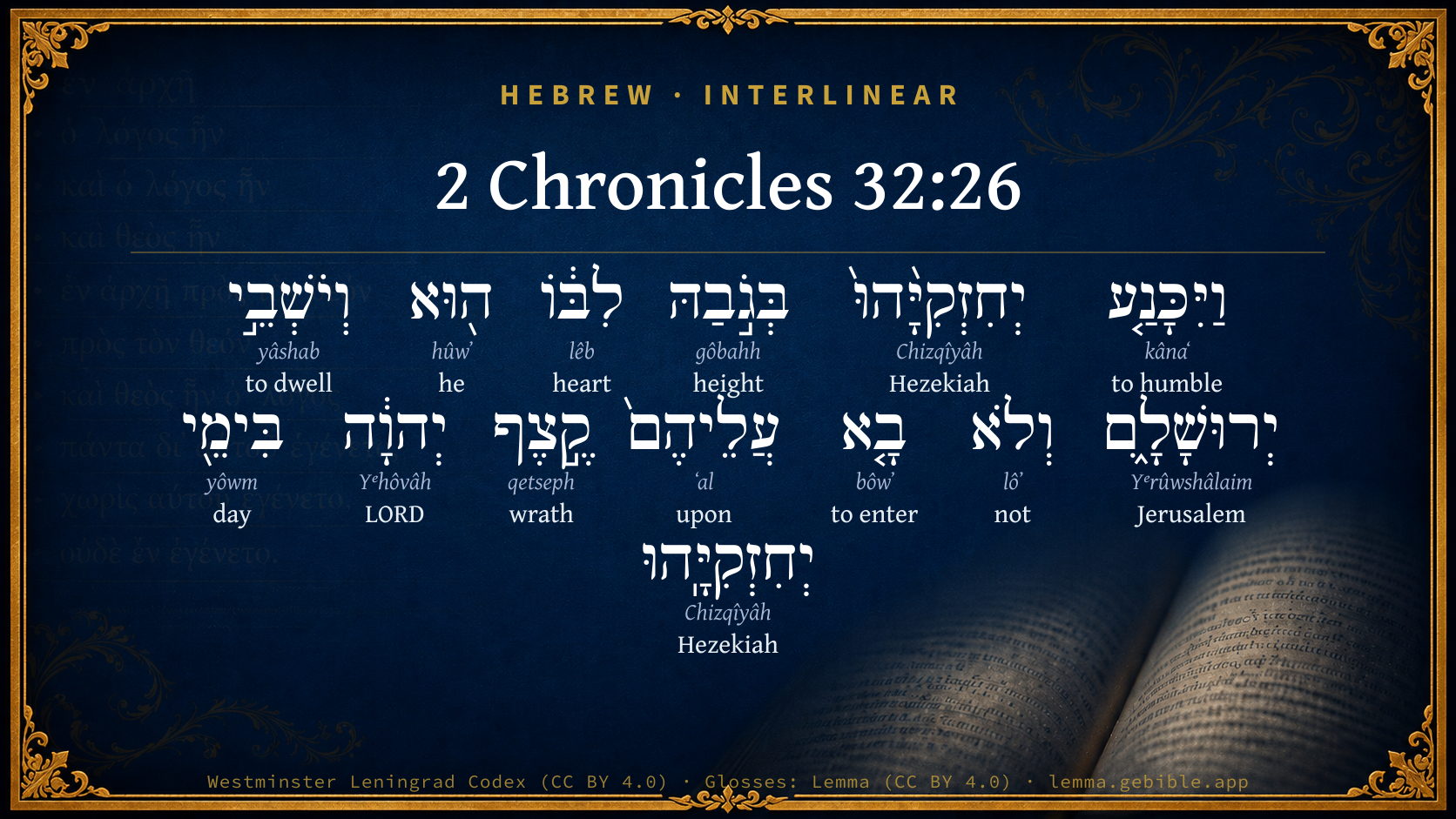
2 Chronicles 32:26

Hebrew (Westminster Leningrad Codex) 2 Chronicles 32:26 appears in the Hebrew Old Testament. The text above is from the Westminster Leningrad Codex. Each word links to its Strong’s number, a concise gloss, and parsing drawn from the Open Scriptures Hebrew Bible morphology. Click any word for its full Brown-Driver-Briggs (BDB) entry.
Download image
Cite this verse

2 Chronicles 32:26 (World English Bible). Public Domain. Lemma interlinear Bible study tool, https://lemma.gebible.app/v/2-chronicles/32/26.

Show BibTeX & RIS
BibTeX
RIS
English Translation
Notwithstanding Hezekiah humbled himself for the pride of his heart, both he and the inhabitants of Jerusalem, so that the wrath of Yahweh didn't come on them in the days of Hezekiah.
World English Bible · Public Domain
Download a study sheet

One document with this verse’s original text, its word-by-word gloss line, the meaning frame, cross-references with their text, attributed commentary, and full source and license credits — printable, and it pastes into notes with its structure intact.

This verse Autodidact and up

Study sheet (.html) Plain text (.txt)

A passage Seminary Student

Up to 50 verses in one chapter. A passage sheet keeps up to 6 commentary sources and 12 cross-references per verse, in the order this page ranks them, and says so on the sheet whenever that leaves anything out. Ask for a single verse and you get the Autodidact verse sheet above.

Everything on this page stays free to read, with no account — the sheet is a download of what is already on screen, not access to it.

Want to remove ads? Support Godless Engineer
Compare translations 3

The same verse in 3 English versions, stacked beneath the original-language interlinear above. Click any original word for its lexicon entry.

Each is an independent rendering of the whole verse — the interlinear is not word-aligned to these translations.

Highlighted words mark where these versions differ — a whole-verse word diff, not a word-by-word alignment.

  • World English Bible Public Domain
    Notwithstanding Hezekiah humbled himself for the pride of his heart, both he and the inhabitants of Jerusalem, so that the wrath of Yahweh didn't come on them in the days of Hezekiah.
  • King James Version Public Domain
    Notwithstanding Hezekiah humbled himself for the pride of his heart, both he and the inhabitants of Jerusalem, so that the wrath of the LORD came not upon them in the days of Hezekiah.
  • unfoldingWord Literal Text CC BY-SA 4.0
    And Hezekiah humbled himself from the height of his heart, he and the inhabitants of Jerusalem, and the wrath of Yahweh did not come upon them in the days of Hezekiah.

unfoldingWord Literal Text — © unfoldingWord, licensed CC BY-SA 4.0. Word-aligned USFM3 via Door43 (git.door43.org/unfoldingWord/en_ult).

Versions to compare (up to 4)

3 of 4 selected

Show all 18 translations

Every available English version of this verse, each an independent rendering of the whole verse.

  • World English Bible Public Domain
    Notwithstanding Hezekiah humbled himself for the pride of his heart, both he and the inhabitants of Jerusalem, so that the wrath of Yahweh didn't come on them in the days of Hezekiah.
  • Berean Standard Bible Public Domain
    Then Hezekiah humbled the pride of his heart—he and the people of Jerusalem—so that the wrath of the LORD did not come upon them during the days of Hezekiah.
  • Majority Standard Bible Public Domain
    Then Hezekiah humbled the pride of his heart—he and the people of Jerusalem—so that the wrath of the LORD did not come upon them during the days of Hezekiah.
  • King James Version Public Domain
    Notwithstanding Hezekiah humbled himself for the pride of his heart, both he and the inhabitants of Jerusalem, so that the wrath of the LORD came not upon them in the days of Hezekiah.
  • American Standard Version (1901) Public Domain
    Notwithstanding Hezekiah humbled himself for the pride of his heart, both he and the inhabitants of Jerusalem, so that the wrath of Jehovah came not upon them in the days of Hezekiah.
  • Revised Version (1885) Public Domain
    Notwithstanding Hezekiah humbled himself for the pride of his heart, both he and the inhabitants of Jerusalem, so that the wrath of the LORD came not upon them in the days of Hezekiah.
  • Geneva Bible (1599) Public Domain
    Notwithstanding Hezekiah humbled him selfe (after that his heart was lifted vp) he and the inhabitants of Ierusalem, and the wrath of the Lord came not vpon them in the dayes of Hezekiah.
  • Douay-Rheims (1899) Public Domain
    And he humbled himself afterwards, because his heart had been lifted up, both he and the inhabitants of Jerusalem: and therefore the wrath of the Lord came not upon them in the days of Ezechias.
  • Young's Literal Translation Public Domain
    and Hezekiah is humbled for the loftiness of his heart, he and the inhabitants of Jerusalem, and the wrath of Jehovah hath not come upon them in the days of Hezekiah.
  • Literal Standard Version CC BY-SA 4.0
    and Hezekiah is humbled for the loftiness of his heart, he and the inhabitants of Jerusalem, and the wrath of YHWH has not come on them in the days of Hezekiah.
  • Unlocked Literal Bible CC BY-SA 4.0
    Nevertheless, Hezekiah later humbled himself for the pride of his heart, both he and the inhabitants of Jerusalem, so that Yahweh's anger did not come on them during Hezekiah's days.
  • unfoldingWord Literal Text CC BY-SA 4.0
    And Hezekiah humbled himself from the height of his heart, he and the inhabitants of Jerusalem, and the wrath of Yahweh did not come upon them in the days of Hezekiah.
  • Darby Bible Public Domain
    And Hezekiah humbled himself for the pride of his heart, he and the inhabitants of Jerusalem, so that the wrath of Jehovah came not upon them in the days of Hezekiah.
  • World Messianic Bible Public Domain
    However, Hezekiah humbled himself for the pride of his heart, both he and the inhabitants of Jerusalem, so that the LORD’s wrath didn’t come on them in the days of Hezekiah.
  • Webster's Bible Public Domain
    Notwithstanding, Hezekiah humbled himself for the pride of his heart, both he and the inhabitants of Jerusalem, so that the wrath of the LORD came not upon them in the days of Hezekiah.
  • Free Bible Version CC BY-SA 4.0
    Then Hezekiah apologized for his arrogance, as did the people of Jerusalem, and the Lord's anger no longer fell on them during Hezekiah's lifetime.
  • Bible in Basic English Public Domain
    But then, Hezekiah, in sorrow for what he had done, put away his pride; and he and all Jerusalem made themselves low, so that the wrath of the Lord did not come on them in Hezekiah's life-time.
  • JPS Tanakh (1917) Public Domain
    Notwithstanding Hezekiah humbled himself for the pride of his heart, both he and the inhabitants of Jerusalem, so that the wrath of the LORD came not upon them in the days of Hezekiah.

Literal Standard Version (2020), Covenant Press — licensed CC BY-SA 4.0. Text via the HelloAO Bible API (eBible.org). Unlocked Literal Bible (unfoldingWord) — licensed CC BY-SA 4.0. Text via the HelloAO Bible API (eBible.org). unfoldingWord Literal Text — © unfoldingWord, licensed CC BY-SA 4.0. Word-aligned USFM3 via Door43 (git.door43.org/unfoldingWord/en_ult). Free Bible Version, Dr. Jonathan Gallagher — licensed CC BY-SA 4.0. Text via the HelloAO Bible API (eBible.org).

Word by word

More ways to search: Search by grammar → Find every occurrence → Compare this word →

Practice this passage: Drill this verse → Learn its vocabulary →

בְּגֹ֣בַהּ
gôbahh
H1363
“in/at · height of”
Preposition + Noun, Common, Masculine, Singular, Construct
Part of Speech
Preposition + Noun
Type
Common
Gender
Masculine
Number
Singular
State
Construct
Full BDB Definition

Origin: from H1361

TWOT: 305b

height, exaltation - height - exaltation, grandeur - haughtiness
  1. וַיִּכָּנַ֤ע kânaʻ H3665 “and · to humble” Conjunction + Verb, Niphal, Sequential Imperfect, 3rd Person, Masculine, Singular
  2. יְחִזְקִיָּ֨הוּ֙ Chizqîyâh H2396 “Hezekiah” Noun, Proper
  3. לִבּ֔וֹ lêb H3820 “heart · his” Noun, Common, Masculine, Singular, Construct + Suffix, Personal, 3rd Person, Masculine, Singular
  4. ה֖וּא hûwʼ H1931 “he” Pronoun, Personal, 3rd Person, Masculine, Singular
  5. וְיֹשְׁבֵ֣י yâshab H3427 “and · dwelling” Conjunction + Verb, Qal, Participle Active, Masculine, Plural, Construct
  6. יְרוּשָׁלִָ֑ם Yᵉrûwshâlaim H3389 “Jerusalem” Noun, Proper
  7. וְלֹא lôʼ H3808 “and · not” Conjunction + Particle, Negative
  8. בָ֤א bôwʼ H935 “to enter” Verb, Qal, Perfect, 3rd Person, Masculine, Singular
  9. עֲלֵיהֶם֙ ʻal H5921 “upon · them” Preposition + Suffix, Personal, 3rd Person, Masculine, Plural
  10. קֶ֣צֶף qetseph H7110 “wrath of” Noun, Common, Masculine, Singular, Construct
  11. יְהוָ֔ה Yᵉhôvâh H3068 “LORD” Noun, Proper
  12. בִּימֵ֖י yôwm H3117 “in/at · days of” Preposition + Noun, Common, Masculine, Plural, Construct
  13. יְחִזְקִיָּֽהוּ Chizqîyâh H2396 “Hezekiah” Noun, Proper

About this verse

These counts appear in no published source. They are computed here, from the morphology-tagged text and Lemma’s own curated glosses. What Lemma adds →

14
words
13
distinct lemmas
Historical
section

Notable vocabulary

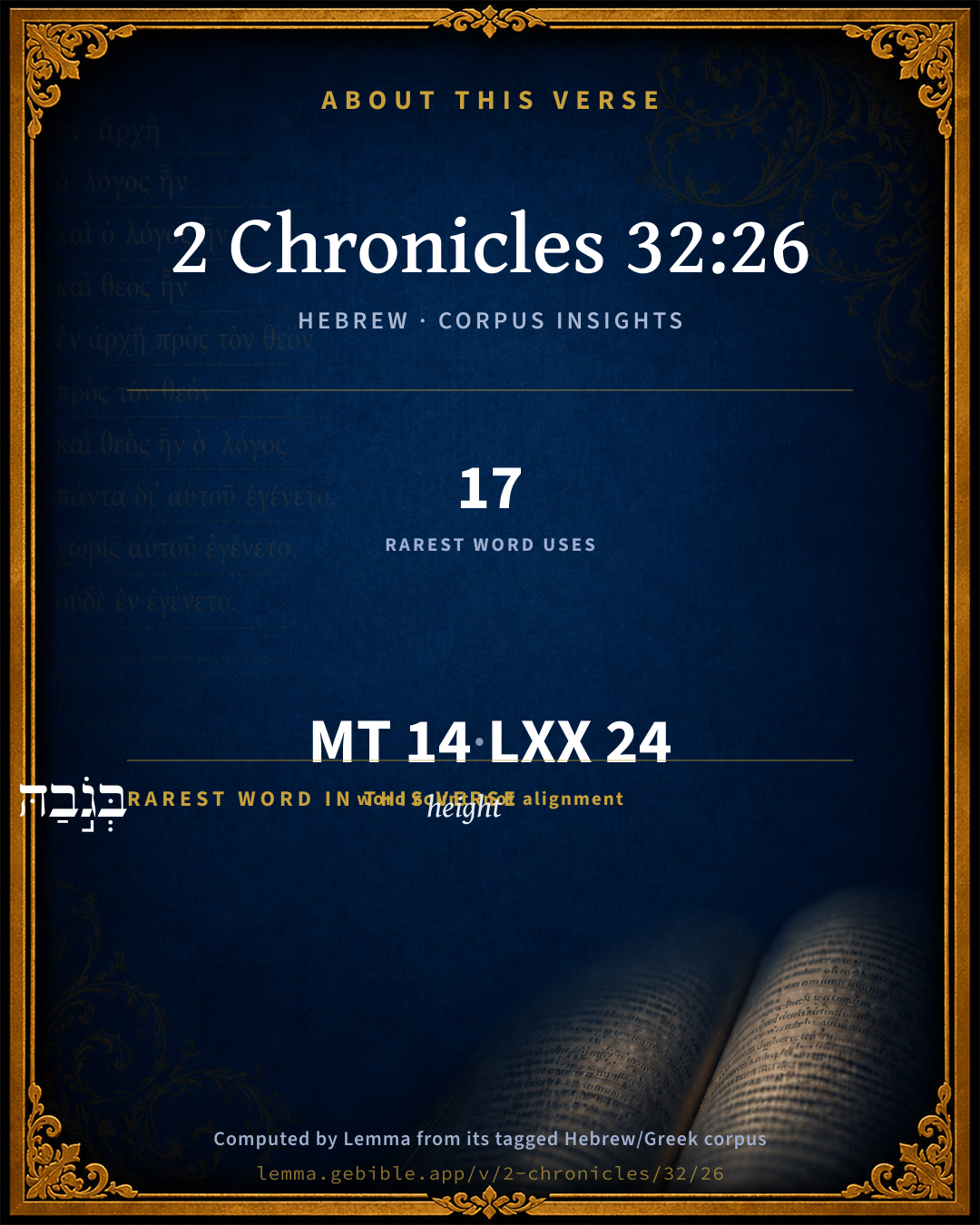
The rarest word here is בְּגֹ֣בַהּ height H1363 — appearing just 17 times in the whole Hebrew Bible.

Shared distinctive vocabulary

בְּגֹ֣בַהּ height H1363 occurs in 16 verses of the Hebrew Bible. Also found in:

Grammatical profile

  • 3 verbs
  • 8 nouns
  • 1 pronoun
  • 1 preposition
  • 1 particle

Verb forms

  • וַיִּכָּנַ֤ע Niphal · Sequential Imperfect
  • וְיֹשְׁבֵ֣י Qal · Participle Active
  • בָ֤א Qal · Perfect

Repetition

A word recurs within this verse — often emphatic in Hebrew:

  • יְחִזְקִיָּ֨הוּ֙ Hezekiah H2396 ×2

Hebrew & Septuagint length

In English translation the verse runs 32 words from the Hebrew and 32 from the Septuagint (LXX English) — the same length.

A rough comparison of the two English renderings, which tokenize alike — not a word-level alignment.

Word counts can differ between the Hebrew and the Greek without any difference in meaning — e.g. the Hebrew direct-object marker אֵת has no separate Greek word, and Greek often adds the article ὁ.

In the original languages it is 14 Hebrew tokens and 24 Greek tokens — but the two are counted differently (Hebrew bundles its prefixes and suffixes into one token; the Greek is in lemma form), so that isn’t a like-for-like length.

Cross-references

11

Topical passages linked to 2 Chronicles 32:26 in the Treasury of Scripture Knowledge — connected by theme and wording, ordered by reader-vote popularity; previews shown in the World English Bible.

  • Jeremiah 26:18–19 Micah the Morashtite prophesied in the days of Hezekiah king of Judah; and he spoke to all the people of Judah, saying, Thus says Yahweh of Hosts: Zion shall be plowed as a field, and Jerusalem shall become heaps, and the mountain of the house as the high places of a forest.
  • 2 Chronicles 33:12 When he was in distress, he begged Yahweh his God, and humbled himself greatly before the God of his fathers.
  • 2 Chronicles 34:27–28 because your heart was tender, and you did humble yourself before God, when you heard his words against this place, and against the inhabitants of it, and have humbled yourself before me, and have torn your clothes, and wept before me; I also have heard you, says Yahweh.
  • James 4:10 Humble yourselves in the sight of the Lord, and he will exalt you.
  • Leviticus 26:40–41 "'If they confess their iniquity, and the iniquity of their fathers, in their trespass which they trespassed against me, and also that, because they walked contrary to me,
  • 1 Kings 21:19 You shall speak to him, saying, Thus says Yahweh, Have you killed and also taken possession? You shall speak to him, saying, Thus says Yahweh, In the place where dogs licked the blood of Naboth shall dogs lick your blood, even yours.
  • 1 Kings 21:29 See you how Ahab humbles himself before me? because he humbles himself before me, I will not bring the evil in his days; but in his son's days will I bring the evil on his house.
  • 2 Kings 20:16–19 Isaiah said to Hezekiah, Hear the word of Yahweh.
  • 2 Chronicles 33:19 His prayer also, and how [God] was entreated of him, and all his sin and his trespass, and the places in which he built high places, and set up the Asherim and the engraved images, before he humbled himself: behold, they are written in the history of Hozai.
  • 2 Chronicles 33:23 He didn't humble himself before Yahweh, as Manasseh his father had humbled himself; but this same Amon trespassed more and more.
  • Isaiah 39:6–8 Behold, the days are coming, when all that is in your house, and that which your fathers have laid up in store until this day, shall be carried to Babylon: nothing shall be left, says Yahweh.

Cross-references courtesy of OpenBible.info (CC BY 4.0).

Hebrew and Greek witnesses Masoretic Hebrew ↔ Greek Septuagint

The same verse in the two great witnesses to the Old Testament, shown verse-for-verse.

These are two independent witnesses, not word-aligned to each other, and the Septuagint is shown in lemma (dictionary) form.

Hebrew 2 Chronicles 32:26 Masoretic · Westminster Leningrad Codex

וַיִּכָּנַ֤ע יְחִזְקִיָּ֨הוּ֙ בְּגֹ֣בַהּ לִבּ֔וֹ ה֖וּא וְיֹשְׁבֵ֣י יְרוּשָׁלִָ֑ם וְלֹא בָ֤א עֲלֵיהֶם֙ קֶ֣צֶף יְהוָ֔ה בִּימֵ֖י יְחִזְקִיָּֽהוּ

Notwithstanding Hezekiah humbled himself for the pride of his heart, both he and the inhabitants of Jerusalem, so that the wrath of Yahweh didn't come on them in the days of Hezekiah.

World English Bible · Public Domain

Greek LXX 2 Chronicles 32:26 Septuagint · lemma form

καί ταπεινόω εζεκιας ἀπό ὁ ὕψος ὁ καρδία αὐτός καί ὁ καταοἰκέω ἰερουσαλήμ καί οὐ ἐπιἔρχομαι ἐπί αὐτός ὀργή κύριος ἐν ὁ ἡμέρα εζεκιας

And Ezekias humbled himself after the exaltation of his heart, he and the dwellers in Jerusalem; and the wrath of the Lord did not come upon them in the days of Ezekias.

LXX2012 (modern English Septuagint) · Public Domain

Hebrew: Westminster Leningrad Codex (CC BY 4.0). Greek: Septuagint (public domain); English from LXX2012 (modern English Septuagint) (Public Domain). How the Septuagint differs from the Hebrew →

Commentary

Notes on 2 Chronicles 32:26 from classic Christian and Jewish commentators (each source and its license shown beneath its notes). The classic Christian expositions comment on the surrounding passage and are grouped to its opening verse, so a note may address several verses; the Jewish commentaries on the Tanakh (Rashi and others) are per-verse, so they appear only where the commentator wrote on this verse.

Lemma curates 59 commentaries, every one of them public domain or Creative Commons licensed, each selected and text-cleaned for this edition rather than reprinted as found. About our sources →

Trapp's Complete Commentary

John Trapp

2Ch 32:26 Notwithstanding Hezekiah humbled himself for the pride of his heart, [both] he and the inhabitants of Jerusalem, so that the wrath of the LORD came not upon them in the days of Hezekiah.

Ver. 26. Notwithstanding Hezekiah humbled himself.] He afflicted himself with voluntary sorrows, when once, by the preaching of the prophet, he came to a sight of his sin. Submissior factus est superbia cordis sui - so Vatablus rendereth it - he was made more humble by the pride of his heart: as God’s people are gainers by their sins also; whence that paradox of Augustine, My sins, in some sense, do me more good than my graces; for they make me afterwards more humble, more careful, more thankful for a Saviour, more merciful to others, more desirous of the state of perfection, &c. See 2Ki 20:17-19.

John Trapp, A Commentary or Exposition upon All the Books of the Old and New Testament (1647–1656) — public domain. Text from a community e-Sword module.

The Biblical Illustrator

Joseph S. Exell

2Ch_32:26

Notwithstanding, Hezekiah humbled himself for the pride of his heart.

Hezekiahs sin and humiliation

I. Show the nature and grounds of hezekiahs humiliation. His sin does not seem great in human estimation; but it was exceeding sinful in Gods sight.

1. He sought his own glory. He wished to show what a great man he was, in order that his alliance might be courted and his power feared.

2. He sought his own glory in preference to Gods honour. He had now a happy opportunity of magnifying the God of Israel. He might have

(1) recounted Gods past dealings with His people;

(2) commended Jehovah as an answerer of prayer.

3. He sought his own glory before the good of his friends. He should have recompensed the great kindness of the ambassadors by instructing them in the knowledge of the God of Israel.

II. Enquire whether we also have not similar grounds for humiliation.

1. Pride is deeply rooted in the heart of fallen man. We are vain

(1) of any natural endowments of body or mind.

(2) Of any acquired distinctions.

(3) Even the gifts of grace become occasions of pride.

2. We indulge this disposition to the neglect of Gods honour and of the eternal welfare of those around us.

(1) We have many opportunities of speaking for God.

(2) But how rarely is our intercourse with each other made subservient to His glory.

III. Inferences.

1. What dreadful evils arise from small beginnings. Hezekiah at first probably intended only to show civility to his friends.

2. How great is the efficacy of fervent prayer and intercession. God deferred the evil threatened till the next generation. (Skeletons of Sermon.)

The Biblical Illustrator, edited by Joseph S. Exell (c. 1880s–1900s) — public domain. Text from a community e-Sword module.

Joseph Benson's Commentary

2Ch 32:26. Hezekiah humbled himself for the pride of his heart — For the sins of the heart, though they should never show themselves in any external way, either by word or deed, must be acknowledged to God and repented of, if we would find mercy; and self-humiliation is a necessary branch of repentance. Both he and the inhabitants of Jerusalem — Who humbled themselves with Hezekiah, either because they were conscious they had been guilty of the same sin, or, at least, feared they might share in the punishment. So that the wrath of the Lord came not upon them in the days of Hezekiah — In his days there were peace and truth; so much doth repentance avail to put by, or at least to put off, the tokens of God’s anger.

Joseph Benson's Commentary on the Old and New Testaments (1811–1818) — public domain. Text from a community e-Sword module.

Tyndale Open Study Notes

Tyndale Open Resources

32:26 The humble repentance of both Hezekiah and the people pleased God, so the Lord’s anger did not fall on them during Hezekiah’s lifetime.

Tyndale Open Study Notes — © Tyndale Open Resources, licensed CC BY-SA 4.0. Text via the HelloAO Bible API.

Adam Clarke's Commentary

Verse 26. Humbled himself] Awoke from his sleep, was sorry for his sin, deprecated the wrath of God, and the Divine displeasure was turned away from him.

Adam Clarke's Commentary on the Bible (1810–1826) — public domain. Text from a community e-Sword/MySword module.

Ellicott's Commentary for English Readers

(26) Notwithstanding.—And.

The wrath of the Lord . . . days of Hezekiah.—(Comp. Isa_39:8.) On hearing Isaiah’s prophecy of coming evil, Hezekiah humbly acquiesced in the will of Jehovah. “Then said Hezekiah unto Isaiah. Good is the word of the Lord which thou hast spoken. And he said, There shall be peace and permanence in my own days” (2Ki_20:19).

A Bible Commentary for English Readers, edited by Charles John Ellicott (1878–1897) — public domain. Text from a community e-Sword module.

The Cambridge Bible for Schools and Colleges

gen. ed. J. J. S. Perowne

26. humbled himself] Cp. 2Ki_20:19.

The Cambridge Bible for Schools and Colleges (gen. ed. J. J. S. Perowne; Cambridge University Press, 1878–1918) — public domain. Text from a community e-Sword module.

John Gill's Exposition

Howbeit, in the business of the ambassadors of the princes of Babylon, who sent unto him to inquire the wonder that was done in the land,.... Not to see the two tables of stone which were in the ark, with the other two that were broken because of the sin of the calf, as the Targum; nor to ask about the destruction of the Assyrian army, and the manner of it, as Grotius; but to be informed of the miracle of the sun's going back ten degrees, when Hezekiah was recovered from his sickness; the Chaldeans being a people much given to astrology, and curious in their observations of that kind:

God left him to try him; by showing him all his treasures:

that he might know all that was in his heart; not that God might know, who knows all things, unless spoken of him after the manner of men; but rather that Hezekiah might know the pride lurking in his heart, and other sins which escaped his notice, Jer 17:9 or that it might be known by others; that the children of men might know it, as Kimchi; and take warning by it, and observe the frailty and infirmity of the best of men.

John Gill's Exposition of the Whole Bible (1746–1763) — public domain (CC PDM 1.0). Text via the HelloAO Bible API.

Albert Barnes' Notes on the Bible

Hezekiah humbled himself - Perhaps this is the self-humiliation of which Jeremiah speaks (marginal reference) as following on a certain prophecy uttered by Micah. The prophecy Mic 3:12 is by some referred to the earlier part of the reign of Hezekiah; but there is nothing to show that it was not delivered about this time.

Albert Barnes' Notes on the Bible (1834–1885) — public domain. Text from a community e-Sword/MySword module.

The Pulpit Commentary

Hezekiah humbled himself. Possibly the language of the nineteenth verse in the parallel is the one surviving historic trace of this. The language found in Jer_26:19 may be also a note of the same, though its dependence (see vers. 17, 18) on Mic_3:12 seems to make it less likely.

The Pulpit Commentary (1880–1919), ed. H.D.M. Spence-Jones & Joseph S. Exell — public domain. Text from a community e-Sword module.

Rashi

Rabbi Shlomo Yitzchaki (Rashi)

And Hezekiah became humbled when his heart was haughty as it is written there: “And Hezekiah said to Isaiah: [The word of the Lord that you have spoken is] good.” And when he became humble, the wrath did not come upon them in his days.

Rashi on the Tanakh — English translations: “The Judaica Press complete Tanach with Rashi, translated by A. J. Rosenberg” (CC BY 4.0); “Pentateuch with Rashi's commentary by M. Rosenbaum and A.M. Silbermann, 1929-1934” (public domain); “The Metsudah Tanach series, Lakewood, N.J” (CC BY 4.0); and “The Book of Joshua, Metsudah Publications, 1997” (CC BY 4.0). Text via Sefaria.

Lesson kit

Teaching starters — assembled from the data on this page, not authored interpretation. Every prompt links to the verse data it draws on. Edit before teaching.

2 Chronicles, in the Historical, opens this verse with 14 words (13 distinct Hebrew lemmas). Its most distinctive word is gôbahh (“height”). A historical commentator’s framing appears above. Read the whole chapter for the surrounding context.

Discussion questions

  1. The word gôbahh carries the sense “height.” How does it shape the verse?
  2. How does 1 Samuel 17:4, which shares the word «height», read alongside this verse?
  3. What does the repetition of “Hezekiah” (2× in this one verse) do in this verse?
  4. These translations render this verse differently; the difference is in the English rendering, not the original. What questions does that raise?
  5. «וַיִּכָּנַ֤ע» is a Niphal Sequential Imperfect verb. How does that grammatical form shape the action described?
  6. Compare how Trapp's Complete Commentary and The Biblical Illustrator read this verse. Where do they agree or differ?

Things to notice

Reading settings

Reading text

Shown beneath each verse's original-language words.

Old Testament
Old Testament edition

Read the OT as the Masoretic Hebrew (MT) or the Greek Septuagint (LXX).

English shown for the Greek Septuagint (in the Hebrew ↔ Greek comparison).

Comparing translations? Open the Compare panel on any verse page to stack up to four side by side.