
2 Chronicles 32:2

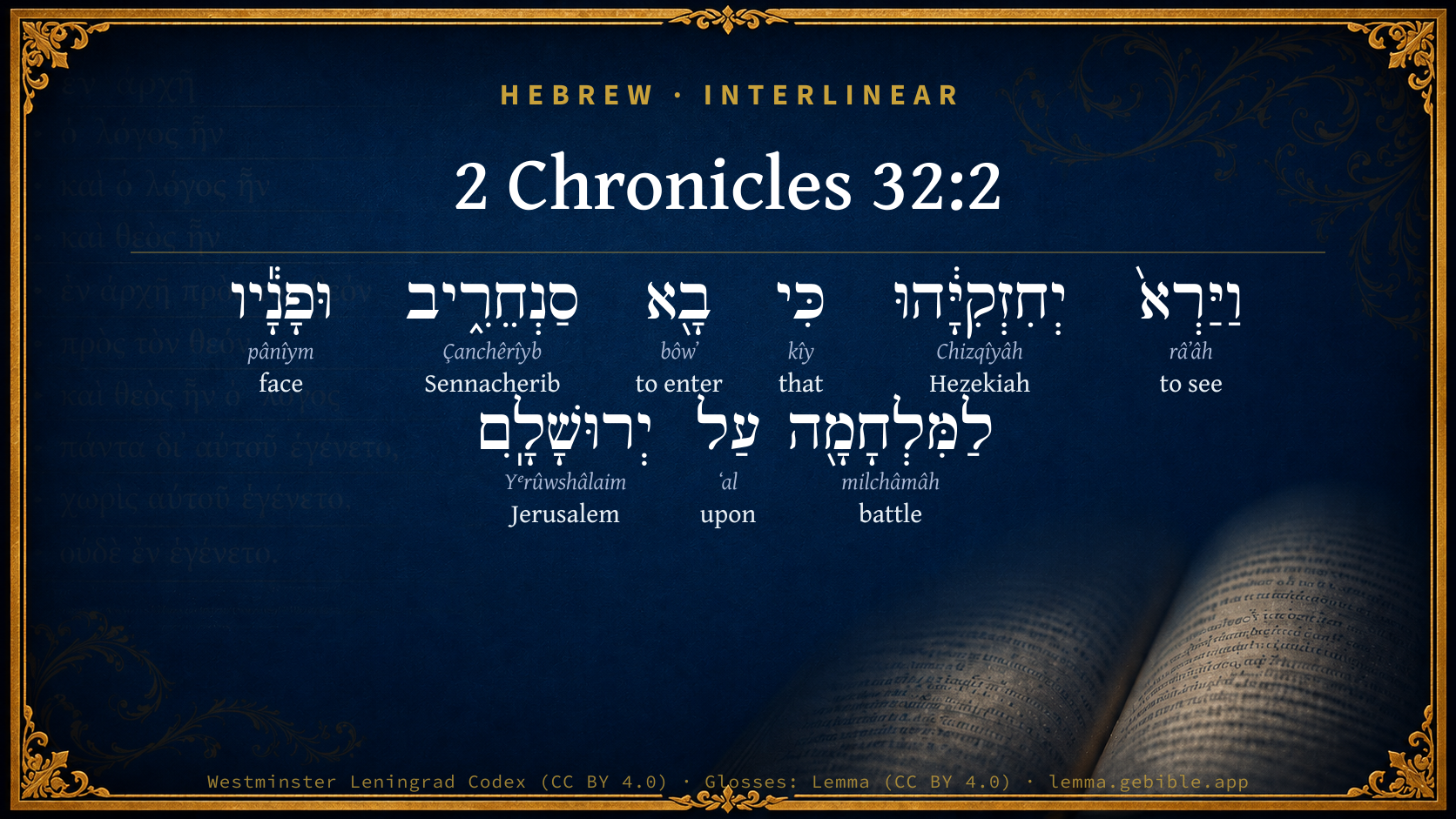
Hebrew (Westminster Leningrad Codex) 2 Chronicles 32:2 appears in the Hebrew Old Testament. The text above is from the Westminster Leningrad Codex. Each word links to its Strong’s number, a concise gloss, and parsing drawn from the Open Scriptures Hebrew Bible morphology. Click any word for its full Brown-Driver-Briggs (BDB) entry.
Download image
Cite this verse

2 Chronicles 32:2 (World English Bible). Public Domain. Lemma interlinear Bible study tool, https://lemma.gebible.app/v/2-chronicles/32/2.

Show BibTeX & RIS
BibTeX
RIS
English Translation
When Hezekiah saw that Sennacherib was come, and that he was purposed to fight against Jerusalem,
World English Bible · Public Domain
Download a study sheet

One document with this verse’s original text, its word-by-word gloss line, the meaning frame, cross-references with their text, attributed commentary, and full source and license credits — printable, and it pastes into notes with its structure intact.

This verse Autodidact and up

Study sheet (.html) Plain text (.txt)

A passage Seminary Student

Up to 50 verses in one chapter. A passage sheet keeps up to 6 commentary sources and 12 cross-references per verse, in the order this page ranks them, and says so on the sheet whenever that leaves anything out. Ask for a single verse and you get the Autodidact verse sheet above.

Everything on this page stays free to read, with no account — the sheet is a download of what is already on screen, not access to it.

Want to remove ads? Support Godless Engineer
Compare translations 3

The same verse in 3 English versions, stacked beneath the original-language interlinear above. Click any original word for its lexicon entry.

Each is an independent rendering of the whole verse — the interlinear is not word-aligned to these translations.

Highlighted words mark where these versions differ — a whole-verse word diff, not a word-by-word alignment.

  • World English Bible Public Domain
    When Hezekiah saw that Sennacherib was come, and that he was purposed to fight against Jerusalem,
  • King James Version Public Domain
    And when Hezekiah saw that Sennacherib was come, and that he was purposed to fight against Jerusalem,
  • unfoldingWord Literal Text CC BY-SA 4.0
    And Hezekiah saw that Sennacherib had come and his face was to battle against Jerusalem.

unfoldingWord Literal Text — © unfoldingWord, licensed CC BY-SA 4.0. Word-aligned USFM3 via Door43 (git.door43.org/unfoldingWord/en_ult).

Versions to compare (up to 4)

3 of 4 selected

Show all 18 translations

Every available English version of this verse, each an independent rendering of the whole verse.

  • World English Bible Public Domain
    When Hezekiah saw that Sennacherib was come, and that he was purposed to fight against Jerusalem,
  • Berean Standard Bible Public Domain
    When Hezekiah saw that Sennacherib had come to make war against Jerusalem,
  • Majority Standard Bible Public Domain
    When Hezekiah saw that Sennacherib had come to make war against Jerusalem,
  • King James Version Public Domain
    And when Hezekiah saw that Sennacherib was come, and that he was purposed to fight against Jerusalem,
  • American Standard Version (1901) Public Domain
    And when Hezekiah saw that Sennacherib was come, and that he was purposed to fight against Jerusalem,
  • Revised Version (1885) Public Domain
    And when Hezekiah saw that Sennacherib was come, and that he was purposed to fight against Jerusalem,
  • Geneva Bible (1599) Public Domain
    When Hezekiah sawe that Saneherib was come, and that his purpose was to fight against Ierusalem,
  • Douay-Rheims (1899) Public Domain
    And when Ezechias saw that Sennacherib was come, and that the whole force of the war was turning against Jerusalem,
  • Young's Literal Translation Public Domain
    And Hezekiah seeth that Sennacherib hath come, and his face `is' to the battle against Jerusalem,
  • Literal Standard Version CC BY-SA 4.0
    And Hezekiah sees that Sennacherib has come, and his face [is] to the battle against Jerusalem,
  • Unlocked Literal Bible CC BY-SA 4.0
    When Hezekiah saw that Sennacherib had come and that he intended to fight against Jerusalem,
  • unfoldingWord Literal Text CC BY-SA 4.0
    And Hezekiah saw that Sennacherib had come and his face was to battle against Jerusalem.
  • Darby Bible Public Domain
    And when Hezekiah saw that Sennacherib was come, and that he was minded to fight against Jerusalem,
  • World Messianic Bible Public Domain
    When Hezekiah saw that Sennacherib had come, and that he was planning to fight against Jerusalem,
  • Webster's Bible Public Domain
    And when Hezekiah saw that Sennacherib had come, and that he purposed to fight against Jerusalem,
  • Free Bible Version CC BY-SA 4.0
    When Hezekiah saw that Sennacherib had come to attack Jerusalem,
  • Bible in Basic English Public Domain
    And when Hezekiah saw that Sennacherib had come for the purpose of fighting against Jerusalem,
  • JPS Tanakh (1917) Public Domain
    And when Hezekiah saw that Sennacherib was come, and that he was purposed to fight against Jerusalem,

Literal Standard Version (2020), Covenant Press — licensed CC BY-SA 4.0. Text via the HelloAO Bible API (eBible.org). Unlocked Literal Bible (unfoldingWord) — licensed CC BY-SA 4.0. Text via the HelloAO Bible API (eBible.org). unfoldingWord Literal Text — © unfoldingWord, licensed CC BY-SA 4.0. Word-aligned USFM3 via Door43 (git.door43.org/unfoldingWord/en_ult). Free Bible Version, Dr. Jonathan Gallagher — licensed CC BY-SA 4.0. Text via the HelloAO Bible API (eBible.org).

Word by word

More ways to search: Search by grammar → Find every occurrence → Compare this word →

Practice this passage: Drill this verse → Learn its vocabulary →

סַנְחֵרִ֑יב
Çanchêrîyb
H5576
“Sennacherib”
Noun, Proper
Part of Speech
Noun
Type
Proper
Full BDB Definition

Origin: of foreign origin

TWOT: None

Sennacherib = "Sin multiplied brothers" (Sin = the moon) - son of Sargon, father of Esarhaddon, and king of Assyria from 705-681 BC; attacked Judah during the reign of king Hezekiah and Judah was delivered when in response to the prayer of Hezekiah an angel smote 185,000 Assyrian soldiers
  1. וַיַּרְא֙ râʼâh H7200 “and · to see” Conjunction + Verb, Qal, Sequential Imperfect, 3rd Person, Masculine, Singular
  2. יְחִזְקִיָּ֔הוּ Chizqîyâh H2396 “Hezekiah” Noun, Proper
  3. כִּי kîy H3588 “that” Conjunction
  4. בָ֖א bôwʼ H935 “to enter” Verb, Qal, Perfect, 3rd Person, Masculine, Singular
  5. וּפָנָ֕יו pânîym H6440 “and · face(s) · his” Conjunction + Noun, Common, Both, Plural, Construct + Suffix, Personal, 3rd Person, Masculine, Singular
  6. לַמִּלְחָמָ֖ה milchâmâh H4421 “to/for the · battle” Preposition, Determined + Noun, Common, Feminine, Singular, Absolute
  7. עַל ʻal H5921 “upon” Preposition
  8. יְרוּשָׁלִָֽם Yᵉrûwshâlaim H3389 “Jerusalem” Noun, Proper

About this verse

These counts appear in no published source. They are computed here, from the morphology-tagged text and Lemma’s own curated glosses. What Lemma adds →

9
words
9
distinct lemmas
Historical
section

Notable vocabulary

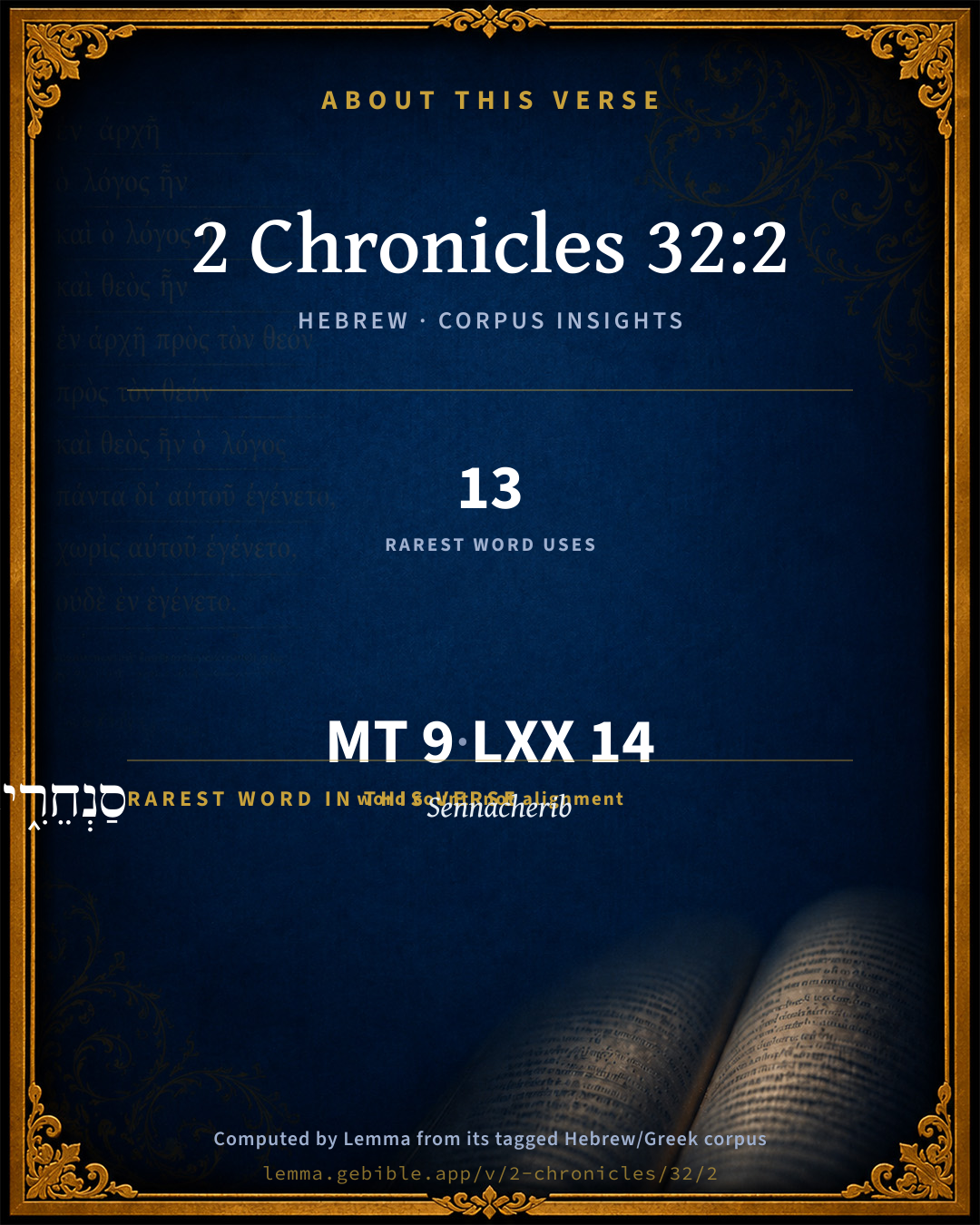
The rarest word here is סַנְחֵרִ֑יב Sennacherib H5576 — appearing just 13 times in the whole Hebrew Bible.

Shared distinctive vocabulary

סַנְחֵרִ֑יב Sennacherib H5576 occurs in 13 verses of the Hebrew Bible. Also found in:

Grammatical profile

  • 2 verbs
  • 5 nouns
  • 1 preposition
  • 1 conjunction

Verb forms

  • וַיַּרְא֙ Qal · Sequential Imperfect
  • בָ֖א Qal · Perfect

Hebrew & Septuagint length

In English translation the verse runs 16 words from the Hebrew and 17 from the Septuagint (LXX English) — closely comparable.

A rough comparison of the two English renderings, which tokenize alike — not a word-level alignment.

Word counts can differ between the Hebrew and the Greek without any difference in meaning — e.g. the Hebrew direct-object marker אֵת has no separate Greek word, and Greek often adds the article ὁ.

In the original languages it is 9 Hebrew tokens and 14 Greek tokens — but the two are counted differently (Hebrew bundles its prefixes and suffixes into one token; the Greek is in lemma form), so that isn’t a like-for-like length.

Cross-references

3

Topical passages linked to 2 Chronicles 32:2 in the Treasury of Scripture Knowledge — connected by theme and wording, ordered by reader-vote popularity; previews shown in the World English Bible.

  • 2 Kings 12:17 Then Hazael king of Syria went up, and fought against Gath, and took it; and Hazael set his face to go up to Jerusalem.
  • Luke 9:51 It came to pass, when the days were near that he should be taken up, he intently set his face to go to Jerusalem,
  • Luke 9:53 They didn't receive him, because he was traveling with his face set towards Jerusalem.

Cross-references courtesy of OpenBible.info (CC BY 4.0).

Hebrew and Greek witnesses Masoretic Hebrew ↔ Greek Septuagint

The same verse in the two great witnesses to the Old Testament, shown verse-for-verse.

These are two independent witnesses, not word-aligned to each other, and the Septuagint is shown in lemma (dictionary) form.

Hebrew 2 Chronicles 32:2 Masoretic · Westminster Leningrad Codex

וַיַּרְא֙ יְחִזְקִיָּ֔הוּ כִּי בָ֖א סַנְחֵרִ֑יב וּפָנָ֕יו לַמִּלְחָמָ֖ה עַל יְרוּשָׁלִָֽם

When Hezekiah saw that Sennacherib was come, and that he was purposed to fight against Jerusalem,

World English Bible · Public Domain

Greek LXX 2 Chronicles 32:2 Septuagint · lemma form

καί ὁράω εζεκιας ὅτι ἥκω σενναχηριμ καί ὁ πρόσωπον αὐτός ὁ πολεμέω ἐπί ἰερουσαλήμ

And Ezekias saw that Sennacherim was come, and that his face was set to fight against Jerusalem.

LXX2012 (modern English Septuagint) · Public Domain

On this verse, Ellicott's Commentary for English Readers discusses the Septuagint’s reading. Read the note in Commentary ↓

Hebrew: Westminster Leningrad Codex (CC BY 4.0). Greek: Septuagint (public domain); English from LXX2012 (modern English Septuagint) (Public Domain). How the Septuagint differs from the Hebrew →

Commentary

Notes on 2 Chronicles 32:2 from classic Christian and Jewish commentators (each source and its license shown beneath its notes). The classic Christian expositions comment on the surrounding passage and are grouped to its opening verse, so a note may address several verses; the Jewish commentaries on the Tanakh (Rashi and others) are per-verse, so they appear only where the commentator wrote on this verse.

Lemma curates 59 commentaries, every one of them public domain or Creative Commons licensed, each selected and text-cleaned for this edition rather than reprinted as found. About our sources →

Ellicott's Commentary for English Readers

(2) And that he was purposed to fight.—Literally, and his face was for the war. (Comp. 2Ch_20:3; Luk_9:53.)

To stop.—To close in with masonry, so as to conceal. (But comp. 2Ki_3:19; 2Ki_3:25.) LXX., ἐμφράξαι τά ὕδατα.

They did help him.—By “gathering much people together” (2Ch_32:4).

PREPARATIONS FOR THE DEFENCE (2Ch_32:2-8).

This section is peculiar to the Chronicles. Its contents are “perfectly credible” (Thenius), and are borne out by Isa_22:8-11, and 2Ki_20:20, and by the inscription of Sennacherib.

A Bible Commentary for English Readers, edited by Charles John Ellicott (1878–1897) — public domain. Text from a community e-Sword module.

Trapp's Complete Commentary

John Trapp

2Ch 32:2 And when Hezekiah saw that Sennacherib was come, and that he was purposed to fight against Jerusalem,

Ver. 2. That Sennacherib was come.] See on 2Ki 18:13.

John Trapp, A Commentary or Exposition upon All the Books of the Old and New Testament (1647–1656) — public domain. Text from a community e-Sword module.

Geneva Bible (1599)

Geneva Bible translators

Hebrew, face.

Geneva Bible (1599) marginal notes — public domain. Text via Bolls.life.

Jamieson, Fausset & Brown

Robert Jamieson, A. R. Fausset & David Brown

when Hezekiah saw that Sennacherib . . . was purposed to fight against Jerusalem--An account of the means taken to fortify Jerusalem against the threatened siege is given only in this passage. The polluting or filling up of wells, and the altering of the course of rivers, is an old practice that still obtains in the wars of the East. Hezekiah's plan was to cover the fountain heads, so that they might not be discovered by the enemy, and to carry the water by subterranean channels or pipes into the city--a plan which, while it would secure a constant supply to the inhabitants, would distress the besiegers, as the country all around Jerusalem was very destitute of water.

Jamieson, Fausset & Brown — Commentary Critical and Explanatory on the Whole Bible (1871) — public domain (CC PDM 1.0). Text via the HelloAO Bible API.

Adam Clarke's Commentary

Verse 2. When Hezekiah saw] This was in the fourteenth year of the reign of Hezekiah; and at first the Jewish king bought him off at the great price of three hundred talents of silver, and thirty talents of gold; and even emptied his own treasures, and spoiled the house of the Lord, to gratify the oppressive avarice of the Assyrian king. See the whole account, 2Kg 18:13, &c.

Adam Clarke's Commentary on the Bible (1810–1826) — public domain. Text from a community e-Sword/MySword module.

John Gill's Exposition

And when Hezekiah saw that Sennacherib was come,.... Into the land of Judah, which he perceived and understood by reports brought to him: and that he was purposed to fight against Jerusalem; to besiege it and take it, if possible; this he saw was his design, by taking the fenced cities in his way, and coming forward with his forces.

And when Hezekiah saw that Sennacherib was come,.... Into the land of Judah, which he perceived and understood by reports brought to him: and that he was purposed to fight against Jerusalem; to besiege it and take it, if possible; this he saw was his design, by taking the fenced cities in his way, and coming forward with his forces.

2 Chronicles 32:3

ch2 32:3

ch2 32:3

ch2 32:3He took counsel with his princes, and his mighty men,.... With his nobles, and the officers of his army, what steps should be taken to resist, retard, and distress the enemy, and among the rest what follows was proposed:

to stop the waters of the fountains which were without the city; that so the Assyrian army would find it difficult to supply themselves with water, which was an article of great importance:

and they did help him; to stop the fountains, not only with their advice how to do it, but with their men, their servants, who assisted those that Hezekiah employed in this work.

John Gill's Exposition of the Whole Bible (1746–1763) — public domain (CC PDM 1.0). Text via the HelloAO Bible API.

Haydock's Catholic Bible Commentary

Jerusalem; as many cities had fallen. The king entered into an agreement with the Assyrians, who soon broke it.

George Leo Haydock (1774–1849), Haydock's Catholic Family Bible and Commentary, 1859 edition — public domain. Excludes Psalms (Douay-Rheims chapter numbering differs from Protestant) and Deuterocanonical books (Catholic canon only).

The Pulpit Commentary

When Hezekiah saw and that he purposed Jerusalem. Whether the three verses of ill omen already alluded to (2Ki_18:14-16) may be road precedent to this verse, and purport that the bribes had been paid, and yet had failed of their object, so that Hezekiah was now compelled to brace himself to the occasion, and "took counsel," etc. (next verse); or whether this verse dates (as some think)the quailing heart of Hezekiah, and an offer or part payment of treasure by Hezekiah to Sennacherib, which only increased his insolence, as immediately now related, is uncertain, perhaps. In the face of the emphatic language of the three verses of the parallel, and in consideration of the possible motives as suggested above for our compiler omitting the matter altogether, we incline to the former opinion. That would have the effect of making this verse say that when Hezekiah had his eyes opened to the failure of his bribe a waste payment, for that Sennacherib still "purposed to fight against Jerusalem he finally proceeded to take the right steps. However, the witness and indications of Isa_22:13-19 Isa_29:2-4, may go some wayto shield Hezekiah from the entire blame. The silence of our compiler on the whole matter is the one residuum of fact, and unfortunate in its suggestion.

The Pulpit Commentary (1880–1919), ed. H.D.M. Spence-Jones & Joseph S. Exell — public domain. Text from a community e-Sword module.

unfoldingWord translationNotes

Door43 World Missions Community

that Sennacherib had come and that he intended

Here Sennacherib also represents his army. AT: "that Sennacherib and his army had come and that they intended" (See: Synecdoche)

to fight against Jerusalem

Here "Jerusalem" represents the people there. AT: "to fight against the people of Jerusalem" or "to fight against the army of Jerusalem" (See: Metonymy)

to stop up the waters of the springs that were outside the city

The people of the city would fill up wells and fountain springs with earth and rocks, hiding the water from the Assyrians, but the people would cause the water to flow into the city through secret pathways.

Why should the kings of Assyria come and find a lot of water?

The people use a rhetorical question to emphasize that they do not want the kings of Assyria to find their water. The question can be translated as a statement. AT: "We do not want the kings of Assyria to come here and find a lot of water." (See: Rhetorical Question)

the kings of Assyria

Possible meanings for "kings" are 1) this is an idiom that refers to the one king of Assyria. AT: "the king of Assyria" or 2) this may refer to the king and his other leaders. AT: "the king and the other leaders of Assyria" (See: Idiom)

translationWords

power

water

unfoldingWord translationNotes — © Distant Shores Media and the Door43 World Missions Community, licensed CC BY-SA 4.0. Source: git.door43.org/Door43/en_tn.

Lesson kit

Teaching starters — assembled from the data on this page, not authored interpretation. Every prompt links to the verse data it draws on. Edit before teaching.

2 Chronicles, in the Historical, opens this verse with 9 words (9 distinct Hebrew lemmas). Its most distinctive word is Çanchêrîyb (“Sennacherib”). A historical commentator’s framing appears above. Read the whole chapter for the surrounding context.

Discussion questions

  1. What does “Sennacherib” (Çanchêrîyb) contribute to the verse as a whole?
  2. How does 2 Kings 18:13, which shares the word «Sennacherib», read alongside this verse?
  3. The translations on this page render this verse differently — a whole-verse word diff, not a word-by-word alignment. What might account for the different wordings?
  4. «וַיַּרְא֙» is a Qal Sequential Imperfect verb. How does that grammatical form shape the action described?
  5. Compare how Ellicott's Commentary for English Readers and Trapp's Complete Commentary read this verse. Where do they agree or differ?

Things to notice

Reading settings

Reading text

Shown beneath each verse's original-language words.

Old Testament
Old Testament edition

Read the OT as the Masoretic Hebrew (MT) or the Greek Septuagint (LXX).

English shown for the Greek Septuagint (in the Hebrew ↔ Greek comparison).

Comparing translations? Open the Compare panel on any verse page to stack up to four side by side.