
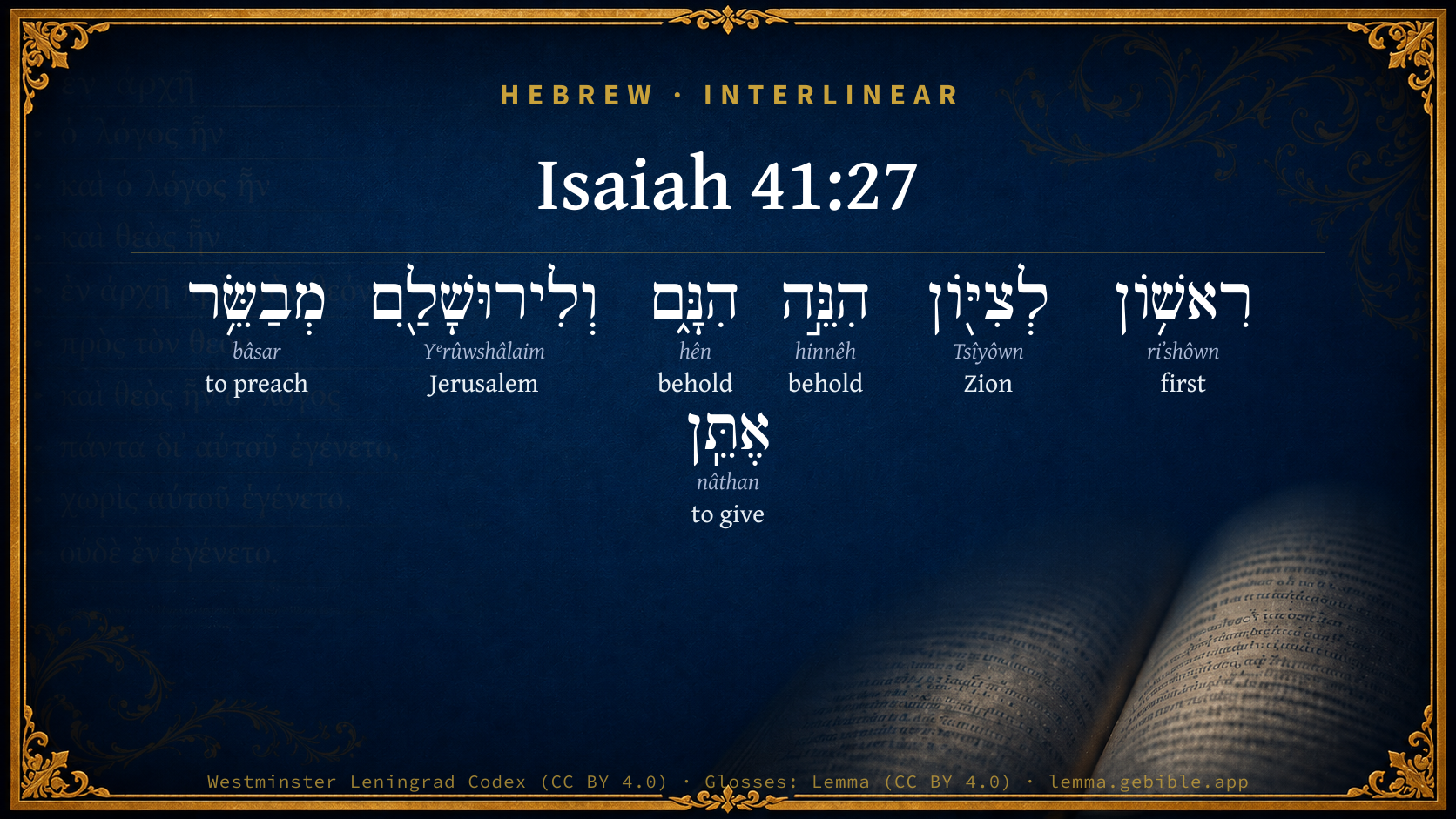
Isaiah 41:27

Hebrew (Westminster Leningrad Codex) Isaiah 41:27 appears in the Hebrew Old Testament. The text above is from the Westminster Leningrad Codex. Each word links to its Strong’s number, a concise gloss, and parsing drawn from the Open Scriptures Hebrew Bible morphology. Click any word for its full Brown-Driver-Briggs (BDB) entry.
Download image
Cite this verse

Isaiah 41:27 (World English Bible). Public Domain. Lemma interlinear Bible study tool, https://lemma.gebible.app/v/isaiah/41/27.

Show BibTeX & RIS
BibTeX
RIS
English Translation
[I am the] first [who says] to Zion, Behold, behold them; and I will give to Jerusalem one who brings good news.
World English Bible · Public Domain
Download a study sheet

One document with this verse’s original text, its word-by-word gloss line, the meaning frame, cross-references with their text, attributed commentary, and full source and license credits — printable, and it pastes into notes with its structure intact.

This verse Autodidact and up

Study sheet (.html) Plain text (.txt)

A passage Seminary Student

Up to 50 verses in one chapter. A passage sheet keeps up to 6 commentary sources and 12 cross-references per verse, in the order this page ranks them, and says so on the sheet whenever that leaves anything out. Ask for a single verse and you get the Autodidact verse sheet above.

Everything on this page stays free to read, with no account — the sheet is a download of what is already on screen, not access to it.

Want to remove ads? Support Godless Engineer
Compare translations 3

The same verse in 3 English versions, stacked beneath the original-language interlinear above. Click any original word for its lexicon entry.

Each is an independent rendering of the whole verse — the interlinear is not word-aligned to these translations.

Highlighted words mark where these versions differ — a whole-verse word diff, not a word-by-word alignment.

  • World English Bible Public Domain
    [I am the] first [who says] to Zion, Behold, behold them; and I will give to Jerusalem one who brings good news.
  • King James Version Public Domain
    The first shall say to Zion, Behold, behold them: and I will give to Jerusalem one that bringeth good tidings.
  • unfoldingWord Literal Text CC BY-SA 4.0
    The first to Zion, ‘Behold, behold them!’ And I sent a herald to Jerusalem.

unfoldingWord Literal Text — © unfoldingWord, licensed CC BY-SA 4.0. Word-aligned USFM3 via Door43 (git.door43.org/unfoldingWord/en_ult).

Versions to compare (up to 4)

3 of 4 selected

Show all 18 translations

Every available English version of this verse, each an independent rendering of the whole verse.

  • World English Bible Public Domain
    [I am the] first [who says] to Zion, Behold, behold them; and I will give to Jerusalem one who brings good news.
  • Berean Standard Bible Public Domain
    I was the first to tell Zion: ‘Look, here they are!’ And I gave to Jerusalem a herald of good news.
  • Majority Standard Bible Public Domain
    I was the first to tell Zion: ‘Look, here they are!’ And I gave to Jerusalem a herald of good news.
  • King James Version Public Domain
    The first shall say to Zion, Behold, behold them: and I will give to Jerusalem one that bringeth good tidings.
  • American Standard Version (1901) Public Domain
    `I am the' first `that saith' unto Zion, Behold, behold them; and I will give to Jerusalem one that bringeth good tidings.
  • Revised Version (1885) Public Domain
    I first will say unto Zion, Behold, behold them; and I will give to Jerusalem one that bringeth good tidings.
  • Geneva Bible (1599) Public Domain
    I am the first, that saieth to Zion, Beholde, beholde them: and I will giue to Ierusalem one that shall bring good tidings.
  • Douay-Rheims (1899) Public Domain
    The first shall say to Sion: Behold they are here, and to Jerusalem I will give an evangelist.
  • Young's Literal Translation Public Domain
    First to Zion, Behold, behold them, And to Jerusalem one proclaiming tidings I give,
  • Literal Standard Version CC BY-SA 4.0
    First to Zion, || Behold, behold them, || And to Jerusalem I give one proclaiming tidings,
  • Unlocked Literal Bible CC BY-SA 4.0
    I first said to Zion, “Look here they are;” I sent a herald to Jerusalem.
  • unfoldingWord Literal Text CC BY-SA 4.0
    The first to Zion, ‘Behold, behold them!’ And I sent a herald to Jerusalem.
  • Darby Bible Public Domain
    The first, [I said] to Zion, Behold, behold them! and to Jerusalem, I will give one that bringeth glad tidings.
  • World Messianic Bible Public Domain
    I am the first to say to Zion, ‘Behold, look at them;’ and I will give one who brings good news to Jerusalem.
  • Webster's Bible Public Domain
    The first shall say to Zion, Behold, behold them: and I will give to Jerusalem one that bringeth good tidings.
  • Free Bible Version CC BY-SA 4.0
    I was the first to announce to Zion: ‘Look, here they are!’ I was the one who brought to Jerusalem the good news.
  • Bible in Basic English Public Domain
    I was the first to give word of it to Zion, and I gave the good news to Jerusalem.
  • JPS Tanakh (1917) Public Domain
    A harbinger unto Zion will I give: 'Behold, behold them', and to Jerusalem a messenger of good tidings.

Literal Standard Version (2020), Covenant Press — licensed CC BY-SA 4.0. Text via the HelloAO Bible API (eBible.org). Unlocked Literal Bible (unfoldingWord) — licensed CC BY-SA 4.0. Text via the HelloAO Bible API (eBible.org). unfoldingWord Literal Text — © unfoldingWord, licensed CC BY-SA 4.0. Word-aligned USFM3 via Door43 (git.door43.org/unfoldingWord/en_ult). Free Bible Version, Dr. Jonathan Gallagher — licensed CC BY-SA 4.0. Text via the HelloAO Bible API (eBible.org).

Word by word

More ways to search: Search by grammar → Find every occurrence → Compare this word →

Practice this passage: Drill this verse → Learn its vocabulary →

About this verse

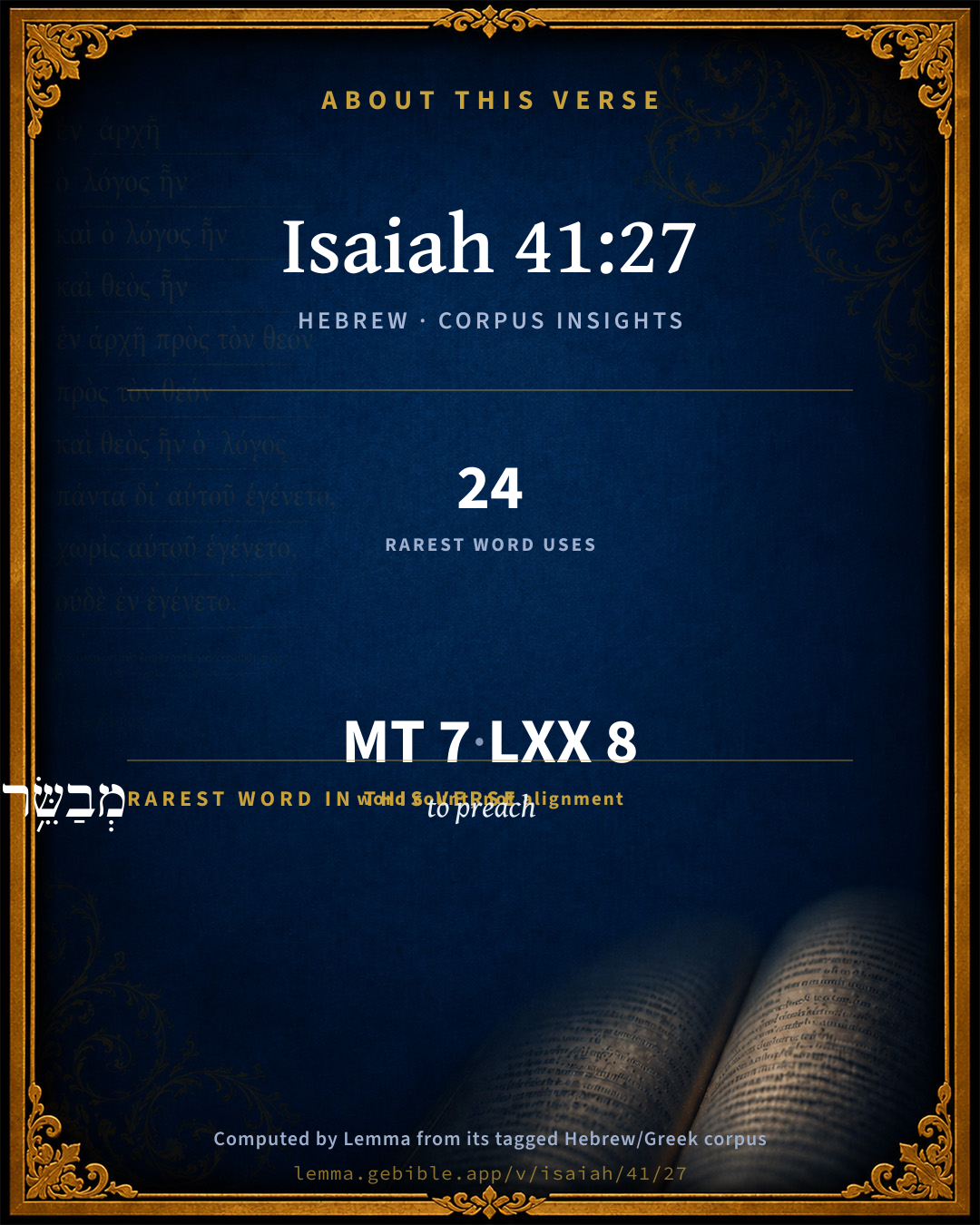
These counts appear in no published source. They are computed here, from the morphology-tagged text and Lemma’s own curated glosses. What Lemma adds →

7
words
7
distinct lemmas
Prophets
section

Notable vocabulary

The rarest word here is מְבַשֵּׂ֥ר to preach H1319 — appearing just 24 times in the whole Hebrew Bible.

Shared distinctive vocabulary

מְבַשֵּׂ֥ר to preach H1319 occurs in 21 verses of the Hebrew Bible. Also found in:

Grammatical profile

  • 2 verbs
  • 2 nouns
  • 1 adjective
  • 2 particles

Verb forms

  • מְבַשֵּׂ֥ר Piel · Participle Active
  • אֶתֵּֽן Qal · Imperfect

Hebrew & Septuagint length

In English translation the verse runs 22 words from the Hebrew and 13 from the Septuagint (LXX English) — the Septuagint runs noticeably shorter here. See the side-by-side →

A rough comparison of the two English renderings, which tokenize alike — not a word-level alignment.

Word counts can differ between the Hebrew and the Greek without any difference in meaning — e.g. the Hebrew direct-object marker אֵת has no separate Greek word, and Greek often adds the article ὁ.

In the original languages it is 7 Hebrew tokens and 8 Greek tokens — but the two are counted differently (Hebrew bundles its prefixes and suffixes into one token; the Greek is in lemma form), so that isn’t a like-for-like length.

Cross-references

13

Topical passages linked to Isaiah 41:27 in the Treasury of Scripture Knowledge — connected by theme and wording, ordered by reader-vote popularity; previews shown in the World English Bible.

  • Isaiah 40:9 You who tell good news to Zion, go up on a high mountain; you who tell good news to Jerusalem, lift up your voice with strength; lift it up, don't be afraid; say to the cities of Judah, Behold, your God!
  • Isaiah 52:7 How beautiful on the mountains are the feet of him who brings good news, who publishes peace, who brings good news of good, who publishes salvation, who says to Zion, Your God reigns!
  • Isaiah 44:28 Who says of Cyrus, [He is] my shepherd, and shall perform all my pleasure, even saying of Jerusalem, She shall be built; and of the temple, Your foundation shall be laid.
  • Isaiah 48:3 I have declared the former things from of old; yes, they went forth out of my mouth, and I shown them: suddenly I did them, and they happened.
  • Nahum 1:15 Behold, on the mountains the feet of him who brings good news, who publishes peace! Keep your feasts, Judah! Perform your vows, for the wicked one will no more pass through you. He is utterly cut off.
  • Ezra 1:1–2 Now in the first year of Cyrus king of Persia, that the word of Yahweh by the mouth of Jeremiah might be accomplished, Yahweh stirred up the spirit of Cyrus king of Persia, so that he made a proclamation throughout all his kingdom, and [put it] also in writing, saying,
  • Isaiah 41:4 Who has worked and done it, calling the generations from the beginning? I, Yahweh, the first, and with the last, I am he.
  • Isaiah 43:10 You are my witnesses, says Yahweh, and my servant whom I have chosen; that you may know and believe me, and understand that I am he: before me there was no God formed, neither shall there be after me.
  • Isaiah 44:6 Thus says Yahweh, the King of Israel, and his Redeemer, Yahweh of Hosts: I am the first, and I am the last; and besides me there is no God.
  • Isaiah 48:12 Listen to me, O Jacob, and Israel my called: I am he; I am the first, I also am the last.
  • Luke 2:10–11 The angel said to them, "Don't be afraid, for behold, I bring you good news of great joy which will be to all the people.
  • Romans 10:15 And how will they preach unless they are sent? As it is written: "How beautiful are the feet of those who preach the Gospel of peace, Who bring glad tidings of good things!"
  • Revelation 2:8 "To the angel of the assembly in Smyrna write: "The first and the last, who was dead, and has come to life says these things:

Cross-references courtesy of OpenBible.info (CC BY 4.0).

Hebrew and Greek witnesses Masoretic Hebrew ↔ Greek Septuagint

The same verse in the two great witnesses to the Old Testament, shown verse-for-verse.

Here the Septuagint runs noticeably shorter than the Hebrew — LXX2012 (modern English Septuagint) 13 words vs World English Bible 22. A rough length comparison of the two English translations, not a word-level alignment — read both below.

These are two independent witnesses, not word-aligned to each other, and the Septuagint is shown in lemma (dictionary) form.

Hebrew Isaiah 41:27 Masoretic · Westminster Leningrad Codex

רִאשׁ֥וֹן לְצִיּ֖וֹן הִנֵּ֣ה הִנָּ֑ם וְלִירוּשָׁלִַ֖ם מְבַשֵּׂ֥ר אֶתֵּֽן

[I am the] first [who says] to Zion, Behold, behold them; and I will give to Jerusalem one who brings good news.

World English Bible · Public Domain

Greek LXX Isaiah 41:27 Septuagint · lemma form

ἀρχή σιων δίδωμι καί ἰερουσαλήμ παρακαλέω εἰς ὁδός

I will give dominion to Sion, and will comfort Jerusalem by the way.

LXX2012 (modern English Septuagint) · Public Domain

On this verse, Albert Barnes' Notes on the Bible discusses the Septuagint’s reading. Read the note in Commentary ↓

Hebrew: Westminster Leningrad Codex (CC BY 4.0). Greek: Septuagint (public domain); English from LXX2012 (modern English Septuagint) (Public Domain). How the Septuagint differs from the Hebrew →

Targum (Aramaic paraphrase)

1

The Targum is the ancient Jewish Aramaic paraphrase of the Hebrew Scriptures — an interpretive translation, not the Hebrew text itself. Onkelos (literal) and Pseudo-Jonathan (expansive) render the Torah, and Jonathan the Prophets. Coverage is partial: where no permissively-licensed English translation exists for a verse, only the Aramaic is shown. This is verse-level text, not a word-by-word alignment to the Hebrew.

  1. Targum Jonathan Prophets (Joshua–Malachi)
    פִּתְגָמֵי נֶחְמָתָא דְאִתְנַבִּיאוּ נְבִיָיא מִלְקָדְמִין עַל צִיוֹן הָא אֲתוֹ וְלִירוּשְׁלֵם מְבַסֵר אֶתֵּן:

    The words of consolation which the prophets prophesied from of old concerning Zion, behold, they shall come to pass! and unto Jerusalem I will give one that bringeth good tidings.

    Targum Jonathan — Aramaic: “Mikraot Gedolot” (public domain). English: “Sefaria Community Translation” (CC0 1.0 (public-domain dedication)); “London "Chaldee Paraphrase," 1871” (public domain). Text via Sefaria.

Commentary

Notes on Isaiah 41:27 from classic Christian and Jewish commentators (each source and its license shown beneath its notes). The classic Christian expositions comment on the surrounding passage and are grouped to its opening verse, so a note may address several verses; the Jewish commentaries on the Tanakh (Rashi and others) are per-verse, so they appear only where the commentator wrote on this verse.

Lemma curates 59 commentaries, every one of them public domain or Creative Commons licensed, each selected and text-cleaned for this edition rather than reprinted as found. About our sources →

Trapp's Complete Commentary

John Trapp

Isa 41:27 The first [shall say] to Zion, Behold, behold them: and I will give to Jerusalem one that bringeth good tidings.

Ver. 27. The first shall say to Zion.] Or, I first said to Zion. I first brought her that good tidings by my prophets.

John Trapp, A Commentary or Exposition upon All the Books of the Old and New Testament (1647–1656) — public domain. Text from a community e-Sword module.

The Biblical Illustrator

Joseph S. Exell

Isa_41:27

One that bringeth good tidings

Divine ordination

I.

MINISTERS ARE DIVINELY ORDAINED. They come from God. f will give. The ministry is not one of the literary professions, nor a secular office. Colleges and seminaries do not make them.

II. THEY ARE A GIFT OF GODS GRACE. Neither the Churchs merit, wealth, or respectability has s claim to them, nor does a salary hire them, nor ordination commission them in the highest sense. They are a benefaction.

III. THE MINISTERS CHIEF WORK IS TO BE THE BEARER OF GOOD TIDINGS. It does not exclude other things that accompany salvation, but the Gospel proclamation is to be his specific, constant, cheerful, enthusiastic, confident employment. In season, out of season, in pulpit and private, his heart and lips are to overflow with the good tidings. Because--

1. They are what men, all men, all men everywhere and always need, and need most imperatively.

2. The more the good tidings are preached the more open is the way for everything else connected with the pastors work, and the more effective all departments of his ministry.

3. It, and it alone, is the power of God and the wisdom of God unto salvation and sanctification. (Homiletic Review.)

.

The Biblical Illustrator, edited by Joseph S. Exell (c. 1880s–1900s) — public domain. Text from a community e-Sword module.

Joseph Benson's Commentary

Isa 41:27. The first shall say, &c. — Hebrew, ראשׁון לציון, literally, first, or the first to Zion; which words some interpret thus: I, who am the first, (Isa 41:4,) do and will foretel to my people things to come. Behold, behold them — I represent things future (namely, the rise of Cyrus, and the deliverance of my people from Babylon by him) as if they were present, and to be beheld with men’s bodily eyes. Behold the wonderful works which God hath wrought for you: or, Behold my people returning to their ancient habitations. Bishop Lowth, who observes, “The verse is somewhat obscure by the transposition of the parts of the sentence,” translates it thus: I first to Zion, (gave the word,) Behold, they are here; And to Jerusalem I give the messenger of good tidings. The sense of which he says is, “I first, by my prophets, give notice of these events, saying, Behold, they are at hand! I give to Jerusalem,” &c.

Joseph Benson's Commentary on the Old and New Testaments (1811–1818) — public domain. Text from a community e-Sword module.

Tyndale Open Study Notes

Tyndale Open Resources

41:27 The messenger with good news told of God’s coming to rescue his people (see 40:9).

Tyndale Open Study Notes — © Tyndale Open Resources, licensed CC BY-SA 4.0. Text via the HelloAO Bible API.

Geneva Bible (1599)

Geneva Bible translators

To wit, a continual succession of Prophets and ministers.

That is, the Israelites which return from the captivity.

Geneva Bible (1599) marginal notes — public domain. Text via Bolls.life.

Jamieson, Fausset & Brown

Robert Jamieson, A. R. Fausset & David Brown

Rather, "I first will give to Zion and to Jerusalem the messenger of good tidings, Behold, behold them!" The clause, "Behold . . . them" (the wished-for event is now present) is inserted in the middle of the sentence as a detached exclamation, by an elegant transposition, the language being framed abruptly, as one would speak in putting vividly as it were, before the eyes of others, some joyous event which he had just learned [LUDOVICUS DE DIEU] (compare Isa 40:9). None of the idols had foretold these events. Jehovah was the "first" to do so (see Isa 41:4).

Jamieson, Fausset & Brown — Commentary Critical and Explanatory on the Whole Bible (1871) — public domain (CC PDM 1.0). Text via the HelloAO Bible API.

Adam Clarke's Commentary

Verse 27. The first shall say to Zion, Behold, behold them - "I first to Zion gave the word, Behold they are here"] This verse is somewhat obscure by the transposition of the parts of the sentence, and the peculiar manner in which it is divided into two parallel lines. The verb at the end of the sentence belongs to both parts; and the phrase, Behold, they are here! is parallel to the messenger of glad tidings; and stands like it, as the accusative case to the verb. The following paraphrase will explain the form and the sense of it. "I first, by my prophets, give notice of these events, saying, Behold, they are at hand! and I give to Jerusalem a messenger of glad tidings."

Adam Clarke's Commentary on the Bible (1810–1826) — public domain. Text from a community e-Sword/MySword module.

Ellicott's Commentary for English Readers

(27) The first shall say to Zion.—The italics show the difficulty and abruptness of the originals. A preferable rendering is, (1) I was the first that said to Zion, &c. No oracle or soothsayer anticipated that message of deliverance (Ewald, Del.); or (2) a forerunner shall say . . . The words “Behold them” point to the returning exiles. The second clause fits in better with (2), and explains it. Jehovah sends a herald of good news (not Cyrus himself, but a messenger reporting his victories, or possibly Isaiah himself, as a more distant herald) to Jerusalem, to say that the exiles are returning.

A Bible Commentary for English Readers, edited by Charles John Ellicott (1878–1897) — public domain. Text from a community e-Sword module.

The Cambridge Bible for Schools and Colleges

gen. ed. J. J. S. Perowne

27. The first … behold them] A very perplexing sentence: lit. “A first one to Zion, Behold, behold them!” We may render (nearly as R.V.) (I) first (have said) to Zion, Behold, etc. Or we may supply the verb from the following line, thus: “I first will give to Zion (one saying) Behold,” etc.; or “I will give a first one (i.e. a forerunner) to Zion (saying), Behold, etc.” It is difficult to choose. In any case there appears (from the phrase “behold them”) to be a reference back to ch. Isa_40:9 ff.; and the general sense must be that that prediction was the first authoritative declaration of the meaning of the appearance of Cyrus. That Cyrus himself is the “forerunner” (Nägelsbach) is not a probable interpretation.

one that bringeth good tidings] an evangelist (see ch. Isa_40:9).

The Cambridge Bible for Schools and Colleges (gen. ed. J. J. S. Perowne; Cambridge University Press, 1878–1918) — public domain. Text from a community e-Sword module.

John Gill's Exposition

The first shall say to Zion, behold, behold them,.... Or, "I the first say to Zion"; I who am the first and the last, Isa 41:4 which some ancient Jewish writers (d) observe is the name of the Messiah, and apply the passage to him; or, I am the "first" that say these things to Zion (e),

behold, behold them; behold such and such things shall come to pass, and accordingly they have come to pass; or, "behold", the promised Messiah, whom I have long spoken of, behold, he is come; see Isa 42:1, and behold them, his apostles and ministers, publishing the good tidings of salvation, as follows. The Targum is,

"the words of consolation which the prophets prophesied from the beginning concerning Sion, behold they come;''

they come to pass; which is such a proof of deity the idols and their worshippers cannot give:

and I will give to Jerusalem one that bringeth good tidings; which some interpret of Isaiah; others of Cyrus; others of Christ; and others of John the Baptist. I suppose the singular put for the plural, "one that bringeth good tidings", or, "an evangelist for evangelists"; and may be understood of Gospel teachers, whom the Lord gave to his church and people, and by means of whom he spread his Gospel, not only in Judea, but in the Gentile world, to the overthrow of Paganism.

(d) T. Bab. Pesach. fol. 5. 1. Bereshit Rabba, sect. 63. fol. 55. 3. and Vajikra Rabba, sect. 30. fol. 171. 2. (e) "ego primus sum qui dico haec Sioni", Tigurine version.

John Gill's Exposition of the Whole Bible (1746–1763) — public domain (CC PDM 1.0). Text via the HelloAO Bible API.

Albert Barnes' Notes on the Bible

The first shall say to Zion - This translation is unhappy. It does not convey any clear meaning, nor is it possible from the translation to conjecture what the word ‘first’ refers to. The correct rendering undoubtedly is, ‘I first said to Zion;’ and the sense is, ‘I, Yahweh, first gave to Zion the announcement of these things. I predicted the restoration of the Jews to their own land, and the raising up of the man who should deliver them; and I only have uttered the prophecies respecting the time and circumstances in which these events would occur.’ The Septuagint renders it, ‘I will first give notice to Zion, and I will comfort Jerusalem in the way.’ The Chaldee renders it ‘The words of consolation which the prophets have uttered respecting Zion in the beginning, lo, they are about to come to pass.’ The sense of the passage is, that no one of the idol-gods, or their prophets, had predicted these events. The first intimation of them had been by Yahweh, and this had been made to Zion, and designed for its consolation.

Behold, behold them - Lo, these events are about to come to pass. Zion, or Jerusalem, was to behold them, for they were intended to effect its deliverance, and secure its welfare. The words ‘Zion’ and ‘Jerusalem’ here seem intended to denote the Jewish people in general, or to refer to Jerusalem as the capital of the Jewish nation. The intimation had been given in the capital of the nation, and thence to the entire people.

And I will give - Or rather, I give, or I have given. The passage means, that the hearer of the good tidings of the raising up of a deliverer should be sent to the Jewish people. To them the joyful news was announced long before the event; the news of the raising up of such a man - an event of so much interest to them - was made to them long before the pagan had any intimation of it; and it would occur as the fulfillment of an ancient prophecy recorded among the Jews. The prophet refers here, doubtless, in the main, to his own prophecies uttered so long before the event would occur, and which would be distinctly known when they would be in exile in Babylon.

Albert Barnes' Notes on the Bible (1834–1885) — public domain. Text from a community e-Sword/MySword module.

Matthew Poole's English Annotations

The first; I who am the first, as I said before, Isa 41:4, and therefore capable of declaring or foretelling things to come from the beginning, which your idols cannot do, Isa 41:26.

Shall say to Zion; do and will foretell unto my people by my prophets things to come.

Behold, behold them; I represent things future as if they were present, and to be beheld with your eyes. By them he means either,

1. These things which are to come: or,

2. These men; either Cyrus and his forces, who came to deliver the Jews out of Babylon; or, which is the same thing in effect, the Jews returning from their captivity in Babylon.

One that bringeth good tidings; a messenger or messengers, the singular number being here put for the plural, as it is in many other places, to wit, my prophets, who shall foretell the good tidings of their deliverance from captivity.

Matthew Poole's English Annotations on the Holy Bible (1683–1685) — public domain. Text from a community e-Sword/MySword module.

Whedon's Commentary on the Bible

Daniel D. Whedon

27. The first shall say to Zion — This verse is severely difficult. Who, or what is meant by ראשׁון, first? One explanation refers back to Isa_41:4, where “I the Lord, the first” is found, and reads in this verse, “I, the Lord, will say to Zion,” — I, the first and only great Being, am alone competent to make this prediction.

Behold them — Behold it, that is, there it is, namely, the fulfilled prediction. Others, making “the first” the first fruits (as in Septuagint, and Syriac Version) of Zion, consider Cyrus as meant and personified in the word “first,” and as such he becomes the fulfilled prediction; he is the evangelist to Jerusalem. Nagelsbach, apparently, adopts this view, and finds some support for it in Isa_45:1, where Cyrus is called “the anointed” of Jehovah, that is, the Messiah: not the true Messiah, indeed, yet in an important sense the beginning of the redemption of the restoration of God’s people from exile, and so a pre-eminent type of the true Messiah, and civilly the first fruits of the prediction.

I will give to Jerusalem one — A publisher of good tidings; in other words, an evangelist. See Isa_40:9.

Daniel D. Whedon (gen. ed.), Commentary on the Old and New Testaments (1874–1909) — public domain. Text from a community e-Sword module.

The Pulpit Commentary

The first shall say to Zion, Behold, behold them; rather, the first has said. By "the first" must certainly be meant Jehovah the First, and with the last" of ver. 4. He has already announced to Zion her deliverance. (see Isa_40:9-11 Isa_41:2, etc.) I will give to Jerusalem one that bringeth good tidings. Perhaps Isaiah himself (Grotius, Stier, Delitzsch). Perhaps some prophet of the Captivity, as Daniel, who "knew by books" when the Captivity was drawing to a close, (Dan_9:2) and may be supposed to have announced the good tidings to the other exiles.

The Pulpit Commentary (1880–1919), ed. H.D.M. Spence-Jones & Joseph S. Exell — public domain. Text from a community e-Sword module.

John Wesley's Explanatory Notes

The first - I who am the first, do and will foretel to my people things to come. Them - I also represent future things as if they were present. By them he means things which are to come. One - Messengers, who shall foretel the good tidings of their deliverance from captivity.

John Wesley, Explanatory Notes Upon the Whole Bible (1754–1765) — public domain. Text via the GEBible commentary corpus.

J. A. Alexander on Isaiah

Joseph Addison Alexander

“First to Zion, Behold, behold them! and to Jerusalem a bringer of good news will I give.” This very peculiar idiomatic sentence may be paraphrased as follows. ‘I am the first to say to Zion, Behold, behold them! and to give Jerusalem a bringer of good news.’ The simplest construction is to make the verb at the end govern both clauses; but in English the sense may be expressed more clearly by supplying the verb ‘say’. The common version of the last clause is correct, but that of the first appears to have no meaning. The sense is not ‘the first shall say’, but ‘I first,’ (i.e., before any other god or prophet).

Joseph Addison Alexander, The Prophecies of Isaiah (1846–1847; New York: Scribner, 1870–1878) — public domain. Text from a community e-Sword module.

unfoldingWord translationNotes

Door43 World Missions Community

General Information:

Yahweh continues speaking.

not one among them

"not one idol"

their cast metal figures are wind and emptiness

Yahweh speaks of the worthlessness of the idols as if the idols are wind and nothing at all. AT: "their idols are all worthless" (See: Metaphor)

translationWords

Zion

Jerusalem

advice

word

works

unfoldingWord translationNotes — © Distant Shores Media and the Door43 World Missions Community, licensed CC BY-SA 4.0. Source: git.door43.org/Door43/en_tn.

Rashi

Rabbi Shlomo Yitzchaki (Rashi)

The first to Zion, behold, behold them The first king who will give heart to Zion, behold he is the one I mentio ned, and even though the redemption will not be completed through him, he will be the one to initiate it. (Ezra 1:3) “Whoever of you from all His people...”

behold them The elders of Israel will be ready, according to his statement, to go up from the exile and to begin.

and for Jerusalem I will give a herald in those days, [viz.] Haggai and Zechariah, who will encourage them to build it in the days of Darius III of Persia.

Rashi on the Tanakh — English translations: “The Judaica Press complete Tanach with Rashi, translated by A. J. Rosenberg” (CC BY 4.0); “Pentateuch with Rashi's commentary by M. Rosenbaum and A.M. Silbermann, 1929-1934” (public domain); “The Metsudah Tanach series, Lakewood, N.J” (CC BY 4.0); and “The Book of Joshua, Metsudah Publications, 1997” (CC BY 4.0). Text via Sefaria.

Ibn Ezra

Rabbi Abraham ibn Ezra

The first. The first relatively; it is the attribute to מבשר one that bringeth good tidings, which is to be supplied.

הנה הם ═ הנם Behold them. These are the words which the messenger will say to Zion, behold there they are. The repetition of הנה behold is to indicate the speediness of the appreach.

Ibn Ezra on the Tanakh — English translations: “Sefaria Community Translation” (CC0 1.0 (public-domain dedication)); “Yalkut, Sifsei Chachomim Chumash, Metsudah Publications, 2009” (CC BY 4.0); and “Commentary of Ibn Ezra on Isaiah - trans. by M. Friedlander, 1873” (public domain). Text via Sefaria.

Lesson kit

Teaching starters — assembled from the data on this page, not authored interpretation. Every prompt links to the verse data it draws on. Edit before teaching.

Isaiah, in the Prophets, opens this verse with 7 words (7 distinct Hebrew lemmas). Its most distinctive word is bâsar (“to preach”). The Greek Septuagint runs shorter here. A historical commentator’s framing appears above. Read the whole chapter for the surrounding context.

Discussion questions

  1. What does “to preach” (bâsar) contribute to the verse as a whole?
  2. How does 1 Samuel 4:17, which shares the word «to preach», read alongside this verse?
  3. The Septuagint runs shorter here than the Hebrew. What might account for the difference?
  4. The translations on this page render this verse differently — a whole-verse word diff, not a word-by-word alignment. What might account for the different wordings?
  5. «מְבַשֵּׂ֥ר» is a Piel Participle Active verb. How does that grammatical form shape the action described?
  6. Compare how Trapp's Complete Commentary and The Biblical Illustrator read this verse. Where do they agree or differ?

Things to notice

Reading settings

Reading text

Shown beneath each verse's original-language words.

Old Testament
Old Testament edition

Read the OT as the Masoretic Hebrew (MT) or the Greek Septuagint (LXX).

English shown for the Greek Septuagint (in the Hebrew ↔ Greek comparison).

Comparing translations? Open the Compare panel on any verse page to stack up to four side by side.