2 Chronicles 36:11

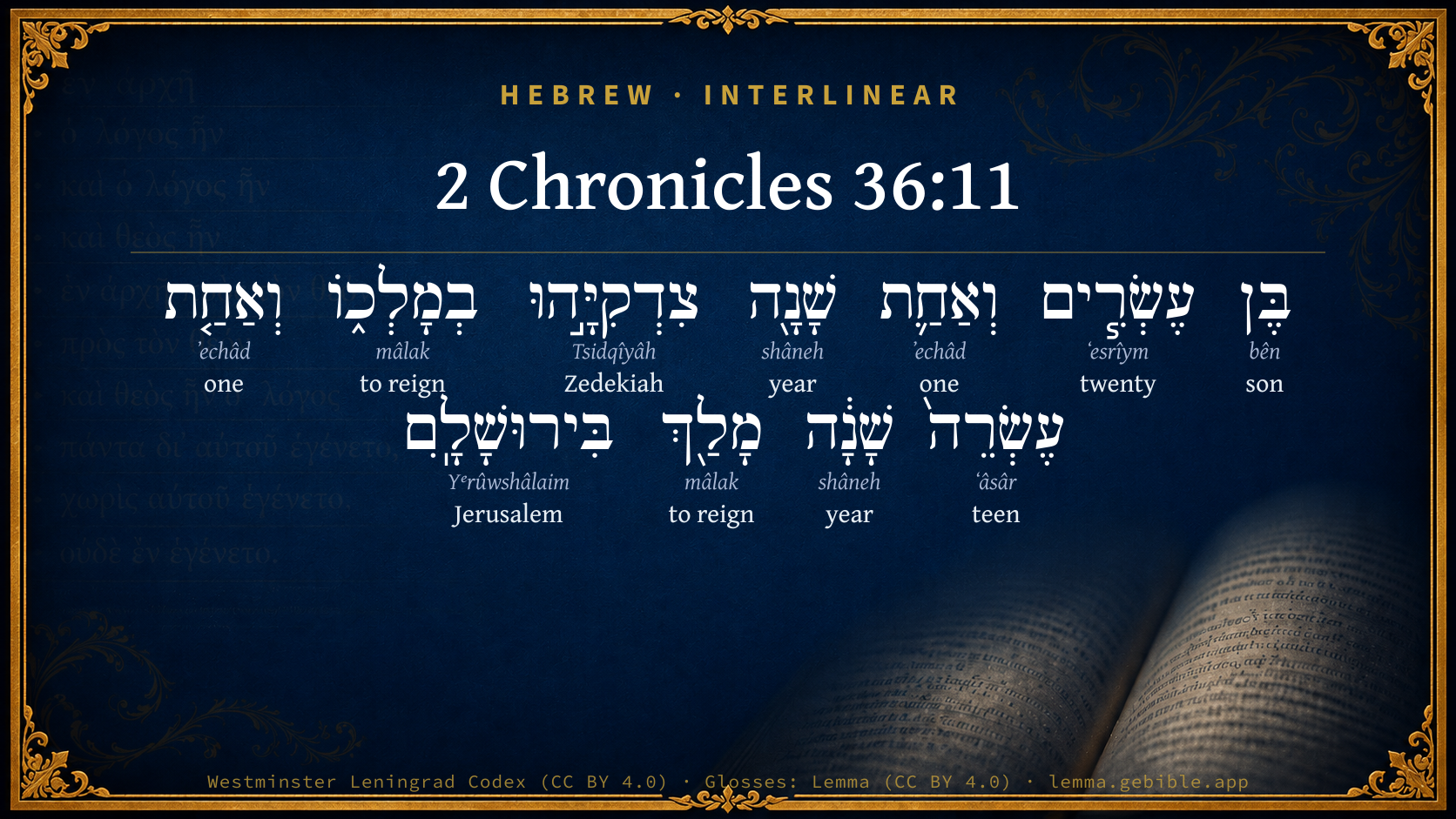
Hebrew (Westminster Leningrad Codex) 2 Chronicles 36:11 appears in the Hebrew Old Testament. The text above is from the Westminster Leningrad Codex. Each word links to its Strong’s number, a concise gloss, and parsing drawn from the Open Scriptures Hebrew Bible morphology. Click any word for its full Brown-Driver-Briggs (BDB) entry.
Download image
Cite this verse

2 Chronicles 36:11 (World English Bible). Public Domain. Lemma interlinear Bible study tool, https://lemma.gebible.app/v/2-chronicles/36/11.

Show BibTeX & RIS
BibTeX
RIS
English Translation
Zedekiah was twenty-one years old when he began to reign; and he reigned eleven years in Jerusalem:
World English Bible · Public Domain
Download a study sheet

One document with this verse’s original text, its word-by-word gloss line, the meaning frame, cross-references with their text, attributed commentary, and full source and license credits — printable, and it pastes into notes with its structure intact.

This verse Autodidact and up

Study sheet (.html) Plain text (.txt)

A passage Seminary Student

Up to 50 verses in one chapter. A passage sheet keeps up to 6 commentary sources and 12 cross-references per verse, in the order this page ranks them, and says so on the sheet whenever that leaves anything out. Ask for a single verse and you get the Autodidact verse sheet above.

Everything on this page stays free to read, with no account — the sheet is a download of what is already on screen, not access to it.

Want to remove ads? Support Godless Engineer
Compare translations 3

The same verse in 3 English versions, stacked beneath the original-language interlinear above. Click any original word for its lexicon entry.

Each is an independent rendering of the whole verse — the interlinear is not word-aligned to these translations.

Highlighted words mark where these versions differ — a whole-verse word diff, not a word-by-word alignment.

  • World English Bible Public Domain
    Zedekiah was twenty-one years old when he began to reign; and he reigned eleven years in Jerusalem:
  • King James Version Public Domain
    Zedekiah was one and twenty years old when he began to reign, and reigned eleven years in Jerusalem.
  • unfoldingWord Literal Text CC BY-SA 4.0
    A son of 21 years was Zedekiah when he became king; and 11 years he reigned in Jerusalem.

unfoldingWord Literal Text — © unfoldingWord, licensed CC BY-SA 4.0. Word-aligned USFM3 via Door43 (git.door43.org/unfoldingWord/en_ult).

Versions to compare (up to 4)

3 of 4 selected

Show all 18 translations

Every available English version of this verse, each an independent rendering of the whole verse.

  • World English Bible Public Domain
    Zedekiah was twenty-one years old when he began to reign; and he reigned eleven years in Jerusalem:
  • Berean Standard Bible Public Domain
    Zedekiah was twenty-one years old when he became king, and he reigned in Jerusalem eleven years.
  • Majority Standard Bible Public Domain
    Zedekiah was twenty-one years old when he became king, and he reigned in Jerusalem eleven years.
  • King James Version Public Domain
    Zedekiah was one and twenty years old when he began to reign, and reigned eleven years in Jerusalem.
  • American Standard Version (1901) Public Domain
    Zedekiah was twenty and one years old when he began to reign; and he reigned eleven years in Jerusalem:
  • Revised Version (1885) Public Domain
    Zedekiah was twenty and one years old when he began to reign; and he reigned eleven years in Jerusalem:
  • Geneva Bible (1599) Public Domain
    Zedekiah was one and twentie yeere olde, when he beganne to reigne, and reigned eleuen yeere in Ierusalem.
  • Douay-Rheims (1899) Public Domain
    Sedecias was one and twenty years old when he began to reign: and he reigned eleven years in Jerusalem.
  • Young's Literal Translation Public Domain
    A son of twenty and one years `is' Zedekiah in his reigning, and eleven years he hath reigned in Jerusalem;
  • Literal Standard Version CC BY-SA 4.0
    Zedekiah [is] a son of twenty-one years in his reigning, and he has reigned eleven years in Jerusalem;
  • Unlocked Literal Bible CC BY-SA 4.0
    Zedekiah was twenty-one years old when he began to reign; he reigned eleven years in Jerusalem.
  • unfoldingWord Literal Text CC BY-SA 4.0
    A son of 21 years was Zedekiah when he became king; and 11 years he reigned in Jerusalem.
  • Darby Bible Public Domain
    Zedekiah was twenty-one years old when he began to reign; and he reigned eleven years in Jerusalem.
  • World Messianic Bible Public Domain
    Zedekiah was twenty-one years old when he began to reign, and he reigned eleven years in Jerusalem.
  • Webster's Bible Public Domain
    Zedekiah was one and twenty years old when he began to reign, and reigned eleven years in Jerusalem.
  • Free Bible Version CC BY-SA 4.0
    Zedekiah was twenty-one when he became king, and he reigned in Jerusalem for eleven years.
  • Bible in Basic English Public Domain
    Zedekiah was twenty-one years old when he became king; he was ruling in Jerusalem for eleven years.
  • JPS Tanakh (1917) Public Domain
    Zedekiah was twenty and one years old when he began to reign; and he reigned eleven years in Jerusalem;

Literal Standard Version (2020), Covenant Press — licensed CC BY-SA 4.0. Text via the HelloAO Bible API (eBible.org). Unlocked Literal Bible (unfoldingWord) — licensed CC BY-SA 4.0. Text via the HelloAO Bible API (eBible.org). unfoldingWord Literal Text — © unfoldingWord, licensed CC BY-SA 4.0. Word-aligned USFM3 via Door43 (git.door43.org/unfoldingWord/en_ult). Free Bible Version, Dr. Jonathan Gallagher — licensed CC BY-SA 4.0. Text via the HelloAO Bible API (eBible.org).

Word by word

More ways to search: Search by grammar → Find every occurrence → Compare this word →

Practice this passage: Drill this verse → Learn its vocabulary →

צִדְקִיָּ֣הוּ
Tsidqîyâh
H6667
“Zedekiah”
Noun, Proper
Part of Speech
Noun
Type
Proper
Full BDB Definition

Origin: from H6664 and H3050

TWOT: None

Zedekiah = "Jehovah is righteous" - the last king of Judah renamed from 'Mattaniah' by Nebuchadnezzar; son of Josiah by wife Hamutal; placed on the throne by Nebuchadnezzar when he carried his nephew Jehoiakim in captivity - false prophet at the court of king Ahab of the northern kingdom of Israel - son of Maaseiah, a false prophet in Babylon - son of Hananiah, one of the princes of Judah in the time of Jeremiah - a priest who sealed the covenant with Nehemiah - son of king Jehoiakim of Judah
  1. בֶּן bên H1121 “son of” Noun, Common, Masculine, Singular, Construct
  2. עֶשְׂרִ֧ים ʻesrîym H6242 “twenty” Adjective, Cardinal number, Both, Plural, Absolute
  3. וְאַחַ֛ת ʼechâd H259 “and · one” Conjunction + Adjective, Cardinal number, Feminine, Singular, Absolute
  4. שָׁנָ֖ה shâneh H8141 “year” Noun, Common, Feminine, Singular, Absolute
  5. בְמָלְכ֑וֹ mâlak H4427 “in/at · to reign · him” Preposition + Verb, Qal, Infinitive Construct + Suffix, Personal, 3rd Person, Masculine, Singular
  6. וְאַחַ֤ת ʼechâd H259 “and · one” Conjunction + Adjective, Cardinal number, Feminine, Singular, Absolute
  7. עֶשְׂרֵה֙ ʻâsâr H6240 “teen” Adjective, Cardinal number, Feminine, Singular, Absolute
  8. שָׁנָ֔ה shâneh H8141 “year” Noun, Common, Feminine, Singular, Absolute
  9. מָלַ֖ךְ mâlak H4427 “to reign” Verb, Qal, Perfect, 3rd Person, Masculine, Singular
  10. בִּירוּשָׁלִָֽם Yᵉrûwshâlaim H3389 “in/at · Jerusalem” Preposition + Noun, Proper

About this verse

These counts appear in no published source. They are computed here, from the morphology-tagged text and Lemma’s own curated glosses. What Lemma adds →

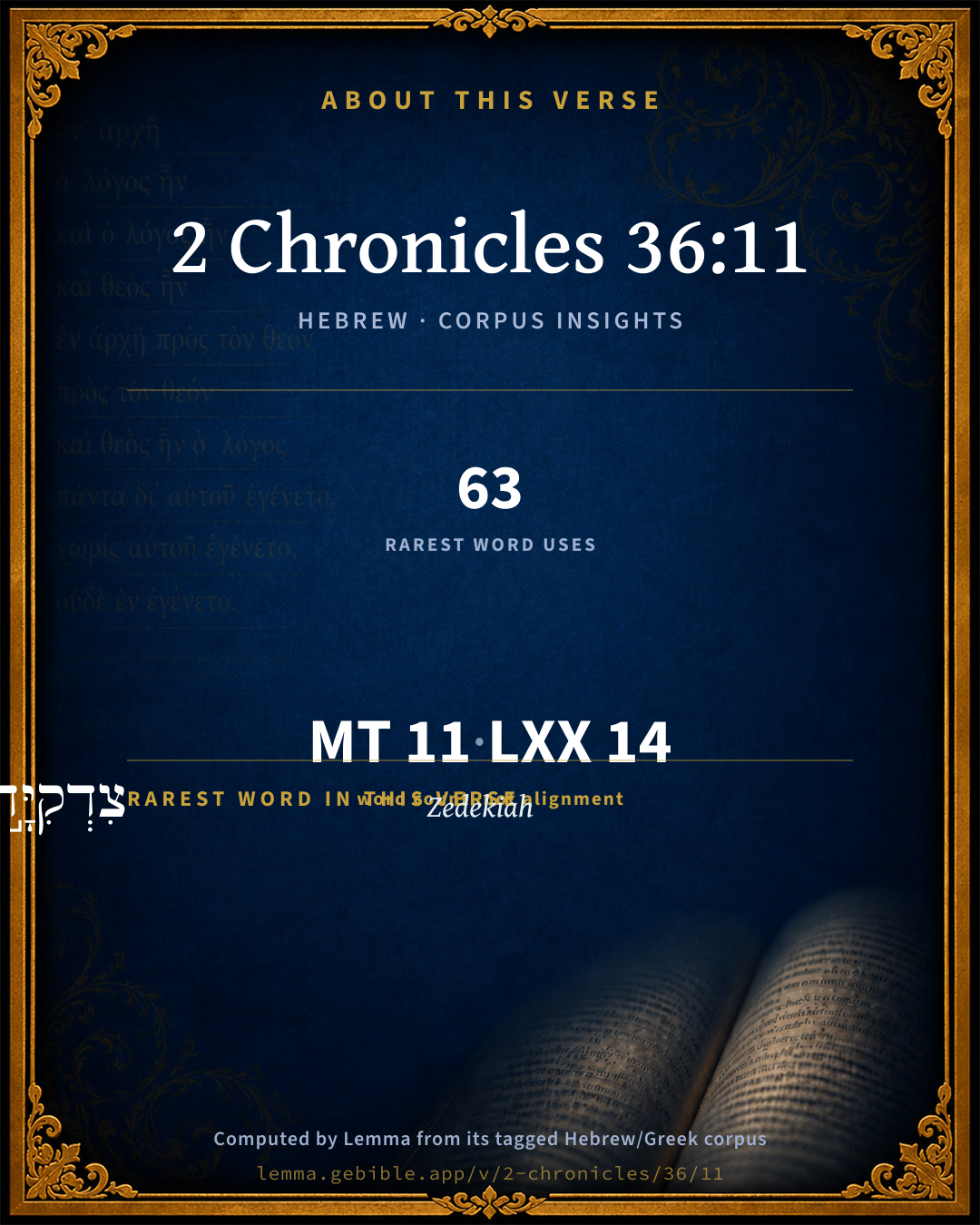
11
words
8
distinct lemmas
Historical
section

Grammatical profile

  • 2 verbs
  • 5 nouns
  • 4 adjectives

Verb forms

  • בְמָלְכ֑וֹ Qal · Infinitive Construct
  • מָלַ֖ךְ Qal · Perfect

Repetition

Words recur within this verse — often emphatic in Hebrew:

  • וְאַחַ֛ת one H259 ×2
  • שָׁנָ֖ה year H8141 ×2
  • בְמָלְכ֑וֹ to reign H4427 ×2

Hebrew & Septuagint length

In English translation the verse runs 17 words from the Hebrew and 17 from the Septuagint (LXX English) — the same length.

A rough comparison of the two English renderings, which tokenize alike — not a word-level alignment.

Word counts can differ between the Hebrew and the Greek without any difference in meaning — e.g. the Hebrew direct-object marker אֵת has no separate Greek word, and Greek often adds the article ὁ.

In the original languages it is 11 Hebrew tokens and 14 Greek tokens — but the two are counted differently (Hebrew bundles its prefixes and suffixes into one token; the Greek is in lemma form), so that isn’t a like-for-like length.

Cross-references

4

Topical passages linked to 2 Chronicles 36:11 in the Treasury of Scripture Knowledge — connected by theme and wording, ordered by reader-vote popularity; previews shown in the World English Bible.

  • 2 Kings 24:18–20 Zedekiah was twenty-one years old when he began to reign; and he reigned eleven years in Jerusalem: and his mother's name was Hamutal the daughter of Jeremiah of Libnah.
  • Jeremiah 27:1 In the beginning of the reign of Jehoiakim the son of Josiah, king of Judah, came this word to Jeremiah from Yahweh, saying,
  • Jeremiah 28:1 It happened the same year, in the beginning of the reign of Zedekiah king of Judah, in the fourth year, in the fifth month, that Hananiah the son of Azzur, the prophet, who was of Gibeon, spoke to me in the house of Yahweh, in the presence of the priests and of all the people, saying,
  • Jeremiah 52:1–3 Zedekiah was twenty-one years old when he began to reign; and he reigned eleven years in Jerusalem: and his mother's name was Hamutal the daughter of Jeremiah of Libnah.

Cross-references courtesy of OpenBible.info (CC BY 4.0).

Hebrew and Greek witnesses Masoretic Hebrew ↔ Greek Septuagint

The same verse in the two great witnesses to the Old Testament, shown verse-for-verse.

These are two independent witnesses, not word-aligned to each other, and the Septuagint is shown in lemma (dictionary) form.

Hebrew 2 Chronicles 36:11 Masoretic · Westminster Leningrad Codex

בֶּן עֶשְׂרִ֧ים וְאַחַ֛ת שָׁנָ֖ה צִדְקִיָּ֣הוּ בְמָלְכ֑וֹ וְאַחַ֤ת עֶשְׂרֵה֙ שָׁנָ֔ה מָלַ֖ךְ בִּירוּשָׁלִָֽם

Zedekiah was twenty-one years old when he began to reign; and he reigned eleven years in Jerusalem:

World English Bible · Public Domain

Greek LXX 2 Chronicles 36:11 Septuagint · lemma form

ἔτος εἴκοσι εἷς σεδεκιας ἐν ὁ βασιλεύω αὐτός καί ἕνδεκα ἔτος βασιλεύω ἐν ἰερουσαλήμ

Sedekias was twenty-one years old when he began to reign, and be reigned eleven years in Jerusalem.

LXX2012 (modern English Septuagint) · Public Domain

On this verse, The Pulpit Commentary discusses the Septuagint’s reading. Read the note in Commentary ↓

Hebrew: Westminster Leningrad Codex (CC BY 4.0). Greek: Septuagint (public domain); English from LXX2012 (modern English Septuagint) (Public Domain). How the Septuagint differs from the Hebrew →

Commentary

Notes on 2 Chronicles 36:11 from classic Christian and Jewish commentators (each source and its license shown beneath its notes). The classic Christian expositions comment on the surrounding passage and are grouped to its opening verse, so a note may address several verses; the Jewish commentaries on the Tanakh (Rashi and others) are per-verse, so they appear only where the commentator wrote on this verse.

Lemma curates 59 commentaries, every one of them public domain or Creative Commons licensed, each selected and text-cleaned for this edition rather than reprinted as found. About our sources →

Jamieson, Fausset & Brown

Robert Jamieson, A. R. Fausset & David Brown

ZEDEKIAH'S REIGN. (Ch2 36:11-21)

Zedekiah--Nebuchadnezzar appointed him. His name, originally Mattaniah, was, according to the custom of Oriental conquerors, changed into Zedekiah. Though the son of Josiah (Ch1 3:15; Jer 1:2-3; Jer 37:1), he is called the brother of Jehoiachin (Ch2 36:10), that is, according to the latitude of Hebrew style in words expressing affinity, his relative or kinsman (see Kg2 24:18; 2Ki. 25:1-21).

Jamieson, Fausset & Brown — Commentary Critical and Explanatory on the Whole Bible (1871) — public domain (CC PDM 1.0). Text via the HelloAO Bible API.

Ellicott's Commentary for English Readers

ZEDEKIAH AND THE FINAL CATASTROPHE (2Ch_36:11-21). (Comp. 2Ki_24:18 to 2Ki_25:21; Jeremiah 39, 52; Jeremiah 3 Esdr. 1:44-55.)

(11) Zedekiah was one and twenty.—So 2Ki_24:18, adding his mother’s name (Hamutal, who was also mother of Jehoahaz).

Before Jeremian . . . mouth of the Lord.—Not in Kings. (Comp. Jeremiah 21, Jer_22:1-10, Jeremiah 27, 28, 32-34, 37, 38)

Two special sins of Zedekiah are mentioned in this and the next verse—viz., his disregard of Jeremiah’s counsel, and his perjury to Nebuchadnezzar.

A Bible Commentary for English Readers, edited by Charles John Ellicott (1878–1897) — public domain. Text from a community e-Sword module.

Trapp's Complete Commentary

John Trapp

2Ch 36:11 Zedekiah [was] one and twenty years old when he began to reign, and reigned eleven years in Jerusalem.

Ver. 11-13. {See Trapp on "2Ki 24:10"} {See Trapp on "2Ki 24:11"} {See Trapp on "2Ki 24:17"} {See Trapp on "2Ki 24:18"} {See Trapp on "2Ki 24:19"} {See Trapp on "2Ki 24:20"}

John Trapp, A Commentary or Exposition upon All the Books of the Old and New Testament (1647–1656) — public domain. Text from a community e-Sword module.

MacLaren's Expositions of Holy Scripture

Alexander MacLaren

2 Chronicles

THE FALL OF JUDAH

2Ch 36:11 - 2Ch 36:21.

Bigness is not greatness, nor littleness smallness. Nebuchadnezzar’s conquest of Judah was, in his eyes, one of the least important of his many victories, but it is the only one of them which survives in the world’s memory and keeps his name as a household word. The Jews were a mere handful, and their country a narrow strip of land between the desert and the sea; but little Judaea, like little Greece, has taught the world. The tragedy of its fall has importance quite disproportioned to its apparent magnitude. Our passage brings together Judah’s sin and Judah’s punishment, and we shall best gather the lessons of its fall by following the order of the text.

Consider the sin. There is nothing more remarkable than the tone in which the chronicler, like all the Old Testament writers, deals with the national sin. Patriotic historians make it a point of pride and duty to gloss over their country’s faults, but these singular narrators paint them as strongly as they can. Their love of their country impels them to ‘make known to Israel its transgression and to Judah its sin.’ There are tears in their eyes, as who can doubt? But there is no faltering in their voices as they speak. A higher feeling than misguided ‘patriotism’ moves them. Loyalty to Israel’s God forces them to deal honestly with Israel’s sin. That is the highest kind of love of country, and might well be commended to loudmouthed ‘patriot’s in modern lands.

Look at the piled-up clauses of the long indictment of Judah in 2Ch 36:12 - 2Ch 36:16. Slow, passionless, unsparing, the catalogue enumerates the whole black list. It is like the long-drawn blast of the angel of judgment’s trumpet. Any trace of heated emotion would have weakened the impression. The nation’s sin was so crimson as to need no heightening of colour. With like judicial calmness, with like completeness, omitting nothing, does ‘the book,’ which will one day be opened, set down every man’s deeds, and he will be ‘judged according to the things that are written in this book.’ Some of us will find our page sad reading.

But the points brought out in this indictment are instructive. Judah’s idolatry and ‘trespass after all the abominations of the heathen’ is, of course, prominent, but the spirit which led to their idolatry, rather than the idolatry itself, is dwelt on. Zedekiah’s doing ‘evil in the sight of the Lord’ is regarded as aggravated by his not humbling himself before Jeremiah, and the head and front of his offending is that ‘he stiffened his neck and hardened his heart from turning unto the Lord.’ Similarly, the people’s sin reaches its climax in their ‘mocking’ and ‘scoffing’ at the prophets and ‘despising’ God’s words by them. So then, an evil life has its roots in an alienated heart, and the source of all sin is an obstinate self-will. That is the sulphur-spring from which nothing but unwholesome streams can flow, and the greatest of all sins is refusing to hear God’s voice when He speaks to us.

Further, this indictment brings out the patient love of God seeking, in spite of all their deafness, to find a way to the sinners’ ears and hearts. In a bold transference to Him of men’s ways, He is said to have ‘risen early’ to send the prophets. Surely that means earnest effort. The depths of God’s heart are disclosed when we are bidden to think of His compassion as the motive for the prophet’s messages and threatenings. What a wonderful and heart-melting revelation of God’s placableness, wistful hoping against hope, and reluctance to abandon the most indurated sinner, is given in that centuries-long conflict of the patient God with treacherous Israel! That divine charity suffered long and was kind, endured all things and hoped all things.

Consider the punishment. The tragic details of the punishment are enumerated with the same completeness and suppression of emotion as those of the sin. The fact that all these were divine judgments brings the chronicler to the Psalmist’s attitude. ‘I was dumb, I opened not my mouth because Thou didst it.’ Sorrow and pity have their place, but the awed recognition of God’s hand outstretched in righteous retribution must come first. Modern sentimentalists, who are so tenderhearted as to be shocked at the Christian teachings of judgment, might learn a lesson here.

The first point to note is that a time arrives when even God can hope for no amendment and is driven to change His methods. His patience is not exhausted, but man’s obstinacy makes another treatment inevitable. God lavished benefits and pleadings for long years in vain, till He saw that there was ‘no remedy.’ Only then did He, as if reluctantly forced, do ‘His work, His strange work.’ Behold, therefore, the ‘goodness and severity’ of God, goodness in His long delay, severity in the final blow, and learn that His purpose is the same though His methods are opposite.

To the chronicler God is the true Actor in human affairs. Nebuchadnezzar thought of his conquest as won by his own arm. Secular historians treat the fall of Zedekiah as simply the result of the political conditions of the time, and sometimes seem to think that it could not be a divine judgment because it was brought about by natural causes. But this old chronicler sees deeper, and to him, as to us, if we are wise, ‘the history of the world is the judgment of the world.’ The Nebuchadnezzars are God’s axes with which He hews down fruitless trees. They are responsible for their acts, but they are His instruments, and it is His hand that wields them.

The iron band that binds sin and suffering is disclosed in Judah’s fall. We cannot allege that the same close connection between godlessness and national disaster is exemplified now as it was in Israel. Nor can we contend that for individuals suffering is always the fruit of sin. But it is still true that ‘righteousness exalteth a nation,’ and that ‘by the soul only are the nations great,’ in the true sense of the word. To depart from God is always ‘a bitter and an evil thing’ for communities and individuals, however sweet draughts of outward prosperity may for a time mask the bitterness. Not armies nor fleets, not ships, colonies and commerce, not millionaires and trusts, not politicians and diplomatists, but the fear of the Lord and the keeping of His commandments, are the true life of a nation. If Christian men lived up to the ideal set them by Jesus, ‘Ye are the salt of the land,’ and sought more earnestly and wisely to leaven their nation, they would be doing more than any others to guarantee its perpetual prosperity.

The closing words of this chapter, not included in the passage, are significant. They are the first words of the Book of Ezra. Whoever put them here perhaps wished to show a far-off dawn following the stormy sunset. He opens a ‘door of hope’ in ‘the valley of trouble.’ It is an Old Testament version of ‘God hath not cast away His people whom He foreknew.’ It throws a beam of light on the black last page of the chronicle, and reveals that God’s chastisement was in love, that it was meant for discipline, not for destruction, that it was educational, and that the rod was burned when the lesson had been learned. It was learned, for the Captivity cured the nation of hankering after idolatry, and whatever defects it brought back from Babylon, it brought back a passionate abhorrence of all the gods of the nations.

Alexander MacLaren, Expositions of Holy Scripture (1904–1910) — public domain. Text from a community e-Sword module.

Tyndale Open Study Notes

Tyndale Open Resources

36:11-14 Although Jeremiah repeatedly urged Zedekiah to submit to the Babylonians rather than look for help from Egypt (Jer 25:1-11; 27:1-22; 34:1-22; 37:1–38:28), Zedekiah refused to humble himself and rebelled, violating his oath.

36:11 Zedekiah reigned from 597 to 586 BC.

Tyndale Open Study Notes — © Tyndale Open Resources, licensed CC BY-SA 4.0. Text via the HelloAO Bible API.

Matthew Henry's Commentary

We have here an account of the destruction of the kingdom of Judah and the city of Jerusalem by the Chaldeans. Abraham, God's friend, was called out of that country, from Ur of the Chaldees, when God took him into covenant and communion with himself; and now his degenerate seed were carried into that country again, to signify that they had forfeited all that kindness wherewith they had been regarded for the father's sake, and the benefit of that covenant into which he was called; all was now undone again. Here we have,

I. The sins that brought this desolation.

1. Zedekiah, the king in whose days it came, brought it upon himself by his own folly; for he conducted himself very ill both towards God and towards the king of Babylon. (1.) If he had but made God his friend, that would have prevented the ruin. Jeremiah brought him messages from God, which, if he had given due regard to them, might have secured a lengthening of his tranquillity; but it is here charged upon him that he humbled not himself before Jeremiah, Ch2 36:12. It was expected that this mighty prince, high as he was, should humble himself before a poor prophet, when he spoke from the mouth of the Lord, should submit to his admonitions and be amended by them, to his counsels and be ruled by them, should lay himself under the commanding power of the word of God in his mouth; and, because he would not thus make himself a servant to God, he was made a slave to his enemies. God will find some way or other to humble those that will not humble themselves. Jeremiah, as a prophet, was set over the nations and kingdoms (Jer 1:10), and, as mean a figure as he made, whoever would not humble themselves before him found that it was at their peril. (2.) If he had but been true to his covenant with the king of Babylon, that would have prevented his ruin; but he rebelled against him, though he had sworn to be his faithful tributary, and perfidiously violated his engagements to him, Ch2 36:13. It was this that provoked the king of Babylon to deal so severely with him as he did. All nations looked upon an oath as a sacred thing, and on those that durst break through the obligations of it as the worst of men, abandoned of God and to be abhorred by all mankind. If therefore Zedekiah falsify his oath, when, lo, he has given his hand, he shall not escape, Eze 17:18. Though Nebuchadnezzar was a heathen, an enemy, yet if, having sworn to him, he be false to him, he shall know there is a God to whom vengeance belongs. The thing that ruined Zedekiah was not only that he turned not to the Lord God of Israel, but that he stiffened his neck and hardened his heart from turning to him, that is, he as obstinately resolved not to return to him, would not lay his neck under God's yoke nor his heart under the impressions of his word, and so, in effect, he would not be healed, he would not live.

2. The great sin that brought this destruction was idolatry. The priests and people went after the abominations of the heathen, forsook the pure worship of God for the lewd and filthy rites of the Pagan superstition, and so polluted the house of the Lord, Ch2 36:14. The priests, the chief of the priests, who should have opposed idolatry, were ring-leaders in it. That place is not far from ruin in which religion is already ruined.

3. The great aggravation of their sin, and that which filled the measure of it, was the abuse they gave to God's prophets, who were sent to call them to repentance, Ch2 36:15, Ch2 36:16. Here we have, (1.) God's tender compassion towards them in sending prophets to them. Because he was the God of their fathers, in covenant with them, and whom they worshipped (though this degenerate race forsook him), therefore he sent to them by his messengers, to convince them of their sin and warn them of the ruin they would bring upon themselves by it, rising up betimes and sending, which denotes not only that he did it with the greatest care and concern imaginable, as men rise betimes to set their servants to work when their heart is upon their business, but that, upon their first deviation from God to idols, if they took but one step that way, God immediately sent to them by his messengers to reprove them for it. He gave them early timely notice both of their duty and danger. Let this quicken us to seek God early, that he rises betimes to send to us. The prophets that were sent rose betimes to speak to them, were diligent and faithful in their office, lost no time, slipped no opportunity of dealing with them; and therefore God is said to rise betimes. The more pains ministers take in their work the more will the people have to answer for if it be all in vain. The reason given why God by his prophets did thus strive with them is because he had compassion on his people and on his dwelling-place, and would by these means have prevented their ruin. Note, The methods God takes to reclaim sinners by his word, by ministers, by conscience, by providences, are all instances of his compassion towards them and his unwillingness that any should perish. (2.) Their base and disingenuous carriage towards God (Ch2 36:16): They mocked the messengers of God (which was a high affront to him that sent them), despised his word in their mouths, and not only so, but misused the prophets, treating them as their enemies. The ill usage they gave Jeremiah who lived at this time, and which we read much of in the book of his prophecy, is an instance of this. This was an evidence of an implacable enmity to God, and an invincible resolution to go on in their sins. This brought wrath upon them without remedy, for it was sinning against the remedy. Nothing is more provoking to God than abuses given to his faithful ministers; for what is done against them he takes as done against himself. Saul, Saul, why persecutest thou me? Persecution was the sin that brought upon Jerusalem its final destruction by the Romans. See Mat 23:34-37. Those that mock at God's faithful ministers, and do all they can to render them despicable or odious, that vex and misuse them, to discourage them and to keep others from hearkening to them, should be reminded that a wrong done to an ambassador is construed as done to the prince that sends him, and that the day is coming when they will find it would have been better for them if they had been thrown into the sea with a mill-stone about their necks; for hell is deeper and more dreadful.

II. The desolation itself, and some few of the particular so fit, which we had more largely Kg2 25:1. Multitudes were put to the sword, even in the house of their sanctuary (Ch2 36:17), whither they fled for refuge, hoping that the holiness of the place would be their protection. But how could they expect to find it so when they themselves had polluted it with their abominations? Ch2 36:14. Those that cast off the dominion of their religion forfeit all the benefit and comfort of it. The Chaldeans not only paid no reverence to the sanctuary, but showed no natural pity either to the tender sex or to venerable age. They forsook God, who had compassion on them (Ch2 36:15), and would have none of him; justly therefore are they given up into the hands of cruel men, for they had no compassion on young man or maiden. 2. All the remaining vessels of the temple, great and small, and all the treasures, sacred and secular, the treasures of God's house and of the king and his princes, were seized, and brought to Babylon, Ch2 36:18. 3. The temple was burnt, the walls of Jerusalem were demolished, the houses (called here the palaces, as Psa 48:3, so stately, rich, and sumptuous were they) laid in ashes, and all the furniture, called here the goodly vessels thereof, destroyed, Ch2 36:19. Let us see where what woeful havock sin makes, and, as we value the comfort and continuance of our estates, keep that worm from the root of them. 4. The remainder of the people that escaped the sword were carried captives to Babylon (Ch2 36:20), impoverished, enslaved, insulted, and exposed to all the miseries, not only of a strange and barbarous land, but of an enemy's land, where those that hated them bore rule over them. They were servants to those monarchs, and no doubt were ruled with rigour so long as that monarchy lasted. Now they sat down by the rivers of Babylon, with the streams of which they mingled their tears, Psa 137:1. And though there, it should seem, they were cured of idolatry, yet, as appears by the prophet Ezekiel, they were not cured of mocking the prophets. 5. The land lay desolate while they were captives in Babylon, Ch2 36:21. That fruitful land, the glory of all lands, was now turned into a desert, not tilled, nor husbanded. The pastures were not clothed as they used to be with flocks, nor the valleys with corn, but all lay neglected. Now this may be considered, (1.) As the just punishment of their former abuse of it. They had served Baal with its fruits; cursed therefore is the ground for their sakes. Now the land enjoyed her sabbaths; (Ch2 36:21), as God had threatened by Moses, Lev 26:34, and the reason there given (v. 35) is, "Because it did not rest on your sabbaths; you profaned the sabbath-day, did not observe the sabbatical year." They many a time ploughed and sowed their land in the seventh year, when it should have rested, and now it lay unploughed and unsown for ten times seven years. Note, God will be no loser in his glory at last by the disobedience of men: if the tribute be not paid, he will distrain and recover it, as he speaks, Hos 2:9. If they would not let the land rest, God would make it rest whether they would or no. Some think they had neglected the observance of seventy sabbatical years in all, and just so many, by way of reprisal, the land now enjoyed; or, if those that had been neglected were fewer, it was fit that the law should be satisfied with interest. We find that one of the quarrels God had with them at this time was for not observing another law which related to the seventh year, and that was the release of servants; see Jer 34:13, etc. (2.) Yet we may consider it as giving some encouragement to their hopes that they should, in due time, return to it again. Had others come and taken possession of it, they might have despaired of ever recovering it; but, while it lay desolate, it did, as it were, lie waiting for them again, and refuse to acknowledge any other owners.

Matthew Henry's Commentary on the Whole Bible (1708–1710) — public domain (CC PDM 1.0). Text via the HelloAO Bible API.

The Cambridge Bible for Schools and Colleges

gen. ed. J. J. S. Perowne

11–19 (= 1Es_1:46-56; cp. 2Ki_24:18 to 2Ki_25:21; Jer_37:1 to Jer_39:8; Jer_52:1-27). Reign of Zedekiah. Destruction of Jerusalem

11. in Jerusalem] The Chronicler omits, as usual, his mother’s name. She was “Hamutal, the daughter of Jeremiah of Libnah” (2Ki_24:18), and was mother of Jehoahaz also (ibid. 2Ki_23:31). Jehoiakim was by a different mother (ibid. 2Ki_23:36).

The Cambridge Bible for Schools and Colleges (gen. ed. J. J. S. Perowne; Cambridge University Press, 1878–1918) — public domain. Text from a community e-Sword module.

The Pulpit Commentary

Vers. 11-21.

Zedekiah; or the fall of Judah.

I AN EXAMPLE OF INSENSATE WICKEDNESS. (Vers. 11-16.)

1. On the part of the king. Seemingly the third, (1Ch_3:15) but in reality the fourth, son of Josiah, (cf. 2Ki_23:31, 2Ki_23:36) and the full brother of Jehoahaz, or Shallum. (2Ki_23:31 2Ki_24:18) but the half-brother of Jehoiakim, (2Ki_23:36) Mattanias, or Jehovah s gift, as he was originally called, ascended the throne of Judah in his twenty-first year, by the favour of Nebuchadnezzar his overlord (ver. 10). With his superior"s consent, like Jehoiakim, he adopted of his own accord, or had chosen for him by others (Cheyne), a special throne-name. Zedekiah, Zidkiah, meaning "Jehovah is righteous," or "Justice of Jehovah," had been the name of a former sovereign of Ascalon, whom Sennacherib had subdued (Schrader, "Die Keilinschriften," p. 291); and whatever may have been the object of Mattanias or his princes in selecting this as the designation of Judah"s last king, it is hardly possible not to be struck with its singular propriety. To a people who were frequently instructed by "signs" it was a double symbol first by way of contrast of the utter corruption of the nation, both prince and people; and second by way of prediction of coming doom for the kingdom. So far as the king was concerned, it was a grim satire on holy things to designate a creature like him Zedekiah. If his person and character were remarkable for anything, it was for the absence of righteousness.

(1) His devotion to idols was intense. He did evil in the sight of the Lord his God (ver. 12), by adhering to the heathen worship of his predecessors (2Ki_24:19; Jer_52:2)

(2) His unbelief was pronounced. He refused to believe Jeremiah the prophet speaking to him in Jehovah"s name. (Jer_37:2)

(3) His disobedience was flagrant. He rebelled against Nebuchadnezzar, who had made him swear (allegiance) by God (ver. 13; cf. Eze_17:13-19) a wickedness for which Jehovah declared he should die in Babylon. The reason of this revolt was the accession of a new Pharaoh, Hophrah in Scripture, (Jer_44:30) in the hieroglyphic inscriptions Uahibri, Oujafrh in the LXX, jApihv, or Apries, in Herodotus (2:161, 169; 4:159). To him Zedekiah, against Jeremiah"s advice, despatched ambassadors, hoping to obtain "horses and much people". (Eze_17:15) Nebuchadnezzar at once took the field, uncertain whether to march against Egypt or Jerusalem. By means of divination he decided for Jerusalem. (Eze_21:20-22) In the ninth year of Zedekiah"s reign, on the tenth month, Nebuchadnezzar with his armies sat down before Jerusalem. (2Ki_25:1) Hearing, however, of Pharaoh-Hophra"s approach, he raised the siege. (Jer_37:5) This having excited false hopes as to Nebuchadnezzar"s final withdrawal from the city, (Eze_17:17) Jeremiah warned king and people that he would soon return. (Jer_37:8-10) This warning Zedekiah would not hear. (2Ch_36:16)

2. On the part of the people. Hardly second to their monarch were the priests, the princes, and the people.

(1) Their passion for idolatry was as great: "They trespassed very greatly after all the abominations of the heathen" (ver. 14). "Like priest, like people a proverb applicable to kings and subjects, masters and servants, as well as ecclesiastics and worshippers.

(2) Their insolence was as high. "They polluted the house of the Lord which he had hallowed in Jerusalem" (ver. 14). "Jeremiah (Jer_23:11) alludes to practices specially inconsistent with the holy place, and one of the Jewish,captives explains what they were. (Eze_8:11-17) There was

(a) an image of Asherah;

(b) totemistic animal-emblems on the wall of a temple-chamber;

(c) weeping for "Tammuz dearly wounded;

(4) sun-worship and the rite of holding up "the twig" to the nose (Cheyne, "Jeremiah: his Life" etc., pp. 166, 167).

(3) Their unbelief was as daring. Though Jehovah had "sent to them by his messengers, rising up early and sending them," yet had they "mocked the messengers of God, and despised his words, and scoffed at his prophets" (vers. 15, 16) a degree of criminality beyond that of which the Israelites had been guilty when they laughed Hezekiah"s messengers to scorn, (2Ch_30:10) but not above that which hearers of the gospel may (Act_2:13 Act_17:32; Heb_10:29; 2Pe_2:3, 2Pe_2:4; Jud_1:18)

II AN INSTANCE OF DIVINE RETRIBUTION. (Vers. 17-21.) The moral and spiritual corruption of the community in Zedekiah"s time was so great that nothing remained but to pour out upon them the vials of long-threatened wrath. (Deu_28:21, Deu_28:36, 52 31:16-21; Jer_5:19 Jer_32:28-36) In the expressive language of the Chronicler, "there was no remedy," "no healing," more; nothing but fire and sword. After defeating Pharaoh-Hophra, or causing him to retreat, Nebuchadnezzar returned to his head-quarters at Riblah, on the east bank of the Orontes, thirty-five miles northeast of Baalbec, and despatched his captains, Nergalsharezer, Samgar-nebo, Sar-sechim, Rab-saris, Rab-mag, and others to resume the siege of Jerusalem, which, however, triumphantly withstood their assaults until the beginning of the eleventh year, when the supply of provisions began to fail. (Jer_52:6) On the ninth day of the fourth month, i.e. in July, B.C. 586, "there was no bread for the people of the land." The starving defenders of the city could no longer hold out. The horrors of the situation may be gathered from Lam_2:19 Lam_4:3; Eze_5:10 RAPC Bar 2:3. The besiegers eventually effected a breach in the north wall, and poured in like a destroying flood. Then ensued:

1. Merciless carnage. The Chaldean soldiers butchered all and sundry, young and old, lad and maiden, not even sparing such as had taken refuge in the temple (ver. 17). The massacre was wholesale, truculent, and pitiless, eclipsed in horror only by that which took place when Jerusalem was captured by Titus (Josephus, "Wars" 6:9. 4).

2. Ruthless sacrilege. They completely despoiled the temple of its sacred vessels, great and small, as well as pillaged the royal palaces, carrying off their treasures (ver. 18). Among the articles removed from the temple were the brazen and golden utensils of service, the two pillars, the brazen sea, and the vases which Solomon had made (2Ki_25:13-17; Jer_52:17-23)

3. Wholesale destruction. "They burnt the house of God, and brake down the wall of Jerusalem, and burnt all the palaces" (ver. 19); which was pure vandalism. This appears to have been done not on the night of the city"s capture (tenth day of tenth month), but seven months after, on the tenth day of the fifth month, i.e. in February, B.C. 587, (Jer_52:12) andto have been carried out by one of Nebuchadnezzar"s generals, Nebuzaradan, captain of the king"s guards, or "chief of the executioners", (cf. Gen_39:1) despatched from Riblah for the purpose. What happened in the interval is narrated in 2 Kings (2Ki_25:4-7) and Jeremiah, (Jer_52:7-11) viz. the capture, near Jericho, of Zedekiah with his court and his forces, who had escaped when the city was taken, and their journey north to Riblah, the head-quarters of Nebuchadnezzar, where, after judgment held, (2Ki_25:6) Zedekiah"s sons and the princes of Judah were slain, and Zedekiah himself blinded according to an inhuman practice of the time (see "Records," etc., 3:50, 1. 117, "Of many soldiers I destroyed the eyes;" and comp. Herod., 7:18), and cast into bonds preparatory to being deported to Babylon. In Babylon he was cast into prison until the day of his death; (Jer_52:11) according to tradition, his work in prison was that of grinding in a mill like an ordinary slave (Ewald, "History of Israel," 4:273, note 5).

4. Pitiless expatriation. Those that had escaped the sword were driven off, like gangs of slaves, to become exiles in a strange land, and servants to the kings of Babylon, "until the land had enjoyed her sabbaths," viz. for three score and ten years (vers. 20, 21). Such transplantations of conquered populations were common in the ancient Orient. "Sargon transported the Samaritans to Gozan and Media; Sennacherib carried off two hundred thousand Jews from Judaea; Esarhaddon placed Elamites, Susianians, and Babylonians in Samaria. Darius Hystaspis brought the nation of the Paeonians from Europe into Asia Minor, removed the Barcaeans to Bactria, and the Eretrians to Ardericca near Susa" (Rawlinson, "Egypt and Babylon," pp. 45, 46).

LESSONS.

1. The incorrigible character of some sit, hers.

2. The offensiveness in God"s sight of pride and hardness of heart.

3. The heinousness of oath-breaking and of unjustifiable rebellion.

4. The hopelessness of reformation in a city or a land when all classes are in love with wicked ways.

5. The infinite compassion of God towards the worst of men.

6. The certainty that mercy despised will turn into wrath displayed.

7. The pitiless character of Heaven"s judgments upon them for whom there is no remedy.

8. The indifference God shows towards the external symbols of religion when the inner spirit is wanting.

9. The impossibility of God"s Word failing. W.

The Pulpit Commentary (1880–1919), ed. H.D.M. Spence-Jones & Joseph S. Exell — public domain. Text from a community e-Sword module.

Keil & Delitzsch

C. F. Keil & F. Delitzsch

The reign of Zedekiah; the destruction of Jerusalem, and Judah carried away into exile. Cf. 2 Kings 24:18-25:21. - Zedekiah, made king at the age of twenty-one years, reigned eleven years, and filled up the measure of sins, so that the Lord was compelled to give the kingdom of Judah up to destruction by the Chaldeans. To that Zedekiah brought it by the two main sins of his evil reign, - namely, by not humbling himself before the prophet Jeremiah, from the mouth of Jahve (Ch2 36:12); and by rebelling against King Nebuchadnezzar, who had caused him to swear by God, and by so hardening his neck (being stiff-necked), and making stout his heart, that he did not return to Jahve the God of Israel. Zedekiah's stiffness of neck and hardness of heart showed itself in his refusing to hearken to the words which Jeremiah spoke to him from the mouth of God, and his breaking the oath he had sworn to Nebuchadnezzar by God. The words, "he humbled himself not before Jeremiah," recall Jer 37:2, and the events narrated in Jer 37 and 38, and 21:4-22:9, which show how the chief of the people ill-treated the prophet because of his prophecies, while Zedekiah was too weak and languid to protect him against them. The rebellion against Nebuchadnezzar, to whom he had sworn a vassal's oath of fidelity, is mentioned in Kg2 24:20, and Eze 17:13. also, as a great crime on the part of Zedekiah and the chief of the people; see the commentary on both passages. In consequence of this rebellion, Nebuchadnezzar marched against Judah with a powerful army; and after the capture of the fenced cities of the land, he advanced to the siege of Jerusalem, which ended in its capture and destruction, Kg2 25:1-10. Without further noticing these results of this breach of faith, the author of the Chronicle proceeds to depict the sins of the king and of the people. In the first place, he again brings forward, in Ch2 36:13, the stiffness of neck and obduracy of the king, which manifested itself in the acts just mentioned: he made hard his neck, etc. Bertheau would interpret the words וגו ויּקשׁ, according to Deu 2:30, thus: "Then did God make him stiff-necked and hardened his heart; so that he did not return to Jahve the God of Israel, notwithstanding the exhortations of the prophets." But although hardening is not seldom represented as inflicted by God, there is here no ground for supposing that with ויּקשׁ the subject is changed, while the bringing forward of the hardening as an act of God does not at all suit the context. And, moreover, ערף הקשׁה, making hard the neck, is nowhere ascribed to God, it is only said of men; cf. Kg2 17:14; Deu 10:16; Jer 19:15, etc. To God only את־לב הקשׁה or את־רוּח is attributed, Exo 7:3; Deu 2:30.

Keil & Delitzsch — Biblical Commentary on the Old Testament (1861–1891) — public domain (CC PDM 1.0). Text via the HelloAO Bible API. (Old Testament only.)

Kretzmann's Popular Commentary

Paul E. Kretzmann

Zedekiah’s Reign and the end of Judah

v. 11. Zedekiah was one and twenty years old when he began to reign, and reigned eleven years in Jerusalem. Cf 2Ki 24:18 to 2Ki 25:21; Jeremiah 52. All the nobles, artisans, and craftsmen of the people having been removed, there remained only the laboring class and the farmers and gardeners.

v. 12. And he did that which was evil in the sight of the Lord, his God, persisting in idolatry in the face of the Lord’s punishment upon his predecessors, and humbled not himself before Jeremiah, the prophet, speaking from the mouth of the Lord. Cf Jeremiah 37.

v. 13. And he also rebelled against King Nebuchadnezzar, who had made him swear by God, taking a solemn oath of loyalty from him. wherefore his league with Pharaohhophrah of Egypt included the crime of perjury; but he stiffened his neck and hardened his heart from turning unto the Lord God of Israel. That is the height of God’s judgment upon man when He permits self-hardening to take place and delivers man to his own evil way of thinking.

v. 14. Moreover, all the chief of the priests and the people transgressed very much after all the abominations of the heathen, thus agreeing with the king in his idolatrous practices; and polluted the house of the Lord which He had hallowed in Jerusalem, by heathen sacrifices and customs.

v. 15. And the Lord God of their fathers sent to them by His messengers, especially the prophets Isaiah, Micah, Habakkuk, and Jeremiah, rising up betimes and sending, that is, constantly and earnestly, because He had compassion on His people and on His dwelling-place, wishing to save the people from the punishment which they were inviting upon their own heads.

v. 16. But they mocked the messengers of God, as in the case of Jeremiah, Jer 5:12-13, and despised His words, and misused His prophets, Jer 32:3, until the wrath of the Lord arose against His people, like a fire eating through into a high flame, till there was no remedy, till the state of affairs was past healing.

v. 17. Therefore He brought upon them the king of the Chaldees, Nebuchadnezzar undertaking a third siege of Jerusalem, who slew their young men with the sword in the house of their sanctuary, so called because they had profaned the Temple by their idolatry, and had no compassion upon young man or maiden, old man, or him that stooped for age; He gave them all into his hand, namely, when the city was captured after a siege lasting a year and a half, in the year 587 B. C.

v. 18. And all the vessels of the house of God, great and small, those still remaining after the first sacking of the city, and the treasures of the house of the Lord, with the many presents of consecration, and the treasures of the king and of his princes, the entire contents of the royal treasury; all these he brought to Babylon.

v. 19. And they burned the house of God, for the floors and the inner walls of the Temple were of wood, and therefore very inflammable, and brake down the wall of Jerusalem, and burned all the palaces thereof with fire, and destroyed all the goodly vessels thereof, all those of value which they could not well transport to Babylon.

v. 20. And them that had escaped from the sword, during the siege and at the capture of the city, carried he away to Babylon, where they were servants to him and his sons until the reign of the kingdom of Persia, 2Ki 25:9; Jer 39:8; Jer 27:7,

v. 21. to fulfill the word of the Lord by the mouth of Jeremiah, until the land had enjoyed her Sabbaths; the Sabbatic years, as seasons of rest for all classes of people and for the land itself having been ignored for centuries, the Lord was now giving the land lest, Lev 26:34; for as long as she lay desolate, she kept Sabbath, for a mere handful of people remained in the land after Nebuchadnezzar’s campaign, and many of these went down into Egypt in the course of time, to fulfil threescore and ten years. It seems that no attempt was made to colonize the land in the interval, and that Judah was actually desolate for seventy years.

v. 22. Now, in the first year of Cyrus, king of Persia, that the word of the Lord spoken by the mouth of Jeremiah might be accomplished, Jer 25:12-13, the Lord stirred up the spirit of Cyrus, king of Persia, the Babylonian empire having meanwhile passed into the power of the Persian empire, that he made a proclamation throughout all his kingdom, and put it also in writing, saying,

v. 23. Thus saith Cyrus, king of Persia, All the kingdoms of the earth hath the Lord God of heaven given me; and He hath charged me to build Him an house in Jerusalem, which is in Judah. This had been revealed to Cyrus either directly or by the mouth of some prophet. Who is there among you of all His people? The Lord, His God, be with him, and let him go up. It was a free invitation calling upon the Jews to return to the land of their fathers. Note the kindness and mercy of the Lord in reinstating a remnant of His people in their country, since the Redeemer was to come out of Zion, born in Bethlehem from the stock of David.

Paul E. Kretzmann, Popular Commentary of the Bible (1921–1924) — public domain. Text from a community e-Sword module.

unfoldingWord translationNotes

Door43 World Missions Community

twenty-one years old ... eleven years

"21 years old ... 11 years" (See: Numbers)

what was evil in the sight of Yahweh his God

Here "sight" represents judgment. Yahweh saw and did not approve of Zedekiah's actions. AT: "what Yahweh his God judged to be evil" or "what Yahweh his God considered to be evil" (See: Metaphor)

who spoke from the mouth of Yahweh

Here the word "mouth" represents the words that Yahweh spoke. AT: "who spoke the words that Yahweh spoke to him" (See: Metonymy)

translationWords

humble

Jeremiah

prophet

unfoldingWord translationNotes — © Distant Shores Media and the Door43 World Missions Community, licensed CC BY-SA 4.0. Source: git.door43.org/Door43/en_tn.

Lesson kit

Teaching starters — assembled from the data on this page, not authored interpretation. Every prompt links to the verse data it draws on. Edit before teaching.

2 Chronicles, in the Historical, opens this verse with 11 words (8 distinct Hebrew lemmas). Its most distinctive word is Tsidqîyâh (“Zedekiah”). A historical commentator’s framing appears above. Read the whole chapter for the surrounding context.

Discussion questions

  1. The word Tsidqîyâh carries the sense “Zedekiah.” How does it shape the verse?
  2. How does 2 Kings 24:18–20, which shares this passage’s theme, read alongside this verse?
  3. What does the repetition of “one” (2× in this one verse) do in this verse?
  4. The translations on this page render this verse differently — a whole-verse word diff, not a word-by-word alignment. What might account for the different wordings?
  5. «בְמָלְכ֑וֹ» is a Qal Infinitive Construct verb. How does that grammatical form shape the action described?
  6. Compare how Jamieson, Fausset & Brown and Ellicott's Commentary for English Readers read this verse. Where do they agree or differ?

Things to notice

Reading settings

Reading text

Shown beneath each verse's original-language words.

Old Testament
Old Testament edition

Read the OT as the Masoretic Hebrew (MT) or the Greek Septuagint (LXX).

English shown for the Greek Septuagint (in the Hebrew ↔ Greek comparison).

Comparing translations? Open the Compare panel on any verse page to stack up to four side by side.