
2 Chronicles 34:32

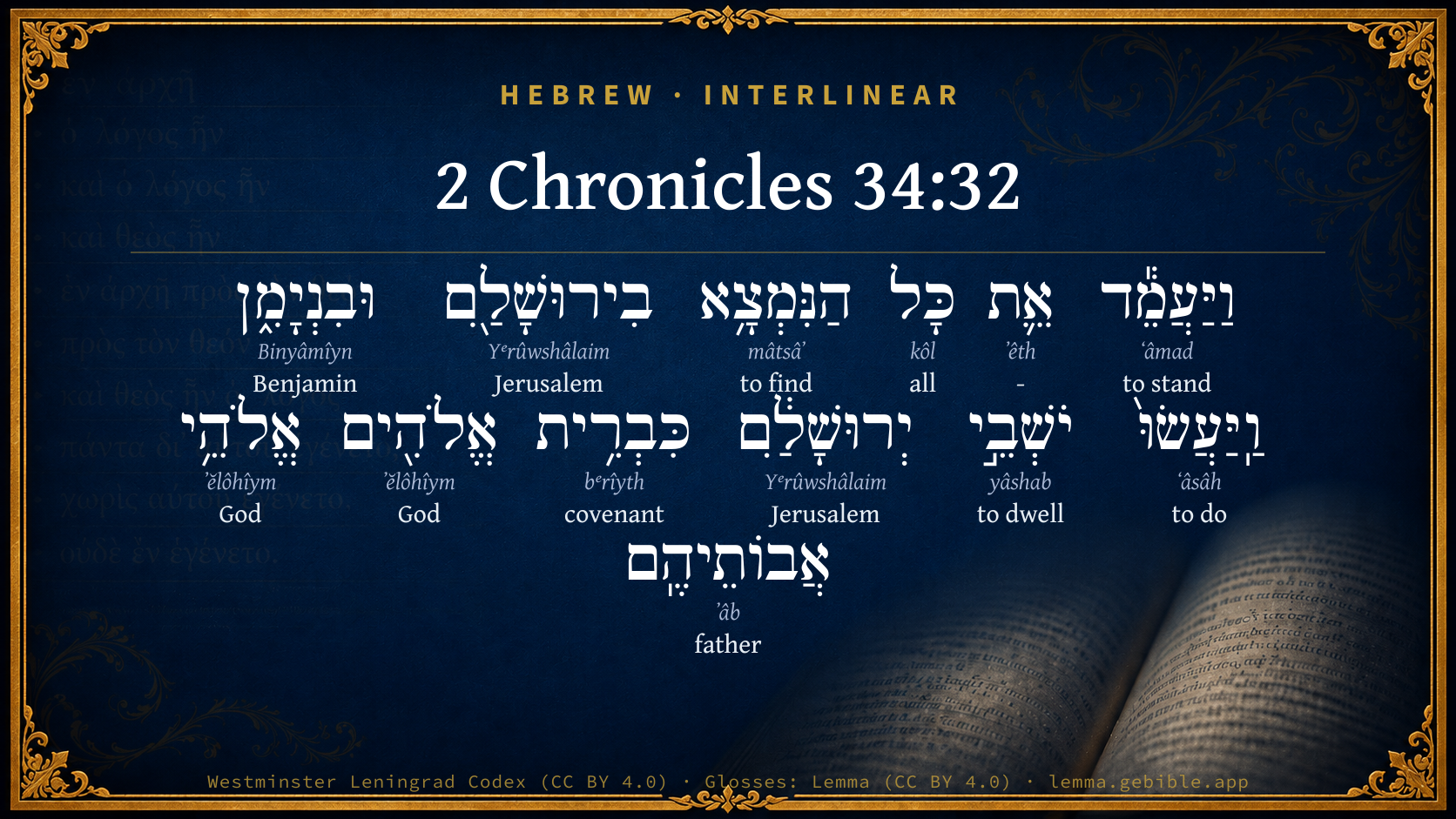
Hebrew (Westminster Leningrad Codex) 2 Chronicles 34:32 appears in the Hebrew Old Testament. The text above is from the Westminster Leningrad Codex. Each word links to its Strong’s number, a concise gloss, and parsing drawn from the Open Scriptures Hebrew Bible morphology. Click any word for its full Brown-Driver-Briggs (BDB) entry.
Download image
Cite this verse

2 Chronicles 34:32 (World English Bible). Public Domain. Lemma interlinear Bible study tool, https://lemma.gebible.app/v/2-chronicles/34/32.

Show BibTeX & RIS
BibTeX
RIS
English Translation
He caused all who were found in Jerusalem and Benjamin to stand [to it]. The inhabitants of Jerusalem did according to the covenant of God, the God of their fathers.
World English Bible · Public Domain
Download a study sheet

One document with this verse’s original text, its word-by-word gloss line, the meaning frame, cross-references with their text, attributed commentary, and full source and license credits — printable, and it pastes into notes with its structure intact.

This verse Autodidact and up

Study sheet (.html) Plain text (.txt)

A passage Seminary Student

Up to 50 verses in one chapter. A passage sheet keeps up to 6 commentary sources and 12 cross-references per verse, in the order this page ranks them, and says so on the sheet whenever that leaves anything out. Ask for a single verse and you get the Autodidact verse sheet above.

Everything on this page stays free to read, with no account — the sheet is a download of what is already on screen, not access to it.

Want to remove ads? Support Godless Engineer
Compare translations 3

The same verse in 3 English versions, stacked beneath the original-language interlinear above. Click any original word for its lexicon entry.

Each is an independent rendering of the whole verse — the interlinear is not word-aligned to these translations.

Highlighted words mark where these versions differ — a whole-verse word diff, not a word-by-word alignment.

  • World English Bible Public Domain
    He caused all who were found in Jerusalem and Benjamin to stand [to it]. The inhabitants of Jerusalem did according to the covenant of God, the God of their fathers.
  • King James Version Public Domain
    And he caused all that were present in Jerusalem and Benjamin to stand to it. And the inhabitants of Jerusalem did according to the covenant of God, the God of their fathers.
  • unfoldingWord Literal Text CC BY-SA 4.0
    And he made stand each one found in Jerusalem and Benjamin. And the inhabitants of Jerusalem acted according to the covenant of God, the God of their fathers.

unfoldingWord Literal Text — © unfoldingWord, licensed CC BY-SA 4.0. Word-aligned USFM3 via Door43 (git.door43.org/unfoldingWord/en_ult).

Versions to compare (up to 4)

3 of 4 selected

Show all 18 translations

Every available English version of this verse, each an independent rendering of the whole verse.

  • World English Bible Public Domain
    He caused all who were found in Jerusalem and Benjamin to stand [to it]. The inhabitants of Jerusalem did according to the covenant of God, the God of their fathers.
  • Berean Standard Bible Public Domain
    Then he had everyone in Jerusalem and Benjamin take a stand in agreement to it. So all the people of Jerusalem carried out the covenant of God, the God of their fathers.
  • Majority Standard Bible Public Domain
    Then he had everyone in Jerusalem and Benjamin take a stand in agreement to it. So all the people of Jerusalem carried out the covenant of God, the God of their fathers.
  • King James Version Public Domain
    And he caused all that were present in Jerusalem and Benjamin to stand to it. And the inhabitants of Jerusalem did according to the covenant of God, the God of their fathers.
  • American Standard Version (1901) Public Domain
    And he caused all that were found in Jerusalem and Benjamin to stand `to it'. And the inhabitants of Jerusalem did according to the covenant of God, the God of their fathers.
  • Revised Version (1885) Public Domain
    And he caused all that were found in Jerusalem and Benjamin to stand to it. And the inhabitants of Jerusalem did according to the covenant of God, the God of their fathers.
  • Geneva Bible (1599) Public Domain
    And he caused all that were found in Ierusalem, and Beniamin to stande to it: and the inhabitants of Ierusalem did according to the couenant of God, euen the God of their fathers.
  • Douay-Rheims (1899) Public Domain
    And he adjured all that were found in Jerusalem and Benjamin to do the same: and the inhabitants of Jerusalem did according to the covenant of the Lord the God of their fathers.
  • Young's Literal Translation Public Domain
    And he presenteth every one who is found in Jerusalem and Benjamin, and the inhabitants of Jerusalem do according to the covenant of God, the God of their fathers.
  • Literal Standard Version CC BY-SA 4.0
    And he presents everyone who is found in Jerusalem and Benjamin, and the inhabitants of Jerusalem do according to the covenant of God, the God of their fathers.
  • Unlocked Literal Bible CC BY-SA 4.0
    He caused all who were found in Jerusalem and Benjamin to stand by the covenant. The inhabitants of Jerusalem acted in obedience to the covenant of God, the God of their ancestors.
  • unfoldingWord Literal Text CC BY-SA 4.0
    And he made stand each one found in Jerusalem and Benjamin. And the inhabitants of Jerusalem acted according to the covenant of God, the God of their fathers.
  • Darby Bible Public Domain
    And he caused all that were present in Jerusalem and Benjamin to stand [to it]. And the inhabitants of Jerusalem did according to the covenant of God, the God of their fathers.
  • World Messianic Bible Public Domain
    He caused all who were found in Jerusalem and Benjamin to stand. The inhabitants of Jerusalem did according to the covenant of God, the God of their fathers.
  • Webster's Bible Public Domain
    And he caused all that were present in Jerusalem and Benjamin, to stand to it. And the inhabitants of Jerusalem did according to the covenant of God, the God of their fathers.
  • Free Bible Version CC BY-SA 4.0
    Then he had everyone present from Jerusalem and Benjamin stand up to show they agreed to it. So all the people of Jerusalem accepted and followed the agreement with God, the God of their forefathers.
  • Bible in Basic English Public Domain
    And he made all the people in Jerusalem and Benjamin give their word to keep it. And the people of Jerusalem kept the agreement of God, the God of their fathers.
  • JPS Tanakh (1917) Public Domain
    And he caused all that were found in Jerusalem and Benjamin to stand to it. And the inhabitants of Jerusalem did according to the covenant of God, the God of their fathers.

Literal Standard Version (2020), Covenant Press — licensed CC BY-SA 4.0. Text via the HelloAO Bible API (eBible.org). Unlocked Literal Bible (unfoldingWord) — licensed CC BY-SA 4.0. Text via the HelloAO Bible API (eBible.org). unfoldingWord Literal Text — © unfoldingWord, licensed CC BY-SA 4.0. Word-aligned USFM3 via Door43 (git.door43.org/unfoldingWord/en_ult). Free Bible Version, Dr. Jonathan Gallagher — licensed CC BY-SA 4.0. Text via the HelloAO Bible API (eBible.org).

Word by word

More ways to search: Search by grammar → Find every occurrence → Compare this word →

Practice this passage: Drill this verse → Learn its vocabulary →

וּבִנְיָמִ֑ן
Binyâmîyn
H1144
“and · Benjamin”
Conjunction + Noun, Proper
Part of Speech
Conjunction + Noun
Type
Proper
Full BDB Definition

Origin: from H1121 and H3225

TWOT: 254a

Benjamin = "son of the right hand" - Jacob's and Rachel's youngest son, Joseph's full brother - son of Bilhan, great-grandson of Benjamin - a Benjamite, one of the sons of Harim, in the time of Ezra who had taken a strange wife - the tribe descended from Benjamin, the son of Jacob
  1. וַיַּעֲמֵ֕ד ʻâmad H5975 “and · to stand” Conjunction + Verb, Hiphil, Sequential Imperfect, 3rd Person, Masculine, Singular
  2. אֵ֛ת ʼêth H853 “-” Particle, Direct Object
  3. כָּל kôl H3605 “all of” Noun, Common, Masculine, Singular, Construct
  4. הַנִּמְצָ֥א mâtsâʼ H4672 “the · finding” Particle, Definite Article + Verb, Niphal, Participle Active, Masculine, Singular, Absolute
  5. בִירוּשָׁלִַ֖ם Yᵉrûwshâlaim H3389 “in/at · Jerusalem” Preposition + Noun, Proper
  6. וַֽיַּעֲשׂוּ֙ ʻâsâh H6213 “and · to do” Conjunction + Verb, Qal, Sequential Imperfect, 3rd Person, Masculine, Plural
  7. יֹשְׁבֵ֣י yâshab H3427 “dwelling” Verb, Qal, Participle Active, Masculine, Plural, Construct
  8. יְרוּשָׁלִַ֔ם Yᵉrûwshâlaim H3389 “Jerusalem” Noun, Proper
  9. כִּבְרִ֥ית bᵉrîyth H1285 “like/as · covenant of” Preposition + Noun, Common, Feminine, Singular, Construct
  10. אֱלֹהִ֖ים ʼĕlôhîym H430 “God(s)” Noun, Common, Masculine, Plural, Absolute
  11. אֱלֹהֵ֥י ʼĕlôhîym H430 “God(s) of” Noun, Common, Masculine, Plural, Construct
  12. אֲבוֹתֵיהֶֽם ʼâb H1 “fathers · their” Noun, Common, Masculine, Plural, Construct + Suffix, Personal, 3rd Person, Masculine, Plural

About this verse

These counts appear in no published source. They are computed here, from the morphology-tagged text and Lemma’s own curated glosses. What Lemma adds →

13
words
11
distinct lemmas
Historical
section

Grammatical profile

  • 4 verbs
  • 8 nouns
  • 1 particle

Verb forms

  • וַיַּעֲמֵ֕ד Hiphil · Sequential Imperfect
  • הַנִּמְצָ֥א Niphal · Participle Active
  • וַֽיַּעֲשׂוּ֙ Qal · Sequential Imperfect
  • יֹשְׁבֵ֣י Qal · Participle Active

Repetition

Words recur within this verse — often emphatic in Hebrew:

  • בִירוּשָׁלִַ֖ם Jerusalem H3389 ×2
  • אֱלֹהִ֖ים God H430 ×2

Hebrew & Septuagint length

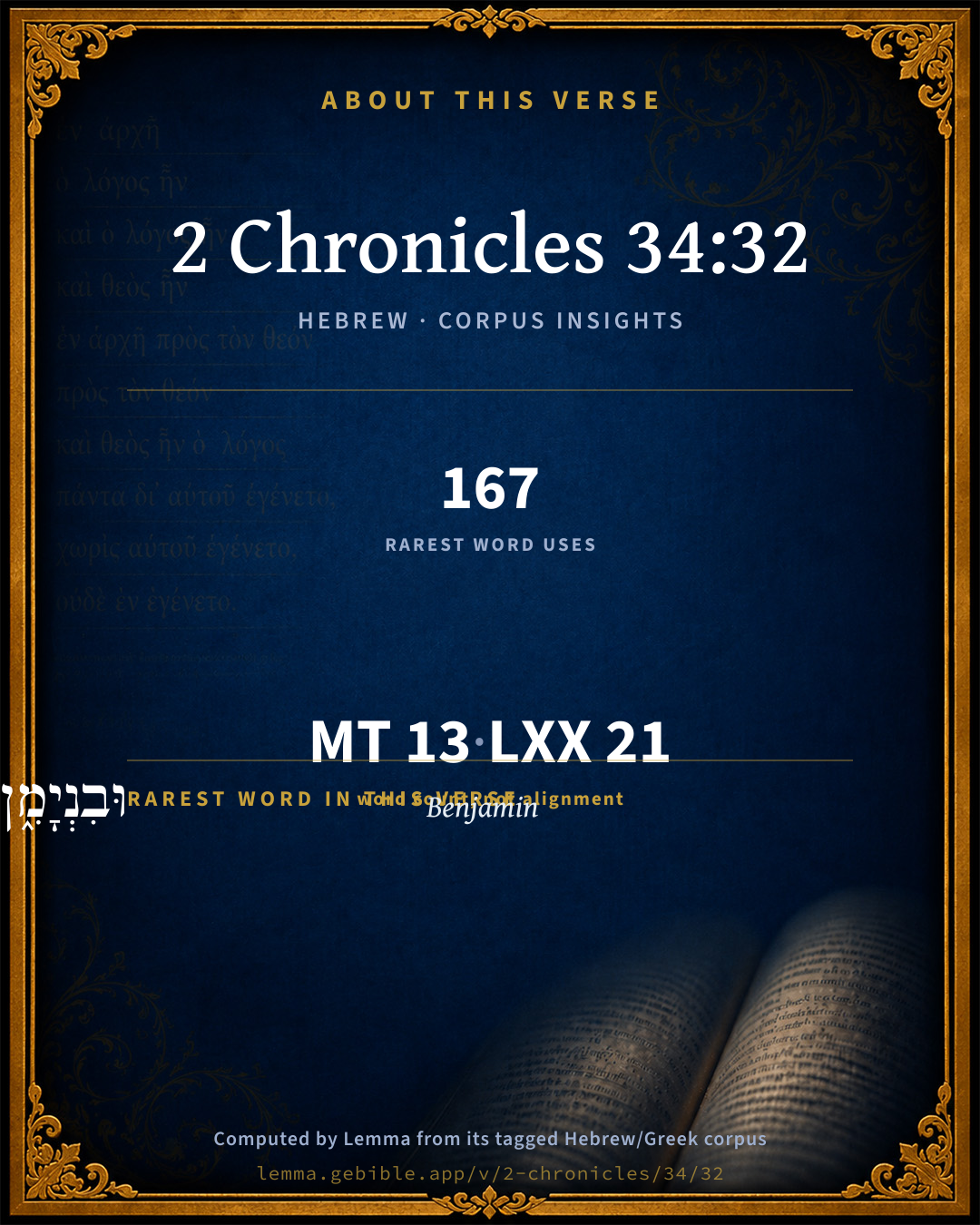
In English translation the verse runs 30 words from the Hebrew and 31 from the Septuagint (LXX English) — closely comparable.

A rough comparison of the two English renderings, which tokenize alike — not a word-level alignment.

Word counts can differ between the Hebrew and the Greek without any difference in meaning — e.g. the Hebrew direct-object marker אֵת has no separate Greek word, and Greek often adds the article ὁ.

In the original languages it is 13 Hebrew tokens and 21 Greek tokens — but the two are counted differently (Hebrew bundles its prefixes and suffixes into one token; the Greek is in lemma form), so that isn’t a like-for-like length.

Cross-references

7

Topical passages linked to 2 Chronicles 34:32 in the Treasury of Scripture Knowledge — connected by theme and wording, ordered by reader-vote popularity; previews shown in the World English Bible.

  • Genesis 18:19 For I have known him, to the end that he may command his children and his household after him, that they may keep the way of Yahweh, to do righteousness and justice; to the end that Yahweh may bring on Abraham that which he has spoken of him."
  • 2 Chronicles 14:4 and commanded Judah to seek Yahweh, the God of their fathers, and to do the law and the commandment.
  • 2 Chronicles 29:29 When they had made an end of offering, the king and all who were present with him bowed themselves and worshiped.
  • 2 Chronicles 30:12 Also on Judah came the hand of God to give them one heart, to do the commandment of the king and of the princes by the word of Yahweh.
  • 2 Chronicles 33:16 He built up the altar of Yahweh, and offered thereon sacrifices of peace-offerings and of thanksgiving, and commanded Judah to serve Yahweh, the God of Israel.
  • Ecclesiastes 8:2 I say, "Keep the king's command!" because of the oath to God.
  • Jeremiah 3:10 Yet for all this her treacherous sister Judah has not returned to me with her whole heart, but only in pretense, says Yahweh.

Cross-references courtesy of OpenBible.info (CC BY 4.0).

Hebrew and Greek witnesses Masoretic Hebrew ↔ Greek Septuagint

The same verse in the two great witnesses to the Old Testament, shown verse-for-verse.

These are two independent witnesses, not word-aligned to each other, and the Septuagint is shown in lemma (dictionary) form.

Hebrew 2 Chronicles 34:32 Masoretic · Westminster Leningrad Codex

וַיַּעֲמֵ֕ד אֵ֛ת כָּל הַנִּמְצָ֥א בִירוּשָׁלִַ֖ם וּבִנְיָמִ֑ן וַֽיַּעֲשׂוּ֙ יֹשְׁבֵ֣י יְרוּשָׁלִַ֔ם כִּבְרִ֥ית אֱלֹהִ֖ים אֱלֹהֵ֥י אֲבוֹתֵיהֶֽם

He caused all who were found in Jerusalem and Benjamin to stand [to it]. The inhabitants of Jerusalem did according to the covenant of God, the God of their fathers.

World English Bible · Public Domain

Greek LXX 2 Chronicles 34:32 Septuagint · lemma form

καί ἵστημι πᾶς ὁ εὑρίσκω ἐν ἰερουσαλήμ καί βενιαμίν καί ποιέω ὁ καταοἰκέω ἰερουσαλήμ διαθήκη ἐν οἶκος κύριος θεός πατήρ αὐτός

And he caused all that were found in Jerusalem and Benjamin to stand; and the inhabitants of Jerusalem made a covenant in the house of the Lord God of their fathers.

LXX2012 (modern English Septuagint) · Public Domain

Hebrew: Westminster Leningrad Codex (CC BY 4.0). Greek: Septuagint (public domain); English from LXX2012 (modern English Septuagint) (Public Domain). How the Septuagint differs from the Hebrew →

Commentary

Notes on 2 Chronicles 34:32 from classic Christian and Jewish commentators (each source and its license shown beneath its notes). The classic Christian expositions comment on the surrounding passage and are grouped to its opening verse, so a note may address several verses; the Jewish commentaries on the Tanakh (Rashi and others) are per-verse, so they appear only where the commentator wrote on this verse.

Lemma curates 59 commentaries, every one of them public domain or Creative Commons licensed, each selected and text-cleaned for this edition rather than reprinted as found. About our sources →

Joseph Benson's Commentary

2Ch 34:32-33. He caused all present to stand to it — He caused them to engage by an oath or covenant, that they would observe the laws of God, as his predecessors had formerly done, and which indeed they were before obliged to do. The inhabitants of Jerusalem did according to the covenant, &c. — They complied with God’s and the king’s command, as to the outward acts of God’s worship, though not with an upright and renewed heart, as appears by the history. To serve, even to serve the Lord their God — The repetition shows, that this was the only thing his heart was set upon. He aimed at nothing, in all he did, but to engage them to God and their duty.

Joseph Benson's Commentary on the Old and New Testaments (1811–1818) — public domain. Text from a community e-Sword module.

Adam Clarke's Commentary

Verse 32. To stand to it.] It is likely that he caused them all to arise when he read the terms of the covenant, and thus testify their approbation of the covenant itself, and their resolution to observe it faithfully and perseveringly.

Adam Clarke's Commentary on the Bible (1810–1826) — public domain. Text from a community e-Sword/MySword module.

Ellicott's Commentary for English Readers

(32) And he caused . . . stand to it.—Kings, “and all the people stood into (i.e., came into) the covenant.” So Syriac: “And everyone that was found in Jerusalem and in Benjamin rose, and the inhabitants of Jerusalem entered into the covenant of the Lord God of their fathers.” (The chronicler’s reading may be accounted for by the fact that the verbs “he stood and” he caused to stand “differ only in the vowels, which anciently were not written at all. “All that were present in Jerusalem and Benjamin” is an unusual phrase; and it is likely that “and Benjamin” is really a corruption of “into the covenant” which is required by the context here as much as in Kings.)

And the inhabitants . . . fathers—i.e., after they had thus solemnly taken it upon them to do so. The statement is not read in Kings.

A Bible Commentary for English Readers, edited by Charles John Ellicott (1878–1897) — public domain. Text from a community e-Sword module.

The Cambridge Bible for Schools and Colleges

gen. ed. J. J. S. Perowne

32. he caused all that were found … to stand to it] In 2 Kin., “all the people stood to the covenant.”

The Cambridge Bible for Schools and Colleges (gen. ed. J. J. S. Perowne; Cambridge University Press, 1878–1918) — public domain. Text from a community e-Sword module.

Albert Barnes' Notes on the Bible

And Benjamin - It is scarcely possible that the text here can be sound. “Benjamin” is never put in contrast with “Jerusalem,” but always with Judah. The reading may be corrected from the parallel passage 2Ki 23:3; “And he caused all those that were present in Jerusalem to stand to the covenant.”

Albert Barnes' Notes on the Bible (1834–1885) — public domain. Text from a community e-Sword/MySword module.

Matthew Poole's English Annotations

To stand to it; to own or maintain it, or persist in it, as this phrase is used, Deu 25:1. He caused them to engage themselves by an oath or covenant, that they would observe and obey the laws of God, as his godly predecessors had formerly done, and which indeed they were before obliged to do. They complied with God’s and the king’s command, as to the outward acts of God’s worship, though not with an upright heart, as appears by the history.

Matthew Poole's English Annotations on the Holy Bible (1683–1685) — public domain. Text from a community e-Sword/MySword module.

The Pulpit Commentary

Some think the text hero corrupt, both for the presence of the words, and in Benjamin, and the absence of the words, "in the covenant." Their case, however, is scarcely conclusive. (see 2Ki_23:3)

The Pulpit Commentary (1880–1919), ed. H.D.M. Spence-Jones & Joseph S. Exell — public domain. Text from a community e-Sword module.

John Wesley's Explanatory Notes

To stand to it - He caused them to engage by an oath or covenant, that they would observe the laws of God, as his predecessors had formerly done, and which indeed they were before obliged to do.

John Wesley, Explanatory Notes Upon the Whole Bible (1754–1765) — public domain. Text via the GEBible commentary corpus.

Rashi

Rabbi Shlomo Yitzchaki (Rashi)

according to the covenant of God, the God of their forefathers According to all that which is written there: “the God of their forefathers.” Therefore, it is written here, “the God of their forefathers,” which He enacted for their forefathers in the desert. And every covenant that is there concerns idolatry, as it is written (Deut. 29:16f.): “And you saw their abominations and their depravities, etc....turns away today from the Lord.” Therefore, Josiah “removed all the abominations, etc.”

Rashi on the Tanakh — English translations: “The Judaica Press complete Tanach with Rashi, translated by A. J. Rosenberg” (CC BY 4.0); “Pentateuch with Rashi's commentary by M. Rosenbaum and A.M. Silbermann, 1929-1934” (public domain); “The Metsudah Tanach series, Lakewood, N.J” (CC BY 4.0); and “The Book of Joshua, Metsudah Publications, 1997” (CC BY 4.0). Text via Sefaria.

Lesson kit

Teaching starters — assembled from the data on this page, not authored interpretation. Every prompt links to the verse data it draws on. Edit before teaching.

2 Chronicles, in the Historical, opens this verse with 13 words (11 distinct Hebrew lemmas). Its most distinctive word is Binyâmîyn (“Benjamin”). A historical commentator’s framing appears above. Read the whole chapter for the surrounding context.

Discussion questions

  1. The word Binyâmîyn carries the sense “Benjamin.” How does it shape the verse?
  2. Genesis 18:19 shares this passage’s theme. How do the two illuminate each other?
  3. “Jerusalem” occurs 2× in this one verse. What is the effect of the repetition?
  4. These translations render this verse differently. What is at stake in choosing one wording over another?
  5. The verb «וַיַּעֲמֵ֕ד» is Hiphil Sequential Imperfect. How does its form color the action?
  6. Reading how Joseph Benson's Commentary and Adam Clarke's Commentary read this verse, where do the two commentators agree and where do they part?

Things to notice

Reading settings

Reading text

Shown beneath each verse's original-language words.

Old Testament
Old Testament edition

Read the OT as the Masoretic Hebrew (MT) or the Greek Septuagint (LXX).

English shown for the Greek Septuagint (in the Hebrew ↔ Greek comparison).

Comparing translations? Open the Compare panel on any verse page to stack up to four side by side.