Isaiah 4:3

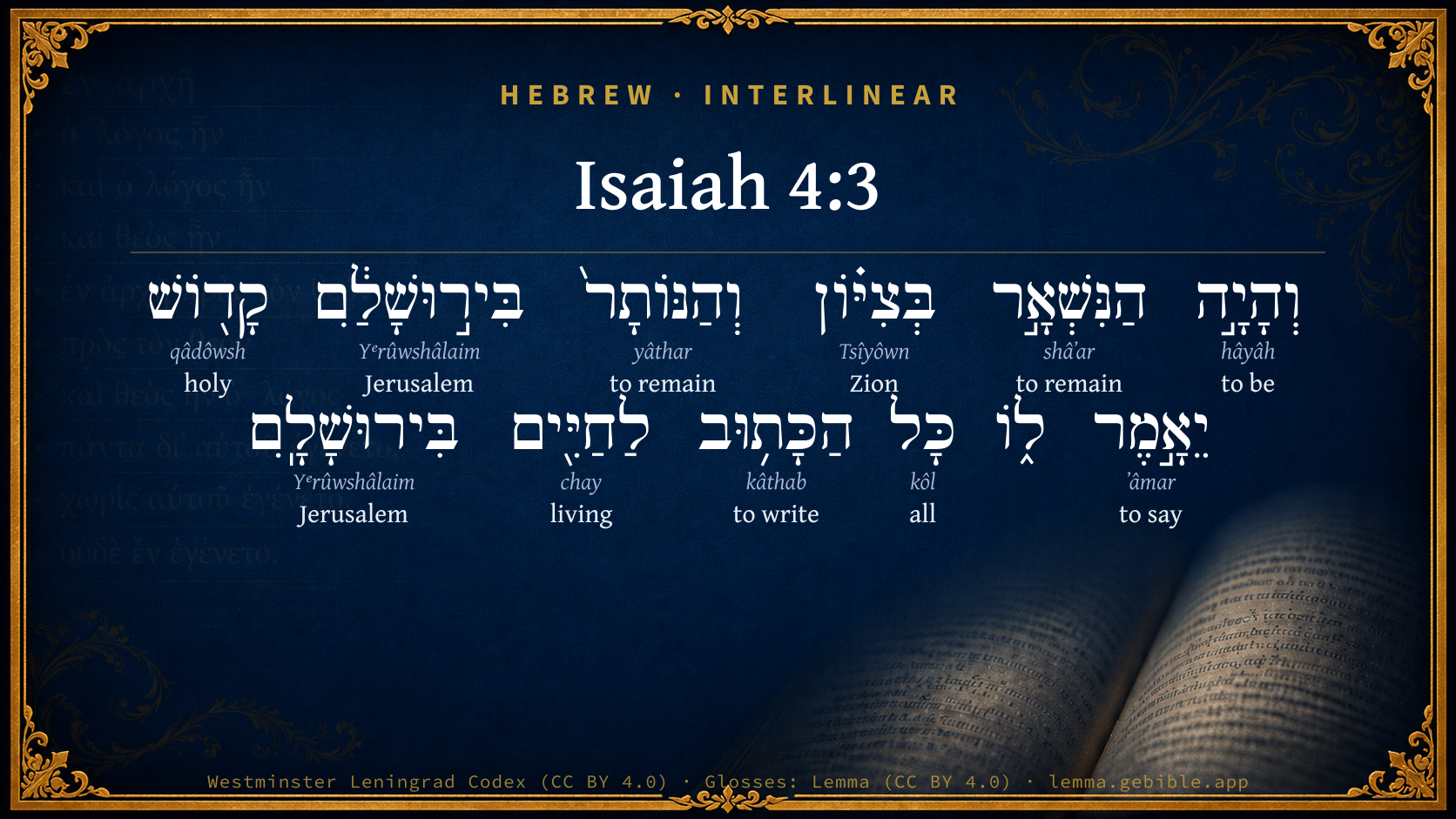
Hebrew (Westminster Leningrad Codex) Isaiah 4:3 appears in the Hebrew Old Testament. The text above is from the Westminster Leningrad Codex. Each word links to its Strong’s number, a concise gloss, and parsing drawn from the Open Scriptures Hebrew Bible morphology. Click any word for its full Brown-Driver-Briggs (BDB) entry.
Download image
Cite this verse

Isaiah 4:3 (World English Bible). Public Domain. Lemma interlinear Bible study tool, https://lemma.gebible.app/v/isaiah/4/3.

Show BibTeX & RIS
BibTeX
RIS
English Translation
It will happen, that he who is left in Zion, and he who remains in Jerusalem, shall be called holy, even everyone who is written among the living in Jerusalem;
World English Bible · Public Domain
Download a study sheet

One document with this verse’s original text, its word-by-word gloss line, the meaning frame, cross-references with their text, attributed commentary, and full source and license credits — printable, and it pastes into notes with its structure intact.

This verse Autodidact and up

Study sheet (.html) Plain text (.txt)

A passage Seminary Student

Up to 50 verses in one chapter. A passage sheet keeps up to 6 commentary sources and 12 cross-references per verse, in the order this page ranks them, and says so on the sheet whenever that leaves anything out. Ask for a single verse and you get the Autodidact verse sheet above.

Everything on this page stays free to read, with no account — the sheet is a download of what is already on screen, not access to it.

Want to remove ads? Support Godless Engineer
Compare translations 3

The same verse in 3 English versions, stacked beneath the original-language interlinear above. Click any original word for its lexicon entry.

Each is an independent rendering of the whole verse — the interlinear is not word-aligned to these translations.

Highlighted words mark where these versions differ — a whole-verse word diff, not a word-by-word alignment.

  • World English Bible Public Domain
    It will happen, that he who is left in Zion, and he who remains in Jerusalem, shall be called holy, even everyone who is written among the living in Jerusalem;
  • King James Version Public Domain
    And it shall come to pass, that he that is left in Zion, and he that remaineth in Jerusalem, shall be called holy, even every one that is written among the living in Jerusalem:
  • unfoldingWord Literal Text CC BY-SA 4.0
    And it will be, the one remained in Zion and the one left in Jerusalem, “Holy” will be said of him, everyone written for life in Jerusalem,

unfoldingWord Literal Text — © unfoldingWord, licensed CC BY-SA 4.0. Word-aligned USFM3 via Door43 (git.door43.org/unfoldingWord/en_ult).

Versions to compare (up to 4)

3 of 4 selected

Show all 18 translations

Every available English version of this verse, each an independent rendering of the whole verse.

  • World English Bible Public Domain
    It will happen, that he who is left in Zion, and he who remains in Jerusalem, shall be called holy, even everyone who is written among the living in Jerusalem;
  • Berean Standard Bible Public Domain
    Whoever remains in Zion and whoever is left in Jerusalem will be called holy—all in Jerusalem who are recorded among the living—
  • Majority Standard Bible Public Domain
    Whoever remains in Zion and whoever is left in Jerusalem will be called holy—all in Jerusalem who are recorded among the living—
  • King James Version Public Domain
    And it shall come to pass, that he that is left in Zion, and he that remaineth in Jerusalem, shall be called holy, even every one that is written among the living in Jerusalem:
  • American Standard Version (1901) Public Domain
    And it shall come to pass, that he that is left in Zion, and he that remaineth in Jerusalem, shall be called holy, even every one that is written among the living in Jerusalem;
  • Revised Version (1885) Public Domain
    And it shall come to pass, that he that is left in Zion, and he that remaineth in Jerusalem, shall be called holy, even every one that is written among the living in Jerusalem:
  • Geneva Bible (1599) Public Domain
    Then hee that shalbe left in Zion, and hee that shall remaine in Ierusalem, shalbe called holy, and euery one shalbe written among the liuing in Ierusalem,
  • Douay-Rheims (1899) Public Domain
    And it shall come to pass, that every one that shall be left in Sion, and that shall remain in Jerusalem, shall be called holy, every one that is written in life in Jerusalem.
  • Young's Literal Translation Public Domain
    And it hath been, he who is left in Zion, And he who is remaining in Jerusalem, `Holy' is said of him, Of every one who is written for life in Jerusalem.
  • Literal Standard Version CC BY-SA 4.0
    And it has been, he who is left in Zion, || And he who is remaining in Jerusalem, “Holy” is said of him, || Of everyone who is written for life in Jerusalem.
  • Unlocked Literal Bible CC BY-SA 4.0
    It will happen that the one who is left in Zion and the one who remains in Jerusalem will be called holy, everyone who is written down as living in Jerusalem.
  • unfoldingWord Literal Text CC BY-SA 4.0
    And it will be, the one remained in Zion and the one left in Jerusalem, “Holy” will be said of him, everyone written for life in Jerusalem,
  • Darby Bible Public Domain
    And it shall come to pass that he who remaineth in Zion, and he that is left in Jerusalem, shall be called holy, -- every one that is written among the living in Jerusalem;
  • World Messianic Bible Public Domain
    It will happen that he who is left in Zion and he who remains in Jerusalem shall be called holy, even everyone who is written among the living in Jerusalem,
  • Webster's Bible Public Domain
    And it shall come to pass, that he that is left in Zion, and he that remaineth in Jerusalem, shall be called holy, even every one that is written among the living in Jerusalem:
  • Free Bible Version CC BY-SA 4.0
    Everyone who remains in Zion will be called holy—all of those who are recorded among the living in Jerusalem—
  • Bible in Basic English Public Domain
    And it will come about that the rest of the living in Zion, and of those who have been kept from destruction in Jerusalem, will be named holy, even everyone who has been recorded for life in Jerusalem:
  • JPS Tanakh (1917) Public Domain
    And it shall come to pass, that he that is left in Zion, and he that remaineth in Jerusalem, shall be called holy, even every one that is written unto life in Jerusalem;

Literal Standard Version (2020), Covenant Press — licensed CC BY-SA 4.0. Text via the HelloAO Bible API (eBible.org). Unlocked Literal Bible (unfoldingWord) — licensed CC BY-SA 4.0. Text via the HelloAO Bible API (eBible.org). unfoldingWord Literal Text — © unfoldingWord, licensed CC BY-SA 4.0. Word-aligned USFM3 via Door43 (git.door43.org/unfoldingWord/en_ult). Free Bible Version, Dr. Jonathan Gallagher — licensed CC BY-SA 4.0. Text via the HelloAO Bible API (eBible.org).

Word by word

More ways to search: Search by grammar → Find every occurrence → Compare this word →

Practice this passage: Drill this verse → Learn its vocabulary →

וְהַנּוֹתָר֙
yâthar
H3498
“and · the · remaining”
Conjunction + Particle, Definite Article + Verb, Niphal, Participle Active, Masculine, Singular, Absolute
Part of Speech
Conjunction + Particle + Verb
Stem
Niphal
Form
Participle Active
Gender
Masculine
Number
Singular
State
Absolute
Full BDB Definition

Origin: a primitive root

TWOT: 936

to be left over, remain, remain over, leave - (Qal) remainder (participle) - (Niphal) to be left over, remain over, be left behind - (Hiphil) - to leave over, leave - to save over, preserve alive - to excel, show pre-eminence - to show excess, have more than enough, have an excess
  1. וְהָיָ֣ה hâyâh H1961 “and · to be” Conjunction + Verb, Qal, Sequential Perfect, 3rd Person, Masculine, Singular
  2. הַנִּשְׁאָ֣ר shâʼar H7604 “the · remaining” Particle, Definite Article + Verb, Niphal, Participle Active, Masculine, Singular, Absolute
  3. בְּצִיּ֗וֹן Tsîyôwn H6726 “in/at · Zion” Preposition + Noun, Proper
  4. בִּיר֣וּשָׁלִַ֔ם Yᵉrûwshâlaim H3389 “in/at · Jerusalem” Preposition + Noun, Proper
  5. קָד֖וֹשׁ qâdôwsh H6918 “holy” Adjective, Adjective, Masculine, Singular, Absolute
  6. יֵאָ֣מֶר ʼâmar H559 “to say” Verb, Niphal, Imperfect, 3rd Person, Masculine, Singular
  7. כָּל kôl H3605 “all of” Noun, Common, Masculine, Singular, Construct
  8. הַכָּת֥וּב kâthab H3789 “the · written” Particle, Definite Article + Verb, Qal, Participle Passive, Masculine, Singular, Absolute
  9. לַחַיִּ֖ים chay H2416 “to/for the · living things” Preposition, Determined + Noun, Common, Masculine, Plural, Absolute
  10. בִּירוּשָׁלִָֽם Yᵉrûwshâlaim H3389 “in/at · Jerusalem” Preposition + Noun, Proper

About this verse

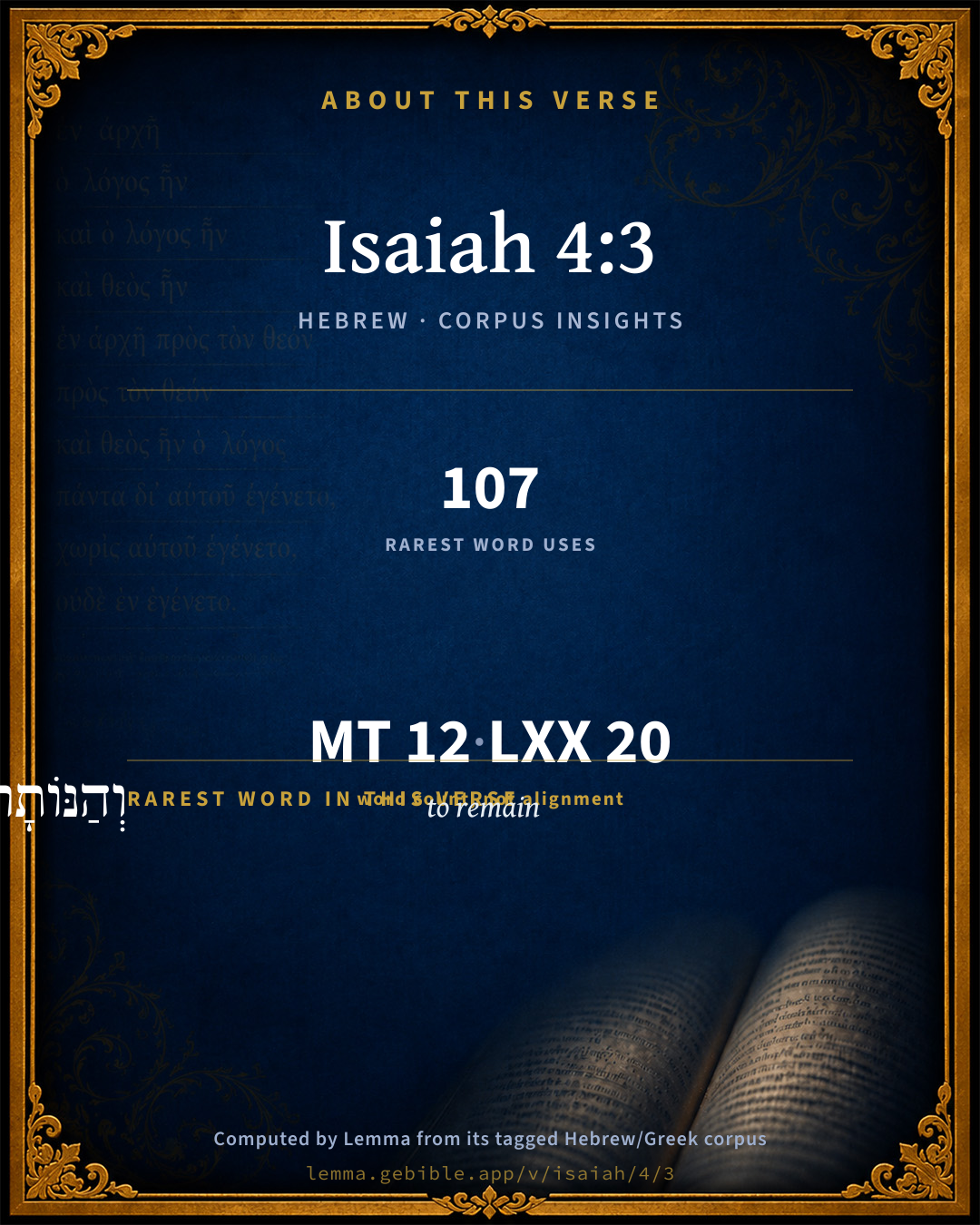
These counts appear in no published source. They are computed here, from the morphology-tagged text and Lemma’s own curated glosses. What Lemma adds →

12
words
10
distinct lemmas
Prophets
section

Grammatical profile

  • 5 verbs
  • 5 nouns
  • 1 adjective
  • 1 preposition

Verb forms

  • וְהָיָ֣ה Qal · Sequential Perfect
  • הַנִּשְׁאָ֣ר Niphal · Participle Active
  • וְהַנּוֹתָר֙ Niphal · Participle Active
  • יֵאָ֣מֶר Niphal · Imperfect
  • הַכָּת֥וּב Qal · Participle Passive

Repetition

A word recurs within this verse — often emphatic in Hebrew:

  • בִּיר֣וּשָׁלִַ֔ם Jerusalem H3389 ×2

Hebrew & Septuagint length

In English translation the verse runs 30 words from the Hebrew and 29 from the Septuagint (LXX English) — closely comparable.

A rough comparison of the two English renderings, which tokenize alike — not a word-level alignment.

Word counts can differ between the Hebrew and the Greek without any difference in meaning — e.g. the Hebrew direct-object marker אֵת has no separate Greek word, and Greek often adds the article ὁ.

In the original languages it is 12 Hebrew tokens and 20 Greek tokens — but the two are counted differently (Hebrew bundles its prefixes and suffixes into one token; the Greek is in lemma form), so that isn’t a like-for-like length.

Cross-references

22

Topical passages linked to Isaiah 4:3 in the Treasury of Scripture Knowledge — connected by theme and wording, ordered by reader-vote popularity; previews shown in the World English Bible.

  • Luke 10:20 Nevertheless, don't rejoice in this, that the spirits are subject to you, but rejoice that your names are written in heaven."
  • Exodus 32:32–33 Yet now, if you will, forgive their sin-- and if not, please blot me out of your book which you have written."
  • Psalms 69:28 Let them be blotted out of the book of life, And not be written with the righteous.
  • Isaiah 52:1 Awake, awake, put on your strength, Zion; put on your beautiful garments, Jerusalem, the holy city: for henceforth there shall no more come into you the uncircumcised and the unclean.
  • Isaiah 60:21 Your people also shall be all righteous; they shall inherit the land forever, the branch of my planting, the work of my hands, that I may be glorified.
  • Revelation 21:27 There will in no way enter into it anything profane, or one who causes an abomination or a lie, but only those who are written in the Lamb's book of life.
  • Ezekiel 36:24–28 For I will take you from among the nations, and gather you out of all the countries, and will bring you into your own land.
  • Ezekiel 43:12 This is the law of the house: on the top of the mountain the whole limit of it round about shall be most holy. Behold, this is the law of the house.
  • Romans 11:5 Even so then at this present time also there is a remnant according to the election of grace.
  • Philippians 4:3 Yes, I beg you also, true yoke-fellow, help these women, for they labored with me in the Gospel, with Clement also, and the rest of my fellow workers, whose names are in the book of life.
  • Colossians 3:12 Put on therefore, as God's chosen ones, holy and beloved, a heart of compassion, kindness, lowliness, humility, and perseverance;
  • Hebrews 12:14 Follow after peace with all men, and the sanctification without which no man will see the Lord,
  • Revelation 3:5 He who overcomes will be arrayed in white garments, and I will in no way blot his name out of the book of life, and I will confess his name before my Father, and before his angels.
  • Revelation 13:8 All who dwell on the earth will worship him, everyone whose name has not been written from the foundation of the world in the book of life of the Lamb who has been killed.
  • Revelation 17:8 The beast that you saw was, and is not; and is about to come up out of the abyss and to go into destruction. Those who dwell on the earth and whose names have not been written in the book of life from the foundation of the world will marvel when they see that the beast was, and is not, and shall be present.
  • Revelation 20:15 If anyone was not found written in the book of life, he was cast into the lake of fire.
  • Isaiah 1:27 Zion shall be redeemed with justice, And her converts with righteousness.
  • Ezekiel 13:9 My hand shall be against the prophets who see false visions, and who divine lies: they shall not be in the council of my people, neither shall they be written in the writing of the house of Israel, neither shall they enter into the land of Israel; and you shall know that I am the Lord Yahweh.
  • Zechariah 14:20–21 In that day there will be on the bells of the horses, "HOLY TO YAHWEH;" and the pots in Yahweh's house will be like the bowls before the altar.
  • Acts 13:48 As the Gentiles heard this, they were glad, and glorified the word of God. As many as were appointed to eternal life believed.
  • Ephesians 1:4 even as he chose us in him before the foundation of the world, that we would be holy and without blemish before him in love;
  • 1 Peter 2:9 But you are a chosen race, a royal priesthood, a holy nation, a people for God's own possession, that you may show forth the excellencies of him who called you out of darkness into his marvelous light:

Cross-references courtesy of OpenBible.info (CC BY 4.0).

Hebrew and Greek witnesses Masoretic Hebrew ↔ Greek Septuagint

The same verse in the two great witnesses to the Old Testament, shown verse-for-verse.

These are two independent witnesses, not word-aligned to each other, and the Septuagint is shown in lemma (dictionary) form.

Hebrew Isaiah 4:3 Masoretic · Westminster Leningrad Codex

וְהָיָ֣ה הַנִּשְׁאָ֣ר בְּצִיּ֗וֹן וְהַנּוֹתָר֙ בִּיר֣וּשָׁלִַ֔ם קָד֖וֹשׁ יֵאָ֣מֶר ל֑וֹ כָּל הַכָּת֥וּב לַחַיִּ֖ים בִּירוּשָׁלִָֽם

It will happen, that he who is left in Zion, and he who remains in Jerusalem, shall be called holy, even everyone who is written among the living in Jerusalem;

World English Bible · Public Domain

Greek LXX Isaiah 4:3 Septuagint · lemma form

καί εἰμί ὁ ὑπολείπω ἐν σιων καί ὁ καταλείπω ἐν ἰερουσαλήμ ἅγιος καλέω πᾶς ὁ γράφω εἰς ζωή ἐν ἰερουσαλήμ

And it shall be, that the remnant left in Sion, and the remnant left in Jerusalem, even all that are appointed to life in Jerusalem, shall be called holy.

LXX2012 (modern English Septuagint) · Public Domain

Hebrew: Westminster Leningrad Codex (CC BY 4.0). Greek: Septuagint (public domain); English from LXX2012 (modern English Septuagint) (Public Domain). How the Septuagint differs from the Hebrew →

Targum (Aramaic paraphrase)

1

The Targum is the ancient Jewish Aramaic paraphrase of the Hebrew Scriptures — an interpretive translation, not the Hebrew text itself. Onkelos (literal) and Pseudo-Jonathan (expansive) render the Torah, and Jonathan the Prophets. Coverage is partial: where no permissively-licensed English translation exists for a verse, only the Aramaic is shown. This is verse-level text, not a word-by-word alignment to the Hebrew.

  1. Targum Jonathan Prophets (Joshua–Malachi)
    וִיהֵי דְאִשְׁתָּאַר יְתוּב לְצִיוֹן וּדְעָבַד אוֹרַיְתָא יִתְקַיֵם בִּירוּשְׁלֵם קַדִישׁ יִתְאֲמַר לֵיהּ כָּל דִכְתִיב לְחַיֵי עַלְמָא יֶחֱזֵי בִּנְחָמַת יְרוּשְׁלֵם:

    And it shall come to pass, that he that shall return to Zion, and he that is doing the law, shall be established in Jerusalem, he shall be called holy; every one that is written for eternal life shall see the consolation of Jerusalem.

    Targum Jonathan — Aramaic: “Mikraot Gedolot” (public domain). English: “Sefaria Community Translation” (CC0 1.0 (public-domain dedication)); “London "Chaldee Paraphrase," 1871” (public domain). Text via Sefaria.

Commentary

Notes on Isaiah 4:3 from classic Christian and Jewish commentators (each source and its license shown beneath its notes). The classic Christian expositions comment on the surrounding passage and are grouped to its opening verse, so a note may address several verses; the Jewish commentaries on the Tanakh (Rashi and others) are per-verse, so they appear only where the commentator wrote on this verse.

Lemma curates 59 commentaries, every one of them public domain or Creative Commons licensed, each selected and text-cleaned for this edition rather than reprinted as found. About our sources →

Jamieson, Fausset & Brown

Robert Jamieson, A. R. Fausset & David Brown

left in Zion--equivalent to the "escaped of Israel" (Isa 4:2).

shall be called--shall be (Isa 9:6).

holy-- (Isa 52:1; Isa 60:21; Rev 21:27).

written--in the book of life, antitypically (Phi 4:3; Rev 3:5; Rev 17:8). Primarily, in the register kept of Israel's families and tribes.

living--not "blotted out" from the registry, as dead; but written there as among the "escaped of Israel" (Dan 12:1; Eze 13:9). To the elect of Israel, rather than the saved in general, the special reference is here (Joe 3:17).

Jamieson, Fausset & Brown — Commentary Critical and Explanatory on the Whole Bible (1871) — public domain (CC PDM 1.0). Text via the HelloAO Bible API.

Ellicott's Commentary for English Readers

(3) He that is left in Zion . . .—The prophet turns from the Jerusalem that then was, with the hypocrisies and crimes of the men and the harlot fashions of its women, to the vision of a new Jerusalem, which shall realise the ideal of Psalms 15, 24. There every one should be called “holy” (comp. 1Co_1:2; 2Co_1:1), and the name should be no unreal mockery (Isa_32:5), but should express the self-consecration and purity of its inhabitants.

Every one that is written among the living.—Literally, for life. The idea is that of “the book” or “register” of life in which are written the names of those who are worthy of living in the heavenly city. It meets us as early as Exo_32:32, and appears in Psa_56:8; Psa_69:28; Eze_13:9.; Mal_3:16; Dan_12:1; Acts xiii 48; Php_4:3; Rev_3:5; Rev_13:8; Rev_21:27. An examination of the passages, especially the first, will show that while it involves the idea of an election, it excludes that of an irreversible predestination, and that the election has to be “made sure” by a life in harmony with it. (2Pe_1:10.)

A Bible Commentary for English Readers, edited by Charles John Ellicott (1878–1897) — public domain. Text from a community e-Sword module.

The Cambridge Bible for Schools and Colleges

gen. ed. J. J. S. Perowne

3. The character of the escaped remnant. They shall be called holy ch. Isa_60:14, Isa_61:6, Isa_62:12. “Holiness” here includes the ideas of consecration to God, and inviolability (Jer_2:3) as well as of moral purity (Isa_4:4).

written among the living] rather, written for life, i.e. not any chance survivor, but those who are predestined to life (cf. Act_13:48). The figure is derived from the burgess rolls in which the name of every qualified citizen was to be found (cf. Neh_7:64); hence comes the idea of the “book of life” containing the names of all the true people of God; Exo_32:32 f.; Psa_69:28; Dan_12:1; Luk_10:20; Php_4:3; Rev_3:5; Rev_13:8; Rev_20:12; Rev_20:15; Rev_22:19 (and cf. “bundle of life,” 1Sa_25:29). The transition from the secular to the religious sense may be seen in Eze_13:9.

The Cambridge Bible for Schools and Colleges (gen. ed. J. J. S. Perowne; Cambridge University Press, 1878–1918) — public domain. Text from a community e-Sword module.

Trapp's Complete Commentary

John Trapp

Isa 4:3 And it shall come to pass, [that he that is] left in Zion, and [he that] remaineth in Jerusalem, shall be called holy, [even] every one that is written among the living in Jerusalem:

Ver. 3. He that is left in Zion.] See Isa 4:2.

Shall be called holy.] Heb., Holy shall be said to him or of him: he shall have the name and note of a saint, the comfort and the credit of it. Christ’s holiness shall be both imputed and imparted unto them: he shall both expiate their sins and heal their natures, pay their debts, and give them a stock of grace and holiness, so that men shall call them a "holy people." {Isa 62:12}

Even every one that is written among the living.] Written in God’s book of life, which is matter of greater joy than to have the devils subdued unto us; {Luk 10:17} for a man may cast out devils, and yet be himself cast to the devil; {Mat 7:22-23} but in God’s book of life there are no blots, no crossings out, but "as many as are ordained to eternal life believe," and the same are "kept as in a garrison by the power of God through faith unto salvation." {1Pe 1:4} The prophet seemeth here to allude to that custom in Jerusalem of enrolling the names of all the citizens. {Psa 87:6} Christ Jesus is the Master of the Rolls in heaven, {Rev 13:8} wherein none are recorded but such as are designed "to glory and virtue." {1Pe 1:2 2Th 2:13} All others are said to be "dead in trespasses and sins," {Eph 2:1} and to be "written in the earth." {Jer 17:13} Those priests that could not produce their genealogy were cashiered by the Tirshatha: {Ezr 2:63} so shall those one day be by Christ whose names are not found written among the living in Jerusalem.

John Trapp, A Commentary or Exposition upon All the Books of the Old and New Testament (1647–1656) — public domain. Text from a community e-Sword module.

Albert Barnes' Notes on the Bible

He that is left in Zion - This “properly” refers to the remnant that should remain after the mass of the people should be cut off by wars, or be borne into captivity. If it refer to the few that would come back from Babylon, it means that they would be reformed, and would be a generation different from their fathers - which was undoubtedly true. If it refer, as the connection seems to indicate, to the times of the Messiah, then it speaks of those who are ‘left,’ while the great mass of the nation would be unbelievers, and would be destroyed. The mass of the nation would be cut off, and the remnant that was left would be holy; that is, all true friends of the Messiah would be holy.

Shall be called holy - That is, shall “be” holy. The expression ‘to be called,’ is often used in the Scriptures as synonymous with ‘to be.’

Every one that is written among the living - The Jews were accustomed to register the names of all the people. Those names were written in a catalogue, or register, of each tribe or family. To be written in that book, or register, meant to be alive, for when a death occurred, the name was stricken out; Exo 32:32; Dan 12:1; Eze 13:9. The expression came also to denote all who were truly the friends of God; they whose names are written in “his” book - the book of life. In this sense it is used in the New Testament; Phi 4:3; Rev 3:5; Rev 17:5. In this sense it is understood in this place by the Chaldee Par.: ‘Every one shall be called holy who is written to eternal life; he shall see the consolation of Jerusalem.’ If the reference here is to the Messiah, then the passage denotes that under the reign of the Messiah, all who should be found enrolled as his followers, would be holy. An effectual separation would subsist between them and the mass of the people. They would be “enrolled” as his friends, and they would be a separate, holy community; compare 1Pe 2:9.

Albert Barnes' Notes on the Bible (1834–1885) — public domain. Text from a community e-Sword/MySword module.

Matthew Poole's English Annotations

Shall be called holy, i.e. shall be really holy, as is said, Isa 60:21. To be called is oft put for to be, as Gen 21:12; Isa 1:26; 44:5.

Every one that is written among the living: so this is a restriction of the foregoing indefinite proposition. Not all that are left, but a great number of them, shall be holy, even all that are written, &c., i.e. all the elect, who are frequently described by this character, that they are written in God’s or the Lamb’s book, or in the book of life, or of the living, Psa 69:28; Dan 12:1; Phi 4:3; Rev 3:5; 13:8; 17:8, &c. But this last clause of the verse is by some learned interpreters rendered thus, all that are in Jerusalem (i.e. a very great number of them, as such general expressions are frequently used, or the generality of them) shall be written unto life, i.e. shall be such as are elected unto salvation through sanctification; which may deserve consideration. So he notes the singular privilege of this people at this time above the former ages, in which many were called, but few were chosen.

In Jerusalem; of the people living in or belonging to Jerusalem.

Matthew Poole's English Annotations on the Holy Bible (1683–1685) — public domain. Text from a community e-Sword/MySword module.

The Biblical Illustrator

Joseph S. Exell

Isa_4:3

He that is left in Zion

The holy remnant

Holy means what is separated from the world and superior to it; the congregation of the saints, or holy ones, who now inhabit Jerusalem, are what remain after a smelting; their holiness is the consequence of a washing.

(F. Delitzsch.)

God has never yet left the world without a nucleus of heaven

He has drowned the world, but left a seed to build an altar; He has burned the Gomorrahs of the world, but He has allowed the faithful to escape, and to become the beginning of a new progeny. There is always a remnant, the one left, the true heart, the faithful among the faithless found. (J. Parker, D. D.)

Holiness becomes the Christian

We are told that the little creature called the ermine is so sensitive to its own cleanliness that it becomes paralysed and powerless at the slightest touch of defilement upon its snow-white fur. A like sensibility should belong to the Christian, who should abstain from the very appearance of evil. (Sunday School Chronicle.)

The Biblical Illustrator, edited by Joseph S. Exell (c. 1880s–1900s) — public domain. Text from a community e-Sword module.

Joseph Benson's Commentary

Isa 4:3. And he that is left in Zion — Those that escape the common destruction brought on their countrymen; see Isa 4:2; shall be called holy — Shall be really such. The Jews that survived the Babylonish captivity, and returned into their own land, were greatly reformed, especially in one point, they relapsed no more into idolatry: and in other respects also a spirit of religion was revived among them. But the prophecy was much more eminently fulfilled in the first converts from Judaism to Christianity, to whose purity and holiness the apostles often bear witness, and of which they glory in their writings. Even every one that is written among the living, &c. — Whose names are recorded in the book of life, or the book of the divine knowledge and remembrance, as persons who, by repentance toward God and faith in the Messiah, expected, or already revealed, have passed from death unto life. The phrase is used in allusion to the registers which were kept of the Jewish tribes and families: see notes on Exo 32:32; Psa 69:28.

Joseph Benson's Commentary on the Old and New Testaments (1811–1818) — public domain. Text from a community e-Sword module.

The Pulpit Commentary

He that is left... he that remaineth. Equivalent to the escaped" of the preceding verse. Shall be called holy. Strikingly fulfilled in the filet that the early Christians were known as titter, holy," or klhtoi agoi , "those called to be holy," in the first age. (Act_9:13, Act_9:32, 41 Rom_1:7 1Co_1:2 2Co_1:1 Eph_1:1 Php_1:1, etc.) Perhaps, however, more is meant than this. The early Christians not only were called, but were holy." Even Gibbon places the innocent lives of the early Christians among the causes of the conversion of the Roman empire. Every one that is written among the living. A register of the "living," or "heirs of life," is here assumed, as in Exo_32:32 Psa_69:28 Dan_12:1 Rev_13:8 Rev_21:27, etc. It is a "book," however, out of which names may be "blotted". (Rev_3:5)

The roll of the living.

"Every one that is written among the living in Jerusalem." For the figure of "Jehovah"s book," or the "book of life," see Exo_32:32 Psa_56:8 Psa_69:28 Mal_3:16 Dan_12:1 Php_4:3 Rev_13:8 Rev_21:27. Matthew Henry says, "Those that are kept alive in killing, dying times were written for life in the book of Divine providence; and shall we not suppose those who are rescued from a greater death to be such as were written in the Lamb"s book of life?" We have a further description of them, which really explains their being on the roll; they are "called holy." Now, God never calls people what they are not. In olden times names were always significant, and expressed the personality to which they were applied; thus Jacob was called Israel, because he was a "prince." We have, then, two answering views of the godly man. Here he is holy;" in heaven his name is in the "book of the living." Following this out in a meditative way, we dwell on

I THE BELIEVER"S PRESENT CHARACTER. In some sense he is "holy," for God calls him holy." Illustrate the following senses in which we may be called "holy," even while we tarry amidst the human frailties:

1. Holy, as separated from self-service and the world"s service.

2. Holy, as consecrated to God"s service.

3. Holy, as called to pursue holiness.

4. Holy, as in some measure actually holy.

5. Holy, as standing, in the holiness of the Lord Jesus Christ.

II THE BELIEVER"S ETERNAL SECURITY. Name is among the living ones. Illustrate:

1. The necessary permanence of all goodness. Evil can die; good can never die. Eternal life is in everything and every one who is good.

2. God rewards holiness with immortality. That is the "crown of life." Upon all goodness God"s special favor and protection rests.

1. The holy are the natural citizens of the heavenly, which is the secure eternal home. How, then, can our names be written in the book of life? Illustrate

1. the way of regeneration;

2. the way of consecration;

3. the way of sanctification.

If, through grace, we are numbered among the holy here, then one day the great voice will speak to us out of the heavenly and say, "He that is holy, let him be holy still. R.T.

The Pulpit Commentary (1880–1919), ed. H.D.M. Spence-Jones & Joseph S. Exell — public domain. Text from a community e-Sword module.

Keil & Delitzsch

C. F. Keil & F. Delitzsch

"And it will come to pass, whoever is left in Zion and remains in Jerusalem, holy will he be called, all who are written down for life in Jerusalem." The leading emphasis of the whole v. rests upon kadosh (holy). Whereas formerly in Jerusalem persons had been distinguished according to their rank and condition, without any regard to their moral worth (Isa 3:1-3, Isa 3:10-11; cf., Isa 32:5); so the name kadosh (holy) would now be the one chief name of honour, and would be given to every individual, inasmuch as the national calling of Israel would now be realized in the persons of all (Exo 19:6, etc.). Consequently the expression "he shall be called" is not exactly equivalent to "he shall be," but rather presupposes the latter, as in Isa 1:26; Isa 61:6; Isa 62:4. The term kadosh denotes that which is withdrawn from the world, or separated from it. The church of the saints or holy ones, which now inhabits Jerusalem, is what has been left from the smelting; and their holiness is the result of washing. הנוּתר is interchanged with נהנּשׁאר. The latter, as Papenheim has shown in his Hebrew synonyms, involves the idea of intention, viz., "that which has been left behind;" the former merely expresses the fact, viz., that which remains. The character of this "remnant of grace," and the number of members of which it would consist, are shown in the apposition contained in Isa 4:3. This apposition means something more than those who are entered as living in Jerusalem, i.e., the population of Jerusalem as entered in the city register (Hofmann); for the verb with Lamed does not mean merely to enter as a certain thing, but (like the same verb with the accusative in Jer 22:30) to enter as intended for a certain purpose. The expression להיּים may either be taken as a noun, viz., "to life" (Dan 12:2), or as an adjective, "to the living" (a meaning which is quite as tenable; cf., Psa 69:29; Sa1 25:29). In either case the notion of predestination is implied, and the assumption of the existence of a divine "book of life" (Exo 32:32-33; Dan 12:1; cf., Psa 139:16); so that the idea is the same as that of Act 13:48 : "As many as were ordained to eternal life." The reference here is to persons who were entered in the book of God, on account of the good kernel of faith within them, as those who should become partakers of the life in the new Jerusalem, and should therefore be spared in the midst of the judgment of sifting in accordance with this divine purpose of grace. For it was only through the judgment setting this kernel of faith at liberty, that such a holy community as is described in the protasis which comes afterwards, as in Psa 63:6-7, could possibly arise.

Keil & Delitzsch — Biblical Commentary on the Old Testament (1861–1891) — public domain (CC PDM 1.0). Text via the HelloAO Bible API. (Old Testament only.)

Tyndale Open Study Notes

Tyndale Open Resources

4:3 To be holy was the requirement for citizenship in Zion, where God dwells in his glorious majesty (see 6:3; Heb 12:14). • The remnant would have their names recorded among the living in the Book of Life (Exod 32:32; Dan 12:1; Mal 3:16; Rev 3:5; 20:12).

Tyndale Open Study Notes — © Tyndale Open Resources, licensed CC BY-SA 4.0. Text via the HelloAO Bible API.

Geneva Bible (1599)

Geneva Bible translators

He alludeth to the book of life, whereof read Exod. 32:32, meaning, God’s secret counsel, wherein his elect are predestinate to life everlasting.

Geneva Bible (1599) marginal notes — public domain. Text via Bolls.life.

Adam Clarke's Commentary

Verse 3. Written among the living] That is, whose name stands in the enrolment or register of the people; or every man living, who is a citizen of Jerusalem. See Eze 13:9, where, "they shall not be written in the writing of the house of Israel," is the same with what immediately goes before, "they shall not be in the assembly of my people." Compare Ps 69:28; Ps 87:6; Ex 32:32. To number and register the people was agreeable to the law of Moses, and probably was always practised; being, in sound policy, useful, and even necessary. David's design of numbering the people was of another kind; it was to enrol them for his army. Michaelis Mosaisches Recht, Part iii., p. 227. See also his Dissert. de Censibus Hebraeorum.

Adam Clarke's Commentary on the Bible (1810–1826) — public domain. Text from a community e-Sword/MySword module.

John Gill's Exposition

And it shall come to pass, that he that is left in Zion, and he that remaineth in Jerusalem,.... These are the persons to whom Christ appears beautiful and glorious, excellent and comely, who will be left, and remain in Zion and Jerusalem; by which is meant the Gospel church, or church as in the latter day; in which these shall continue, abide by the truths and doctrines of the Gospel, and the ordinances thereof, and persevere unto the end; even when Christ shall take his fan in his hand, and purge his floor of the chaff; when the filth of the daughter of Zion shall be washed away by the spirit of judgment and burning, as in the following verse Isa 4:4; when it shall be a shocking and shaking time in the churches, and the hour of temptation shall come, that shall try those that dwell upon earth; these shall be pillars in the temple of God, that shall never go out. The doctrine of the saints' final perseverance is held forth in these words, as their sanctification and election are in the following clauses, which secure it to them: they

shall be called holy: in the original text it is added, "unto him"; either the person left, it shall be said to him, that he is holy or rather the branch; and Kimchi interprets it, "because of him"; for these are accounted holy, through the imputation of the holiness of Christ unto them; and they are really and inherently holy, through the grace of Christ implanted in them; they are called to be holy, to be saints, and they are called with a holy calling, and unto holiness; and, in effectual calling, principles of grace and holiness are wrought in them, and which appear in their lives and conversations. The principal meaning seems to be, that those who shall hold fast their profession, and hold out, and persevere through the trying dispensation in the latter day, they shall be remarkably holy; they shall shine in the beauties of holiness; holiness shall be upon their horses' bells, and they themselves shall be holiness unto the Lord, Zac 14:20.

even everyone that is written among the living in Jerusalem; or, "everyone that is written unto life" (m), that is, unto eternal life, as the Targum paraphrases the words; and it is the same with being ordained unto eternal life, Act 13:48 or predestination unto life, which is a writing of the names of God's elect in the book of life: this writing is God's writing, it is his act and deed, the act of God the Father, and an eternal one, flowing from his sovereign will and pleasure, and is sure, certain, and unfrustrable; what is written is written, and can never be altered; and election being signified by writing names in a book, shows it to be particular and personal, not of nations, churches, and bodies of men, but of particular persons; and that it is irrespective of faith, holiness, and good works, and entirely unconditional; it is of naked persons, and not as so and so qualified; and that it is distinguishing of some, and not others, whom God has an exact knowledge of, and calls by name: and this writing is "unto life", or "lives", as in the original text; not to a temporal life, but to a spiritual and eternal one; in consequence of which, such become living, holy, and persevering Christians in Jerusalem, in the church of God, and shall be admitted into the New Jerusalem, and none else, Rev 21:27 and so Jarchi interprets it, everyone that is written to the life of the world to come, or to eternal life, shall be in Jerusalem; and the Targum adds,

"and he shall see the consolation of Jerusalem;''

from hence it appears that election is the source and spring of holiness, and the security of the saints final perseverance, Rom 8:30 and is not a licentious doctrine, but a doctrine according to godliness; holiness is a fruit and evidence of it; whoever are written or ordained to life become holy; and these being brought to Zion, remain there, and persevere unto the end.

(m) "quicunque fuerit scriptus ad vitam", Piscator; "omnis scriptus ad vitam", Cocceius.

John Gill's Exposition of the Whole Bible (1746–1763) — public domain (CC PDM 1.0). Text via the HelloAO Bible API.

Haydock's Catholic Bible Commentary

Life. Only the faithful shall be saved. (Worthington) --- The Jews, after the captivity, shall be more obedient. But converts to the faith of Christ are styled saints, (Romans i. 7., &c.) such particularly as are predestined to glory, Romans viii. 30. (Calmet) --- Those who are called to life and the true faith, may forfeit this honour, by their own fault. (Menochius)

George Leo Haydock (1774–1849), Haydock's Catholic Family Bible and Commentary, 1859 edition — public domain. Excludes Psalms (Douay-Rheims chapter numbering differs from Protestant) and Deuterocanonical books (Catholic canon only).

Whedon's Commentary on the Bible

Daniel D. Whedon

3, 4. He that is left in Zion — The true descendants of the few who, amid the immoralities of Jerusalem life, and despite surrounding temptations to the contrary, preserve themselves pure and loyal to Jehovah.

Shall be called holy — Shall be holy. The idiom “shall be called” means this.

Written among the living — Those who are alive in Jerusalem; typically, who continue unto eternal life.

Filth of the daughters of Zion — Their vain-gloriousness; their silly and demoralizing pride and defilements. The judgments upon Judah and Jerusalem are to remove — wash away —

these, and the guiltiness of the people likewise.

Spirit of burning — An intensified expression of the idea of the previous clause. The people, by a long but thorough process of spiritual cleansing, shall cease to love idolatry and crime, and shall learn truly to serve Jehovah.

Daniel D. Whedon (gen. ed.), Commentary on the Old and New Testaments (1874–1909) — public domain. Text from a community e-Sword module.

John Wesley's Explanatory Notes

Holy - Shall be really holy. Jerusalem - Of the people living in or belonging to Jerusalem.

John Wesley, Explanatory Notes Upon the Whole Bible (1754–1765) — public domain. Text via the GEBible commentary corpus.

J. A. Alexander on Isaiah

Joseph Addison Alexander

“And it shall be (happen, come to pass), that the left in Zion and the spared in Jerusalem,” singular forms with a collective application, “shall be called holy,” literally, holy shall be said to him, (i.e., this name shall be used in addressing him), or rather may be used with truth, implying that the persons so called should be what they seemed to be, every one written, enrolled, ordained, to life in Jerusalem.

Having foretold the happiness and honor which the Son of God should one day confer upon His people, the Prophet now explains to whom the promise was intended to apply. In the preceding verse they were described by their condition as survivors of God’s desolating judgments. In this they are described by their moral character, and by their eternal destination to this character and that which follows it.

Joseph Addison Alexander, The Prophecies of Isaiah (1846–1847; New York: Scribner, 1870–1878) — public domain. Text from a community e-Sword module.

unfoldingWord translationNotes

Door43 World Missions Community

the one who is left in Zion and the one who remains in Jerusalem

Both of these statements mean the same thing. Here "the one who" does not refer to a specific person but to people in general who are still alive in Jerusalem. AT: "everyone who remains in Jerusalem" (See: Parallelism and Generic Noun Phrases)

will be called holy

This can be stated in active form. AT: "the Lord will call them holy" or "will belong to the Lord" (See: Active or Passive)

everyone who is written down as living in Jerusalem

This can be stated in active form. AT: "everyone whose name is on the list of the people who live in Jerusalem" (See: Active or Passive)

when the Lord will have washed away the filth of the daughters of Zion

This expression speaks of sin as if it were physical dirt. AT: "after the Lord removes the sins of the daughters of Zion as someone washes away filth" (See: Metaphor)

the daughters of Zion

Possible meanings are 1) the women of Jerusalem or 2) the people of Jerusalem.

will have cleansed the blood stains from Jerusalem's midst

"Blood stains" here represents violence and murder. AT: "will have taken away those in Jerusalem who harm innocent people" (See: Metonymy)

by means of the spirit of judgment and the spirit of flaming fire

This is how God would remove the sin from Jerusalem. Here "spirit" probably represents the activity of judging and burning. AT: "by judgment and flaming fire" (See: Metaphor)

spirit of judgment

Possible meanings are 1) Yahweh will punish the people or 2) Yahweh will declare the people guilty.

the spirit of flaming fire

Possible meanings are 1) this is a metaphor that means Yahweh will remove sinners from Zion like a fire removes impurities or 2) "flaming fire" is a metonym that represents the destruction in general of all the sinners. (See: Metaphor and Metonymy)

translationWords

Zion

Jerusalem

holy

lord

clean

blood

spirit

judge

fire

unfoldingWord translationNotes — © Distant Shores Media and the Door43 World Missions Community, licensed CC BY-SA 4.0. Source: git.door43.org/Door43/en_tn.

Rashi

Rabbi Shlomo Yitzchaki (Rashi)

And it shall come to pass, that every survivor among them will settle in Zion.

and whoever is left anywhere, shall dwell in Jerusalem.

“holy” shall be said of him All of them will be righteous. Now lest you say that the righteous who died prior to this day have lost their honor, the Scripture states: “anyone inscribed for life,” in the Hereafter, will be in Jerusalem.In this manner, Jonathan translates it.

Rashi on the Tanakh — English translations: “The Judaica Press complete Tanach with Rashi, translated by A. J. Rosenberg” (CC BY 4.0); “Pentateuch with Rashi's commentary by M. Rosenbaum and A.M. Silbermann, 1929-1934” (public domain); “The Metsudah Tanach series, Lakewood, N.J” (CC BY 4.0); and “The Book of Joshua, Metsudah Publications, 1997” (CC BY 4.0). Text via Sefaria.

Ibn Ezra

Rabbi Abraham ibn Ezra

That is written, etc. I shall explain this in the minor prophets (Mal. 3:16).

Ibn Ezra on the Tanakh — English translations: “Sefaria Community Translation” (CC0 1.0 (public-domain dedication)); “Yalkut, Sifsei Chachomim Chumash, Metsudah Publications, 2009” (CC BY 4.0); and “Commentary of Ibn Ezra on Isaiah - trans. by M. Friedlander, 1873” (public domain). Text via Sefaria.

Lesson kit

Teaching starters — assembled from the data on this page, not authored interpretation. Every prompt links to the verse data it draws on. Edit before teaching.

Isaiah, in the Prophets, opens this verse with 12 words (10 distinct Hebrew lemmas). Its most distinctive word is yâthar (“to remain”). A historical commentator’s framing appears above. Read the whole chapter for the surrounding context.

Discussion questions

  1. What does “to remain” (yâthar) contribute to the verse as a whole?
  2. Luke 10:20 shares this passage’s theme. How do the two illuminate each other?
  3. “Jerusalem” occurs 2× in this one verse. What is the effect of the repetition?
  4. These translations render this verse differently. What is at stake in choosing one wording over another?
  5. The verb «וְהָיָ֣ה» is Qal Sequential Perfect. How does its form color the action?
  6. Reading how Jamieson, Fausset & Brown and Ellicott's Commentary for English Readers read this verse, where do the two commentators agree and where do they part?

Things to notice

Reading settings

Reading text

Shown beneath each verse's original-language words.

Old Testament
Old Testament edition

Read the OT as the Masoretic Hebrew (MT) or the Greek Septuagint (LXX).

English shown for the Greek Septuagint (in the Hebrew ↔ Greek comparison).

Comparing translations? Open the Compare panel on any verse page to stack up to four side by side.