
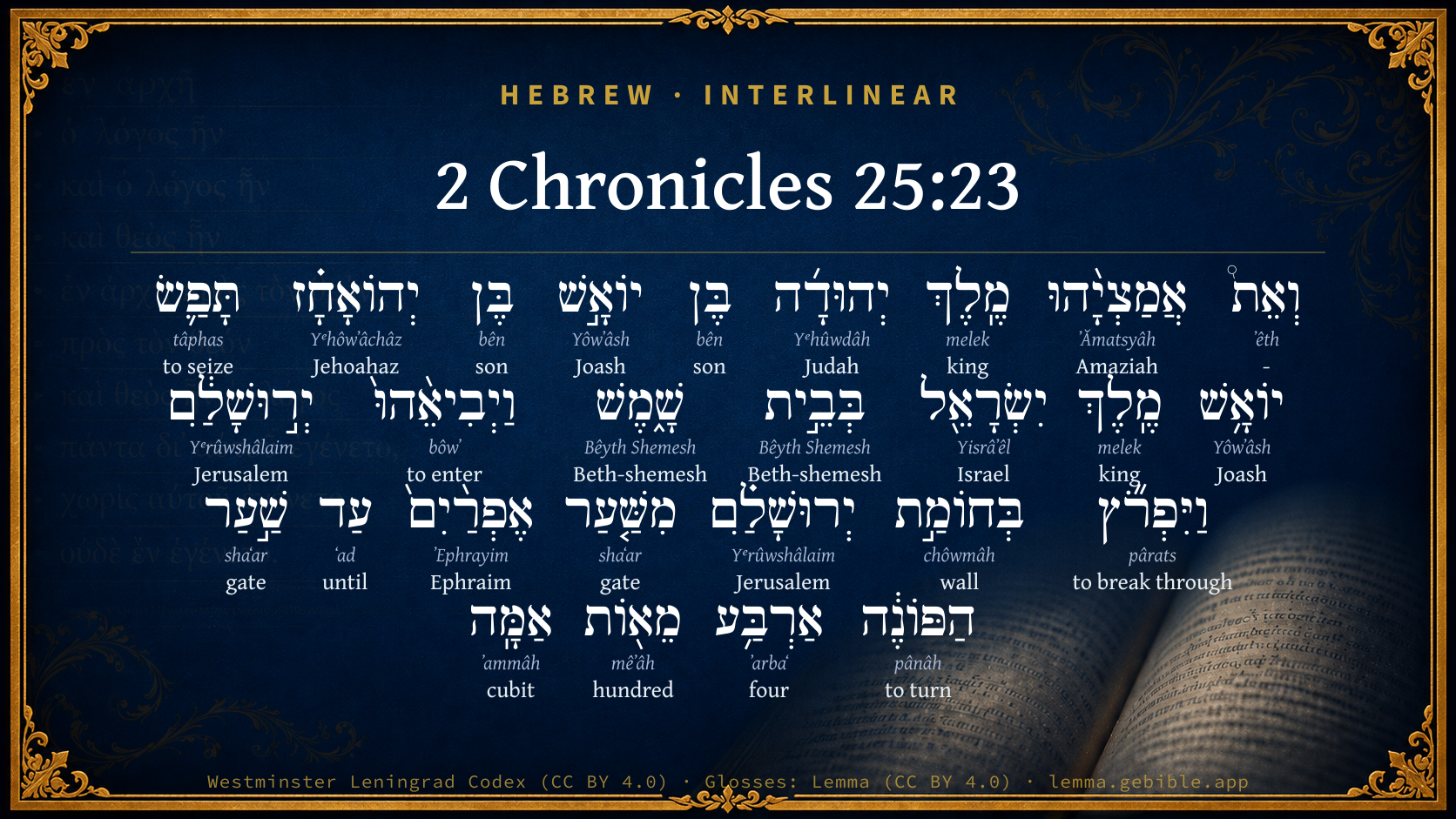
2 Chronicles 25:23

Hebrew (Westminster Leningrad Codex) 2 Chronicles 25:23 appears in the Hebrew Old Testament. The text above is from the Westminster Leningrad Codex. Each word links to its Strong’s number, a concise gloss, and parsing drawn from the Open Scriptures Hebrew Bible morphology. Click any word for its full Brown-Driver-Briggs (BDB) entry.
Download image
Cite this verse

2 Chronicles 25:23 (World English Bible). Public Domain. Lemma interlinear Bible study tool, https://lemma.gebible.app/v/2-chronicles/25/23.

Show BibTeX & RIS
BibTeX
RIS
English Translation
Joash king of Israel took Amaziah king of Judah, the son of Joash the son of Jehoahaz, at Beth-shemesh, and brought him to Jerusalem, and broke down the wall of Jerusalem from the gate of Ephraim to the corner gate, four hundred cubits.
World English Bible · Public Domain
Download a study sheet

One document with this verse’s original text, its word-by-word gloss line, the meaning frame, cross-references with their text, attributed commentary, and full source and license credits — printable, and it pastes into notes with its structure intact.

This verse Autodidact and up

Study sheet (.html) Plain text (.txt)

A passage Seminary Student

Up to 50 verses in one chapter. A passage sheet keeps up to 6 commentary sources and 12 cross-references per verse, in the order this page ranks them, and says so on the sheet whenever that leaves anything out. Ask for a single verse and you get the Autodidact verse sheet above.

Everything on this page stays free to read, with no account — the sheet is a download of what is already on screen, not access to it.

Want to remove ads? Support Godless Engineer
Compare translations 3

The same verse in 3 English versions, stacked beneath the original-language interlinear above. Click any original word for its lexicon entry.

Each is an independent rendering of the whole verse — the interlinear is not word-aligned to these translations.

Highlighted words mark where these versions differ — a whole-verse word diff, not a word-by-word alignment.

  • World English Bible Public Domain
    Joash king of Israel took Amaziah king of Judah, the son of Joash the son of Jehoahaz, at Beth-shemesh, and brought him to Jerusalem, and broke down the wall of Jerusalem from the gate of Ephraim to the corner gate, four hundred cubits.
  • King James Version Public Domain
    And Joash the king of Israel took Amaziah king of Judah, the son of Joash, the son of Jehoahaz, at Bethshemesh, and brought him to Jerusalem, and brake down the wall of Jerusalem from the gate of Ephraim to the corner gate, four hundred cubits.
  • unfoldingWord Literal Text CC BY-SA 4.0
    And Amaziah, the king of Judah, the son of Joash, the son of Jehoahaz, Joash, the king of Israel, seized at Beth Shemesh. And he brought him to Jerusalem, and he broke through the wall of Jerusalem from the gate of Ephraim until the gate of the Corner, 400 cubits.

unfoldingWord Literal Text — © unfoldingWord, licensed CC BY-SA 4.0. Word-aligned USFM3 via Door43 (git.door43.org/unfoldingWord/en_ult).

Versions to compare (up to 4)

3 of 4 selected

Show all 18 translations

Every available English version of this verse, each an independent rendering of the whole verse.

  • World English Bible Public Domain
    Joash king of Israel took Amaziah king of Judah, the son of Joash the son of Jehoahaz, at Beth-shemesh, and brought him to Jerusalem, and broke down the wall of Jerusalem from the gate of Ephraim to the corner gate, four hundred cubits.
  • Berean Standard Bible Public Domain
    There at Beth-shemesh, Jehoash king of Israel captured Amaziah king of Judah, the son of Joash, the son of Jehoahaz. Then Jehoash brought him to Jerusalem and broke down the wall of Jerusalem from the Ephraim Gate to the Corner Gate—a section of four hundred cubits.
  • Majority Standard Bible Public Domain
    There at Beth-shemesh, Jehoash king of Israel captured Amaziah king of Judah, the son of Joash, the son of Jehoahaz. Then Jehoash brought him to Jerusalem and broke down the wall of Jerusalem from the Ephraim Gate to the Corner Gate—a section of four hundred cubits.
  • King James Version Public Domain
    And Joash the king of Israel took Amaziah king of Judah, the son of Joash, the son of Jehoahaz, at Bethshemesh, and brought him to Jerusalem, and brake down the wall of Jerusalem from the gate of Ephraim to the corner gate, four hundred cubits.
  • American Standard Version (1901) Public Domain
    And Joash king of Israel took Amaziah king of Judah, the son of Joash the son of Jehoahaz, at Beth-shemesh, and brought him to Jerusalem, and brake down the wall of Jerusalem from the gate of Ephraim unto the corner gate, four hundred cubits.
  • Revised Version (1885) Public Domain
    And Joash king of Israel took Amaziah king of Judah, the son of Joash the son of Jehoahaz, at Beth-shemesh, and brought him to Jerusalem, and brake down the wall of Jerusalem from the gate of Ephraim unto the corner gate, four hundred cubits.
  • Geneva Bible (1599) Public Domain
    But Ioash the King of Israel tooke Amaziah King of Iudah, the sonne of Ioash, the sonne of Iehoahaz in Bethshemesh, and brought him to Ierusalem, and brake downe the wall of Ierusalem, from the gate of Ephraim vnto the corner gate, foure hundreth cubites.
  • Douay-Rheims (1899) Public Domain
    And Joas king of Israel took Amasias king of Juda, the son of Joas, the son Joachaz, in Bethsames, and brought him to Jerusalem: and broke down the walls thereof from the gate of Ephraim, to the gate of the corner, four hundred cubits.
  • Young's Literal Translation Public Domain
    And Amaziah king of Judah, son of Joash, son of Jehoahaz, hath Joash king of Israel caught in Beth-Shemesh, and bringeth him in to Jerusalem, and breaketh down in the wall of Jerusalem from the gate of Ephraim unto the gate of the corner, four hundred cubits,
  • Literal Standard Version CC BY-SA 4.0
    And Joash king of Israel has caught Amaziah king of Judah, son of Joash, son of Jehoahaz, in Beth-Shemesh, and brings him to Jerusalem, and breaks down in the wall of Jerusalem from the Gate of Ephraim to the Corner Gate—four hundred cubits,
  • Unlocked Literal Bible CC BY-SA 4.0
    Jehoash, king of Israel, captured Amaziah son of Jehoash son of Ahaziah, king of Judah, at Beth Shemesh. He brought him to Jerusalem and tore down the wall of Jerusalem from the Ephraim Gate to the Corner Gate, four hundred cubits in distance.
  • unfoldingWord Literal Text CC BY-SA 4.0
    And Amaziah, the king of Judah, the son of Joash, the son of Jehoahaz, Joash, the king of Israel, seized at Beth Shemesh. And he brought him to Jerusalem, and he broke through the wall of Jerusalem from the gate of Ephraim until the gate of the Corner, 400 cubits.
  • Darby Bible Public Domain
    And Joash king of Israel took Amaziah king of Judah, the son of Joash the son of Jehoahaz, at Beth-shemesh, and brought him to Jerusalem, and he broke down the wall of Jerusalem from the gate of Ephraim to the corner gate, four hundred cubits.
  • World Messianic Bible Public Domain
    Joash king of Israel took Amaziah king of Judah, the son of Joash the son of Jehoahaz, at Beth Shemesh and brought him to Jerusalem, and broke down the wall of Jerusalem from the gate of Ephraim to the corner gate, four hundred cubits.
  • Webster's Bible Public Domain
    And Joash the king of Israel took Amaziah king of Judah, the son of Joash, the son of Jehoahaz, at Beth-shemesh, and brought him to Jerusalem, and broke down the wall of Jerusalem from the gate of Ephraim to the corner gate, four hundred cubits.
  • Free Bible Version CC BY-SA 4.0
    Joash, king of Israel, captured Amaziah, king of Judah, son of Joash, son of Ahaziah, at Beth-shemesh. He took him to Jerusalem, and demolished the wall of Jerusalem for 400 cubits, from the Ephraim Gate to the Corner Gate.
  • Bible in Basic English Public Domain
    And Joash, king of Israel, made Amaziah, king of Judah, the son of Joash, the son of Jehoahaz, prisoner at Beth-shemesh, and took him to Jerusalem; and he had the wall of Jerusalem pulled down from the doorway of Ephraim to the doorway in the angle, four hundred cubits.
  • JPS Tanakh (1917) Public Domain
    And Joash king of Israel took Amaziah king of Judah, the son of Joash, the son of Jehoahaz, at Beth-shemesh, and brought him to Jerusalem, and broke down the wall of Jerusalem from the gate of Ephraim unto the corner gate, four hundred cubits.

Literal Standard Version (2020), Covenant Press — licensed CC BY-SA 4.0. Text via the HelloAO Bible API (eBible.org). Unlocked Literal Bible (unfoldingWord) — licensed CC BY-SA 4.0. Text via the HelloAO Bible API (eBible.org). unfoldingWord Literal Text — © unfoldingWord, licensed CC BY-SA 4.0. Word-aligned USFM3 via Door43 (git.door43.org/unfoldingWord/en_ult). Free Bible Version, Dr. Jonathan Gallagher — licensed CC BY-SA 4.0. Text via the HelloAO Bible API (eBible.org).

Word by word

More ways to search: Search by grammar → Find every occurrence → Compare this word →

Practice this passage: Drill this verse → Learn its vocabulary →

יְהוֹאָחָ֗ז
Yᵉhôwʼâchâz
H3059
“Jehoahaz”
Noun, Proper
Part of Speech
Noun
Type
Proper
Full BDB Definition

Origin: from H3068 and H270

TWOT: None

Jehoahaz = "Jehovah has seized" - a king of Judah and son of Josiah - a king of the northern kingdom of Israel and son of Jehu - a king of Judah and son of Jehoram (Ahaziah)
  1. וְאֵת֩ ʼêth H853 “and · -” Conjunction + Particle, Direct Object
  2. אֲמַצְיָ֨הוּ ʼĂmatsyâh H558 “Amaziah” Noun, Proper
  3. מֶֽלֶךְ melek H4428 “king of” Noun, Common, Masculine, Singular, Construct
  4. יְהוּדָ֜ה Yᵉhûwdâh H3063 “Judah” Noun, Proper
  5. בֶּן bên H1121 “son of” Noun, Common, Masculine, Singular, Construct
  6. יוֹאָ֣שׁ Yôwʼâsh H3101 “Joash” Noun, Proper
  7. בֶּן bên H1121 “son of” Noun, Common, Masculine, Singular, Construct
  8. תָּפַ֛שׂ tâphas H8610 “to seize” Verb, Qal, Perfect, 3rd Person, Masculine, Singular
  9. יוֹאָ֥שׁ Yôwʼâsh H3101 “Joash” Noun, Proper
  10. מֶֽלֶךְ melek H4428 “king of” Noun, Common, Masculine, Singular, Construct
  11. יִשְׂרָאֵ֖ל Yisrâʼêl H3478 “Israel” Noun, Proper
  12. בְּבֵ֣ית Bêyth Shemesh H1053 “in/at · Beth-shemesh” Preposition + Noun, Proper
  13. שָׁ֑מֶשׁ Bêyth Shemesh H1053 “Beth-shemesh” Noun, Proper
  14. וַיְבִיאֵ֨הוּ֙ bôwʼ H935 “and · to enter · him” Conjunction + Verb, Hiphil, Sequential Imperfect, 3rd Person, Masculine, Singular + Suffix, Personal, 3rd Person, Masculine, Singular
  15. יְר֣וּשָׁלִַ֔ם Yᵉrûwshâlaim H3389 “Jerusalem” Noun, Proper
  16. וַיִּפְרֹ֞ץ pârats H6555 “and · to break through” Conjunction + Verb, Qal, Sequential Imperfect, 3rd Person, Masculine, Singular
  17. בְּחוֹמַ֣ת chôwmâh H2346 “in/at · wall of” Preposition + Noun, Common, Feminine, Singular, Construct
  18. יְרוּשָׁלִַ֗ם Yᵉrûwshâlaim H3389 “Jerusalem” Noun, Proper
  19. מִשַּׁ֤עַר shaʻar H8179 “from · gate of” Preposition + Noun, Common, Masculine, Singular, Construct
  20. אֶפְרַ֨יִם֙ ʼEphrayim H669 “Ephraim” Noun, Proper
  21. עַד ʻad H5704 “until” Preposition
  22. שַׁ֣עַר shaʻar H8179 “gate of” Noun, Common, Masculine, Singular, Construct
  23. הַפּוֹנֶ֔ה pânâh H6437 “the · turning” Particle, Definite Article + Verb, Qal, Participle Active, Masculine, Singular, Absolute
  24. אַרְבַּ֥ע ʼarbaʻ H702 “four” Adjective, Cardinal number, Feminine, Singular, Absolute
  25. מֵא֖וֹת mêʼâh H3967 “hundred” Adjective, Cardinal number, Both, Plural, Absolute
  26. אַמָּֽה ʼammâh H520 “cubit” Noun, Common, Feminine, Singular, Absolute

About this verse

These counts appear in no published source. They are computed here, from the morphology-tagged text and Lemma’s own curated glosses. What Lemma adds →

27
words
21
distinct lemmas
Historical
section

Notable vocabulary

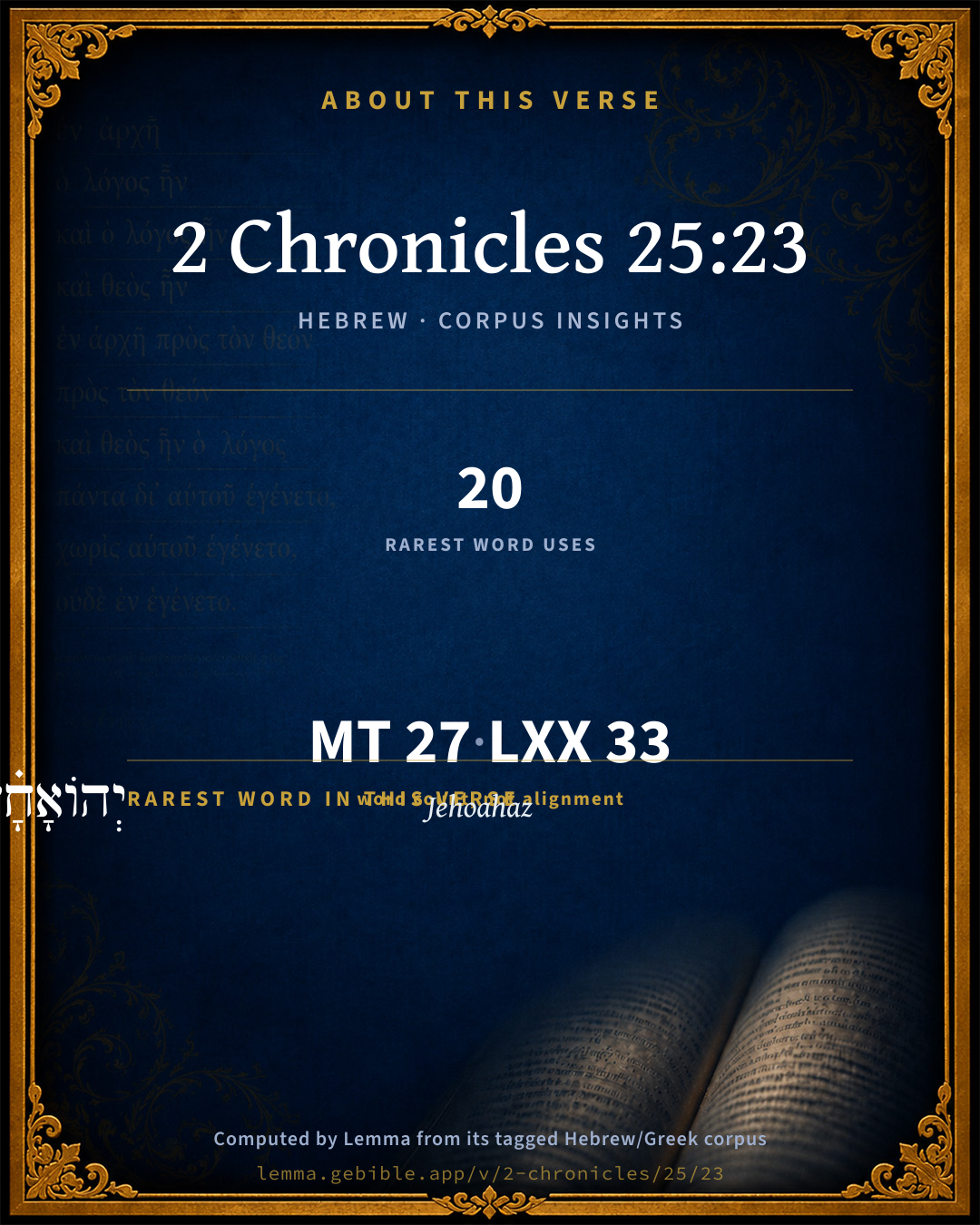
The rarest word here is יְהוֹאָחָ֗ז Jehoahaz H3059 — appearing just 20 times in the whole Hebrew Bible.

Shared distinctive vocabulary

יְהוֹאָחָ֗ז Jehoahaz H3059 occurs in 19 verses of the Hebrew Bible. Also found in:

Grammatical profile

  • 4 verbs
  • 19 nouns
  • 2 adjectives
  • 1 preposition
  • 1 particle

Verb forms

  • תָּפַ֛שׂ Qal · Perfect
  • וַיְבִיאֵ֨הוּ֙ Hiphil · Sequential Imperfect
  • וַיִּפְרֹ֞ץ Qal · Sequential Imperfect
  • הַפּוֹנֶ֔ה Qal · Participle Active

Repetition

Words recur within this verse — often emphatic in Hebrew:

  • מֶֽלֶךְ king H4428 ×2
  • בֶּן son H1121 ×2
  • יוֹאָ֣שׁ Joash H3101 ×2
  • בְּבֵ֣ית Beth-shemesh H1053 ×2
  • יְר֣וּשָׁלִַ֔ם Jerusalem H3389 ×2
  • מִשַּׁ֤עַר gate H8179 ×2

Hebrew & Septuagint length

In English translation the verse runs 43 words from the Hebrew and 46 from the Septuagint (LXX English) — closely comparable.

A rough comparison of the two English renderings, which tokenize alike — not a word-level alignment.

Word counts can differ between the Hebrew and the Greek without any difference in meaning — e.g. the Hebrew direct-object marker אֵת has no separate Greek word, and Greek often adds the article ὁ.

In the original languages it is 27 Hebrew tokens and 33 Greek tokens — but the two are counted differently (Hebrew bundles its prefixes and suffixes into one token; the Greek is in lemma form), so that isn’t a like-for-like length.

Cross-references

15

Topical passages linked to 2 Chronicles 25:23 in the Treasury of Scripture Knowledge — connected by theme and wording, ordered by reader-vote popularity; previews shown in the World English Bible.

  • 2 Chronicles 21:17 and they came up against Judah, and broke into it, and carried away all the substance that was found in the king's house, and his sons also, and his wives; so that there was never a son left him, save Jehoahaz, the youngest of his sons.
  • Nehemiah 8:16 So the people went forth, and brought them, and made themselves booths, everyone on the roof of his house, and in their courts, and in the courts of the house of God, and in the broad place of the water gate, and in the broad place of the gate of Ephraim.
  • 2 Chronicles 22:1 The inhabitants of Jerusalem made Ahaziah his youngest son king in his place; for the band of men who came with the Arabians to the camp had slain all the eldest. So Ahaziah the son of Jehoram king of Judah reigned.
  • 2 Chronicles 26:9 Moreover Uzziah built towers in Jerusalem at the corner gate, and at the valley gate, and at the turning [of the wall], and fortified them.
  • Nehemiah 12:39 and above the gate of Ephraim, and by the old gate, and by the fish gate, and the tower of Hananel, and the tower of Hammeah, even to the sheep gate: and they stood still in the gate of the guard.
  • Jeremiah 31:38 Behold, the days come, says Yahweh, that the city shall be built to Yahweh from the tower of Hananel to the gate of the corner.
  • 2 Chronicles 22:6 He returned to be healed in Jezreel of the wounds which they had given him at Ramah, when he fought against Hazael king of Syria. Azariah the son of Jehoram king of Judah went down to see Jehoram the son of Ahab in Jezreel, because he was sick.
  • 2 Chronicles 33:11 Therefore Yahweh brought on them the captains of the host of the king of Assyria, who took Manasseh in chains, and bound him with fetters, and carried him to Babylon.
  • 2 Chronicles 36:6 Against him came up Nebuchadnezzar king of Babylon, and bound him in fetters, to carry him to Babylon.
  • 2 Chronicles 36:10 At the return of the year king Nebuchadnezzar sent, and brought him to Babylon, with the goodly vessels of the house of Yahweh, and made Zedekiah his brother king over Judah and Jerusalem.
  • Proverbs 16:18 Pride goes before destruction, And a haughty spirit before a fall.
  • Proverbs 29:23 A man's pride brings him low, But one of lowly spirit gains honor.
  • Daniel 4:37 Now I, Nebuchadnezzar, praise and extol and honor the King of heaven; for all his works are truth, and his ways justice; and those who walk in pride he is able to abase.
  • Obadiah 1:3 The pride of your heart has deceived you, you who dwell in the clefts of the rock, whose habitation is high, who says in his heart, 'Who will bring me down to the ground?'
  • Luke 14:11 For everyone who exalts himself will be humbled, and whoever humbles himself will be exalted."

Cross-references courtesy of OpenBible.info (CC BY 4.0).

Hebrew and Greek witnesses Masoretic Hebrew ↔ Greek Septuagint

The same verse in the two great witnesses to the Old Testament, shown verse-for-verse.

These are two independent witnesses, not word-aligned to each other, and the Septuagint is shown in lemma (dictionary) form.

Hebrew 2 Chronicles 25:23 Masoretic · Westminster Leningrad Codex

וְאֵת֩ אֲמַצְיָ֨הוּ מֶֽלֶךְ יְהוּדָ֜ה בֶּן יוֹאָ֣שׁ בֶּן יְהוֹאָחָ֗ז תָּפַ֛שׂ יוֹאָ֥שׁ מֶֽלֶךְ יִשְׂרָאֵ֖ל בְּבֵ֣ית שָׁ֑מֶשׁ וַיְבִיאֵ֨הוּ֙ יְר֣וּשָׁלִַ֔ם וַיִּפְרֹ֞ץ בְּחוֹמַ֣ת יְרוּשָׁלִַ֗ם מִשַּׁ֤עַר אֶפְרַ֨יִם֙ עַד שַׁ֣עַר הַפּוֹנֶ֔ה אַרְבַּ֥ע מֵא֖וֹת אַמָּֽה

Joash king of Israel took Amaziah king of Judah, the son of Joash the son of Jehoahaz, at Beth-shemesh, and brought him to Jerusalem, and broke down the wall of Jerusalem from the gate of Ephraim to the corner gate, four hundred cubits.

World English Bible · Public Domain

Greek LXX 2 Chronicles 25:23 Septuagint · lemma form

καί ὁ αμασιας βασιλεύς ἰουδά ὁ ὁ ιωας καταλαμβάνω ιωας βασιλεύς ἰσραήλ ἐν βαιθσαμυς καί εἰςἄγω αὐτός εἰς ἰερουσαλήμ καί κατασπάω ἀπό ὁ τεῖχος ἰερουσαλήμ ἀπό πύλη ἐφράιμ ἕως πύλη γωνία τετρακόσιοι πῆχυς

And Joas king of Israel took prisoner Amasias king of Juda, son of Joas, son of Joachaz, in Baethsamys, and brought him to Jerusalem; and he pulled down part of the wall of Jerusalem from the gate of Ephraim to the corner gate, four hundred cubits.

LXX2012 (modern English Septuagint) · Public Domain

On this verse, The Cambridge Bible for Schools and Colleges discusses the Septuagint’s reading. Read the note in Commentary ↓

Hebrew: Westminster Leningrad Codex (CC BY 4.0). Greek: Septuagint (public domain); English from LXX2012 (modern English Septuagint) (Public Domain). How the Septuagint differs from the Hebrew →

Commentary

Notes on 2 Chronicles 25:23 from classic Christian and Jewish commentators (each source and its license shown beneath its notes). The classic Christian expositions comment on the surrounding passage and are grouped to its opening verse, so a note may address several verses; the Jewish commentaries on the Tanakh (Rashi and others) are per-verse, so they appear only where the commentator wrote on this verse.

Lemma curates 59 commentaries, every one of them public domain or Creative Commons licensed, each selected and text-cleaned for this edition rather than reprinted as found. About our sources →

Tyndale Open Study Notes

Tyndale Open Resources

25:23 The Ephraim Gate was on the north side of the city, while the Corner Gate was on the western wall.

Tyndale Open Study Notes — © Tyndale Open Resources, licensed CC BY-SA 4.0. Text via the HelloAO Bible API.

Ellicott's Commentary for English Readers

(23) Jehoahaz.—Several Hebrew MSS. read Ahaziah, as in 2Ki_14:13, with which the rest of the verse agrees: see the Notes there. (See Note on 2Ch_21:17.)

The corner gate.—So 2Ki_14:13, rightly. Our Hebrew text has, “gate of the turning one,” or “gate that turneth;” which would require some word indicating the direction of the turning. (Comp. Eze_8:3, “gate that turneth northward.”) Some MSS., and all the versions, agree with Kings. It is merely a matter of different points. (Comp. also 2Ch_26:9.)

A Bible Commentary for English Readers, edited by Charles John Ellicott (1878–1897) — public domain. Text from a community e-Sword module.

The Cambridge Bible for Schools and Colleges

gen. ed. J. J. S. Perowne

23. the son of Jehoahaz] i.e. the son of Ahaziah, Jehoahaz and Ahaziah being varying forms of the same name; cp. 2Ch_21:17 (note).

brake down the wall] Rather, made a breach (or breaches) in the wall. The same verb is used in Neh_1:3 (“broken down”) and ibid. Neh_4:7 (“the breaches”).

the gate of Ephraim] This gate cannot be identified, but its name suggests that it was on the north.

the corner gate] Heb. text doubtful, but LXX. ἕως πύλης γωνίας. Cp. 2Ch_26:9; Jer_31:38; Zec_14:10. Most probably this gate also was on the north, but nothing certain is known of its position.

four hundred cubits] About 600 feet according to the ancient cubit, and 700 according to the later standard; cp. 2Ch_3:3 (note).

The Cambridge Bible for Schools and Colleges (gen. ed. J. J. S. Perowne; Cambridge University Press, 1878–1918) — public domain. Text from a community e-Sword module.

The Pulpit Commentary

Joash took; Hebrew, cPT; "seized", (as Gen_39:12) or "caught up", (as Deu_9:17) or "capture". (as Jos_8:8) The gate of Ephraim (see Conder"s "Handbook to the Bible," p. 343). It led out on the north or north-west side of the city. There is very little to identify it with the high gate of Benjamin (see ditto, p. 346). The corner gate. This is not the translation of our Hebrew text (hnwOPh rv, which, see margin, means "that looketh"), but of the Hebrew text of the parallel (hNpij); see pp. 343-346 of Conder"s "Handbook to the Bible," and map facing p. 334, 2nd edit. Four hundred cubits. Probably about a hundred and eighty yards.

The Pulpit Commentary (1880–1919), ed. H.D.M. Spence-Jones & Joseph S. Exell — public domain. Text from a community e-Sword module.

unfoldingWord translationNotes

Door43 World Missions Community

four hundred cubits in distance

A cubit is 46 centimeters. AT: "400 cubits in distance" or "a length of 180 meters" (See: Numbers and Biblical Distance)

with Obed Edom

Here "Obed Edom" refers to this man's descendants. AT: "under the care of the descendants of Obed Edom" (See: Metonymy and How to Translate Names)

the king's house

"the royal palace"

translationWords

king

Israel

Amaziah

Ahaziah

Beth Shemesh

Jerusalem

Ephraim

gate

gold

house of God

Samaria

unfoldingWord translationNotes — © Distant Shores Media and the Door43 World Missions Community, licensed CC BY-SA 4.0. Source: git.door43.org/Door43/en_tn.

Rashi

Rabbi Shlomo Yitzchaki (Rashi)

and breached the wall of... He said, “From now on, he will not rebel against me, because his heart will not be so haughty since the wall has been breached”

Rashi on the Tanakh — English translations: “The Judaica Press complete Tanach with Rashi, translated by A. J. Rosenberg” (CC BY 4.0); “Pentateuch with Rashi's commentary by M. Rosenbaum and A.M. Silbermann, 1929-1934” (public domain); “The Metsudah Tanach series, Lakewood, N.J” (CC BY 4.0); and “The Book of Joshua, Metsudah Publications, 1997” (CC BY 4.0). Text via Sefaria.

Lesson kit

Teaching starters — assembled from the data on this page, not authored interpretation. Every prompt links to the verse data it draws on. Edit before teaching.

2 Chronicles, in the Historical, opens this verse with 27 words (21 distinct Hebrew lemmas). Its most distinctive word is Yᵉhôwʼâchâz (“Jehoahaz”). A historical commentator’s framing appears above. Read the whole chapter for the surrounding context.

Discussion questions

  1. What does “Jehoahaz” (Yᵉhôwʼâchâz) contribute to the verse as a whole?
  2. 2 Kings 10:35 shares the word «Jehoahaz» with this verse. How do the two illuminate each other?
  3. “king” occurs 2× in this one verse. What is the effect of the repetition?
  4. These translations render this verse differently. What is at stake in choosing one wording over another?
  5. The verb «תָּפַ֛שׂ» is Qal Perfect. How does its form color the action?
  6. Reading how Tyndale Open Study Notes and Ellicott's Commentary for English Readers read this verse, where do the two commentators agree and where do they part?

Things to notice

Reading settings

Reading text

Shown beneath each verse's original-language words.

Old Testament
Old Testament edition

Read the OT as the Masoretic Hebrew (MT) or the Greek Septuagint (LXX).

English shown for the Greek Septuagint (in the Hebrew ↔ Greek comparison).

Comparing translations? Open the Compare panel on any verse page to stack up to four side by side.