

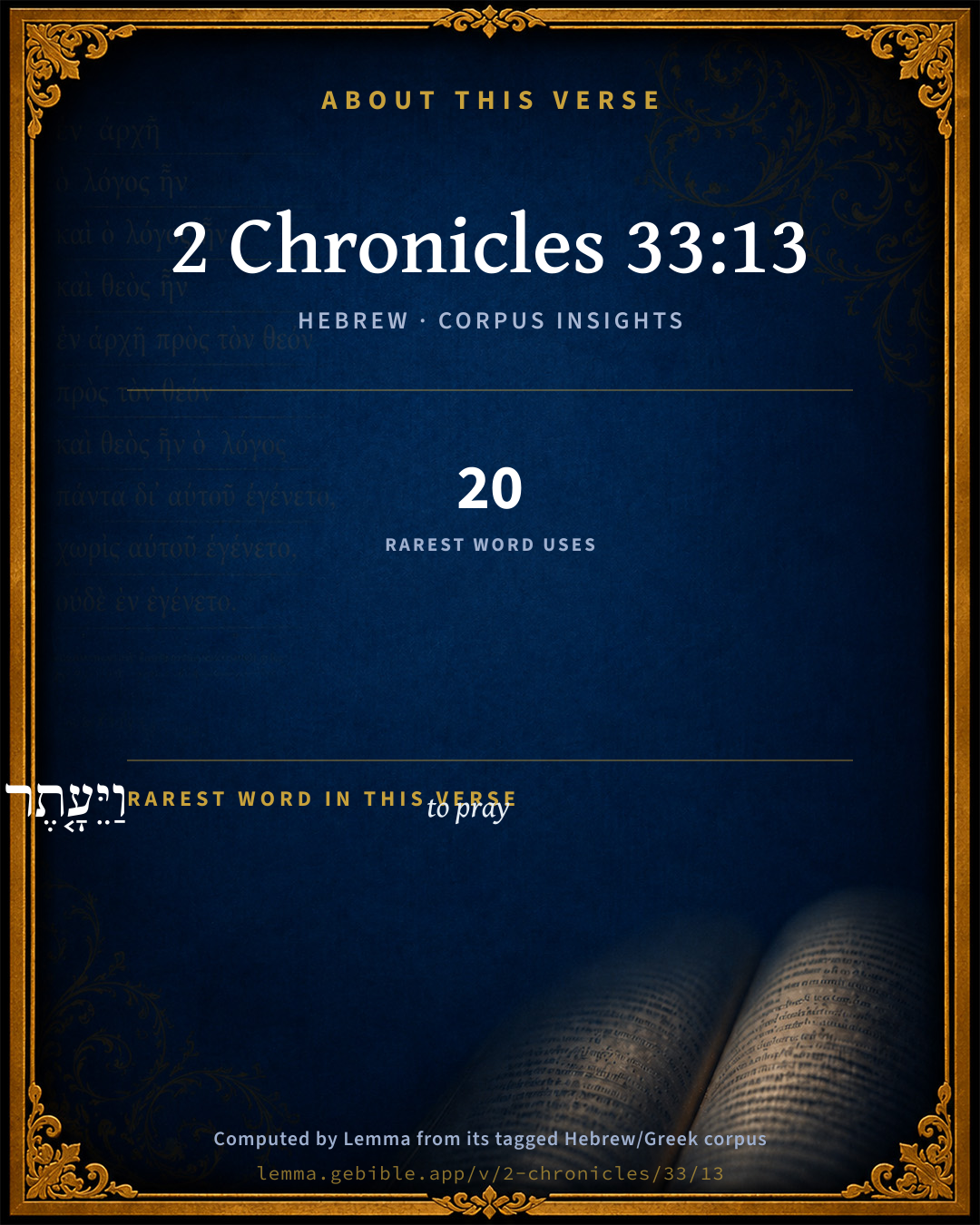
2 Chronicles 33:13

Hebrew (Westminster Leningrad Codex) 2 Chronicles 33:13 appears in the Hebrew Old Testament. The text above is from the Westminster Leningrad Codex. Each word links to its Strong’s number, a concise gloss, and parsing drawn from the Open Scriptures Hebrew Bible morphology. Click any word for its full Brown-Driver-Briggs (BDB) entry.
Download image
Cite this verse

2 Chronicles 33:13 (World English Bible). Public Domain. Lemma interlinear Bible study tool, https://lemma.gebible.app/v/2-chronicles/33/13.

Show BibTeX & RIS
BibTeX
RIS
English Translation
He prayed to him; and he was entreated of him, and heard his supplication, and brought him again to Jerusalem into his kingdom. Then Manasseh knew that Yahweh he was God.
World English Bible · Public Domain
Download a study sheet

One document with this verse’s original text, its word-by-word gloss line, the meaning frame, cross-references with their text, attributed commentary, and full source and license credits — printable, and it pastes into notes with its structure intact.

This verse Autodidact and up

Study sheet (.html) Plain text (.txt)

A passage Seminary Student

Up to 50 verses in one chapter. A passage sheet keeps up to 6 commentary sources and 12 cross-references per verse, in the order this page ranks them, and says so on the sheet whenever that leaves anything out. Ask for a single verse and you get the Autodidact verse sheet above.

Everything on this page stays free to read, with no account — the sheet is a download of what is already on screen, not access to it.

Want to remove ads? Support Godless Engineer
Compare translations 3

The same verse in 3 English versions, stacked beneath the original-language interlinear above. Click any original word for its lexicon entry.

Each is an independent rendering of the whole verse — the interlinear is not word-aligned to these translations.

Highlighted words mark where these versions differ — a whole-verse word diff, not a word-by-word alignment.

  • World English Bible Public Domain
    He prayed to him; and he was entreated of him, and heard his supplication, and brought him again to Jerusalem into his kingdom. Then Manasseh knew that Yahweh he was God.
  • King James Version Public Domain
    And prayed unto him: and he was intreated of him, and heard his supplication, and brought him again to Jerusalem into his kingdom. Then Manasseh knew that the LORD he was God.
  • unfoldingWord Literal Text CC BY-SA 4.0
    And he prayed to him; and he was entreated by him, and he heard his supplication, and he brought him back to Jerusalem to his kingdom. And Manasseh knew that Yahweh, he is God.

unfoldingWord Literal Text — © unfoldingWord, licensed CC BY-SA 4.0. Word-aligned USFM3 via Door43 (git.door43.org/unfoldingWord/en_ult).

Versions to compare (up to 4)

3 of 4 selected

Show all 18 translations

Every available English version of this verse, each an independent rendering of the whole verse.

  • World English Bible Public Domain
    He prayed to him; and he was entreated of him, and heard his supplication, and brought him again to Jerusalem into his kingdom. Then Manasseh knew that Yahweh he was God.
  • Berean Standard Bible Public Domain
    And when he prayed to Him, the LORD received his plea and heard his petition; so He brought him back to Jerusalem and to his kingdom. Then Manasseh knew that the LORD is God.
  • Majority Standard Bible Public Domain
    And when he prayed to Him, the LORD received his plea and heard his petition. So He brought him back to Jerusalem and to his kingdom. Then Manasseh knew that the LORD is God.
  • King James Version Public Domain
    And prayed unto him: and he was intreated of him, and heard his supplication, and brought him again to Jerusalem into his kingdom. Then Manasseh knew that the LORD he was God.
  • American Standard Version (1901) Public Domain
    And he prayed unto him; and he was entreated of him, and heard his supplication, and brought him again to Jerusalem into his kingdom. Then Manasseh knew that Jehovah he was God.
  • Revised Version (1885) Public Domain
    And he prayed unto him; and he was entreated of him, and heard his supplication, and brought him again to Jerusalem into his kingdom. Then Manasseh knew that the LORD he was God.
  • Geneva Bible (1599) Public Domain
    And prayed vnto him: and God was entreated of him, and heard his prayer, and brought him againe to Ierusalem into his kingdome: then Manasseh knewe that the Lord was God.
  • Douay-Rheims (1899) Public Domain
    And he entreated him, and besought him earnestly: and he heard his prayer, and brought him again to Jerusalem into his kingdom, and Manasses knew that the Lord was God.
  • Young's Literal Translation Public Domain
    and prayeth unto Him, and He is entreated of him, and heareth his supplication, and bringeth him back to Jerusalem, to his kingdom, and Manasseh knoweth that Jehovah -- He `is' God.
  • Literal Standard Version CC BY-SA 4.0
    and prays to Him, and He accepts his plea, and hears his supplication, and brings him back to Jerusalem, to his kingdom, and Manasseh knows that He, YHWH, [is] God.
  • Unlocked Literal Bible CC BY-SA 4.0
    He prayed to him; and God was begged by him, and God heard his begging and brought him back to Jerusalem, into his kingship. Then Manasseh knew that Yahweh was God.
  • unfoldingWord Literal Text CC BY-SA 4.0
    And he prayed to him; and he was entreated by him, and he heard his supplication, and he brought him back to Jerusalem to his kingdom. And Manasseh knew that Yahweh, he is God.
  • Darby Bible Public Domain
    and prayed to him. And he was intreated of him and heard his supplication, and brought him again to Jerusalem into his kingdom. Then Manasseh knew that Jehovah, he was God.
  • World Messianic Bible Public Domain
    He prayed to him; and he was entreated by him, and heard his supplication, and brought him again to Jerusalem into his kingdom. Then Manasseh knew that the LORD was God.
  • Webster's Bible Public Domain
    And prayed to him: and he was entreated by him, and heard his supplication, and brought him again to Jerusalem into his kingdom. Then Manasseh knew that the LORD he is God.
  • Free Bible Version CC BY-SA 4.0
    He prayed and prayed, and the Lord listened to his pleadings; so the Lord brought Manasseh back to Jerusalem and to his kingdom. Then Manasseh was convinced that the Lord is God.
  • Bible in Basic English Public Domain
    And made prayer to him; and in answer to his prayer God let him come back to Jerusalem and to his kingdom. Then Manasseh was certain that the Lord was God.
  • JPS Tanakh (1917) Public Domain
    And he prayed unto Him; and He was entreated of him, and heard his supplication, and brought him back to Jerusalem into his kingdom. Then Manasseh knew that the LORD He was God.

Literal Standard Version (2020), Covenant Press — licensed CC BY-SA 4.0. Text via the HelloAO Bible API (eBible.org). Unlocked Literal Bible (unfoldingWord) — licensed CC BY-SA 4.0. Text via the HelloAO Bible API (eBible.org). unfoldingWord Literal Text — © unfoldingWord, licensed CC BY-SA 4.0. Word-aligned USFM3 via Door43 (git.door43.org/unfoldingWord/en_ult). Free Bible Version, Dr. Jonathan Gallagher — licensed CC BY-SA 4.0. Text via the HelloAO Bible API (eBible.org).

Word by word

More ways to search: Search by grammar → Find every occurrence → Compare this word →

Practice this passage: Drill this verse → Learn its vocabulary →

וַיֵּעָ֤תֶר
ʻâthar
H6279
“and · to pray”
Conjunction + Verb, Niphal, Sequential Imperfect, 3rd Person, Masculine, Singular
Part of Speech
Conjunction + Verb
Stem
Niphal
Form
Sequential Imperfect
Person
3rd Person
Gender
Masculine
Number
Singular
Full BDB Definition

Origin: a primitive root [rather denominative from H6281 ]

TWOT: 1722

to pray, entreat, supplicate - (Qal) to pray, entreat - (Niphal) to be supplicated, be entreated - (Hiphil) to make supplication, plead
  1. וַיִּתְפַּלֵּ֣ל pâlal H6419 “and · to pray” Conjunction + Verb, Hithpael, Sequential Imperfect, 3rd Person, Masculine, Singular
  2. אֵלָ֗יו ʼêl H413 “to · him” Preposition + Suffix, Personal, 3rd Person, Masculine, Singular
  3. וַיִּשְׁמַ֣ע shâmaʻ H8085 “and · to hear” Conjunction + Verb, Qal, Sequential Imperfect, 3rd Person, Masculine, Singular
  4. תְּחִנָּת֔וֹ tᵉchinnâh H8467 “supplication · his” Noun, Common, Feminine, Singular, Construct + Suffix, Personal, 3rd Person, Masculine, Singular
  5. וַיְשִׁיבֵ֥הוּ shûwb H7725 “and · to return · him” Conjunction + Verb, Hiphil, Sequential Imperfect, 3rd Person, Masculine, Singular + Suffix, Personal, 3rd Person, Masculine, Singular
  6. יְרוּשָׁלִַ֖ם Yᵉrûwshâlaim H3389 “Jerusalem” Noun, Proper
  7. לְמַלְכוּת֑וֹ malkûwth H4438 “to/for · kingdom · his” Preposition + Noun, Common, Feminine, Singular, Construct + Suffix, Personal, 3rd Person, Masculine, Singular
  8. וַיֵּ֣דַע yâdaʻ H3045 “and · to know” Conjunction + Verb, Qal, Sequential Imperfect, 3rd Person, Masculine, Singular
  9. מְנַשֶּׁ֔ה Mᵉnashsheh H4519 “Manasseh” Noun, Proper
  10. כִּ֥י kîy H3588 “that” Conjunction
  11. יְהוָ֖ה Yᵉhôvâh H3068 “LORD” Noun, Proper
  12. ה֥וּא hûwʼ H1931 “he” Pronoun, Personal, 3rd Person, Masculine, Singular
  13. הָֽאֱלֹהִֽים ʼĕlôhîym H430 “the · God(s)” Particle, Definite Article + Noun, Common, Masculine, Plural, Absolute

About this verse

These counts appear in no published source. They are computed here, from the morphology-tagged text and Lemma’s own curated glosses. What Lemma adds →

15
words
14
distinct lemmas
Historical
section

Notable vocabulary

The rarest word here is וַיֵּעָ֤תֶר to pray H6279 — appearing just 20 times in the whole Hebrew Bible.

Shared distinctive vocabulary

וַיֵּעָ֤תֶר to pray H6279 occurs in 19 verses of the Hebrew Bible. Also found in:

Grammatical profile

  • 5 verbs
  • 6 nouns
  • 1 pronoun
  • 2 prepositions
  • 1 conjunction

Verb forms

  • וַיִּתְפַּלֵּ֣ל Hithpael · Sequential Imperfect
  • וַיֵּעָ֤תֶר Niphal · Sequential Imperfect
  • וַיִּשְׁמַ֣ע Qal · Sequential Imperfect
  • וַיְשִׁיבֵ֥הוּ Hiphil · Sequential Imperfect
  • וַיֵּ֣דַע Qal · Sequential Imperfect

Hebrew & Septuagint length

In English translation the verse runs 31 words from the Hebrew and 33 from the Septuagint (LXX English) — closely comparable.

A rough comparison of the two English renderings, which tokenize alike — not a word-level alignment.

Word counts can differ between the Hebrew and the Greek without any difference in meaning — e.g. the Hebrew direct-object marker אֵת has no separate Greek word, and Greek often adds the article ὁ.

Cross-references

24

Topical passages linked to 2 Chronicles 33:13 in the Treasury of Scripture Knowledge — connected by theme and wording, ordered by reader-vote popularity; previews shown in the World English Bible.

  • 1 Chronicles 5:20 They were helped against them, and the Hagrites were delivered into their hand, and all who were with them; for they cried to God in the battle, and he was entreated of them, because they put their trust in him.
  • Ezra 8:23 So we fasted and begged our God for this: and he was entreated of us.
  • Jeremiah 29:12–13 You shall call on me, and you shall go and pray to me, and I will listen to you.
  • Daniel 4:25 that you shall be driven from men, and your dwelling shall be with the animals of the field, and you shall be made to eat grass as oxen, and shall be wet with the dew of the sky, and seven times shall pass over you; until you know that the Most High rules in the kingdom of men, and gives it to whoever he will.
  • Matthew 6:33 But seek first God's Kingdom, and his righteousness; and all these things will be given to you as well.
  • Matthew 7:7–8 "Ask, and it will be given you. Seek, and you will find. Knock, and it will be opened for you.
  • Jeremiah 24:7 I will give them a heart to know me, that I am Yahweh: and they shall be my people, and I will be their God; for they shall return to me with their whole heart.
  • Psalms 86:5 For you, Lord, are good, and ready to forgive; Abundant in loving kindness to all those who call on you.
  • Proverbs 21:1 The king's heart is in Yahweh's hand like the watercourses. He turns it wherever he desires.
  • Isaiah 55:6–9 Seek you Yahweh while he may be found; call you on him while he is near:
  • Daniel 4:34–35 At the end of the days I, Nebuchadnezzar, lifted up my eyes to heaven, and my understanding returned to me, and I blessed the Most High, and I praised and honored him who lives forever; for his dominion is an everlasting dominion, and his kingdom from generation to generation.
  • Deuteronomy 29:6 You have not eaten bread, neither have you drunk wine or strong drink; that you may know that I am Yahweh your God.
  • Ezra 7:27 Blessed be Yahweh, the God of our fathers, who has put such a thing as this in the king's heart, to beautify the house of Yahweh which is in Jerusalem;
  • Job 22:23 If you return to the Almighty, you shall be built up, If you put away unrighteousness far from your tents.
  • Job 22:27 You shall make your prayer to him, and he will hear you. You shall pay your vows.
  • Job 33:16–30 Then he opens the ears of men, And seals their instruction,
  • Psalms 9:16 Yahweh has made himself known. He has executed judgment. The wicked is snared by the work of his own hands. Meditation. Selah.
  • Psalms 32:3–5 When I kept silence, my bones wasted away through my groaning all day long.
  • Psalms 46:10 "Be still, and know that I am God. I will be exalted among the nations. I will be exalted in the earth."
  • Proverbs 16:7 When a man's ways please Yahweh, He makes even his enemies to be at peace with him.
  • Luke 23:42–43 He said to Jesus, "Lord, remember me when you come into your Kingdom."
  • John 4:10 Jesus answered her, "If you knew the gift of God, and who it is who says to you, 'Give me a drink,' you would have asked him, and he would have given you living water."
  • John 17:3 This is eternal life, that they should know you, the only true God, and him whom you sent, Jesus Christ.
  • Hebrews 8:11 They will not teach every man his fellow citizen, Every man his brother, saying, 'Know the Lord,' For all will know me, From the least of them to the greatest of them.

Cross-references courtesy of OpenBible.info (CC BY 4.0).

Hebrew and Greek witnesses Masoretic Hebrew ↔ Greek Septuagint

The same verse in the two great witnesses to the Old Testament, shown verse-for-verse.

These are two independent witnesses, not word-aligned to each other, and the Septuagint is shown in lemma (dictionary) form.

Hebrew 2 Chronicles 33:13 Masoretic · Westminster Leningrad Codex

וַיִּתְפַּלֵּ֣ל אֵלָ֗יו וַיֵּעָ֤תֶר לוֹ֙ וַיִּשְׁמַ֣ע תְּחִנָּת֔וֹ וַיְשִׁיבֵ֥הוּ יְרוּשָׁלִַ֖ם לְמַלְכוּת֑וֹ וַיֵּ֣דַע מְנַשֶּׁ֔ה כִּ֥י יְהוָ֖ה ה֥וּא הָֽאֱלֹהִֽים

He prayed to him; and he was entreated of him, and heard his supplication, and brought him again to Jerusalem into his kingdom. Then Manasseh knew that Yahweh he was God.

World English Bible · Public Domain

Greek LXX 2 Chronicles 33:13 Septuagint · lemma form

καί προςεὔχομαι πρός αὐτός καί ἐπιἀκούω αὐτός καί ἐπιἀκούω ὁ βοή αὐτός καί ἐπιστρέφω αὐτός εἰς ἰερουσαλήμ ἐπί ὁ βασιλεία αὐτός καί γιγνώσκω μανασσής ὅτι κύριος αὐτός εἰμί ὁ θεός

and he prayed to him: and he listened to him, and listened to his cry, and brought him back to Jerusalem to his kingdom: and Manasses knew that the Lord he is God.

LXX2012 (modern English Septuagint) · Public Domain

Hebrew: Westminster Leningrad Codex (CC BY 4.0). Greek: Septuagint (public domain); English from LXX2012 (modern English Septuagint) (Public Domain). How the Septuagint differs from the Hebrew →

Commentary

Notes on 2 Chronicles 33:13 from classic Christian and Jewish commentators (each source and its license shown beneath its notes). The classic Christian expositions comment on the surrounding passage and are grouped to its opening verse, so a note may address several verses; the Jewish commentaries on the Tanakh (Rashi and others) are per-verse, so they appear only where the commentator wrote on this verse.

Lemma curates 59 commentaries, every one of them public domain or Creative Commons licensed, each selected and text-cleaned for this edition rather than reprinted as found. About our sources →

Trapp's Complete Commentary

John Trapp

2Ch 33:13 And prayed unto him: and he was intreated of him, and heard his supplication, and brought him again to Jerusalem into his kingdom. Then Manasseh knew that the LORD he [was] God.

Ver. 13. And prayed to him.] His afflictions, like Benhadad’s best counsellors, sent Manasseh with a cord about his neck, to the merciful King of Israel.

And he was entreated of him, and heard his supplication.] Note this against those old and our new Novatians. Despair not of mercy, though never so sinful; but know, that if men can find a praying heart, God will find a pitying heart.

And brought him again to Jerusalem.] How, and by what means, is not recorded. The Lord knoweth how to deliver his. {2Pe 2:9}

Then Manasseh knew that the Lord he was God.] This lesson he had learned in the school of BabyIon. Christianorum Theologia, Crux, saith Luther. The cross had taught Manasseh more of God than ever he knew before.

John Trapp, A Commentary or Exposition upon All the Books of the Old and New Testament (1647–1656) — public domain. Text from a community e-Sword module.

Joseph Benson's Commentary

2Ch 33:13. Then Manasseh knew that the Lord he was God — He was convinced, by his own experience, of God’s power, justice, and goodness; that Jehovah alone was the true God, and not those idols which he had worshipped, by which he had received great hurt and no good. He might have known this at a less expense, if he would have given due attention and credit to the word written and preached: but it was better to pay thus dear for the knowledge of God, than perish in ignorance and unbelief.

Joseph Benson's Commentary on the Old and New Testaments (1811–1818) — public domain. Text from a community e-Sword module.

Tyndale Open Study Notes

Tyndale Open Resources

33:13 Manasseh’s experience was a microcosm of what the nation would experience: exile and bondage brought on by apostasy, then repentance and returning to the Lord.

Tyndale Open Study Notes — © Tyndale Open Resources, licensed CC BY-SA 4.0. Text via the HelloAO Bible API.

Geneva Bible (1599)

Geneva Bible translators

Thus affliction giveth understanding: for he that hated God in his prosperity, now in his misery he seeketh unto him.

Geneva Bible (1599) marginal notes — public domain. Text via Bolls.life.

Adam Clarke's Commentary

Verse 13. And prayed unto him] "While he was thus praying, all the presiding angels went away to the gates of prayer in heaven; and shut all the gates of prayer, and all the windows and apertures in heaven, lest that his prayer should be heard. Immediately the compassions of the Creator of the world were moved, whose right hand is stretched out to receive sinners, who are converted to his fear, and break their hearts' concupiscence by repentance. He made therefore a window and opening in heaven, under the throne of his glory; and having heard his prayer, he favourably received his supplication. And when his WORD had shaken the earth, the mule was burst and he escaped. Then the Spirit went out from between the wings of the cherubim; by which, being inspired through the decree of the WORD of the Lord, he returned to his kingdom in Jerusalem. And then Manasseh knew that it was the Lord God who had done these miracles and signs; and he turned to the Lord with his whole heart, left all his idols, and never served them more." This long addition gives the Jewish account of those particulars which the sacred writer has passed by: it is curious, though in some sort trifling. The gates of prayer may be considered childish; but in most of those things the ancient rabbins purposely hid deep and important meanings.

Adam Clarke's Commentary on the Bible (1810–1826) — public domain. Text from a community e-Sword/MySword module.

Ellicott's Commentary for English Readers

(13) He was intreated of him.—1Ch_5:20.

And brought him again to Jerusalem.—The Assyrian monarch after a time saw fit to restore Manasseh to his throne as a vassal king. The case is exactly parallel to that of the Egyptian king Nikû (Necho I.), who was bound hand and foot, and sent to Nineveh; after which Assurbanipal extended his clemency to his captive, and restored him to his former state in his own country. (See Schrader, p. 371.)

Then.—And.

That the Lord he was God.—That Jehovah was the true God. (Comp. 1Ki_18:39, where the same Hebrew words occur twice over.)

A Bible Commentary for English Readers, edited by Charles John Ellicott (1878–1897) — public domain. Text from a community e-Sword module.

John Gill's Exposition

Now after this he built a wall without the city of David,.... Which perhaps had been broken down by the Assyrian army, when it came and took him; Vitringa (l) thinks this is the wall of the pool of Siloah, Neh 3:15 which seems to be the first and oldest wall, as Josephus (m); for that turning to the north bent towards the pool of Siloam; an Arabic writer (n) calls it the southern wall:

on the west side of Gihon; on the west side of the city, towards Gihon; for that was to the west of it, Ch2 32:30,

in the valley, even to the entering in at the fish gate; through which the fish were brought from Joppa, and where, according to the Targum, they were sold:

and compassed about Ophel; the eastern part of Mount Zion; some say it was the holy of holies, Ch2 27:3,

and raised it up a very great height; built the wall very high there:

and put captains of war in all the fenced cities of Judah; this he did to put his kingdom in a posture of defence, should it be attacked by the Assyrian army again.

(l) Comment. in Jesaiam, c. 22. 9. (m) De Bello Jud. l. 5. c. 4. sect. 9. (n) Abulpharag. Hist. Dynast. Dyn. 3. p. 67.

John Gill's Exposition of the Whole Bible (1746–1763) — public domain (CC PDM 1.0). Text via the HelloAO Bible API.

Matthew Poole's English Annotations

i.e. He was convinced by his own experience of God’s power, justice, and goodness, that Jehovah alone was the true God, and not those idols which he had worshipped, by which he had received great hurt, and no good.

Matthew Poole's English Annotations on the Holy Bible (1683–1685) — public domain. Text from a community e-Sword/MySword module.

Whedon's Commentary on the Bible

Daniel D. Whedon

13. Brought him again to Jerusalem into his kingdom — Ewald suggests that this restoration of Manasseh was done by Esar-haddon’s successor, as an act of clemency at the beginning of his reign; just as Evil-merodach signalized the beginning of his reign with an act of kindness to the captive Jehoiachin. 2Ki_25:27-30. But whether restored by Esar-haddon or his successor, Manasseh was so effectually humiliated that the king anticipated from him no further trouble.

Daniel D. Whedon (gen. ed.), Commentary on the Old and New Testaments (1874–1909) — public domain. Text from a community e-Sword module.

The Pulpit Commentary

And prayed unto him. The apocryphal "Prayer of Manasses" is not at all likely to be authentic. And brought him again to Jerusalem. The Targum gives many mythical tales as to how this deliverance was effected. Then Manasseh knew that. Did he not know, well know, before? So far as the mode of expression may in any degree warrant such a stretch of charity, what an idea it gives of the force with which grossest error will captivate even the taught; and with what force of a furious wind did the contaminating influence of idolatries all around sweep betimes before them these very kings and chief men of Judah and Jerusalem! It is evident that there was always among the people a "remnant" who kept the faith. See here, e.g. , the reference to the innocent blood" shed in Jerusalem, no doubt bleed of those who would not consent to idolatry blood of noble martyrs.

The Pulpit Commentary (1880–1919), ed. H.D.M. Spence-Jones & Joseph S. Exell — public domain. Text from a community e-Sword module.

Lesson kit

Teaching starters — assembled from the data on this page, not authored interpretation. Every prompt links to the verse data it draws on. Edit before teaching.

2 Chronicles, in the Historical, opens this verse with 15 words (14 distinct Hebrew lemmas). Its most distinctive word is ʻâthar (“to pray”). A historical commentator’s framing appears above. Read the whole chapter for the surrounding context.

Discussion questions

  1. How does “to pray” (ʻâthar) shape what this verse is saying?
  2. Genesis 25:21 shares the word «to pray» with this verse. How do the two illuminate each other?
  3. These translations render this verse differently; the difference is in the English rendering, not the original. What questions does that raise?
  4. The verb «וַיִּתְפַּלֵּ֣ל» is Hithpael Sequential Imperfect. How does its form color the action?
  5. Reading how Trapp's Complete Commentary and Joseph Benson's Commentary read this verse, where do the two commentators agree and where do they part?

Things to notice

Reading settings

Reading text

Shown beneath each verse's original-language words.

Old Testament
Old Testament edition

Read the OT as the Masoretic Hebrew (MT) or the Greek Septuagint (LXX).

English shown for the Greek Septuagint (in the Hebrew ↔ Greek comparison).

Comparing translations? Open the Compare panel on any verse page to stack up to four side by side.