2 Kings 25:9

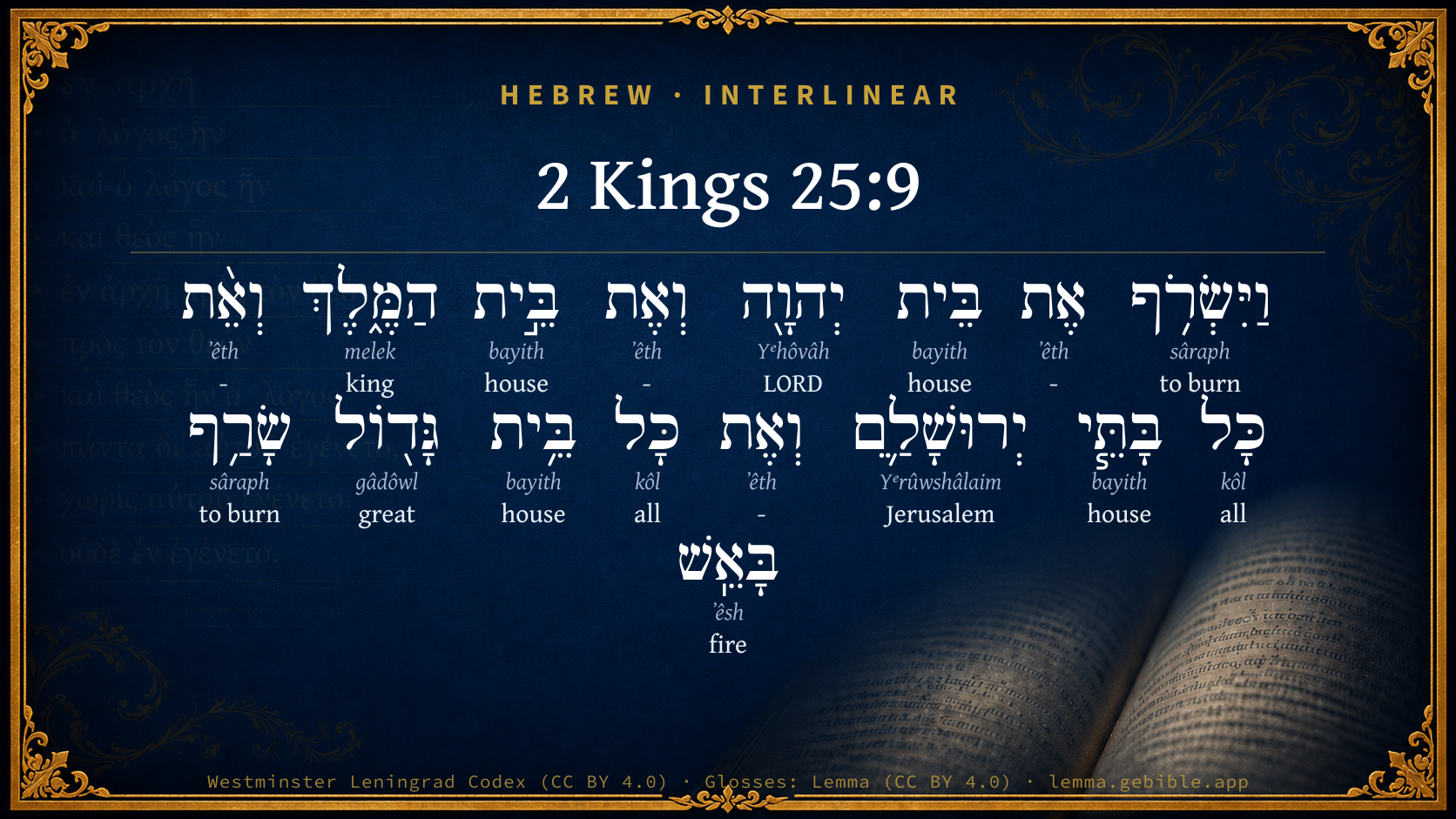
Hebrew (Westminster Leningrad Codex) 2 Kings 25:9 appears in the Hebrew Old Testament. The text above is from the Westminster Leningrad Codex. Each word links to its Strong’s number, a concise gloss, and parsing drawn from the Open Scriptures Hebrew Bible morphology. Click any word for its full Brown-Driver-Briggs (BDB) entry.
Download image
Cite this verse

2 Kings 25:9 (World English Bible). Public Domain. Lemma interlinear Bible study tool, https://lemma.gebible.app/v/2-kings/25/9.

Show BibTeX & RIS
BibTeX
RIS
English Translation
He burnt the house of Yahweh, and the king's house; and all the houses of Jerusalem, even every great house, burnt he with fire.
World English Bible · Public Domain
Download a study sheet

One document with this verse’s original text, its word-by-word gloss line, the meaning frame, cross-references with their text, attributed commentary, and full source and license credits — printable, and it pastes into notes with its structure intact.

This verse Autodidact and up

Study sheet (.html) Plain text (.txt)

A passage Seminary Student

Up to 50 verses in one chapter. A passage sheet keeps up to 6 commentary sources and 12 cross-references per verse, in the order this page ranks them, and says so on the sheet whenever that leaves anything out. Ask for a single verse and you get the Autodidact verse sheet above.

Everything on this page stays free to read, with no account — the sheet is a download of what is already on screen, not access to it.

Want to remove ads? Support Godless Engineer
Compare translations 3

The same verse in 3 English versions, stacked beneath the original-language interlinear above. Click any original word for its lexicon entry.

Each is an independent rendering of the whole verse — the interlinear is not word-aligned to these translations.

Highlighted words mark where these versions differ — a whole-verse word diff, not a word-by-word alignment.

  • World English Bible Public Domain
    He burnt the house of Yahweh, and the king's house; and all the houses of Jerusalem, even every great house, burnt he with fire.
  • King James Version Public Domain
    And he burnt the house of the LORD, and the king's house, and all the houses of Jerusalem, and every great man's house burnt he with fire.
  • unfoldingWord Literal Text CC BY-SA 4.0
    And he burned the house of Yahweh and the house of the king. And all of the houses of Jerusalem and every house of the great, he burned with fire.

unfoldingWord Literal Text — © unfoldingWord, licensed CC BY-SA 4.0. Word-aligned USFM3 via Door43 (git.door43.org/unfoldingWord/en_ult).

Versions to compare (up to 4)

3 of 4 selected

Show all 18 translations

Every available English version of this verse, each an independent rendering of the whole verse.

  • World English Bible Public Domain
    He burnt the house of Yahweh, and the king's house; and all the houses of Jerusalem, even every great house, burnt he with fire.
  • Berean Standard Bible Public Domain
    He burned down the house of the LORD, the royal palace, and all the houses of Jerusalem—every significant building.
  • Majority Standard Bible Public Domain
    He burned down the house of the LORD, the royal palace, and all the houses of Jerusalem—every significant building.
  • King James Version Public Domain
    And he burnt the house of the LORD, and the king's house, and all the houses of Jerusalem, and every great man's house burnt he with fire.
  • American Standard Version (1901) Public Domain
    And he burnt the house of Jehovah, and the king's house; and all the houses of Jerusalem, even every great house, burnt he with fire.
  • Revised Version (1885) Public Domain
    And he burnt the house of the LORD, and the king’s house; and all the houses of Jerusalem, even every great house, burnt he with fire.
  • Geneva Bible (1599) Public Domain
    And burnt the house of the Lord, and the Kings house, and all the houses of Ierusalem, and all the great houses burnt he with fire.
  • Douay-Rheims (1899) Public Domain
    And he burnt the house of the Lord, and the king's house, and the houses of Jerusalem, and every house he burnt with fire.
  • Young's Literal Translation Public Domain
    and he burneth the house of Jehovah, and the house of the king, and all the houses of Jerusalem, yea, every great house he hath burned with fire;
  • Literal Standard Version CC BY-SA 4.0
    and he burns the house of YHWH, and the house of the king, and all the houses of Jerusalem, indeed, he has burned every great house with fire;
  • Unlocked Literal Bible CC BY-SA 4.0
    He burned the house of Yahweh, the king's palace, and all the houses of Jerusalem; also every important building in the city he burned.
  • unfoldingWord Literal Text CC BY-SA 4.0
    And he burned the house of Yahweh and the house of the king. And all of the houses of Jerusalem and every house of the great, he burned with fire.
  • Darby Bible Public Domain
    and he burned the house of Jehovah, and the king's house, and all the houses of Jerusalem; and every great [man's] house he burned with fire.
  • World Messianic Bible Public Domain
    He burned the LORD’s house, the king’s house, and all the houses of Jerusalem. He burned every great house with fire.
  • Webster's Bible Public Domain
    And he burnt the house of the LORD, and the king's house, and all the houses of Jerusalem, and every great man's house he burnt with fire.
  • Free Bible Version CC BY-SA 4.0
    He burned down the Lord's Temple, the royal palace, and all the large buildings of Jerusalem.
  • Bible in Basic English Public Domain
    And he had the house of the Lord and the king's house and all the houses of Jerusalem, even every great house, burned with fire;
  • JPS Tanakh (1917) Public Domain
    And he burnt the house of the LORD, and the king's house; and all the houses of Jerusalem, even every great man's house, burnt he with fire.

Literal Standard Version (2020), Covenant Press — licensed CC BY-SA 4.0. Text via the HelloAO Bible API (eBible.org). Unlocked Literal Bible (unfoldingWord) — licensed CC BY-SA 4.0. Text via the HelloAO Bible API (eBible.org). unfoldingWord Literal Text — © unfoldingWord, licensed CC BY-SA 4.0. Word-aligned USFM3 via Door43 (git.door43.org/unfoldingWord/en_ult). Free Bible Version, Dr. Jonathan Gallagher — licensed CC BY-SA 4.0. Text via the HelloAO Bible API (eBible.org).

Word by word

More ways to search: Search by grammar → Find every occurrence → Compare this word →

Practice this passage: Drill this verse → Learn its vocabulary →

וַיִּשְׂרֹ֥ף
sâraph
H8313
“and · to burn”
Conjunction + Verb, Qal, Sequential Imperfect, 3rd Person, Masculine, Singular
Part of Speech
Conjunction + Verb
Stem
Qal
Form
Sequential Imperfect
Person
3rd Person
Gender
Masculine
Number
Singular
Full BDB Definition

Origin: a primitive root

TWOT: 2292

to burn - (Qal) to burn - (Niphal) to be burned - (Piel) burner, burning (participle) - (Pual) to be burnt up, be burned
  1. אֶת ʼêth H853 “-” Particle, Direct Object
  2. בֵּית bayith H1004 “house of” Noun, Common, Masculine, Singular, Construct
  3. יְהוָ֖ה Yᵉhôvâh H3068 “LORD” Noun, Proper
  4. וְאֶת ʼêth H853 “and · -” Conjunction + Particle, Direct Object
  5. בֵּ֣ית bayith H1004 “house of” Noun, Common, Masculine, Singular, Construct
  6. הַמֶּ֑לֶךְ melek H4428 “the · king” Particle, Definite Article + Noun, Common, Masculine, Singular, Absolute
  7. וְאֵ֨ת ʼêth H853 “and · -” Conjunction + Particle, Direct Object
  8. כָּל kôl H3605 “all of” Noun, Common, Masculine, Singular, Construct
  9. בָּתֵּ֧י bayith H1004 “houses of” Noun, Common, Masculine, Plural, Construct
  10. יְרוּשָׁלִַ֛ם Yᵉrûwshâlaim H3389 “Jerusalem” Noun, Proper
  11. וְאֶת ʼêth H853 “and · -” Conjunction + Particle, Direct Object
  12. כָּל kôl H3605 “all of” Noun, Common, Masculine, Singular, Construct
  13. בֵּ֥ית bayith H1004 “house of” Noun, Common, Masculine, Singular, Construct
  14. גָּד֖וֹל gâdôwl H1419 “great” Adjective, Adjective, Masculine, Singular, Absolute
  15. שָׂרַ֥ף sâraph H8313 “to burn” Verb, Qal, Perfect, 3rd Person, Masculine, Singular
  16. בָּאֵֽשׁ ʼêsh H784 “in/at the · fire” Preposition, Determined + Noun, Common, Both, Singular, Absolute

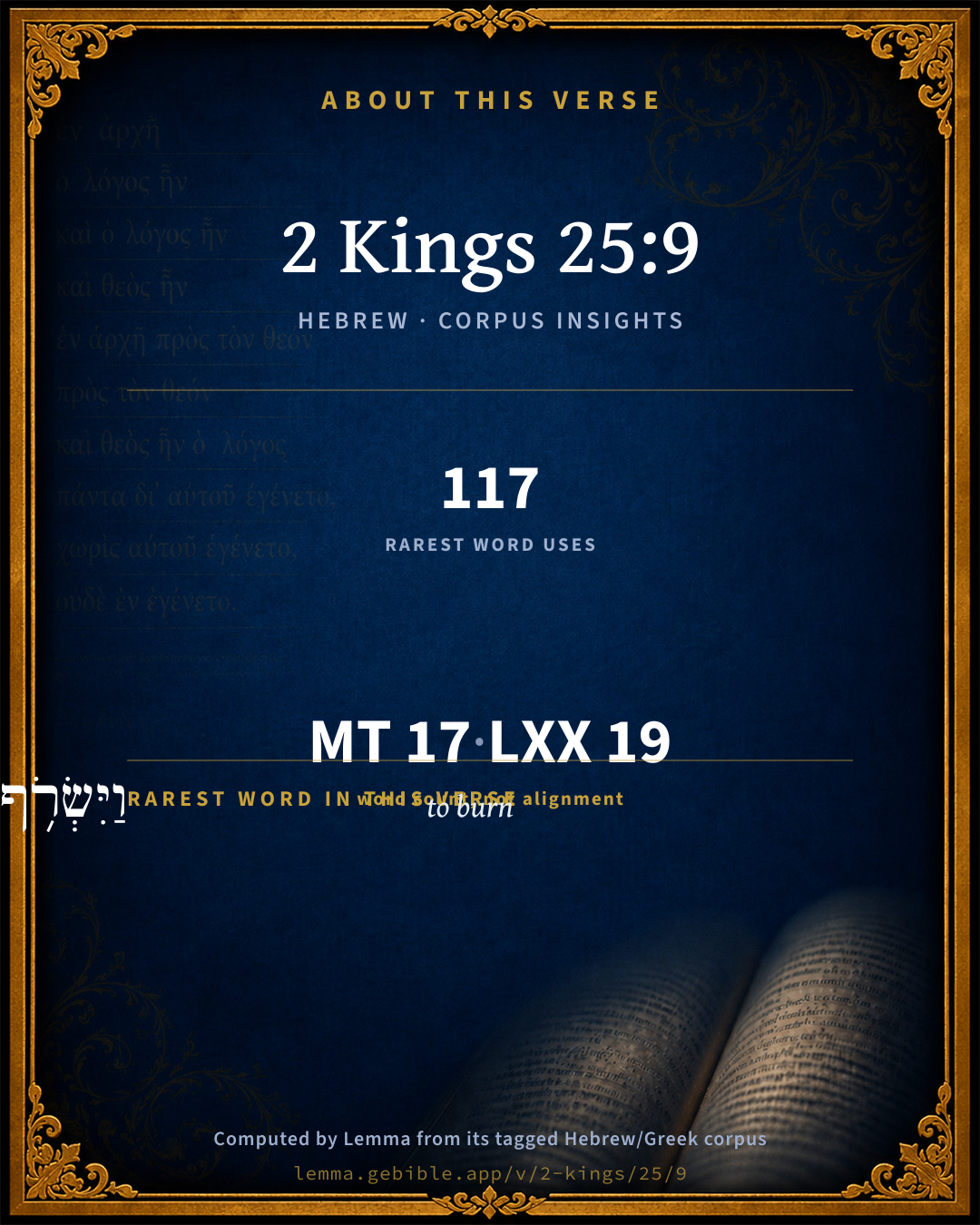
About this verse

These counts appear in no published source. They are computed here, from the morphology-tagged text and Lemma’s own curated glosses. What Lemma adds →

17
words
9
distinct lemmas
Historical
section

Grammatical profile

  • 2 verbs
  • 10 nouns
  • 1 adjective
  • 4 particles

Verb forms

  • וַיִּשְׂרֹ֥ף Qal · Sequential Imperfect
  • שָׂרַ֥ף Qal · Perfect

Repetition

Words recur within this verse — often emphatic in Hebrew:

  • בֵּית house H1004 ×4
  • וַיִּשְׂרֹ֥ף to burn H8313 ×2
  • כָּל all H3605 ×2

Hebrew & Septuagint length

In English translation the verse runs 24 words from the Hebrew and 28 from the Septuagint (LXX English) — closely comparable.

A rough comparison of the two English renderings, which tokenize alike — not a word-level alignment.

Word counts can differ between the Hebrew and the Greek without any difference in meaning — e.g. the Hebrew direct-object marker אֵת has no separate Greek word, and Greek often adds the article ὁ.

In the original languages it is 17 Hebrew tokens and 19 Greek tokens — but the two are counted differently (Hebrew bundles its prefixes and suffixes into one token; the Greek is in lemma form), so that isn’t a like-for-like length.

Cross-references

18

Topical passages linked to 2 Kings 25:9 in the Treasury of Scripture Knowledge — connected by theme and wording, ordered by reader-vote popularity; previews shown in the World English Bible.

  • Psalms 74:3–7 Lift up your feet to the perpetual ruins, All the evil that the enemy has done in the sanctuary.
  • Amos 2:5 But I will send a fire on Judah, And it will devour the palaces of Jerusalem."
  • 1 Kings 9:8 Though this house is so high, yet shall everyone who passes by it be astonished, and shall hiss; and they shall say, Why has Yahweh done thus to this land, and to this house?
  • 2 Chronicles 36:19 They burnt the house of God, and broke down the wall of Jerusalem, and burnt all the palaces of it with fire, and destroyed all the goodly vessels of it.
  • Psalms 79:1 God, the nations have come into your inheritance. They have defiled your holy temple. They have laid Jerusalem in heaps.
  • Micah 3:12 Therefore Zion for your sake will be plowed like a field, And Jerusalem will become heaps of rubble, And the mountain of the temple like the high places of a forest.
  • Isaiah 64:10–11 Your holy cities are become a wilderness, Zion is become a wilderness, Jerusalem a desolation.
  • Jeremiah 34:22 Behold, I will command, says Yahweh, and cause them to return to this city; and they shall fight against it, and take it, and burn it with fire: and I will make the cities of Judah a desolation, without inhabitant.
  • Jeremiah 37:8 The Chaldeans shall come again, and fight against this city; and they shall take it, and burn it with fire.
  • Jeremiah 37:10 For though you had struck the whole army of the Chaldeans who fight against you, and there remained but wounded men among them, yes would they rise up every man in his tent, and burn this city with fire.
  • Jeremiah 52:13 and he burned the house of Yahweh, and the king's house; and all the houses of Jerusalem, even every great house, burned he with fire.
  • Acts 6:13–14 and set up false witnesses who said, "This man never stops speaking blasphemous words against this holy place and the law.
  • Jeremiah 7:14 therefore will I do to the house which is called by my name, in which you trust, and to the place which I gave to you and to your fathers, as I did to Shiloh.
  • Jeremiah 26:9 Why have you prophesied in the name of Yahweh, saying, This house shall be like Shiloh, and this city shall be desolate, without inhabitant? All the people were gathered to Jeremiah in the house of Yahweh.
  • Jeremiah 39:8 The Chaldeans burned the king's house, and the houses of the people, with fire, and broke down the walls of Jerusalem.
  • Lamentations 1:10 The adversary has spread out his hand on all her pleasant things: For she has seen that the nations are entered into her sanctuary, Concerning whom you did command that they should not enter into your assembly.
  • Lamentations 2:7 The Lord has cast off his altar, he has abhorred his sanctuary; He has given up into the hand of the enemy the walls of her palaces: They have made a noise in the house of Yahweh, as in the day of a solemn assembly.
  • Luke 21:5–6 As some were talking about the temple and how it was decorated with beautiful stones and gifts, he said,

Cross-references courtesy of OpenBible.info (CC BY 4.0).

Hebrew and Greek witnesses Masoretic Hebrew ↔ Greek Septuagint

The same verse in the two great witnesses to the Old Testament, shown verse-for-verse.

These are two independent witnesses, not word-aligned to each other, and the Septuagint is shown in lemma (dictionary) form.

Hebrew 2 Kings 25:9 Masoretic · Westminster Leningrad Codex

וַיִּשְׂרֹ֥ף אֶת בֵּית יְהוָ֖ה וְאֶת בֵּ֣ית הַמֶּ֑לֶךְ וְאֵ֨ת כָּל בָּתֵּ֧י יְרוּשָׁלִַ֛ם וְאֶת כָּל בֵּ֥ית גָּד֖וֹל שָׂרַ֥ף בָּאֵֽשׁ

He burnt the house of Yahweh, and the king's house; and all the houses of Jerusalem, even every great house, burnt he with fire.

World English Bible · Public Domain

Greek LXX 2 Kings 25:9 Septuagint · lemma form

καί ἐνπίμπρημι ὁ οἶκος κύριος καί ὁ οἶκος ὁ βασιλεύς καί πᾶς ὁ οἶκος ἰερουσαλήμ καί πᾶς οἶκος ἐνπίμπρημι

And he burnt the house of the Lord, and the king's house, and all the houses of Jerusalem, even every house did the captain of the guard burn.

LXX2012 (modern English Septuagint) · Public Domain

Hebrew: Westminster Leningrad Codex (CC BY 4.0). Greek: Septuagint (public domain); English from LXX2012 (modern English Septuagint) (Public Domain). How the Septuagint differs from the Hebrew →

Targum (Aramaic paraphrase)

1

The Targum is the ancient Jewish Aramaic paraphrase of the Hebrew Scriptures — an interpretive translation, not the Hebrew text itself. Onkelos (literal) and Pseudo-Jonathan (expansive) render the Torah, and Jonathan the Prophets. Coverage is partial: where no permissively-licensed English translation exists for a verse, only the Aramaic is shown. This is verse-level text, not a word-by-word alignment to the Hebrew.

  1. Targum Jonathan Prophets (Joshua–Malachi)
    וְאוֹקִיד יַת מַקְדְשָׁא דַייָ וְיַת בֵּית מַלְכָּא וְיַת כָּל בָּתֵּי יְרוּשְׁלֵם וְיַת כָּל בָּתֵּי רַבְרְבַיָא אוֹקִיר בְּנוּרָא:

    (no public-domain English translation for this verse)

    Targum Jonathan — Aramaic: “Mikraot Gedolot” (public domain). English: “Sefaria Community Translation” (CC0 1.0 (public-domain dedication)); “London "Chaldee Paraphrase," 1871” (public domain). Text via Sefaria.

Commentary

Notes on 2 Kings 25:9 from classic Christian and Jewish commentators (each source and its license shown beneath its notes). The classic Christian expositions comment on the surrounding passage and are grouped to its opening verse, so a note may address several verses; the Jewish commentaries on the Tanakh (Rashi and others) are per-verse, so they appear only where the commentator wrote on this verse.

Lemma curates 59 commentaries, every one of them public domain or Creative Commons licensed, each selected and text-cleaned for this edition rather than reprinted as found. About our sources →

Trapp's Complete Commentary

John Trapp

2Ki 25:9 And he burnt the house of the LORD, and the king’s house, and all the houses of Jerusalem, and every great [man’s] house burnt he with fire.

Ver. 9. And he burnt the house of the Lord.] Which had now stood about four hundred and fifty years. With this house were burnt, say some ancients, all the copies of the holy Scriptures; but that is not likely.

John Trapp, A Commentary or Exposition upon All the Books of the Old and New Testament (1647–1656) — public domain. Text from a community e-Sword module.

Joseph Benson's Commentary

2Ki 25:9. And he burnt the house of the Lord — The king of Babylon, it appears, did not design to send any colonies to people Judea, and therefore ordered Jerusalem to be laid in ashes, as a nest of rebels. “At the burning of the king’s house,” says Henry, “and the houses of the great men, one cannot much wonder, the inhabitants had by their sins kindled the fire of God’s wrath against them; but that the house of the Lord should perish in these flames, that that holy and beautiful house should be burned with fire, (Isa 64:11,) is very strange; that house which David prepared for, and which Solomon built, at such a vast expense; that house which had the eye and the heart of God perpetually upon it, (1Ki 9:3,) might not that have been snatched as a brand out of the burning? No, that will not be fireproof against God’s judgments; this stately structure must be laid in ashes, and it is probable the ark in it; for the enemies, probably having heard how dear the Philistines paid for the abusing it, durst not seize it; nor did any of its friends take care to preserve it; for then we should have heard of it again in the second temple.” The temple was burned four hundred years after the time that it was built, says Sir John Marsham; four hundred and twenty-four years three months and eight days, says Archbishop Usher; four hundred thirty years, says Abarbinel and other learned Jews; but Josephus computes the matter still higher; for he tells us that the temple was burned four hundred and seventy years six months and ten days after the building of it; one thousand and sixty years six months and ten days from the time of the Israelites coming out of the land of Egypt; one thousand nine hundred, and fifty years six months and ten days from the deluge; three thousand five hundred and thirty years six months and ten days from the creation; and he mentions it as a very remarkable circumstance, that the second temple was burned by the Romans in the same month and on the very same day of the month that this was set on fire by the Chaldeans, and, as some of the Jewish rabbis say, when the Levites were singing the very same passage, namely, He shall bring upon them their own iniquity, and shall cut them off in their own wickedness: yea, the Lord our God shall cut them off, Psa 94:23. By the burning of the temple, God would show how little he cares for the external pomp of his worship, when the life and power of religion are neglected. The people trusted to the temple, as if that would protect them in their sins, (Jer 7:4,) but God by this let them know that when they had profaned it, they would find it but a refuge of lies.

Joseph Benson's Commentary on the Old and New Testaments (1811–1818) — public domain. Text from a community e-Sword module.

Tyndale Open Study Notes

Tyndale Open Resources

25:9-10 destroyed all the important buildings: The Babylonians destroyed key religious and civic buildings to discourage further resistance or insurrection, and they demolished the city’s walls, leaving Jerusalem defenseless.

Tyndale Open Study Notes — © Tyndale Open Resources, licensed CC BY-SA 4.0. Text via the HelloAO Bible API.

Ellicott's Commentary for English Readers

(9) He burnt the house . . . king’s house.—Which were in the upper city. (There should be a semicolon after “king’s house.”)

And every great man’s house.—Omit man’s. The phrase limits the preceding one, “all the houses of Jerusalem,” that is to say, “every great house” (2Ch_36:19, “all her palaces”). The common houses were spared for the poor who were left (2Ki_25:12).

A Bible Commentary for English Readers, edited by Charles John Ellicott (1878–1897) — public domain. Text from a community e-Sword module.

The Cambridge Bible for Schools and Colleges

gen. ed. J. J. S. Perowne

9. every great man’s house burnt he with fire] R.V. omits ‘man’s’. The expression in 2 Chronicles is ‘he burnt all the palaces thereof with fire’.

The Cambridge Bible for Schools and Colleges (gen. ed. J. J. S. Perowne; Cambridge University Press, 1878–1918) — public domain. Text from a community e-Sword module.

Albert Barnes' Notes on the Bible

He burnt the house of the Lord - Compare the prophecies of Jeremiah Jer 21:10; Jer 34:2; Jer 38:18, Jer 38:23. Psa 79:1-13 is thought to have been written soon after this destruction of the temple.

Albert Barnes' Notes on the Bible (1834–1885) — public domain. Text from a community e-Sword/MySword module.

Haydock's Catholic Bible Commentary

Great. This word is supplied from Jeremias lii. 13., and Hebrew, "great man’s house." (Protestants) But Jeremias xxxix. 8., we read, they burnt the houses of the people, (Haydock) even the meanest, destroyed the walls, and took the people to Babylon, only leaving some countrymen to cultivate the land. Jeremias was set at liberty by Nabuzardan, (ibid. xi.[Jeremias xxxix. 9.?]) and chose to continue with this remnant of the people, for their comfort and direction. (Haydock) --- They applied to him to know whether they should retire into Egypt; and after ten days, he gave them God’s injunction to the contrary: but they despised it, Jeremias xlii. 7., and xliii. 1. The prophet, and his secretary, Baruch, followed them into Egypt. Thus was the country abandoned, and the monarchy at an end, after it had subsisted 468 years from the commencement of David’s reign. (Calmet) --- Yet some little power remained in the family of David, even at Babylon; (ver. 27.) and the Jewish affairs were re-established, after the captivity, though not in such splendour as formerly, nor always under princes of the same royal family. (Haydock)

George Leo Haydock (1774–1849), Haydock's Catholic Family Bible and Commentary, 1859 edition — public domain. Excludes Psalms (Douay-Rheims chapter numbering differs from Protestant) and Deuterocanonical books (Catholic canon only).

Matthew Poole's English Annotations

He burnt the house of the Lord, which had now stood about four hundred and fifty years.

Matthew Poole's English Annotations on the Holy Bible (1683–1685) — public domain. Text from a community e-Sword/MySword module.

Whedon's Commentary on the Bible

Daniel D. Whedon

9. All the houses of Jerusalem — All the principal houses, or, as the next sentence explains, the houses of all the chief citizens. 2Ch_36:19 has, all the palaces. Thus all the architectural glory of the ancient Jerusalem — temple, palaces, and noble edifices — was reduced to a mass of ruins.

Daniel D. Whedon (gen. ed.), Commentary on the Old and New Testaments (1874–1909) — public domain. Text from a community e-Sword module.

The Pulpit Commentary

And he burnt the house of the Lord. After it had stood, according to Josephus ("Ant. Jud:," 10:8. four hundred and seventy years six months and ten days. This calculation, however, seems to exceed the truth. Neither the Assyrians nor the Babylonians had any regard for the gods of other nations. They everywhere burnt the temples, plundered the shrines, and carried off the images as trophies of victory. In the temple of Jerusalem they would find no images except those of the two cherubim, (1Ki_6:23-28) which they probably took away with them. And the king"s house (see 1Ki_7:1, 1Ki_7:8-12; 2Ki_11:16) The royal palace was, perhaps, almost as magnificent as the temple; and its destruction was almost as great a loss to art. It doubtless contained Solomon"s throne of ivory, (1Ki_10:18) to which there was an ascent by six steps, with two sculptured lions on each step. And all the houses of Jerusalem. This statement is qualified by the words of the following clause, which show that only the houses of the princes and great men were purposely set on fire. Many of the remaining habitations may have perished in the conflagration, but some probably escaped, and were inhabited by "the poor of the land." And every great man"s house burnt he with fire. (comp. 2Ch_36:19, where the Chaldeans are said to have burnt "all the palaces

The Pulpit Commentary (1880–1919), ed. H.D.M. Spence-Jones & Joseph S. Exell — public domain. Text from a community e-Sword module.

John Wesley's Explanatory Notes

Burnt the house of the Lord - One of the apocryphal writers tells us, that Jeremiah got the ark out of the temple, and conveyed it to a cave in mount Nebo, 2Macc ii, 4, 5. But this is like the other tales of that author, who has no regard either to truth or probability. For Jeremiah was at this time a close prisoner. By the burning of the temple God would shew, how little he cares for the outward pomp of his worship, when the life and power of religion are gone. About four hundred and thirty years the temple of Solomon had stood. And it is observed by Josephus, that the second temple was burnt by the Romans, the same month, and the same day of the month, that the first temple was burnt by the Chaldeans.

John Wesley, Explanatory Notes Upon the Whole Bible (1754–1765) — public domain. Text via the GEBible commentary corpus.

Rashi

Rabbi Shlomo Yitzchaki (Rashi)

And all the houses of the dignitaries. [This includes] synagogues wherein Torah and prayer are aggrandized, and the houses of the princes.

Rashi on the Tanakh — English translations: “The Judaica Press complete Tanach with Rashi, translated by A. J. Rosenberg” (CC BY 4.0); “Pentateuch with Rashi's commentary by M. Rosenbaum and A.M. Silbermann, 1929-1934” (public domain); “The Metsudah Tanach series, Lakewood, N.J” (CC BY 4.0); and “The Book of Joshua, Metsudah Publications, 1997” (CC BY 4.0). Text via Sefaria.

Lesson kit

Teaching starters — assembled from the data on this page, not authored interpretation. Every prompt links to the verse data it draws on. Edit before teaching.

2 Kings, in the Historical, opens this verse with 17 words (9 distinct Hebrew lemmas). Its most distinctive word is sâraph (“to burn”). A historical commentator’s framing appears above. Read the whole chapter for the surrounding context.

Discussion questions

  1. What does “to burn” (sâraph) contribute to the verse as a whole?
  2. Psalms 74:3–7 shares this passage’s theme. How do the two illuminate each other?
  3. “house” occurs 4× in this one verse. What is the effect of the repetition?
  4. These translations render this verse differently. What is at stake in choosing one wording over another?
  5. The verb «וַיִּשְׂרֹ֥ף» is Qal Sequential Imperfect. How does its form color the action?
  6. Reading how Trapp's Complete Commentary and Joseph Benson's Commentary read this verse, where do the two commentators agree and where do they part?

Things to notice

Reading settings

Reading text

Shown beneath each verse's original-language words.

Old Testament
Old Testament edition

Read the OT as the Masoretic Hebrew (MT) or the Greek Septuagint (LXX).

English shown for the Greek Septuagint (in the Hebrew ↔ Greek comparison).

Comparing translations? Open the Compare panel on any verse page to stack up to four side by side.