2 Chronicles 30:13

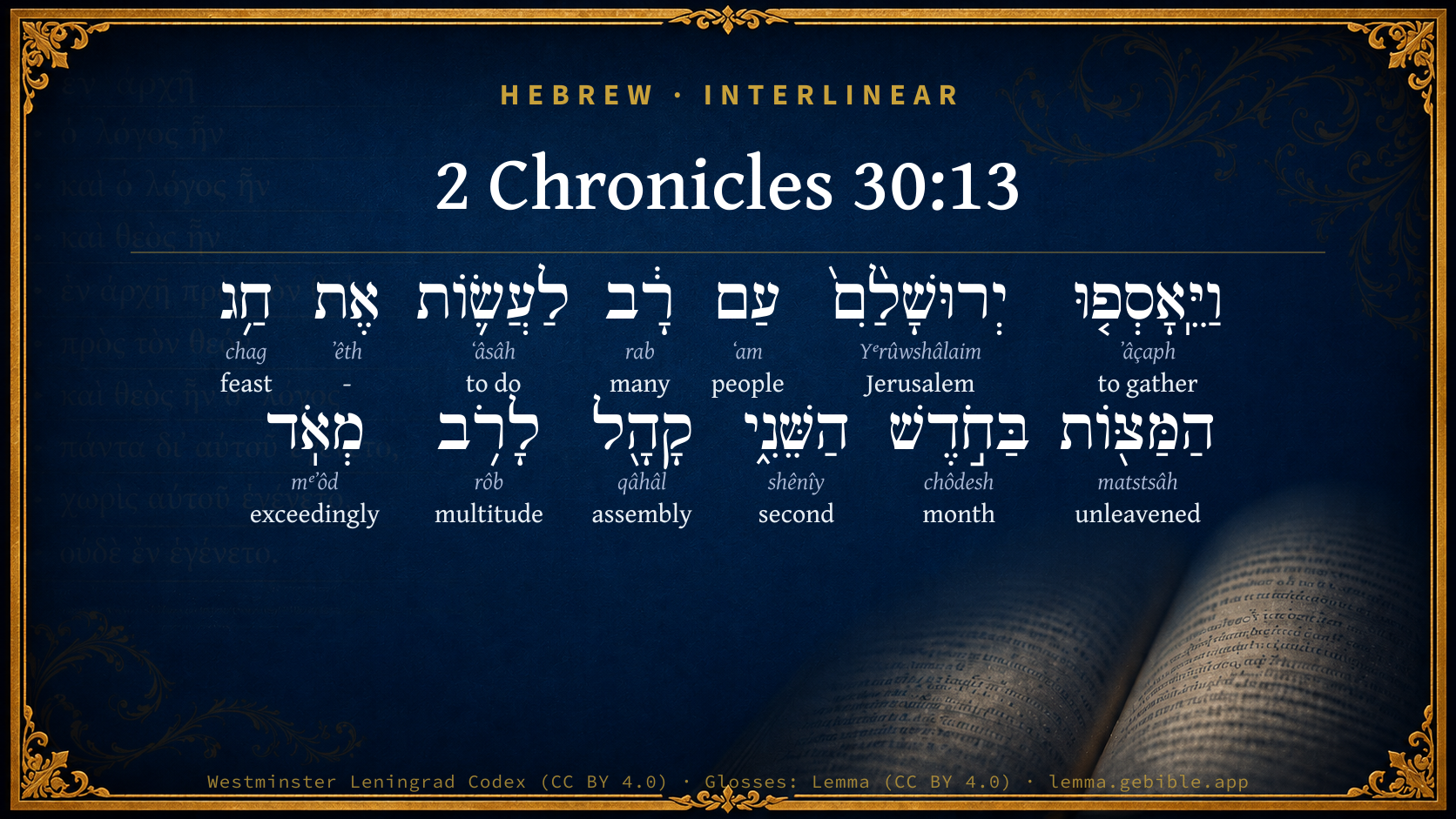
Hebrew (Westminster Leningrad Codex) 2 Chronicles 30:13 appears in the Hebrew Old Testament. The text above is from the Westminster Leningrad Codex. Each word links to its Strong’s number, a concise gloss, and parsing drawn from the Open Scriptures Hebrew Bible morphology. Click any word for its full Brown-Driver-Briggs (BDB) entry.
Download image
Cite this verse

2 Chronicles 30:13 (World English Bible). Public Domain. Lemma interlinear Bible study tool, https://lemma.gebible.app/v/2-chronicles/30/13.

Show BibTeX & RIS
BibTeX
RIS
English Translation
There assembled at Jerusalem much people to keep the feast of unleavened bread in the second month, a very great assembly.
World English Bible · Public Domain
Download a study sheet

One document with this verse’s original text, its word-by-word gloss line, the meaning frame, cross-references with their text, attributed commentary, and full source and license credits — printable, and it pastes into notes with its structure intact.

This verse Autodidact and up

Study sheet (.html) Plain text (.txt)

A passage Seminary Student

Up to 50 verses in one chapter. A passage sheet keeps up to 6 commentary sources and 12 cross-references per verse, in the order this page ranks them, and says so on the sheet whenever that leaves anything out. Ask for a single verse and you get the Autodidact verse sheet above.

Everything on this page stays free to read, with no account — the sheet is a download of what is already on screen, not access to it.

Want to remove ads? Support Godless Engineer
Compare translations 3

The same verse in 3 English versions, stacked beneath the original-language interlinear above. Click any original word for its lexicon entry.

Each is an independent rendering of the whole verse — the interlinear is not word-aligned to these translations.

Highlighted words mark where these versions differ — a whole-verse word diff, not a word-by-word alignment.

  • World English Bible Public Domain
    There assembled at Jerusalem much people to keep the feast of unleavened bread in the second month, a very great assembly.
  • King James Version Public Domain
    And there assembled at Jerusalem much people to keep the feast of unleavened bread in the second month, a very great congregation.
  • unfoldingWord Literal Text CC BY-SA 4.0
    And many people gathered in Jerusalem to do the Feast of the Unleavened Bread in the second month, a very abundant assembly.

unfoldingWord Literal Text — © unfoldingWord, licensed CC BY-SA 4.0. Word-aligned USFM3 via Door43 (git.door43.org/unfoldingWord/en_ult).

Versions to compare (up to 4)

3 of 4 selected

Show all 18 translations

Every available English version of this verse, each an independent rendering of the whole verse.

  • World English Bible Public Domain
    There assembled at Jerusalem much people to keep the feast of unleavened bread in the second month, a very great assembly.
  • Berean Standard Bible Public Domain
    In the second month, a very great assembly gathered in Jerusalem to celebrate the Feast of Unleavened Bread.
  • Majority Standard Bible Public Domain
    In the second month, a very great assembly gathered in Jerusalem to celebrate the Feast of Unleavened Bread.
  • King James Version Public Domain
    And there assembled at Jerusalem much people to keep the feast of unleavened bread in the second month, a very great congregation.
  • American Standard Version (1901) Public Domain
    And there assembled at Jerusalem much people to keep the feast of unleavened bread in the second month, a very great assembly.
  • Revised Version (1885) Public Domain
    And there assembled at Jerusalem much people to keep the feast of unleavened bread in the second month, a very great congregation.
  • Geneva Bible (1599) Public Domain
    And there assembled to Ierusalem much people, to keepe the feast of ye vnleauened bread in the second moneth, a very great assemblie.
  • Douay-Rheims (1899) Public Domain
    But the hand of God was in Juda, to give them one heart to do the word of the Lord, according to the commandment of the king, and of the princes.
  • Young's Literal Translation Public Domain
    and much people are gathered to Jerusalem, to make the feast of unleavened things in the second month -- a mighty assembly for multitude.
  • Literal Standard Version CC BY-SA 4.0
    and many people are gathered to Jerusalem to make the Celebration of Unleavened Things in the second month—a mighty assembly for multitude.
  • Unlocked Literal Bible CC BY-SA 4.0
    Many people, a very great assembly, gathered in Jerusalem to celebrate the Festival of Unleavened Bread in the second month.
  • unfoldingWord Literal Text CC BY-SA 4.0
    And many people gathered in Jerusalem to do the Feast of the Unleavened Bread in the second month, a very abundant assembly.
  • Darby Bible Public Domain
    And there assembled at Jerusalem much people to hold the feast of unleavened bread in the second month, a very great congregation.
  • World Messianic Bible Public Domain
    Many people assembled at Jerusalem to keep the feast of unleavened bread in the second month, a very great assembly.
  • Webster's Bible Public Domain
    And there assembled at Jerusalem many people to keep the feast of unleavened bread in the second month, a very great congregation.
  • Free Bible Version CC BY-SA 4.0
    Many people gathered in Jerusalem to celebrate the Feast of Unleavened Bread in the second month—a really large crowd.
  • Bible in Basic English Public Domain
    So a very great number of people came together at Jerusalem to keep the feast of unleavened bread in the second month.
  • JPS Tanakh (1917) Public Domain
    And there assembled at Jerusalem much people to keep the feast of unleavened bread in the second month, a very great congregation.

Literal Standard Version (2020), Covenant Press — licensed CC BY-SA 4.0. Text via the HelloAO Bible API (eBible.org). Unlocked Literal Bible (unfoldingWord) — licensed CC BY-SA 4.0. Text via the HelloAO Bible API (eBible.org). unfoldingWord Literal Text — © unfoldingWord, licensed CC BY-SA 4.0. Word-aligned USFM3 via Door43 (git.door43.org/unfoldingWord/en_ult). Free Bible Version, Dr. Jonathan Gallagher — licensed CC BY-SA 4.0. Text via the HelloAO Bible API (eBible.org).

Word by word

More ways to search: Search by grammar → Find every occurrence → Compare this word →

Practice this passage: Drill this verse → Learn its vocabulary →

הַמַּצּ֖וֹת
matstsâh
H4682
“the · unleavened bread”
Particle, Definite Article + Noun, Common, Feminine, Plural, Absolute
Part of Speech
Particle + Noun
Type
Common
Gender
Feminine
Number
Plural
State
Absolute
Full BDB Definition

Origin: from H4711 in the sense of greedily devouring for sweetness

TWOT: None

unleavened (bread, cake), without leaven.
  1. וַיֵּֽאָסְפ֤וּ ʼâçaph H622 “and · to gather” Conjunction + Verb, Niphal, Sequential Imperfect, 3rd Person, Masculine, Plural
  2. יְרוּשָׁלִַ֨ם֙ Yᵉrûwshâlaim H3389 “Jerusalem” Noun, Proper
  3. עַם ʻam H5971 “people” Noun, Common, Masculine, Singular, Absolute
  4. רָ֔ב rab H7227 “many” Adjective, Adjective, Masculine, Singular, Absolute
  5. לַעֲשׂ֛וֹת ʻâsâh H6213 “to do” Preposition + Verb, Qal, Infinitive Construct
  6. אֶת ʼêth H853 “-” Particle, Direct Object
  7. חַ֥ג chag H2282 “feast of” Noun, Common, Masculine, Singular, Construct
  8. בַּחֹ֣דֶשׁ chôdesh H2320 “in/at the · month” Preposition, Determined + Noun, Common, Masculine, Singular, Absolute
  9. הַשֵּׁנִ֑י shênîy H8145 “the · second” Particle, Definite Article + Adjective, Ordinal number, Masculine, Singular, Absolute
  10. קָהָ֖ל qâhâl H6951 “assembly” Noun, Common, Masculine, Singular, Absolute
  11. לָרֹ֥ב rôb H7230 “to/for · multitude” Preposition + Noun, Common, Both, Singular, Absolute
  12. מְאֹֽד mᵉʼôd H3966 “exceedingly” Adverb

About this verse

These counts appear in no published source. They are computed here, from the morphology-tagged text and Lemma’s own curated glosses. What Lemma adds →

13
words
13
distinct lemmas
Historical
section

Shared distinctive vocabulary

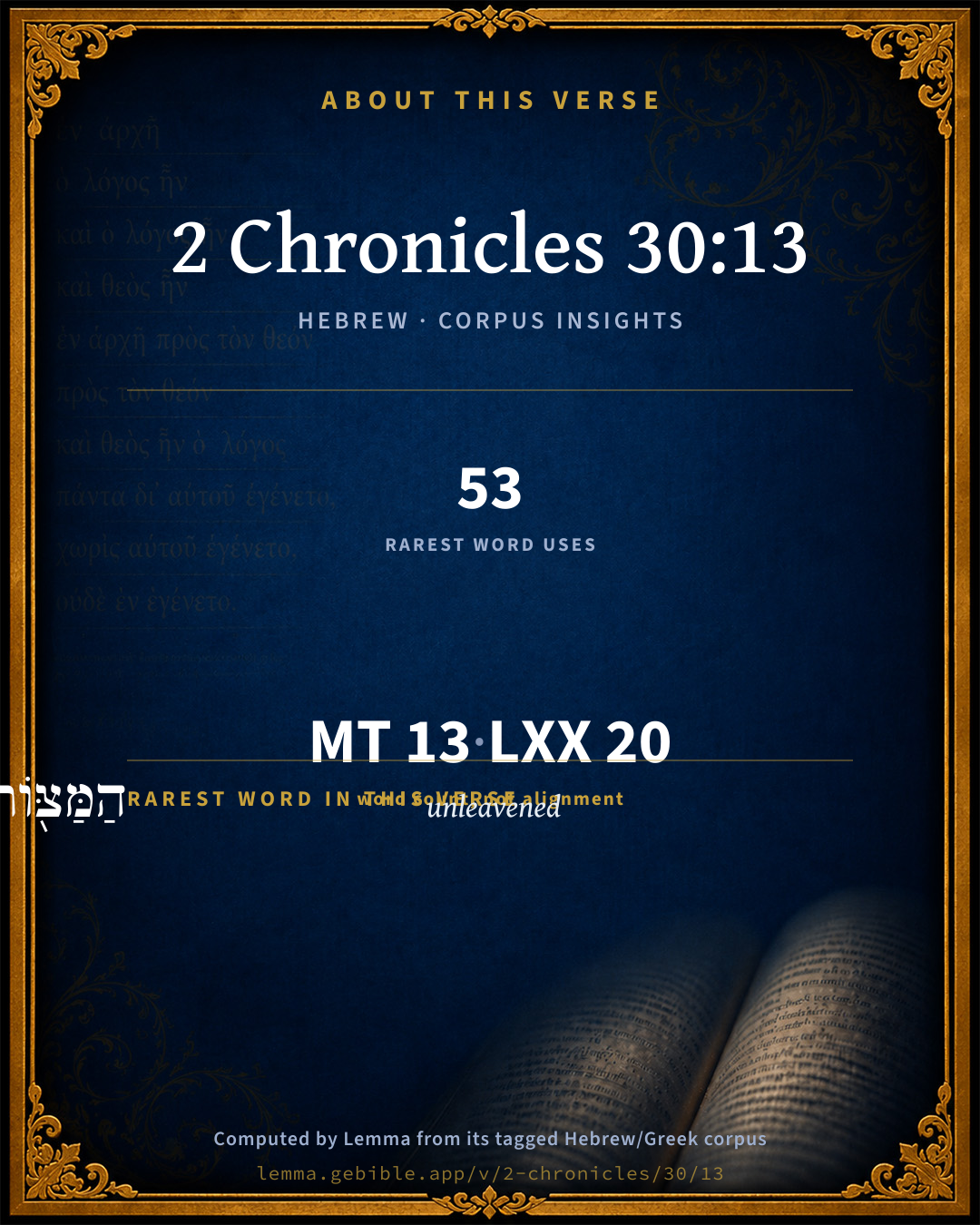
הַמַּצּ֖וֹת unleavened H4682 occurs in 42 verses of the Hebrew Bible. Also found in:

Grammatical profile

  • 2 verbs
  • 7 nouns
  • 2 adjectives
  • 1 adverb
  • 1 particle

Verb forms

  • וַיֵּֽאָסְפ֤וּ Niphal · Sequential Imperfect
  • לַעֲשׂ֛וֹת Qal · Infinitive Construct

Hebrew & Septuagint length

In English translation the verse runs 21 words from the Hebrew and 23 from the Septuagint (LXX English) — closely comparable.

A rough comparison of the two English renderings, which tokenize alike — not a word-level alignment.

Word counts can differ between the Hebrew and the Greek without any difference in meaning — e.g. the Hebrew direct-object marker אֵת has no separate Greek word, and Greek often adds the article ὁ.

In the original languages it is 13 Hebrew tokens and 20 Greek tokens — but the two are counted differently (Hebrew bundles its prefixes and suffixes into one token; the Greek is in lemma form), so that isn’t a like-for-like length.

Cross-references

2

Topical passages linked to 2 Chronicles 30:13 in the Treasury of Scripture Knowledge — connected by theme and wording, ordered by reader-vote popularity; previews shown in the World English Bible.

  • 2 Chronicles 30:2 For the king had taken counsel, and his princes, and all the assembly in Jerusalem, to keep the Passover in the second month.
  • Psalms 84:7 They go from strength to strength. Everyone of them appears before God in Zion.

Cross-references courtesy of OpenBible.info (CC BY 4.0).

Hebrew and Greek witnesses Masoretic Hebrew ↔ Greek Septuagint

The same verse in the two great witnesses to the Old Testament, shown verse-for-verse.

These are two independent witnesses, not word-aligned to each other, and the Septuagint is shown in lemma (dictionary) form.

Hebrew 2 Chronicles 30:13 Masoretic · Westminster Leningrad Codex

וַיֵּֽאָסְפ֤וּ יְרוּשָׁלִַ֨ם֙ עַם רָ֔ב לַעֲשׂ֛וֹת אֶת חַ֥ג הַמַּצּ֖וֹת בַּחֹ֣דֶשׁ הַשֵּׁנִ֑י קָהָ֖ל לָרֹ֥ב מְאֹֽד

There assembled at Jerusalem much people to keep the feast of unleavened bread in the second month, a very great assembly.

World English Bible · Public Domain

Greek LXX 2 Chronicles 30:13 Septuagint · lemma form

καί συνἄγω εἰς ἰερουσαλήμ λαός πολύς ὁ ποιέω ὁ ἑορτή ὁ ἄζυμος ἐν ὁ μήν ὁ δεύτερος ἐκκλησία πολύς σφόδρα

And a great multitude were gathered to Jerusalem to keep the feast of unleavened bread in the second month, a very great congregation.

LXX2012 (modern English Septuagint) · Public Domain

Hebrew: Westminster Leningrad Codex (CC BY 4.0). Greek: Septuagint (public domain); English from LXX2012 (modern English Septuagint) (Public Domain). How the Septuagint differs from the Hebrew →

Commentary

Notes on 2 Chronicles 30:13 from classic Christian and Jewish commentators (each source and its license shown beneath its notes). The classic Christian expositions comment on the surrounding passage and are grouped to its opening verse, so a note may address several verses; the Jewish commentaries on the Tanakh (Rashi and others) are per-verse, so they appear only where the commentator wrote on this verse.

Lemma curates 59 commentaries, every one of them public domain or Creative Commons licensed, each selected and text-cleaned for this edition rather than reprinted as found. About our sources →

Matthew Henry's Commentary

The time appointed for the passover having arrived, a very great congregation came together upon the occasion, Ch2 30:13. Now here we have,

I. The preparation they made for the passover, and good preparation it was: They took away all the idolatrous altars that were found, not only in the temple, but in Jerusalem, Ch2 30:14. Before they kept the feast, they cast out this old leaven. The best preparation we can make for the gospel passover is to cast away our iniquities, our spiritual idolatries.

II. The celebration of the passover. In this the people were so forward and zealous that the priests and Levites blushed to see themselves out-done by the commonalty, to see them more ready to bring sacrifices than they were to offer them. This put them upon sanctifying themselves (Ch2 30:15), that the work might not stand still for want of hands to carry it on. The notice we take of the zeal of others should make us ashamed of our own coldness, and quicken us not only to do our duty, but to do it well, and to sanctify ourselves to it. They did according to the duty of their place (Ch2 30:16), sprinkling the blood upon the altar, which was a type of Christ our passover sacrificed for us.

III. The irregularities they were guilty of in this solemnity. The substance was well managed, and with a great deal of devotion; but, besides that it was a month out of time, 1. The Levites killed the passover, which should have been done by the priests only, Ch2 30:17. They also assisted more than the law ordinarily allowed in offering the other sacrifices, particularly those that were for the purifying of the unclean, many of which there was now occasion for. Some think that it was the offerers' work, not the priests', that the Levites had here the charge of. Ordinarily every man killed his lamb, but now for those that were under any ceremonial pollution the Levites killed it. 2. Many were permitted to eat the passover who were not purified according to the strictness of the law, Ch2 30:18. This was the second month, and there was not warrant to put them off further to the third month, as, if it had been the first month, the law would have permitted them to eat it the second. And they were loth to forbid them communicating at all, lest they should discourage new converts, and send those away complaining whom they desired to send away rejoicing. Grotius observes from this that ritual institutions must give way, not only to a public necessity, but to a public benefit and advantage.

IV. Hezekiah's prayer to God for the forgiveness of this irregularity. It was his zeal that had called them together in such haste, and he would not that any should fare the worse for being straitened of time in their preparation. He therefore thought himself concerned to be an intercessor for those that ate the passover otherwise than it was written, that there might not be wrath upon them from the Lord. His prayer was,

1. A short prayer, but to the purpose: The good Lord pardon every one in the congregation that has fixed, engaged, or prepared, his heart to those services, though the ceremonial preparation be wanting. Note, (1.) The great thing required in our attendance upon God in solemn ordinances is that we prepare our hearts to seek him, that we be sincere and upright in all we do, that the inward man be engaged and employed in it, and that we make heart-work of it; it is all nothing without this. Behold, thou desirest truth in the inward part. Hezekiah does not pray that this might be dispensed with, nor that the want of other things might be pardoned where there was not this. For this is the one thing needful, that we seek God, his favour, his honour, and that we set our hearts to do it. (2.) Where this sincerity and fixedness of heart are there may still be many defects and infirmities, both the frame of the spirit and the performance of the service may be short of the purification of the sanctuary. Corruptions may not be so fully conquered, thoughts not so closely fixed, affections not so lively, faith not so operative, as they should be. Here is a defect in sanctuary purification. There is nothing perfect under the sun, nor a just man that doeth good, and sinneth not. (3.) These defects need pardoning healing grace; for omissions in duty are sins as well as omissions of duty. If God should deal with us in strict justice according to the best of our performances, we should be undone. (4.) The way to obtain pardon for our deficiencies in duty, and all the iniquities of our holy things, is to seek it of God by prayer; it is not so a pardon of course but that it must be obtained by petition through the blood of Christ. (5.) In this prayer we must take encouragement from the goodness of God: The good Lord pardon; for, when he proclaimed his goodness, he insisted most upon this branch of it, forgiving iniquity, transgression, and sin. (6.) It is the duty of those that have the charge of others, not only to look to themselves, but to those also that are under their charge, to see wherein they are wanting, and to pray for them, as Hezekiah here. See Job 1:5.

2. A successful prayer: The Lord hearkened to Hezekiah, was well pleased with his pious concern for the congregation, and, in answer to his prayer, healed the people (Ch2 30:20), not only did not lay their sin to their charge, but graciously accepted their services notwithstanding; for healing denotes not only forgiveness (Isa 6:10; Psa 103:3), but comfort and peace, Isa 57:18; Mal 4:2.

Matthew Henry's Commentary on the Whole Bible (1708–1710) — public domain (CC PDM 1.0). Text via the HelloAO Bible API.

Ellicott's Commentary for English Readers

THE PASSOVER AT JERUSALEM (2Ch_30:13-22).

(13) Much people.—A very great congregation—a congregation in great multitude (lârôb mĕ’ôd). (See on 2Ch_30:5.)

A Bible Commentary for English Readers, edited by Charles John Ellicott (1878–1897) — public domain. Text from a community e-Sword module.

Trapp's Complete Commentary

John Trapp

2Ch 30:13 And there assembled at Jerusalem much people to keep the feast of unleavened bread in the second month, a very great congregation.

Ver. 13. A very great congregation.] Brought thither by God’s holy hand; {2Ch 30:12} yea, the arm of the Lord was revealed unto them. {Isa 53:1}

John Trapp, A Commentary or Exposition upon All the Books of the Old and New Testament (1647–1656) — public domain. Text from a community e-Sword module.

The Cambridge Bible for Schools and Colleges

gen. ed. J. J. S. Perowne

13–27 (not in 2 Kin.). Hezekiah’s Great Passover

13. the feast of unleavened bread] In the “Passover” were united two separate “feasts,” (1) the eating of the lamb on the fourteenth of Nisan, (2) the eating of unleavened bread from the fourteenth to the twenty-first of Nisan. The combined Feast was sometimes called “the Passover” and sometimes (as here) “the feast of unleavened bread”; cp. Exo_12:1-14; Exo_12:17-20, and note that the intervening verses, 15, 16, bind the two feasts into one celebration.

The Cambridge Bible for Schools and Colleges (gen. ed. J. J. S. Perowne; Cambridge University Press, 1878–1918) — public domain. Text from a community e-Sword module.

John Gill's Exposition

And they arose,.... Before they slew and ate the passover:

and took away the altars that were in Jerusalem; which Ahaz had set up in every corner of Jerusalem, to offer sacrifices upon, Ch2 28:24.

and all the altars for incense took they away; for as there were some to offer sacrifices on, there were others to burn incense upon, not to the Lord, but to idols, as the Targum adds:

and cast them into the brook Kidron; having reduced them to dust and ashes, see Ch2 29:16.

John Gill's Exposition of the Whole Bible (1746–1763) — public domain (CC PDM 1.0). Text via the HelloAO Bible API.

The Pulpit Commentary

This verse purports to say that the total, at any rate, of the attendance on the Passover was very large.

Vers. 13-27.

A national Passover at Jerusalem.

I THE CELEBRATING CONGREGATION.

1. Large. "Much people; a very great congregation" (ver. 13). Though this was usual at the chief religious festivals of the nation, probably so vast a concourse of people as assembled at Jerusalem in answer to the king"s invitation, in the second month of the first or seventh year of his reign (see preceding homily), had not been witnessed since the days of Jehoiada (2Ch_23:2) or of Asa. (2Ch_15:9, 2Ch_15:10) Something stimulating and impressive in the sight of a crowded city, even when its seething population drifts aimlessly about, much more when all are swayed by a common feeling and moved by a common impulse.

2. Mixed. Composed of

(1) all the congregation of Judah, i.e. of the inhabitants of the metropolis and of the country districts of Judaea, with the priests and the Levites;

(2) all the congregation that came out of Israel, viz. a multitude of people from Ephraim and Manasseh, Issachar, and Zabulon (ver. 18); and

(3) the strangers, or proselytes who dwelt within the borders of Judah, and those who came from Israel or the northern kingdom (ver. 25).

1. United. All actuated by one purpose that of keeping the Feast of Unleavened Bread (ver. 13), which probably none of them in their lifetime had ever done. It was such a festival as could be rightly celebrated only by a united people, and such as was fitted to draw closer the bonds of union between the celebrants.

2. Resolute. Prepared to undergo any sacrifices and attempt any labours necessary to carry the feast through with success, determined to be hindered by nothing and no one from their great act of religious homage to the Lord God of their fathers (vers. 19, 22).

3. Joyous. Inspired with feelings of gladness (ver. 23), even "great gladness" (ver. 21), and "great joy" (ver. 26), which found expression in peace offerings and penitential confessions (ver. 22), accompanied by vocal and instrumental strains, and abated not during the seven days of the feast proper (ver. 21), but sustained the people throughout seven superadded days (ver. 23). Indeed, so high ran the enthusiasm, and so overflowing became the joy, that nothing like it had been witnessed since the days of Solomon, when the dedication of the temple had been celebrated by a double period of rejoicing. (2Ch_7:1-10) The occasion certainly was fitted to excite gladness the return of the nation to its allegiance to Jehovah. So is the soul"s return to God in penitence, faith, and holy obedience a cause of jubilation not only in heaven, (Luk_15:7, Luk_15:10) but also on earth; (Act_8:8) and not among spectators merely, but also in the souls of them who return (Luk_24:52; Rom_5:11) Moreover, the service of God and Christ should always be accompanied with gladness (Psa_100:2 Psa_149:2, Psa_149:5; Isa_12:3) as in gladness it will invariably result (Psa_64:10; Isa_48:18 Isa_51:11; Rom_14:17; 1Th_5:16)

II THE CELEBRATED FESTIVAL.

1. The zeal of the people.

(1) Necessary preparation. This consisted of two things the purgation of the city from idolatry, and the cleansing of themselves from defilement. The first they carried out with promptitude and decision arose and took away the altars" (ver. 14); and with thoroughgoing energy and efficiency which allowed of no escape took them all away," the altars for offering to heathen divinities, and the altars or "vessels" for incense, which Ahaz had erected in every corner of the city, (2Ch_28:24) and cast them into the Kidron, where already the filth of the temple had been thrown. (2Ch_29:16) Never in any previous reign had there been such a clearance of the instruments of idolatry as now occurred under Hezekiah. The second, though not mentioned, is implied, at least, of those who belonged to Judah (see ver. 17; and cf. on ver. 3). These, having had the means of self-sanctification at hand, most likely used them; those who came from Israel having not had such means, their want of sanctification was prayed for and overlooked (vers. 17-20).

(2) Statutory adoration. They killed the Passover on the fourteenth day of the second month (see on ver. 2). The heads of families in Judah who were sanctified killed their own Jambs and placed the blood in the priests" hands; for such as had not been cleansed according to the purification of the sactuary, the Levites killed the Passovers, and delivered the blood into the hands of the priests (ver. 17). These sprinkled the blood upon the altars.

2. The behaviour of the priests and Levites.

(1) Their sanctification of themselves. The priests and Levites were not those of Jerusalem merely who had taken part in the dedication of the temple, and of whom it is said (2Ch_29:34) that the Levites had been more forward to sanctify themselves than the priests, but the whole body of the priests and Levites who had come from Judah and Israel, among whom were many who did not immediately purify themselves from defilement as they ought to have done on convening at Jerusalem. Most likely at first half-hearted in the business, afterwards through beholding the zeal of the people they were shamed into repairing their neglect.

(2) Their discharge of official duties. Having sanctified themselves, they performed the statutory functions required of them in connection with their consecration: "They brought burnt offerings into the house of the Lord" (Lev_8:18; Num_8:12) or with the Passover: "They brought the Authorized Version burnt offerings" presented by the people "into the house of the Lord," and "they stood in their places after their order according to the Law of Moses," the priests sprinkling the blood upon the altar, (Lev_16:14-19) and the Levites, for the reason above explained, handing the blood to them.

3. The piety of the king.

(1) The king"s prayer (vers. 18-20).

(a) To whom addressed. "The good Lord." Goodness an attribute of the Divine nature (Psa_25:8 Psa_34:8; Nah_1:7) in its ideal character belonging only to him, (Mat_19:17) infinite in its measure (Exo_34:6) and excellence, (Psa_36:7) unwearied in its operation (Psa_33:5; Jam_1:5) ever-during in its continuance. (Psa_52:1)

(b) For whom presented? "Every one that prepareth Authorized Version, or "setteth" Revised Version his heart to seek the Lord God of his fathers, though he be not cleansed according to the purification of the sanctuary;" i.e. for every one who approached God with earnestness and resolution, "preparing and setting his heart in the margin, "his whole heart" (2Ch_15:12; Psa_119:2) with humility and faith, seeking "the Lord God of his fathers" thereby acknowledging he believed in Jehovah as his rightful Lord, and had sinned in turning aside to idolatry (1Sa_12:10; 2Ch_6:37; Psa_106:6; Jer_14:7) with obedience and submission, embracing the right way of seeking God, in Jerusalem, (Deu_12:5) at his temple, (Exo_25:8) through the sacrificial worship by him appointed (Heb_9:13) as under the New Testament dispensation no one can approach God acceptably except through Christ, (Joh_14:6) though with imperfection and defect in external ceremonial which showed that the be, t spirits in the Hebrew Church had some conception of the spirituality of all true worship of God, of the value of real heart-adoration even when accompanied by errors in form, and of the worthlessness of the most externally correct, complete, aesthetically beautiful, and perfect performance when divorced from the inner homage of the heart.

(c) What it sought. The pardon of every one who had approached the Divine altar without complying with the Divine prescription as to self-purification. A sin of ignorance in case of some, in that of others a sin of involuntary disability, it was nevertheless a violation of the divinely appointed order, as real though not as heinous as that of Uzziah, (2Ch_26:18) and as such fitted to evoke a display of Divine anger similar to that which fell on Uzziah.

(d) How it fared. "The Lord hearkened to Hezekiah, and healed the people" (ver. 20); which may signify either that symptoms of bodily malady had begun to appear among the people, or that Hezekiah feared they would. In either case Hezekiah"s prayer was successful for his people, as afterwards was his supplication for himself. (2Ch_32:24) Cf. the intercession of Abraham for the cities of the plain, (Gen_18:23-32) of Moses for Israel, (Exo_32:31, Exo_32:32) of David for his people, (2Sa_24:17) of Daniel for Jerusalem (9:17-19), of Paul for his converts (Eph_3:14 Eph_3:19; Php_1:3-9)

(2) The king"s exhortation (ver. 22).

(a) The recipients of it. "All the Levites that taught the good knowledge of the Lord" (Authorized Version), i.e. "who were more skilled and able to instruct" others in the proper method of worshipping Jehovah (Piscator); or, more accurately, "all the Levites that were well skilled in the service of Jehovah" (Revised Version), or as regards Jehovah; i.e. "who had distinguished themselves by intelligent playing to the honour of the Lord" (Keil).

(b) The spirit of it. He spake comfortably, or to the heart, of all. No doubt there were degrees of excellence amongst the players and their music, but the king made no distinction in his treatment of them; he spake to the hearts of all His words of encouragement and good cheer were needed by all, perhaps most by those least skilled who yet were doing their best. Leaders of men, pastors of Churches, and such-like, sometimes forget this, and, by making distinctions between the more gifted and the less, do injury to both inflate the former with pride, and cast down the latter with discouragement.

(3) The king"s liberality (ver. 24). This was:

(a) Munificent. Hezekiah presented to the congregation a thousand bullocks and seven thousand sheep.

(b) Catching. "The princes gave to the congregation a thousand bullocks and ten thousand sheep.

(c) Timely. It enabled the people to carry out their good resolution to prolong the feast for seven more days.

(d) Appreciated. It filled the people"s hearts with gladness, and doubtless contributed largely to entwine their affections round the person and the throne of the king.

Learn:

1. The duty of not forsaking the assembling of ourselves together forDivine worship. (Heb_10:25)

2. The excellence of unity among the people of God (Psa_132:1; Act_4:32; 1Co_1:10)

3. The joyous character of all true worship (1Ch_16:27; Psa_32:11 Psa_100:1, Psa_100:2; Luk_24:52; Eph_5:18, Eph_5:19)

4. The acceptableness of sincere worship even when mingled with imperfection. (Act_10:35)

5. The beauty as well as propriety of Christian liberality W. (Exo_23:15; 2Co_8:9)

The Pulpit Commentary (1880–1919), ed. H.D.M. Spence-Jones & Joseph S. Exell — public domain. Text from a community e-Sword module.

Kretzmann's Popular Commentary

Paul E. Kretzmann

The Joyful Celebration

v. 13. And there assembled at Jerusalem much people, a great multitude, to keep the Feast of Unleavened Bread, as the Passover Festival was also called, because the two festivals were always celebrated together, in the second month, a very great congregation.

v. 14. And they, fired with the enthusiasm of the reformation, arose and took away the altars that were in Jerusalem, and all the altars for incense took they away, those which had been used for idolatrous purposes, and cast them into the brook Kidron.

v. 15. Then they killed the passover on the fourteenth day of the second month; and the priests and the Levites were ashamed, they were put to shame and stimulated to greater zeal by the enthusiasm of the people, and sanctified themselves, and brought in the burnt offerings into the house of the Lord.

v. 16. And they stood in their place after their manner, as it was prescribed for the sacrifices of the day, according to the Law of Moses, the man of God. The priests sprinkled the blood which they received of the hand of the Levites, either because the Levites slaughtered the paschal lambs for such of the Israelites as were unclean, or because they handed the basins to the priests from the line of waiting men, since the number was so great.

v. 17. For there were many in the congregation that were not sanctified, not Levitically clean; therefore the Levites had the charge of the killing of the passovers for everyone that was not clean, to sanctify them unto the Lord.

v. 18. For a multitude of the people, even many of Ephraim, and Manasseh, Issachar, and Zebulun, had not cleansed themselves, not gone through the rite of purification as demanded before this festival, yet did they eat the passover otherwise than it was written, a feature opposed to the Law, Num 9:6. But Hezekiah prayed for them, saying, The good Lord pardon everyone

v. 19. that prepareth his heart to seek God, the Lord God of his fathers, eager to enter into the covenant relation with Him once more, though he be not cleansed according to the purification of the Sanctuary, even if he had not complied with the strict ritual of purification.

v. 20. And the Lord hearkened to Hezekiah and healed the people. It was either that in consequence of their transgression they had reason to fear disease and even death, Lev 15:31, or that some of them had already been stricken with some malady.

v. 21. And the children of Israel, the members of the congregation in general, that were present at Jerusalem kept the Feast of Unleavened Bread seven days with great gladness. And the Levites and the priests praised the Lord day by day, singing with loud instruments unto the Lord, their psalms accompanied by the playing of the Temple orchestra as provided for by David.

v. 22. And Hezekiah spake comfortably unto all the Levites that taught the good knowledge of the Lord, literally, "he spake to the heart," he addressed cordial, loving, encouraging words to them. And they did eat throughout the feast seven days, offering peace-offerings, in connection with which sacrificial feasts were held, and making confession to the Lord God of their fathers, confessing Him with praise and thanksgiving.

v. 23. And the whole assembly, filled with joyful enthusiasm, took counsel to keep other seven days; and they kept other seven days with gladness.

v. 24. For Hezekiah, king of Judah, in order to make this extension of the festival possible, did give to the congregation a thousand bullocks and seven thousand sheep; and the princes, joining the king in his munificence, gave to the congregation a thousand bullocks and ten thousand sheep; and a great number of priests sanctified themselves, that is, they had sanctified themselves during the first week of the festival in order that a sufficient number might be on hand.

v. 25. And all the congregation of Judah, with the priests and the Levites, and all the congregation that came out of Israel, and the strangers that came out of the land of Israel and that dwelt in Judah, proselytes from heathen nations, rejoiced.

v. 26. So there was great joy in Jerusalem; for since the time of Solomon, the son of David, king of Israel, there was not the like in Jerusalem, in point of attendance and unrestrained enthusiasm.

v. 27. Then the priests, the Levites, of the tribe of Levi, arose and blessed the people; and their voice was heard, and their prayer came up to His holy dwelling-place, the habitation of God’s holiness, even unto heaven. Even in times of general trouble and distress the Spirit of the Lord is busily engaged in the hearts of at least some men in leading them to the knowledge of truth and in making them willing to serve their God with all their heart.

Paul E. Kretzmann, Popular Commentary of the Bible (1921–1924) — public domain. Text from a community e-Sword module.

unfoldingWord translationNotes

Door43 World Missions Community

the second month

This is the second month of the Hebrew calendar. It is during the last part of April and the first part of May on Western calendars. (See: Hebrew Months and Ordinal Numbers)

They rose and took away the altars

Here "They rose" means that they started to work at taking away the altars. AT: "They began to work and took away the altars" or "They took away the altars"

the altars that were in Jerusalem, and all the altars for incense

These two phrases refer to altars that people had built to false gods.

the brook Kidron

This was a small stream of water in the Kidron Valley. (See: How to Translate Names)

the fourteenth day of the second month

This is near the beginning of May on Western calendars. (See: Hebrew Months and Ordinal Numbers)

translationWords

assembly

festival

unleavened bread

raise

incense

Passover

lamb

day

Levi

shame

consecrate

burnt offering

house of God

unfoldingWord translationNotes — © Distant Shores Media and the Door43 World Missions Community, licensed CC BY-SA 4.0. Source: git.door43.org/Door43/en_tn.

Lesson kit

Teaching starters — assembled from the data on this page, not authored interpretation. Every prompt links to the verse data it draws on. Edit before teaching.

2 Chronicles, in the Historical, opens this verse with 13 words (13 distinct Hebrew lemmas). Its most distinctive word is matstsâh (“unleavened”). A historical commentator’s framing appears above. Read the whole chapter for the surrounding context.

Discussion questions

  1. What does “unleavened” (matstsâh) contribute to the verse as a whole?
  2. How does Genesis 19:3, which shares the word «unleavened», read alongside this verse?
  3. The translations on this page render this verse differently — a whole-verse word diff, not a word-by-word alignment. What might account for the different wordings?
  4. «וַיֵּֽאָסְפ֤וּ» is a Niphal Sequential Imperfect verb. How does that grammatical form shape the action described?
  5. Compare how Matthew Henry's Commentary and Ellicott's Commentary for English Readers read this verse. Where do they agree or differ?

Things to notice

Reading settings

Reading text

Shown beneath each verse's original-language words.

Old Testament
Old Testament edition

Read the OT as the Masoretic Hebrew (MT) or the Greek Septuagint (LXX).

English shown for the Greek Septuagint (in the Hebrew ↔ Greek comparison).

Comparing translations? Open the Compare panel on any verse page to stack up to four side by side.