
Zechariah 14:2

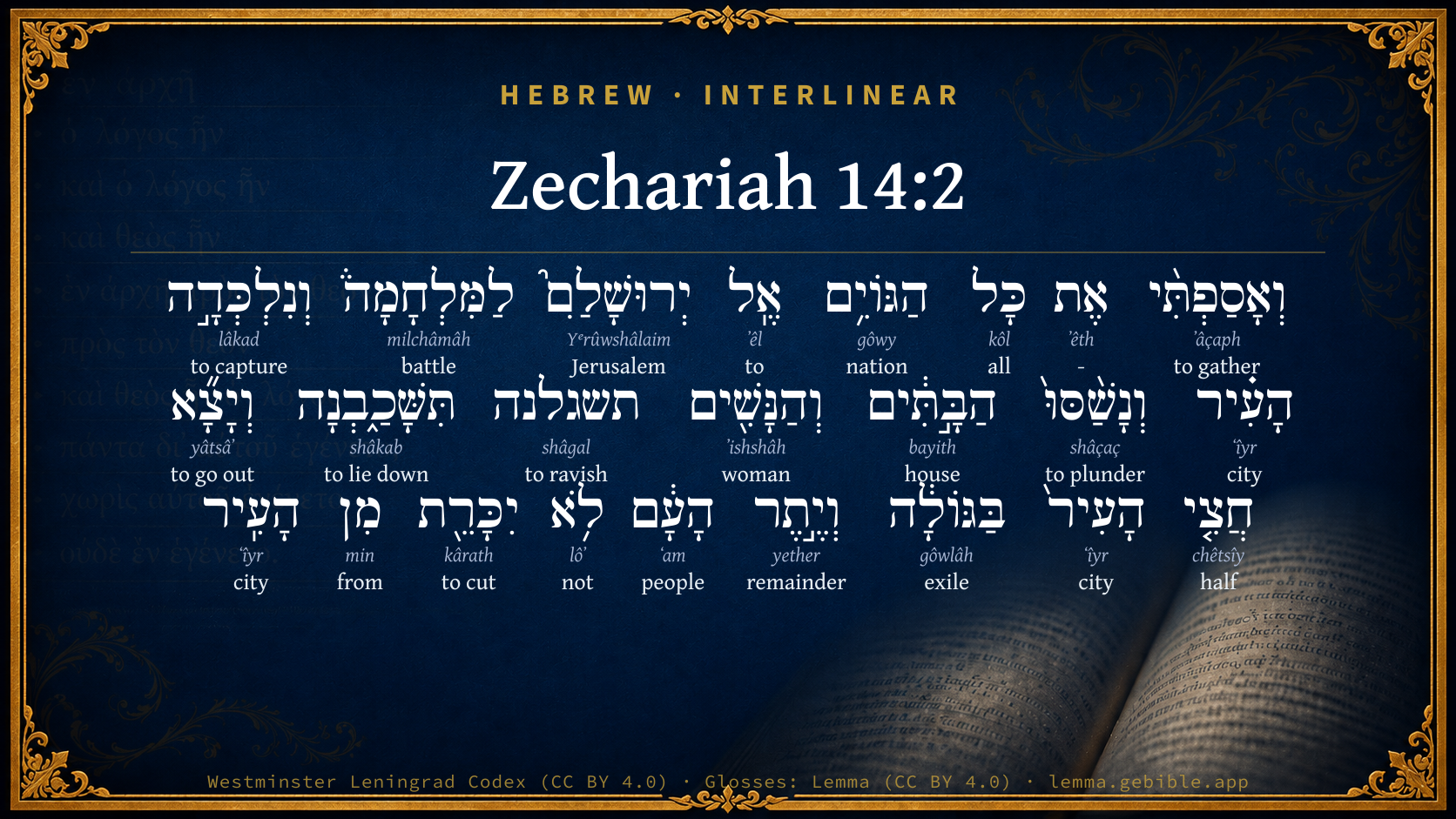
Hebrew (Westminster Leningrad Codex) Zechariah 14:2 appears in the Hebrew Old Testament. The text above is from the Westminster Leningrad Codex. Each word links to its Strong’s number, a concise gloss, and parsing drawn from the Open Scriptures Hebrew Bible morphology. Click any word for its full Brown-Driver-Briggs (BDB) entry.
Download image
Cite this verse

Zechariah 14:2 (World English Bible). Public Domain. Lemma interlinear Bible study tool, https://lemma.gebible.app/v/zechariah/14/2.

Show BibTeX & RIS
BibTeX
RIS
English Translation
For I will gather all nations against Jerusalem to battle; and the city will be taken, the houses rifled, and the women ravished. half of the city will go out into captivity, and the rest of the people will not be cut off from the city.
World English Bible · Public Domain
Download a study sheet

One document with this verse’s original text, its word-by-word gloss line, the meaning frame, cross-references with their text, attributed commentary, and full source and license credits — printable, and it pastes into notes with its structure intact.

This verse Autodidact and up

Study sheet (.html) Plain text (.txt)

A passage Seminary Student

Up to 50 verses in one chapter. A passage sheet keeps up to 6 commentary sources and 12 cross-references per verse, in the order this page ranks them, and says so on the sheet whenever that leaves anything out. Ask for a single verse and you get the Autodidact verse sheet above.

Everything on this page stays free to read, with no account — the sheet is a download of what is already on screen, not access to it.

Want to remove ads? Support Godless Engineer
Compare translations 3

The same verse in 3 English versions, stacked beneath the original-language interlinear above. Click any original word for its lexicon entry.

Each is an independent rendering of the whole verse — the interlinear is not word-aligned to these translations.

Highlighted words mark where these versions differ — a whole-verse word diff, not a word-by-word alignment.

  • World English Bible Public Domain
    For I will gather all nations against Jerusalem to battle; and the city will be taken, the houses rifled, and the women ravished. half of the city will go out into captivity, and the rest of the people will not be cut off from the city.
  • King James Version Public Domain
    For I will gather all nations against Jerusalem to battle; and the city shall be taken, and the houses rifled, and the women ravished; and half of the city shall go forth into captivity, and the residue of the people shall not be cut off from the city.
  • unfoldingWord Literal Text CC BY-SA 4.0
    For I will gather every nation against Jerusalem for battle and the city will be captured. The houses will be plundered and the women raped. Half of the city will go out into captivity, but the remainder of the people will not be cut off from the city.

unfoldingWord Literal Text — © unfoldingWord, licensed CC BY-SA 4.0. Word-aligned USFM3 via Door43 (git.door43.org/unfoldingWord/en_ult).

Versions to compare (up to 4)

3 of 4 selected

Show all 18 translations

Every available English version of this verse, each an independent rendering of the whole verse.

  • World English Bible Public Domain
    For I will gather all nations against Jerusalem to battle; and the city will be taken, the houses rifled, and the women ravished. half of the city will go out into captivity, and the rest of the people will not be cut off from the city.
  • Berean Standard Bible Public Domain
    For I will gather all the nations for battle against Jerusalem, and the city will be captured, the houses looted, and the women ravished. Half of the city will go into exile, but the rest of the people will not be removed from the city.
  • Majority Standard Bible Public Domain
    For I will gather all the nations for battle against Jerusalem, and the city will be captured, the houses looted, and the women ravished. Half of the city will go into exile, but the rest of the people will not be removed from the city.
  • King James Version Public Domain
    For I will gather all nations against Jerusalem to battle; and the city shall be taken, and the houses rifled, and the women ravished; and half of the city shall go forth into captivity, and the residue of the people shall not be cut off from the city.
  • American Standard Version (1901) Public Domain
    For I will gather all nations against Jerusalem to battle; and the city shall be taken, and the houses rifled, and the women ravished; and half of the city shall go forth into captivity, and the residue of the people shall not be cut off from the city.
  • Revised Version (1885) Public Domain
    For I will gather all nations against Jerusalem to battle; and the city shall be taken, and the houses rifled, and the women ravished: and half of the city shall go forth into captivity, and the residue of the people shall not be cut off from the city.
  • Geneva Bible (1599) Public Domain
    For I will gather all nations against Ierusalem to battell, and the citie shall be taken, and the houses spoyled, and the women defiled, and halfe of the citie shall goe into captiuitie, and the residue of the people shall not be cut off from ye citie.
  • Douay-Rheims (1899) Public Domain
    And I will gather all nations to Jerusalem to battle, and the city shall be taken, and the houses shall be rifled, and the women shall be defiled: and half of the city shall go forth into captivity, and the rest of the people shall not be taken away out of the city.
  • Young's Literal Translation Public Domain
    And I have gathered all the nations unto Jerusalem to battle, And captured hath been the city, And spoiled have been the houses, And the women are lain with, Gone forth hath half the city in a removal, And the remnant of the people are not cut off from the city.
  • Literal Standard Version CC BY-SA 4.0
    And I have gathered all the nations to Jerusalem to battle, || And the city has been captured, || And the houses have been spoiled, || And the women are lain with, || Half the city has gone forth in a removal, || And the remnant of the people are not cut off from the city.
  • Unlocked Literal Bible CC BY-SA 4.0
    For I will gather every nation against Jerusalem for battle and the city will be captured. The houses will be plundered and the women raped. Half of the city will go out into captivity, but the remainder of the people will not be cut off from the city.
  • unfoldingWord Literal Text CC BY-SA 4.0
    For I will gather every nation against Jerusalem for battle and the city will be captured. The houses will be plundered and the women raped. Half of the city will go out into captivity, but the remainder of the people will not be cut off from the city.
  • Darby Bible Public Domain
    And I will assemble all the nations against Jerusalem to battle; and the city shall be taken, and the houses rifled, and the women ravished; and half of the city shall go forth into captivity; and the rest of the people shall not be cut off from the city.
  • World Messianic Bible Public Domain
    For I will gather all nations against Jerusalem to battle; and the city will be taken, the houses rifled, and the women ravished. Half of the city will go out into captivity, and the rest of the people will not be cut off from the city.
  • Webster's Bible Public Domain
    For I will gather all nations against Jerusalem to battle; and the city shall be taken, and the houses rifled, and the women ravished; and half of the city shall go forth into captivity, and the residue of the people shall not be cut off from the city.
  • Free Bible Version CC BY-SA 4.0
    I will bring together all the nations to attack Jerusalem. The city will be captured, the houses looted, and the women raped. Half the population will be taken into exile, but the rest of the people will not be removed from the city.
  • Bible in Basic English Public Domain
    For I will get all the nations together to make war against Jerusalem; and the town will be overcome, and the goods taken from the houses, and the women taken by force: and half the town will go away as prisoners, and the rest of the people will not be cut off from the town.
  • JPS Tanakh (1917) Public Domain
    For I will gather all nations against Jerusalem to battle; and the city shall be taken, and the houses rifled, and the women ravished; and half of the city shall go forth into captivity, but the residue of the people shall not be cut off from the city.

Literal Standard Version (2020), Covenant Press — licensed CC BY-SA 4.0. Text via the HelloAO Bible API (eBible.org). Unlocked Literal Bible (unfoldingWord) — licensed CC BY-SA 4.0. Text via the HelloAO Bible API (eBible.org). unfoldingWord Literal Text — © unfoldingWord, licensed CC BY-SA 4.0. Word-aligned USFM3 via Door43 (git.door43.org/unfoldingWord/en_ult). Free Bible Version, Dr. Jonathan Gallagher — licensed CC BY-SA 4.0. Text via the HelloAO Bible API (eBible.org).

Word by word

More ways to search: Search by grammar → Find every occurrence → Compare this word →

Practice this passage: Drill this verse → Learn its vocabulary →

תשגלנה
shâgal
H7693
“to ravish”
Verb, Niphal, Imperfect, 3rd Person, Feminine, Plural
Part of Speech
Verb
Stem
Niphal
Form
Imperfect
Person
3rd Person
Gender
Feminine
Number
Plural
Full BDB Definition

Origin: a primitive root

TWOT: 2327

to violate, ravish - (Qal) to violate, ravish - (Niphal) to be ravished - (Pual) to be ravished
  1. וְאָסַפְתִּ֨י ʼâçaph H622 “and · to gather” Conjunction + Verb, Qal, Sequential Perfect, 1st Person, Common, Singular
  2. אֶת ʼêth H853 “-” Particle, Direct Object
  3. כָּל kôl H3605 “all of” Noun, Common, Masculine, Singular, Construct
  4. הַגּוֹיִ֥ם gôwy H1471 “the · nations” Particle, Definite Article + Noun, Common, Masculine, Plural, Absolute
  5. אֶֽל ʼêl H413 “to” Preposition
  6. יְרוּשָׁלִַם֮ Yᵉrûwshâlaim H3389 “Jerusalem” Noun, Proper
  7. לַמִּלְחָמָה֒ milchâmâh H4421 “to/for the · battle” Preposition, Determined + Noun, Common, Feminine, Singular, Absolute
  8. וְנִלְכְּדָ֣ה lâkad H3920 “and · to capture” Conjunction + Verb, Niphal, Sequential Perfect, 3rd Person, Feminine, Singular
  9. הָעִ֗יר ʻîyr H5892 “the · city” Particle, Definite Article + Noun, Common, Feminine, Singular, Absolute
  10. וְנָשַׁ֨סּוּ֙ shâçaç H8155 “and · to plunder” Conjunction + Verb, Niphal, Sequential Perfect, 3rd Person, Common, Plural
  11. הַבָּ֣תִּ֔ים bayith H1004 “the · houses” Particle, Definite Article + Noun, Common, Masculine, Plural, Absolute
  12. וְהַנָּשִׁ֖ים ʼishshâh H802 “and · the · women” Conjunction + Particle, Definite Article + Noun, Common, Feminine, Plural, Absolute
  13. תִּשָּׁכַ֑בְנָה shâkab H7901 “to lie down” Verb, Niphal, Imperfect, 3rd Person, Feminine, Plural
  14. וְיָצָ֞א yâtsâʼ H3318 “and · to go out” Conjunction + Verb, Qal, Sequential Perfect, 3rd Person, Masculine, Singular
  15. חֲצִ֤י chêtsîy H2677 “half of” Noun, Common, Masculine, Singular, Construct
  16. הָעִיר֙ ʻîyr H5892 “the · city” Particle, Definite Article + Noun, Common, Feminine, Singular, Absolute
  17. בַּגּוֹלָ֔ה gôwlâh H1473 “in/at the · exile” Preposition, Determined + Noun, Common, Feminine, Singular, Absolute
  18. וְיֶ֣תֶר yether H3499 “and · remainder of” Conjunction + Noun, Common, Masculine, Singular, Construct
  19. הָעָ֔ם ʻam H5971 “the · people” Particle, Definite Article + Noun, Common, Masculine, Singular, Absolute
  20. לֹ֥א lôʼ H3808 “not” Particle, Negative
  21. יִכָּרֵ֖ת kârath H3772 “to cut” Verb, Niphal, Imperfect, 3rd Person, Masculine, Singular
  22. מִן min H4480 “from” Preposition
  23. הָעִֽיר ʻîyr H5892 “the · city” Particle, Definite Article + Noun, Common, Feminine, Singular, Absolute

About this verse

These counts appear in no published source. They are computed here, from the morphology-tagged text and Lemma’s own curated glosses. What Lemma adds →

24
words
22
distinct lemmas
Prophets
section

Notable vocabulary

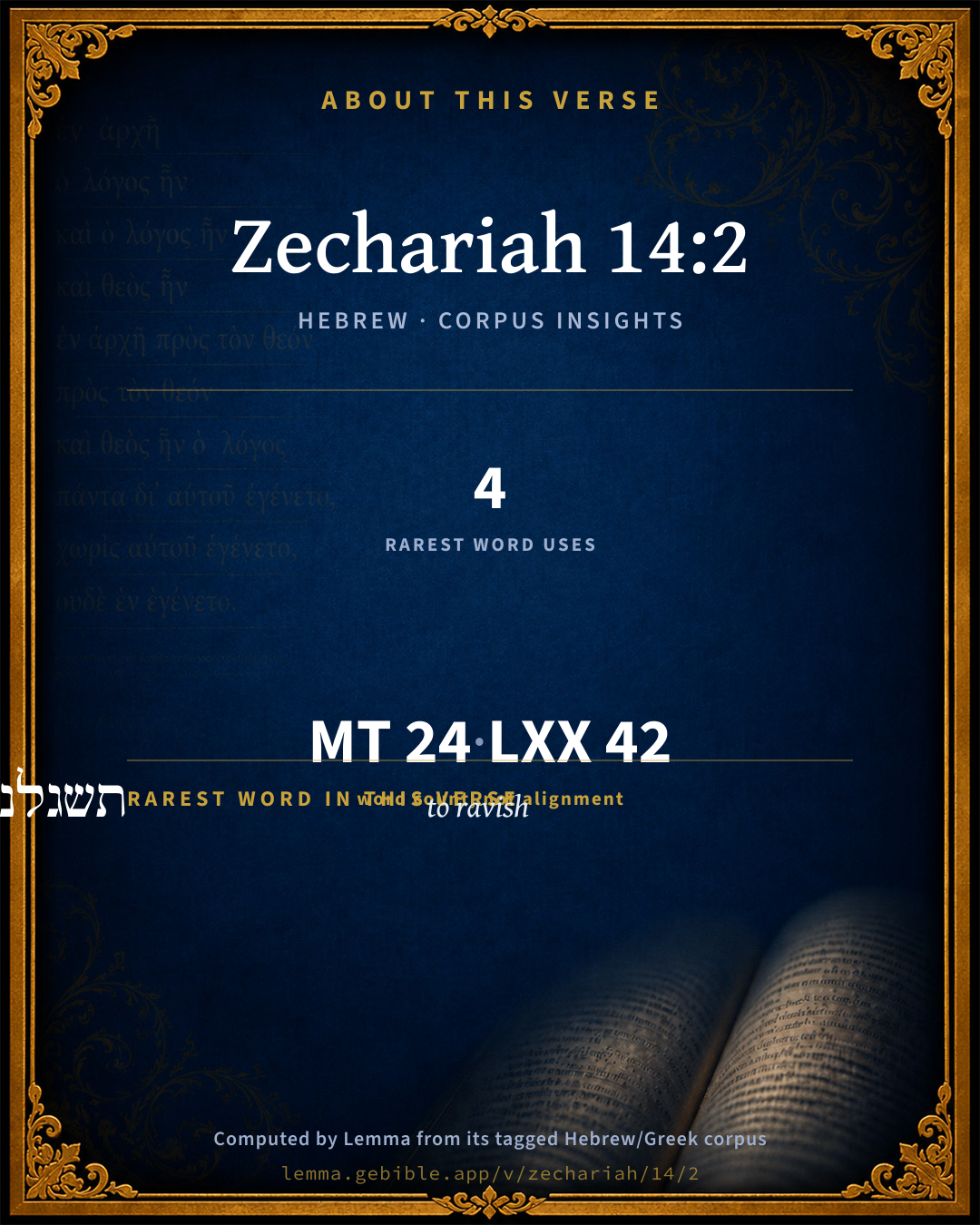
The rarest word here is תשגלנה to ravish H7693 — appearing just 4 times in the whole Hebrew Bible.

Shared distinctive vocabulary

תשגלנה to ravish H7693 occurs in 4 verses of the Hebrew Bible. Also found in:

Grammatical profile

  • 7 verbs
  • 13 nouns
  • 2 prepositions
  • 2 particles

Verb forms

  • וְאָסַפְתִּ֨י Qal · Sequential Perfect
  • וְנִלְכְּדָ֣ה Niphal · Sequential Perfect
  • וְנָשַׁ֨סּוּ֙ Niphal · Sequential Perfect
  • תשגלנה Niphal · Imperfect
  • תִּשָּׁכַ֑בְנָה Niphal · Imperfect
  • וְיָצָ֞א Qal · Sequential Perfect
  • יִכָּרֵ֖ת Niphal · Imperfect

Repetition

A word recurs within this verse — often emphatic in Hebrew:

  • הָעִ֗יר city H5892 ×3

Hebrew & Septuagint length

In English translation the verse runs 46 words from the Hebrew and 50 from the Septuagint (LXX English) — closely comparable.

A rough comparison of the two English renderings, which tokenize alike — not a word-level alignment.

Word counts can differ between the Hebrew and the Greek without any difference in meaning — e.g. the Hebrew direct-object marker אֵת has no separate Greek word, and Greek often adds the article ὁ.

In the original languages it is 24 Hebrew tokens and 42 Greek tokens — but the two are counted differently (Hebrew bundles its prefixes and suffixes into one token; the Greek is in lemma form), so that isn’t a like-for-like length.

Cross-references

23

Topical passages linked to Zechariah 14:2 in the Treasury of Scripture Knowledge — connected by theme and wording, ordered by reader-vote popularity; previews shown in the World English Bible.

  • Luke 21:20–24 "But when you see Jerusalem surrounded by armies, then know that its desolation is at hand.
  • Isaiah 13:16 Their infants also shall be dashed in pieces before their eyes; their houses shall be rifled, and their wives ravished.
  • Romans 9:27–29 Isaiah cries concerning Israel, "If the number of the children of Israel are as the sand of the sea, It is the remnant who will be saved;
  • Matthew 24:19–22 But woe to those who are with child and to nursing mothers in those days!
  • Mark 13:14 But when you see the abomination of desolation, spoken of by Daniel the prophet, standing where it ought not (let the reader understand), then let those who are in Judea flee to the mountains,
  • Matthew 24:15–16 "When, therefore, you see the abomination of desolation, which was spoken of through Daniel the prophet, standing in the holy place (let the reader understand),
  • Isaiah 65:6–9 Behold, it is written before me: I will not keep silence, but will recompense, yes, I will recompense into their bosom,
  • Luke 19:43–44 For the days will come on you, when your enemies will throw up a barricade against you, surround you, hem you in on every side,
  • Galatians 4:26–27 But the Jerusalem that is above is free, which is the mother of us all.
  • Deuteronomy 28:9–14 Yahweh will establish you for a holy people to himself, as he has sworn to you; if you shall keep the commandments of Yahweh your God, and walk in his ways.
  • Isaiah 5:26 He will lift up a banner to the nations from far, And he will whistle for them from the end of the earth. Behold, they will come speedily and swiftly.
  • Joel 3:2 I will gather all nations, And will bring them down into the valley of Jehoshaphat; And I will execute judgment on them there for my people, And for my heritage, Israel, whom they have scattered among the nations. They have divided my land,
  • Amos 7:17 Therefore thus says Yahweh: 'Your wife shall be a prostitute in the city, and your sons and your daughters shall fall by the sword, and your land shall be divided by line; and you yourself shall die in a land that is unclean, and Israel shall surely be led away captive out of his land.'"
  • Zechariah 13:8–9 It shall happen that in all the land," says Yahweh, Two parts in it will be cut off and die; But the third will be left in it.
  • Matthew 22:7 When the king heard that, he was angry, and he sent his armies, destroyed those murderers, and burned their city.
  • Isaiah 65:18 But be you glad and rejoice forever in that which I create; for, behold, I create Jerusalem a rejoicing, and her people a joy.
  • Jeremiah 34:1 The word which came to Jeremiah from Yahweh, when Nebuchadnezzar king of Babylon, and all his army, and all the kingdoms of the earth that were under his dominion, and all the peoples, were fighting against Jerusalem, and against all the cities of it, saying:
  • Lamentations 1:10 The adversary has spread out his hand on all her pleasant things: For she has seen that the nations are entered into her sanctuary, Concerning whom you did command that they should not enter into your assembly.
  • Lamentations 5:11–12 They ravished the women in Zion, The virgins in the cities of Judah.
  • Daniel 2:40–43 The fourth kingdom shall be strong as iron, because iron breaks in pieces and subdues all things; and as iron that crushes all these, shall it break in pieces and crush.
  • Matthew 23:37–38 "Jerusalem, Jerusalem, who kills the prophets, and stones those who are sent to her! How often would I have gathered your children together, even as a hen gathers her chickens under her wings, and you would not!
  • Mark 13:19 For in those days there will be oppression, such as there has not been the like from the beginning of the creation which God created until now, and never will be.
  • Luke 2:1 Now it happened in those days, that a decree went out from Caesar Augustus that all the world should be enrolled.

Cross-references courtesy of OpenBible.info (CC BY 4.0).

Hebrew and Greek witnesses Masoretic Hebrew ↔ Greek Septuagint

The same verse in the two great witnesses to the Old Testament, shown verse-for-verse.

These are two independent witnesses, not word-aligned to each other, and the Septuagint is shown in lemma (dictionary) form.

Hebrew Zechariah 14:2 Masoretic · Westminster Leningrad Codex

וְאָסַפְתִּ֨י אֶת כָּל הַגּוֹיִ֥ם אֶֽל יְרוּשָׁלִַם֮ לַמִּלְחָמָה֒ וְנִלְכְּדָ֣ה הָעִ֗יר וְנָשַׁ֨סּוּ֙ הַבָּ֣תִּ֔ים וְהַנָּשִׁ֖ים תשגלנה תִּשָּׁכַ֑בְנָה וְיָצָ֞א חֲצִ֤י הָעִיר֙ בַּגּוֹלָ֔ה וְיֶ֣תֶר הָעָ֔ם לֹ֥א יִכָּרֵ֖ת מִן הָעִֽיר

For I will gather all nations against Jerusalem to battle; and the city will be taken, the houses rifled, and the women ravished. half of the city will go out into captivity, and the rest of the people will not be cut off from the city.

World English Bible · Public Domain

Greek LXX Zechariah 14:2 Septuagint · lemma form

καί ἐπι συνἄγω πᾶς ὁ ἔθνος ἐπί ἰερουσαλήμ εἰς πόλεμος καί ἁλίσκω ὁ πόλις καί διαἁρπάζω ὁ οἰκία καί ὁ γυνή μολύνω καί ἐκἔρχομαι ὁ ἥμισυς ὁ πόλις ἐν αἰχμαλωσία ὁ δέ κατάλοιπος ὁ λαός ἐγώ οὐ μή ἐκὀλεθρεύω ἐκ ὁ πόλις

And I will gather all the Gentiles to Jerusalem to war, and the city shall be taken, and the houses plundered, and the women ravished; and half of the city shall go forth into captivity, but the rest of my people shall not be utterly cut off from the city.

LXX2012 (modern English Septuagint) · Public Domain

On this verse, Haydock's Catholic Bible Commentary discusses the Septuagint’s reading. Read the note in Commentary ↓

Hebrew: Westminster Leningrad Codex (CC BY 4.0). Greek: Septuagint (public domain); English from LXX2012 (modern English Septuagint) (Public Domain). How the Septuagint differs from the Hebrew →

Targum (Aramaic paraphrase)

1

The Targum is the ancient Jewish Aramaic paraphrase of the Hebrew Scriptures — an interpretive translation, not the Hebrew text itself. Onkelos (literal) and Pseudo-Jonathan (expansive) render the Torah, and Jonathan the Prophets. Coverage is partial: where no permissively-licensed English translation exists for a verse, only the Aramaic is shown. This is verse-level text, not a word-by-word alignment to the Hebrew.

  1. Targum Jonathan Prophets (Joshua–Malachi)
    וְאַכְנֵישׁ יַת כָּל עַמְמַיָא לִירוּשְׁלֵם לַאֲגָחָא קְרָבָא וְתִתְכְּבִישׁ קַרְתָּא וְיִתְבַּזְזוּן בָּתַּיָא וּנְשַׁיָא יִשְׁתַּכְבָן וְיִפּוֹק פַּלְגָא דְקַרְתָּא בְּגָלוּתָא וּשְׁאָר עַמָא לָא יִפְסוֹק מִן קַרְתָּא:

    (no public-domain English translation for this verse)

    Targum Jonathan — Aramaic: “Mikraot Gedolot” (public domain). English: “Sefaria Community Translation” (CC0 1.0 (public-domain dedication)); “London "Chaldee Paraphrase," 1871” (public domain). Text via Sefaria.

Commentary

Notes on Zechariah 14:2 from classic Christian and Jewish commentators (each source and its license shown beneath its notes). The classic Christian expositions comment on the surrounding passage and are grouped to its opening verse, so a note may address several verses; the Jewish commentaries on the Tanakh (Rashi and others) are per-verse, so they appear only where the commentator wrote on this verse.

Lemma curates 59 commentaries, every one of them public domain or Creative Commons licensed, each selected and text-cleaned for this edition rather than reprinted as found. About our sources →

Trapp's Complete Commentary

John Trapp

Zec 14:2 For I will gather all nations against Jerusalem to battle; and the city shall be taken, and the houses rifled, and the women ravished; and half of the city shall go forth into captivity, and the residue of the people shall not be cut off from the city.

Ver. 2. For I will gather all nations] The Romans, that styled and held themselves lords of all nations, and who had levied a mighty army out of all nations to fight against Jerusalem. See Joseph. B. J. III 1, 3. Or Gog and Magog, with all his armies and associates, Eze 37:4-6, shall compass the beloved city, Rev 20:8-9. See Zec 14:1. {See Trapp on "Zec 14:1"} Would any man take the Church’s picture? then let him, saith Luther, paint a silly poor maid sitting in a wood or wilderness, and compassed about with hungry lions, wolves, boars, and bears, &c., and in the midst of a great many furious men assaulting her every moment; let him give her, say I, that of Martial for her motto,

“ In me omnis terraeque, aviumque, marisque rapina est. ”

And the city shall be taken] Non tamen ad exitium, sed ad exercitium. Not yet for destruction but for a lesson. I have forsaken mine house, I have left mine heritage (saith the Lord, Jer 12:7). I have given the dearly beloved of my soul into the hand of her enemies. At which times there is usually, as at Athens when taken by Sulla, ανελεης σφαγη, a bloody butchery.

And the houses rifled] As at the sack of Constantinople by the Turks; where the soldiers are said to have divided money among themselves by whole hatfulls; and were therewith so enriched, that it is a proverb among them to this day, if any grow suddenly rich, to say, he hath been at the sacking of Constantinople. The Emperor had in vain many times with tears requested to have borrowed money of his covetous subjects, to have been employed in the defence of the city; but they would still swear that they had it not, as men grown poor for want of trade; which, in few days after, their enemies found in such abundance, that they wondered at their wealth, and derided their folly, that possessing so much, they would bestow so little in the defence of themselves and their country.

And the women ravished] These are the common calamities of war; in the lawless violence whereof those three commandments, "Thou shalt not kill, Thou shalt not commit adultery, Thou shalt not steal," as they are ranked together in the law, so they are usually violated together; hence Isa 13:16 "Their children also shall be dashed to pieces before their eyes; their houses shall be spoiled, and their wives ravished." The Irish rebels bound the husband to the bedpost while they abused his wife before his face. In the time of King Edward III the French soldiers at Winchelsea, in Sussex, took their lustful turns upon a beautiful woman in the Church, and at the time of divine service, until they had turned her out of the world, as a learned man phraseth it, Donec mulier fatigata spiritum exhalaret While a weary woman to breath out her life. (Walsing.).

And half of the city shall go forth into captivity] An evil, an only evil, threatened Deu 28:15-68, and fulfilled to the utmost upon this nation, so shamelessly, so lawlessly wicked, as can hardly be peered or paralleled. I have noted before, that this their last captivity and dispersion is such, as that one of their own Rabbis concludeth from thence that their Messiah must needs be come, and they must needs suffer so much for killing him. They used to say that there is still an ounce of the golden calf in all their public calamities. There is another thing lieth more heavily upon them to this day, were they but sensible of it. Let us be sending up, and sighing out for them that of the Psalmist, "Oh that the salvation of Israel were come out of Zion! when the Lord bringeth back the captivity of his people, Jacob shall rejoice, and Israel shall be glad," Psa 14:7.

And the residue of the people shall not be cut off from the city] A remnant shall be reserved, as it were for royal use; whether a third part, as Zec 13:8, or a half, as here, it is not much material; in numeris non est anxie laborendum, saith Calvin here; for the direct number it is neither here nor there, as we say. God shall reserve unto himself a set and select number. He who comforteth those that are cast down speaketh this to his, for encouragement. The Church may be shaken, not shivered; persecuted, but not forsaken; cast down, but not destroyed, 2Co 4:9.

John Trapp, A Commentary or Exposition upon All the Books of the Old and New Testament (1647–1656) — public domain. Text from a community e-Sword module.

Tyndale Open Study Notes

Tyndale Open Resources

14:2 The rest is the remnant of Israel that survived the sack of Jerusalem (see 13:8).

Tyndale Open Study Notes — © Tyndale Open Resources, licensed CC BY-SA 4.0. Text via the HelloAO Bible API.

Jamieson, Fausset & Brown

Robert Jamieson, A. R. Fausset & David Brown

gather all nations, &c.--The prophecy seems literal (compare Joe 3:2). If Antichrist be the leader of the nations, it seems inconsistent with the statement that he will at this time be sitting in the temple as God at Jerusalem (Th2 2:4); thus Antichrist outside would be made to besiege Antichrist within the city. But difficulties do not set aside revelations: the event will clear up seeming difficulties. Compare the complicated movements, Dan. 11:1-45.

half . . . the residue--In Zac 13:8-9, it is "two-thirds" that perish, and "the third" escapes. There, however, it is "in all the land"; here it is "half of the city." Two-thirds of the "whole people" perish, one-third survives. One-half of the citizens are led captive, the residue are not cut off. Perhaps, too, we ought to translate, "a (not 'the') residue."

Jamieson, Fausset & Brown — Commentary Critical and Explanatory on the Whole Bible (1871) — public domain (CC PDM 1.0). Text via the HelloAO Bible API.

Adam Clarke's Commentary

Verse 2. I will gather all nations] The Romans, whose armies were composed of all the nations of the world. In this verse there is a pitiful account given of the horrible outrages which should be committed during the siege of Jerusalem, and at its capture.

The residue of the people shall not be cut off] Many were preserved for slaves, and for exhibition in the provincial theatres.

Adam Clarke's Commentary on the Bible (1810–1826) — public domain. Text from a community e-Sword/MySword module.

John Calvin's Commentaries

He afterwards adds, I will gather all nations against Jerusalem. He confirms what I have already said, that God would be the author of those calamities, and thus he puts a restraint on the Jews, that they might not expostulate with him respecting the severity of their punishment. He then shortly intimates, that the nations would not come by chance to attack Jerusalem; and that whatever commotions would arise, they could not be ascribed to chance or to fortune, or to the purposes of men, but to the decree of heaven. He then bids them to look to God, that they might humble themselves umber his mighty hand, according to what Peter also does. (1 Peter 5:6.) He might have said in a briefer manner, “All the nations shall conspire;” but he ascribes this to God, and says, that he will bring them, like a prince, who collects an army, which he commands to fight under his banner. And by naming all nations, he reminds them that their trials would not be light; for such would be the union of enemies, and so large would be their number, that Jerusalem would be brought nigh to utter ruin. But afterwards he subjoins a consolation to moderate the grievousness of that calamity: yet he says first -

Taken shall be the city, plundered shall be the houses, and the women shall be ravished. What usually happens to a city taken by storm, the citizens of Jerusalem, the Prophet says, would have to endure. It is indeed an extreme outrage, when women are ravished by enemies; and then, poverty is often more grievous than death; and yet he says, that when deprived of their substance they would have to witness an outrage more hard to be borne than death itself, because their women would be subjected to such a disgrace.

He adds, that half part of the city would depart. He had said before that a third part only would be saved; but he now seems to be inconsistent with himself. But as to number we need not anxiously enquire, as I have elsewhere reminded you; for the Prophets often mention half part and then the third, when yet they mean the same thing. It is the same as though he had said, that the destruction would be so great, that hardly half of them would remain alive.

Now follows the consolation which I have mentioned, — that the residue of the people would not be exterminated from the city. By these words the Prophet teaches them, that though hard would be the condition of the city, as it would be reduced nearly to a waste, yet they who having returned to their country sincerely worshipped God, would be blessed; for the Church would ever remain safe, and that how much soever God might lessen the number, yet a part of the Church, however small, would be kept safe. The object then of the Prophet is to comfort the faithful, that they might sustain whatever evils might be at hand, and look for what God promises, even that a Church would again emerge, and that God would really prove that Jerusalem was not in vain his sanctuary, where he would bless the remnant which escaped, and escaped through his wonderful favor. He afterwards adds —

John Calvin's Commentaries (1540-1563) — public domain. Text from the Calvin Translation Society English edition (1840s-50s) via the Christian Classics Ethereal Library (ccel.org). Calvin's coverage is partial (roughly two-thirds of the Bible); uncommented books and verses are honest gaps, never fabricated. The 19th-century editor's footnotes and remarks are omitted so the notes are faithfully Calvin's own voice.

Ellicott's Commentary for English Readers

(2) This verse is but a further description of the event depicted in the second half of the preceding verse.

And the residue of the people shall not be cut off from the city.—This was the case (with regard to Judah) in the Chaldæan conquest (2Ki_25:22). Whether or no this can be interpreted of the taking of Jerusalem by Titus, we leave our readers to decide, after placing before them the following words of Josephus (Bel. Jud. vi. 9, § 2):—“And now, since his soldiers were already quite tired of killing men, yet there appeared to be a vast multitude still remaining alive, Caesar gave orders that they should kill none but those that were in arms and opposed them, but should take the rest alive. But, together with those whom they had orders to slay, they slew the aged and the infirm; but for those that were in their flourishing age, and who might be useful to them, they drove them together into the Temple, and shut them up within the walls of the court of the women, over which Caesar set one of his freedmen, as also Fronto, one of his friends, which last was to determine every one’s fate according to his merits. So this Fronto slew all those that had been seditious and robbers, who were impeached one by another; but of the young men he chose out the tallest and most beautiful, and reserved them for the triumph; and as for the rest of the multitude that were above seventeen years old, he put them in bonds, and sent them to the Egyptian mines. Titus also sent a great number into the provinces, as a present to them, that they might be destroyed upon their theatres by the sword and by wild beasts; but those that were under seventeen years of age were sold for slaves.” We simply ask, what room is there for a remnant?

A Bible Commentary for English Readers, edited by Charles John Ellicott (1878–1897) — public domain. Text from a community e-Sword module.

The Cambridge Bible for Schools and Colleges

gen. ed. J. J. S. Perowne

2. all nations] Comp. Joe_3:2; Joe_3:9-11; Ezekiel 38, 39; Rev_20:7-9.

The Cambridge Bible for Schools and Colleges (gen. ed. J. J. S. Perowne; Cambridge University Press, 1878–1918) — public domain. Text from a community e-Sword module.

John Gill's Exposition

For I will gather all nations against Jerusalem to battle,.... Meaning not the Romans, in the time of Vespasian, for they were not all nations; nor did a part of the city only go into captivity then, but the whole; nor did any remain in it: it seems right to refer it to the gathering of the kings of the earth to the battle of the Lord God Almighty at Armageddon, Rev 16:14 unless it may be thought better to interpret it of the vast numbers, out of several nations, the Turk will bring against Jerusalem, to dispossess the Jews of it, by whom it will be again inhabited in the latter day; see Eze 38:4 and Kimchi interprets it of the Gog and Magog army. The Jews, in their ancient Midrashes (d), apply it to the times of the Messiah; which is true, if understood not of the first times of the Messiah, whose coming they vainly expect, but of the last times of the Messiah.

And the city shall be taken, and the houses rifled, and the women ravished, and half of the city shall go into captivity: this will be the time when the outward court shall be given, to the Gentiles, the Papists; the two witnesses shall be slain, and their enemies shall rejoice and send gifts to one another, Rev 11:2 this will be a trying season, and such a time of trouble as has not been known:

and the residue of the people shall not be cut off from the city; there will be a remnant according to the election of grace; the city, the church, shall not be wholly extinct; Christ will reserve a seed for himself in those very worst of times, as he has always done: this cannot refer to the destruction of Jerusalem by the Romans, for then all the inhabitants of the city were cut off, or carried captive, and none left; but, if literally to be understood, must refer to what will be, when the army of Gog shall come against it in the latter day; though these circumstances are not mentioned in Ezekiel.

(d) Shirhashirim Rabba, fol. 22. 3. & Midrash Ruth, fol. 33. 2.

John Gill's Exposition of the Whole Bible (1746–1763) — public domain (CC PDM 1.0). Text via the HelloAO Bible API.

Albert Barnes' Notes on the Bible

I Will gather all nations against Jerusalem to battle - This is a feature which belongs to the end. It had been dwelt upon by Joel; Joe 3:2-9, Joe 3:11; Ezekiel spoke of the “many nations” Eze 38:6, Eze 38:15, Eze 38:22 which should come under Gog. John foretells of an universal strife at the end, when “The spirits of devils, working miracles, go forth unto the king; of the earth and of the whole world, to gather them to the battle of that great day of God Almighty” Rev 16:14; and “Satan shall be loosed out of his prison and shall go out to deceive the nations which are in the four quarters of the earth, Gog and Magog, to gather them together to battle, the number of whom is as the sand of the sea. And they went up on the breadth of the earth, and compassed the camp of the saints round about, and the beloved city” Rev 20:7-9. Since no creature can do aught but what God wills, and, in his phrensy against God’s people, is but His instrument, “to try them and to purge and to make white to the time of the end” Dan 11:35; Dan 12:10; and the strength of body or intellect, which is abused against His law, He continuously in the order of nature supplies, God may be said to do what Satan does against Him. Satan, in his blind fury, crowns martyrs, fills the thrones of heaven, works, against his will, the All-wise Will of God.

And the houses rifled, and the women ... - The horrors of pagan war repeat themselves through people’s ever-recurring passions. What was foretold as to Babylon is repeated in the same words as to the Church of God. Seemingly “all things” come “alike to all Ecc 9:2 : there is one event to the righteous and to the wicked; to the good and to the clean and to the unclean: to him that sacrificeth and to him that sacrificeth not: as is the good, so is the sinner.” The outward event is the same, the hidden part is known to God alone. “And the residue of the people shall not be cut off from the city,” unlike the lot of the earthly Jerusalem, in the destruction both by Nebuchadnezzar (which was past) and the Romans (see at Mic 3:12, pp. 46-50). At the first, “Nebuzaradan, the captain of the guard, carried away the rest of the people left in the city, and the fugitives that fell away to the king of Babylon, with the remnant of the multitude” 2Ki 25:11, so that Jeremiah mourned over it, “Because of the mountain of Zion which is desolate, foxes walk” (habitually) “upon it” Lam 5:18. The Romans (see at pp. 46, 47) “effaced the city.” Now “a remnant is not cut off,” because “for the elect’s sake those days shall be shortened” Mat 24:32; for our Lord had said, that “the gates of hell should not prevail against” His Church Mat 16:18.

Albert Barnes' Notes on the Bible (1834–1885) — public domain. Text from a community e-Sword/MySword module.

Haydock's Catholic Bible Commentary

I will gather, &c. This seems to be a prophecy of what was done by Antiochus, (Challoner) or of the last siege, (Worthington) by the Romans. (St. Jerome; Theodoret; Eusebius, Dem. vi. 18.) (Calmet) --- Vespasian collected numerous forces. (Josephus, Jewish Wars iii. 1.) --- Titus had six legions and many auxiliaries, Arabs, &c. (Tacitus, Hist. v.) --- Various nations composed their army. (Worthington) --- Rifled, or demolished. None was left standing. (Josephus, Jewish Wars vii. 6.; Heges. v. 49.) --- St. Jerome and others think that the city on Sion was spared, (Calmet) and 40,000 were permitted to dwell where they had a mind. (Josephus, Jewish Wars vii. 15.) --- But it is not said that they continued at Jerusalem. Half the Jews therefore perished, and those who maintained the siege found a grave in the city. (Theodoret) --- Half only denotes a considerable part, as [in] ver. 8. Those who followed our Saviour’s admonition, retired before, and were safe (Calmet) at Pella, chap. x. 11. Septuagint, "the rest of my people shall not be destroyed out of the city."

George Leo Haydock (1774–1849), Haydock's Catholic Family Bible and Commentary, 1859 edition — public domain. Excludes Psalms (Douay-Rheims chapter numbering differs from Protestant) and Deuterocanonical books (Catholic canon only).

Matthew Poole's English Annotations

For: this gives not the reason why, but introduceth an account how, this thing shall be done.

I will gather: God will summon and bring together his army. They do it themselves by their own counsels, for their own works and ends; God also hath his work for them to do, and by his counsel and at his call they shall come.

All nations; the Romans, with the power of their empire, which at that time had the rule over all the known world, or over all the Nations of that part of the world.

Against Jerusalem to battle; to make war with the Jews, which lasted some years, and cost many thousand lives, and ended at last as our prophet foretold.

The city shall be taken, by assault and force, whereby all lay at mercy of the soldiers, who showed little to those who first refused the mercy of their God, and, justly given up by God to their own blind, obstinate wills, refused the mercy of their enemy also.

The houses rifled; all houses pillaged, and all in them Worth taking was taken away.

The women ravished; wives, widows, and virgins barbarously violated.

Half of the city; a certain part for uncertain, or, in common speech, many; were it one half precisely it would be but a sixth part of what were before the wars; two-thirds being cut off, as Zec 13:8, and one-third remaining, of which one half is for captivity.

The residue of the people; that small number of the Jews which fled to Pella, and who were spared by Titus.

Shall not be cut off from the city; literally, were not forbidden to dwell in or about the city; mystically, were not cut off from the church, nor ceased to be a church; this the more likely, for Titus utterly ruined the city.

Matthew Poole's English Annotations on the Holy Bible (1683–1685) — public domain. Text from a community e-Sword/MySword module.

The Pulpit Commentary

How this shall come to pass is now shown. For I will gather all nations. God uses the Gentile nations as his instruments in this trial of his people; they are the fires by which he refines and purifies his elect. (comp. Joe_3:2, Joe_3:9-11) The city shall be taken. The outrages offered to the captive city are such as are indicated in the case of Babylon. (Isa_13:16 Lam_5:11, etc.) Half of the city. The term "half" must not be pressed, as if it contradicted the mention of the two-thirds that were to perish, according to the prediction in Zec_13:8. It is a mere rhetorical expression. Or it may apply to the city alone, while the other referred to the whole land. Shall not be out off. In the former captivity all the people were carried away; in this capture of the city a remnant shall be left therein. It is plain from this statement that the prophecy cannot apply to the destruction of the city by the Romans; for, according to the account of Josephus, ("Bell. Jud:," 6:9) the city itself was razed to the ground, and all the inhabitants were either put to the sword or sold for slaves.

The Pulpit Commentary (1880–1919), ed. H.D.M. Spence-Jones & Joseph S. Exell — public domain. Text from a community e-Sword module.

John Wesley's Explanatory Notes

All nations - The Roman who at that time had the rule over all the nations of that part of the world. The residue - That small number of the Jews who were spared by Titus. Shall not be cut off - Were not forbidden to dwell about the city.

John Wesley, Explanatory Notes Upon the Whole Bible (1754–1765) — public domain. Text via the GEBible commentary corpus.

Rashi

Rabbi Shlomo Yitzchaki (Rashi)

and the rest of the people Not all of them will be exiled. Now, why will He permit them [i.e., the gentile nations] to exile half of them and to plunder the houses? So that they should not have an excuse, saying, “We have not come for war, but we have come to prostrate ourselves.”

Rashi on the Tanakh — English translations: “The Judaica Press complete Tanach with Rashi, translated by A. J. Rosenberg” (CC BY 4.0); “Pentateuch with Rashi's commentary by M. Rosenbaum and A.M. Silbermann, 1929-1934” (public domain); “The Metsudah Tanach series, Lakewood, N.J” (CC BY 4.0); and “The Book of Joshua, Metsudah Publications, 1997” (CC BY 4.0). Text via Sefaria.

Lesson kit

Teaching starters — assembled from the data on this page, not authored interpretation. Every prompt links to the verse data it draws on. Edit before teaching.

Zechariah, in the Prophets, opens this verse with 24 words (22 distinct Hebrew lemmas). Its most distinctive word is shâgal (“to ravish”). A historical commentator’s framing appears above. Read the whole chapter for the surrounding context.

Discussion questions

  1. The word shâgal carries the sense “to ravish.” How does it shape the verse?
  2. Deuteronomy 28:30 shares the word «to ravish» with this verse. How do the two illuminate each other?
  3. “city” occurs 3× in this one verse. What is the effect of the repetition?
  4. These translations render this verse differently; the difference is in the English rendering, not the original. What questions does that raise?
  5. The verb «וְאָסַפְתִּ֨י» is Qal Sequential Perfect. How does its form color the action?
  6. Reading how Trapp's Complete Commentary and Tyndale Open Study Notes read this verse, where do the two commentators agree and where do they part?

Things to notice

Reading settings

Reading text

Shown beneath each verse's original-language words.

Old Testament
Old Testament edition

Read the OT as the Masoretic Hebrew (MT) or the Greek Septuagint (LXX).

English shown for the Greek Septuagint (in the Hebrew ↔ Greek comparison).

Comparing translations? Open the Compare panel on any verse page to stack up to four side by side.