
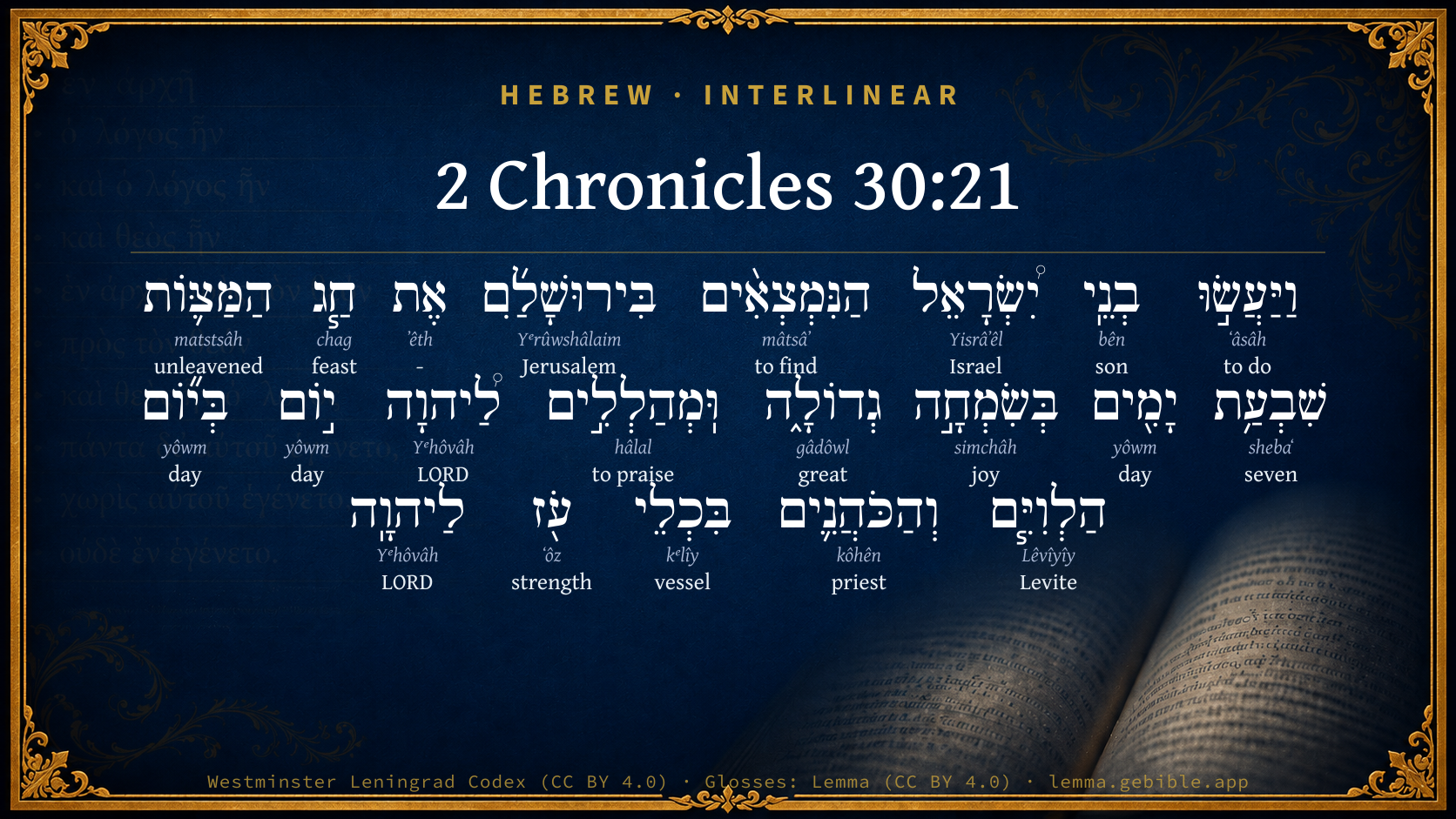
2 Chronicles 30:21

Hebrew (Westminster Leningrad Codex) 2 Chronicles 30:21 appears in the Hebrew Old Testament. The text above is from the Westminster Leningrad Codex. Each word links to its Strong’s number, a concise gloss, and parsing drawn from the Open Scriptures Hebrew Bible morphology. Click any word for its full Brown-Driver-Briggs (BDB) entry.
Download image
Cite this verse

2 Chronicles 30:21 (World English Bible). Public Domain. Lemma interlinear Bible study tool, https://lemma.gebible.app/v/2-chronicles/30/21.

Show BibTeX & RIS
BibTeX
RIS
English Translation
The children of Israel who were present at Jerusalem kept the feast of unleavened bread seven days with great gladness; and the Levites and the priests praised Yahweh day by day, [singing] with loud instruments to Yahweh.
World English Bible · Public Domain
Download a study sheet

One document with this verse’s original text, its word-by-word gloss line, the meaning frame, cross-references with their text, attributed commentary, and full source and license credits — printable, and it pastes into notes with its structure intact.

This verse Autodidact and up

Study sheet (.html) Plain text (.txt)

A passage Seminary Student

Up to 50 verses in one chapter. A passage sheet keeps up to 6 commentary sources and 12 cross-references per verse, in the order this page ranks them, and says so on the sheet whenever that leaves anything out. Ask for a single verse and you get the Autodidact verse sheet above.

Everything on this page stays free to read, with no account — the sheet is a download of what is already on screen, not access to it.

Want to remove ads? Support Godless Engineer
Compare translations 3

The same verse in 3 English versions, stacked beneath the original-language interlinear above. Click any original word for its lexicon entry.

Each is an independent rendering of the whole verse — the interlinear is not word-aligned to these translations.

Highlighted words mark where these versions differ — a whole-verse word diff, not a word-by-word alignment.

  • World English Bible Public Domain
    The children of Israel who were present at Jerusalem kept the feast of unleavened bread seven days with great gladness; and the Levites and the priests praised Yahweh day by day, [singing] with loud instruments to Yahweh.
  • King James Version Public Domain
    And the children of Israel that were present at Jerusalem kept the feast of unleavened bread seven days with great gladness: and the Levites and the priests praised the LORD day by day, singing with loud instruments unto the LORD.
  • unfoldingWord Literal Text CC BY-SA 4.0
    And the sons of Israel who were found in Jerusalem did the Feast of the Unleavened Bread seven days with great joy. And the Levites and the priests were praising Yahweh day by day, with instruments of might to Yahweh.

unfoldingWord Literal Text — © unfoldingWord, licensed CC BY-SA 4.0. Word-aligned USFM3 via Door43 (git.door43.org/unfoldingWord/en_ult).

Versions to compare (up to 4)

3 of 4 selected

Show all 18 translations

Every available English version of this verse, each an independent rendering of the whole verse.

  • World English Bible Public Domain
    The children of Israel who were present at Jerusalem kept the feast of unleavened bread seven days with great gladness; and the Levites and the priests praised Yahweh day by day, [singing] with loud instruments to Yahweh.
  • Berean Standard Bible Public Domain
    The Israelites who were present in Jerusalem celebrated the Feast of Unleavened Bread for seven days with great joy, and the Levites and priests praised the LORD day after day, accompanied by loud instruments of praise to the LORD.
  • Majority Standard Bible Public Domain
    The Israelites who were present in Jerusalem celebrated the Feast of Unleavened Bread for seven days with great joy, and the Levites and priests praised the LORD day after day, accompanied by loud instruments of praise to the LORD.
  • King James Version Public Domain
    And the children of Israel that were present at Jerusalem kept the feast of unleavened bread seven days with great gladness: and the Levites and the priests praised the LORD day by day, singing with loud instruments unto the LORD.
  • American Standard Version (1901) Public Domain
    And the children of Israel that were present at Jerusalem kept the feast of unleavened bread seven days with great gladness; and the Levites and the priests praised Jehovah day by day, `singing' with loud instruments unto Jehovah.
  • Revised Version (1885) Public Domain
    And the children of Israel that were present at Jerusalem kept the feast of unleavened bread seven days with great gladness: and the Levites and the priests praised the LORD day by day, singing with loud instruments unto the LORD.
  • Geneva Bible (1599) Public Domain
    And the children of Israel that were present at Ierusalem, kept the feast of the vnleauened bread seuen dayes with great ioye, and the Leuites, and the Priestes praysed the Lord, day by day, singing with loude instruments vnto the Lord.
  • Douay-Rheims (1899) Public Domain
    And the Lord heard him, and was merciful to the people.
  • Young's Literal Translation Public Domain
    And the sons of Israel, those found in Jerusalem, make the feast of unleavened things seven days with great joy; and giving praise to Jehovah day by day are the Levites and the priests, with instruments of praise before Jehovah.
  • Literal Standard Version CC BY-SA 4.0
    And the sons of Israel, those found in Jerusalem, make the Celebration of Unleavened Things [for] seven days with great joy; and the Levites and the priests are giving praise to YHWH day by day with instruments of praise before YHWH.
  • Unlocked Literal Bible CC BY-SA 4.0
    The people of Israel who were present in Jerusalem kept the Festival of Unleavened Bread for seven days with great joy. The Levites and the priests praised Yahweh day after day, singing with loud instruments to Yahweh.
  • unfoldingWord Literal Text CC BY-SA 4.0
    And the sons of Israel who were found in Jerusalem did the Feast of the Unleavened Bread seven days with great joy. And the Levites and the priests were praising Yahweh day by day, with instruments of might to Yahweh.
  • Darby Bible Public Domain
    And the children of Israel, that were present at Jerusalem, held the feast of unleavened bread seven days with great gladness; and the Levites and the priests praised Jehovah day by day, with the instruments of praise to Jehovah.
  • World Messianic Bible Public Domain
    The children of Israel who were present at Jerusalem kept the feast of unleavened bread seven days with great gladness. The Levites and the priests praised the LORD day by day, singing with loud instruments to the LORD.
  • Webster's Bible Public Domain
    And the children of Israel that were present at Jerusalem kept the feast of unleavened bread seven days with great gladness: and the Levites and the priests praised the LORD day by day, singing with loud instruments to the LORD.
  • Free Bible Version CC BY-SA 4.0
    The people of Israel who were there in Jerusalem celebrated the Feast of Unleavened Bread for seven days with great enthusiasm, and every day the Levites and priests praised the Lord, accompanied by loud instruments.
  • Bible in Basic English Public Domain
    So the children of Israel who were present in Jerusalem kept the feast of unleavened bread for seven days with great joy: and the Levites and the priests gave praise to the Lord day by day, making melody to the Lord with loud instruments.
  • JPS Tanakh (1917) Public Domain
    And the children of Israel that were present at Jerusalem kept the feast of unleavened bread seven days with great gladness; and the Levites and the priests praised the LORD day by day, singing with loud instruments unto the LORD.

Literal Standard Version (2020), Covenant Press — licensed CC BY-SA 4.0. Text via the HelloAO Bible API (eBible.org). Unlocked Literal Bible (unfoldingWord) — licensed CC BY-SA 4.0. Text via the HelloAO Bible API (eBible.org). unfoldingWord Literal Text — © unfoldingWord, licensed CC BY-SA 4.0. Word-aligned USFM3 via Door43 (git.door43.org/unfoldingWord/en_ult). Free Bible Version, Dr. Jonathan Gallagher — licensed CC BY-SA 4.0. Text via the HelloAO Bible API (eBible.org).

Word by word

More ways to search: Search by grammar → Find every occurrence → Compare this word →

Practice this passage: Drill this verse → Learn its vocabulary →

הַמַּצּ֛וֹת
matstsâh
H4682
“the · unleavened bread”
Particle, Definite Article + Noun, Common, Feminine, Plural, Absolute
Part of Speech
Particle + Noun
Type
Common
Gender
Feminine
Number
Plural
State
Absolute
Full BDB Definition

Origin: from H4711 in the sense of greedily devouring for sweetness

TWOT: None

unleavened (bread, cake), without leaven.
  1. וַיַּעֲשׂ֣וּ ʻâsâh H6213 “and · to do” Conjunction + Verb, Qal, Sequential Imperfect, 3rd Person, Masculine, Plural
  2. בְנֵֽי bên H1121 “sons of” Noun, Common, Masculine, Plural, Construct
  3. יִ֠שְׂרָאֵל Yisrâʼêl H3478 “Israel” Noun, Proper
  4. הַנִּמְצְאִ֨ים mâtsâʼ H4672 “the · finding” Particle, Definite Article + Verb, Niphal, Participle Active, Masculine, Plural, Absolute
  5. בִּירוּשָׁלִַ֜ם Yᵉrûwshâlaim H3389 “in/at · Jerusalem” Preposition + Noun, Proper
  6. אֶת ʼêth H853 “-” Particle, Direct Object
  7. חַ֧ג chag H2282 “feast of” Noun, Common, Masculine, Singular, Construct
  8. שִׁבְעַ֥ת shebaʻ H7651 “seven” Adjective, Cardinal number, Masculine, Singular, Construct
  9. יָמִ֖ים yôwm H3117 “days” Noun, Common, Masculine, Plural, Absolute
  10. בְּשִׂמְחָ֣ה simchâh H8057 “in/at · joy” Preposition + Noun, Common, Feminine, Singular, Absolute
  11. גְדוֹלָ֑ה gâdôwl H1419 “great” Adjective, Adjective, Feminine, Singular, Absolute
  12. וּֽמְהַלְלִ֣ים hâlal H1984 “and · praising” Conjunction + Verb, Piel, Participle Active, Masculine, Plural, Absolute
  13. לַ֠יהוָה Yᵉhôvâh H3068 “to/for · LORD” Preposition + Noun, Proper
  14. י֣וֹם yôwm H3117 “day” Noun, Common, Masculine, Singular, Absolute
  15. בְּי֞וֹם yôwm H3117 “in/at · day” Preposition + Noun, Common, Masculine, Singular, Absolute
  16. הַלְוִיִּ֧ם Lêvîyîy H3881 “the · Levites” Particle, Definite Article + Noun, Gentilic, Masculine, Plural, Absolute
  17. וְהַכֹּהֲנִ֛ים kôhên H3548 “and · the · priests” Conjunction + Particle, Definite Article + Noun, Common, Masculine, Plural, Absolute
  18. בִּכְלֵי kᵉlîy H3627 “in/at · vessels of” Preposition + Noun, Common, Masculine, Plural, Construct
  19. עֹ֖ז ʻôz H5797 “strength” Noun, Common, Masculine, Singular, Absolute
  20. לַיהוָֽה Yᵉhôvâh H3068 “to/for · LORD” Preposition + Noun, Proper

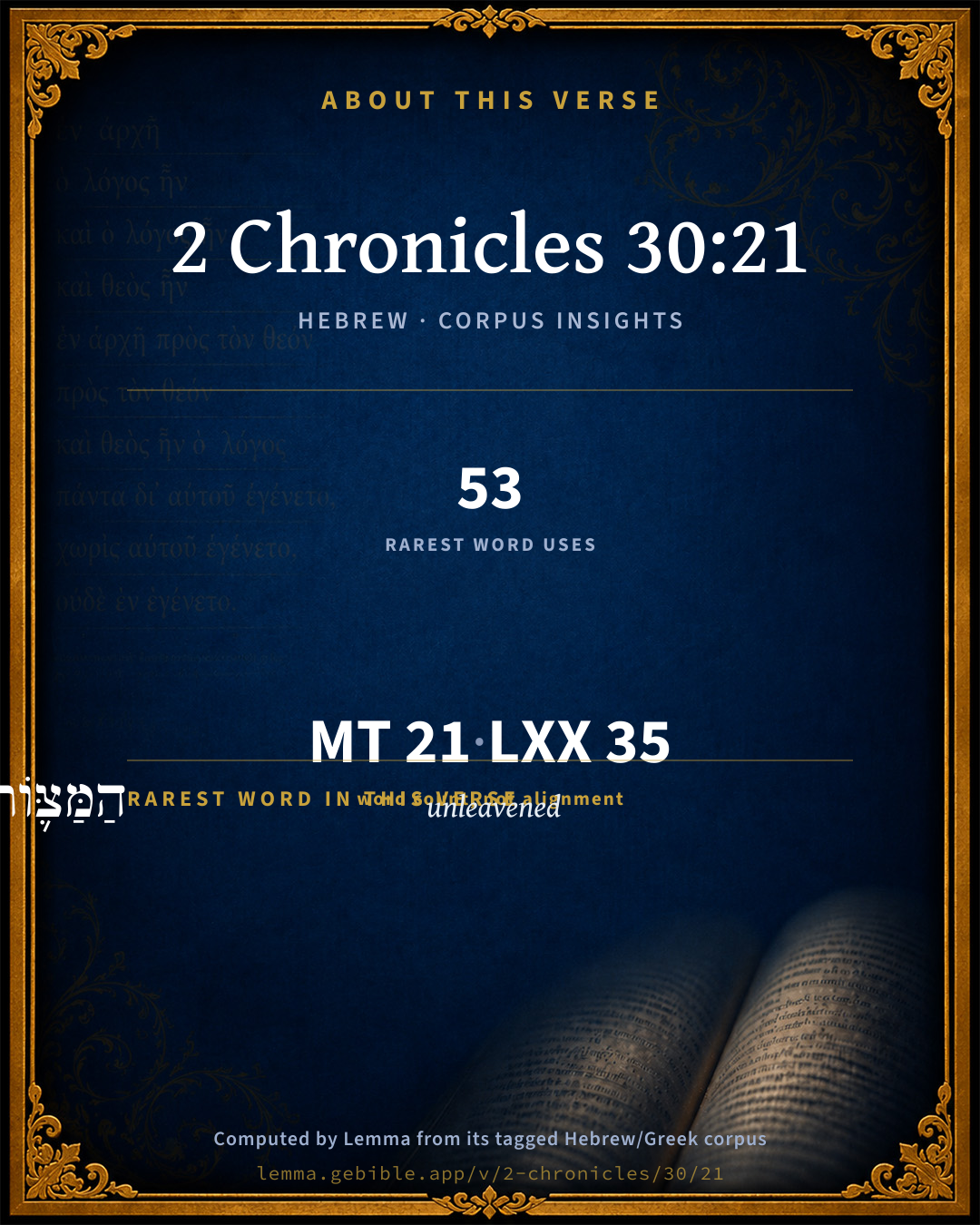
About this verse

These counts appear in no published source. They are computed here, from the morphology-tagged text and Lemma’s own curated glosses. What Lemma adds →

21
words
18
distinct lemmas
Historical
section

Shared distinctive vocabulary

הַמַּצּ֛וֹת unleavened H4682 occurs in 42 verses of the Hebrew Bible. Also found in:

Grammatical profile

  • 3 verbs
  • 15 nouns
  • 2 adjectives
  • 1 particle

Verb forms

  • וַיַּעֲשׂ֣וּ Qal · Sequential Imperfect
  • הַנִּמְצְאִ֨ים Niphal · Participle Active
  • וּֽמְהַלְלִ֣ים Piel · Participle Active

Repetition

Words recur within this verse — often emphatic in Hebrew:

  • יָמִ֖ים day H3117 ×3
  • לַ֠יהוָה LORD H3068 ×2

Hebrew & Septuagint length

In English translation the verse runs 37 words from the Hebrew and 43 from the Septuagint (LXX English) — closely comparable.

A rough comparison of the two English renderings, which tokenize alike — not a word-level alignment.

Word counts can differ between the Hebrew and the Greek without any difference in meaning — e.g. the Hebrew direct-object marker אֵת has no separate Greek word, and Greek often adds the article ὁ.

In the original languages it is 21 Hebrew tokens and 35 Greek tokens — but the two are counted differently (Hebrew bundles its prefixes and suffixes into one token; the Greek is in lemma form), so that isn’t a like-for-like length.

Cross-references

17

Topical passages linked to 2 Chronicles 30:21 in the Treasury of Scripture Knowledge — connected by theme and wording, ordered by reader-vote popularity; previews shown in the World English Bible.

  • Exodus 12:15 Seven days shall you eat unleavened bread; even the first day you shall put away yeast out of your houses, for whoever eats leavened bread from the first day until the seventh day, that soul shall be cut off from Israel.
  • Exodus 13:6 Seven days you shall eat unleavened bread, and in the seventh day shall be a feast to Yahweh.
  • Leviticus 23:6 On the fifteenth day of the same month is the feast of unleavened bread to Yahweh. Seven days you shall eat unleavened bread.
  • Deuteronomy 12:7 and there you shall eat before Yahweh your God, and you shall rejoice in all that you put your hand to, you and your households, in which Yahweh your God has blessed you.
  • Deuteronomy 12:12 You shall rejoice before Yahweh your God, you, and your sons, and your daughters, and your men-servants, and your maid-servants, and the Levite who is within your gates, because he has no portion nor inheritance with you.
  • Deuteronomy 16:14 and you shall rejoice in your feast, you, and your son, and your daughter, and your man-servant, and your maid-servant, and the Levite, and the foreigner, and the fatherless, and the widow, who are within your gates.
  • 2 Chronicles 7:10 On the three and twentieth day of the seventh month he sent the people away to their tents, joyful and glad of heart for the goodness that Yahweh had shown to David, and to Solomon, and to Israel his people.
  • 2 Chronicles 20:21 When he had taken counsel with the people, he appointed those who should sing to Yahweh, and give praise in holy array, as they went out before the army, and say, Give thanks to Yahweh; for his loving kindness endures forever.
  • 2 Chronicles 29:25–27 He set the Levites in the house of Yahweh with cymbals, with psalteries, and with harps, according to the commandment of David, and of Gad the king's seer, and Nathan the prophet; for the commandment was of Yahweh by his prophets.
  • 2 Chronicles 30:26 So there was great joy in Jerusalem; for since the time of Solomon the son of David king of Israel there was not the like in Jerusalem.
  • Nehemiah 8:10 Then he said to them, Go your way, eat the fat, and drink the sweet, and send portions to him for whom nothing is prepared; for this day is holy to our Lord: neither be you grieved; for the joy of Yahweh is your strength.
  • Psalms 150:3–5 Praise him with the sounding of the trumpet! Praise him with harp and lyre!
  • Luke 22:1 Now the feast of unleavened bread, which is called the Passover, drew near.
  • Luke 22:7 The day of unleavened bread came, on which the Passover must be sacrificed.
  • Acts 2:46 Day by day, continuing steadfastly with one accord in the temple, and breaking bread at home, they took their food with gladness and singleness of heart,
  • 1 Corinthians 5:7–8 Purge out the old yeast, that you may be a new lump, even as you are unleavened. For indeed Christ, our Passover, has been sacrificed in our place.

Cross-references courtesy of OpenBible.info (CC BY 4.0).

Hebrew and Greek witnesses Masoretic Hebrew ↔ Greek Septuagint

The same verse in the two great witnesses to the Old Testament, shown verse-for-verse.

These are two independent witnesses, not word-aligned to each other, and the Septuagint is shown in lemma (dictionary) form.

Hebrew 2 Chronicles 30:21 Masoretic · Westminster Leningrad Codex

וַיַּעֲשׂ֣וּ בְנֵֽי יִ֠שְׂרָאֵל הַנִּמְצְאִ֨ים בִּירוּשָׁלִַ֜ם אֶת חַ֧ג הַמַּצּ֛וֹת שִׁבְעַ֥ת יָמִ֖ים בְּשִׂמְחָ֣ה גְדוֹלָ֑ה וּֽמְהַלְלִ֣ים לַ֠יהוָה י֣וֹם בְּי֞וֹם הַלְוִיִּ֧ם וְהַכֹּהֲנִ֛ים בִּכְלֵי עֹ֖ז לַיהוָֽה

The children of Israel who were present at Jerusalem kept the feast of unleavened bread seven days with great gladness; and the Levites and the priests praised Yahweh day by day, [singing] with loud instruments to Yahweh.

World English Bible · Public Domain

Greek LXX 2 Chronicles 30:21 Septuagint · lemma form

καί ποιέω ὁ υἱός ἰσραήλ ὁ εὑρίσκω ἐν ἰερουσαλήμ ὁ ἑορτή ὁ ἄζυμος ἑπτά ἡμέρα ἐν εὐφροσύνη μέγας καί καταὑμνέω ὁ κύριος ἡμέρα κατά ἡμέρα καί ὁ ἱερεύς καί ὁ λευείτης ἐν ὄργανον ὁ κύριος

And the children of Israel who were present in Jerusalem kept the feast of unleavened bread seven days with great joy; and they continued to sing hymns to the Lord daily, and the priests and the Levites played on instruments to the Lord.

LXX2012 (modern English Septuagint) · Public Domain

Hebrew: Westminster Leningrad Codex (CC BY 4.0). Greek: Septuagint (public domain); English from LXX2012 (modern English Septuagint) (Public Domain). How the Septuagint differs from the Hebrew →

Commentary

Notes on 2 Chronicles 30:21 from classic Christian and Jewish commentators (each source and its license shown beneath its notes). The classic Christian expositions comment on the surrounding passage and are grouped to its opening verse, so a note may address several verses; the Jewish commentaries on the Tanakh (Rashi and others) are per-verse, so they appear only where the commentator wrote on this verse.

Lemma curates 59 commentaries, every one of them public domain or Creative Commons licensed, each selected and text-cleaned for this edition rather than reprinted as found. About our sources →

Matthew Henry's Commentary

After the passover followed the feast of unleavened bread, which continued seven days. How that was observed we are here told, and every thing in this account looks pleasant and lively. 1. Abundance of sacrifices were offered to God in peace-offerings, by which they both acknowledged and implored the favour of God, and on part of which the offerers feasted with their friends during these seven days (Ch2 30:22), in token of their communion with God and the comfort they took in his favour and their reconciliation to him. To keep up this part of the service, that God's altar might be abundantly regaled with the fat and blood and his priests and people with the flesh of the peace-offerings, Hezekiah gave out of his own stock 1000 bullocks and 7000 sheep, and the princes, excited by his pious example, gave the same number of bullocks and a greater number of sheep, and all for peace-offerings, Ch2 30:24. By this God was honoured, the joy of the festival was kept up, and the strangers were encouraged to come again to Jerusalem. It was generously done of the king and the princes thus plentifully to entertain the whole congregation; but what is a great estate good for but that it puts men into a capacity of doing so much the more good? Christ feasted those that followed him. I believe neither Hezekiah nor his princes were the poorer at the year's end for this their pious liberality. 2. Many good prayers were put up to God with the peace-offerings, Ch2 30:22. They made confession to the Lord God of their fathers, in which the intent and meaning of the peace-offerings were directed and explained. When the priests sprinkled the blood and burnt the fat they made confession, so did the people when they feasted on their part. They made a religious confession of their relation to God and dependence upon him, a penitent confession of their sins and infirmities, a thankful confession of God's mercies to them, and a supplicatory confession of their wants and desires; and, in all these, they had an eye to God as the God of their fathers, a God in covenant with them. 3. There was a great deal of good preaching. The Levites (whose office it was, Deu 33:10) taught the people the good knowledge of the Lord, read and opened the scriptures, and instructed the congregation concerning God and their duty to him; and great need there was of this, after so long a famine of the word as there had been in the last reign. Hezekiah did not himself preach, but he spoke comfortably to the Levites that did, attended their preaching, commended their diligence, and assured them of his protection and countenance. Hereby he encouraged them to study hard and take pains, and put a reputation upon them, that the people might respect and regard them the more. Princes and magistrates, by owning and encouraging faithful and laborious preachers, greatly serve the interest of God's kingdom among men. 4. They sang psalms every day (Ch2 30:21): The Levites and priests praised the Lord day by day, both with songs and musical instruments, thus expressing their own and exciting one another's joy in God and thankfulness to him. Praising God should be much of our work in our religious assemblies. 5. Having kept the seven days of the feast in this religious manner, they had so much comfort in the service that they kept other seven days, Ch2 30:23. They did not institute any new modes of worship, but repeated and continued the old. The case was extraordinary: they had been long without the ordinance; guilt had been contracted by the neglect of it; they had now got a very great congregation together, and were in a devout serious frame; they knew not when they might have such another opportunity, and therefore could not now find in their hearts to separate till they had doubled the time. Many of them were a great way from home, and had business in the country to look after, for, this being the second month, they were in the midst of their harvest; yet they were in no haste to return: the zeal of God's house made them forget their secular affairs. How unlike those who snuffed at God's service, and said, What a weariness is it! Or those who asked, When will the sabbath be gone? The servants of God should abound in his work. 6. All this they did with gladness (Ch2 30:23); they all rejoiced, and particularly the strangers, Ch2 30:25. So there was great joy in Jerusalem, Ch2 30:26. Never was the like since the dedication of the temple in Solomon's time. Note, Holy duties should be performed with holy gladness; we should be forward to them, and take pleasure in them, relish the sweetness of communion with God, and look upon it as matter of unspeakable joy and comfort that we are thus favoured and have such earnests of everlasting joy. 7. The congregation was at length dismissed with a solemn blessing, Ch2 30:27. (1.) The priests pronounced it; for it was part of their office to bless the people (Num 6:22, Num 6:23), in which they were both the people's mouth to God by way of prayer and God's mouth to the people by way of promise; for their blessing included both. In it they testified both their desire of the people's welfare and their dependence upon God and that word of his grace to which they commended them. What a comfort is it to a congregation to be sent home thus crowned! (2.) God said Amen to it. The voice of the priests, when they blessed the people, was heard in heaven and came up to the habitation of God's holiness. When they pronounced the blessing God commanded it, and perhaps gave some sensible token of the ratification of it. The prayer that comes up to heaven in a cloud of incense will come down again to this earth in showers of blessings.

Matthew Henry's Commentary on the Whole Bible (1708–1710) — public domain (CC PDM 1.0). Text via the HelloAO Bible API.

Trapp's Complete Commentary

John Trapp

2Ch 30:21 And the children of Israel that were present at Jerusalem kept the feast of unleavened bread seven days with great gladness: and the Levites and the priests praised the LORD day by day, [singing] with loud instruments unto the LORD.

Ver. 21. Singing with loud instruments.] Heb., With instruments of strength; or, concerning the strength and power of God, as Munster senseth it.

John Trapp, A Commentary or Exposition upon All the Books of the Old and New Testament (1647–1656) — public domain. Text from a community e-Sword module.

Joseph Benson's Commentary

2Ch 30:21. The Levites and the priests praised the Lord day by day — All the seven days they praised him with songs and musical instruments, thus expressing their own, and exciting one another’s joy in God, and thankfulness to him. Much of our time in our religious meetings should be spent in praising God.

Joseph Benson's Commentary on the Old and New Testaments (1811–1818) — public domain. Text from a community e-Sword module.

Jamieson, Fausset & Brown

Robert Jamieson, A. R. Fausset & David Brown

the children of Israel . . . kept the feast--The time appointed by the law for the continuance of the feast was seven days [Exo 12:15; Exo 13:6; Lev 23:6]; but in consequence of its having been allowed to fall so long into desuetude, they doubled the period of celebration and kept it fourteen days with unabated satisfaction and joy. Materials for the additional sacrificial meals were supplied by the munificence of the king and the princes.

Jamieson, Fausset & Brown — Commentary Critical and Explanatory on the Whole Bible (1871) — public domain (CC PDM 1.0). Text via the HelloAO Bible API.

Ellicott's Commentary for English Readers

(21) Kept the feast. . . . with great gladness.—See 1Ch_13:8; 1Ch_15:16, seq., 1Ch_15:28, and similar passages.

And the Levites.—With stringed instruments.

And the priests.—With clarions.

Praised.—Were praising; throughout the seven days’ festival.

Singing.—Omit.

With loud instruments unto the Lord.—With instruments of strength to Jehovah. This curious phrase apparently means instruments with which they ascribed strength to Jehovah; that is to say, with which they accompanied their psalms of praise. (Comp. the many psalms which glorify the strength of the God of Israel—e.g., Psa_29:1, “Ascribe unto Jehovah, ye sons of God, ascribe unto Jehovah glory and strength.”)

There is, however, something to be said for the Authorised Version. (Comp. 2Ch_5:12-13; 1Ch_15:28; 1Ch_16:42, from which it appears that the chronicler preferred music that was loud and strong.)

A Bible Commentary for English Readers, edited by Charles John Ellicott (1878–1897) — public domain. Text from a community e-Sword module.

The Cambridge Bible for Schools and Colleges

gen. ed. J. J. S. Perowne

21. with loud instruments] Lit. “with instruments of strength.” It has been proposed to read “with all their might” (as 1Ch_13:8). The change in Heb. amounts only to the dropping of the smallest letter (yôd).

The Cambridge Bible for Schools and Colleges (gen. ed. J. J. S. Perowne; Cambridge University Press, 1878–1918) — public domain. Text from a community e-Sword module.

John Gill's Exposition

And Hezekiah spake comfortably to all the Levites,.... Or "to the heart" (u) of them, such things as were very encouraging to them to go on in the work and worship of God, commending their singing, exhorting them to diligence in instructing the people, promising them his favour and protection:

even those that taught the good knowledge of the Lord; who instructed the people well in his word, worship, and ordinances; though some restrain this to their skill in singing the praises of God, both vocally and instrumentally, and their abilities and diligence in teaching others:

and they did eat throughout the feast: or did eat the feast; that is, the sacrifices of it; not the Levites only, but the king, and all the congregation:

offering peace offerings; part of which belonged to the Lord, another part to the priests, and a third to the offerers, on which they feasted with their friends; and this they did throughout all the seven days of the feast:

and making confession to the Lord God of their fathers; confessing their sins of omission and commission they had been guilty of; owning the goodness, grace, and mercy of God towards them; blessing and praising his name for the restoration of his worship and ordinances among them.

(u) "ad cor", Pagninus, Montanus, &c.

John Gill's Exposition of the Whole Bible (1746–1763) — public domain (CC PDM 1.0). Text via the HelloAO Bible API.

Haydock's Catholic Bible Commentary

Days. It seems all the observances had been omitted in the first month. The Jews teach, that those who have complied with those prescriptions, which require no particular purity, are not bound to keep the festival for seven days, nor to abstain from leavened bread the second month. --- That agreed. Heb. and Sept. "of strength," sonorous, (M.) which they played on with all their force, or which sounded for the divine power. C.

George Leo Haydock (1774–1849), Haydock's Catholic Family Bible and Commentary, 1859 edition — public domain. Excludes Psalms (Douay-Rheims chapter numbering differs from Protestant) and Deuterocanonical books (Catholic canon only).

The Pulpit Commentary

See Exo_12:18, and many repetitions of the same matter, respecting the duration of the Passover and eating of unleavened bread. With loud instruments. Some render this, "instruments ascribing might to Jehovah." There seems no necessity for this; and the plain Hebrew text is "instruments of might," i.e. strong or loud instruments.

Vers. 21-27.

Religious enthusiasm.

This chapter reads as if written by an eyewitness of the scenes described, so vivid is the account, so much colour is in the picture. It was evidently a time of very great enthusiasm, of spiritual exuberance. These are very pleasant, and they may be very profitable occasions; but they need to be rightly directed and well controlled. Of religious enthusiasm, we may consider

I ITS ONLY FIRM FOUNDATION. This is a true sense of the Divine favour. Unless God be with us, granting us his own approval, intending to further us with his blessing, all our congratulations are ill-timed and all our action will be fruitless. And it is needful that we know that we have his approval. It is too often assumed in its absence. Hezekiah and his people, with Isaiah among them, were resting in a well-grounded confidence. Without such prophetic guidance, we must inquire of ourselves whether our repentance and our faith are deep and real; whether we have in truth "yielded cur-selves unto the Lord" (ver. 8), whether we are "Christ"s disciples indeed". (Joh_8:31)

II ITS NATURAL ATMOSPHERE. Sacred joy. They "kept the feast with great gladness" (ver. 21); "There was great joy in Jerusalem" (ver. 26). There are many sources of happiness, reaching upwards from the most gross to the most spiritual and refined. There is none deeper or purer, none more elevated or enlarging, than the joy of the human spirit in the worship and service of the Supreme. To be holding hallowed fellowship with our Divine Father and Saviour, and to be so doing in unison with a multitude of our Christian brethren and sisters, or to be engaged with them in doing some earnest and faithful work, this is a source of truest and worthiest human joy.

III ITS BEST MANIFESTATIONS.

1. In sacred song. The Levites "praised the Lord day by day" (ver. 21). A large measure of spiritual fervour finds utterance in song, happily to

2. ourselves and acceptably to God. There is no phase of sacred feeling which may not find fitting expression thus.

3. In wise and kind encouragement. Hezekiah "spake comfortably unto all the Levites" (ver. 22). He no doubt congratulated them on their good spiritual estate and on their opportunity of service, and invited and urged them to exercise their sacred functions in all fidelity. A few words of timely encouragement from one that is in a higher position go a long way; such words constitute a stronger inducement to duty and devotion than many words of criticism or censure.

1. In religious instruction. That taught the good knowledge of the Lord" (ver. 22).

2. In re-dedication. "A great number of priests sanctified themselves." Some of the priests, probably many, if not most of them, had shown slackness and had held back; (2Ch_29:34) they had some reason for being ashamed (see ver. 15). But in this hour of widespread enthusiasm they came forward and made themselves ready for their sacred functions. At such a time, much is gained if those who have become cool in the service of their Lord, whose faith is failing and whose zeal is dying down, re-consecrate themselves to him, take afresh upon them his vows, and solemnly and formally undertake to live and labour in his cause.

3. In expansiveness. Room was found for "the strangers that came out of the land of Israel room in the hearts and at the tables of the people. Nothing can be better than that our own great gladness of heart in God should overflow to those beyond our own pale. By all means let there be a generous expansiveness at such a time; let the stranger, let the "outsider," let the outcast, let the abandoned," let those who have come to despair of themselves, be remembered, be sought out, be encouraged, be enlightened, be admitted and welcomed. We tread closely in the steps of our Leader when we act thus.

4. In liberality. In the generous use of our substance (see ver. 24). When we are receiving freely of God"s good gift of sacred joy, we should give freely of the good he has entrusted to our care. C.

The Pulpit Commentary (1880–1919), ed. H.D.M. Spence-Jones & Joseph S. Exell — public domain. Text from a community e-Sword module.

unfoldingWord translationNotes

Door43 World Missions Community

kept the Festival of Unleavened Bread

Here "kept the festival" is a idiom meaning to participate in the festival or celebrate the festival. AT: "celebrate the festival" (See: Idiom)

singing with loud instruments to Yahweh

"singing and playing loud musical instruments to Yahweh"

who understood the service of Yahweh

This was the reason that he spoke encouragingly to them. AT: "because they understood the service of Yahweh" or "because they served Yahweh skillfully" (See: Distinguishing versus Informing or Reminding)

So they ate throughout the festival

The word "they" refers to the people of Israel.

making confession to Yahweh

Possible meanings are 1) "confession" here refers to saying that God is great. AT: "praising Yahweh" or 2) "confession" here refers to admitting their sins. AT: "confessing their sins to Yahweh"

translationWords

Israel

Jerusalem

joy

praise

servant

sacrifice

fellowship offering

confess

unfoldingWord translationNotes — © Distant Shores Media and the Door43 World Missions Community, licensed CC BY-SA 4.0. Source: git.door43.org/Door43/en_tn.

Rashi

Rabbi Shlomo Yitzchaki (Rashi)

and the priests with powerful instruments with trumpets.

Rashi on the Tanakh — English translations: “The Judaica Press complete Tanach with Rashi, translated by A. J. Rosenberg” (CC BY 4.0); “Pentateuch with Rashi's commentary by M. Rosenbaum and A.M. Silbermann, 1929-1934” (public domain); “The Metsudah Tanach series, Lakewood, N.J” (CC BY 4.0); and “The Book of Joshua, Metsudah Publications, 1997” (CC BY 4.0). Text via Sefaria.

Lesson kit

Teaching starters — assembled from the data on this page, not authored interpretation. Every prompt links to the verse data it draws on. Edit before teaching.

2 Chronicles, in the Historical, opens this verse with 21 words (18 distinct Hebrew lemmas). Its most distinctive word is matstsâh (“unleavened”). A historical commentator’s framing appears above. Read the whole chapter for the surrounding context.

Discussion questions

  1. The word matstsâh carries the sense “unleavened.” How does it shape the verse?
  2. Genesis 19:3 shares the word «unleavened» with this verse. How do the two illuminate each other?
  3. “day” occurs 3× in this one verse. What is the effect of the repetition?
  4. The translations on this page render this verse differently — a whole-verse word diff, not a word-by-word alignment. What might account for the different wordings?
  5. The verb «וַיַּעֲשׂ֣וּ» is Qal Sequential Imperfect. How does its form color the action?
  6. Reading how Matthew Henry's Commentary and Trapp's Complete Commentary read this verse, where do the two commentators agree and where do they part?

Things to notice

Reading settings

Reading text

Shown beneath each verse's original-language words.

Old Testament
Old Testament edition

Read the OT as the Masoretic Hebrew (MT) or the Greek Septuagint (LXX).

English shown for the Greek Septuagint (in the Hebrew ↔ Greek comparison).

Comparing translations? Open the Compare panel on any verse page to stack up to four side by side.