
2 Kings 24:15

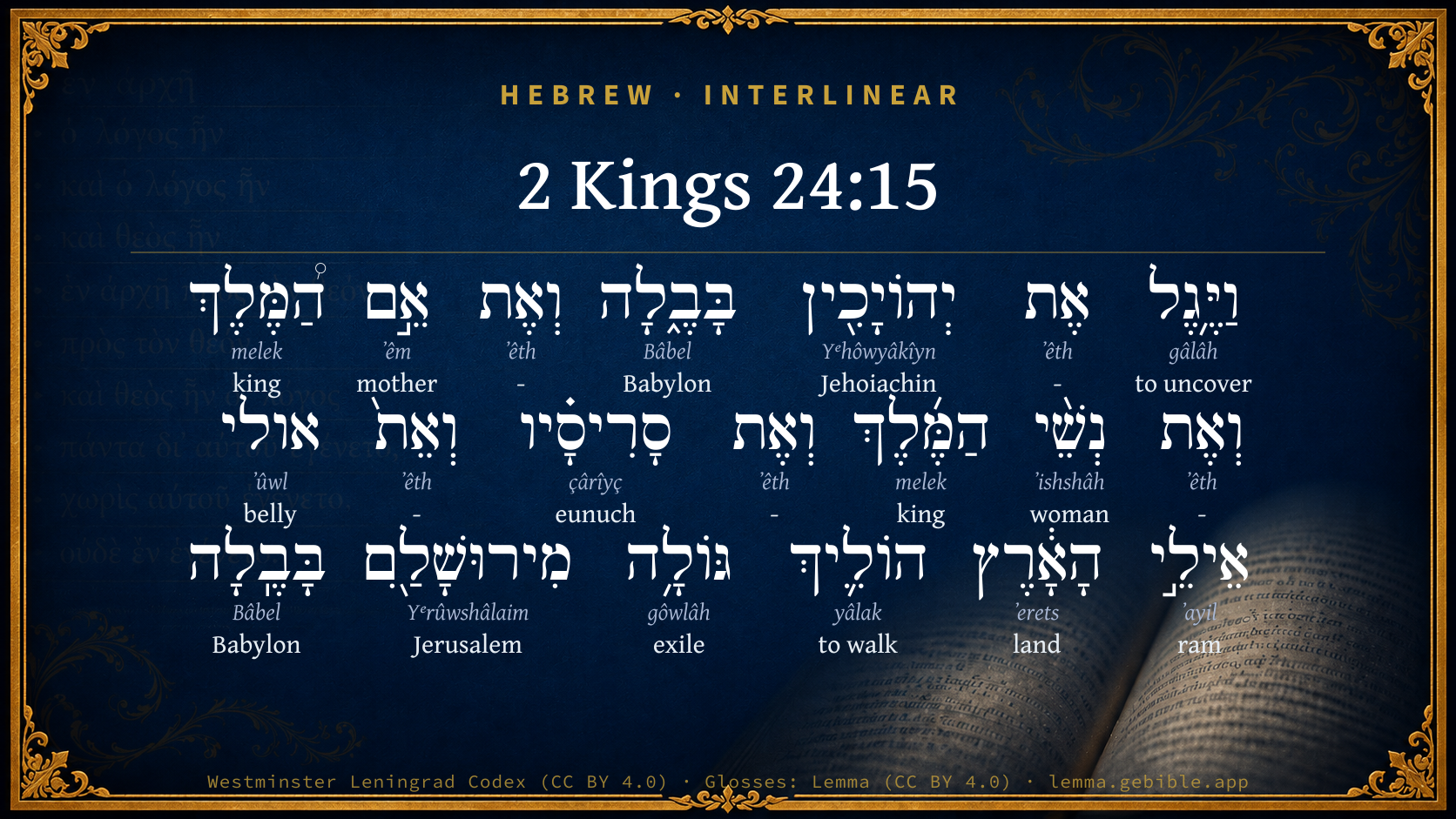
Hebrew (Westminster Leningrad Codex) 2 Kings 24:15 appears in the Hebrew Old Testament. The text above is from the Westminster Leningrad Codex. Each word links to its Strong’s number, a concise gloss, and parsing drawn from the Open Scriptures Hebrew Bible morphology. Click any word for its full Brown-Driver-Briggs (BDB) entry.
Download image
Cite this verse

2 Kings 24:15 (World English Bible). Public Domain. Lemma interlinear Bible study tool, https://lemma.gebible.app/v/2-kings/24/15.

Show BibTeX & RIS
BibTeX
RIS
English Translation
He carried away Jehoiachin to Babylon; and the king's mother, and the king's wives, and his officers, and the chief men of the land, carried he into captivity from Jerusalem to Babylon.
World English Bible · Public Domain
Highlights
  • 1 first appearance in the Hebrew Bible
Full analysis ↓
Download a study sheet

One document with this verse’s original text, its word-by-word gloss line, the meaning frame, cross-references with their text, attributed commentary, and full source and license credits — printable, and it pastes into notes with its structure intact.

This verse Autodidact and up

Study sheet (.html) Plain text (.txt)

A passage Seminary Student

Up to 50 verses in one chapter. A passage sheet keeps up to 6 commentary sources and 12 cross-references per verse, in the order this page ranks them, and says so on the sheet whenever that leaves anything out. Ask for a single verse and you get the Autodidact verse sheet above.

Everything on this page stays free to read, with no account — the sheet is a download of what is already on screen, not access to it.

Want to remove ads? Support Godless Engineer
Compare translations 3

The same verse in 3 English versions, stacked beneath the original-language interlinear above. Click any original word for its lexicon entry.

Each is an independent rendering of the whole verse — the interlinear is not word-aligned to these translations.

Highlighted words mark where these versions differ — a whole-verse word diff, not a word-by-word alignment.

  • World English Bible Public Domain
    He carried away Jehoiachin to Babylon; and the king's mother, and the king's wives, and his officers, and the chief men of the land, carried he into captivity from Jerusalem to Babylon.
  • King James Version Public Domain
    And he carried away Jehoiachin to Babylon, and the king's mother, and the king's wives, and his officers, and the mighty of the land, those carried he into captivity from Jerusalem to Babylon.
  • unfoldingWord Literal Text CC BY-SA 4.0
    And he exiled Jehoiachin to Babylon. And the mother of the king and the wives of the king and his eunuchs and the leaders of the land he led exile from Jerusalem to Babylon,

unfoldingWord Literal Text — © unfoldingWord, licensed CC BY-SA 4.0. Word-aligned USFM3 via Door43 (git.door43.org/unfoldingWord/en_ult).

Versions to compare (up to 4)

3 of 4 selected

Show all 18 translations

Every available English version of this verse, each an independent rendering of the whole verse.

  • World English Bible Public Domain
    He carried away Jehoiachin to Babylon; and the king's mother, and the king's wives, and his officers, and the chief men of the land, carried he into captivity from Jerusalem to Babylon.
  • Berean Standard Bible Public Domain
    Nebuchadnezzar carried away Jehoiachin to Babylon, as well as the king’s mother, his wives, his officials, and the leading men of the land. He took them into exile from Jerusalem to Babylon.
  • Majority Standard Bible Public Domain
    Nebuchadnezzar carried away Jehoiachin to Babylon, as well as the king’s mother, his wives, his officials, and the leading men of the land. He took them into exile from Jerusalem to Babylon.
  • King James Version Public Domain
    And he carried away Jehoiachin to Babylon, and the king's mother, and the king's wives, and his officers, and the mighty of the land, those carried he into captivity from Jerusalem to Babylon.
  • American Standard Version (1901) Public Domain
    And he carried away Jehoiachin to Babylon; and the king's mother, and the king's wives, and his officers, and the chief men of the land, carried he into captivity from Jerusalem to Babylon.
  • Revised Version (1885) Public Domain
    And he carried away Jehoiachin to Babylon; and the king’s mother, and the king’s wives, and his officers, and the chief men of the land, carried he into captivity from Jerusalem to Babylon.
  • Geneva Bible (1599) Public Domain
    And he caryed away Iehoiachin into Babel, and the Kings mother, and the Kinges wiues, and his eunuches, and the mightie of the lande caryed he away into captiuitie from Ierusalem to Babel,
  • Douay-Rheims (1899) Public Domain
    And he carried away Joachin into Babylon, and the king's mother, and the king's wives, and his eunuchs: and the judges of the land he carried into captivity from Jerusalem into Babylon.
  • Young's Literal Translation Public Domain
    And he removeth Jehoiachin to Babylon, and the mother of the king, and the wives of the king, and his eunuchs, and the mighty ones of the land -- he hath caused a removal to go from Jerusalem to Babylon,
  • Literal Standard Version CC BY-SA 4.0
    And he removes Jehoiachin to Babylon, and the mother of the king, and the wives of the king, and his eunuchs, and the mighty ones of the land—he has caused a removal to go from Jerusalem to Babylon,
  • Unlocked Literal Bible CC BY-SA 4.0
    Nebuchadnezzar took Jehoiachin into exile at Babylon, as well as the king's mother, wives, officers, and the chief men of the land. He took them into exile from Jerusalem to Babylon.
  • unfoldingWord Literal Text CC BY-SA 4.0
    And he exiled Jehoiachin to Babylon. And the mother of the king and the wives of the king and his eunuchs and the leaders of the land he led exile from Jerusalem to Babylon,
  • Darby Bible Public Domain
    And he carried away Jehoiachin to Babylon, and the king's mother, and the king's wives, and his chamberlains, and the mighty of the land, he led into captivity from Jerusalem to Babylon;
  • World Messianic Bible Public Domain
    He carried away Jehoiachin to Babylon, with the king’s mother, the king’s wives, his officers, and the chief men of the land. He carried them into captivity from Jerusalem to Babylon.
  • Webster's Bible Public Domain
    And he carried away Jehoiachin to Babylon, and the king's mother, and the king's wives, and his officers, and the mighty of the land, those carried he into captivity from Jerusalem to Babylon.
  • Free Bible Version CC BY-SA 4.0
    He took Jehoiachin away into exile to Babylon, as well as the king's mother and the king's wives and his officials and the leading men of the land, he deported them all from Jerusalem to Babylon.
  • Bible in Basic English Public Domain
    He took Jehoiachin a prisoner to Babylon, with his mother and his wives and his unsexed servants and the great men of the land; he took them all as prisoners from Jerusalem to Babylon.
  • JPS Tanakh (1917) Public Domain
    And he carried away Jehoiachin to Babylon; and the king's mother, and the king's wives, and his officers, and the chief men of the land, carried he into captivity from Jerusalem to Babylon.

Literal Standard Version (2020), Covenant Press — licensed CC BY-SA 4.0. Text via the HelloAO Bible API (eBible.org). Unlocked Literal Bible (unfoldingWord) — licensed CC BY-SA 4.0. Text via the HelloAO Bible API (eBible.org). unfoldingWord Literal Text — © unfoldingWord, licensed CC BY-SA 4.0. Word-aligned USFM3 via Door43 (git.door43.org/unfoldingWord/en_ult). Free Bible Version, Dr. Jonathan Gallagher — licensed CC BY-SA 4.0. Text via the HelloAO Bible API (eBible.org).

Word by word

More ways to search: Search by grammar → Find every occurrence → Compare this word →

Practice this passage: Drill this verse → Learn its vocabulary →

אולי
ʼûwl
H193
“nobles of”
Noun, Common, Masculine, Plural, Construct
Part of Speech
Noun
Type
Common
Gender
Masculine
Number
Plural
State
Construct
Full BDB Definition

Origin: from an unused root meaning to twist, i.e. (by implication) be strong

TWOT: 45a

prominence - body, belly (contemptuous) - nobles, wealthy men
  1. וַיֶּ֥גֶל gâlâh H1540 “and · to uncover” Conjunction + Verb, Hiphil, Sequential Imperfect, 3rd Person, Masculine, Singular
  2. אֶת ʼêth H853 “-” Particle, Direct Object
  3. יְהוֹיָכִ֖ין Yᵉhôwyâkîyn H3078 “Jehoiachin” Noun, Proper
  4. בָּבֶ֑לָה Bâbel H894 “Babylon · toward” Noun, Proper + Suffix, Demonstrative
  5. וְאֶת ʼêth H853 “and · -” Conjunction + Particle, Direct Object
  6. אֵ֣ם ʼêm H517 “mother of” Noun, Common, Feminine, Singular, Construct
  7. הַ֠מֶּלֶךְ melek H4428 “the · king” Particle, Definite Article + Noun, Common, Masculine, Singular, Absolute
  8. וְאֶת ʼêth H853 “and · -” Conjunction + Particle, Direct Object
  9. נְשֵׁ֨י ʼishshâh H802 “women of” Noun, Common, Feminine, Plural, Construct
  10. הַמֶּ֜לֶךְ melek H4428 “the · king” Particle, Definite Article + Noun, Common, Masculine, Singular, Absolute
  11. וְאֶת ʼêth H853 “and · -” Conjunction + Particle, Direct Object
  12. סָרִיסָ֗יו çârîyç H5631 “eunuchs · his” Noun, Common, Masculine, Plural, Construct + Suffix, Personal, 3rd Person, Masculine, Singular
  13. וְאֵת֙ ʼêth H853 “and · -” Conjunction + Particle, Direct Object
  14. אֵילֵ֣י ʼayil H352 “rams of” Noun, Common, Masculine, Plural, Construct
  15. הָאָ֔רֶץ ʼerets H776 “the · land” Particle, Definite Article + Noun, Common, Both, Singular, Absolute
  16. הוֹלִ֛יךְ yâlak H3212 “to walk” Verb, Hiphil, Perfect, 3rd Person, Masculine, Singular
  17. גּוֹלָ֥ה gôwlâh H1473 “exile” Noun, Common, Feminine, Singular, Absolute
  18. מִירוּשָׁלִַ֖ם Yᵉrûwshâlaim H3389 “from · Jerusalem” Preposition + Noun, Proper
  19. בָּבֶֽלָה Bâbel H894 “Babylon · toward” Noun, Proper + Suffix, Demonstrative

About this verse

These counts appear in no published source. They are computed here, from the morphology-tagged text and Lemma’s own curated glosses. What Lemma adds →

20
words
14
distinct lemmas
Historical
section

Notable vocabulary

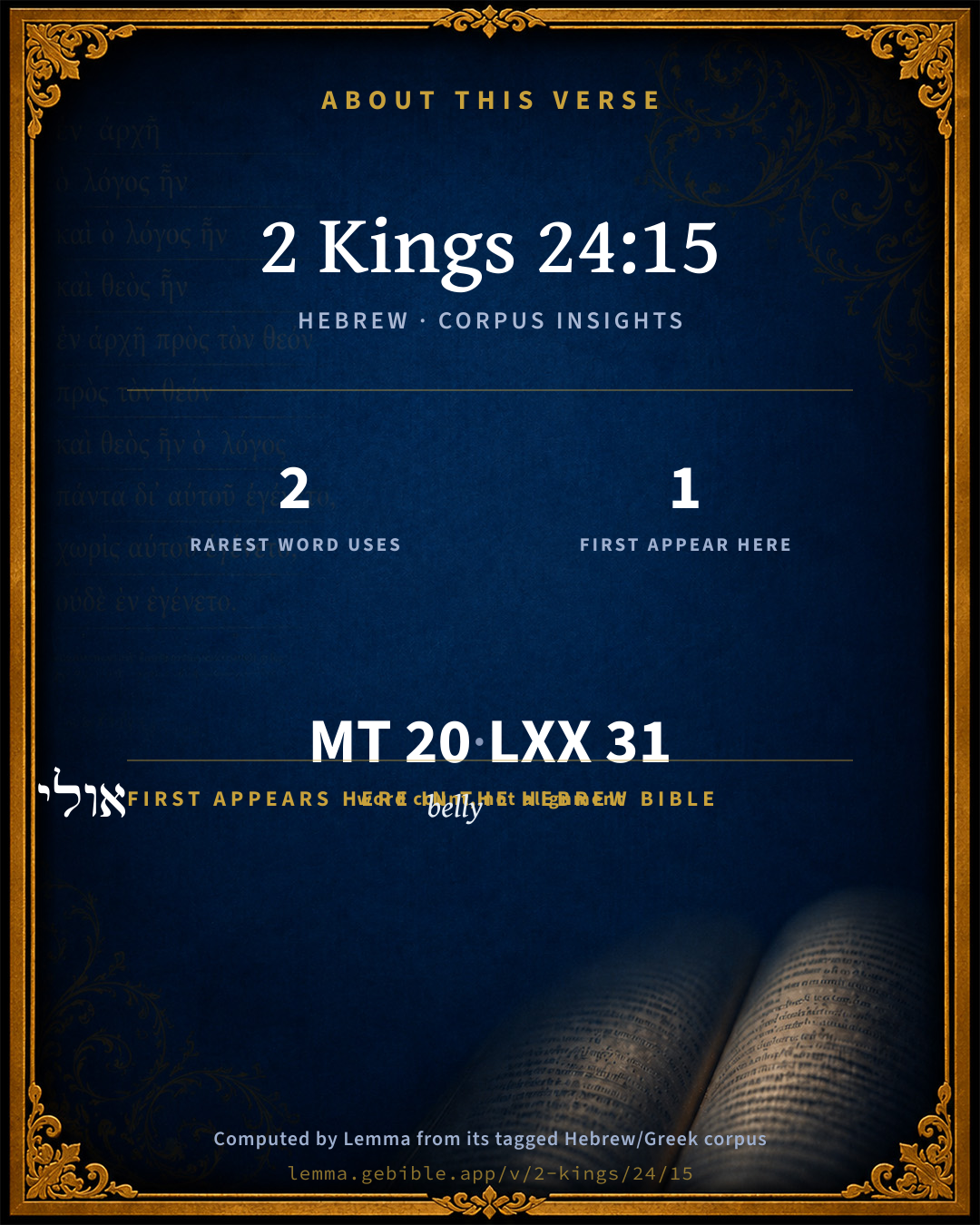
The rarest word here is אולי belly H193 — appearing just 2 times in the whole Hebrew Bible.

First appearance in Scripture

This word makes its first canonical appearance in the Hebrew Bible here:

  • אולי belly H193

Shared distinctive vocabulary

אולי belly H193 occurs in 2 verses of the Hebrew Bible. Also found in:

Grammatical profile

  • 2 verbs
  • 13 nouns
  • 5 particles

Verb forms

  • וַיֶּ֥גֶל Hiphil · Sequential Imperfect
  • הוֹלִ֛יךְ Hiphil · Perfect

Repetition

Words recur within this verse — often emphatic in Hebrew:

  • בָּבֶ֑לָה Babylon H894 ×2
  • הַ֠מֶּלֶךְ king H4428 ×2

Hebrew & Septuagint length

In English translation the verse runs 32 words from the Hebrew and 34 from the Septuagint (LXX English) — closely comparable.

A rough comparison of the two English renderings, which tokenize alike — not a word-level alignment.

Word counts can differ between the Hebrew and the Greek without any difference in meaning — e.g. the Hebrew direct-object marker אֵת has no separate Greek word, and Greek often adds the article ὁ.

In the original languages it is 20 Hebrew tokens and 31 Greek tokens — but the two are counted differently (Hebrew bundles its prefixes and suffixes into one token; the Greek is in lemma form), so that isn’t a like-for-like length.

Cross-references

5

Topical passages linked to 2 Kings 24:15 in the Treasury of Scripture Knowledge — connected by theme and wording, ordered by reader-vote popularity; previews shown in the World English Bible.

  • 2 Chronicles 36:10 At the return of the year king Nebuchadnezzar sent, and brought him to Babylon, with the goodly vessels of the house of Yahweh, and made Zedekiah his brother king over Judah and Jerusalem.
  • Esther 2:6 who had been carried away from Jerusalem with the captives who had been carried away with Jeconiah king of Judah, whom Nebuchadnezzar the king of Babylon had carried away.
  • Jeremiah 22:24–28 As I live, says Yahweh, though Coniah the son of Jehoiakim king of Judah were the signet on my right hand, yet would I pluck you there;
  • 2 Kings 24:8 Jehoiachin was eighteen years old when he began to reign; and he reigned in Jerusalem three months: and his mother's name was Nehushta the daughter of Elnathan of Jerusalem.
  • Ezekiel 17:12 Say now to the rebellious house, Don't you know what these things mean? tell them, Behold, the king of Babylon came to Jerusalem, and took the king of it, and the princes of it, and brought them to him to Babylon:

Cross-references courtesy of OpenBible.info (CC BY 4.0).

Hebrew and Greek witnesses Masoretic Hebrew ↔ Greek Septuagint

The same verse in the two great witnesses to the Old Testament, shown verse-for-verse.

These are two independent witnesses, not word-aligned to each other, and the Septuagint is shown in lemma (dictionary) form.

Hebrew 2 Kings 24:15 Masoretic · Westminster Leningrad Codex

וַיֶּ֥גֶל אֶת יְהוֹיָכִ֖ין בָּבֶ֑לָה וְאֶת אֵ֣ם הַ֠מֶּלֶךְ וְאֶת נְשֵׁ֨י הַמֶּ֜לֶךְ וְאֶת סָרִיסָ֗יו וְאֵת֙ אולי אֵילֵ֣י הָאָ֔רֶץ הוֹלִ֛יךְ גּוֹלָ֥ה מִירוּשָׁלִַ֖ם בָּבֶֽלָה

He carried away Jehoiachin to Babylon; and the king's mother, and the king's wives, and his officers, and the chief men of the land, carried he into captivity from Jerusalem to Babylon.

World English Bible · Public Domain

Greek LXX 2 Kings 24:15 Septuagint · lemma form

καί ἀποοἰκίζω ὁ ιωακιμ εἰς βαβυλών καί ὁ μήτηρ ὁ βασιλεύς καί ὁ γυνή ὁ βασιλεύς καί ὁ εὐνοῦχος αὐτός καί ὁ ἰσχυρός ὁ γῆ ἀποἄγω ἀποικεσία ἐκ ἰερουσαλήμ εἰς βαβυλών

And he carried Joachim away to Babylon, and the king's mother, and the king's wives, and his eunuchs: and he carried away the mighty men of the land into captivity from Jerusalem to Babylon.

LXX2012 (modern English Septuagint) · Public Domain

Hebrew: Westminster Leningrad Codex (CC BY 4.0). Greek: Septuagint (public domain); English from LXX2012 (modern English Septuagint) (Public Domain). How the Septuagint differs from the Hebrew →

Targum (Aramaic paraphrase)

1

The Targum is the ancient Jewish Aramaic paraphrase of the Hebrew Scriptures — an interpretive translation, not the Hebrew text itself. Onkelos (literal) and Pseudo-Jonathan (expansive) render the Torah, and Jonathan the Prophets. Coverage is partial: where no permissively-licensed English translation exists for a verse, only the Aramaic is shown. This is verse-level text, not a word-by-word alignment to the Hebrew.

  1. Targum Jonathan Prophets (Joshua–Malachi)
    וְאַגְלֵי יַת יְהוֹיָכִין לְבָבֶל וְיַת אִמָא דְמַלְכָּא וְיַת נְשֵׁי דְמַלְכָּא וְיַת רַבְרְבָנוֹהִי וְיַת רַבְרְבֵי אַרְעָא אוֹבִיל בְּגָלוּתָא מִירוּשְׁלֵם לְבָבֶל:

    (no public-domain English translation for this verse)

    Targum Jonathan — Aramaic: “Mikraot Gedolot” (public domain). English: “Sefaria Community Translation” (CC0 1.0 (public-domain dedication)); “London "Chaldee Paraphrase," 1871” (public domain). Text via Sefaria.

Commentary

Notes on 2 Kings 24:15 from classic Christian and Jewish commentators (each source and its license shown beneath its notes). The classic Christian expositions comment on the surrounding passage and are grouped to its opening verse, so a note may address several verses; the Jewish commentaries on the Tanakh (Rashi and others) are per-verse, so they appear only where the commentator wrote on this verse.

Lemma curates 59 commentaries, every one of them public domain or Creative Commons licensed, each selected and text-cleaned for this edition rather than reprinted as found. About our sources →

Ellicott's Commentary for English Readers

(15) And he carried away.—The form of the verb is different from that in 2Ki_24:14. We might render: “Yea, he carried away;” for 2Ki_24:15-16 simply give the particulars of what was stated generally in 2Ki_24:14. In the present verse the “princes” are defined.

He carried away Jehoiachin to Babylon, and the king’s mother.—Fulfilment of Jer_22:24-27.

The mighty of the land.—So the Targum, “the magnates of the land.” All who could do so, must have taken refuge in Jerusalem at the approach of the Chaldæan army.

A Bible Commentary for English Readers, edited by Charles John Ellicott (1878–1897) — public domain. Text from a community e-Sword module.

Trapp's Complete Commentary

John Trapp

2Ki 24:15 And he carried away Jehoiachin to Babylon, and the king’s mother, and the king’s wives, and his officers, and the mighty of the land, [those] carried he into captivity from Jerusalem to Babylon.

Ver. 15. These carried he into captivity into Babylon.] Where it fared better with them than with those that were left behind. {Jer 24:4-5, &c.} To these the prophet Jeremiah wrote a letter, if Apocryphal Baruch may be believed. {/APC Bar 6:1}

John Trapp, A Commentary or Exposition upon All the Books of the Old and New Testament (1647–1656) — public domain. Text from a community e-Sword module.

John Gill's Exposition

And the king of Babylon made Mattaniah his father's brother king in his stead,.... The third son of Josiah, Ch1 3:15.

and changed his name to Zedekiah; for the same reason the king of Egypt changed the name of Eliakim, Kg2 23:34 to signify his subjection to him; though some think it was to put him in mind of the justice of God, as the name signifies, that would overtake him, should he be treacherous to him, and rebel against him; so the Jewish Midrash.

John Gill's Exposition of the Whole Bible (1746–1763) — public domain (CC PDM 1.0). Text via the HelloAO Bible API.

Albert Barnes' Notes on the Bible

The mighty of the land - Or “the great,” “the powerful.” The word used is quite distinct from that in 2Ki 24:14, 2Ki 24:16. It refers, not to bodily strength or fitness for war, hut to civil rank or dignity. The term would include all civil and all ecclesiastical functionaries - the nobles, courtiers, and elders of the city on the one hand, the priests, prophets (among them, Ezekiel), and Levites on the other.

Albert Barnes' Notes on the Bible (1834–1885) — public domain. Text from a community e-Sword/MySword module.

Haydock's Catholic Bible Commentary

Judges. Hebrew, "the rams." Chaldean, "the grandees." These are not included in the 10,000, (ver. 14.) nor more than (Calmet) the 8,000 who were taken from the country (ver. 16.; Calmet) or 3,000 were taken from Jerusalem, and 7,000 from other places. (Du Hamel)

George Leo Haydock (1774–1849), Haydock's Catholic Family Bible and Commentary, 1859 edition — public domain. Excludes Psalms (Douay-Rheims chapter numbering differs from Protestant) and Deuterocanonical books (Catholic canon only).

Whedon's Commentary on the Bible

Daniel D. Whedon

15. Carried away Jehoiachin to Babylon — Where he remained in prison for thirty-seven years, and then was liberated and honoured by Evil-merodach. 2Ki_25:27-30.

Daniel D. Whedon (gen. ed.), Commentary on the Old and New Testaments (1874–1909) — public domain. Text from a community e-Sword module.

The Pulpit Commentary

And he carried away Jehoiachin to Babylon. (comp. 2Ch_36:10; Jer_22:26 Jer_24:1 Jer_52:31; Josephus, "Ant. Jud.," 10:7. Jehoiachin continued a captive in Babylon during the remainder of Nebuchadnezzar"s reign a space of thirty-seven years. (see the comment on 2Ki_25:27) And the king"s mother (see above, ver. 12), and the king"s wives this is important, as helping to determine Jehoiachin"s ago (see the comment on ver. 8)and his officers rather, his eunuchs. (comp. Jer_38:7 Jer_39:16) and the mighty of the land. Not only the "princes" and the trained soldiers and the skilled artisans (ver. 14), but all who were of much account, as the bulk of the priests and the prophets. (see Jer_29:1-24) Those carried he into captivity from Jerusalem to Babylon. "Babylon" (lbb) is the city, not the country (as Thenius imagines). It was the practice for the conquering kings to carry their captives with them to their capital, for ostentation"s sake, before determining on their destination. The Jewish prisoners were, no doubt, ultimately settled in various parts of Babylonia. Hence they are called (Ezr_2:1; Neh_7:6) "the children of the province."

The Pulpit Commentary (1880–1919), ed. H.D.M. Spence-Jones & Joseph S. Exell — public domain. Text from a community e-Sword module.

unfoldingWord translationNotes

Door43 World Missions Community

seven thousand ... one thousand

"7,000 ... 1,000" (See: Numbers)

Mattaniah

This is a man's name. (See: How to Translate Names)

translationWords

Jehoiachin

exile

Zedekiah

unfoldingWord translationNotes — © Distant Shores Media and the Door43 World Missions Community, licensed CC BY-SA 4.0. Source: git.door43.org/Door43/en_tn.

Rashi

Rabbi Shlomo Yitzchaki (Rashi)

And the dignitaries of the land. These are the dignitaries of Yehudah and Binyomin, who were righteous men. Concerning them Scripture states, ”Like these good figs, so will I recognize the exiles of Yehudah.”

Rashi on the Tanakh — English translations: “The Judaica Press complete Tanach with Rashi, translated by A. J. Rosenberg” (CC BY 4.0); “Pentateuch with Rashi's commentary by M. Rosenbaum and A.M. Silbermann, 1929-1934” (public domain); “The Metsudah Tanach series, Lakewood, N.J” (CC BY 4.0); and “The Book of Joshua, Metsudah Publications, 1997” (CC BY 4.0). Text via Sefaria.

Lesson kit

Teaching starters — assembled from the data on this page, not authored interpretation. Every prompt links to the verse data it draws on. Edit before teaching.

2 Kings, in the Historical, opens this verse with 20 words (14 distinct Hebrew lemmas). Its most distinctive word is ʼûwl (“belly”). A historical commentator’s framing appears above. Read the whole chapter for the surrounding context.

Discussion questions

  1. What does “belly” (ʼûwl) contribute to the verse as a whole?
  2. The word “belly” first appears here in Scripture. What is being introduced at this debut?
  3. Psalms 73:4 shares the word «belly» with this verse. How do the two illuminate each other?
  4. “Babylon” occurs 2× in this one verse. What is the effect of the repetition?
  5. These translations render this verse differently; the difference is in the English rendering, not the original. What questions does that raise?
  6. The verb «וַיֶּ֥גֶל» is Hiphil Sequential Imperfect. How does its form color the action?
  7. Reading how Ellicott's Commentary for English Readers and Trapp's Complete Commentary read this verse, where do the two commentators agree and where do they part?

Things to notice

Reading settings

Reading text

Shown beneath each verse's original-language words.

Old Testament
Old Testament edition

Read the OT as the Masoretic Hebrew (MT) or the Greek Septuagint (LXX).

English shown for the Greek Septuagint (in the Hebrew ↔ Greek comparison).

Comparing translations? Open the Compare panel on any verse page to stack up to four side by side.