
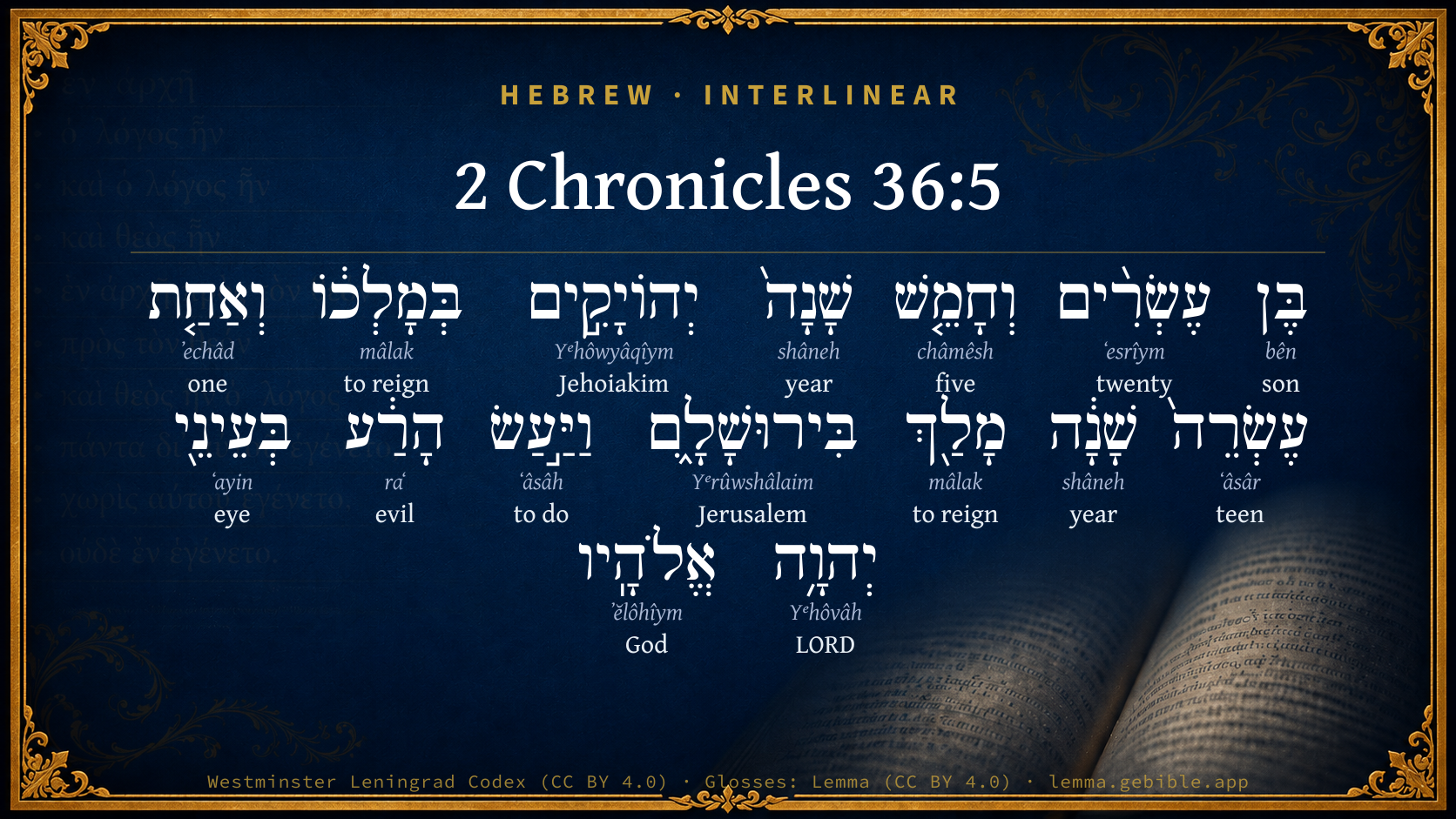
2 Chronicles 36:5

Hebrew (Westminster Leningrad Codex) 2 Chronicles 36:5 appears in the Hebrew Old Testament. The text above is from the Westminster Leningrad Codex. Each word links to its Strong’s number, a concise gloss, and parsing drawn from the Open Scriptures Hebrew Bible morphology. Click any word for its full Brown-Driver-Briggs (BDB) entry.
Download image
Cite this verse

2 Chronicles 36:5 (World English Bible). Public Domain. Lemma interlinear Bible study tool, https://lemma.gebible.app/v/2-chronicles/36/5.

Show BibTeX & RIS
BibTeX
RIS
English Translation
Jehoiakim was Twenty-five years old when he began to reign; and he reigned eleven years in Jerusalem: and he did that which was evil in the sight of Yahweh his God.
World English Bible · Public Domain
Download a study sheet

One document with this verse’s original text, its word-by-word gloss line, the meaning frame, cross-references with their text, attributed commentary, and full source and license credits — printable, and it pastes into notes with its structure intact.

This verse Autodidact and up

Study sheet (.html) Plain text (.txt)

A passage Seminary Student

Up to 50 verses in one chapter. A passage sheet keeps up to 6 commentary sources and 12 cross-references per verse, in the order this page ranks them, and says so on the sheet whenever that leaves anything out. Ask for a single verse and you get the Autodidact verse sheet above.

Everything on this page stays free to read, with no account — the sheet is a download of what is already on screen, not access to it.

Want to remove ads? Support Godless Engineer
Compare translations 3

The same verse in 3 English versions, stacked beneath the original-language interlinear above. Click any original word for its lexicon entry.

Each is an independent rendering of the whole verse — the interlinear is not word-aligned to these translations.

Highlighted words mark where these versions differ — a whole-verse word diff, not a word-by-word alignment.

  • World English Bible Public Domain
    Jehoiakim was Twenty-five years old when he began to reign; and he reigned eleven years in Jerusalem: and he did that which was evil in the sight of Yahweh his God.
  • King James Version Public Domain
    Jehoiakim was twenty and five years old when he began to reign, and he reigned eleven years in Jerusalem: and he did that which was evil in the sight of the LORD his God.
  • unfoldingWord Literal Text CC BY-SA 4.0
    A son of 25 years was Jehoiakim when he became king, and 11 years he reigned in Jerusalem. And he did what was evil in the eyes of Yahweh his God.

unfoldingWord Literal Text — © unfoldingWord, licensed CC BY-SA 4.0. Word-aligned USFM3 via Door43 (git.door43.org/unfoldingWord/en_ult).

Versions to compare (up to 4)

3 of 4 selected

Show all 18 translations

Every available English version of this verse, each an independent rendering of the whole verse.

  • World English Bible Public Domain
    Jehoiakim was Twenty-five years old when he began to reign; and he reigned eleven years in Jerusalem: and he did that which was evil in the sight of Yahweh his God.
  • Berean Standard Bible Public Domain
    Jehoiakim was twenty-five years old when he became king, and he reigned in Jerusalem eleven years. And he did evil in the sight of the LORD his God.
  • Majority Standard Bible Public Domain
    Jehoiakim was twenty-five years old when he became king, and he reigned in Jerusalem eleven years. And he did evil in the sight of the LORD his God.
  • King James Version Public Domain
    Jehoiakim was twenty and five years old when he began to reign, and he reigned eleven years in Jerusalem: and he did that which was evil in the sight of the LORD his God.
  • American Standard Version (1901) Public Domain
    Jehoiakim was twenty and five years old when he began to reign; and he reigned eleven years in Jerusalem: and he did that which was evil in the sight of Jehovah his God.
  • Revised Version (1885) Public Domain
    Jehoiakim was twenty and five years old when he began to reign; and he reigned eleven years in Jerusalem: and he did that which was evil in the sight of the LORD his God.
  • Geneva Bible (1599) Public Domain
    Iehoiakim was fiue and twentie yeere old, when he began to reigne, and he reigned eleuen yeere in Ierusalem, and did euill in the sight of the Lord his God.
  • Douay-Rheims (1899) Public Domain
    Joakim was five and twenty years old when he began to reign, and he reigned eleven years in Jerusalem: and he did evil before the Lord his God.
  • Young's Literal Translation Public Domain
    A son of twenty and five years `is' Jehoiakim in his reigning, and eleven years he hath reigned in Jerusalem, and he doth the evil thing in the eyes of Jehovah his God;
  • Literal Standard Version CC BY-SA 4.0
    Jehoiakim [is] a son of twenty-five years in his reigning, and he has reigned eleven years in Jerusalem, and he does evil in the eyes of his God YHWH;
  • Unlocked Literal Bible CC BY-SA 4.0
    Jehoiakim was twenty-five years old when he began to reign, and he reigned eleven years in Jerusalem. He did what was evil in the sight of Yahweh his God.
  • unfoldingWord Literal Text CC BY-SA 4.0
    A son of 25 years was Jehoiakim when he became king, and 11 years he reigned in Jerusalem. And he did what was evil in the eyes of Yahweh his God.
  • Darby Bible Public Domain
    Jehoiakim was twenty-five years old when he began to reign; and he reigned eleven years in Jerusalem; and he did evil in the sight of Jehovah his God.
  • World Messianic Bible Public Domain
    Jehoiakim was twenty-five years old when he began to reign, and he reigned eleven years in Jerusalem. He did that which was evil in the LORD his God’s sight.
  • Webster's Bible Public Domain
    Jehoiakim was twenty and five years old when he began to reign, and he reigned eleven years in Jerusalem: and he did that which was evil in the sight of the LORD his God.
  • Free Bible Version CC BY-SA 4.0
    Jehoiakim was twenty-five when he became king, and he reigned in Jerusalem for eleven years. He did evil in the sight of the Lord his God.
  • Bible in Basic English Public Domain
    Jehoiakim was twenty-five years old when he became king; he was ruling in Jerusalem for eleven years, and he did evil in the eyes of the Lord his God.
  • JPS Tanakh (1917) Public Domain
    Jehoiakim was twenty and five years old when he began to reign; and he reigned eleven years in Jerusalem; and he did that which was evil in the sight of the LORD his God.

Literal Standard Version (2020), Covenant Press — licensed CC BY-SA 4.0. Text via the HelloAO Bible API (eBible.org). Unlocked Literal Bible (unfoldingWord) — licensed CC BY-SA 4.0. Text via the HelloAO Bible API (eBible.org). unfoldingWord Literal Text — © unfoldingWord, licensed CC BY-SA 4.0. Word-aligned USFM3 via Door43 (git.door43.org/unfoldingWord/en_ult). Free Bible Version, Dr. Jonathan Gallagher — licensed CC BY-SA 4.0. Text via the HelloAO Bible API (eBible.org).

Word by word

More ways to search: Search by grammar → Find every occurrence → Compare this word →

Practice this passage: Drill this verse → Learn its vocabulary →

יְהוֹיָקִ֣ים
Yᵉhôwyâqîym
H3079
“Jehoiakim”
Noun, Proper
Part of Speech
Noun
Type
Proper
Full BDB Definition

Origin: from H3068 abbreviated and H6965 , cf. H3113

TWOT: None

Jehoiakim = "Jehovah raises up" - son of Josiah and the third from the last king of Judah; subject vassel of Nebuchadnezzar who reigned for 11 years before he died a violent death either in combat or by the hands of his own subjects
  1. בֶּן bên H1121 “son of” Noun, Common, Masculine, Singular, Construct
  2. עֶשְׂרִ֨ים ʻesrîym H6242 “twenty” Adjective, Cardinal number, Both, Plural, Absolute
  3. וְחָמֵ֤שׁ châmêsh H2568 “and · five” Conjunction + Adjective, Cardinal number, Feminine, Singular, Absolute
  4. שָׁנָה֙ shâneh H8141 “year” Noun, Common, Feminine, Singular, Absolute
  5. בְּמָלְכ֔וֹ mâlak H4427 “in/at · to reign · him” Preposition + Verb, Qal, Infinitive Construct + Suffix, Personal, 3rd Person, Masculine, Singular
  6. וְאַחַ֤ת ʼechâd H259 “and · one” Conjunction + Adjective, Cardinal number, Feminine, Singular, Absolute
  7. עֶשְׂרֵה֙ ʻâsâr H6240 “teen” Adjective, Cardinal number, Feminine, Singular, Absolute
  8. שָׁנָ֔ה shâneh H8141 “year” Noun, Common, Feminine, Singular, Absolute
  9. מָלַ֖ךְ mâlak H4427 “to reign” Verb, Qal, Perfect, 3rd Person, Masculine, Singular
  10. בִּירוּשָׁלִָ֑ם Yᵉrûwshâlaim H3389 “in/at · Jerusalem” Preposition + Noun, Proper
  11. וַיַּ֣עַשׂ ʻâsâh H6213 “and · to do” Conjunction + Verb, Qal, Sequential Imperfect, 3rd Person, Masculine, Singular
  12. הָרַ֔ע raʻ H7451 “the · evil” Particle, Definite Article + Adjective, Adjective, Masculine, Singular, Absolute
  13. בְּעֵינֵ֖י ʻayin H5869 “in/at · eyes of” Preposition + Noun, Common, Both, Dual, Construct
  14. יְהוָ֥ה Yᵉhôvâh H3068 “LORD” Noun, Proper
  15. אֱלֹהָֽיו ʼĕlôhîym H430 “God(s) · his” Noun, Common, Masculine, Plural, Construct + Suffix, Personal, 3rd Person, Masculine, Singular

About this verse

These counts appear in no published source. They are computed here, from the morphology-tagged text and Lemma’s own curated glosses. What Lemma adds →

16
words
14
distinct lemmas
Historical
section

Shared distinctive vocabulary

יְהוֹיָקִ֣ים Jehoiakim H3079 occurs in 37 verses of the Hebrew Bible. Also found in:

Grammatical profile

  • 3 verbs
  • 8 nouns
  • 5 adjectives

Verb forms

  • בְּמָלְכ֔וֹ Qal · Infinitive Construct
  • מָלַ֖ךְ Qal · Perfect
  • וַיַּ֣עַשׂ Qal · Sequential Imperfect

Repetition

Words recur within this verse — often emphatic in Hebrew:

  • שָׁנָה֙ year H8141 ×2
  • בְּמָלְכ֔וֹ to reign H4427 ×2

Hebrew & Septuagint length

In English translation the verse runs 31 words from the Hebrew and 171 from the Septuagint (LXX English) — the Septuagint runs noticeably longer here. See the side-by-side →

A rough comparison of the two English renderings, which tokenize alike — not a word-level alignment.

Word counts can differ between the Hebrew and the Greek without any difference in meaning — e.g. the Hebrew direct-object marker אֵת has no separate Greek word, and Greek often adds the article ὁ.

Cross-references

7

Topical passages linked to 2 Chronicles 36:5 in the Treasury of Scripture Knowledge — connected by theme and wording, ordered by reader-vote popularity; previews shown in the World English Bible.

  • 2 Kings 23:36–37 Jehoiakim was twenty-five years old when he began to reign; and he reigned eleven years in Jerusalem: and his mother's name was Zebidah the daughter of Pedaiah of Rumah.
  • Jeremiah 22:13–19 Woe to him who builds his house by unrighteousness, and his chambers by injustice; who uses his neighbor's service without wages, and doesn't give him his hire;
  • Jeremiah 26:1 In the beginning of the reign of Jehoiakim the son of Josiah, king of Judah, came this word from Yahweh, saying,
  • Jeremiah 26:21–23 and when Jehoiakim the king, with all his mighty-men, and all the princes, heard his words, the king sought to put him to death; but when Uriah heard it, he was afraid, and fled, and went into Egypt:
  • Jeremiah 35:1 The word which came to Jeremiah from Yahweh in the days of Jehoiakim the son of Josiah, king of Judah, saying,
  • Jeremiah 36:1 It happened in the fourth year of Jehoiakim the son of Josiah, king of Judah, that this word came to Jeremiah from Yahweh, saying,
  • Jeremiah 36:27–32 Then the word of Yahweh came to Jeremiah, after that the king had burned the scroll, and the words which Baruch wrote at the mouth of Jeremiah, saying,

Cross-references courtesy of OpenBible.info (CC BY 4.0).

Hebrew and Greek witnesses Masoretic Hebrew ↔ Greek Septuagint

The same verse in the two great witnesses to the Old Testament, shown verse-for-verse.

Here the Septuagint runs noticeably longer than the Hebrew — LXX2012 (modern English Septuagint) 171 words vs World English Bible 31. A rough length comparison of the two English translations, not a word-level alignment — read both below.

These are two independent witnesses, not word-aligned to each other, and the Septuagint is shown in lemma (dictionary) form.

Hebrew 2 Chronicles 36:5 Masoretic · Westminster Leningrad Codex

בֶּן עֶשְׂרִ֨ים וְחָמֵ֤שׁ שָׁנָה֙ יְהוֹיָקִ֣ים בְּמָלְכ֔וֹ וְאַחַ֤ת עֶשְׂרֵה֙ שָׁנָ֔ה מָלַ֖ךְ בִּירוּשָׁלִָ֑ם וַיַּ֣עַשׂ הָרַ֔ע בְּעֵינֵ֖י יְהוָ֥ה אֱלֹהָֽיו

Jehoiakim was Twenty-five years old when he began to reign; and he reigned eleven years in Jerusalem: and he did that which was evil in the sight of Yahweh his God.

World English Bible · Public Domain

Greek LXX 2 Chronicles 36:5 Septuagint · lemma form

εἰμί εἴκοσι καί πέντε ἔτος ιωακιμ ἐν ὁ βασιλεύω αὐτός καί ἕνδεκα ἔτος βασιλεύω ἐν ἰερουσαλήμ καί ὄνομα ὁ μήτηρ αὐτός ζεχωρα θυγάτηρ νηριου ἐκ ραμα καί ποιέω ὁ πονηρός ἐναντίον κύριος κατά πᾶς ὅσος ποιέω ὁ πατήρ αὐτός ἐν ὁ ἡμέρα αὐτός ἔρχομαι ναβουχοδονοσορ βασιλεύς βαβυλών εἰς ὁ γῆ καί εἰμί αὐτός δουλεύω τρεῖς ἔτος καί ἀποἵστημι ἀπό αὐτός καί ἀποστέλλω κύριος ἐπί αὐτός ὁ χαλδαῖος καί λῃστήριον σύρος καί λῃστήριον μωαβίτις καί υἱός αμμων καί ὁ σαμαρεία καί ἀποἵστημι μετά ὁ λόγος οὗτος κατά ὁ λόγος κύριος ἐν χείρ ὁ παῖς αὐτός ὁ προφήτης πλήν θυμός κύριος εἰμί ἐπί ἰούδας ὁ ἀποἵστημι αὐτός ἀπό πρόσωπον αὐτός διά ὁ ἁμαρτία μανασσή ἐν πᾶς ὅς ποιέω καί ἐν αἷμα ἀθῷος ὅς ἐκχέω ιωακιμ καί πίμπλημι ὁ ἰερουσαλήμ αἷμα ἀθῷος καί οὐ θέλω κύριος ἐκὀλεθρεύω αὐτός

Joachim was twenty-five years old when he began to reign, and he reigned eleven years in Jerusalem: and his mother's name was Zechora, daughter of Nerias of Rama. And he did that which was evil in the sight of the Lord, according to all that his fathers did. In his days came Nabuchodonosor king of Babylon into the land, and he served him three years, and then revolted from him. And the Lord sent against them the Chaldeans, and plundering parties of Syrians, and plundering parties of the Moabites, and of the children of Ammon, and of Samaria; but after this they departed, according to the word of the Lord by the hand of his servants the prophets. Nevertheless the wrath of the Lord was upon Juda, so that they should be removed from his presence, because of the sins of Manasses in all that he did, and for the innocent blood which Joakim shed, for he had filled Jerusalem with innocent blood; yet the Lord would not utterly destroy them.

LXX2012 (modern English Septuagint) · Public Domain

On this verse, Ellicott's Commentary for English Readers discusses the Septuagint’s reading. Read the note in Commentary ↓

Hebrew: Westminster Leningrad Codex (CC BY 4.0). Greek: Septuagint (public domain); English from LXX2012 (modern English Septuagint) (Public Domain). How the Septuagint differs from the Hebrew →

Commentary

Notes on 2 Chronicles 36:5 from classic Christian and Jewish commentators (each source and its license shown beneath its notes). The classic Christian expositions comment on the surrounding passage and are grouped to its opening verse, so a note may address several verses; the Jewish commentaries on the Tanakh (Rashi and others) are per-verse, so they appear only where the commentator wrote on this verse.

Lemma curates 59 commentaries, every one of them public domain or Creative Commons licensed, each selected and text-cleaned for this edition rather than reprinted as found. About our sources →

Jamieson, Fausset & Brown

Robert Jamieson, A. R. Fausset & David Brown

JEHOIAKIM, REIGNING ILL, IS CARRIED INTO BABYLON. (Ch2 36:5-8)

Jehoiakim . . . did that which was evil in the sight of the Lord--He followed the course of his idolatrous predecessors; and the people, to a great extent, disinclined to the reforming policy of his father, eagerly availed themselves of the vicious license which his lax administration restored. His character is portrayed with a masterly hand in the prophecy of Jeremiah (Jer 22:13-19). As the deputy of the king of Egypt, he departed further than his predecessor from the principles of Josiah's government; and, in trying to meet the insatiable cupidity of his master by grinding exactions from his subjects, he recklessly plunged into all evil.

Jamieson, Fausset & Brown — Commentary Critical and Explanatory on the Whole Bible (1871) — public domain (CC PDM 1.0). Text via the HelloAO Bible API.

Ellicott's Commentary for English Readers

THE REIGN OF JEHOIAKIM (2Ch_36:5-8). (Comp. 2Ki_23:36 to 2Ki_24:7; 2 Kings 3 Esdr. 1:37-41; Jer_25:26)

(5) Jehoiakim . . . in Jerusalem.—2Ki_23:36, adding the mother’s name. here. So LXX.

And he did . . . the Lord.—2Ki_23:37, which adds “according to all that his fathers had done.” So LXX.

Nebuchadnezzar king of Babylon.—Nabium-kudurri-uçur (“Nebo guard the crown! “) son of Nabopalassar, who had founded this dynasty by successful revolt against Assyria. His extant inscriptions chiefly relate to palace and temple building. Schrader gives a short inscription from a brick now in the Zürich Museum. “Nabû-Kudurri-uçur, king of Babylon, restorer of Esagili and Ezida [two famous temples], son of Nabû-abala-uçur, King of Babylon am I.” No really historical inscription is known except a fragment relating to his Egyptian campaign in his 37th year (568 B.C. ), and an illegible one on the rocks of Nahr-el-Kelb near Beirut. The LXX. here interpolates the account of Jehoiakim’s three years of vassalage, and his revolt against Nebuchadnezzar, and the other events and reflections contained in 2Ki_24:1-4. The LXX. makes Jehoiakim, instead of Manasseh, “fill Jerusalem with innocent blood,” contrary to the Hebrew text.

And bound him in fetters.—Two bronze (chains), as in 2Ch_33:11.

To carry him to Babylon.—To make him go. It is not said that this intention was carried out. (Comp. 2Ch_33:11, “and carried him to Babylon.”) Nebuchadnezzar, who, according to Jer_46:2, had defeated Necho in a great battle at Carchemish, in the 4th year of Jehoiakim, appears to have left the king of Judah to reign as a vassal-king, after inflicting upon him a severe humiliation. (The LXX., 3 Esdr., Vulg., and Arabic, but not the Syriac, read: “and carried him to Babylon.”) Thenius says this must be the right reading, and then denies its claim to credibility. He further asserts that, “in order to allow ample scope for the fulfilment of the prophecy of Jeremiah” (see Note on 2Ch_36:8), the chronicler has represented Jehoiakim as carried alive to Babylon in the last year of his reign. This statement rests not upon objective historical grounds, but upon subjective prejudices against the chronicler.

Dan_1:1, by a transcriber’s error, puts this first capture of Jerusalem by Nebuchadnezzar in the third year of Jehoiakim; whereas Nebuchadnezzar only became king in the fourth of Jehoiakim. (2Ki_25:8; Jer_25:1.)

A Bible Commentary for English Readers, edited by Charles John Ellicott (1878–1897) — public domain. Text from a community e-Sword module.

Tyndale Open Study Notes

Tyndale Open Resources

36:5 Jehoiakim reigned from 609 to 598 BC. • He did what was evil: Jeremiah characterized his reign as one of self-aggrandizement and injustice (Jer 22:13-17).

Tyndale Open Study Notes — © Tyndale Open Resources, licensed CC BY-SA 4.0. Text via the HelloAO Bible API.

Geneva Bible (1599)

Geneva Bible translators

Because he and the people turned not to God by his first plague, he brought a new upon him, and at length rooted them out.

Geneva Bible (1599) marginal notes — public domain. Text via Bolls.life.

The Cambridge Bible for Schools and Colleges

gen. ed. J. J. S. Perowne

5–8 (= 1Es_1:39-42; 2Ki_23:35 to 2Ki_24:7). The Reign of Jehoiakim

5. in Jerusalem] The Chronicler omits his mother’s name (cp. 2Ch_36:2, note) and also the statement that he raised the indemnity imposed by Neco by means of a poll-tax (2Ki_23:35).

he did that which was evil] Cp. 2Ki_23:37; Jer_22:13-18; Jer_26:20-23; Jer_36:1-32.

The Cambridge Bible for Schools and Colleges (gen. ed. J. J. S. Perowne; Cambridge University Press, 1878–1918) — public domain. Text from a community e-Sword module.

The Pulpit Commentary

Here we note the age of Jehoiakim as greater than that of Jeoahaz, and in the parallel we read that his mother was different.

Vers. 5-8.

The fortunes of Jehoiakim.

I A NEW KING UPON THE THRONE OF JUDAH. (Ver. 5.)

1. His designation. Eliakim, "Whom God establishes," changed into Jehoiakim, "Jehovah has set up;" not by himself (Cheyne, "Jeremiah: his Life and Times," p. 142), though it would almost seem as if Uzziah had adopted that name instead of Azariah on acceding to the crown, (2Ch_26:1) and Pal had assumed the title Tiglath-Pileser, "Adar is my confidence," on succeeding Shalmaneser of Assyria (Saye, "Fresh Light," etc., p. 126); but by Necho II; (ver. 4 2Ki_23:34) as Mattaniah"s name was changed into Zedekiah by Nebuchadnezzar; (2Ki_24:17) which statements may be harmonized by supposing that "Necho and

2. Nebuchadnezzar treated the vassal kings appointed by them not altogether as slaves, but permitted them to choose themselves the new names, which they only confirmed in token of their supremacy" (Keil).

3. His lineage. The son of Josiah and of Zebudah, the daughter of Pedaiah of Rumah, supposed to be identical with Arumah, near Shechem. (2Ki 32:3-6) Jehoahaz., whom he succeeded, was his younger brother by a different mother, Hamutal, the daughter of Jeremiah of Libnah. (2Ki_23:31)

1. His accession.

(1) As to time, when he was twenty-five years of age, which shows he must have been born in his father"s fourteenth year.

(2) As to means, by the help of Necho II, who deposed his usurping brother (ver. 3), partly perhaps because he was a usurper, but partly also, it may be assumed, because the people had elected that brother without having first obtained Necho"s consent.

(3) As to title, he was Josiah"s eldest son, and therefore the crown prince and legal heir to the throne.

4. His character. Bad; modelled upon that of Ahab rather than of Josiah. Jer_22:15, reading of two Septuagint manuscripts, adopted by Cheyne.

(1) Idolatrous: "He did that which was evil in the sight of the Lord" (ver. 5), as his half-brother had done. (2Ki_23:32) "He devoted himself with his whole soul to the heathen party, reintroduced all the foreign rites formerly extirpated by Josiah, and added the Egyptian to their number" (Ewald), of which the amplest proof appears in the prophets (Jer_7:9, etc.; Jer_17:2 Jer_19:4, Jer_19:5; Eze_8:9-17)

(2) Violent; in this respect like his brother, compared to a young lion who learnt to catch the prey and devoured men (Eze_19:5, Eze_19:6; of.; (Jer_22:17) the worst examples of his violence being his murder of Urijah the prophet, whom he fetched out of Egypt and slew, (Jer_26:22) and his burning of Jeremiah"s roll, accompanied with an order to arrest the prophet. (Jer_36:23, Jer_36:26)

(3) Luxurious; he strove to excel in cedar, by building for himself a costly palace of ample proportions, with spacious chambers and large windows, celled with cedar, and painted with vermilion. (Jer_22:14, Jer_22:15) "At another time certainly no one could have blamed Jehoiakim and his nobles for being discontented with the narrow, ill-lighted chambers of Syrian houses; but was this the moment for beautifying Jerusalem when the land was still groaning under Necho"s war-fine?" (Cheyne, "Jeremiah: his Life and Times," p. 141).

(4) Exacting; grinding the faces of his people with severe taxation to pay the tribute to Pharaoh, (2Ki_23:33) and cheating of their hard-earned wages the very labourers who built his palace. (Jer_22:13)

(5) Licentious; abandoning himself to lewdness. (Eze_19:7, margin; RAPC 1Est 1:42) In short, "he remained fixed in the recollections of his countrymen as the last example of those cruel, selfish, luxurious princes, the natural product of Oriental monarchies, the disgrace of the monarchy of David "(Stanley).

1. His reign. Eleven years. Too long for any good it wrought. Judah could hardly have fared worse, had he been uncrowned after three months, as his brother had been.

2. His death. Accounts vary.

(1) The Chronicler does not make it clear whether he was carried to Babylon or not. If he was, (Dan_1:2 RAPC 1Est 1:40) he was probably, like Manasseh, (2Ch_33:13) permitted after a time to return to his own land (Keil, Bertheau, Jamieson), since

(2) according to 2 Kings, (2Ki_24:6) Jehoiakim "slept with his fathers," and, according to the LXX, "was buried in the garden of Uzzah." The addendum of the LXX is obviously non-authentic, and the statement of Scripture seems contradicted by

(3) passages in Jeremiah, which say that Jehoiakim should be "buried with the burial of an ass, drawn and cast forth beyond the gates of Jerusalem", (Jer_22:19) and that his dead body should be "cast out in the day to the heat, and in the night to the frost". (Jer_36:30) The reconciliation, however, of the seeming discrepancy is easy. He may have been slain by the hand of an assassin, and his dead body thereupon cast out unburied (Cheyne); or "he may have perished in a battle with some one of the irregular marauding bands who, according to, (2Ki_24:2) came against him" (Keil, Bahr) and his corpse been left to rot upon the battlefield; or, after being first executed by Nebuchadnezzar and buried with the burial of an ass, his bones may have been collected and interred in the sepulchre of Manasseh (Rawlinson).

II. A NEW ENEMY AT THE GATE OF JERUSALEM. (Ver. 6.)

1. His person. Nebuchadnezzar, Nebuchadrezzar, (Jer_21:2) Nabuchodonosor (LXX), in the inscriptions Nabu-kudurri-usur, meaning "Nebo protect the crown.

2. His descent. A son of Nabopolassar, a general of Sarak, the last King of Nineveh (Ewald), perhaps the viceroy of Babylon (Cheyne). On the fall of Nineveh he founded the new Babylonian empire (B.C. 625-610).

3. His title. King of Babylon. Hitherto the enemies of Jerusalem and Judah had been kings of Egypt (2Ch_12:2 2Ch_36:3) or of Assyria; (2Ch_28:20 2Ch_32:1, 2Ch_32:2) now it is a King of Babylon. According to the canon of Ptolemy, Nebuchadnezzar ascended the throne in B.C. 604; according to Berosus, while crown prince he was, in B.C. 605, despatched by his father "to crush a revolt of the western provinces," in which he was entirely successful, having conquered Syria and Phoenicia as well as Egypt.

4. His invasion. According to Daniel, this occurred in Jehoiakim"s third, (Dan_1:1) the year before Nebuchadnezzar defeated Necho at Carchemish, (Jer_25:1 Jer_46:2) i.e. B.C. 606. The probability is that, either before or immediately after defeating Necho, he proceeded to Jerusalem and received the submission of Jehoiakim, who had up till that time been Necho"s vassal. In order to secure this transference of Jehoialdm"s allegiance, he appears to have both taken the city and put its sovereign in chains, as if, should he prove refractory, to deport him to Babylon, but to have departed from this design on obtaining promise of Jehoiakim"s fealty. This, however, Jehoiakim only kept for three years, (2Ki_24:1) at the end of which he rebelled, Nebuchadnezzar, being occupied with affairs in Babylon, having acceded to the throne only two years prior to Jehoiakim"s revolt, despatched against the rebel several detachments of troops, "bands of Chaldeans," at the same time stirring up the Ammonites, Syrians, and Moabites to harass Judah, (2Ki_24:2) but not himself returning to Jerusalem till five years later, in the reign of Jehoiachin.

III A NEW SPOLIATION OF JEHOVAH"S TEMPLE. (Ver. 7.)

1. The first plundering of the sacred edifice.

(1) By whom? Shishak (Sheshonk) King of Egypt.

(2) When? In the fifth year of Rehoboam, B.C. 971.

(3) To what extent? Total: "He took away the treasures of the house of the Lord: he took all" (2Ch_12:9; 1Ki_14:26)

2. The second plundering of the sacred edifice.

(1) The despoiler. Ahaz King of Judah.

(2) The time. B.C. 734, during the Syro-Ephraimitish invasion.

(3) The reason. To purchase therewith the help of Tiglath-Pileser II against Rezin of Damascus and Pekah of Samaria. (2Ch_28:21)

3. The third plundering of the sacred edifice.

(1) The agent, Hezekiah, the son of Ahaz.

(2) The act. He took "all the silver found in the house of the Lord and the gold from the doors and pillars of the temple". (2Ki_18:15, 2Ki_18:16)

(3) The object. To give to Sennacherib King of Assyria as tribute-money.

(4) The date. When Sennacherib was encamped at Lachish, B.C. 701.

4. The fourth plundering of the sacred edifice.

(1) The person. Nebuchadnezzar, called King of Babylon, though at the time only crown-prince.

(2) The extent. Partial: "He carried off the vessels of the house of the Lord." Jeremiah (Jer_27:18, Jer_27:20) predicted that the vessels which had been left would one day be carried to Babylon, and would remain there until the return from captivity, when they should again be restored to their place in the temple (cf. ver. 18; (Dan_5:2; Ezr_1:7)

(3) The cause. To punish Judah as well as Jehoiakim, and to ensure their fealty.

(4) The aggravation. The pillaged vessels were transported to Babylon and deposited in "his temple," or "treasure house of his god", (Dan_1:2 RAPC 1Est 1:41) rather than "his palace" (Bertheau). The inscriptions show that Marduk, or Merodach, was Nebuchadnezzar"s patron divinity, that Nebuchadnezzar"s temple was the temple of Merodach at Babylon, which he completely built and restored, and that Nebuchadnezzar himself was, according to his ideas, intensely religions, even calling himself "the heaven-adoring king" ("Records," etc., 5:113, etc.; 7:75, etc.).

LESSONS.

1. The native corruption of the human heart, attested by the wickedcharacters of Josiah"s sons.

2. The impossibility of going on in sin with impunity. W.

The Pulpit Commentary (1880–1919), ed. H.D.M. Spence-Jones & Joseph S. Exell — public domain. Text from a community e-Sword module.

Keil & Delitzsch

C. F. Keil & F. Delitzsch

The reign of Jehoiakim. Cf. 2 Kings 23:36-24:7. - Jehoiakim was at his accession twenty-five years of age, reigned eleven years, and did that which was evil in the eyes of Jahve his God.

Ch2 36:6-8

"Against him came Nebuchadnezzar (in inscriptions, Nabucudurriusur, i.e., Nebo coronam servat; see on Dan. S. 56) the king of Babylon, and bound him with brazen double fetters to carry him to Babylon." This campaign, Nebuchadnezzar's first against Judah, is spoken of also in 2 Kings 24 and Dan 1:1-2. The capture of Jerusalem, at which Jehoiakim was put in fetters, occurred, as we learn from Dan 1:1, col. c. Jer 46:2 and Jer 36:7, in the fourth year of Jehoiakim's reign, i.e., in the year 606 b.c.; and with it commence the seventy years of the Chaldean servitude of Judah. Nebuchadnezzar did not carry out his purpose of deporting the captured king Jehoiakim to Babylon, but allowed him to continue to reign at Jerusalem as his servant (vassal). To alter the infin. להוליכו into the perf., or to translate as the perf., is quite arbitrary, as is also the supplying of the words, "and he carried him away to Babylon." That the author of the Chronicle does not mention the actual carrying away, but rather assumes the contrary, namely, that Jehoiakim continued to reign in Jerusalem until his death, as well known, is manifest from the way in which, in Ch2 36:8, he records his son's accession to the throne. He uses the same formula which he has used in the case of all the kings whom at their death their sons succeeded, according to established custom. Had Nebuchadnezzar dethroned Jehoiakim, as Necho deposed Jehoahaz, the author of the Chronicle would not have left the installation of Jehoiachin by the Chaldean king unmentioned. For the defence of this view against opposing opinions, see the commentary on Kg2 24:1 and Dan 1:1; and in regard to Ch2 36:7, see on Dan 1:2. The Chronicle narrates nothing further as to Jehoiakim's reign, but refers, Ch2 36:8, for his other deeds, and especially his abominations, to the book of the kings of Israel and Judah, whence the most important things have been excerpted and incorporated in Kg2 24:1-4. עשׂה אשׁר תּועבותיו Bertheau interprets of images which he caused to be prepared, and עליו הנּמצא of his evil deeds; but in both he is incorrect. The passages which Bertheau cites for his interpretation of the first words, Jer 7:9. and Eze 8:17, prove the contrary; for Jeremiah mentions as תּועבות of the people, murder, adultery, false swearing, offering incense to Baal, and going after other gods; and Ezekiel, loc. cit., uses תּועבות עשׂות of the idolatry of the people indeed, but not of the making of images - only of the worship of idols, the practice of idol-worship. The abominations, consequently, which Jehoiakim committed are both his evil deeds and crimes, e.g., the shedding of innocent blood (Kg2 24:4), as well as the idolatry which he had practised. עליו הנּמצא, "what was found upon him," is a comprehensive designation of his whole moral and religious conduct and attitude; cf. Ch2 19:3. Jehoiakim's revolt from Nebuchadnezzar after three years' servitude (Kg2 24:1) is passed over by the author of the Chronicle, because the punishment of this crime influenced the fate of the kingdom of Judah only after his death. The punishment fell upon Jehoiachin; for the detachments of Arameans, Moabites, and Ammonites, which were sent by Nebuchadnezzar to punish the rebels, did not accomplish much.

Keil & Delitzsch — Biblical Commentary on the Old Testament (1861–1891) — public domain (CC PDM 1.0). Text via the HelloAO Bible API. (Old Testament only.)

unfoldingWord translationNotes

Door43 World Missions Community

twenty-five years old ... eleven years

"25 years old ... 11 years" (See: Numbers)

what was evil in the sight of Yahweh his God

Here "sight" represents judgment. Yahweh saw and did not approve of Jehoiakim's actions. AT: "what Yahweh judged to be evil" or "what Yahweh considered to be evil" (See: Metaphor)

attacked him

The word "him" refers to Jehoiakim. Jehoiakim represents either Jerusalem or the nation of Judah. AT: "attacked Jerusalem" or "attacked Judah" (See: Metonymy)

Nebuchadnezzar also carried

Since Nebuchadnezzar was king, he may have had his soldiers do this. AT: "Nebuchadnezzar also had his soldiers carry" (See: Metonymy)

the house of Yahweh

Here the word "house" represents the temple. AT: "the temple of Yahweh" (See: Metonymy)

translationWords

evil

Yahweh

God

Nebuchadnezzar

Babylon

house of God

unfoldingWord translationNotes — © Distant Shores Media and the Door43 World Missions Community, licensed CC BY-SA 4.0. Source: git.door43.org/Door43/en_tn.

Lesson kit

Teaching starters — assembled from the data on this page, not authored interpretation. Every prompt links to the verse data it draws on. Edit before teaching.

2 Chronicles, in the Historical, opens this verse with 16 words (14 distinct Hebrew lemmas). Its most distinctive word is Yᵉhôwyâqîym (“Jehoiakim”). The Greek Septuagint runs longer here. A historical commentator’s framing appears above. Read the whole chapter for the surrounding context.

Discussion questions

  1. What does “Jehoiakim” (Yᵉhôwyâqîym) contribute to the verse as a whole?
  2. 2 Kings 23:34 shares the word «Jehoiakim» with this verse. How do the two illuminate each other?
  3. “year” occurs 2× in this one verse. What is the effect of the repetition?
  4. Compared with the Hebrew, the Septuagint runs longer here. What questions does that raise?
  5. The translations on this page render this verse differently — a whole-verse word diff, not a word-by-word alignment. What might account for the different wordings?
  6. The verb «בְּמָלְכ֔וֹ» is Qal Infinitive Construct. How does its form color the action?
  7. Reading how Jamieson, Fausset & Brown and Ellicott's Commentary for English Readers read this verse, where do the two commentators agree and where do they part?

Things to notice

Reading settings

Reading text

Shown beneath each verse's original-language words.

Old Testament
Old Testament edition

Read the OT as the Masoretic Hebrew (MT) or the Greek Septuagint (LXX).

English shown for the Greek Septuagint (in the Hebrew ↔ Greek comparison).

Comparing translations? Open the Compare panel on any verse page to stack up to four side by side.