Nehemiah 12:29

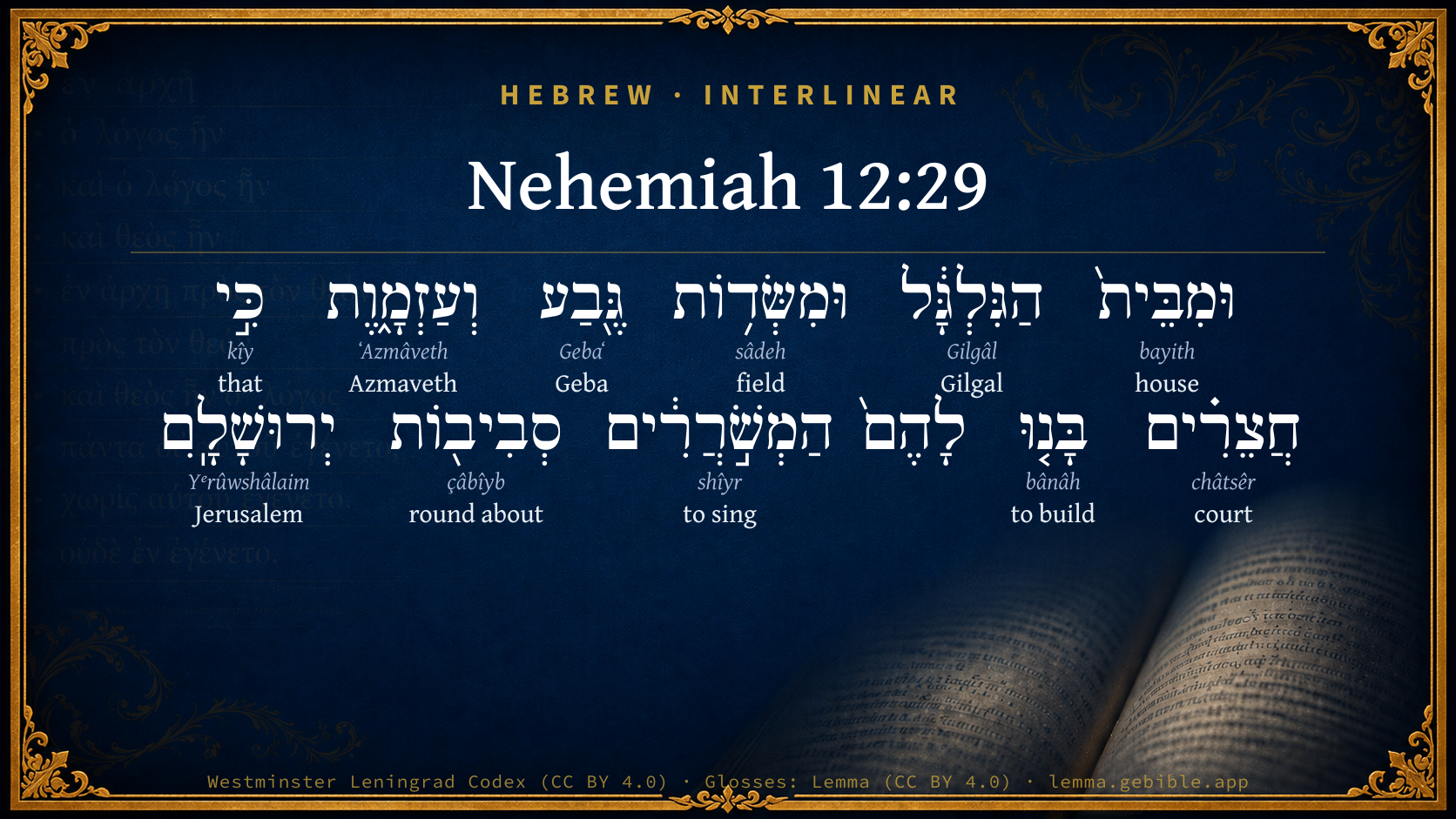
Hebrew (Westminster Leningrad Codex) Nehemiah 12:29 appears in the Hebrew Old Testament. The text above is from the Westminster Leningrad Codex. Each word links to its Strong’s number, a concise gloss, and parsing drawn from the Open Scriptures Hebrew Bible morphology. Click any word for its full Brown-Driver-Briggs (BDB) entry.
Download image
Cite this verse

Nehemiah 12:29 (World English Bible). Public Domain. Lemma interlinear Bible study tool, https://lemma.gebible.app/v/nehemiah/12/29.

Show BibTeX & RIS
BibTeX
RIS
English Translation
also from Beth Gilgal, and out of the fields of Geba and Azmaveth: for the singers had built them villages round about Jerusalem.
World English Bible · Public Domain
Download a study sheet

One document with this verse’s original text, its word-by-word gloss line, the meaning frame, cross-references with their text, attributed commentary, and full source and license credits — printable, and it pastes into notes with its structure intact.

This verse Autodidact and up

Study sheet (.html) Plain text (.txt)

A passage Seminary Student

Up to 50 verses in one chapter. A passage sheet keeps up to 6 commentary sources and 12 cross-references per verse, in the order this page ranks them, and says so on the sheet whenever that leaves anything out. Ask for a single verse and you get the Autodidact verse sheet above.

Everything on this page stays free to read, with no account — the sheet is a download of what is already on screen, not access to it.

Want to remove ads? Support Godless Engineer
Compare translations 3

The same verse in 3 English versions, stacked beneath the original-language interlinear above. Click any original word for its lexicon entry.

Each is an independent rendering of the whole verse — the interlinear is not word-aligned to these translations.

Highlighted words mark where these versions differ — a whole-verse word diff, not a word-by-word alignment.

  • World English Bible Public Domain
    also from Beth Gilgal, and out of the fields of Geba and Azmaveth: for the singers had built them villages round about Jerusalem.
  • King James Version Public Domain
    Also from the house of Gilgal, and out of the fields of Geba and Azmaveth: for the singers had builded them villages round about Jerusalem.
  • unfoldingWord Literal Text CC BY-SA 4.0
    and from Beth-Gilgal and from the fields of Geba and Azmaveth; for the ones who sang had built villages for themselves around Jerusalem.

unfoldingWord Literal Text — © unfoldingWord, licensed CC BY-SA 4.0. Word-aligned USFM3 via Door43 (git.door43.org/unfoldingWord/en_ult).

Versions to compare (up to 4)

3 of 4 selected

Show all 18 translations

Every available English version of this verse, each an independent rendering of the whole verse.

  • World English Bible Public Domain
    also from Beth Gilgal, and out of the fields of Geba and Azmaveth: for the singers had built them villages round about Jerusalem.
  • Berean Standard Bible Public Domain
    from Beth-gilgal, and from the fields of Geba and Azmaveth, for they had built villages for themselves around Jerusalem.
  • Majority Standard Bible Public Domain
    from Beth-gilgal, and from the fields of Geba and Azmaveth, for they had built villages for themselves around Jerusalem.
  • King James Version Public Domain
    Also from the house of Gilgal, and out of the fields of Geba and Azmaveth: for the singers had builded them villages round about Jerusalem.
  • American Standard Version (1901) Public Domain
    also from Beth-gilgal, and out of the fields of Geba and Azmaveth: for the singers had builded them villages round about Jerusalem.
  • Revised Version (1885) Public Domain
    also from Beth-gilgal, and out of the fields of Geba and Azmaveth: for the singers had builded them villages round about Jerusalem.
  • Geneva Bible (1599) Public Domain
    And from the house of Gilgal, and out of the countreis of Geba, and Azmaueth: for the singers had built them villages round about Ierusalem.
  • Douay-Rheims (1899) Public Domain
    And from the house of Galgal, and from the countries of Geba and Azmaveth: for the singing men had built themselves villages round about Jerusalem.
  • Young's Literal Translation Public Domain
    and from the house of Gilgal, and from fields of Geba and Azmaveth, for villages have the singers built for themselves round about Jerusalem;
  • Literal Standard Version CC BY-SA 4.0
    and from the house of Gilgal, and from fields of Geba and Azmaveth, the singers have built for villages for themselves around Jerusalem;
  • Unlocked Literal Bible CC BY-SA 4.0
    They also came from Beth Gilgal and from the fields of Geba and Azmaveth, for the singers had built for themselves villages around Jerusalem.
  • unfoldingWord Literal Text CC BY-SA 4.0
    and from Beth-Gilgal and from the fields of Geba and Azmaveth; for the ones who sang had built villages for themselves around Jerusalem.
  • Darby Bible Public Domain
    also from Beth-Gilgal, and out of the fields of Geba and Azmaveth; for the singers had built themselves hamlets round about Jerusalem.
  • World Messianic Bible Public Domain
    also from Beth Gilgal and out of the fields of Geba and Azmaveth, for the singers had built themselves villages around Jerusalem.
  • Webster's Bible Public Domain
    Also from the house of Gilgal, and from the fields of Geba and Azmaveth: for the singers had built them villages around Jerusalem.
  • Free Bible Version CC BY-SA 4.0
    as well as from Beth-gilgal and from the area of Geba and Azmaveth, for the singers had built villages for themselves all around Jerusalem.
  • Bible in Basic English Public Domain
    And from Beth-gilgal and from the fields of Geba and Azmaveth: for the music-makers had made daughter-towns for themselves round about Jerusalem.
  • JPS Tanakh (1917) Public Domain
    also from Beth-gilgal, and out of the fields of Geba and Azmaveth; for the singers had builded them villages round about Jerusalem.

Literal Standard Version (2020), Covenant Press — licensed CC BY-SA 4.0. Text via the HelloAO Bible API (eBible.org). Unlocked Literal Bible (unfoldingWord) — licensed CC BY-SA 4.0. Text via the HelloAO Bible API (eBible.org). unfoldingWord Literal Text — © unfoldingWord, licensed CC BY-SA 4.0. Word-aligned USFM3 via Door43 (git.door43.org/unfoldingWord/en_ult). Free Bible Version, Dr. Jonathan Gallagher — licensed CC BY-SA 4.0. Text via the HelloAO Bible API (eBible.org).

Word by word

More ways to search: Search by grammar → Find every occurrence → Compare this word →

Practice this passage: Drill this verse → Learn its vocabulary →

וְעַזְמָ֑וֶת
ʻAzmâveth
H5820
“and · Azmaveth”
Conjunction + Noun, Proper
Part of Speech
Conjunction + Noun
Type
Proper
Full BDB Definition

Origin: from H5794 and H4194

TWOT: None

Azmaveth = "strong unto death" - one of David's mighty warriors (noun proper masculine) - a descendant of Mephibosheth, the son of Jonathan and grandson of king Saul (noun proper masculine) - a Benjamite, father of Jeziel and Pelet who were two of David's men who joined him at Ziklag (noun proper masculine) - overseer of the royal treasures in the reign of David (noun proper masculine) - a place in Benjamin; also 'Beth-azmeveth' (noun proper locative)
  1. וּמִבֵּית֙ bayith H1004 “and · from · house” Conjunction + Preposition + Noun, Proper
  2. הַגִּלְגָּ֔ל Gilgâl H1537 “Gilgal” Noun, Proper
  3. וּמִשְּׂד֥וֹת sâdeh H7704 “and · from · fields of” Conjunction + Preposition + Noun, Common, Masculine, Plural, Construct
  4. גֶּ֖בַע Gebaʻ H1387 “Geba” Noun, Proper
  5. כִּ֣י kîy H3588 “that” Conjunction
  6. חֲצֵרִ֗ים châtsêr H2691 “courts” Noun, Common, Both, Plural, Absolute
  7. בָּנ֤וּ bânâh H1129 “to build” Verb, Qal, Perfect, 3rd Person, Common, Plural
  8. הַמְשֹׁ֣רֲרִ֔ים shîyr H7891 “the · singing” Particle, Definite Article + Verb, Polel, Participle Active, Masculine, Plural, Absolute
  9. סְבִיב֖וֹת çâbîyb H5439 “surroundings” Noun, Common, Both, Plural, Absolute
  10. יְרוּשָׁלִָֽם Yᵉrûwshâlaim H3389 “Jerusalem” Noun, Proper

About this verse

These counts appear in no published source. They are computed here, from the morphology-tagged text and Lemma’s own curated glosses. What Lemma adds →

12
words
11
distinct lemmas
Historical
section

Notable vocabulary

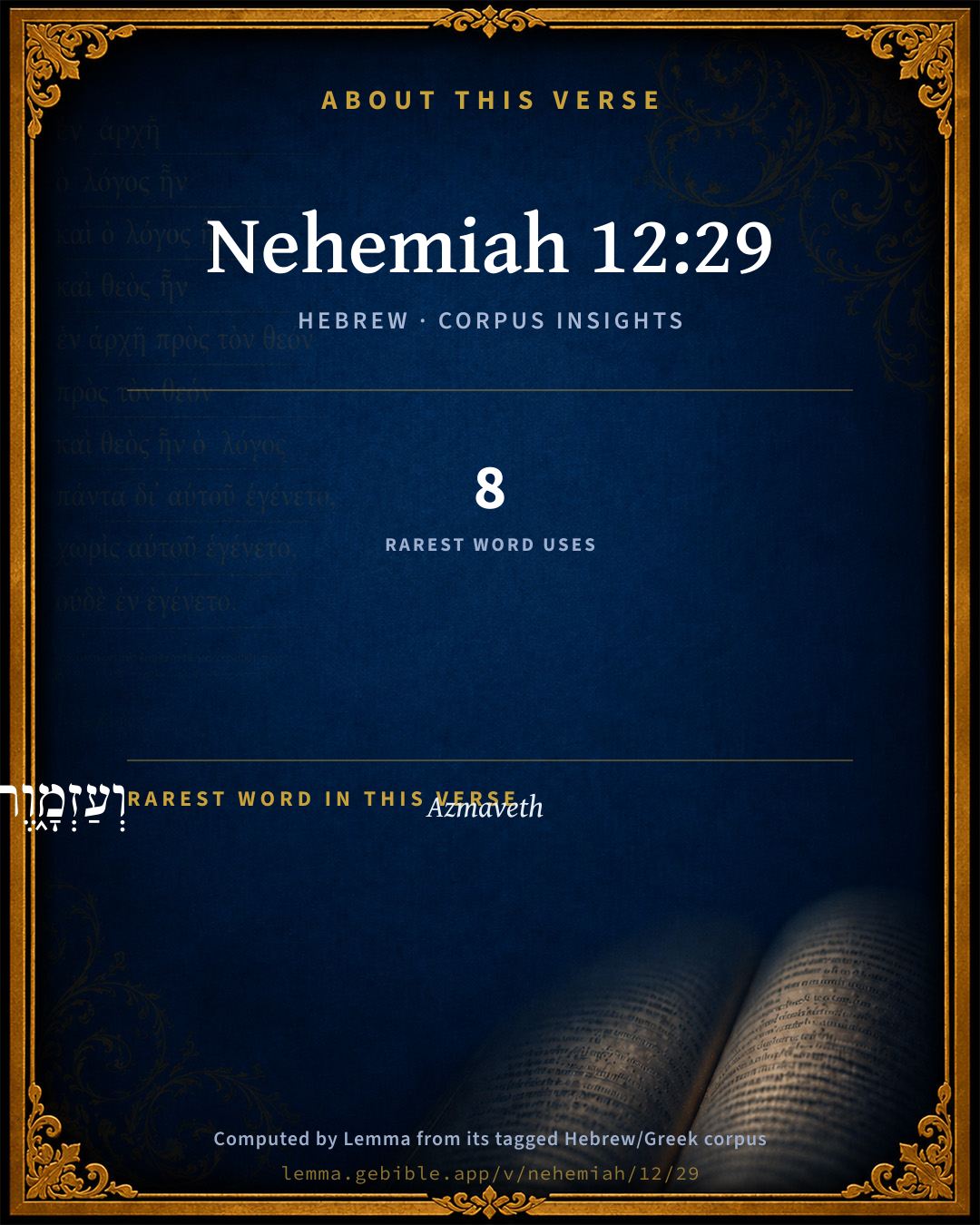
The rarest word here is וְעַזְמָ֑וֶת Azmaveth H5820 — appearing just 8 times in the whole Hebrew Bible.

Shared distinctive vocabulary

וְעַזְמָ֑וֶת Azmaveth H5820 occurs in 8 verses of the Hebrew Bible. Also found in:

Grammatical profile

  • 2 verbs
  • 8 nouns
  • 1 preposition
  • 1 conjunction

Verb forms

  • בָּנ֤וּ Qal · Perfect
  • הַמְשֹׁ֣רֲרִ֔ים Polel · Participle Active

Cross-references

7

Topical passages linked to Nehemiah 12:29 in the Treasury of Scripture Knowledge — connected by theme and wording, ordered by reader-vote popularity; previews shown in the World English Bible.

  • Deuteronomy 11:30 Aren't they beyond the Jordan, behind the way of the going down of the sun, in the land of the Canaanites who dwell in the Arabah, over against Gilgal, beside the oaks of Moreh?
  • Joshua 5:9 Yahweh said to Joshua, This day have I rolled away the reproach of Egypt from off you. Therefore the name of that place was called Gilgal, to this day.
  • Joshua 10:43 Joshua returned, and all Israel with him, to the camp to Gilgal.
  • Joshua 21:17 Out of the tribe of Benjamin, Gibeon with its suburbs, Geba with its suburbs,
  • 1 Chronicles 6:60 and out of the tribe of Benjamin, Geba with its suburbs, and Allemeth with its suburbs, and Anathoth with its suburbs. All their cities throughout their families were thirteen cities.
  • Ezra 2:24 The children of Azmaveth, forty-two.
  • Nehemiah 11:31 The children of Benjamin also [lived] from Geba [onward], at Michmash and Aija, and at Bethel and the towns of it,

Cross-references courtesy of OpenBible.info (CC BY 4.0).

Hebrew and Greek witnesses Masoretic Hebrew ↔ Greek Septuagint

The same verse in the two great witnesses to the Old Testament, shown verse-for-verse.

These are two independent witnesses, not word-aligned to each other, and the Septuagint is shown in lemma (dictionary) form.

Hebrew Nehemiah 12:29 Masoretic · Westminster Leningrad Codex

וּמִבֵּית֙ הַגִּלְגָּ֔ל וּמִשְּׂד֥וֹת גֶּ֖בַע וְעַזְמָ֑וֶת כִּ֣י חֲצֵרִ֗ים בָּנ֤וּ לָהֶם֙ הַמְשֹׁ֣רֲרִ֔ים סְבִיב֖וֹת יְרוּשָׁלִָֽם

also from Beth Gilgal, and out of the fields of Geba and Azmaveth: for the singers had built them villages round about Jerusalem.

World English Bible · Public Domain

Greek LXX Structure differs

The Septuagint has no separate book of Nehemiah. Its Greek text is the second half of Esdras B (2 Esdras), chapters 11–23; Ezra is the first half (1–10).

A verse-for-verse comparison isn’t shown here because the chapters and verses don’t line up. Switch to the LXX edition with the MT / LXX toggle above to read the Greek directly.

Hebrew: Westminster Leningrad Codex (CC BY 4.0). Greek: Septuagint (public domain); English from a public-domain English Septuagint. How the Septuagint differs from the Hebrew →

Commentary

Notes on Nehemiah 12:29 from classic Christian and Jewish commentators (each source and its license shown beneath its notes). The classic Christian expositions comment on the surrounding passage and are grouped to its opening verse, so a note may address several verses; the Jewish commentaries on the Tanakh (Rashi and others) are per-verse, so they appear only where the commentator wrote on this verse.

Lemma curates 59 commentaries, every one of them public domain or Creative Commons licensed, each selected and text-cleaned for this edition rather than reprinted as found. About our sources →

Joseph Benson's Commentary

Neh 12:29-30. The singers had built them villages, &c. — That they might be near at hand for the service of God and of his house. The priests and the Levites purified themselves — By sprinkling the water of purification upon them, by which the tabernacle and sacred utensils were purified; (Num 8:7;) by solemn prayers and sacrifices; and especially by keeping themselves from all impurity. And purified the people — By sprinkling, it is probable, the same water upon them, and by prayers and sacrifices.

Joseph Benson's Commentary on the Old and New Testaments (1811–1818) — public domain. Text from a community e-Sword module.

Adam Clarke's Commentary

Verse 29. From the house of Gilgal, and out of the fields of Geba and Azmaveth] Or, from Beth-Gilgal; a village erected in the place where the Israelites encamped after they had, under the direction of Joshua, passed over Jordan.

Adam Clarke's Commentary on the Bible (1810–1826) — public domain. Text from a community e-Sword/MySword module.

Ellicott's Commentary for English Readers

(29) The singers.—As the Nethinim were settled in Ophel, so the class of Levitical singers were chiefly to be found in villages to the north of the city.

A Bible Commentary for English Readers, edited by Charles John Ellicott (1878–1897) — public domain. Text from a community e-Sword module.

The Cambridge Bible for Schools and Colleges

gen. ed. J. J. S. Perowne

29. from the house of Gilgal] R.V. from Beth-gilgal. Possibly to be identified with the Gilgal of 2Ki_2:1; 2Ki_4:38, and if so it was about 14 miles N. of Jerusalem.

Geba] Cf. Neh_11:31.

Azmaveth] See note on Ezr_2:24.

The Cambridge Bible for Schools and Colleges (gen. ed. J. J. S. Perowne; Cambridge University Press, 1878–1918) — public domain. Text from a community e-Sword module.

John Gill's Exposition

And the priests and the Levites purified themselves,.... By washing their bodies and their clothes, perhaps by sprinkling the water of purification on them, see Num 8:6.

.

Nehemiah 12:31

neh 12:31

neh 12:31

neh 12:31Then I brought up the princes of Judah upon the wall,.... Which was so broad as to walk upon it, and there was a procession of the princes on it at its dedication, and here is described the manner of it; the princes of Benjamin must be included here:

and appointed two great companies of them that gave thanks; he divided the people who were met together to praise God on this occasion into two companies: whereof

one went on the right hand upon the wall; that is, on the southern part of it:

towards the dung gate; of which see Neh 2:13 some Jewish writers, as Jarchi and Ben Melech, give a different sense of , which we render "two companies", and take them to be two eucharistical loaves of leavened bread, with which a rite or ceremony was performed at the enlargement of a court or city; at the utmost boundary of which those were carried, and one was eaten and the other burnt (r); which rite is thus described by Maimonides (s),"how do they add to a city? the sanhedrim make two eucharistical sacrifices, and they take the leavened bread in them, and the sanhedrim go after the two eucharistical sacrifices, which follow one another, and they stand with harps, and psalteries, and cymbals, at every corner and at every stone in Jerusalem, and say, I will extol thee, for thou hast lifted up, &c. (#Ps 30:1) until they come to the end of the place they consecrate, there they stand and eat the thanksgiving loaf, one of the two, and the other is burnt.''

(r) Miss. Shebuot, c. 2. sect. 2. & Maimon, & Bartenora in ib. (s) Hilchot, Beth-habechirah, c. 6. sect. 12. Vid. Selden. de Synedr. l. 3. c. 13. sect. 6.

John Gill's Exposition of the Whole Bible (1746–1763) — public domain (CC PDM 1.0). Text via the HelloAO Bible API.

Albert Barnes' Notes on the Bible

The house of Gilgal - Or, “Beth-Gilgal” - probably the Gilgal north of Jerusalem (now “Jiljilia).

Albert Barnes' Notes on the Bible (1834–1885) — public domain. Text from a community e-Sword/MySword module.

Matthew Poole's English Annotations

That they might be near at hand for the service of God, and of his house.

Matthew Poole's English Annotations on the Holy Bible (1683–1685) — public domain. Text from a community e-Sword/MySword module.

Whedon's Commentary on the Bible

Daniel D. Whedon

29. House of Gilgal — Or Beth-gilgal; probably the modern Jiljilia, about half way between Jerusalem and Shechem.

Geba — See on Jos_18:24. The site of Azmaveth is unknown.

The singers had builded them villages — That is, new villages or towns, in the immediate vicinity of those just named.

Daniel D. Whedon (gen. ed.), Commentary on the Old and New Testaments (1874–1909) — public domain. Text from a community e-Sword module.

The Pulpit Commentary

From the house of Gilgal. Rather, "from Beth-Gilgal," which was the name now borne by the Gilgal due north of Jerusalem. Out of the fields of Geba. See above, Neh_11:31. And Azmaveth, Compare Ezr_2:24 Neh_7:28. Azmaveth was a Benjamite town, not far from Anathoth. The singers had built themselves villages round Jerusalem. Such of the singers as were not located in Jerusalem itself fixed their dwellings in the immediate neighbourhood, in order the more readily to attend the temple service.

The Pulpit Commentary (1880–1919), ed. H.D.M. Spence-Jones & Joseph S. Exell — public domain. Text from a community e-Sword module.

unfoldingWord translationNotes

Door43 World Missions Community

Beth Gilgal ... Geba and Azmaveth

These are the names of places. (See: How to Translate Names)

translationWords

Jerusalem

priest

Levi

pure

gate

unfoldingWord translationNotes — © Distant Shores Media and the Door43 World Missions Community, licensed CC BY-SA 4.0. Source: git.door43.org/Door43/en_tn.

Lesson kit

Teaching starters — assembled from the data on this page, not authored interpretation. Every prompt links to the verse data it draws on. Edit before teaching.

Nehemiah, in the Historical, opens this verse with 12 words (11 distinct Hebrew lemmas). Its most distinctive word is ʻAzmâveth (“Azmaveth”). A historical commentator’s framing appears above. Read the whole chapter for the surrounding context.

Discussion questions

  1. What does “Azmaveth” (ʻAzmâveth) contribute to the verse as a whole?
  2. How does 2 Samuel 23:31, which shares the word «Azmaveth», read alongside this verse?
  3. The translations on this page render this verse differently — a whole-verse word diff, not a word-by-word alignment. What might account for the different wordings?
  4. «בָּנ֤וּ» is a Qal Perfect verb. How does that grammatical form shape the action described?
  5. Compare how Joseph Benson's Commentary and Adam Clarke's Commentary read this verse. Where do they agree or differ?

Things to notice

Reading settings

Reading text

Shown beneath each verse's original-language words.

Old Testament
Old Testament edition

Read the OT as the Masoretic Hebrew (MT) or the Greek Septuagint (LXX).

English shown for the Greek Septuagint (in the Hebrew ↔ Greek comparison).

Comparing translations? Open the Compare panel on any verse page to stack up to four side by side.