
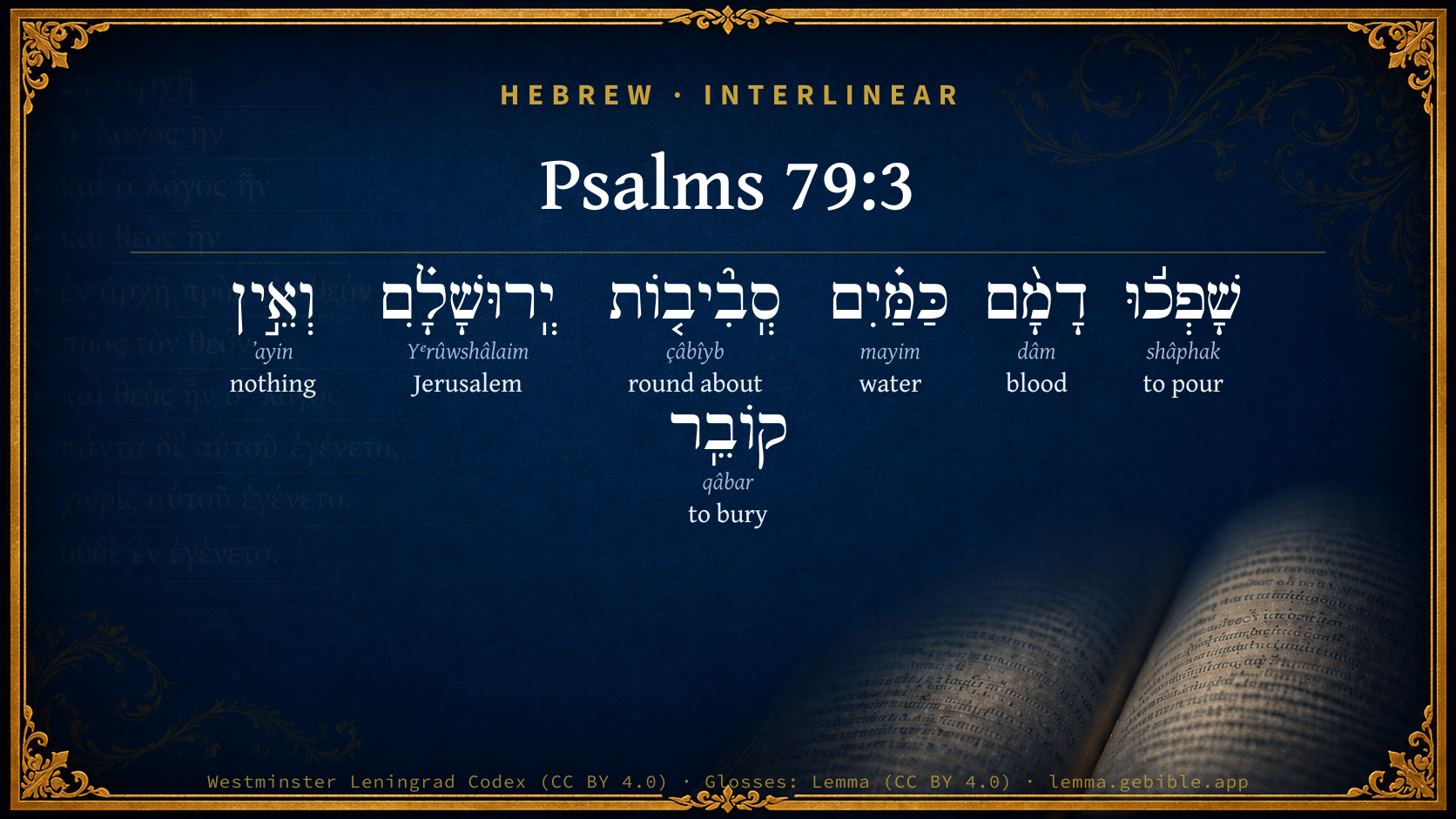
Psalms 79:3

Hebrew (Westminster Leningrad Codex) Psalms 79:3 appears in the Hebrew Old Testament. The text above is from the Westminster Leningrad Codex. Each word links to its Strong’s number, a concise gloss, and parsing drawn from the Open Scriptures Hebrew Bible morphology. Click any word for its full Brown-Driver-Briggs (BDB) entry.
Download image
Cite this verse

Psalms 79:3 (World English Bible). Public Domain. Lemma interlinear Bible study tool, https://lemma.gebible.app/v/psalms/79/3.

Show BibTeX & RIS
BibTeX
RIS
English Translation
Their blood they have shed like water around Jerusalem. There was no one to bury them.
World English Bible · Public Domain
Download a study sheet

One document with this verse’s original text, its word-by-word gloss line, the meaning frame, cross-references with their text, attributed commentary, and full source and license credits — printable, and it pastes into notes with its structure intact.

This verse Autodidact and up

Study sheet (.html) Plain text (.txt)

A passage Seminary Student

Up to 50 verses in one chapter. A passage sheet keeps up to 6 commentary sources and 12 cross-references per verse, in the order this page ranks them, and says so on the sheet whenever that leaves anything out. Ask for a single verse and you get the Autodidact verse sheet above.

Everything on this page stays free to read, with no account — the sheet is a download of what is already on screen, not access to it.

Want to remove ads? Support Godless Engineer
Compare translations 3

The same verse in 3 English versions, stacked beneath the original-language interlinear above. Click any original word for its lexicon entry.

Each is an independent rendering of the whole verse — the interlinear is not word-aligned to these translations.

Highlighted words mark where these versions differ — a whole-verse word diff, not a word-by-word alignment.

  • World English Bible Public Domain
    Their blood they have shed like water around Jerusalem. There was no one to bury them.
  • King James Version Public Domain
    Their blood have they shed like water round about Jerusalem; and there was none to bury them.
  • unfoldingWord Literal Text CC BY-SA 4.0
    They have poured out their blood like water around Jerusalem, and there is no burying.

unfoldingWord Literal Text — © unfoldingWord, licensed CC BY-SA 4.0. Word-aligned USFM3 via Door43 (git.door43.org/unfoldingWord/en_ult).

Versions to compare (up to 4)

3 of 4 selected

Show all 18 translations

Every available English version of this verse, each an independent rendering of the whole verse.

  • World English Bible Public Domain
    Their blood they have shed like water around Jerusalem. There was no one to bury them.
  • Berean Standard Bible Public Domain
    They have poured out their blood like water all around Jerusalem, and there is no one to bury the dead.
  • Majority Standard Bible Public Domain
    They have poured out their blood like water all around Jerusalem, and there is no one to bury the dead.
  • King James Version Public Domain
    Their blood have they shed like water round about Jerusalem; and there was none to bury them.
  • American Standard Version (1901) Public Domain
    Their blood have they shed like water round about Jerusalem; And there was none to bury them.
  • Revised Version (1885) Public Domain
    Their blood have they shed like water round about Jerusalem; and there was none to bury them.
  • Geneva Bible (1599) Public Domain
    Their blood haue they shead like waters rounde about Ierusalem, and there was none to burie them.
  • Douay-Rheims (1899) Public Domain
    They have poured out their blood as water, round about Jerusalem and there was none to bury them.
  • Young's Literal Translation Public Domain
    They have shed their blood As water round about Jerusalem, And there is none burying.
  • Literal Standard Version CC BY-SA 4.0
    They have shed their blood || As water around Jerusalem, || And there is none burying.
  • Unlocked Literal Bible CC BY-SA 4.0
    They have shed their blood like water around Jerusalem, and there was none to bury them.
  • unfoldingWord Literal Text CC BY-SA 4.0
    They have poured out their blood like water around Jerusalem, and there is no burying.
  • Darby Bible Public Domain
    Their blood have they shed like water round about Jerusalem, and there was none to bury [them].
  • World Messianic Bible Public Domain
    They have shed their blood like water around Jerusalem. There was no one to bury them.
  • Webster's Bible Public Domain
    Their blood have they shed like water around Jerusalem; and there was none to bury them.
  • Free Bible Version CC BY-SA 4.0
    They have poured out the blood of Jerusalem's people like water all through the city; no one remains to bury the dead.
  • Bible in Basic English Public Domain
    Their blood has been flowing like water round about Jerusalem; there was no one to put them in their last resting-place.
  • JPS Tanakh (1917) Public Domain
    They have shed their blood like water round about Jerusalem, with none to bury them.

Literal Standard Version (2020), Covenant Press — licensed CC BY-SA 4.0. Text via the HelloAO Bible API (eBible.org). Unlocked Literal Bible (unfoldingWord) — licensed CC BY-SA 4.0. Text via the HelloAO Bible API (eBible.org). unfoldingWord Literal Text — © unfoldingWord, licensed CC BY-SA 4.0. Word-aligned USFM3 via Door43 (git.door43.org/unfoldingWord/en_ult). Free Bible Version, Dr. Jonathan Gallagher — licensed CC BY-SA 4.0. Text via the HelloAO Bible API (eBible.org).

Word by word

More ways to search: Search by grammar → Find every occurrence → Compare this word →

Practice this passage: Drill this verse → Learn its vocabulary →

About this verse

These counts appear in no published source. They are computed here, from the morphology-tagged text and Lemma’s own curated glosses. What Lemma adds →

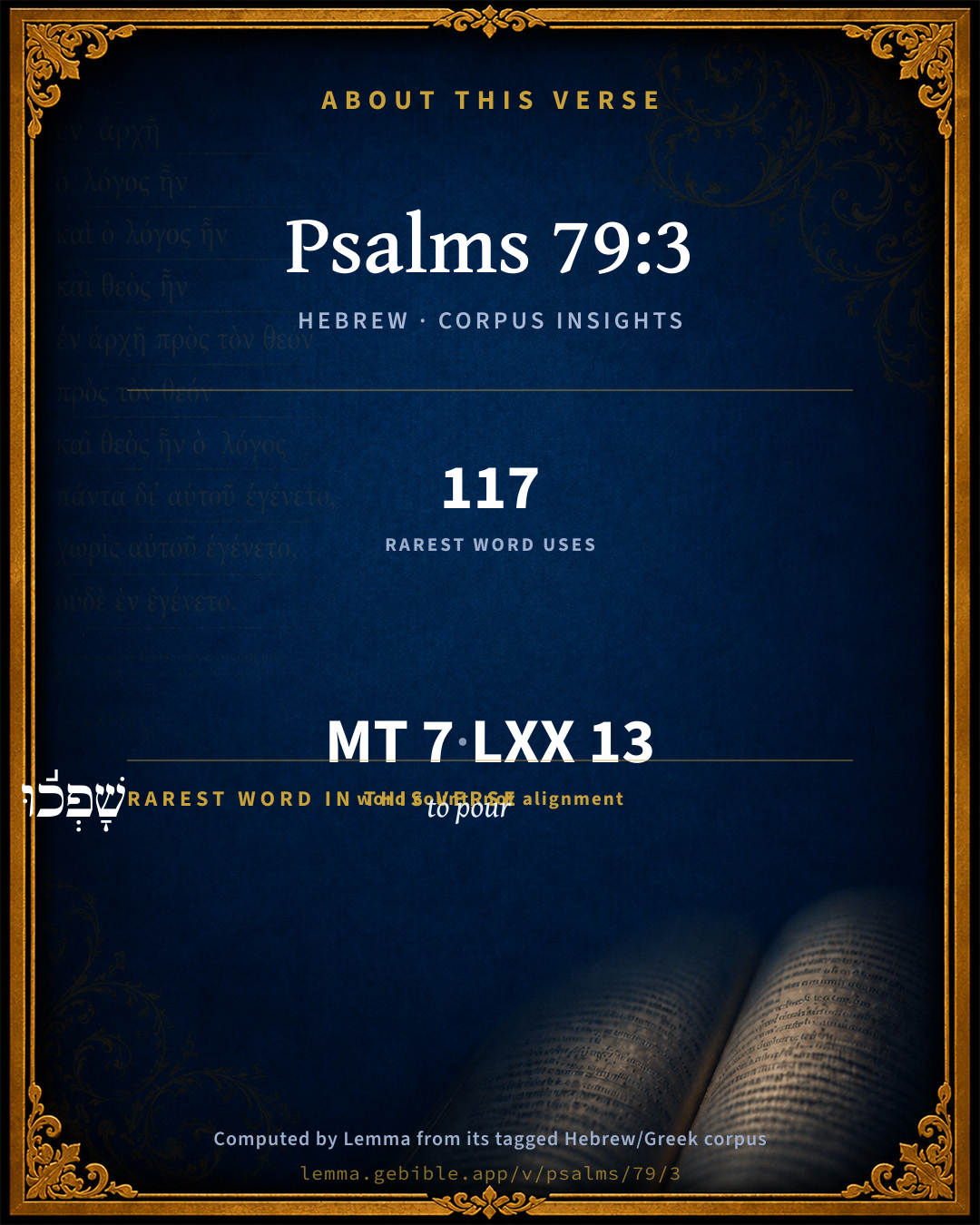
7
words
7
distinct lemmas
Wisdom
section

Grammatical profile

  • 2 verbs
  • 4 nouns
  • 1 particle

Verb forms

  • שָׁפְכ֬וּ Qal · Perfect
  • קוֹבֵֽר Qal · Participle Active

Hebrew & Septuagint length

In English translation the verse runs 16 words from the Hebrew and 17 from the Septuagint (LXX English) — closely comparable.

A rough comparison of the two English renderings, which tokenize alike — not a word-level alignment.

Word counts can differ between the Hebrew and the Greek without any difference in meaning — e.g. the Hebrew direct-object marker אֵת has no separate Greek word, and Greek often adds the article ὁ.

In the original languages it is 7 Hebrew tokens and 13 Greek tokens — but the two are counted differently (Hebrew bundles its prefixes and suffixes into one token; the Greek is in lemma form), so that isn’t a like-for-like length.

Cross-references

14

Topical passages linked to Psalms 79:3 in the Treasury of Scripture Knowledge — connected by theme and wording, ordered by reader-vote popularity; previews shown in the World English Bible.

  • Jeremiah 14:16 The people to whom they prophesy shall be cast out in the streets of Jerusalem because of the famine and the sword; and they shall have none to bury them-them, their wives, nor their sons, nor their daughters: for I will pour their wickedness on them.
  • Jeremiah 16:4 They shall die grievous deaths: they shall not be lamented, neither shall they be buried; they shall be as dung on the surface of the ground; and they shall be consumed by the sword, and by famine; and their dead bodies shall be food for the birds of the sky, and for the animals of the earth.
  • Revelation 11:9 From among the peoples, tribes, languages, and nations people will look at their dead bodies for three and a half days, and will not allow their dead bodies to be laid in a tomb.
  • Psalms 79:10 Why should the nations say, "Where is their God?" Let it be known among the nations, before our eyes, That vengeance for your servants' blood is being poured out.
  • Psalms 141:7 "As when one plows and breaks up the earth, Our bones are scattered at the mouth of Sheol."
  • Jeremiah 8:1–2 At that time, says Yahweh, they shall bring out the bones of the kings of Judah, and the bones of his princes, and the bones of the priests, and the bones of the prophets, and the bones of the inhabitants of Jerusalem, out of their graves;
  • Jeremiah 15:3 I will appoint over them four kinds, says Yahweh: the sword to kill, and the dogs to tear, and the birds of the sky, and the animals of the earth, to devour and to destroy.
  • Jeremiah 25:33 The slain of Yahweh shall be at that day from one end of the earth even to the other end of the earth: they shall not be lamented, neither gathered, nor buried; they shall be dung on the surface of the ground.
  • Jeremiah 34:20 I will even give them into the hand of their enemies, and into the hand of those who seek their life; and their dead bodies shall be for food to the birds of the sky, and to the animals of the earth.
  • Matthew 23:35 that on you may come all the righteous blood shed on the earth, from the blood of righteous Abel to the blood of Zachariah son of Barachiah, whom you killed between the sanctuary and the altar.
  • Romans 8:36 Even as it is written, "For your sake we are killed all day long. We were accounted as sheep for the slaughter."
  • Revelation 16:6 For they poured out the blood of the saints and the prophets, and you have given them blood to drink. They deserve this."
  • Revelation 17:6 I saw the woman drunken with the blood of the saints, and with the blood of the martyrs of Jesus. When I saw her, I wondered with great amazement.
  • Revelation 18:24 In her was found the blood of prophets and of saints, and of all who have been slain on the earth."

Cross-references courtesy of OpenBible.info (CC BY 4.0).

Hebrew and Greek witnesses Masoretic Hebrew ↔ Greek Septuagint

The same verse in the two great witnesses to the Old Testament, shown verse-for-verse.

You’re reading Greek Psalm 78 (Hebrew Psalm 79). The Septuagint counts the superscription, so verse numbers can differ from the Hebrew — chapter-level alignment, not verse-by-verse. Numbering follows Rahlfs.

These are two independent witnesses, not word-aligned to each other, and the Septuagint is shown in lemma (dictionary) form.

Hebrew Psalms 79:3 Masoretic · Westminster Leningrad Codex

שָׁפְכ֬וּ דָמָ֨ם כַּמַּ֗יִם סְֽבִ֘יב֤וֹת יְֽרוּשָׁלִָ֗ם וְאֵ֣ין קוֹבֵֽר

Their blood they have shed like water around Jerusalem. There was no one to bury them.

World English Bible · Public Domain

Greek LXX Greek Psalm 78:3 Septuagint · lemma form

ἐκχέω ὁ αἷμα αὐτός ὡς ὕδωρ κύκλος ἰερουσαλήμ καί οὐ εἰμί ὁ θάπτω

They have shed their blood as water, round about Jerusalem; and there was none to bury them.

LXX2012 (modern English Septuagint) · Public Domain

Hebrew: Westminster Leningrad Codex (CC BY 4.0). Greek: Septuagint (public domain); English from LXX2012 (modern English Septuagint) (Public Domain). How the Septuagint differs from the Hebrew →

Commentary

Notes on Psalms 79:3 from classic Christian and Jewish commentators (each source and its license shown beneath its notes). The classic Christian expositions comment on the surrounding passage and are grouped to its opening verse, so a note may address several verses; the Jewish commentaries on the Tanakh (Rashi and others) are per-verse, so they appear only where the commentator wrote on this verse.

Lemma curates 59 commentaries, every one of them public domain or Creative Commons licensed, each selected and text-cleaned for this edition rather than reprinted as found. About our sources →

The Cambridge Bible for Schools and Colleges

gen. ed. J. J. S. Perowne

3. like water] Freely, and as though it were of little worth. Contrast Psa_116:15.

none to bury them] Cp. Jer_14:16. This passage is quoted freely in 1Ma_7:17 with reference to the murder of certain Assideans by the high priest Alcimus, “He took of them threescore men and slew them in one day, according to the words which one wrote, The flesh of thy saints and their blood did they shed round about Jerusalem, and they had none to bury them.” Clearly the meaning cannot be that the Psalm was written with reference to that event, for by that time (b.c. 162) the situation of affairs was wholly different from that described in the Psalm. Judas had won many victories, and the Temple had been re-dedicated. Moreover the Psalm implies a much more extensive slaughter of Israelites, and that by heathen, not by a treacherous Israelite. There is probably another reminiscence of Psa_79:3 in 1Ma_1:37, “They shed innocent blood on every side of the sanctuary, and defiled it.”

The Cambridge Bible for Schools and Colleges (gen. ed. J. J. S. Perowne; Cambridge University Press, 1878–1918) — public domain. Text from a community e-Sword module.

Trapp's Complete Commentary

John Trapp

Psa 79:3 Their blood have they shed like water round about Jerusalem; and [there was] none to bury [them].

Ver. 3. Their blood have they shed like water] Contemptim vel abiecte. They made no more reckoning of it than of ditch water; and were ready to say, as Hannibal did when he saw a ditch full of men’s blood, O formosum spectaculum! O beautiful sight!

And there was none to bury them] Either none to bury them at all, which the Jews accounted worse than death, Ecc 6:3, and the Romans extreme cruelty, Immanitatis est Scythicae non sepelire mortuos (Sen. ad Martiam); or none to bury them cum ritibus, with the accustomed rites and ceremonies, as Jacob was buried, Gen 50:1-13, but not Jeconiah, Jer 22:18.

John Trapp, A Commentary or Exposition upon All the Books of the Old and New Testament (1647–1656) — public domain. Text from a community e-Sword module.

J. A. Alexander on Psalms

Joseph Addison Alexander

3. (Psa 79:3) They have shed their blood like water round about Jerusalem, and there is none burying, or none to bury them. There is no period in the history of ancient Israel to which these terms can be applied without extravagance, except that of the Babylonian conquest.

Joseph Addison Alexander, The Psalms Translated and Explained (1850) — public domain. Text from a community e-Sword module.

Geneva Bible (1599)

Geneva Bible translators

Their friends and kinsfolks durst not bury them for fear of the enemies.

Geneva Bible (1599) marginal notes — public domain. Text via Bolls.life.

Adam Clarke's Commentary

Verse 3. There was none to bury them.] The Chaldeans would not; and the Jews who were not slain were carried into captivity.

Adam Clarke's Commentary on the Bible (1810–1826) — public domain. Text from a community e-Sword/MySword module.

Ellicott's Commentary for English Readers

(3) Their blood.—In 1Ma_7:17, we read “The flesh of thy saints and their blood have they shed round about Jerusalem, and there was none to bury them,” introduced by “according to the word which he wrote.” This is evidently a free quotation from this psalm, and seems to imply a reference to a contemporary.

None to bury.—For this aggravation of the evil comp. Jer_14:16; Jer_22:18-19.

A Bible Commentary for English Readers, edited by Charles John Ellicott (1878–1897) — public domain. Text from a community e-Sword module.

John Gill's Exposition

Their blood have they shed like water round about Jerusalem,.... Without any concern of mind, or remorse of conscience; without any fear of God or man; as if it had been so much water only; and this they shed in great abundance: from the Apocrypha:

"And when he had taken all away, he went into his own land, having made a great massacre, and spoken very proudly.'' (1 Maccabees 1:24)

"And spake peaceable words unto them, but all was deceit: for when they had given him credence, he fell suddenly upon the city, and smote it very sore, and destroyed much people of Israel.'' (1 Maccabees 1:30)

"Thus they shed innocent blood on every side of the sanctuary, and defiled it:'' (1 Maccabees 1:37)

"So they rose up against them in battle on the sabbath, and they slew them, with their wives and children and their cattle, to the number of a thousand people.'' (1 Maccabees 2:38)

in like manner the blood of the saints has been shed by the antichristian beast of Rome, for which he and his followers will be righteously retaliated, Rev 17:6.

and there was none to bury them: either the number of the slain was so great, that there were not left enough to bury the dead, or they that did remain were not suffered to do it; this will be the case of the two witnesses, when slain, Rev 11:7.

John Gill's Exposition of the Whole Bible (1746–1763) — public domain (CC PDM 1.0). Text via the HelloAO Bible API.

Albert Barnes' Notes on the Bible

Their blood have they shed like water round about Jerusalem - They have poured it out in such quantities that it seems to flow like water - not an uncommon occurrence in war. There was no event in the history of the Hebrews to which this description would be more applicable than to the Babylonian invasion. The language might indeed be applicable to the desolation of the city by Antiochus Epiphanes, and also to its destruction by the Romans; but, of course, it cannot refer to the latter, and there is no necessity for supposing that it refers to the former. All the conditions of a proper interpretation are fulfilled by supposing that it refers to the time of the Chaldean invasion.

And there was none to bury them - The Chaldeans would not do it, and they would not suffer the Hebrew people to do it.

Albert Barnes' Notes on the Bible (1834–1885) — public domain. Text from a community e-Sword/MySword module.

Matthew Poole's English Annotations

Like water; plentifully and contemptuously, valuing it no more than common water.

None to bury them, because their friends, who should have done it, were either slain or fled, or were not permitted, or durst not undertake, to perform that office to them.

Matthew Poole's English Annotations on the Holy Bible (1683–1685) — public domain. Text from a community e-Sword/MySword module.

The Treasury of David

Charles H. Spurgeon

Ver. 3. "Their blood have they shed like water round about Jerusalem." The invaders slew men as if their blood was of no more value than so much water; they poured it forth as lavishly as when the floods deluge the plains. The city of holy peace became a field of blood.

"And there was none to bury them." The few who survived were afraid to engage in the task. This was a serious trial and grievous horror to the Jews, who evinced much care concerning their burials. Has it come to this, that there are none to bury the dead of thy family, O Lord? Can none be found to grant a shovelful of earth with which to cover up the poor bodies of thy murdered saints? What woe is here! How glad should we be that we live in so quiet an age, when the blast of the trumpet is no more heard in our streets.

Whole Psalm. See Psalms on "Ps 79:1" for further information.

Charles H. Spurgeon's The Treasury of David (1869–1885) — public domain. Psalms only. Text from a community e-Sword/MySword module.

The Pulpit Commentary

Their blood have they shed like water round about Jerusalem. During the long siege (eighteen months) the number slain in the neighbourhood of Jerusalem would be very large. And there was none to bury them. (compare the prophecy of Jeremiah, Jer_14:16) The population being for the most part carried into captivity, and but few left in the land, (Jer_52:15, Jer_52:16) the bodies of the slain lay unburied, the few left not being able to bury them. Compare the preceding verse.

The Pulpit Commentary (1880–1919), ed. H.D.M. Spence-Jones & Joseph S. Exell — public domain. Text from a community e-Sword module.

Lesson kit

Teaching starters — assembled from the data on this page, not authored interpretation. Every prompt links to the verse data it draws on. Edit before teaching.

Psalms, in the Wisdom, opens this verse with 7 words (7 distinct Hebrew lemmas). Its most distinctive word is shâphak (“to pour”). A historical commentator’s framing appears above. Read the whole chapter for the surrounding context.

Discussion questions

  1. How does “to pour” (shâphak) shape what this verse is saying?
  2. How does Jeremiah 14:16, which shares this passage’s theme, read alongside this verse?
  3. The translations on this page render this verse differently — a whole-verse word diff, not a word-by-word alignment. What might account for the different wordings?
  4. «שָׁפְכ֬וּ» is a Qal Perfect verb. How does that grammatical form shape the action described?
  5. Compare how The Cambridge Bible for Schools and Colleges and Trapp's Complete Commentary read this verse. Where do they agree or differ?

Things to notice

Reading settings

Reading text

Shown beneath each verse's original-language words.

Old Testament
Old Testament edition

Read the OT as the Masoretic Hebrew (MT) or the Greek Septuagint (LXX).

English shown for the Greek Septuagint (in the Hebrew ↔ Greek comparison).

Comparing translations? Open the Compare panel on any verse page to stack up to four side by side.