

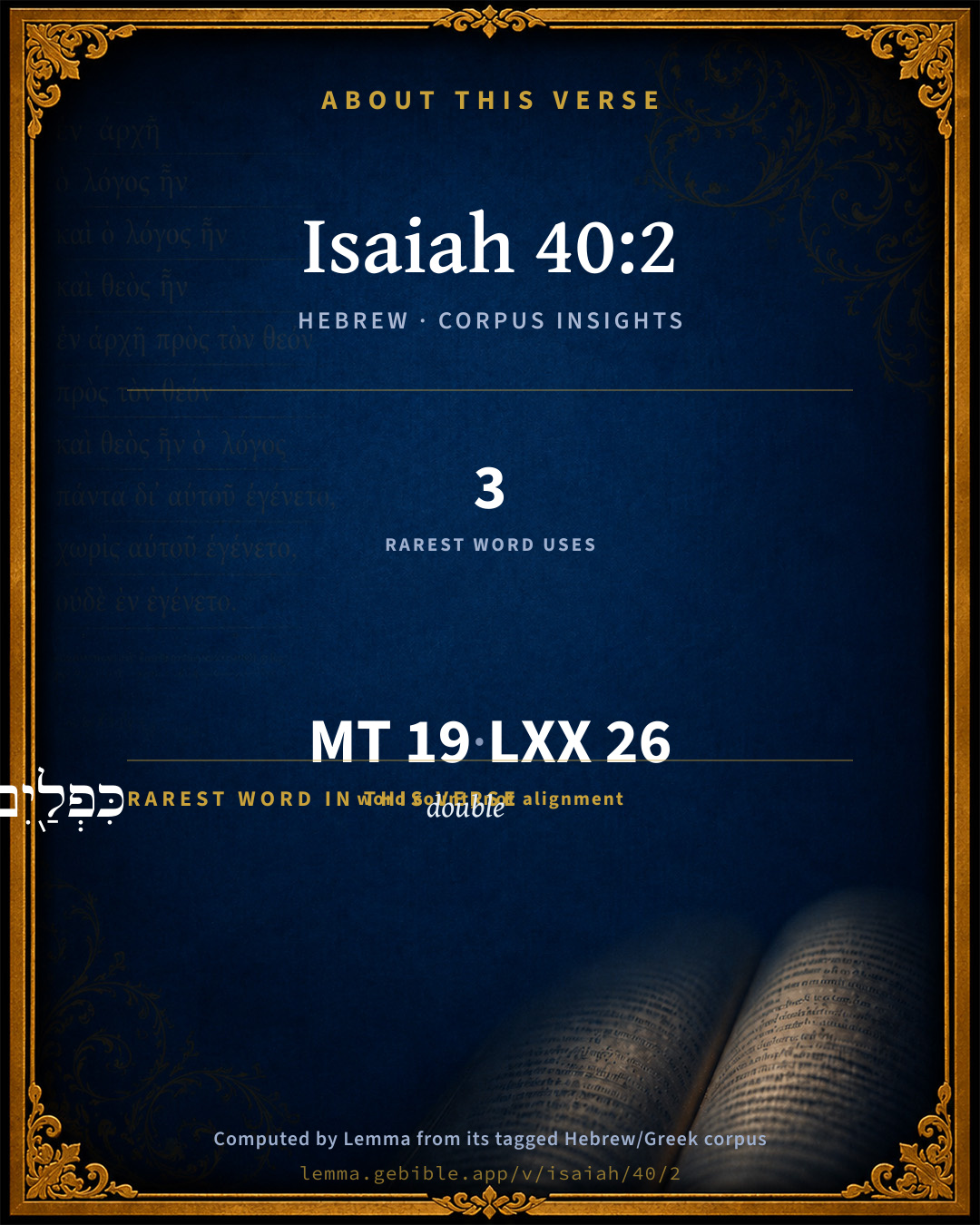
Isaiah 40:2

Hebrew (Westminster Leningrad Codex) Isaiah 40:2 appears in the Hebrew Old Testament. The text above is from the Westminster Leningrad Codex. Each word links to its Strong’s number, a concise gloss, and parsing drawn from the Open Scriptures Hebrew Bible morphology. Click any word for its full Brown-Driver-Briggs (BDB) entry.
Download image
Cite this verse

Isaiah 40:2 (World English Bible). Public Domain. Lemma interlinear Bible study tool, https://lemma.gebible.app/v/isaiah/40/2.

Show BibTeX & RIS
BibTeX
RIS
English Translation
Speak comfortably to Jerusalem; and cry to her, that her warfare is accomplished, that her iniquity is pardoned, that she has received of Yahweh's hand double for all her sins.
World English Bible · Public Domain
Download a study sheet

One document with this verse’s original text, its word-by-word gloss line, the meaning frame, cross-references with their text, attributed commentary, and full source and license credits — printable, and it pastes into notes with its structure intact.

This verse Autodidact and up

Study sheet (.html) Plain text (.txt)

A passage Seminary Student

Up to 50 verses in one chapter. A passage sheet keeps up to 6 commentary sources and 12 cross-references per verse, in the order this page ranks them, and says so on the sheet whenever that leaves anything out. Ask for a single verse and you get the Autodidact verse sheet above.

Everything on this page stays free to read, with no account — the sheet is a download of what is already on screen, not access to it.

Want to remove ads? Support Godless Engineer
Compare translations 3

The same verse in 3 English versions, stacked beneath the original-language interlinear above. Click any original word for its lexicon entry.

Each is an independent rendering of the whole verse — the interlinear is not word-aligned to these translations.

Highlighted words mark where these versions differ — a whole-verse word diff, not a word-by-word alignment.

  • World English Bible Public Domain
    Speak comfortably to Jerusalem; and cry to her, that her warfare is accomplished, that her iniquity is pardoned, that she has received of Yahweh's hand double for all her sins.
  • King James Version Public Domain
    Speak ye comfortably to Jerusalem, and cry unto her, that her warfare is accomplished, that her iniquity is pardoned: for she hath received of the LORD's hand double for all her sins.
  • unfoldingWord Literal Text CC BY-SA 4.0
    “Speak to the heart of Jerusalem and proclaim to her that her service is full, that her iniquity is pardoned, that she has received from the hand of Yahweh double for all her sins.” q1

unfoldingWord Literal Text — © unfoldingWord, licensed CC BY-SA 4.0. Word-aligned USFM3 via Door43 (git.door43.org/unfoldingWord/en_ult).

Versions to compare (up to 4)

3 of 4 selected

Show all 18 translations

Every available English version of this verse, each an independent rendering of the whole verse.

  • World English Bible Public Domain
    Speak comfortably to Jerusalem; and cry to her, that her warfare is accomplished, that her iniquity is pardoned, that she has received of Yahweh's hand double for all her sins.
  • Berean Standard Bible Public Domain
    “Speak tenderly to Jerusalem, and proclaim to her that her forced labor has been completed; her iniquity has been pardoned. For she has received from the hand of the LORD double for all her sins.”
  • Majority Standard Bible Public Domain
    “Speak tenderly to Jerusalem, and proclaim to her that her forced labor has been completed; her iniquity has been pardoned. For she has received from the hand of the LORD double for all her sins.”
  • King James Version Public Domain
    Speak ye comfortably to Jerusalem, and cry unto her, that her warfare is accomplished, that her iniquity is pardoned: for she hath received of the LORD's hand double for all her sins.
  • American Standard Version (1901) Public Domain
    Speak ye comfortably to Jerusalem; and cry unto her, that her warfare is accomplished, that her iniquity is pardoned, that she hath received of Jehovah's hand double for all her sins.
  • Revised Version (1885) Public Domain
    Speak ye comfortably to Jerusalem, and cry unto her, that her warfare is accomplished, that her iniquity is pardoned; that she hath received of the LORD’S hand double for all her sins.
  • Geneva Bible (1599) Public Domain
    Speake comfortably to Ierusalem, and crye vnto her, that her warrefare is accomplished, that her iniquitie is pardoned: for she hath receiued of the Lords hand double for all her sinnes.
  • Douay-Rheims (1899) Public Domain
    Speak ye to the heart of Jerusalem, and call to her: for her evil is come to an end, her iniquity is forgiven: she hath received of the hand of the Lord double for all her sins.
  • Young's Literal Translation Public Domain
    Speak to the heart of Jerusalem, and call to her, That her warfare hath been completed, That accepted hath been her punishment, That she hath received from the hand of Jehovah Double for all her sins.
  • Literal Standard Version CC BY-SA 4.0
    Speak to the heart of Jerusalem, and call to her, || That her warfare has been completed, || That her punishment has been accepted, || That she has received from the hand of YHWH || Double for all her sins.
  • Unlocked Literal Bible CC BY-SA 4.0
    “Speak tenderly to Jerusalem; and proclaim to her that her warfare has ended, that her iniquity is pardoned, that she has received double from Yahweh's hand for all her sins.”
  • unfoldingWord Literal Text CC BY-SA 4.0
    “Speak to the heart of Jerusalem and proclaim to her that her service is full, that her iniquity is pardoned, that she has received from the hand of Yahweh double for all her sins.” q1
  • Darby Bible Public Domain
    Speak to the heart of Jerusalem, and cry unto her, that her time of suffering is accomplished, that her iniquity is pardoned; for she hath received of Jehovah's hand double for all her sins.
  • World Messianic Bible Public Domain
    “Speak comfortably to Jerusalem, and call out to her that her warfare is accomplished, that her iniquity is pardoned, that she has received of the LORD’s hand double for all her sins.”
  • Webster's Bible Public Domain
    Speak ye comfortably to Jerusalem, and cry to her, that her warfare is accomplished, that her iniquity is pardoned: for she hath received from the LORD'S hand double for all her sins.
  • Free Bible Version CC BY-SA 4.0
    “Speak lovingly to the people of Jerusalem, telling them that their hard times are over, that their sins have been forgiven, and that the Lord has paid them twice over for their sins.”
  • Bible in Basic English Public Domain
    Say kind words to the heart of Jerusalem, crying out to her that her time of trouble is ended, that her punishment is complete; that she has been rewarded by the Lord's hand twice over for all her sins.
  • JPS Tanakh (1917) Public Domain
    Bid Jerusalem take heart, and proclaim unto her, that her time of service is accomplished, that her guilt is paid off; that she hath received of the LORD'S hand double for all her sins.

Literal Standard Version (2020), Covenant Press — licensed CC BY-SA 4.0. Text via the HelloAO Bible API (eBible.org). Unlocked Literal Bible (unfoldingWord) — licensed CC BY-SA 4.0. Text via the HelloAO Bible API (eBible.org). unfoldingWord Literal Text — © unfoldingWord, licensed CC BY-SA 4.0. Word-aligned USFM3 via Door43 (git.door43.org/unfoldingWord/en_ult). Free Bible Version, Dr. Jonathan Gallagher — licensed CC BY-SA 4.0. Text via the HelloAO Bible API (eBible.org).

Word by word

More ways to search: Search by grammar → Find every occurrence → Compare this word →

Practice this passage: Drill this verse → Learn its vocabulary →

כִּפְלַ֖יִם
kephel
H3718
“double”
Noun, Common, Masculine, Dual, Absolute
Part of Speech
Noun
Type
Common
Gender
Masculine
Number
Dual
State
Absolute
Full BDB Definition

Origin: from H3717

TWOT: 1019a

double, a doubling
  1. דַּבְּר֞וּ dâbar H1696 “speak” Verb, Piel, Imperative, 2nd Person, Masculine, Plural
  2. עַל ʻal H5921 “upon” Preposition
  3. לֵ֤ב lêb H3820 “heart of” Noun, Common, Masculine, Singular, Construct
  4. יְרֽוּשָׁלִַ֨ם֙ Yᵉrûwshâlaim H3389 “Jerusalem” Noun, Proper
  5. וְקִרְא֣וּ qârâʼ H7121 “and · call” Conjunction + Verb, Qal, Imperative, 2nd Person, Masculine, Plural
  6. אֵלֶ֔יהָ ʼêl H413 “to · her” Preposition + Suffix, Personal, 3rd Person, Feminine, Singular
  7. כִּ֤י kîy H3588 “that” Conjunction
  8. מָֽלְאָה֙ mâlêʼ H4390 “to fill” Verb, Qal, Perfect, 3rd Person, Feminine, Singular
  9. צְבָאָ֔הּ tsâbâʼ H6635 “army · her” Noun, Common, Both, Singular, Construct + Suffix, Personal, 3rd Person, Feminine, Singular
  10. כִּ֥י kîy H3588 “that” Conjunction
  11. נִרְצָ֖ה râtsâh H7521 “to be pleased” Verb, Niphal, Perfect, 3rd Person, Masculine, Singular
  12. עֲוֺנָ֑הּ ʻâvôn H5771 “iniquity · her” Noun, Common, Both, Singular, Construct + Suffix, Personal, 3rd Person, Feminine, Singular
  13. כִּ֤י kîy H3588 “that” Conjunction
  14. לָקְחָה֙ lâqach H3947 “to take” Verb, Qal, Perfect, 3rd Person, Feminine, Singular
  15. מִיַּ֣ד yâd H3027 “from · hand of” Preposition + Noun, Common, Both, Singular, Construct
  16. יְהוָ֔ה Yᵉhôvâh H3068 “LORD” Noun, Proper
  17. בְּכָל kôl H3605 “in/at · all of” Preposition + Noun, Common, Masculine, Singular, Construct
  18. חַטֹּאתֶֽיהָ chaṭṭâʼâh H2403 “sin offerings · her” Noun, Common, Feminine, Plural, Construct + Suffix, Personal, 3rd Person, Feminine, Singular

About this verse

These counts appear in no published source. They are computed here, from the morphology-tagged text and Lemma’s own curated glosses. What Lemma adds →

19
words
17
distinct lemmas
Prophets
section

Notable vocabulary

The rarest word here is כִּפְלַ֖יִם double H3718 — appearing just 3 times in the whole Hebrew Bible.

Shared distinctive vocabulary

כִּפְלַ֖יִם double H3718 occurs in 3 verses of the Hebrew Bible. Also found in:

Grammatical profile

  • 5 verbs
  • 9 nouns
  • 2 prepositions
  • 3 conjunctions

Verb forms

  • דַּבְּר֞וּ Piel · Imperative
  • וְקִרְא֣וּ Qal · Imperative
  • מָֽלְאָה֙ Qal · Perfect
  • נִרְצָ֖ה Niphal · Perfect
  • לָקְחָה֙ Qal · Perfect

Repetition

A word recurs within this verse — often emphatic in Hebrew:

  • כִּ֤י that H3588 ×3

Hebrew & Septuagint length

In English translation the verse runs 30 words from the Hebrew and 34 from the Septuagint (LXX English) — closely comparable.

A rough comparison of the two English renderings, which tokenize alike — not a word-level alignment.

Word counts can differ between the Hebrew and the Greek without any difference in meaning — e.g. the Hebrew direct-object marker אֵת has no separate Greek word, and Greek often adds the article ὁ.

In the original languages it is 19 Hebrew tokens and 26 Greek tokens — but the two are counted differently (Hebrew bundles its prefixes and suffixes into one token; the Greek is in lemma form), so that isn’t a like-for-like length.

Cross-references

34

Topical passages linked to Isaiah 40:2 in the Treasury of Scripture Knowledge — connected by theme and wording, ordered by reader-vote popularity; previews shown in the World English Bible.

  • Zechariah 9:12 Turn to the stronghold, you prisoners of hope! Even today I declare that I will restore double to you.
  • Isaiah 61:7 Instead of your shame [you shall have] double; and instead of dishonor they shall rejoice in their portion: therefore in their land they shall possess double; everlasting joy shall be to them.
  • Hosea 2:14 "Therefore, behold, I will allure her, And bring her into the wilderness, And speak tenderly to her.
  • Jeremiah 33:8–9 I will cleanse them from all their iniquity, by which they have sinned against me; and I will pardon all their iniquities, by which they have sinned against me, and by which they have transgressed against me.
  • Revelation 18:6 Return to her just as she returned, and repay her double as she did, and according to her works. In the cup which she mixed, mix to her double.
  • Isaiah 43:25 I, even I, am he who blots out your transgressions for my own sake; and I will not remember your sins.
  • Isaiah 44:22 I have blotted out, as a thick cloud, your transgressions, and, as a cloud, your sins: return to me; for I have redeemed you.
  • Jeremiah 16:18 First I will recompense their iniquity and their sin double, because they have polluted my land with the carcasses of their detestable things, and have filled my inheritance with their abominations.
  • Song of Solomon 2:11–13 For, behold, the winter is past. The rain is over and gone.
  • Isaiah 35:4 Tell those who are of a fearful heart, Be strong, don't be afraid: behold, your God will come [with] vengeance, [with] the recompense of God; he will come and save you.
  • Jeremiah 29:11 For I know the thoughts that I think toward you, says Yahweh, thoughts of peace, and not of evil, to give you hope in your latter end.
  • Habakkuk 2:3 For the vision is yet for the appointed time, and it hurries toward the end, and won't prove false. Though it takes time, wait for it; because it will surely come. It won't delay.
  • Psalms 102:13–28 You will arise and have mercy on Zion; For it is time to have pity on her. Yes, the set time has come.
  • Isaiah 12:1 In that day you will say, "I will give thanks to you, Yahweh; for though you were angry with me, your anger has turned away and you comfort me.
  • Daniel 11:35 Some of those who are wise shall fall, to refine them, and to purify, and to make them white, even to the time of the end; because it is yet for the time appointed.
  • Job 42:10–12 Yahweh turned the captivity of Job, when he prayed for his friends. Yahweh gave Job twice as much as he had before.
  • Psalms 32:1 Blessed is he whose disobedience is forgiven, Whose sin is covered.
  • Isaiah 33:24 The inhabitant shall not say, I am sick: the people who dwell therein shall be forgiven their iniquity.
  • Isaiah 41:11–13 Behold, all those who are incensed against you shall be disappointed and confounded: those who strive with you shall be as nothing, and shall perish.
  • Isaiah 49:25 But thus says Yahweh, Even the captives of the mighty shall be taken away, and the prey of the terrible shall be delivered; for I will contend with him who contends with you, and I will save your children.
  • Jeremiah 31:33–34 But this is the covenant that I will make with the house of Israel after those days, says Yahweh: I will put my law in their inward parts, and in their heart will I write it; and I will be their God, and they shall be my people:
  • Revelation 11:15–18 The seventh angel sounded, and great voices in heaven followed, saying, "The kingdom of the world has become the Kingdom of our Lord, and of his Christ. He will reign forever and ever!"
  • Genesis 34:3 His soul joined to Dinah, the daughter of Jacob, and he loved the young lady, and spoke kindly to the young lady.
  • 2 Chronicles 30:22 Hezekiah spoke comfortably to all the Levites who had good understanding [in the service] of Yahweh. So they ate throughout the feast for the seven days, offering sacrifices of peace-offerings, and making confession to Yahweh, the God of their fathers.
  • Jeremiah 17:18 Let them be disappointed who persecute me, but let not me be disappointed; let them be dismayed, but don't let me be dismayed; bring on them the day of evil, and destroy them with double destruction.
  • Daniel 9:2 in the first year of his reign I, Daniel, understood by the books the number of the years about which the word of Yahweh came to Jeremiah the prophet, for the accomplishing of the desolations of Jerusalem, even seventy years.
  • Daniel 9:12 He has confirmed his words, which he spoke against us, and against our judges who judged us, by bringing on us a great evil; for under the whole sky has not been done as has been done on Jerusalem.
  • Daniel 9:24–27 Seventy weeks are decreed on your people and on your holy city, to finish disobedience, and to make an end of sins, and to make reconciliation for iniquity, and to bring in everlasting righteousness, and to seal up vision and prophecy, and to anoint the most holy.
  • Daniel 12:4 But you, Daniel, shut up the words, and seal the book, even to the time of the end: many shall run back and forth, and knowledge shall be increased."
  • Daniel 12:9 He said, Go your way, Daniel; for the words are shut up and sealed until the time of the end.
  • Zechariah 1:15 I am very angry with the nations that are at ease; for I was but a little displeased, but they added to the calamity."
  • Acts 1:7 He said to them, "It isn't for you to know times or seasons which the Father has set within His own authority.
  • Galatians 4:4 But when the fullness of the time came, God sent out his Son, born to a woman, born under the law,
  • 1 Corinthians 6:9–11 Or don't you know that the unrighteous will not inherit the Kingdom of God? Don't be deceived. Neither the sexually immoral, nor idolaters, nor adulterers, nor male prostitutes, nor homosexuals,

Cross-references courtesy of OpenBible.info (CC BY 4.0).

Hebrew and Greek witnesses Masoretic Hebrew ↔ Greek Septuagint

The same verse in the two great witnesses to the Old Testament, shown verse-for-verse.

These are two independent witnesses, not word-aligned to each other, and the Septuagint is shown in lemma (dictionary) form.

Hebrew Isaiah 40:2 Masoretic · Westminster Leningrad Codex

דַּבְּר֞וּ עַל לֵ֤ב יְרֽוּשָׁלִַ֨ם֙ וְקִרְא֣וּ אֵלֶ֔יהָ כִּ֤י מָֽלְאָה֙ צְבָאָ֔הּ כִּ֥י נִרְצָ֖ה עֲוֺנָ֑הּ כִּ֤י לָקְחָה֙ מִיַּ֣ד יְהוָ֔ה כִּפְלַ֖יִם בְּכָל חַטֹּאתֶֽיהָ

Speak comfortably to Jerusalem; and cry to her, that her warfare is accomplished, that her iniquity is pardoned, that she has received of Yahweh's hand double for all her sins.

World English Bible · Public Domain

Greek LXX Isaiah 40:2 Septuagint · lemma form

ἱερεύς λαλέω εἰς ὁ καρδία ἰερουσαλήμ παρακαλέω αὐτός ὅτι πίμπλημι ὁ ταπείνωσις αὐτός λύω αὐτός ὁ ἁμαρτία ὅτι δέχομαι ἐκ χείρ κύριος διπλοῦς ὁ ἁμάρτημα αὐτός

Speak, you⌃ priests, to the heart of Jerusalem; comfort her, for her humiliation is accomplished, her sin is put away: for she has received of the Lord's hand double the amount of her sins.

LXX2012 (modern English Septuagint) · Public Domain

On this verse, Albert Barnes' Notes on the Bible discusses the Septuagint’s reading. Read the note in Commentary ↓

Hebrew: Westminster Leningrad Codex (CC BY 4.0). Greek: Septuagint (public domain); English from LXX2012 (modern English Septuagint) (Public Domain). How the Septuagint differs from the Hebrew →

Targum (Aramaic paraphrase)

1

The Targum is the ancient Jewish Aramaic paraphrase of the Hebrew Scriptures — an interpretive translation, not the Hebrew text itself. Onkelos (literal) and Pseudo-Jonathan (expansive) render the Torah, and Jonathan the Prophets. Coverage is partial: where no permissively-licensed English translation exists for a verse, only the Aramaic is shown. This is verse-level text, not a word-by-word alignment to the Hebrew.

  1. Targum Jonathan Prophets (Joshua–Malachi)
    מַלִילוּ עַל לִבָּא דִירוּשְׁלֵם וְאִתְנַבּוּ עֲלָהּ אֲרֵי עֲתִידָא דְתִתְמְלֵי מֵעַם גַלְוָתָהָא אֲרֵי אִישְׁתְּבִיקוּ לָהּ חוֹבָהָא אֲרֵי קַבִּילַת כָּס תַּנְחוּמִין מִן קֳדָם יְיָ כְּאִלוּ לָקַת עַל חַד תְּרֵין בְּכָל חַטָאתָהָא:

    Speak ye comfortably, to Jerusalem, and prophesy concerning her, that she shall be filled with the people of the captivity, because her sins are forgiven, for she hath received the cup of consolations from the Lord, as if she had been smitten twice for all her sins.

    Targum Jonathan — Aramaic: “Mikraot Gedolot” (public domain). English: “Sefaria Community Translation” (CC0 1.0 (public-domain dedication)); “London "Chaldee Paraphrase," 1871” (public domain). Text via Sefaria.

Commentary

Notes on Isaiah 40:2 from classic Christian and Jewish commentators (each source and its license shown beneath its notes). The classic Christian expositions comment on the surrounding passage and are grouped to its opening verse, so a note may address several verses; the Jewish commentaries on the Tanakh (Rashi and others) are per-verse, so they appear only where the commentator wrote on this verse.

Lemma curates 59 commentaries, every one of them public domain or Creative Commons licensed, each selected and text-cleaned for this edition rather than reprinted as found. About our sources →

Trapp's Complete Commentary

John Trapp

Isa 40:2 Speak ye comfortably to Jerusalem, and cry unto her, that her warfare is accomplished, that her iniquity is pardoned: for she hath received of the LORD’S hand double for all her sins.

Ver. 2. Speak ye comfortably.] Speak to the heart, as Gen 34:3 Hos 2:14. Cheer her up, speak to her with utmost earnestness, that your words may work upon her and stick-by her; do it solidly, not frigidly.

That her warfare is accomplished.] Militiam, not malitiam, as the Vulgate hath it; the word signifieth also a set term of time. See Dan 9:2 Gal 4:4. God hath limited the saints’ sufferings. {Rev 2:10} Some by warfare here understand that hard and troublesome pedagogy of Moses’ law, that yoke importable, {Act 15:10} taken away by Christ.

That her iniquity is pardoned.] Heb., Her iniquity is accepted: perfectam esse poenam eius, so Piscator rendereth it. She might be under God’s hand, though her sins were pardoned. The palsyman heard, "Son, thy sins are forgiven thee," some while before he heard, "Take up thy bed and walk."

That she hath received of the Lord’s hand double,] i.e., Abundantly and in a large measure, satis superque, so much as to her merciful Father seemeth over and above, more than enough. "She hath received double for all her sins": and yet death is the just hire of the least sin. {Rom 6:23} But this is the language of God’s compassions rolled together and kindled into repentings; Jerusalem herself was of another judgment. {Ezr 9:13} "Our God hath punished us less than our sins," and yet he reckoneth that we "fill up that which is behind of the afflictions of Christ." {Col 1:24}

John Trapp, A Commentary or Exposition upon All the Books of the Old and New Testament (1647–1656) — public domain. Text from a community e-Sword module.

The Biblical Illustrator

Joseph S. Exell

Isa_40:2

Speak ye comfortably to Jerusalem

Voices that speak to the heart

This is one characteristic of the voices that reach us from God: they speak home to the heart (R.., marg.). The phrase in the Hebrew is the ordinary expression for wooing, and describes the attitude of the suppliant lover endeavouring to woo a maidens heart. Love can detect love.

I. THE VOICE OF FORGIVENESS. The first need of the soul is forgiveness. It can endure suffering; and if that suffering, like the Jewish exile, has been caused by its own follies and sins, it will meekly bow beneath it, saying with Eli, under similar circumstances, It is the Lord; let Him do what seemeth good to Him. But the sense of being unforgiven! This bitterness of heart for sin is the first symptom of returning life! And before God can enter upon His great work of salvation, before He can clear away the debris and restore the ruined temple, before He can reproduce His image, it is needful to assure the penitent and believing soul that its time of service is accomplished, that its iniquity is pardoned. In dealing with the question of sin and its results, let us always distinguish between its penal and natural consequences. The distinction comes out clearly in the ease of drunkenness or criminal violence. Society steps in and inflicts the penalties of the fine, the prison, or the lash; but in addition to these, there is the aching head, the trembling hand, the shattered nervous system. So in respect to all sin. The natural consequences remain. David was forgiven, but the sword never left his house. The drunkard, the dissolute, the passionate, may be pardoned, and yet have to reap as they sowed. The consequences of forgiven sin may be greatly sanctified; the Marah waters cured by the tree of the Cross--yet they must be patiently and inevitably endured. It was thus that Jerusalem was suffering, when these dulcet notes reached her. The backsliding and rebellious people were doomed to serve their appointed time and captivity, and suffer the natural and inevitable results of apostasy. Hence the double comfort of this first announcement.

II. THE VOICE OF DELIVERANCE. Between Babylon and Palestine lay a great desert of more than thirty days journey. But the natural difficulties that seemed to make the idea of return chimerical, were small compared with those that arose from other circumstances. The captives were held by as proud a monarchy as that which refused to let their fathers go from the brick-kilns of Egypt. Mountains arose in ranges between them and freedom, and valleys interposed their yawning gulfs. But when God arises to deliver His people who cry day and night unto Him, mountains swing back, as did the iron gate before Peter; valleys lift their hollows into level plains; crooked things become straight, and rough places smooth.

III. THE VOICES OF DECAY AND IMMORTAL STRENGTH. As mans soul is still, and becomes able to distinguish the voices that speak around him in that eternal world to which he, not less than the unseen speakers, belongs, it hears first and oftenest the lament of the angels over the transcience of human life and glory. In a stillness, in which the taking of the breath is hushed, the soul listens to their conversation as they speak together. Cry, says one watcher to another. What shall I cry? is the instant inquiry. There is, continues the first, but one sentiment suggested by the aspect of the world of men. All flesh is grass, and all its beauty like the wild flowers of the meadow-lands, blasted by the breath of the east wind, or lying in swathes beneath the reapers scythe. The words meet with a deep response in the heart of each thoughtful man. But listen further to the voices of the heavenly watchers. The failure of man shall not frustrate the Divine purpose. The Word of the Lord shall stand for ever.

IV. VOICES TO HERALD THE SHEPHERD-KING. The Old Version and the margin of the R.V. are, perhaps, preferable to the R.V. Zion, the grey fortress of Jerusalem, is bidden to climb the highest mountain within reach, and to lift up her voice in fearless strength, announcing to the cities of Judah lying around in ruins that God was on His way to restore them. Say unto the cities, Behold your God! Behold the Lord God will come. All eyes are turned to behold the entrance on the scene of the Lord God, especially as it has been announced that He will come as a mighty one. But, lo! a Shepherd conducts His flock with leisurely steps across the desert sands, gathering the lambs with His arm, and carrying them in His bosom, and gently leading those that give suck. It is as when, in after centuries, the beloved apostle was taught to expect the Lion of the tribe of Judah, and, lo! in the midst of the throne stood a Lamb as it had been slain. Do not be afraid of God. He has a shepherds heart and skill. (F. B. Meyer, B. A.)

God the Comforter of His people

The skill of a physician is shown, in the first place, in selecting out of many diseases that under which his patient suffers; and, in the second place, in choosing, out of many remedies, that which is most likely to effect his cure. There is as great variety in the diseases of the soul as in those of the body. And if there be this variety in spiritual diseases, and this variety of remedy, then evidently, in ministering to a mixed people, the preacher of Christianity will have to decide in each separate case what is the precise form of sickness, and what the exact medicine best adapted to its cure. Where the soul is utterly insensible to the truths of religion, there must not be the same process as where the conscience is busy in remonstrance. There are spiritual patients with whom we must try argument; but there are others with whom argument would be altogether out of place, whose disquieted minds totally incapacitate them for any process of reasoning; who require the cordials of the Gospel, that they may be strengthened for the trials and endurances of life. There is the lowering medicine for the over-sanguine and presumptuous; and there is the stimulating for the timid and mistrustful.

I. In our text, there is a specification of one large class of medicine; and therefore, by inference, ONE LARGE CLASS OF SICKNESS. Comfort is the staple of the prescription. And what was the condition of these patients? We may ascertain this from the subsequent words, Cry unto her, that her warfare is accomplished, that her iniquity is pardoned: for she hath received of the Lords hands double for all her sins. Here evidently the condition of Jerusalem is one of distress and anxiety and distraction; and this accords most exactly with a passage in the Psalms, and with which we shall connect our text--In the multitude of my thoughts within me, Thy comforts delight my soul. Here there is the same medicine--comfort; but you have the disease more clearly defined--a multitude of thoughts. Bishop Austins version is, The multitude of my anxieties within me; whilst the representation in the original Hebrew would seem that of a man involved in a labyrinth, from whose intricacies there was no way of escape. All this agrees precisely with the case of Jerusalem in the text. And what cause of distressing anxiety would there be whilst there was warfare unfinished, and sin unforgiven! A multitude of thoughts is a very common symptom; but in different patients it requires very different medicines. A man might be a man after Gods own heart, and yet subject to the invasion of a crowd of anxieties. It is not uncommon for religious persons to erect standards of excellence, failing to reach which they become uneasy and doubtful as to their spiritual state. Reading the promises of the Bible, which speak of the righteous as kept in perfect peace, which breathe tranquillity, abstraction from earthly cares and foretastes of the blessedness of heaven, they conclude that what they ought to experience is perfect serenity of mind; and when they often experience distracting anxieties which the spirit is unable to throw off altogether, and when in times of approaching in prayer the Lord God of heaven and earth, they find their attention broken, then they will add to every other grief a worse grief than all--they will suspect their own sincerity in religion. And never can it be a part of our business to lessen the extent of what is blameworthy, or to endeavour to persuade the righteous that freedom from anxiety is not a privilege to be sought for, or that the concentration of the whole soul is not to be attempted, and failure therein not bitterly lamented. But we know that amid the turmoil of this busy world there will often be such an invasion of the altar of the Lord as when the birds came down on Abrahams sacrifice. The spirit indeed is willing, but the flesh is weak. And whilst we could not wish men to regard their infirmities as sufficient excuses, or to be content with imperfection, as though unavoidable; still, where there is the honest endeavour to stay the mind on God, and abstract it from earth, we may tell them that piety may consist with anxiety, and sincerity of prayer with a multitude of thoughts. God is speaking to those who were sorely distracted, and yet He still calls them My people. It is not every failure which should fill you with apprehension as to your state before God.

So wonderfully are we made, so many are the inlets into the mind, so great are the facilities with which evil angels can ply their suggestions, so difficult, moreover, is it to keep that attention to worldly business which is required from us as members of society, from being deformed by that carefulness which is forbidden us as members of Christs Church; that, indeed, it were vain to hope, however it be right to desire, that anxiety shall never harass us in a world that teems with trouble. So far from being necessarily a cause of despair or despondency, the Christian may rise superior to all these intruders, and prove that they do but heighten the blessedness of the blessing, though invaded by the influence of earth. God speaks to those as still His people who are wearied and worn down with warfare and toil; and in place of speaking to them reproachfully He has only soothing things to utter--Comfort ye, etc.

II. Our latter observations have somewhat trenched on THE CHARACTER OF THE MEDICINE which should be tried when the disease is a multitude of thoughts; but we must now examine with attention, and endeavour to determine its faithfulness and its efficiency. The case is that of a righteous man on whom cares and sorrows press with great weight; and whose mind is torn with anxieties and thronged by a crowd of restless intruders distracting him even in his communings with God. Now, the very disease under which this man labours incapacitates him in a great measure for any process of argument. His distracted mind is quite unfitted for that calm and searching inquiry which is required into the matter of the evidences of Christianity for strictly convincing him of the inspiration of Scripture. His mind is evidently unfitted for duly considering, and examining with that singleness of purpose which is demanded by their solemnity, mysteriousness, and importance such truths as those of the Trinity, the Incarnation, and the Atonement. Ask ye what these comforts are? There are the rich assurances of Gods forgiving love; there are the gracious declarations of His everlasting purpose of preserving to the end those whom He has chosen in Christ; there are the multiplied promises which make to the eye of faith the page of Scripture one sheet of burning brightness, always presenting most radiantly what is most suited to the necessity. There are the foretastes of immortality. You may without sinfulness and merely through infirmity be invaded and harassed by a multitude of thoughts. But the evil is that when thus invaded and harassed the Christian is apt to attempt a critical examination of his spiritual state, to encourage doubts as to his acceptance with God, and to try and satisfy himself by some process of reasoning as to whether he has indeed believed unto the saving of his soul, whereas his very state is one which unfits him for reasoning, for sitting in judgment on himself, and delivering an accurate verdict. He is sick, and requires Gods comfort.

III. The comforting message is to be delivered to Jerusalem, and annexed is a statement of her warfare being accomplished; and if you connect with this the exclamation of St. Paul--I have fought the good fight, I have finished my course, you will see that we make no far-fetched application of the text, if we affirm it as SPECIALLY APPROPRIATE ON THE APPROACH OF THE LAST ENEMY, DEATH. Never is it likely that there will be a more tumultuous gathering of conflicting emotions than when the mind fixes itself on approaching death. It is here that the power of all mere human resources must eventually fail. Christianity furnishes an abundance of what is needed for allaying the fear of death, and soothing mans passage to the tomb. (H. Mevill, B. D.)

Her warfare is accomplished

The Christians warfare

The acceptableness of any announcement will depend very much upon the state of mind and feeling in which we are found in respect to the subject of such announcement. Go to the soldier, wearied with a long campaign, and many a hazardous engagement, longing for a sight of his beloved home--to him how welcome will be the announcement, Thy warfare is accomplished! It was on this principle that the prophet Isaiah was directed to take a message of consolation to the ancient people of God. The language of the text may, without any impropriety, be applied to the termination of any state of anxiety, hardship, and grief.

I. THE LIFE OF THE TRUE BELIEVER IS A WARFARE. Frequently is it represented to us in the Holy Scripture by this form of military phraseology. Hence, says the apostle, Fight the good fight of faith; and, writing to Timothy, That by these thou mightest war a good warfare; I have fought a good fight, etc.

1. The great principle of the conflict is faith, founded and implanted in the mind by a super-natural agency. No man will ever in a Christian sense contend, until he is united by a living faith to Jesus, the Son of God: for faith acquaints him with his spiritual enemies; faith is the principle of the new life which puts itself into an attitude of resistance against all that is hostile to itself. This is the victory that over-cometh the world, even our faith. When a man is slumbering in his sin, nothing is further from his thoughts than to maintain a spiritual conflict with invisible, spiritual existences; but, under the influence of faith, he will find he is surrounded by a legion of foes. He looks within, and there he finds the corruption of fallen nature. Besides the corruption of an evil nature, there are the powers of darkness. The world, even in its lawful form, is a very serious enemy to our spiritual progress and our spiritual peace.

2. This contention will continue as long as life shall last.

II. THE HOUR OF DEATH WITNESSES THE ACCOMPLISHMENT OF THIS WARFARE.

1. Death is the instrumental means of separating us from our connection with the present evil world; it strikes at once a line of demarcation, which throws us beyond the reach of all the elements of this present sensible life. He upon whom death has performed his solemn office, has no further interest in the possessions, the endearments, the gains, the business, the pleasures, and the satisfactions of this vain world.

2. Then, death terminates the strife of sin.

3. Death confesses that the believer is a conqueror over himself, and fields the palm of victory at the moment when he inflicts the blow (1Co_15:55-57).

III. THE CONSOLING AND EXHILARATING QUALITIES OF THIS BLESSED CONSUMMATION.

1. When the warfare ends, the rest begins.

2. This state of rest is also a state of peculiar and inexpressible delight. It is something more than rest, as implying a cessation from toil and from contention; it is a joyful rest. Think of the place of rest into which the departed spirits of the just are received. They are where Christ is; they behold His glory. And then, consider the society to which the ransomed spirits of the just are admitted. Think of the employments to which they are advanced. They serve God day and night in His temple, and His name is in their foreheads.

3. This felicity is evermore increasing.

4. This felicity will be for ever and ever. So shall we ever be with the Lord. (G. Clayton.)

Undeserved grace

Fulfilled is her warfare, absolved her guilt, received hath she of Jehovahs hand double for all her sins. The very grammar here is eloquent of grace. The emphasis lies on the three predicates, which ought to stand in translation, as they do in the original, at the beginning of each clause. Prominence is given, not to the warfare, nor to the guilt, nor to the sins, but to this, that accomplished is the warfare, absolved the guilt, sufficiently expiated the sins. It is a great At Last which these clauses peal forth; but an At Last whose tone is not so much inevitableness as undeserved grace. (Prof. G. A. Smith, D. D.)

Grace masked by grace

How full of pity God is, to take so much account of the sufferings sinners have brought upon themselves! How full of grace to reckon those sufferings double the sins that had earned them! It is, as when we have seen gracious men make us a free gift, and in their courtesy insist that we have worked for it. It is grace masked by grace. (Prof. G. A. Smith, D. D.)

Double for all her sins

Double for all her sins

It is not to be pressed arithmetically, in which case God would appear over-righteous, and therefore unrighteous. (F. Delitzsch, D. D.)

The Biblical Illustrator, edited by Joseph S. Exell (c. 1880s–1900s) — public domain. Text from a community e-Sword module.

Tyndale Open Study Notes

Tyndale Open Resources

40:2 Speak tenderly: The prophet’s message was to encourage Jerusalem with the good news of God’s forgiveness, reconciliation, and restoration. • From the prophetic perspective, Israel’s sad days are gone because the Exile is over. • punished her twice over for all her sins: Israel experienced the full brunt of God’s wrath (51:19-23; cp. 61:7).

Tyndale Open Study Notes — © Tyndale Open Resources, licensed CC BY-SA 4.0. Text via the HelloAO Bible API.

Geneva Bible (1599)

Geneva Bible translators

The time of her affliction.

Meaning, sufficient, as Isa. 61:7, and full correction, or double grace, whereas she deserved double punishment.

Geneva Bible (1599) marginal notes — public domain. Text via Bolls.life.

Jamieson, Fausset & Brown

Robert Jamieson, A. R. Fausset & David Brown

comfortably--literally, "to the heart"; not merely to the intellect.

Jerusalem--Jerusalem though then in ruins, regarded by God as about to be rebuilt; her people are chiefly meant, but the city is personified.

cry--publicly and emphatically as a herald cries aloud (Isa 40:3).

warfare--or, the appointed time of her misery (Job 7:1, Margin; Job 14:14; Dan 10:1). The ulterior and Messianic reference probably is the definite time when the legal economy of burdensome rites is at an end (Gal 4:3-4).

pardoned--The Hebrew expresses that her iniquity is so expiated that God now delights in restoring her.

double for all her sins--This can only, in a very restricted sense, hold good of Judah's restoration after the first captivity. For how can it be said her "warfare was accomplished," when as yet the galling yoke of Antiochus and also of Rome was before them? The "double for her sins" must refer to the twofold captivity, the Assyrian and the Roman; at the coming close of this latter dispersion, and then only, can her "iniquity" be said to be "pardoned," or fully expiated [HOUBIGANT]. It does not mean double as much as she deserved, but ample punishment in her twofold captivity. Messiah is the antitypical Israel (compare Mat 2:15, with Hos 11:1). He indeed has "received" of sufferings amply more than enough to expiate "for our sins" (Rom 5:15, Rom 5:17). Otherwise (cry unto her) "that she shall receive (blessings) of the Lord's hand double to the punishment of all her sins" (so "sin" is used, Zac 14:19, Margin) [LOWTH]. The English Version is simpler.

Jamieson, Fausset & Brown — Commentary Critical and Explanatory on the Whole Bible (1871) — public domain (CC PDM 1.0). Text via the HelloAO Bible API.

Adam Clarke's Commentary

Verse 2. Double for all her sins - "Blessings double to the punishment."] It does not seem reconcilable to our notions of the Divine justice, which always punishes less than our iniquities deserve, to suppose that God had punished the sins of the Jews in double proportion; and it is more agreeable to the tenor of this consolatory message to understand it as a promise of ample recompense for the effects of past displeasure, on the reconciliation of God to his returning people. To express this sense of the passage, which the words of the original will very well bear, it was necessary to add a word or two in the version to supply the elliptical expression of the Hebrew. Compare Isa 61:7; Job 42:10; Zec 9:12. חטאה chattaah signifies punishment for sin, La 3:39; Zec 14:19. But Kimchi says, "Double here means the two captivities and emigrations suffered by the Israelites. The first, the Babylonish captivity; the second, that which they now endure." This is not a bad conjecture.

Adam Clarke's Commentary on the Bible (1810–1826) — public domain. Text from a community e-Sword/MySword module.

Ellicott's Commentary for English Readers

(2) Speak ye comfortably . . .—Literally, Speak ye to the heart. The command is addressed to the prophets whom Isaiah contemplates as working towards the close of the exile, and carrying on his work. In Hag_1:13, Hag_2:9, and Zec_1:13; Zec_2:5-10; Zec_9:9-12, we may rightly trace the influence of the words as working out their own fulfilment.

That her warfare is accomplished.—The time of war, with all its suffering, becomes the symbol of sufferings apart from actual war. The exile was one long campaign with enemies who were worse than the Babylonian conquerors. In Job_7:1; Job_14:14, the word is applied (rendered by “appointed time”) to the battle of life from its beginning to its end. This, too, may be noted as one of the many parallelisms between Isaiah and Job.

That her iniquity is pardoned.—Strictly, as in Lev_26:41; Lev_26:43, is paid off, or accepted. The word implies not exemption from punishment, but the fact that the punishment had been accepted, and had done its work.

She hath received of the Lord’s hand . . .—Primarily, the thought is that Jerusalem has suffered a more than sufficient penalty. (Comp. Exo_22:9; Rev_18:6.) This seems more in harmony with the context than the view which takes the meaning that Jerusalem shall receive a double measure of grace and favour. In the long run, however, the one meaning does not exclude the other. It is the mercy of Jehovah which reckons the punishment sufficient, because it has been “accepted” (Lev_26:41), and has done its work. (Comp. Jer_16:18.)

A Bible Commentary for English Readers, edited by Charles John Ellicott (1878–1897) — public domain. Text from a community e-Sword module.

The Cambridge Bible for Schools and Colleges

gen. ed. J. J. S. Perowne

2. speak ye comfortably to] Lit. “speak to the heart of.” To “speak to one’s own heart” is to whisper or meditate (1Sa_1:13); to speak to the heart of another is to soothe, or persuade, or comfort. For the meaning of the phrase, see Gen_34:3; Jdg_19:3; 2Sa_19:7; Hos_2:14; and esp. Gen_50:21; and Rth_2:13, where it is parallel to “comfort” as here.

Jerusalem] an ideal representation of the people, like Zion in Isa_40:9; cf. Isa_49:14 ff., Isa_51:16 f., Isa_52:1 ff. Isa_52:7 ff. That there was an actual population in the ruined city during the Exile is of course not to be inferred from this figure. There are two standing personifications of Israel in this prophecy, the other being the “Servant of the Lord.” These, however, are not interchangeable; Zion represents the nation on its receptive side; she is the mother of the people, the recipient of the blessings of salvation; while the Servant represents the historic Israel, past, present and future, in its religious aspect, with a Divine mission to fulfil for humanity.

her warfare is accomplished] The word for “warfare” is that rendered “appointed time” in A.V. of Job_7:1; Job_14:14. It means properly a term of military service; then figuratively any period of irksome toil or endurance which a man longs to reach the end of; such as life itself had become to Job. The reference here is of course to the Exile. Render: time of service (R.V. marg.).

her iniquity (better, her guilt) is pardoned] The expression for pardon is rare. The verb commonly means “to be pleased with”; in a few places it means (as here) “to pay off a debt to the satisfaction of the creditor” (see Lev_26:34; Lev_26:41; Lev_26:43, and cf. 2Ch_36:21). For the idea see ch. Isa_50:1.

for she hath received … double] i.e. “double penalty for her sins” (cf. Jer_16:18; Jer_17:18; Rev_18:6), not “(she shall receive) double favour for her previous punishment.” It is difficult to say whether the clause is subordinate to the two preceding (as in A.V.) or co-ordinate with them, as in R.V. (reading that instead of for). The idea that Jerusalem’s punishment had been greater than her sin required is not to be pressed theologically; but the idea that Jehovah’s penal purpose can be satisfied by a temporary chastisement is of the essence of the O.T. notion of forgiveness. It must be remembered, however, that in the view of this prophet, Israel includes the Servant of Jehovah, and the unmerited sufferings of the Servant form the atoning element in the punishment which has fallen on the nation as a whole (ch. 53).

The Cambridge Bible for Schools and Colleges (gen. ed. J. J. S. Perowne; Cambridge University Press, 1878–1918) — public domain. Text from a community e-Sword module.

John Gill's Exposition

Speak ye comfortably to Jerusalem, and cry unto her,.... Or, "speak to or according to the heart of Jerusalem (h)"; to her very heart, what will be a cordial to her, very acceptable, grateful, and comfortable; and let it be proclaimed aloud, that she may hear and understand it. By "Jerusalem" is meant the Gospel church, and the true members of it. Aben Ezra interprets it of the congregation of Israel; see Heb 12:22,

that her warfare is accomplished; this life is a warfare; saints have many enemies to engage with, sin, Satan, and the world; many battles to fight, a great fight of afflictions, and the good fight of faith: this is "accomplished", or "filled up (i)"; not that it is at an end before this life is, while that lasts there will be a continual conflict; yet all enemies are now conquered by Christ, and in a short time will be under the feet of his people; the Captain of their salvation, who has got the victory, is gone before them; the crown is laid up for them, and is sure unto them. Some interpret it, as Aben Ezra, Kimchi, and Ben Melech, "her set or appointed time (k)"; and compare it with Job 7:1, and may be understood either of the time of deliverance from captivity: so the Targum,

"that her captivity by the people is filled up:''

or of the time of the Messiah's coming, the fulness of time, when he should appear, afterwards prophesied of; or of the servitude and bondage of the law being at an end, and of all the fatigue, labour, and trouble of that dispensation; and of the Gospel dispensation taking place: it follows,

that her iniquity is pardoned; which is God's act, flows from his free grace, is obtained by the blood of Christ, is full and complete, and yields great relief and comfort to guilty minds: or "is accepted" (l); that is, the punishment of it as bore by her surety; see Lev 26:43. The allusion is to the sacrifices being accepted for the atonement of sin, Lev 1:4, and may have respect here to the acceptation of Christ's sacrifice, for the expiation of the sins of his people. Jarchi interprets the word "appeased"; and so it may be applied to the reconciliation for sin made by the blood of Christ. The Targum understands it of forgiveness, as we do:

for she hath received of the Lord's hand double for all her sins; which may be understood either of a sufficiency of chastisements for sin; though they are not more, but less, than are deserved, yet are as much as their heavenly Father, in his great tenderness and compassion, thinks are enough; and though they are in measure, and do not exceed, yet are in large measure often, at least in their own apprehension: or else of the large and copious blessings of grace and goodness received, instead of punishment for sins, that might be expected: or rather at the complete satisfaction made by Christ for her sins, and of her receiving at the Lord's hands, in her surety, full punishment for them; not that more was required than was due, but that ample satisfaction was made, and, being infinite, fully answers the demerit of sin; and this being in the room and stead of God's people, clears them, and yields comfort to them.

(h) , Sept. "loquimini ad cor", V. L. Pagninus, Montanus, Vatablus, Vitringa; "secundum cor", Calvin. (i) "completa est militia ejus", Pagninus, Montanus. (k) "Tempus praefinitum", Junius & Tremellius. (l) "acccpta est", Piscator, Forerius.

John Gill's Exposition of the Whole Bible (1746–1763) — public domain (CC PDM 1.0). Text via the HelloAO Bible API.

Albert Barnes' Notes on the Bible

Speak ye comfortably - Hebrew, על־לב ‛al-lēb as in the margin, ‘To the heart.’ The heart is the seat of the affections. It is there that sorrow and joy are felt. We are oppressed there with grief, and we speak familiarly of being pained at the heart and of being of a glad or merry heart. To speak ‘to the heart,’ is to speak in such a way as to remove the troubles of the heart; to furnish consolation, and joy. It means that they were not merely to urge such topics as should convince the understanding, but such also as should be adopted to minister consolation to the heart. So the word is used in Gen 34:3 : ‘And his soul clave unto Dinah - and he loved the damsel, and spake kindly (Hebrew, to the heart) of the damsel;’ Gen 50:21 : ‘And he comforted them, and spoke kindly unto them’ (Hebrew, to their hearts); see also 2Ch 32:6.

To Jerusalem - The direction is not merely to speak to the people in Babylon, but also to comfort Jerusalem itself lying in ruins. The general direction is, therefore, that the entire series of topics of consolation should be adduced - the people were to return from their bondage, and Jerusalem was to be rebuilt, and the worship of God to be restored.

And cry unto her - In the manner of a crier; or one making public and loud proclamation (compare Isa 40:3, Isa 40:9). Jerusalem is here personified. She is addressed as in ruins, and as about to be rebuilt, and as capable of consolation from this promise.

That her warfare is accomplished - Septuagint, ‘That her humiliation (ταπείνωσις tapeinōsis) is accomplished.’ The Hebrew word (צבא tsâbâ', ‘warfare’) properly means an army or host (compare the note at Isa 1:9), and is usually applied to an army going forth to war, or marshalled for battle 2Sa 8:16; 2Sa 10:7. It is then used to denote an appointed time of service; the discharge of a duty similar to an enlistment, and is applied to the services of the Levites in the tabernacle Num 4:28 : ‘All that enter in to perform the service (Hebrew, to war the warfare), to do the work in the tabernacle of the congregation.’ Compare Num 8:24-25. Hence, it is applied to human life contemplated as a warfare, or enlistment, involving hard service and calamity; an enlistment from which there is to be a discharge by death.

Is there not a set time (Hebrew, a warfare) to man upon earth?

Are not his days as the days of an hireling?

Job 7:1

But if a man die - shall he indeed live again?

All the days of my appointed time (Hebrew, my warfare) will I wait,

Till my change come.

Job 14:14

Compare Dan 10:1. The word then means hard service, such as soldiers endure; an appointed time which they are to serve; an enlistment involving hardships, toil, privation, danger, calamity. In this sense it is applied hero to Jerusalem - to the trials, calamities, desolations to which she was subjected for her sins, and which were to endure a definite and fixed time - like the enlistment of an army. That time was now coming to an end, and to be succeeded by a release, or discharge. Vitringa, who supposes that this refers primarily and solely to the times of the Messiah, regards this as meaning that the definite time of the legal economy, a time of toil, and of vexatious and troublesome ceremonies, was about to end by the coming of the Messiah. But the more correct interpretation is, probably, that which supposes that there was a primary reference to the long and painful captivity of the Jews, in Babylon.

That her iniquity - The iniquity or sin here referred to, is that long series of acts of rebellion, corruption, and idolatry, with which the Jewish people had been chargeable, and which had rendered their captivity necessary. As a nation, that sin was now expiated, or removed by their protracted punishment in Babylon. It was a sufficient expression of the divine displeasure at the national offences, and God was satisfied (נרצה nı̂retsâh) with it, and could consistently restore them to their land, and to their former privileges. The whole language here has respect to national, and not to individual offences.

Is pardoned - Vulgate, Dimissa est iniquitas illius. Septuagint, Λέλυται αὐτῆς ἡ ἁμαρτία Lelutai autēs hē hamartia - ‘Her sin is loosed,’ dissolved, remitted. The word ‘pardon’ does not quite express the meaning of the word in the original (נרצה nı̂retsâh). The word רצה râtsâh properly means to delight in any person or thing; to take pleasure in; then to receive graciously or favorably; to delight in sacrifices and offerings Job 33:26; Psa 51:18; Eze 20:40; and, in the Hiphil conjugation, satisfy, or pay to off, that is, to cause to be satisfied, or pleased; and then in Hophal, to be satisfied, to be paid off, to be pleased or satisfied with an expiation, or with an atonement for sins, so as to delight in the person who makes it. Here it means not strictly to pardon, but it means that they had endured the national punishment which God saw to be necessary; they had served out the long and painful enlistment which he had appointed, and now he was satisfied, and took delight in restoring them to their own land. It does not refer to the pardon of people in consequence of the atonement made by the Lord Jesus; but it may be used as an illustration of that, when God is satisfied with that atonement; and when he has pleasure or delight in setting the soul free from the bondage of sin, and admitting the sinner to his favor - as he had delight here in restoring his people to their own land.

For she hath received - Jerusalem had now been desolate for almost seventy years, on the supposition that this relates to the period near the close of the exile, and that was regarded as an ample or full expression of what she ought to suffer for her national offences.

Of the Lord’s hand - From the hand, or by the agency of Yahweh. Whoever were the instruments, her sufferings were to be regarded as his appointment.

Double for all her sins - The word rendered ‘double’ (כפלים kipelayim) is the dual form from כפל kepel, ‘a doubling,’ and occurs in Job 41:13 :

Who will rip up the covering of his armor?

Against the doubling of his nostrils who will advance?

Good

And in Job 11:6 :

And that he would unfold to them the secrets of wisdom.

That they are double to that which is;

That is, there are double-folds to God’s wisdom, or the wisdom of of God is complicated, inexplicabIe (Gesenius). The word in Job means ‘conduplications, folds, complications, mazes, intricacies’ (Good). Here the word has doubtless its usual and proper meaning, and denotes double, twice as much; and the expression may denote that God had inflicted on them double that which had been usually inflicted on rebellious nations, or on the nation, before for its sins. Or the word may be used to denote abundance, and the prophet may design to teach that they had been amply, or abundantly punished for their crimes. ‘That is,’ says Grotius, ‘as much as God judged to be sufficient.’ ‘Double, here,’ says Calvin, ‘is to be received for large and abundant.’ Some have supposed (see Rosenmuller, who approves of this interpretation) that the word ‘sins here means the punishment of sins, and that the word ‘double’ refers to the mercies or favors which they were about to receive, or which God had purposed to confer on them. So Lowth understands it; and renders the word לקחה lâqechâh ‘shall receive’ (in the future):

That she shall receive at the hand of Yahweh

(Blessings) double to the punishment of all her sins.

But though it was true that their favors on their return, in the hope of the Messiah, and in their renovated privileges, would be far more numerous than their sufferings had been, yet this does not so well suit the connection, where the prophet is giving a reason why they should be released from their bondage, and restored to the privileges of their own land. That reason manifestly is, that they had suffered what was regarded by Yahweh as an ample expression of his displeasure for their national offences. It does not refer to individual sinners; nor to any power which they have to make atonement for their sins; nor does it refer to the atonement made by the Messiah. But it may be remarked, by the way, that in the sufferings of the Redeemer there has been ample satisfaction for the sins of his people. The Chaldee interpreter understands this as Rosenmuller does, that the word ‘double’ refers to, the mercies which they had received: ‘Because she has received a cup of consolation from the presence of the Lord, as if (כאלוּ ke'ilû) she had been smitten twofold for all her sins.’

Albert Barnes' Notes on the Bible (1834–1885) — public domain. Text from a community e-Sword/MySword module.

Haydock's Catholic Bible Commentary

Evil. Hebrew and some Latin copies have, "warfare." --- Double. A rigorous chastisement, Apocalypse xviii. 6. (Calmet)

George Leo Haydock (1774–1849), Haydock's Catholic Family Bible and Commentary, 1859 edition — public domain. Excludes Psalms (Douay-Rheims chapter numbering differs from Protestant) and Deuterocanonical books (Catholic canon only).

Matthew Poole's English Annotations

Cry unto her; proclaim it in my name.

Her warfare; the time of her servitude, and captivity, and misery.

Her iniquity is pardoned; I am reconciled to her; I will not impute sin to her, to punish her any longer for it.

Double for all her sins; not twice as much as her sins deserved, for she herself confessed the contrary, Ezr 9:13; Lam 3:22; but abundantly enough to answer God’s design in this chastisement, which was to humble and reform them, and to warn others by their example. Double is oft put for abundantly, as Isa 61:7; Jer 16:18; 17:18. God here speaks of himself after the manner of men, and compareth himself to a tender-hearted father, who when he hath corrected his child for his misdemeanour, relenteth and repenteth of his severity, and casteth his rod away.

Matthew Poole's English Annotations on the Holy Bible (1683–1685) — public domain. Text from a community e-Sword/MySword module.

Whedon's Commentary on the Bible

Daniel D. Whedon

2. Speak… comfortably — That is, carry the message in the tenderest way to the very heart. This is a thrice-told charge, rendering the meaning still more intense.

Jerusalem — Another name for God’s beloved Zion or people. Wherever they are the prophet is to give them cheer. Officially sent of God, he has declared that her warfare (צבא, tsaba,) — or the allotted time of her captivity — is accomplished. Here it is service and hardship implied in exile, of which God’s people have a double suffering, and for which there shall be provided twofold comfort in the form of pardon.

Delitzsch calls their trouble “that unsheltered bivouac, as it were, of the people who had been transported into a foreign land, and were living there in bondage, restlessness, and insecurity.” See Job_7:5; Job_14:14; and Dan_10:1.

No doubt there is a Messianic idea underneath here — that of a gloriously better day at hand; and if allusion is also made, as some think, to a past ritualistic hard life in the word “warfare,” above, then the deliverance by Messiah is the freedom of the Gospel, which thought in the prophet’s mind underlies the Babylonian deliverance.

These verses (one and two) open up the subject of the prophecies which now follow to the end of the book, and the two verses are the key words to them all.

Daniel D. Whedon (gen. ed.), Commentary on the Old and New Testaments (1874–1909) — public domain. Text from a community e-Sword module.

The Pulpit Commentary

Speak ye comfortably to Jerusalem; literally, speak ye to the heart of Jerusalem. Address her inmost feelings, her very spirit and soul. Her warfare is accomplished... is pardoned... hath received. These perfects can only be viewed as "perfects of prophetic certainty." According to every theory of the authorship of Isaiah 40-46, they were written before the close of the Captivity, when Israel"s warfare was not yet accomplished, her iniquity not yet fully pardoned. Isaiah, however, sees all as already accomplished in the Divine counsels, and so announces it to the people. Israel"s warfare, her long term of hard service, (comp. Job_7:1) will assuredly come to an end; she will thoroughly turn to God, and then her iniquity will be pardoned, she will be considered to have suffered enough. Double. "It was the ordinary rule under the Law that "for all manner of trespass" a man condemned by the judges should pay double". (Kay; comp. Exo_22:9) Heathen legislators adopted the same rule for certain offences (Arist, "Eth. Nic.," 3:5, It is not here intended to assert that the law of Divine judgment is to exact double; but only to assure Israel that, having been amply punished, she need fear no further vengeance. (Isa_61:7)

The Pulpit Commentary (1880–1919), ed. H.D.M. Spence-Jones & Joseph S. Exell — public domain. Text from a community e-Sword module.

John Wesley's Explanatory Notes

Warfare - The time of her captivity, and misery. Double - Not twice as much as her sins deserved, but abundantly enough to answer God's design in this chastisement, which was to humble and reform them, and to warn others by their example.

John Wesley, Explanatory Notes Upon the Whole Bible (1754–1765) — public domain. Text via the GEBible commentary corpus.

Keil & Delitzsch

C. F. Keil & F. Delitzsch

The summons is now repeated with still greater emphasis, the substance of the consoling proclamation being also given. "Speak ye to the heart of Jerusalem, and cry unto her, that her affliction is ended, that her debt is paid, that she has received from the hand of Jehovah double for all her sins." The holy city is thought of here in connection with the population belonging to it. על־לב דּבּר (to speak to the heart) is an expression applied in Gen 34:3 and Jdg 19:3 to words adapted to win the heart; in Gen 50:21, to the words used by Joseph to inspire his brethren with confidence; whilst here it is used in precisely the same sense as in Hos 2:16, and possibly not without a reminiscence of this earlier prophecy. אל קרא (to call to a person) is applied to a prophetic announcement made to a person, as in Jer 7:27; Zac 1:4. The announcement to be made to Jerusalem is then introduced with כּי, ὅτι, which serves as the introduction to either an indirect or a direct address (Ges. 155, 1, e). (1.) Her affliction has become full, and therefore has come to an end. צבא, military service, then feudal service, and hardship generally (Job 7:1); here it applies to the captivity or exile - that unsheltered bivouac, as it were, of the people who had bee transported into a foreign land, and were living there in bondage, restlessness, and insecurity. (2.) Her iniquity is atoned for, and the justice of God is satisfied: nirtsâh, which generally denotes a satisfactory reception, is used here in the sense of meeting with a satisfactory payment, like עון רצה in Lev 26:41, Lev 26:43, to pay off the debt of sin by enduring the punishment of sin. (3.) The third clause repeats the substance of the previous ones with greater emphasis and in a fuller tone: Jerusalem has already suffered fully for her sins. In direct opposition to לקחה, which cannot, when connected with two actual perfects as it is here, be take as a perfect used to indicate the certainty of some future occurrence, Gesenius, Hitzig, Ewald, Umbreit, Stier, and Hahn suppose kiphlayim to refer to the double favour that Jerusalem was about to receive (like mishneh in Isa 61:7, and possibly borrowed from Isaiah in Zac 9:12), instead of to the double punishment which Jerusalem had endured (like mishneh in Jer 16:18). It is not to be taken, however, in a judicial sense; in which case God would appear over-rigid, and therefore unjust. Jerusalem had not suffered more than its sins had deserved; but the compassion of God regarded what His justice had been obliged to inflict upon Jerusalem as superabundant. This compassion also expresses itself in the words "for all" (bekhol, c. Beth pretii): there is nothing left for further punishment. The turning-point from wrath to love has arrived. The wrath has gone forth in double measure. With what intensity, therefore, will the love break forth, which has been so long restrained!

Keil & Delitzsch — Biblical Commentary on the Old Testament (1861–1891) — public domain (CC PDM 1.0). Text via the HelloAO Bible API. (Old Testament only.)

J. A. Alexander on Isaiah

Joseph Addison Alexander

“Speak to (or according to) the heart of Jerusalem, and cry to her, that her warfare is accomplished, that her iniquity is pardoned, that she hath received from the hand of Jehovah double for all her sins.” By speaking to the heart, we are to understand speaking so as to affect the heart or feelings, and also in accordance with the heart or wishes, (i.e., what the person addressed desires or needs to hear). Jerusalem is here put for the church or chosen people, whose metropolis it was, and for whose sake the place itself was precious in the sight of God. Warfare includes the two ideas of appointed time and hard service, in which sense the verb and noun are both applied to the routine of sacerdotal functions (Num 4:23; Num 8:24-25), but here still more expressively to the old dispensation, as a period of restriction and constraint. The continuance of the ceremonial system and the hardships of the old dispensation are here and elsewhere represented as chastisements due to the defections of the chosen people, notwithstanding which they should continue to exist, and in a far more glorious character, not as a national church, but as a spiritual church, set free from ritual and local fetters.

Joseph Addison Alexander, The Prophecies of Isaiah (1846–1847; New York: Scribner, 1870–1878) — public domain. Text from a community e-Sword module.

Rashi

Rabbi Shlomo Yitzchaki (Rashi)

for she has become full [from] her host Jonathan renders: She is destined to become full from the people of the exiles, as though it would say, “She has become full from her host.” Others interpret צְבָאָה like (Job 7:1), “Is there not a time (צָבָא) for man on the earth?”

has been appeased Heb. נִרְצָה, has been appeased.

for she has taken etc. [Jonathan paraphrases:] For she has received a cup of consolation from before the Lord as though she has been punished doubly for all her sins. According to its simple meaning, it is possible to explain, ‘for she received double punishment.’ Now if you ask, how is it the standard of the Holy One, blessed be He, to pay back a person double his sin, I will tell you that we find an explicit verse (Jer. 16:18): “And I will pay first the doubling of their iniquity and their sin.”

Rashi on the Tanakh — English translations: “The Judaica Press complete Tanach with Rashi, translated by A. J. Rosenberg” (CC BY 4.0); “Pentateuch with Rashi's commentary by M. Rosenbaum and A.M. Silbermann, 1929-1934” (public domain); “The Metsudah Tanach series, Lakewood, N.J” (CC BY 4.0); and “The Book of Joshua, Metsudah Publications, 1997” (CC BY 4.0). Text via Sefaria.

Ibn Ezra

Rabbi Abraham ibn Ezra

דברו על לב Speak ye comfortably. The expression דבר על לב speak to the heart means always to speak kindly, so as to remove sorrow and regret for things which have already past; comp. Gen. 50:21.

Jerusalem. The congregation of Israel is meant.

צבאה Her time. Comp. צבאי my appointed time (Job 14:14); צבא (ib. vii.1). The commentators generally take it in its usual sense; her host; but the first explanation is the right one.

נרצה Is accomplished, that is, is finished and at an end; comp. עד ירצה till he shall accomplish (Job 14:6); תרצה shall accomplish (Levit. 26:34); נרצה עונה has the same meaning as the phrase תם עונן the punishment of thine iniquity is accomplished (Lam. 4:22).

Double. Twice as much affliction as other nations had to suffer.

בכל For all.

Ibn Ezra on the Tanakh — English translations: “Sefaria Community Translation” (CC0 1.0 (public-domain dedication)); “Yalkut, Sifsei Chachomim Chumash, Metsudah Publications, 2009” (CC BY 4.0); and “Commentary of Ibn Ezra on Isaiah - trans. by M. Friedlander, 1873” (public domain). Text via Sefaria.

Lesson kit

Teaching starters — assembled from the data on this page, not authored interpretation. Every prompt links to the verse data it draws on. Edit before teaching.

Isaiah, in the Prophets, opens this verse with 19 words (17 distinct Hebrew lemmas). Its most distinctive word is kephel (“double”). A historical commentator’s framing appears above. Read the whole chapter for the surrounding context.

Discussion questions

  1. How does “double” (kephel) shape what this verse is saying?
  2. How does Job 11:6, which shares the word «double», read alongside this verse?
  3. What does the repetition of “that” (3× in this one verse) do in this verse?
  4. These translations render this verse differently; the difference is in the English rendering, not the original. What questions does that raise?
  5. «דַּבְּר֞וּ» is a Piel Imperative verb. How does that grammatical form shape the action described?
  6. Compare how Trapp's Complete Commentary and The Biblical Illustrator read this verse. Where do they agree or differ?

Things to notice

Reading settings

Reading text

Shown beneath each verse's original-language words.

Old Testament
Old Testament edition

Read the OT as the Masoretic Hebrew (MT) or the Greek Septuagint (LXX).

English shown for the Greek Septuagint (in the Hebrew ↔ Greek comparison).

Comparing translations? Open the Compare panel on any verse page to stack up to four side by side.