Isaiah 52:9

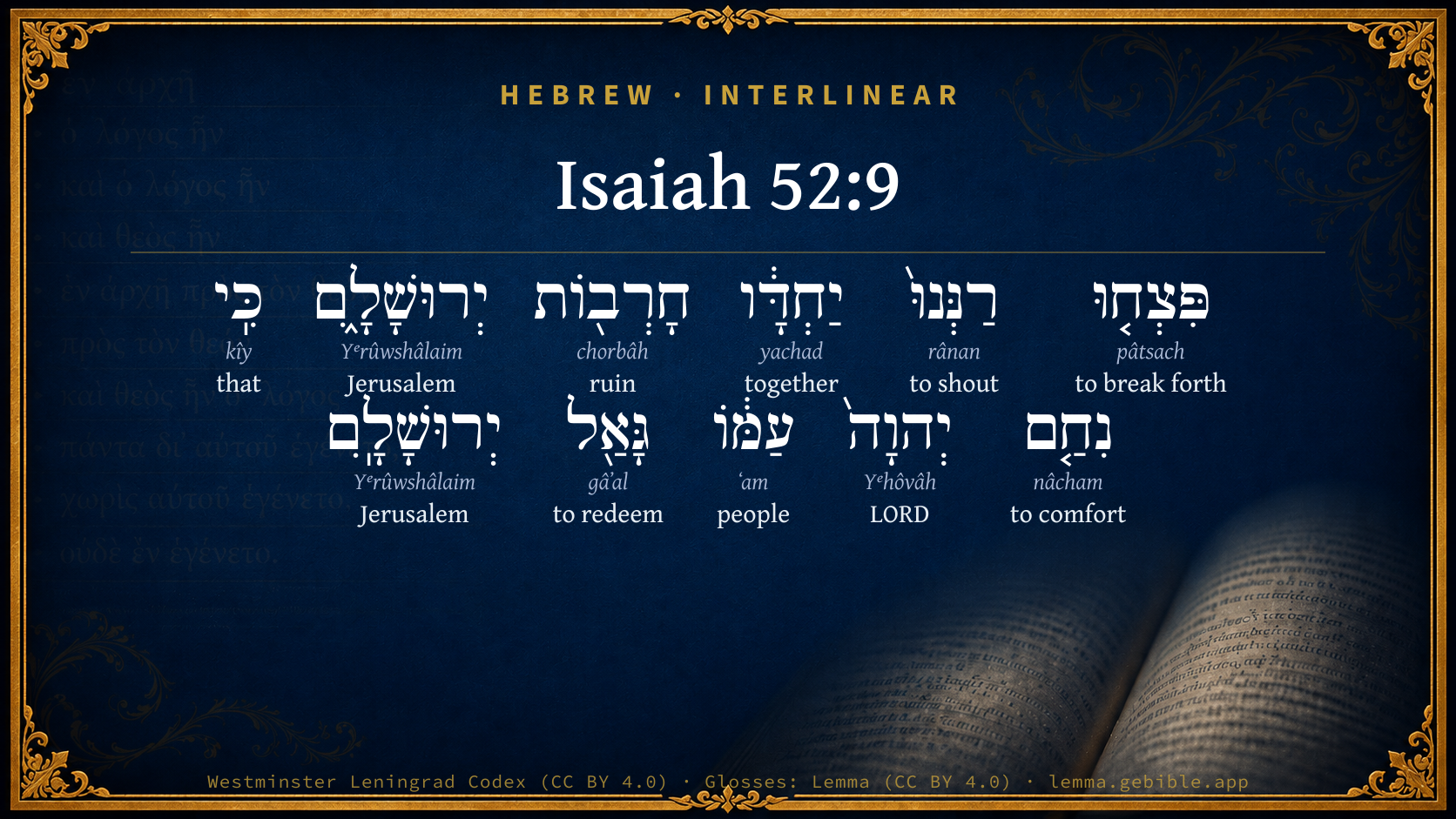
Hebrew (Westminster Leningrad Codex) Isaiah 52:9 appears in the Hebrew Old Testament. The text above is from the Westminster Leningrad Codex. Each word links to its Strong’s number, a concise gloss, and parsing drawn from the Open Scriptures Hebrew Bible morphology. Click any word for its full Brown-Driver-Briggs (BDB) entry.
Download image
Cite this verse

Isaiah 52:9 (World English Bible). Public Domain. Lemma interlinear Bible study tool, https://lemma.gebible.app/v/isaiah/52/9.

Show BibTeX & RIS
BibTeX
RIS
English Translation
Break forth into joy, sing together, you waste places of Jerusalem; for Yahweh has comforted his people, he has redeemed Jerusalem.
World English Bible · Public Domain
Download a study sheet

One document with this verse’s original text, its word-by-word gloss line, the meaning frame, cross-references with their text, attributed commentary, and full source and license credits — printable, and it pastes into notes with its structure intact.

This verse Autodidact and up

Study sheet (.html) Plain text (.txt)

A passage Seminary Student

Up to 50 verses in one chapter. A passage sheet keeps up to 6 commentary sources and 12 cross-references per verse, in the order this page ranks them, and says so on the sheet whenever that leaves anything out. Ask for a single verse and you get the Autodidact verse sheet above.

Everything on this page stays free to read, with no account — the sheet is a download of what is already on screen, not access to it.

Want to remove ads? Support Godless Engineer
Compare translations 3

The same verse in 3 English versions, stacked beneath the original-language interlinear above. Click any original word for its lexicon entry.

Each is an independent rendering of the whole verse — the interlinear is not word-aligned to these translations.

Highlighted words mark where these versions differ — a whole-verse word diff, not a word-by-word alignment.

  • World English Bible Public Domain
    Break forth into joy, sing together, you waste places of Jerusalem; for Yahweh has comforted his people, he has redeemed Jerusalem.
  • King James Version Public Domain
    Break forth into joy, sing together, ye waste places of Jerusalem: for the LORD hath comforted his people, he hath redeemed Jerusalem.
  • unfoldingWord Literal Text CC BY-SA 4.0
    Break forth, sing joyfully together, desolations of Jerusalem, for Yahweh has comforted his people, he has redeemed Jerusalem.

unfoldingWord Literal Text — © unfoldingWord, licensed CC BY-SA 4.0. Word-aligned USFM3 via Door43 (git.door43.org/unfoldingWord/en_ult).

Versions to compare (up to 4)

3 of 4 selected

Show all 18 translations

Every available English version of this verse, each an independent rendering of the whole verse.

  • World English Bible Public Domain
    Break forth into joy, sing together, you waste places of Jerusalem; for Yahweh has comforted his people, he has redeemed Jerusalem.
  • Berean Standard Bible Public Domain
    Break forth in joy, sing together, O ruins of Jerusalem, for the LORD has comforted His people; He has redeemed Jerusalem.
  • Majority Standard Bible Public Domain
    Break forth in joy, sing together, O ruins of Jerusalem, for the LORD has comforted His people; He has redeemed Jerusalem.
  • King James Version Public Domain
    Break forth into joy, sing together, ye waste places of Jerusalem: for the LORD hath comforted his people, he hath redeemed Jerusalem.
  • American Standard Version (1901) Public Domain
    Break forth into joy, sing together, ye waste places of Jerusalem; for Jehovah hath comforted his people, he hath redeemed Jerusalem.
  • Revised Version (1885) Public Domain
    Break forth into joy, sing together, ye waste places of Jerusalem: for the LORD hath comforted his people, he hath redeemed Jerusalem.
  • Geneva Bible (1599) Public Domain
    O ye desolate places of Ierusalem, bee glad and reioyce together: for the Lord hath comforted his people: he hath redeemed Ierusalem.
  • Douay-Rheims (1899) Public Domain
    Rejoice, and give praise together, O ye deserts of Jerusalem: for the Lord hath comforted his people: he hath redeemed Jerusalem.
  • Young's Literal Translation Public Domain
    Break forth, sing together, O wastes of Jerusalem, For Jehovah hath comforted His people, He hath redeemed Jerusalem.
  • Literal Standard Version CC BY-SA 4.0
    Break forth, sing together, || O ruins of Jerusalem, || For YHWH has comforted His people, || He has redeemed Jerusalem.
  • Unlocked Literal Bible CC BY-SA 4.0
    Break out into joyful singing together, you ruins of Jerusalem; for Yahweh has comforted his people; he has redeemed Jerusalem.
  • unfoldingWord Literal Text CC BY-SA 4.0
    Break forth, sing joyfully together, desolations of Jerusalem, for Yahweh has comforted his people, he has redeemed Jerusalem.
  • Darby Bible Public Domain
    Break forth, sing aloud together, waste places of Jerusalem; for Jehovah comforteth his people, he hath redeemed Jerusalem.
  • World Messianic Bible Public Domain
    Break out into joy! Sing together, you waste places of Jerusalem; for the LORD has comforted his people. He has redeemed Jerusalem.
  • Webster's Bible Public Domain
    Break forth into joy, sing together, ye waste places of Jerusalem: for the LORD hath comforted his people, he hath redeemed Jerusalem.
  • Free Bible Version CC BY-SA 4.0
    Let Jerusalem's ruins all sing for joy for the Lord has come to care for his people; he has set Jerusalem free.
  • Bible in Basic English Public Domain
    Give sounds of joy, make melody together, waste places of Jerusalem: for the Lord has given comfort to his people, he has taken up the cause of Jerusalem.
  • JPS Tanakh (1917) Public Domain
    Break forth into joy, sing together, ye waste places of Jerusalem; for the LORD hath comforted His people, He hath redeemed Jerusalem.

Literal Standard Version (2020), Covenant Press — licensed CC BY-SA 4.0. Text via the HelloAO Bible API (eBible.org). Unlocked Literal Bible (unfoldingWord) — licensed CC BY-SA 4.0. Text via the HelloAO Bible API (eBible.org). unfoldingWord Literal Text — © unfoldingWord, licensed CC BY-SA 4.0. Word-aligned USFM3 via Door43 (git.door43.org/unfoldingWord/en_ult). Free Bible Version, Dr. Jonathan Gallagher — licensed CC BY-SA 4.0. Text via the HelloAO Bible API (eBible.org).

Word by word

More ways to search: Search by grammar → Find every occurrence → Compare this word →

Practice this passage: Drill this verse → Learn its vocabulary →

פִּצְח֤וּ
pâtsach
H6476
“break forth”
Verb, Qal, Imperative, 2nd Person, Masculine, Plural
Part of Speech
Verb
Stem
Qal
Form
Imperative
Person
2nd Person
Gender
Masculine
Number
Plural
Full BDB Definition

Origin: a primitive root

TWOT: 1796

to cause to break or burst forth, break forth with, break out - (Qal) to break out, break forth with - (Piel) to break up
  1. רַנְּנוּ֙ rânan H7442 “shout” Verb, Piel, Imperative, 2nd Person, Masculine, Plural
  2. יַחְדָּ֔ו yachad H3162 “together” Adverb
  3. חָרְב֖וֹת chorbâh H2723 “ruins of” Noun, Common, Feminine, Plural, Construct
  4. יְרוּשָׁלִָ֑ם Yᵉrûwshâlaim H3389 “Jerusalem” Noun, Proper
  5. כִּֽי kîy H3588 “that” Conjunction
  6. נִחַ֤ם nâcham H5162 “to comfort” Verb, Piel, Perfect, 3rd Person, Masculine, Singular
  7. יְהוָה֙ Yᵉhôvâh H3068 “LORD” Noun, Proper
  8. עַמּ֔וֹ ʻam H5971 “people · his” Noun, Common, Masculine, Singular, Construct + Suffix, Personal, 3rd Person, Masculine, Singular
  9. גָּאַ֖ל gâʼal H1350 “to redeem” Verb, Qal, Perfect, 3rd Person, Masculine, Singular
  10. יְרוּשָׁלִָֽם Yᵉrûwshâlaim H3389 “Jerusalem” Noun, Proper

About this verse

These counts appear in no published source. They are computed here, from the morphology-tagged text and Lemma’s own curated glosses. What Lemma adds →

11
words
10
distinct lemmas
Prophets
section

Notable vocabulary

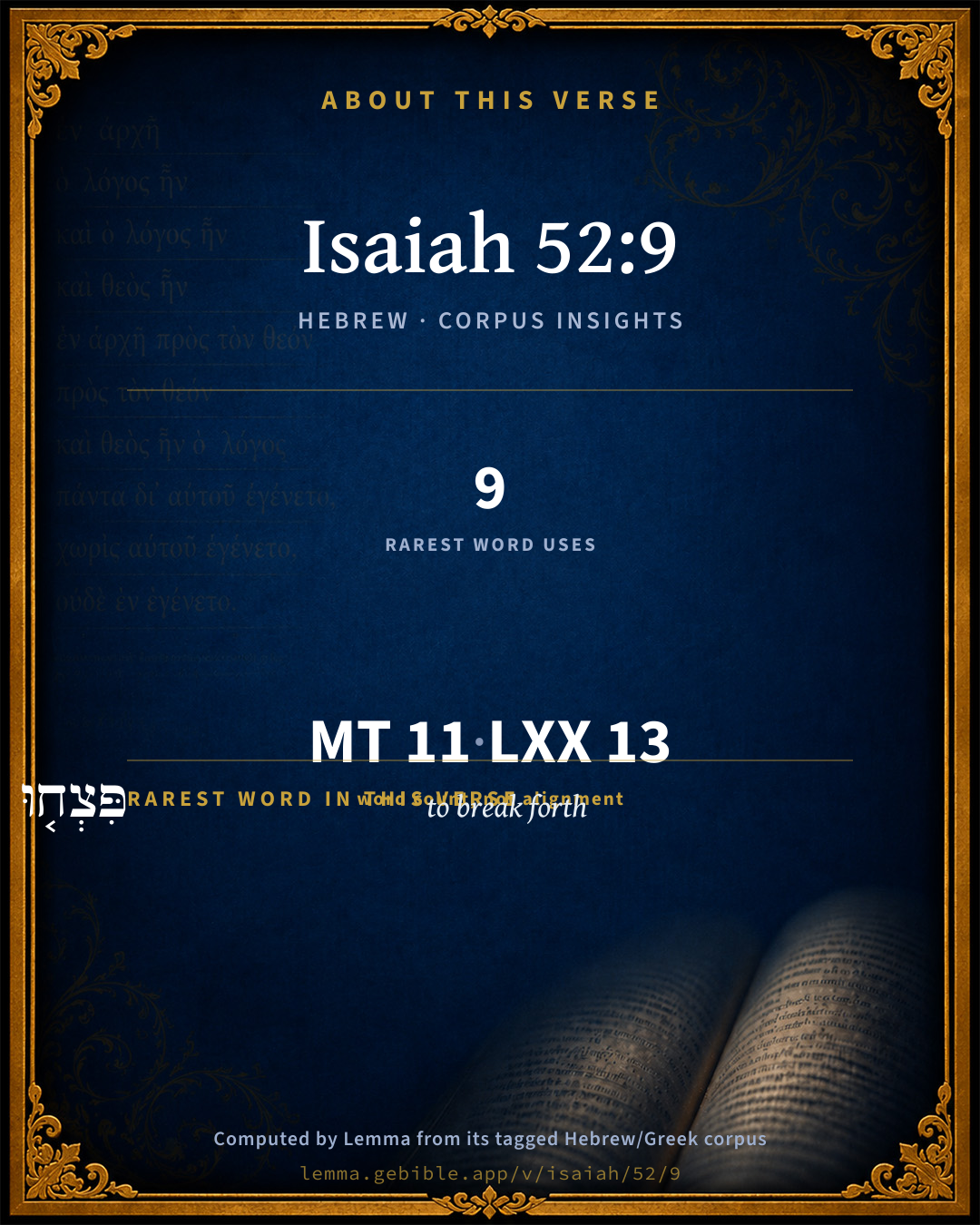
The rarest word here is פִּצְח֤וּ to break forth H6476 — appearing just 9 times in the whole Hebrew Bible.

Shared distinctive vocabulary

פִּצְח֤וּ to break forth H6476 occurs in 8 verses of the Hebrew Bible. Also found in:

Grammatical profile

  • 4 verbs
  • 5 nouns
  • 1 conjunction
  • 1 adverb

Verb forms

  • פִּצְח֤וּ Qal · Imperative
  • רַנְּנוּ֙ Piel · Imperative
  • נִחַ֤ם Piel · Perfect
  • גָּאַ֖ל Qal · Perfect

Repetition

A word recurs within this verse — often emphatic in Hebrew:

  • יְרוּשָׁלִָ֑ם Jerusalem H3389 ×2

Hebrew & Septuagint length

In English translation the verse runs 21 words from the Hebrew and 23 from the Septuagint (LXX English) — closely comparable.

A rough comparison of the two English renderings, which tokenize alike — not a word-level alignment.

Word counts can differ between the Hebrew and the Greek without any difference in meaning — e.g. the Hebrew direct-object marker אֵת has no separate Greek word, and Greek often adds the article ὁ.

In the original languages it is 11 Hebrew tokens and 13 Greek tokens — but the two are counted differently (Hebrew bundles its prefixes and suffixes into one token; the Greek is in lemma form), so that isn’t a like-for-like length.

Cross-references

16

Topical passages linked to Isaiah 52:9 in the Treasury of Scripture Knowledge — connected by theme and wording, ordered by reader-vote popularity; previews shown in the World English Bible.

  • Psalms 98:4 Make a joyful noise to Yahweh, all the earth! Burst out and sing for joy, yes, sing praises!
  • Isaiah 51:3 For Yahweh has comforted Zion; he has comforted all her waste places, and has made her wilderness like Eden, and her desert like the garden of Yahweh; joy and gladness shall be found therein, thanksgiving, and the voice of melody.
  • Isaiah 48:20 Go you forth from Babylon, flee you from the Chaldeans; with a voice of singing declare you, tell this, utter it even to the end of the earth: say you, Yahweh has redeemed his servant Jacob.
  • Psalms 96:11–12 Let the heavens be glad, and let the earth rejoice. Let the sea roar, and it's fullness!
  • Isaiah 14:7 The whole earth is at rest, [and] is quiet: they break forth into singing.
  • Isaiah 42:10–11 Sing to Yahweh a new song, and his praise from the end of the earth; you who go down to the sea, and all that is therein, the isles, and the inhabitants of it.
  • Isaiah 44:23 Sing, you heavens, for Yahweh has done it; shout, you lower parts of the earth; break forth into singing, you mountains, O forest, and every tree therein: for Yahweh has redeemed Jacob, and will glorify himself in Israel.
  • Isaiah 44:26 who confirms the word of his servant, and performs the counsel of his messengers; who says of Jerusalem, She shall be inhabited; and of the cities of Judah, They shall be built, and I will raise up the waste places of it;
  • Isaiah 49:13 Sing, heavens; and be joyful, earth; and break forth into singing, mountains: for Yahweh has comforted his people, and will have compassion on his afflicted.
  • Isaiah 55:12 For you shall go out with joy, and be led forth with peace: the mountains and the hills shall break forth before you into singing; and all the trees of the fields shall clap their hands.
  • Isaiah 61:4 They shall build the old wastes, they shall raise up the former desolations, and they shall repair the waste cities, the desolations of many generations.
  • Zephaniah 3:14–15 Sing, daughter of Zion! Shout, Israel! Be glad and rejoice with all your heart, daughter of Jerusalem.
  • Isaiah 54:1–3 Sing, barren, you who didn't bear; break forth into singing, and cry aloud, you who did not travail with child: for more are the children of the desolate than the children of the married wife, says Yahweh.
  • Isaiah 65:18–19 But be you glad and rejoice forever in that which I create; for, behold, I create Jerusalem a rejoicing, and her people a joy.
  • Isaiah 66:10–13 Rejoice you with Jerusalem, and be glad for her, all you who love her: rejoice for joy with her, all you who mourn over her;
  • Galatians 4:27 For it is written, "Rejoice, you barren who don't bear. Break forth and shout, you that don't travail. For more are the children of the desolate than of her who has a husband."

Cross-references courtesy of OpenBible.info (CC BY 4.0).

Hebrew and Greek witnesses Masoretic Hebrew ↔ Greek Septuagint

The same verse in the two great witnesses to the Old Testament, shown verse-for-verse.

These are two independent witnesses, not word-aligned to each other, and the Septuagint is shown in lemma (dictionary) form.

Hebrew Isaiah 52:9 Masoretic · Westminster Leningrad Codex

פִּצְח֤וּ רַנְּנוּ֙ יַחְדָּ֔ו חָרְב֖וֹת יְרוּשָׁלִָ֑ם כִּֽי נִחַ֤ם יְהוָה֙ עַמּ֔וֹ גָּאַ֖ל יְרוּשָׁלִָֽם

Break forth into joy, sing together, you waste places of Jerusalem; for Yahweh has comforted his people, he has redeemed Jerusalem.

World English Bible · Public Domain

Greek LXX Isaiah 52:9 Septuagint · lemma form

ῥήγνυμι εὐφροσύνη ἅμα ὁ ἔρημος ἰερουσαλήμ ὅτι ἐλεέω κύριος αὐτός καί ῥύομαι ἰερουσαλήμ

Let the waste places of Jerusalem break forth in joy together, because the Lord has had mercy upon her, and has delivered Jerusalem.

LXX2012 (modern English Septuagint) · Public Domain

Hebrew: Westminster Leningrad Codex (CC BY 4.0). Greek: Septuagint (public domain); English from LXX2012 (modern English Septuagint) (Public Domain). How the Septuagint differs from the Hebrew →

Targum (Aramaic paraphrase)

1

The Targum is the ancient Jewish Aramaic paraphrase of the Hebrew Scriptures — an interpretive translation, not the Hebrew text itself. Onkelos (literal) and Pseudo-Jonathan (expansive) render the Torah, and Jonathan the Prophets. Coverage is partial: where no permissively-licensed English translation exists for a verse, only the Aramaic is shown. This is verse-level text, not a word-by-word alignment to the Hebrew.

  1. Targum Jonathan Prophets (Joshua–Malachi)
    בּוּעוּ וְשַׁבַּחוּ כַּחֲדָא חָרְבַת יְרוּשְׁלֵם אֲרֵי עֲתִיד יְיָ לְנַחְמָא עַמֵהּ פָּרִיק יְרוּשְׁלֶם:

    Rejoice and shout together, ye desolate places of Jerusalem, for the Lord shall comfort His people, Jerusalem shall be redeemed.

    Targum Jonathan — Aramaic: “Mikraot Gedolot” (public domain). English: “Sefaria Community Translation” (CC0 1.0 (public-domain dedication)); “London "Chaldee Paraphrase," 1871” (public domain). Text via Sefaria.

Commentary

Notes on Isaiah 52:9 from classic Christian and Jewish commentators (each source and its license shown beneath its notes). The classic Christian expositions comment on the surrounding passage and are grouped to its opening verse, so a note may address several verses; the Jewish commentaries on the Tanakh (Rashi and others) are per-verse, so they appear only where the commentator wrote on this verse.

Lemma curates 59 commentaries, every one of them public domain or Creative Commons licensed, each selected and text-cleaned for this edition rather than reprinted as found. About our sources →

Trapp's Complete Commentary

John Trapp

Isa 52:9 Break forth into joy, sing together, ye waste places of Jerusalem: for the LORD hath comforted his people, he hath redeemed Jerusalem.

Ver. 9. Break forth into joy.] This is the subject matter of gospel ministers’ discourses: they shall call upon God’s people to rejoice, {Isa 52:9-10} and to repent, {Isa 52:11-12} and shall show them that it is as well a sin not to rejoice as not to repent.

John Trapp, A Commentary or Exposition upon All the Books of the Old and New Testament (1647–1656) — public domain. Text from a community e-Sword module.

The Biblical Illustrator

Joseph S. Exell

Isa_52:9-10

Break forth into joy

The return of the Jewish nation

I.

CONSIDER CERTAIN CHANGES WHICH SHALL HAVE TAKEN PLACE AMONG THE GENTILES OF CHRISTENDOM, AT, OR ABOUT, THE ESTABLISHMENT OF

THE JEWISH NATION IN THEIR OWN LAND (Mat_13:24-30). The signal destruction of all false, hypocritical, unbelieving professors of religion, here called the children of the wicked one or the tares; and, secondly, the gathering in of the elect members of Christs mystical body, or the gathering of the wheat into the barn.

II. THE BLESSING WHICH THE JEWISH NATION WILL PROVE TO ALL THE PEOPLE OF THE EARTH. It appears that the plan and purpose of God, as revealed in His Word, is, after having finished the dispensation of the Gentiles as He finished the dispensation of the Jews, and having concluded all in unbelief, the period will then arrive when, according to the language of Paul, He will have mercy upon all.

III. THE NATURE AND DURATION OF THIS BLESSING.

1. As to the nature of the blessing. This is nothing more nor less than a true and saving conversion, terminating in salvation. Not a bringing of them back to the state in which Adam was before his fall; not a grafting them into the mystical body of Christ; but a true, a sound conversion from all that is evil, and the full enjoyment of God s great salvation.

2. As to the duration of this blessing. With reference to converted individuals the effect will be eternal: but there will be a limit to this state of things as to the nations of the earth. (H. McNeile, M. A.)

Matter for joy and praise

Those that share in mercies ought to join in praises. Here is matter for joy and praise.

I. GODS PEOPLE WILL HAVE THE COMFORT OF THIS SALVATION; and what is the matter of our rejoicing ought to be the matter of our thanksgiving.

II. GOD WILL HAVE THE GLORY OF IT (Isa_52:10).

III. ALL THE WORLD WILL HAVE THE BENEFIT OF IT. All the ends of the earth, etc. (M. Henry.)

The Biblical Illustrator, edited by Joseph S. Exell (c. 1880s–1900s) — public domain. Text from a community e-Sword module.

Joseph Benson's Commentary

Isa 52:9-10. Break forth into joy — Break forth in joyful praises; ye waste places of Jerusalem — That is, all parts of Jerusalem, for it was all in ruins, and all parts of Judea, which lay desolate and waste during the captivity: an emblem of the desolate and barren state of the church when the Lord, for her sins, withdraws his presence from her. For the Lord hath comforted his people, &c. — They shall be restored to their former prosperity, and in the days of the Messiah to a far greater degree of holiness and happiness than the church of God ever before possessed. The Lord hath made bare his holy arm — Hath discovered and put forth his great power, which, for a long time, did not appear to be exerted in behalf of his people. And all the ends of the earth shall see the salvation of our God — All nations of the world shall, with astonishment, behold the wonderful work of God; first, in bringing his people out of Babylon; and afterward, in their redemption by Christ.

Joseph Benson's Commentary on the Old and New Testaments (1811–1818) — public domain. Text from a community e-Sword module.

The Preacher's Complete Homiletical Commentary

Joseph S. Exell (gen. ed.)

COMFORT IN TROUBLE

Isa_51:3; Isa_51:12, and Isa_52:9. For the Lord shall comfort Zion, &c.

The prophecy is addressed to those who are striving after the right kind of life and seeking Jehovah, and not turning from Him to make earthly things and themselves the object of their pursuits; for such only are in a condition by faith to regard that as possible, which seems impossible to human understanding, because the very opposite is lying before the eye of the senses (Delitzsch).

I. The people of God often stand in urgent need of Divine comfort. They not only have their full share of the sorrows which are common to humanity, but they have troubles to which the people of the world are strangers. Hence we are told that “many are the afflictions of the righteous,” &c. The Saviour prepared His people for this: “In the world,” &c., “Whosoever will be my disciple,” &c The people of God have to fight every inch of their way to heaven: “These are they,” &c. Their chief sorrows spring from sources unknown to and incomprehensible by the world. They are soul sorrows, having their origin in the vivid views which they have of the evil of sin, and of their own individual guilt in the sight of God, &c. Sometimes they fear that after all they shall never reach the celestial Canaan. Therefore they have the need of all the comfort which can be given them on the way to heaven. (See pp. 2, 4, 386; cf. Rom_7:22-24; Gal_5:17; Gal_4:29; Rom_8:36; 2Co_4:8-14; 2Ti_3:12; Psa_88:18; Pro_17:1; Isa_38:14-15; 2Ti_4:10; 2Ti_4:16; Psa_51:5-8; 2Co_7:5.)

II. It is God’s will that His people should to comforted amid all their tribulations. “See how God resolves to comfort His people: ‘I, even I, will do it.’ He had ordered His ministers to do it (Isa_40:1), but because they cannot reach the heart, He takes the work into His own hands. See how He glories in it; He takes it among the titles of His honour to be “the God that comforteth them that are cast down;” He delights in being so (M. Henry). Because He would have His people happy. His people should remember this, and cultivate the spirit of Christian cheerfulness, because,

1. Uncomfortable Christians often dishonour the Lord.

2. Uncomfortable Christians cannot be as diligent as they ought to be in the duties of religion. Working out their own salvation. Working for God in seeking to save others (Psa_51:12-13; P. D. 450–453).

III. The bestowment of Divine comfort inspires them with grateful and exultant joy (Isa_51:12; Isa_52:9). “Where there is joy and gladness to their satisfaction, it is fit there should be thanksgiving to God’s honour; for whatever is the matter of their rejoicing, ought to be the matter of their thanksgiving, and the returns of God’s favour ought to be celebrated with the voice of melody; which will be the more melodious when God gives songs in the night, songs in the desert” (M. Henry).

There may be elevated joy in the midst of deep affliction (Rom_5:3; Php_3:1; Php_4:4, &c.) Eleven of the thirteen epistles of Paul begin with exclamations of praise and thanksgiving (2Co_1:3-4). Take to praising God under all circumstances, and thus you will lift your soul right out of your sorrow, and taste the pleasures of immortality. “In everything give thanks.” Let this be your constant occupation. He well deserves our warmest praise.

CONCLUSION:

1. The duty and privilege of believers to seek Divine comfort. God has given us express assurances that it is His purpose that His people should have ample and unceasing comfort amid all their sorrows and sufferings (Isa_40:1; Isa_51:3; Isa_51:12; Php_3:1; Php_4:4). Most ungracious on our part not readily and gladly to receive the comfort so provided. To refuse to be comforted, is to be guilty of a frustration of the merciful purposes of God towards us.

2. The duty and privilege of comforted believers to comfort others. God comforts you, that you may comfort others—that He may use you as comforters. Experimental knowledge helps us to speak with authority and power—fits us to be able and ready comforters. What we have received we must give (2Co_1:3-4).—Alfred Tucker.

God will give His people, I. Consolation. II. Fruitfulness. III. Gladness—J. E. Page.

PARADISE RESTORED

Isa_51:3. For the Lord shall comfort Zion, &c.

The Church is a garden planted by the Lord, luxuriant in beauty and fruitfulness, and filled with happy occupants. The promise is as yet only in process of fulfilment; and that we may look more clearly into the future, we are called to look into the past. Eden was the garden of the Lord, the primeval paradise, the place of consummate beauty and happiness, ere sin had blighted its joys and stained its purity. To make Zion like Eden is to bring back the vanished glories of that happy place. To the extent that this is accomplished, the Church is—

I. A PLACE OF DIVINE COMFORT AND FELLOWSHIP. No sooner do we press in by faith, through Christ, the door, than we enjoy the comforts of Divine love, and are admitted to heavenly fellowships (Heb_6:18). Did Adam hear the voice of the Lord God? Here the intercourse is renewed. Life conducts through an Eden radiant with the Divine presence. What a change since the day when the Lord drove forth the man from Eden! That door has been again unbarred, and Christ has secured for us a welcome into a fairer paradise than that then was lost. The Church is “a habitation of God.” Enter, then, and you will enjoy this rich comfort and lofty fellowship. So long as you stand outside, you cannot know the beauties of the garden; you cannot survey its landscapes, nor breathe its perfumes. God has not disowned and forsaken this fallen world: it is not, as we might have expected, desolated by His wrath: we can still find an Eden in it—a garden of God’s presence and favour.

II. A PLACE OF HELPFUL SOCIAL LIFE. Such was the life of the first pair, and such would have been the life of their children, but for the entrance of sin. Alas, how that fact has altered the course of human history! What jarring discords in our domestic and social life! But if the Church is to be as Eden, human society will be regenerated: the love, peace, and helpful companionship that were found in the garden of the Lord will be restored, when this promise is accomplished to the full. The Church will yet leaven society with her principles of brotherly love and mutual help. The world around is like a wilderness, where the wild plants of nature grow in rank profusion. But God has engaged to reclaim Zion’s waste places. This garden is ever extending its walls, and will do so till the whole earth becomes an Eden.

III. A PLACE OF JOY. “Joy and gladness shall be found therein.” No jarring strife shall mar its harmony: love to God and to each other shall reign among the happy inmates of the restored Paradise. We naturally think of a garden as a place of joy. Surrounded by all that is fair and peaceful, the mind depressed by trial is relieved by the cheerful notes of the birds, the luxuriance of the foliage, and the forms and hues of the flowers. The Church of Christ is such a garden, in which we taste joys unknown by the world. “The fruit of the Spirit is joy,”—the joy of sin forgiven and heaven secured,—the joy of communion with Christ, and assurance of His love—the joy of mutual endearment and mutual service. What joy can surpass that which is the heritage of all who dwell within this happy inclosure?

IV. A SCENE OF WORSHIP. There shall be found therein “thanksgiving and the voice of melody.” What a delightful exercise is that of praise! What a happy garden, ever jubilant with sacred song!

These, then, are the features of this garden of the Church. Not on earth can we behold them in all their perfection. The earthly paradise, reopened to us by Christ, will soon become the heavenly paradise (Rev_2:7; Rev_22:1-2). May we all at last become inmates of the Eden above, the paradise of beauty and splendour, the abode of love and joy and worship unending!—William Guthrie, M.A.

The Preacher's Complete Homiletical Commentary (gen. ed. Joseph S. Exell; Funk & Wagnalls, c. 1892) — public domain (pre-1929). A full-Bible homiletical/sermon-outline anthology covering 65 of 66 books (2 John is absent from the source module). Text from a community e-Sword module.

Jamieson, Fausset & Brown

Robert Jamieson, A. R. Fausset & David Brown

(Isa 14:7-8; Isa 42:11).

redeemed--spiritually and nationally (Isa 48:20).

Jamieson, Fausset & Brown — Commentary Critical and Explanatory on the Whole Bible (1871) — public domain (CC PDM 1.0). Text via the HelloAO Bible API.

Adam Clarke's Commentary

Verse 9. He hath redeemed Jerusalem - "He hath redeemed Israel."] For the word ירושלם yerushalaim, which occurs the second time in this verse, MS. Bodleian and another read ישראל yisrael. It is upon a rasure in a third; and left unpointed at first, as suspected, in a fourth. It was an easy mistake, by the transcriber casting his eye on the line above: and the propriety of the correction, both in regard to sense and elegance, is evident.

Adam Clarke's Commentary on the Bible (1810–1826) — public domain. Text from a community e-Sword/MySword module.

Ellicott's Commentary for English Readers

(9) Ye waste places of Jerusalem . . .—The history of the return of the exiles in Ezra 1, 3, seems a somewhat poor and prosaic fulfilment of the glorious vision; but it lies in the nature of the case, that the words of the prophet, contemplating the distant future, idealise that return, and connect it unconsciously, it may be, with another city than the earthly Jerusalem.

A Bible Commentary for English Readers, edited by Charles John Ellicott (1878–1897) — public domain. Text from a community e-Sword module.

The Cambridge Bible for Schools and Colleges

gen. ed. J. J. S. Perowne

9. Break forth into joy, sing …] Render, Break forth into singing (lit. “Break forth, sing”). Cf. Isa_44:23.

the Lord hath comforted his people] Isa_51:3.

The Cambridge Bible for Schools and Colleges (gen. ed. J. J. S. Perowne; Cambridge University Press, 1878–1918) — public domain. Text from a community e-Sword module.

John Gill's Exposition

Break forth into joy, sing together, ye waste places of Jerusalem,.... This is what the watchmen shall say when they lift up their voice; this will be one part of their song, and the intent of it; to observe to the members of the churches, which shall be constituted in those parts which were formerly barren and desolate, what wonderful things the Lord has done in bringing again Zion; in building up the ruins of it; in the clear light of the Gospel he has caused to break forth, and in the good tidings of peace and salvation published; on account of all which they are called upon to express the greatest joy in a social manner, with the utmost unanimity, as having everyone a concern therein:

for the Lord hath comforted his people; with his divine presence, and the light of his countenance; with the discoveries of his love; with the joys of his salvation by Christ; with the comforts of his Spirit; with the doctrines of the Gospel, and the exceeding great and precious promises of it; with the ordinances of his house, those breasts of consolation; and by enlarging his kingdom and interest with the conversion of Jews and Gentiles; and particularly by the donation and application of the various blessings of grace through Christ, and especially that which follows:

he hath redeemed Jerusalem; the same with his people, particularly the Jews, now converted; who will have the blessing of redemption, obtained by the Messiah, made known and applied unto them; which will be matter of comfort to them: as it is to all sensible sinners, who see themselves lost and undone; liable to the wrath of God, and curses of the law; under a sentence of condemnation; the captives of sin and Satan, and prisoners of law and justice; unable to redeem themselves, or any creature capable of giving a ransom for them.

John Gill's Exposition of the Whole Bible (1746–1763) — public domain (CC PDM 1.0). Text via the HelloAO Bible API.

Albert Barnes' Notes on the Bible

Break forth into joy - Jerusalem, at the time here referred to, was lying waste and in ruins. This call on the waste places of Jerusalem to break out into expressions of praise, is in accordance with a style which frequently occurs in Isaiah, and in other sacred writers, by which inanimate objects are called on to manifest their joy (see the notes at Isa 14:7-8; Isa 42:11).

For the Lord hath comforted his people - That is, he does comfort his people, and redeem them. This is seen by the prophet in vision, and to his view it is represented as if it were passing before his eyes.

He hath redeemed Jerusalem - On the meaning of the word ‘redeemed,’ see the notes at Isa 43:1-3. The idea here is, that Yahweh was about to restore his people from their long captivity, and again to cause Jerusalem to be rebuilt.

Albert Barnes' Notes on the Bible (1834–1885) — public domain. Text from a community e-Sword/MySword module.

Matthew Poole's English Annotations

For you shall be restored unto your former and a far greater fertility.

Matthew Poole's English Annotations on the Holy Bible (1683–1685) — public domain. Text from a community e-Sword/MySword module.

Whedon's Commentary on the Bible

Daniel D. Whedon

9. Break forth into joy, sing — The scene again shifts. Zion is restored. Her exiles are home again. They are bid to break forth into joyful song, because what has been heretofore a word of consolation is now an act of consolation; and jubilee shouting is now the appropriate thing.

Daniel D. Whedon (gen. ed.), Commentary on the Old and New Testaments (1874–1909) — public domain. Text from a community e-Sword module.

The Pulpit Commentary

Ye waste places of Jerusalem. (comp. Isa_44:26 Isa_49:19 Isa_64:10, Isa_64:11) The city had not been wholly destroyed. Only the temple, the royal palace, and the houses of the nobles had been "burnt with fire". (2Ki_25:9 2Ch_36:19) The poorer houses had been left. Even these, however, must in the space of fifty years have for the most part fallen into decay. The ruins are now called upon to join in the general chorus of rejoicing, as they rise from their ashes. Hath comforted... hath redeemed. Perfects of prophetic certitude.

The Pulpit Commentary (1880–1919), ed. H.D.M. Spence-Jones & Joseph S. Exell — public domain. Text from a community e-Sword module.

Keil & Delitzsch

C. F. Keil & F. Delitzsch

Zion is restored, inasmuch as Jehovah turns away her misery, brings back her exiles, and causes the holy city to rise again from her ruins. "Break out into exultation, sing together, ye ruins of Jerusalem: for Jehovah hath comforted His people, He hath redeemed Jerusalem." Because the word of consolation has become an act of consolation, i.e., of redemption, the ruins of Jerusalem are to break out into jubilant shouting as they rise again from the ground.

Keil & Delitzsch — Biblical Commentary on the Old Testament (1861–1891) — public domain (CC PDM 1.0). Text via the HelloAO Bible API. (Old Testament only.)

J. A. Alexander on Isaiah

Joseph Addison Alexander

“Burst forth, shout together, ruins of Jerusalem! For Jehovah hath comforted his people, hath redeemed Jerusalem.” The phrase to ‘burst forth into shouting’, is a favorite expression with Isaiah (see above, Isa 14:7; Isa 44:23; Isa 49:13, and below, Isa 54:1; Isa 55:12); but in this case the qualifying noun is exchanged for its verbal root, a combination which occurs elsewhere only in Psa 98:4. As this word is never used in any other connection, and therefore denotes only this one kind of bursting, it may be considered as involving the idea of the whole phrase, and is so translated in the English Version (break forth into joy.) ‘Together’ may either mean ‘all of you’, or ‘at the same time’ with the watchmen mentioned in v. 8. Such appeals to inanimate objects are of frequent occurrence in Isaiah. (See above, Isa 44:23; Isa 49:13, and below, Isa 55:12) The translation of the verbs in the last clause as presents is unnecessary and enfeebling, as it takes away the strong assurance always conveyed by the prateritum propheticum. See above, on Isa 49:13.

Joseph Addison Alexander, The Prophecies of Isaiah (1846–1847; New York: Scribner, 1870–1878) — public domain. Text from a community e-Sword module.

unfoldingWord translationNotes

Door43 World Missions Community

General Information:

Isaiah continues speaking to the people of Israel.

you ruins of Jerusalem

Isaiah speaks of the ruins of Jerusalem as if they were a person that could rejoice. This represents the people of Jerusalem who were defeated. AT: "you people who live among the ruins of Jerusalem" (See: Personification)

he has redeemed Jerusalem

Here "Jerusalem" represents the people. AT: "he has redeemed the people of Jerusalem" (See: Metonymy)

bared his holy arm

Here "arm" represents Yahweh's power. Yahweh showing all the people of the nations that he is holy and powerful is spoken of as if Yahweh were a warrior who removed his cloak, baring his arms for battle. AT: "showed his holiness and mighty power" (See: Metonymy and Metaphor)

all the nations; all the earth

Here "nations" and "earth" represent the people of all the nations all over the earth. (See: Metonymy)

translationWords

joy

ruin

Jerusalem

Yahweh

comfort

people of God

redeem

holy

nation

earth

save

God

unfoldingWord translationNotes — © Distant Shores Media and the Door43 World Missions Community, licensed CC BY-SA 4.0. Source: git.door43.org/Door43/en_tn.

Ibn Ezra

Rabbi Abraham ibn Ezra

פצחו Break forth. A poetical expression for speak. The word has the same meaning in Arabic.

Ibn Ezra on the Tanakh — English translations: “Sefaria Community Translation” (CC0 1.0 (public-domain dedication)); “Yalkut, Sifsei Chachomim Chumash, Metsudah Publications, 2009” (CC BY 4.0); and “Commentary of Ibn Ezra on Isaiah - trans. by M. Friedlander, 1873” (public domain). Text via Sefaria.

Lesson kit

Teaching starters — assembled from the data on this page, not authored interpretation. Every prompt links to the verse data it draws on. Edit before teaching.

Isaiah, in the Prophets, opens this verse with 11 words (10 distinct Hebrew lemmas). Its most distinctive word is pâtsach (“to break forth”). A historical commentator’s framing appears above. Read the whole chapter for the surrounding context.

Discussion questions

  1. What does “to break forth” (pâtsach) contribute to the verse as a whole?
  2. How does Psalms 98:4, which shares the word «to break forth», read alongside this verse?
  3. What does the repetition of “Jerusalem” (2× in this one verse) do in this verse?
  4. The translations on this page render this verse differently — a whole-verse word diff, not a word-by-word alignment. What might account for the different wordings?
  5. «פִּצְח֤וּ» is a Qal Imperative verb. How does that grammatical form shape the action described?
  6. Compare how Trapp's Complete Commentary and The Biblical Illustrator read this verse. Where do they agree or differ?

Things to notice

Reading settings

Reading text

Shown beneath each verse's original-language words.

Old Testament
Old Testament edition

Read the OT as the Masoretic Hebrew (MT) or the Greek Septuagint (LXX).

English shown for the Greek Septuagint (in the Hebrew ↔ Greek comparison).

Comparing translations? Open the Compare panel on any verse page to stack up to four side by side.