
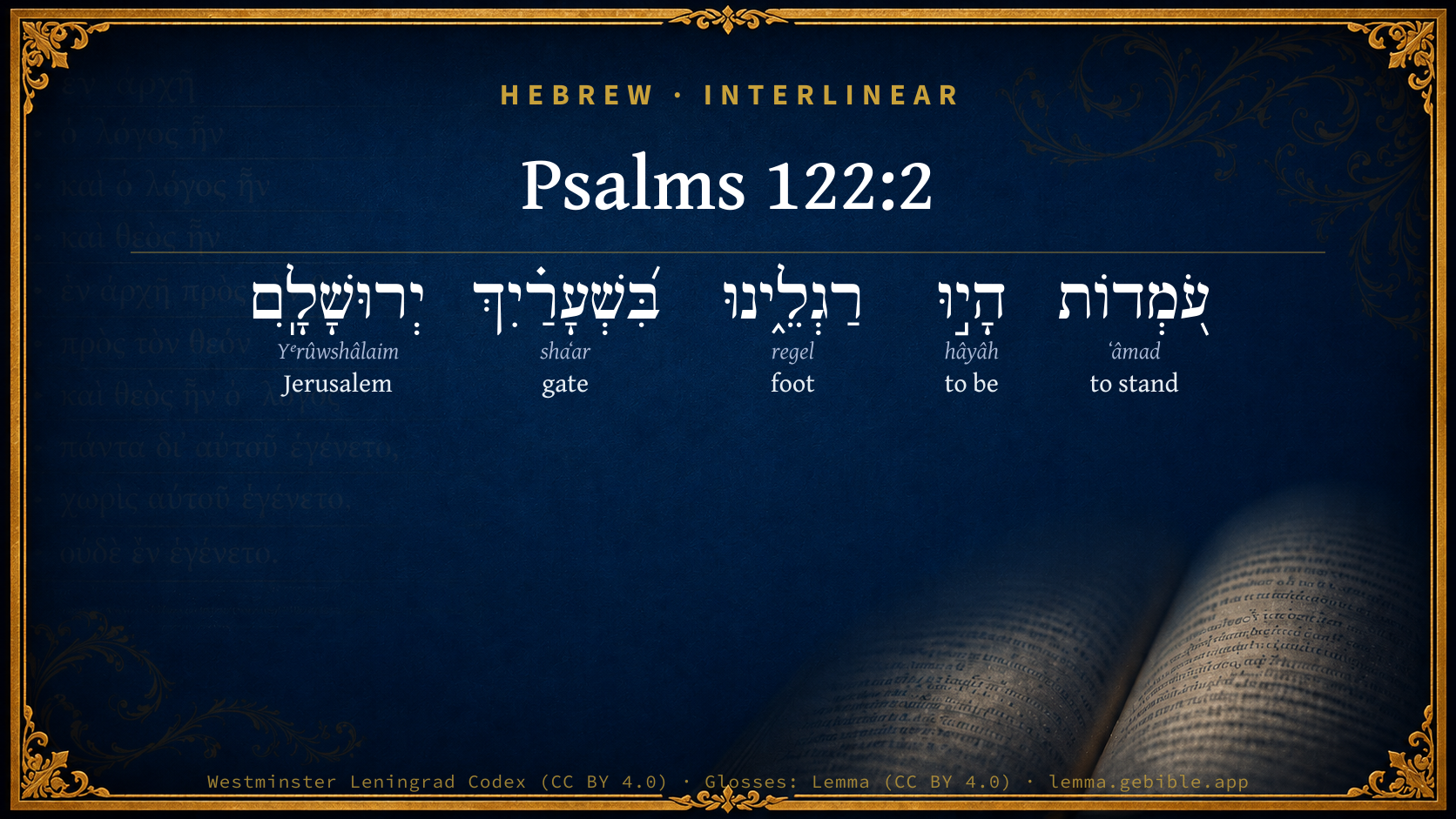
Psalms 122:2

Hebrew (Westminster Leningrad Codex) Psalms 122:2 appears in the Hebrew Old Testament. The text above is from the Westminster Leningrad Codex. Each word links to its Strong’s number, a concise gloss, and parsing drawn from the Open Scriptures Hebrew Bible morphology. Click any word for its full Brown-Driver-Briggs (BDB) entry.
Download image
Cite this verse

Psalms 122:2 (World English Bible). Public Domain. Lemma interlinear Bible study tool, https://lemma.gebible.app/v/psalms/122/2.

Show BibTeX & RIS
BibTeX
RIS
English Translation
Our feet are standing within your gates, Jerusalem;
World English Bible · Public Domain
Download a study sheet

One document with this verse’s original text, its word-by-word gloss line, the meaning frame, cross-references with their text, attributed commentary, and full source and license credits — printable, and it pastes into notes with its structure intact.

This verse Autodidact and up

Study sheet (.html) Plain text (.txt)

A passage Seminary Student

Up to 50 verses in one chapter. A passage sheet keeps up to 6 commentary sources and 12 cross-references per verse, in the order this page ranks them, and says so on the sheet whenever that leaves anything out. Ask for a single verse and you get the Autodidact verse sheet above.

Everything on this page stays free to read, with no account — the sheet is a download of what is already on screen, not access to it.

Want to remove ads? Support Godless Engineer
Compare translations 3

The same verse in 3 English versions, stacked beneath the original-language interlinear above. Click any original word for its lexicon entry.

Each is an independent rendering of the whole verse — the interlinear is not word-aligned to these translations.

Highlighted words mark where these versions differ — a whole-verse word diff, not a word-by-word alignment.

  • World English Bible Public Domain
    Our feet are standing within your gates, Jerusalem;
  • King James Version Public Domain
    Our feet shall stand within thy gates, O Jerusalem.
  • unfoldingWord Literal Text CC BY-SA 4.0
    Our feet are standing in your gates, Jerusalem.

unfoldingWord Literal Text — © unfoldingWord, licensed CC BY-SA 4.0. Word-aligned USFM3 via Door43 (git.door43.org/unfoldingWord/en_ult).

Versions to compare (up to 4)

3 of 4 selected

Show all 18 translations

Every available English version of this verse, each an independent rendering of the whole verse.

  • World English Bible Public Domain
    Our feet are standing within your gates, Jerusalem;
  • Berean Standard Bible Public Domain
    Our feet are standing in your gates, O Jerusalem.
  • Majority Standard Bible Public Domain
    Our feet are standing in your gates, O Jerusalem.
  • King James Version Public Domain
    Our feet shall stand within thy gates, O Jerusalem.
  • American Standard Version (1901) Public Domain
    Our feet are standing Within thy gates, O Jerusalem,
  • Revised Version (1885) Public Domain
    Our feet are standing within thy gates, O Jerusalem;
  • Geneva Bible (1599) Public Domain
    Our feete shall stand in thy gates, O Ierusalem.
  • Douay-Rheims (1899) Public Domain
    My help is from the Lord, who made heaven and earth.
  • Young's Literal Translation Public Domain
    Our feet have been standing in thy gates, O Jerusalem!
  • Literal Standard Version CC BY-SA 4.0
    Our feet have been standing in your gates, O Jerusalem!
  • Unlocked Literal Bible CC BY-SA 4.0
    Jerusalem, our feet are standing within your gates!
  • unfoldingWord Literal Text CC BY-SA 4.0
    Our feet are standing in your gates, Jerusalem.
  • Darby Bible Public Domain
    Our feet shall stand within thy gates, O Jerusalem.
  • World Messianic Bible Public Domain
    Our feet are standing within your gates, Jerusalem!
  • Webster's Bible Public Domain
    Our feet shall stand within thy gates, O Jerusalem.
  • Free Bible Version CC BY-SA 4.0
    Now we're standing inside your gates, Jerusalem!
  • Bible in Basic English Public Domain
    At last our feet were inside your doors, O Jerusalem.
  • JPS Tanakh (1917) Public Domain
    Our feet are standing within thy gates, O Jerusalem;

Literal Standard Version (2020), Covenant Press — licensed CC BY-SA 4.0. Text via the HelloAO Bible API (eBible.org). Unlocked Literal Bible (unfoldingWord) — licensed CC BY-SA 4.0. Text via the HelloAO Bible API (eBible.org). unfoldingWord Literal Text — © unfoldingWord, licensed CC BY-SA 4.0. Word-aligned USFM3 via Door43 (git.door43.org/unfoldingWord/en_ult). Free Bible Version, Dr. Jonathan Gallagher — licensed CC BY-SA 4.0. Text via the HelloAO Bible API (eBible.org).

Word by word

More ways to search: Search by grammar → Find every occurrence → Compare this word →

Practice this passage: Drill this verse → Learn its vocabulary →

About this verse

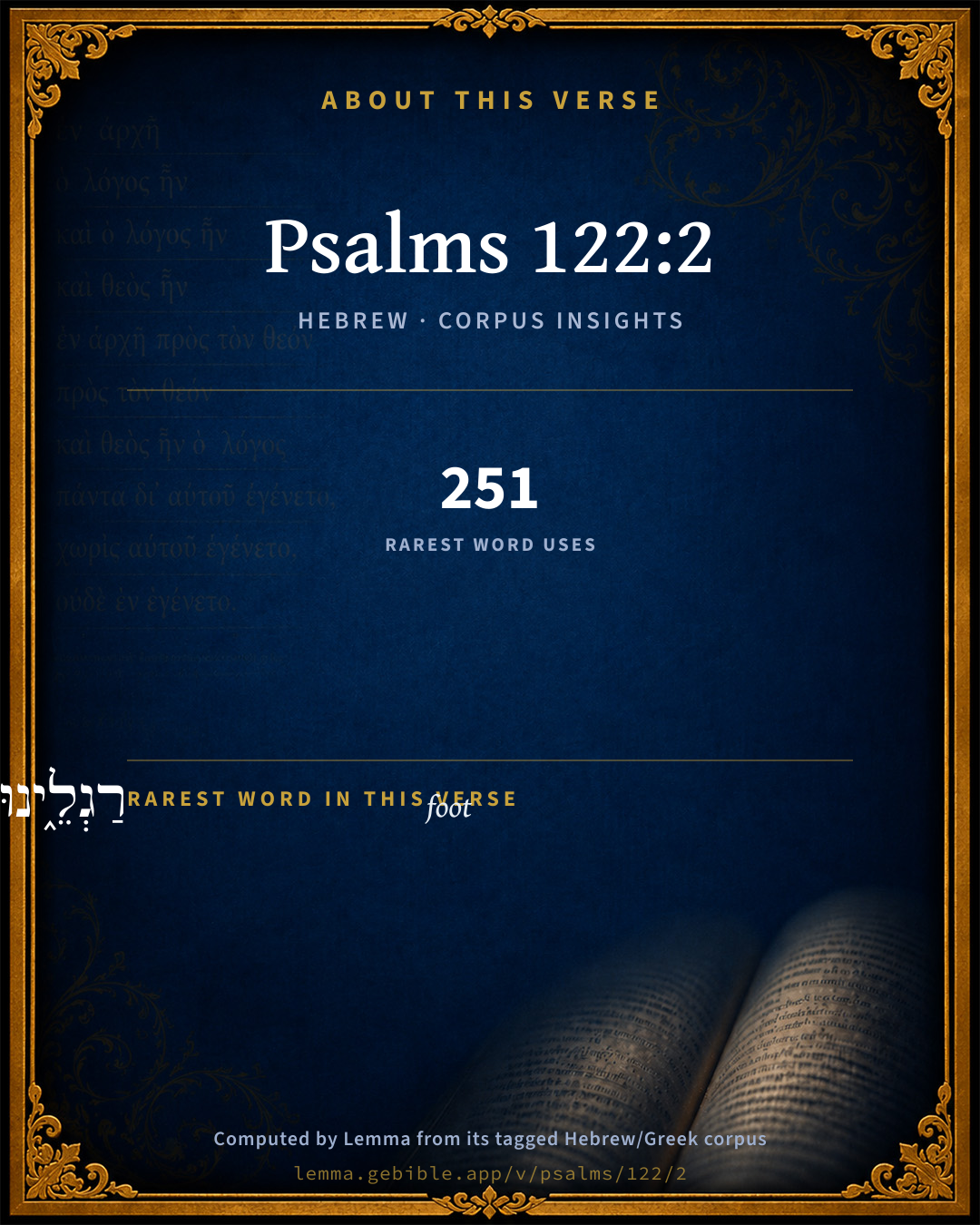
These counts appear in no published source. They are computed here, from the morphology-tagged text and Lemma’s own curated glosses. What Lemma adds →

5
words
5
distinct lemmas
Wisdom
section

Grammatical profile

  • 2 verbs
  • 3 nouns

Verb forms

  • עֹ֭מְדוֹת Qal · Participle Active
  • הָי֣וּ Qal · Perfect

Hebrew & Septuagint length

In English translation the verse runs 8 words from the Hebrew and 8 from the Septuagint (LXX English) — the same length.

A rough comparison of the two English renderings, which tokenize alike — not a word-level alignment.

Word counts can differ between the Hebrew and the Greek without any difference in meaning — e.g. the Hebrew direct-object marker אֵת has no separate Greek word, and Greek often adds the article ὁ.

Cross-references

5

Topical passages linked to Psalms 122:2 in the Treasury of Scripture Knowledge — connected by theme and wording, ordered by reader-vote popularity; previews shown in the World English Bible.

  • Psalms 84:7 They go from strength to strength. Everyone of them appears before God in Zion.
  • Psalms 100:4 Enter into his gates with thanksgiving, Into his courts with praise. Give thanks to him, and bless his name.
  • 2 Chronicles 6:6 but I have chosen Jerusalem, that my name might be there; and have chosen David to be over my people Israel.
  • Exodus 20:24 You shall make an altar of earth for me, and shall sacrifice on it your burnt offerings and your peace-offerings, your sheep and your oxen. In every place where I record my name I will come to you and I will bless you.
  • Psalms 87:1–3 His foundation is in the holy mountains.

Cross-references courtesy of OpenBible.info (CC BY 4.0).

Hebrew and Greek witnesses Masoretic Hebrew ↔ Greek Septuagint

The same verse in the two great witnesses to the Old Testament, shown verse-for-verse.

You’re reading Greek Psalm 121 (Hebrew Psalm 122). The Septuagint counts the superscription, so verse numbers can differ from the Hebrew — chapter-level alignment, not verse-by-verse. Numbering follows Rahlfs.

These are two independent witnesses, not word-aligned to each other, and the Septuagint is shown in lemma (dictionary) form.

Hebrew Psalms 122:2 Masoretic · Westminster Leningrad Codex

עֹ֭מְדוֹת הָי֣וּ רַגְלֵ֑ינוּ בִּ֝שְׁעָרַ֗יִךְ יְרוּשָׁלִָֽם

Our feet are standing within your gates, Jerusalem;

World English Bible · Public Domain

Greek LXX Greek Psalm 121:2 Septuagint · lemma form

ἵστημι εἰμί ὁ πούς ἐγώ ἐν ὁ αὐλή σύ ἰερουσαλήμ

Our feet stood in your courts, O Jerusalem.

LXX2012 (modern English Septuagint) · Public Domain

On this verse, Whedon's Commentary on the Bible discusses the Septuagint’s reading. Read the note in Commentary ↓

Hebrew: Westminster Leningrad Codex (CC BY 4.0). Greek: Septuagint (public domain); English from LXX2012 (modern English Septuagint) (Public Domain). How the Septuagint differs from the Hebrew →

Commentary

Notes on Psalms 122:2 from classic Christian and Jewish commentators (each source and its license shown beneath its notes). The classic Christian expositions comment on the surrounding passage and are grouped to its opening verse, so a note may address several verses; the Jewish commentaries on the Tanakh (Rashi and others) are per-verse, so they appear only where the commentator wrote on this verse.

Lemma curates 59 commentaries, every one of them public domain or Creative Commons licensed, each selected and text-cleaned for this edition rather than reprinted as found. About our sources →

Trapp's Complete Commentary

John Trapp

Psa 122:2 Our feet shall stand within thy gates, O Jerusalem.

Ver. 2. Our feet shall stand within thy gates] Where the ark (at times transported) was now fixed; this was their great joy, so should it be ours that the true religion is now settled among us, and that we are at a certainty. There was a time when good Melancthon groaned out, Quos fugiamus habemus, quos sequamur non intelligimus, We know whom we should fly (viz. the Papists), but whom to follow we yet know not (Respons. ad Staphyl.).

John Trapp, A Commentary or Exposition upon All the Books of the Old and New Testament (1647–1656) — public domain. Text from a community e-Sword module.

The Biblical Illustrator

Joseph S. Exell

Psa_122:2

Our feet shall stand within thy gates, O Jerusalem.

Jerusalem

The psalm was probably written by a pilgrim to Jerusalem at some time previous to the Babylonish Captivity. On the one hand, it is clear that the house of the Lord, the ancient Temple, was still standing; on the other, the reference to the house of David and the anxious prayer for the peace of Jerusalem, its walls, its palaces, seem to point to a later period than that of David. The pilgrim who composed the psalm would have belonged to one of the ten separated tribes; but he had remained after the general defection true to the divinely-ordered worship at Jerusalem, and his psalm may well have been composed on the occasion of his first visit.

1. Now, one thing that would have struck a pilgrim to Jerusalem who should approach the city, as was natural, from its north-eastern side, would be its beauty. Possibly this pilgrim had seen Damascus straggling out amid the beautiful oasis which surrounds it in the plain of the Abana, or he had seen Memphis, a long strip of buildings, thickly populated, extending for some twelve or fourteen miles along the western bank of the Nile. Compared with those Jerusalem had the compact beauty of a highland fortress, its buildings are seen from below standing out against the clear Syrian sky, and conveying an impression of grace and strength that would long linger in the memory. No doubt in the eyes of a pilgrim in these old Jewish times, as afterwards, the physical beauty of Jerusalem must have suggested and blended with a beauty of a higher order. The beauty of the world of spirit imparts to the world of sense a subtle lustre which of itself it could never possess. Walk about Zion, and go round about her, and tell the towers thereof; mark well her bulwarks; set up her houses that ye may tell them that come after. And why? For this God is our God for ever and ever. He shall be our guide unto death.

2. And secondly, Jerusalem was the centre of the religious and national life of Israel. Jerusalem was what it was in a good Israelites eyes less on its own account than because it contained the Temple. Yea, cries the pilgrim, as he looks out on the fair city beneath him--yea, because of the house of the Lord our God, I will seek to do thee good. And so, although the city of Solomon and its Temple passed away, and a new city and a new temple rose upon the ruins of the old, pilgrims still came up with the old psalm upon their lips and in their hearts: Our feet shall stand in thy gates, O Jerusalem.

3. And a third characteristic of Jerusalem, which appealed to religious pilgrims like this psalmist-pilgrim, was, if I may so phrase what I mean, its unworldliness. This appears partly in its situation. Jerusalem was not on the sea, or on a navigable river. The little stream of the Kedron was dry for the greater part of the year in ancient days as now, and nothing but rude mountain-paths connected the city with Egypt on one side or with Syria on the other. It was thus cut off from those activities of commerce and intercourse with distant countries which are essential to the material well-being and development of a great capital.

4. As the centuries went on, Jerusalem, thus dear to the heart of Israel as being what it was in itself, became yet dearer to it by misfortune. Of all that is most beautiful in life, sorrow is the last consecration. Sorrow is the poetry, no less than the discipline of humanity. Certainly, if one thing is clear from Scripture and from experience, sorrows such as those of Jerusalem are the result of sin. And yet this could not kill out the sense of blessing which attached to the sacred spot in the eyes of successive generations of pilgrims. Thinking only of the sure mercies of David, thinking with the apostle of a later age, that the gifts and calling of God are indeed without repentance, again and again under Manasseh as under Hezekiah, under Jehoiakim as under Josiah, they uttered their song, Our feet shall stand in thy gates, O Jerusalem. The events which make Jerusalem what it is in Christian eyes do not belong to the Old Testament. That wonderful self-manifestation of the Eternal Being among men which began at Bethlehem and Nazareth reached its climax at Jerusalem. On the hills around this favoured city, along its streets, in the courts of its great sanctuary, there walked in visible form, One who had already lived from everlasting, and who had folded around His eternal person the body and the soul of the sons of men. Just outside its walls, He condescended to die in agony and in shame only that He might rise in triumph from His grave, and on a hill hard by He went visibly up to heaven to reign for ever in glory. He conferred on it in Christian eyes a patent of nobility which will only become invalid when His Gospel disappears from among men. But the Jerusalem of Christian thought is no longer only or mainly the city of David. It is, first of all, the visible and universal Church of Christ. The towers and walls and shrines of the ancient city, as faith gazes on them, melt away into the outline of a sublimer prospect--that of redeemed humanity through all the Christian centuries gathered and harmonized into the city of God. This was what St. Paul meant when, writing to the Galatians, he contrasted with Jerusalem that now is which is in bondage--that is, to the Romans--with her children; the Jerusalem that is above, or, as we should say, the spiritual Jerusalem that is free, and is the mother of us all. That vast society in whose ample bosom the souls of Christian men from generation to generation find shelter and welcome and warmth and nourishment is the reality of which the old Syrian city was the material type. This is the Jerusalem of the Christian creed--I believe in one holy Catholic Apostolic Church; this is the Jerusalem of, perhaps, the greatest work of the greatest teacher of the Christian Church since apostolic days--Augustines treatise on The City of God. There may be controversies among Christians as to the exact direction and extent of its wails, just as there are controversies among antiquarians as to the extent and direction of the walls of its material prototype, but as to its place in the thoughts and affections of all true Christian men there should be no room for controversy. No other association of men can have such claims on the heart of a Christian as the Church of God. What if sin and division have marred its beauty and its unity. The old Jerusalem did not cease to be Jerusalem in Jeremiahs eyes because of the sins of the priests, of princes, of peoples which he so unsparingly denounced. The factions which rent the city that fell beneath the legions of Titus did not kill out` the love and the loyalty of its noblest sons. The true remedy for disappointment and sorrow on the score of shortcomings and differences within the sacred city is to be found in such prayers as those which we offer in our holiest service to the Divine Majesty, beseeching Him to inspire continually the universal Church with the spirit of truth, unity, and concord. And this earthly Jerusalem suggests another city, a true haven of peace, with which the visible Church of Christ is already in communion, and into which all those true children of Zion who are joyful in their King will one day be received. (Canon Liddon.)

The Biblical Illustrator, edited by Joseph S. Exell (c. 1880s–1900s) — public domain. Text from a community e-Sword module.

J. A. Alexander on Psalms

Joseph Addison Alexander

2. (Psa 122:2) Standing are our feet in thy gates, 0 Jerusalem! The common version (shall stand) is entirely ungrammatical. The past tense of the sub stantive verb with the participle means strictly have been standing, i.e. have begun to stand, or are already standing.

Joseph Addison Alexander, The Psalms Translated and Explained (1850) — public domain. Text from a community e-Sword module.

Tyndale Open Study Notes

Tyndale Open Resources

122:2 Several psalms celebrate or look forward to being inside the gates of the city (9:14; 87:2; 100:4; 118:19).

Tyndale Open Study Notes — © Tyndale Open Resources, licensed CC BY-SA 4.0. Text via the HelloAO Bible API.

Geneva Bible (1599)

Geneva Bible translators

Which were wont to wander to and fro, as the Ark removed.

Geneva Bible (1599) marginal notes — public domain. Text via Bolls.life.

Adam Clarke's Commentary

Verse 2. Our feet shall stand] For seventy years we have been exiled from our own land; our heart was in Jerusalem, but our feet were in Chaldea. Now God has turned our captivity, and our feet shall shortly stand within the gates of Jerusalem. What a transition from misery to happiness! and what a subject for rejoicing!

Adam Clarke's Commentary on the Bible (1810–1826) — public domain. Text from a community e-Sword/MySword module.

John Calvin's Commentaries

2. Our feet shall be standing within thy gates, O Jerusalem! In the Hebrew text the verb is indeed in the past tense, which it would not be unsuitable to retain; but as it makes little difference as to the meaning whether the one reading or the other is adopted, I have no difficulty in leaving my readers to their own choice. David rehearses the language in which all the godly in common expressed themselves — that they should at length stand with sure footing in Jerusalem, because it was the will of God there to establish his Sanctuary, which hitherto had often changed its lodgings, and had been carried from place to place. By such a pilgrimage state of the ark, God reminded the people that he had not without cause spoken by Moses what I have a little ago adverted to. Thus, whenever the ark of the covenant was conveyed from one place to another, God thereby stirred up the hearts of his servants to desire and pray that a certain settled place might be appointed to it. Moreover, this fixing of its seat was not a matter of small moment. As while it was frequently changing its abode, the faith of the people hung in suspense, so after God had chosen for it a permanent residence, he by this testified more unequivocally that he would be the ever, lasting and unchangeable protector of his people. It is, therefore, not surprising to find the faithful gratefully acknowledging that their feet, which had hitherto been wont to run from place to place, should henceforth stand steadfast within the gates of Jerusalem. The ark, it is true, dwelt a long time in Shiloh, (1 Samuel 1:3,) but God having made no promise concerning that place, it could not be the permanent abode of that symbol of the divine presence. On the contrary, since, as we shall see on Psalm 132:14, it was said of mount Zion — “This is my rest for ever,” the faithful, depending upon that promise, confidently boast that their feet shall hereafter be at rest and stand firm. Farther, as Christ,

“in whom dwelleth all the fullness of the Godhead bodily,” (Colossians 2:9,)

and who is our true Immanuel, (Isaiah 7:14,) now resides amongst us, he has furnished us with matter of more abundant joy. We are, therefore, ungrateful and stupid, if that promise —

“Lo, I am wit you always, even unto the end of the world,” (Matthew 28:20,)

does not ravish us with exceeding joy, and especially if we see it in any place received publicly and with common consent. What I have just now quoted concerning the rest or repose of the Lord, has been at length accomplished in the person of Christ, as is evident from Isaiah 11:10 — “His rest shall be glorious;” where the Prophet does not speak of the burial of Christ, as some interpreters erroneously suppose, but of the future distinction of the Church.

John Calvin's Commentaries (1540-1563) — public domain. Text from the Calvin Translation Society English edition (1840s-50s) via the Christian Classics Ethereal Library (ccel.org). Calvin's coverage is partial (roughly two-thirds of the Bible); uncommented books and verses are honest gaps, never fabricated. The 19th-century editor's footnotes and remarks are omitted so the notes are faithfully Calvin's own voice.

Ellicott's Commentary for English Readers

(2) Our feet shall stand.—Rather, Our feet have been, and are now, standing. “Here we stand at last at thy gates, O Jerusalem.” “We must imagine the pilgrims arresting their steps to gaze about them as they reach the gates.

A Bible Commentary for English Readers, edited by Charles John Ellicott (1878–1897) — public domain. Text from a community e-Sword module.

The Cambridge Bible for Schools and Colleges

gen. ed. J. J. S. Perowne

2. Our feet shall stand] The verb cannot be rendered thus. It may mean ‘have been and still are standing,’ hence R.V. are standing; or were standing, which is the most natural rendering. The somewhat unusual combination of the participle with the substantive verb may be an indication of the lateness of the Psalm (the idiom is common in Nehemiah), but it gives prominence to the idea of duration (Driver, Tenses, § 135. 5). It suggests that when the pilgrims reached the city gates, they halted for a while, spell-bound by the sight of its magnificence, and by the memories of its ancient glories.

2–4. The arrival of the pilgrims, and the impression produced by the sight of the city.

The Cambridge Bible for Schools and Colleges (gen. ed. J. J. S. Perowne; Cambridge University Press, 1878–1918) — public domain. Text from a community e-Sword module.

John Gill's Exposition

Our feet shall stand within thy gates, O Jerusalem. Which is to be understood not merely literally of the city of Jerusalem, and of continuance in the possession of it, it being lately taken out of the hands of the Jebusites; but spiritually of the church of God, which is often called by this name; the gates of which are the same as the gates of Zion, and the gates of wisdom, the word and ordinances; attendance on which is signified by "standing": and which also denotes continuance therein: and happy are those that are within these gates, and have a comfortable assurance of their abiding there; and still more happy will they be who will be admitted within the gates of the New Jerusalem, which are said to be twelve, and every, one of them of one pearl; and through which none shall enter into the city but pure and holy persons, Rev 21:2.

.

Psalms 122:3

psa 122:3

psa 122:3

psa 122:3Jerusalem is builded as a city that is compact together. In David's time the upper and lower city were joined together, the streets regularly built, the houses contiguous, not straggling about, here and there one (c). So the church of God, like that, is built in a good situation, on a rock and hill, where it is firm and visible; like a city full of inhabitants, governed by wholesome laws, under proper officers; a free city, which enjoys many privileges and immunities; a well fortified one, having salvation for walls and bulwarks about it; a royal city, the city of the great King, the city of our God, the name of which is "Jehovahshammah", the Lord is there: and this is "compact together" when its citizens are united in affection to one another; agree in their religious sentiments; join in social worships, and live in subjection to one Head and King, the Lord Jesus Christ. The Jews often speak, and so some of their commentators on this passage, of a Jerusalem above and below, and of the one being made like unto the other: so the Targum,

"Jerusalem is built in the firmament as a city, as Jerusalem on earth;''

see Gal 4:26.

(c) Hecataeus, an Heathen writer, describes Jerusalem as a strong fortified city, fifty furlongs in circumference; and inhabited by twelve myriads, or a hundred and twenty thousand men. Vid. Euseb. Praepar. Evangel. l. 9. c. 4.

John Gill's Exposition of the Whole Bible (1746–1763) — public domain (CC PDM 1.0). Text via the HelloAO Bible API.

Albert Barnes' Notes on the Bible

Our feet shall stand within thy gates, O Jerusalem - We shall enter the sacred city. It appears now in full view before us - its walls, its palaces, its sacred places. We shall not stand and gaze upon it at a distance; we shall not merely be charmed with its beauty as we approach it; we shall accomplish the object of our desire, and enter within its walls and gates. So the believer approaches heaven - the New Jerusalem above. he will not merely admire its exterior, and look upon it at a distance; but he will enter in. He draws nearer and nearer to it, and as he approaches it when he is dying, its beauty becomes the more charming to his view, and the joy of his heart increases as he now feels the assurance that he will “stand within its gates:” that he will enter there, and dwell there forever. So said Dr. Payson, when approaching the end of life: “The celestial city is full in my view. Its glories beam upon me, its breezes fan me, its odors are wafted to me, its sounds strike upon my ears, and its spirit is breathed into my heart. Nothing separates me from it but the river of death, which now appears but as an insignificant rill, that may be crossed at a single step, whenever God shall give permission. The Sun of Righteousness has been gradually drawing nearer and nearer, appearing larger and brighter as he approached, and now he fills the whole hemisphere - pouring forth a flood of glory, in which I seem to float like an insect in the beams of the sun; exulting, yet almost trembling, while I gaze on this excessive brightness, and wondering with unutterable wonder why God should deign thus to shine upon a sinful worm.” Works, i. 407. See also the exquisite description of the glories of heaven, familiar to all, as described by Bunyan, as the Christian pilgrims were about to cross the river of death.

Albert Barnes' Notes on the Bible (1834–1885) — public domain. Text from a community e-Sword/MySword module.

Matthew Poole's English Annotations

Our feet shall stand; thither we shall come, and there we shall make our abode during the times of solemn worship.

Within thy gates, O Jerusalem; in that city where the ark is now fixed. We shall wander no more from place to place, as the ark was removed.

Matthew Poole's English Annotations on the Holy Bible (1683–1685) — public domain. Text from a community e-Sword/MySword module.

The Treasury of David

Charles H. Spurgeon

Ver. 2. Our feet shall stand within thy gates, O Jerusalem; or, better, "our feet are standing." The words imply present and joyous standing within the walls of the city of peace; or perhaps the pilgrims felt so sure of getting there that they antedated the joy, and spoke as if they were already there, though they were as yet only on the road. If we are within the church we may well triumph in the fact. While our feet are standing in Jerusalem our lips may well be singing. Outside the gates all is danger, and one day all will be destruction; but within the gates all is safely, seclusion, serenity, salvation, and glory. The gates are opened that we may pass in, and they are only shut that our enemies may not follow us. The Lord loveth the gates of Zion, and so do we when we are enclosed within them. What a choice favour, to be a citizen of the New Jerusalem! Why are we so greatly favoured? Many feet are running the downward road, or kicking against the pricks, or held by snares, or sliding to an awful fall; but our feet, through grace divine, are "standing" an honourable posture, "within thy gates, O Jerusalem" an honourable position, and there shall they stand for everan honourable future.

Ver. 2. With what a blessed hope do they, while they are here in this mortal life, lift up their affections, desires, and thoughts to the heavenly country, because they are able to say with the prophet, Our feet stand within thy gates, O Jerusalem. Like those who haste to any place, they are said to be always thinking as if they were already there, and in reality they are there in mind though not in body, and are able greatly to comfort others. What wonder, if a righteous man, wishing to comfort others, should thus speak, "Our feet stand, "i.e., our desires, our contemplations, shall be fixed and stable in thy courts, O Jerusalem; i.e., in the mansions of the heavenly kingdom, so that our conversation shall be in heaven, and all our works be done in relation to eternal life, for which we long with greatest intensity of desire. This is not that Jerusalem which killed the prophets and stoned those that were sent unto her, but that where the perfect vision of peace reigns. Paulus Palanterius.

Ver. 2. Our feet shall stand within thy gates, O Jerusalem. Dr. Clarke, in his travels, speaking of the companies that were travelling from the East to Jerusalem, represents the procession as being very long, and, after climbing over the extended and heavy ranges of hills that bounded the way, some of the foremost at length reached the top of the last hill, and, stretching up their hands in gestures of joy, cried out, "The Holy City! The Holy City!" and fell down and worshipped; while those who were behind pressed forward to see. So the dying Christian, when he gets on the last summit of life, and stretches his vision to catch a glimpse of the heavenly city, may cry out of its glories, and incite those who are behind to press forward to the sight. Edward Payson, 1783-1827.

Ver. 2. O Jerusalem. The celestial city is full in my view. Its glories beam upon me, its breezes fan me, its odours are wafted to me, its sounds strike upon my ears, and its spirit is breathed into my heart. Nothing separates me from it but the river of death, which now appears but as an insignificant rill, that may be crossed at a single step, whenever God shall give permission. The Sun of Righteousness has been gradually drawing nearer and nearer, appearing larger and brighter as he approached, and now he fills the whole hemisphere; pouring forth a flood of glory, in which I seem to float like an insect in the beams of the sun; exulting, yet almost trembling, while I gaze on this excessive brightness, and wondering, with unutterable wonder, why God should deign thus to shine upon a sinful worm. Edward Payson's dying experience.

Ver. 2. O Jerusalem

Lo, towered Jerusalem salutes the eyes!

A thousand pointing fingers tell the tale;

"Jerusalem!" a thousand voices cry,

"All hail, Jerusalem!" hill, down, and dale

Catch the glad sounds, and shout "Jerusalem, all hail." Torquato Tasso, 1544-1595.

Ver. 2. Here is,

1. Personal attendance: "My feet shall stand, "etc.

2. Personal security: "My feet shall stand."

3. Personal fellowship: "O Jerusalem." G. R.

Ver. 2. The inside of the church. The honour, privilege, joy, and fellowship of standing there.

Psalms 122:3*

Charles H. Spurgeon's The Treasury of David (1869–1885) — public domain. Psalms only. Text from a community e-Sword/MySword module.

Whedon's Commentary on the Bible

Daniel D. Whedon

2. Shall stand—Literally, Have been standing, or, have stood. So Septuagint, εστωτες ησαν, our feet have stood. This also is retrospective, but may apply to the recent past.

Daniel D. Whedon (gen. ed.), Commentary on the Old and New Testaments (1874–1909) — public domain. Text from a community e-Sword module.

The Pulpit Commentary

Our feet shall stand; rather, stand, or are standing. The pilgrim-band has entered the city, and is on its way to God"s house. Within thy gates, O Jerusalem. Jerusalem has its "walls" (ver. 7) and its "gates" set up, which suits the time of David, not that of Ezra or Zerubbabel.

The Pulpit Commentary (1880–1919), ed. H.D.M. Spence-Jones & Joseph S. Exell — public domain. Text from a community e-Sword module.

Rashi

Rabbi Shlomo Yitzchaki (Rashi)

Our feet were standing in battle everywhere because of the gates of Jerusalem, where they were engaged in Torah.

Rashi on the Tanakh — English translations: “The Judaica Press complete Tanach with Rashi, translated by A. J. Rosenberg” (CC BY 4.0); “Pentateuch with Rashi's commentary by M. Rosenbaum and A.M. Silbermann, 1929-1934” (public domain); “The Metsudah Tanach series, Lakewood, N.J” (CC BY 4.0); and “The Book of Joshua, Metsudah Publications, 1997” (CC BY 4.0). Text via Sefaria.

Lesson kit

Teaching starters — assembled from the data on this page, not authored interpretation. Every prompt links to the verse data it draws on. Edit before teaching.

Psalms, in the Wisdom, opens this verse with 5 words (5 distinct Hebrew lemmas). Its most distinctive word is regel (“foot”). A historical commentator’s framing appears above. Read the whole chapter for the surrounding context.

Discussion questions

  1. What does “foot” (regel) contribute to the verse as a whole?
  2. How does Psalms 84:7, which shares this passage’s theme, read alongside this verse?
  3. These translations render this verse differently; the difference is in the English rendering, not the original. What questions does that raise?
  4. «עֹ֭מְדוֹת» is a Qal Participle Active verb. How does that grammatical form shape the action described?
  5. Compare how Trapp's Complete Commentary and The Biblical Illustrator read this verse. Where do they agree or differ?

Things to notice

Reading settings

Reading text

Shown beneath each verse's original-language words.

Old Testament
Old Testament edition

Read the OT as the Masoretic Hebrew (MT) or the Greek Septuagint (LXX).

English shown for the Greek Septuagint (in the Hebrew ↔ Greek comparison).

Comparing translations? Open the Compare panel on any verse page to stack up to four side by side.