
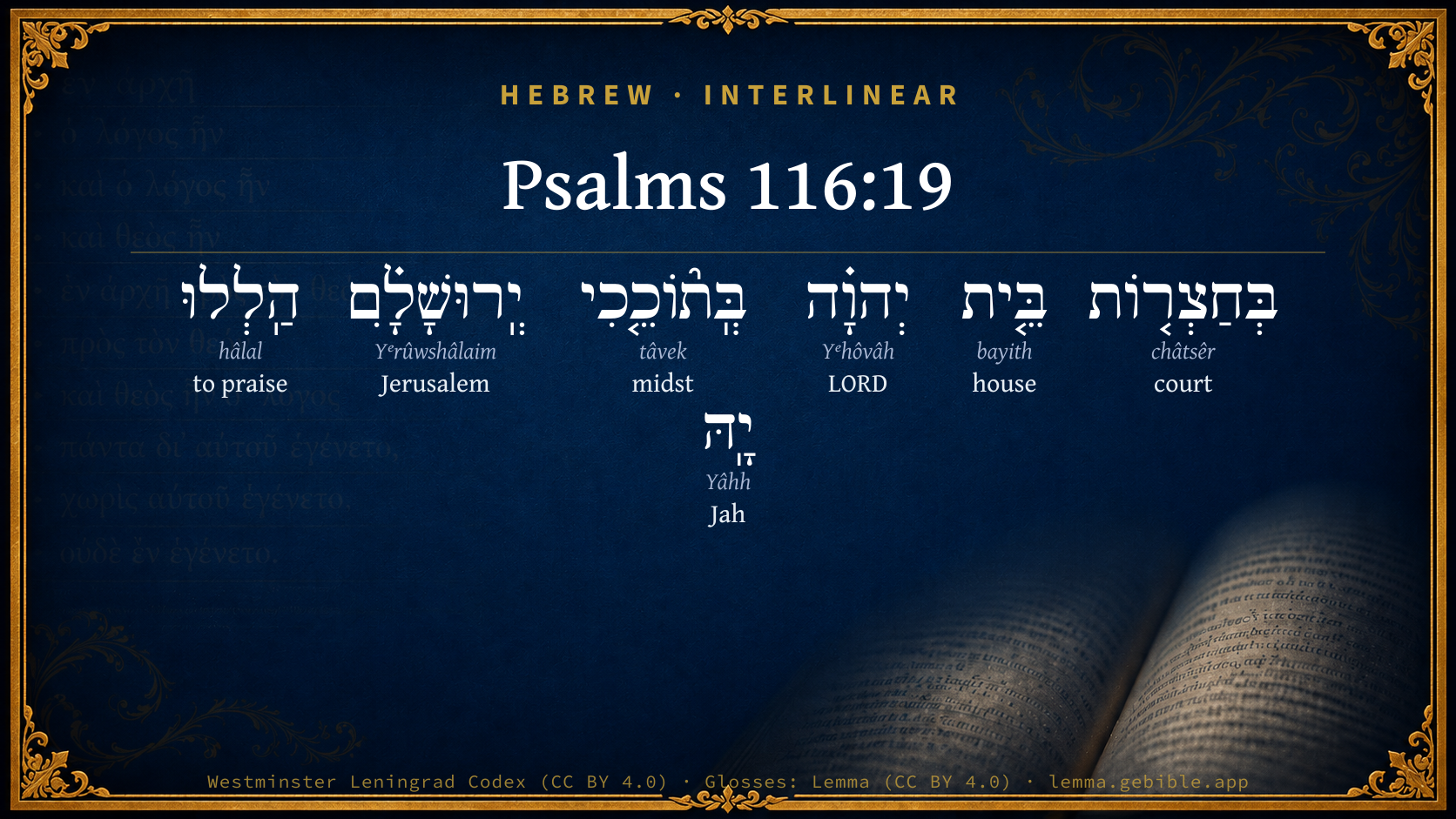
Psalms 116:19

Hebrew (Westminster Leningrad Codex) Psalms 116:19 appears in the Hebrew Old Testament. The text above is from the Westminster Leningrad Codex. Each word links to its Strong’s number, a concise gloss, and parsing drawn from the Open Scriptures Hebrew Bible morphology. Click any word for its full Brown-Driver-Briggs (BDB) entry.
Download image
Cite this verse

Psalms 116:19 (World English Bible). Public Domain. Lemma interlinear Bible study tool, https://lemma.gebible.app/v/psalms/116/19.

Show BibTeX & RIS
BibTeX
RIS
English Translation
In the courts of Yahweh's house, In the midst of you, Jerusalem. Praise Yah!
World English Bible · Public Domain
Download a study sheet

One document with this verse’s original text, its word-by-word gloss line, the meaning frame, cross-references with their text, attributed commentary, and full source and license credits — printable, and it pastes into notes with its structure intact.

This verse Autodidact and up

Study sheet (.html) Plain text (.txt)

A passage Seminary Student

Up to 50 verses in one chapter. A passage sheet keeps up to 6 commentary sources and 12 cross-references per verse, in the order this page ranks them, and says so on the sheet whenever that leaves anything out. Ask for a single verse and you get the Autodidact verse sheet above.

Everything on this page stays free to read, with no account — the sheet is a download of what is already on screen, not access to it.

Want to remove ads? Support Godless Engineer
Compare translations 3

The same verse in 3 English versions, stacked beneath the original-language interlinear above. Click any original word for its lexicon entry.

Each is an independent rendering of the whole verse — the interlinear is not word-aligned to these translations.

Highlighted words mark where these versions differ — a whole-verse word diff, not a word-by-word alignment.

  • World English Bible Public Domain
    In the courts of Yahweh's house, In the midst of you, Jerusalem. Praise Yah!
  • King James Version Public Domain
    In the courts of the LORD's house, in the midst of thee, O Jerusalem. Praise ye the LORD.
  • unfoldingWord Literal Text CC BY-SA 4.0
    in the courts of the house of Yahweh, in your midst, Jerusalem. Hallelu Yah!

unfoldingWord Literal Text — © unfoldingWord, licensed CC BY-SA 4.0. Word-aligned USFM3 via Door43 (git.door43.org/unfoldingWord/en_ult).

Versions to compare (up to 4)

3 of 4 selected

Show all 18 translations

Every available English version of this verse, each an independent rendering of the whole verse.

  • World English Bible Public Domain
    In the courts of Yahweh's house, In the midst of you, Jerusalem. Praise Yah!
  • Berean Standard Bible Public Domain
    in the courts of the LORD’s house, in your midst, O Jerusalem. Hallelujah!
  • Majority Standard Bible Public Domain
    in the courts of the LORD’s house, in your midst, O Jerusalem. Hallelujah!
  • King James Version Public Domain
    In the courts of the LORD's house, in the midst of thee, O Jerusalem. Praise ye the LORD.
  • American Standard Version (1901) Public Domain
    In the courts of Jehovah's house, In the midst of thee, O Jerusalem. Praise ye Jehovah.
  • Revised Version (1885) Public Domain
    In the courts of the LORD’S house, in the midst of thee, O Jerusalem. Praise ye the LORD.
  • Geneva Bible (1599) Public Domain
    In the courtes of ye Lords house, euen in the middes of thee, O Ierusalem. Praise ye the Lord.
  • Douay-Rheims (1899) Public Domain
    in the courts of the house of the Lord, in the midst of thee, O Jerusalem.
  • Young's Literal Translation Public Domain
    In the courts of the house of Jehovah, In thy midst, O Jerusalem, praise ye Jah!
  • Literal Standard Version CC BY-SA 4.0
    In the courts of the house of YHWH, || In your midst, O Jerusalem, praise YAH!
  • Unlocked Literal Bible CC BY-SA 4.0
    in the courts of Yahweh's house, in your midst, Jerusalem. Praise Yahweh.
  • unfoldingWord Literal Text CC BY-SA 4.0
    in the courts of the house of Yahweh, in your midst, Jerusalem. Hallelu Yah!
  • Darby Bible Public Domain
    In the courts of Jehovah's house, in the midst of thee, O Jerusalem. Hallelujah!
  • World Messianic Bible Public Domain
    in the courts of the LORD’s house, in the middle of you, Jerusalem. Praise the LORD!
  • Webster's Bible Public Domain
    In the courts of the LORD'S house, in the midst of thee, O Jerusalem. Praise ye the LORD.
  • Free Bible Version CC BY-SA 4.0
    there in the house of the Lord, right in Jerusalem. Praise the Lord!
  • Bible in Basic English Public Domain
    In the Lord's house, even in Jerusalem. Praise be to the Lord.
  • JPS Tanakh (1917) Public Domain
    In the courts of the LORD'S house, in the midst of thee, O Jerusalem. Hallelujah.

Literal Standard Version (2020), Covenant Press — licensed CC BY-SA 4.0. Text via the HelloAO Bible API (eBible.org). Unlocked Literal Bible (unfoldingWord) — licensed CC BY-SA 4.0. Text via the HelloAO Bible API (eBible.org). unfoldingWord Literal Text — © unfoldingWord, licensed CC BY-SA 4.0. Word-aligned USFM3 via Door43 (git.door43.org/unfoldingWord/en_ult). Free Bible Version, Dr. Jonathan Gallagher — licensed CC BY-SA 4.0. Text via the HelloAO Bible API (eBible.org).

Word by word

More ways to search: Search by grammar → Find every occurrence → Compare this word →

Practice this passage: Drill this verse → Learn its vocabulary →

About this verse

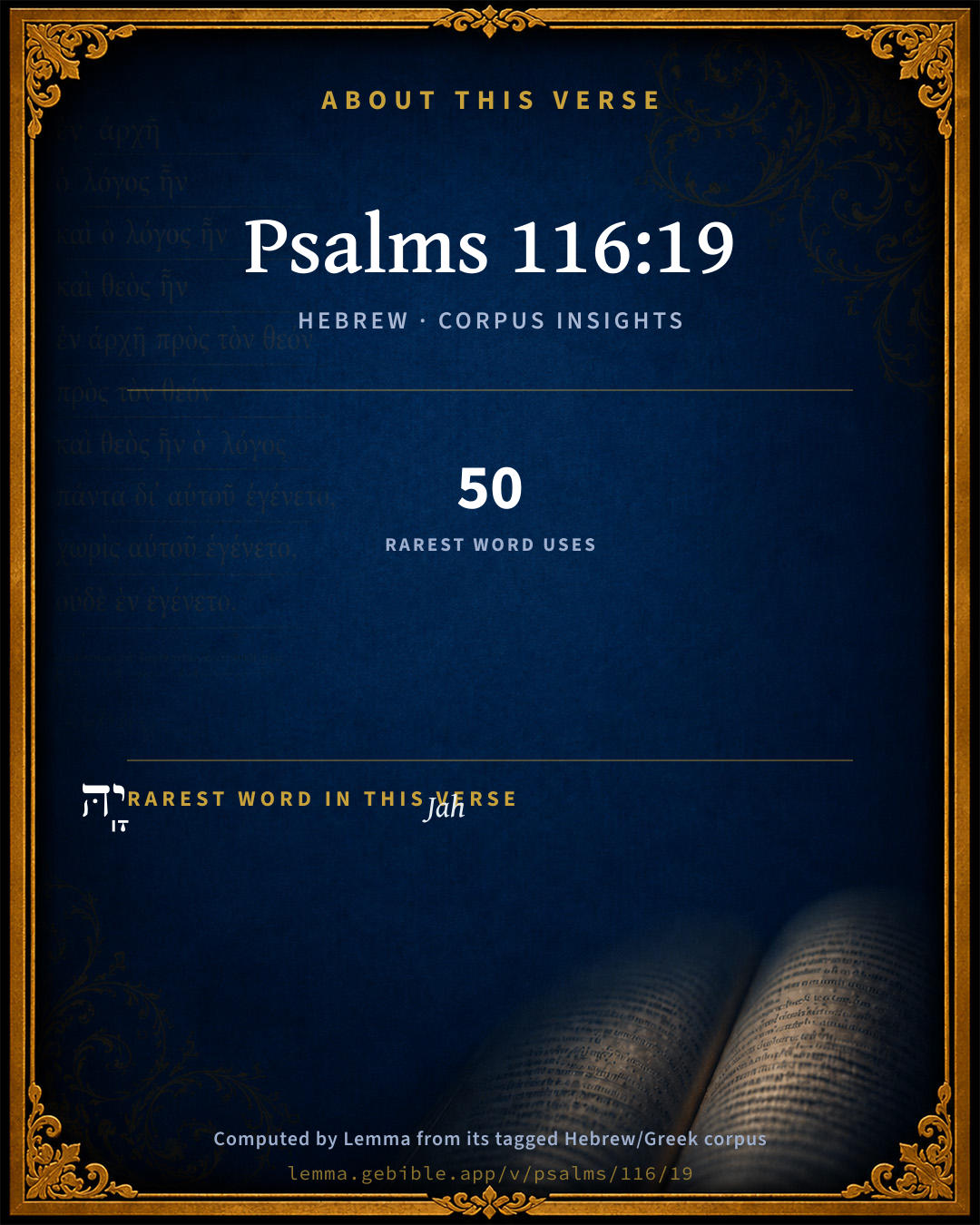
These counts appear in no published source. They are computed here, from the morphology-tagged text and Lemma’s own curated glosses. What Lemma adds →

7
words
7
distinct lemmas
Wisdom
section

Shared distinctive vocabulary

יָֽהּ Jah H3050 occurs in 46 verses of the Hebrew Bible. Also found in:

Grammatical profile

  • 1 verb
  • 6 nouns

Verb forms

  • הַֽלְלוּ Piel · Imperative

Cross-references

6

Topical passages linked to Psalms 116:19 in the Treasury of Scripture Knowledge — connected by theme and wording, ordered by reader-vote popularity; previews shown in the World English Bible.

  • Psalms 96:8 Ascribe to Yahweh the glory due to his name. Bring an offering, and come into his courts.
  • Psalms 135:2 You who stand in the house of Yahweh, In the courts of our God's house.
  • 2 Chronicles 6:6 but I have chosen Jerusalem, that my name might be there; and have chosen David to be over my people Israel.
  • Psalms 100:4 Enter into his gates with thanksgiving, Into his courts with praise. Give thanks to him, and bless his name.
  • Psalms 118:19–20 Open to me the gates of righteousness. I will enter into them. I will give thanks to Yah.
  • Psalms 122:3–4 Jerusalem, that is built as a city that is compact together;

Cross-references courtesy of OpenBible.info (CC BY 4.0).

Hebrew and Greek witnesses Masoretic Hebrew ↔ Greek Septuagint

The same verse in the two great witnesses to the Old Testament, shown verse-for-verse.

You’re reading Greek Psalm 114 (Hebrew Psalm 116). The Septuagint counts the superscription, so verse numbers can differ from the Hebrew — chapter-level alignment, not verse-by-verse. Numbering follows Rahlfs.

These are two independent witnesses, not word-aligned to each other, and the Septuagint is shown in lemma (dictionary) form.

Hebrew Psalms 116:19 Masoretic · Westminster Leningrad Codex

בְּחַצְר֤וֹת בֵּ֤ית יְהוָ֗ה בְּֽת֘וֹכֵ֤כִי יְֽרוּשָׁלִָ֗ם הַֽלְלוּ יָֽהּ

In the courts of Yahweh's house, In the midst of you, Jerusalem. Praise Yah!

World English Bible · Public Domain

On this verse, The Cambridge Bible for Schools and Colleges discusses the Septuagint’s reading. Read the note in Commentary ↓

Hebrew: Westminster Leningrad Codex (CC BY 4.0). Greek: Septuagint (public domain); English from a public-domain English Septuagint. How the Septuagint differs from the Hebrew →

Commentary

Notes on Psalms 116:19 from classic Christian and Jewish commentators (each source and its license shown beneath its notes). The classic Christian expositions comment on the surrounding passage and are grouped to its opening verse, so a note may address several verses; the Jewish commentaries on the Tanakh (Rashi and others) are per-verse, so they appear only where the commentator wrote on this verse.

Lemma curates 59 commentaries, every one of them public domain or Creative Commons licensed, each selected and text-cleaned for this edition rather than reprinted as found. About our sources →

Trapp's Complete Commentary

John Trapp

Psa 116:19 In the courts of the LORD’S house, in the midst of thee, O Jerusalem. Praise ye the LORD.

Ver. 19. In the courts of the Lord’s house] In coetu sacro; in the great congregation, Psa 22:25; Psa 35:18, where there is a more powerful, lively, and effectual working of the Spirit, Psa 89:7 Heb 4:1 1Co 14:24.

John Trapp, A Commentary or Exposition upon All the Books of the Old and New Testament (1647–1656) — public domain. Text from a community e-Sword module.

J. A. Alexander on Psalms

Joseph Addison Alexander

19. (Psa 116:19) In the courts of the house of Jehovah, in the midst of thee, Jerusalem. Hallelujah! This verse completes the one before it, and explains the phrase, before all his people. Some regard it as a proof that the psalm was composed after the actual rebuilding of the temple. But in Ezr 2:68; Ezr 3:8, we find the designation house of God applied to the consecrated site. The use of the word courts is still more natural, because it originally means enclosures, which might be and no doubt were defined, long before the temple was rebuilt. This explanation seems to be confirmed by the addition of the last clause. In the courts of the Lord's house, that is, on the consecrated spot in the midst of thee, 0 Jerusalem, the Holy City.

Joseph Addison Alexander, The Psalms Translated and Explained (1850) — public domain. Text from a community e-Sword module.

Adam Clarke's Commentary

Verse 19. In the midst of thee, O Jerusalem.] He speaks as if present in the city, offering his vowed sacrifices in the temple to the Lord.

Most of this Psalm has been applied to our Lord and his Church; and in this way it has been considered as prophetic; and, taken thus, it is innocently accommodated, and is very edifying. This is the interpretation given of the whole by the old Psalter.

ANALYSIS OF THE HUNDRED AND SIXTEENTH PSALM

This Psalm is gratulatory; for it shows how great straits the psalmist was brought into, from which God delivered him.

This Psalm has three parts: -

I. The psalmist makes profession of his love, and shows the reasons of it: God's goodness in hearing and delivering him from his low and sad condition, Ps 116:1-9.

II. He professes his duty and faith, Ps 116:9-11.

III. He promises to be thankful, and in what manner, Ps 116:12-19.

I. He begins with the expression of his content and love: "I love the Lord." And he gives these reasons: -

1. "Because he hath heard," c. This is reason enough why I should love him.

2. "Because he hath inclined," c. An evidence that he was heard. Upon which experience that he was heard he adds: "Therefore will I call," &c.

Another reason which moved him to love God was, that he heard him in the extremity of his deep distress for, -

1. "The sorrows of death," c. Death is the king of fear.

2. "The pains of hell," &c. He feared the anger of God for his sins.

3. "I found trouble and sorrow." The psalmist was sensible of his condition: though others might suppose him compassed with prosperity, yet he knew himself distressed.

But he prayed to the Lord.

1. "Then." In these troubles and pangs.

2. "I called upon," &c. Invocation to God was his sole refuge.

3. "O Lord, I beseech thee," &c. He sets down the very words of his prayer.

And then, that he might show that he prayed to God in faith and hope, he points out the attributes of God for the encouragement of others.

1. "God is gracious." It is he who inspires prayer and repentance, remits sin, and pardons those who fly in faith to him for mercy.

2. "And righteous and just." He will perform what he has promised.

3. "Yea, our God is merciful." He mingles mercy with his justice he corrects with a father's hand, and loves to forgive rather than to punish. Of which David gives an instance in himself: "I was brought low, and he helped me." And all others may find the same who come in the way that I did to him for pardon.

Another reason he gives for loving God was, the tranquillity of soul he found after this storm was over: "Therefore, return unto thy rest, O my soul." Hitherto thou hast been tossed up and down on the waves of sorrow, finding no port or haven: now faith has opened to thee a harbour where thou mayest be safe: "For the Lord hath dealt," c.: but of his infinite mercy he has given thee joy for sadness.

He attributes to him the whole of his work.

1. "Thou hast delivered," &c. Turned my heaviness into joy, by removing all fear of death.

2. "Thou hast delivered my eyes," &c. Made me joyful.

3. "Thou hast delivered my feet," &c. When my infirmity is great, the devil takes advantage of me that I might fall but now thou hast settled my feet - made me able to resist him. And this God does for all who call upon him, and trust in him.

II. The psalmist, having expressed his sorrows and God's goodness, now professes his dutiful attachment, 1. By his obedience 2. By a faithful confession of his errors, and future confidence.

1. "I will walk before the Lord," c. Be careful to please God, by walking, not after the flesh, but after the Spirit.

He professes his faith, on which he will evermore rely.

1. "I believed, and therefore," c. Which confidence came from faith.

2. "I was greatly afflicted," &c. but I became docile and humble to the Spirit of God. When David was tossed between hope and despair, he found those sorrows were not easily quieted for "I said in my haste," c.

Which clause is differently understood by commentators.

1. Some suppose it to be an amplification of his former grief. I was so amazed, and overwhelmed with sorrow, that if any one reminded me of God's promises, "I said in my haste, All men are liars." I will not believe God he hath no care for me.

2. Others again refer this clause to the preceding: They talk of happiness and felicity, but none is to be found in the land of the living.

3. Some again refer it to Absalom, who deceived David by his vow at Hebron; or to Ahithophel, who revolted from him.

4. Again, others suppose that he taxed even Samuel himself that he spoke not by God's Spirit, when he anointed him king over Israel; because, during Saul's persecution, there appeared so little hope of it. But the first sense is the most cogent.

III. Henceforth, to the end of the Psalm, David declares his gratitude: "What shall I render to the Lord," c. As if he had said, I acknowledge the benefits God has bestowed upon me but in what way can I best evince my gratitude?

1. "I will take the cup of salvation." Here interpreters vary as to what is to be understood by the cup of salvation. 1. Some refer it to the ucharistical sacrifices of the old law, in which, when a man offered a sacrifice to God for some deliverance, he made a feast to the people, as did David, 1Ch 1, 1Ch 2, 1Ch 3. 2. The fathers understood it of the cup of patience and affliction, which is often in Scripture called a cup, Mt 20:22. 3. But here it seems to signify plenty, abundance, c. See the note.

2. "I will pay my vows," c. It was usual in God's service to make vows, or to confess his name in an open assembly. God cares for all his people, however circumstanced for precious in the sight of the Lord is the death of his saints. The servants of God trouble themselves in vain when they distrust him for in life he is with them, and in death he will not forsake them.

The psalmist does not become proud upon God's favours; but in all humility, though a king, he exclaims, -

1. "O Lord, truly I am thy servant," &c.

2. And yet no slave, but a willing servant: "Thou hast loosed my bonds," - taken from my neck the bonds of fear: thou hast made me thy servant through love.

3. And therefore will I do what thy servants ought to do.

Showing his earnestness he repeats again, "I will offer to thee the sacrifice of thanksgiving, and will call upon the name of the Lord. I will pay my vows unto the Lord now in the presence of all his people, in the courts of the Lord's house, in the midst of thee, O Jerusalem. Praise ye the Lord." Within the Church, and at all times, he would praise and do him worship. What is not done according to God's word and Spirit is of little service. He who neglects public worship is not very likely to keep up private devotion, either in his family or in his closet. "I will pay my vows in the midst of thee, O Jerusalem."

Adam Clarke's Commentary on the Bible (1810–1826) — public domain. Text from a community e-Sword/MySword module.

The Cambridge Bible for Schools and Colleges

gen. ed. J. J. S. Perowne

19. Praise ye the Lord] Hallelujah, probably, with LXX, to be transferred to the beginning of Psalms 117.

The Cambridge Bible for Schools and Colleges (gen. ed. J. J. S. Perowne; Cambridge University Press, 1878–1918) — public domain. Text from a community e-Sword module.

Albert Barnes' Notes on the Bible

In the courts of the Lord’s house - See the notes at Psa 65:4. Compare Psa 84:2; Psa 92:13; Psa 96:8; Psa 100:4; Psa 135:2.

In the midst of thee, O Jerusalem - Where the tabernacle, and afterward the temple, was reared.

Praise ye the Lord - Hallelujah. A call on others to join in the praise of God. The psalmist felt his own heart drawn to the service of praise by all the mercies of God; he desired, as an expression of his own feelings, that others should unite with him in that sacred exercise. When our own hearts are filled with gratitude, we wish that all others may partake of the same feeling.

Albert Barnes' Notes on the Bible (1834–1885) — public domain. Text from a community e-Sword/MySword module.

The Treasury of David

Charles H. Spurgeon

Ver. 19. In the courts of the LORD'S house: in the proper place, where God had ordained that he should be worshipped. See how he is stirred up at the remembrance of the house of the Lord, and must needs speak of the holy city with a note of joyful exclamation

In the midst of thee, O Jerusalem. The very thought of the beloved Zion touched his heart, and he writes as if he were actually addressing Jerusalem, whose name was dear to him. There would he pay his vows, in the abode of fellowship, in the very heart of Judea, in the place to which the tribes went up, the tribes of the Lord. There is nothing like witnessing for Jesus, where the report thereof will be carried into a thousand homes. God's praise is not to be confined to a closet, nor his name to be whispered in holes and corners, as if we were afraid that men should hear us; but in the thick of the throng, and in the very centre of assemblies, we should lift up heart and voice unto the Lord, and invite others to join with us in adoring him, saying,

Praise ye the LORD, or Hallelujah. This was a very fit conclusion of a song to be sung when all the people were gathered together at Jerusalem to keep the feast. God's Spirit moved the writers of these Psalms to give them a fitness and suitability which was more evident in their own day than now; but enough is perceptible to convince us that every line and word had a peculiar adaptation to the occasions for which the sacred sonnets were composed. When we worship the Lord we ought with great care to select the words of prayer and praise, and not to trust to the opening of a hymn book, or to the unconsidered extemporizing of the moment. Let all things be done decently and in order, and let all things begin and end with Hallelujah, Praise ye the Lord.

Ver. 19 (second clause). He does not simply say in the midst of Jerusalem: but, in the midst of thee, O Jerusalem? He speaks to the city as one who loved it and delighted in it. We see here, how the saints were affected towards the city in which was the house of God. Thus we should be moved in spirit towards that church in which God dwells, the temple he inhabits, which is built up, not of stones, but of the souls of the faithful. Wolfgang Musculus.

Ver. 19. The Christian at home.

1. In God's house.

2. Among the saints.

3. At his favourite work, "Praise."

David's Harpe full of most delectable harmony newly stringed and set in tune by Thomas Becon. This is an exposition of Ps 116:10-19, or Psalm 115 according to the Latin Version. It was originally published in 12mo, in 1542, and reprinted in "The Early Works of Thomas Becon. S. T. P. Chaplain to Archbishop Cranmer, Prebendary of Canterbury, &c., "by "The Parker Society." 1843.]

AN EXPOSITION upon some select Psalms of David, containing great store of most excellent and comfortable doctrine, and instruction for all those, that (under the burden of sin) thirst for comfort in Christ Jesus. Written by that faithful servant of God, M. ROBERT ROLLOK, sometime Pastor in the Church of Edinburgh: And translated out of Latin into English, by C. L. CHARLES LUMISDEN Minister of the Gospel of Christ at Dudingstoun. 12mo. EDINBURGH. 1600. Contains an Exposition of this Psalm.]

The Saints' Sacrifice: or, A, Commentary on Psalm 116. Which is a gratulatory Psalm, for Deliverance from Deadly Distress. By William Gouge, D.D. London. 1631. Reprinted, with S. Smith, on. Psalm 1, and T. Pierson, on Psalms 27, 84, 87, in Nichol's Series of Commentaries. 1868.]

Sermons Experimental: on Psalms 116 and 117. VERY USEFUL for A Wounded Spirit. By William Slater, D.D., sometimes Rector of Linsham, and Vicar of Pitminster, in SOMMERSETSHIRE. Published by his Son WILLIAM SLATER, Mr. of Arts... London: 1638 4to.

Meditations and Disquisitions upon Seven Consolatory Psalms of David: namely, The 23. The 27, The 30, The 34, The 84, The 103, The

116. By Sir Richard Baker, Knight. London. 1640. 4to.

Divine Drops Distilled from the Fountain of Holy Scriptures: Delivered in several Exercises before Sermons, upon Twenty-three Texts of Scripture. By that worthy Gospel Preacher Gualter Cradock, Late Preacher at All Hallows Great in London. 1650. In this old quarto there is an Exposition of Psalm 116; but it is almost wholly political, and worthless for our purpose; we mention it only as a caution, and to prevent disappointment.]

In "The Golden Diary of Heart Converse with Jesus in the Book of Psalms. By the Rev. Dr. EDERSHEIM, Torquay, 1873, "there is a brief exposition of Ps 116:1-12.

Charles H. Spurgeon's The Treasury of David (1869–1885) — public domain. Psalms only. Text from a community e-Sword/MySword module.

Whedon's Commentary on the Bible

Daniel D. Whedon

19. Courts of the Lord’s house—This does not necessarily prove the temple to be now standing, but the place of worship. In Ezr_2:68; Ezr_3:8, the place where the temple formerly stood, though now covered with ruins, is called the “house of God.” So Bethel, (house of God,) when thus named, was only a “place” in the open field. Gen_28:11; Gen_28:19.

Daniel D. Whedon (gen. ed.), Commentary on the Old and New Testaments (1874–1909) — public domain. Text from a community e-Sword module.

The Pulpit Commentary

In the courts of the Lord"s house. Thanksgiving was always most appropriately offered in the temple courts, where close at hand dwelt the mysterious presence of God, and where God had appointed that his worshippers should appear before him. In the midst of thee, O Jerusalem. This expression and the preceding suit well with Hezekiah"s authorship of the psalm, as Dr. Kay well argues. Praise ye the Lord. The writer calls on all those present (see ver. 18) to join him in singing praise to God. (comp. Ps 104 Ps 105 Ps 106 Ps 113 Ps 115 Ps 117)

The Pulpit Commentary (1880–1919), ed. H.D.M. Spence-Jones & Joseph S. Exell — public domain. Text from a community e-Sword module.

Rashi

Rabbi Shlomo Yitzchaki (Rashi)

in your midst Heb. בתוככי, like בְּתוֹכֵךְ.

Rashi on the Tanakh — English translations: “The Judaica Press complete Tanach with Rashi, translated by A. J. Rosenberg” (CC BY 4.0); “Pentateuch with Rashi's commentary by M. Rosenbaum and A.M. Silbermann, 1929-1934” (public domain); “The Metsudah Tanach series, Lakewood, N.J” (CC BY 4.0); and “The Book of Joshua, Metsudah Publications, 1997” (CC BY 4.0). Text via Sefaria.

Lesson kit

Teaching starters — assembled from the data on this page, not authored interpretation. Every prompt links to the verse data it draws on. Edit before teaching.

Psalms, in the Wisdom, opens this verse with 7 words (7 distinct Hebrew lemmas). Its most distinctive word is Yâhh (“Jah”). A historical commentator’s framing appears above. Read the whole chapter for the surrounding context.

Discussion questions

  1. How does “Jah” (Yâhh) shape what this verse is saying?
  2. Exodus 15:2 shares the word «Jah» with this verse. How do the two illuminate each other?
  3. These translations render this verse differently. What is at stake in choosing one wording over another?
  4. The verb «הַֽלְלוּ» is Piel Imperative. How does its form color the action?
  5. Reading how Trapp's Complete Commentary and J. A. Alexander on Psalms read this verse, where do the two commentators agree and where do they part?

Things to notice

Reading settings

Reading text

Shown beneath each verse's original-language words.

Old Testament
Old Testament edition

Read the OT as the Masoretic Hebrew (MT) or the Greek Septuagint (LXX).

English shown for the Greek Septuagint (in the Hebrew ↔ Greek comparison).

Comparing translations? Open the Compare panel on any verse page to stack up to four side by side.