
2 Chronicles 33:15

Hebrew (Westminster Leningrad Codex) 2 Chronicles 33:15 appears in the Hebrew Old Testament. The text above is from the Westminster Leningrad Codex. Each word links to its Strong’s number, a concise gloss, and parsing drawn from the Open Scriptures Hebrew Bible morphology. Click any word for its full Brown-Driver-Briggs (BDB) entry.
Download image
Cite this verse

2 Chronicles 33:15 (World English Bible). Public Domain. Lemma interlinear Bible study tool, https://lemma.gebible.app/v/2-chronicles/33/15.

Show BibTeX & RIS
BibTeX
RIS
English Translation
He took away the foreign gods, and the idol out of the house of Yahweh, and all the altars that he had built in the mountain of the house of Yahweh, and in Jerusalem, and cast them out of the city.
World English Bible · Public Domain
Download a study sheet

One document with this verse’s original text, its word-by-word gloss line, the meaning frame, cross-references with their text, attributed commentary, and full source and license credits — printable, and it pastes into notes with its structure intact.

This verse Autodidact and up

Study sheet (.html) Plain text (.txt)

A passage Seminary Student

Up to 50 verses in one chapter. A passage sheet keeps up to 6 commentary sources and 12 cross-references per verse, in the order this page ranks them, and says so on the sheet whenever that leaves anything out. Ask for a single verse and you get the Autodidact verse sheet above.

Everything on this page stays free to read, with no account — the sheet is a download of what is already on screen, not access to it.

Want to remove ads? Support Godless Engineer
Compare translations 3

The same verse in 3 English versions, stacked beneath the original-language interlinear above. Click any original word for its lexicon entry.

Each is an independent rendering of the whole verse — the interlinear is not word-aligned to these translations.

Highlighted words mark where these versions differ — a whole-verse word diff, not a word-by-word alignment.

  • World English Bible Public Domain
    He took away the foreign gods, and the idol out of the house of Yahweh, and all the altars that he had built in the mountain of the house of Yahweh, and in Jerusalem, and cast them out of the city.
  • King James Version Public Domain
    And he took away the strange gods, and the idol out of the house of the LORD, and all the altars that he had built in the mount of the house of the LORD, and in Jerusalem, and cast them out of the city.
  • unfoldingWord Literal Text CC BY-SA 4.0
    And he took away the foreign gods, and the idol from the house of Yahweh, and all the altars that he built on the mountain of the house of Yahweh and in Jerusalem. And he threw them outside the city.

unfoldingWord Literal Text — © unfoldingWord, licensed CC BY-SA 4.0. Word-aligned USFM3 via Door43 (git.door43.org/unfoldingWord/en_ult).

Versions to compare (up to 4)

3 of 4 selected

Show all 18 translations

Every available English version of this verse, each an independent rendering of the whole verse.

  • World English Bible Public Domain
    He took away the foreign gods, and the idol out of the house of Yahweh, and all the altars that he had built in the mountain of the house of Yahweh, and in Jerusalem, and cast them out of the city.
  • Berean Standard Bible Public Domain
    He removed the foreign gods and the idol from the house of the LORD, along with all the altars he had built on the temple mount and in Jerusalem, and he dumped them outside the city.
  • Majority Standard Bible Public Domain
    He removed the foreign gods and the idol from the house of the LORD, along with all the altars he had built on the temple mount and in Jerusalem, and he dumped them outside the city.
  • King James Version Public Domain
    And he took away the strange gods, and the idol out of the house of the LORD, and all the altars that he had built in the mount of the house of the LORD, and in Jerusalem, and cast them out of the city.
  • American Standard Version (1901) Public Domain
    And he took away the foreign gods, and the idol out of the house of Jehovah, and all the altars that he had built in the mount of the house of Jehovah, and in Jerusalem, and cast them out of the city.
  • Revised Version (1885) Public Domain
    And he took away the strange gods, and the idol out of the house of the LORD, and all the altars that he had built in the mount of the house of the LORD, and in Jerusalem, and cast them out of the city.
  • Geneva Bible (1599) Public Domain
    And he tooke away the strange gods and the image out of the house of the Lord, and all the altars that he had built in the mount of the house of the Lord, and in Ierusalem, and cast them out of the citie.
  • Douay-Rheims (1899) Public Domain
    And he took away the strange gods, and the idol out of the house of the Lord: the altars also which he had made in the mount of the house of the Lord, and in Jerusalem, and he cast them all out of the city.
  • Young's Literal Translation Public Domain
    And he turneth aside the gods of the stranger, and the idol, out of the house of Jehovah, and all the altars that he had built in the mount of the house of Jehovah and in Jerusalem, and casteth `them' to the outside of the city.
  • Literal Standard Version CC BY-SA 4.0
    And he turns aside the gods of the stranger, and the idol, out of the house of YHWH, and all the altars that he had built on the mountain of the house of YHWH and in Jerusalem, and casts [them] to the outside of the city.
  • Unlocked Literal Bible CC BY-SA 4.0
    He took away the foreign gods, the idol out of the house of Yahweh, and all the altars that he had built on the mount of the house of Yahweh and in Jerusalem, and threw them out of the city.
  • unfoldingWord Literal Text CC BY-SA 4.0
    And he took away the foreign gods, and the idol from the house of Yahweh, and all the altars that he built on the mountain of the house of Yahweh and in Jerusalem. And he threw them outside the city.
  • Darby Bible Public Domain
    And he removed the strange gods, and the idol out of the house of Jehovah, and all the altars that he had built on the mount of the house of Jehovah and in Jerusalem, and cast [them] out of the city.
  • World Messianic Bible Public Domain
    He took away the foreign gods and the idol out of the LORD’s house, and all the altars that he had built in the mountain of the LORD’s house and in Jerusalem, and cast them out of the city.
  • Webster's Bible Public Domain
    And he took away the strange gods, and the idol out of the house of the LORD, and all the altars that he had built in the mount of the house of the LORD, and in Jerusalem, and cast them out of the city.
  • Free Bible Version CC BY-SA 4.0
    He disposed of the foreign gods and the idol from the Lord's Temple, together with all the altars he had built on the Temple hill and in Jerusalem, throwing all of them outside the city.
  • Bible in Basic English Public Domain
    He took away the strange gods and the image out of the house of the Lord, and all the altars he had put up on the hill of the Lord's house and in Jerusalem, and put them out of the town.
  • JPS Tanakh (1917) Public Domain
    And he took away the strange gods, and the idol out of the house of the LORD, and all the altars that he had built in the mount of the house of the LORD, and in Jerusalem, and cast them out of the city.

Literal Standard Version (2020), Covenant Press — licensed CC BY-SA 4.0. Text via the HelloAO Bible API (eBible.org). Unlocked Literal Bible (unfoldingWord) — licensed CC BY-SA 4.0. Text via the HelloAO Bible API (eBible.org). unfoldingWord Literal Text — © unfoldingWord, licensed CC BY-SA 4.0. Word-aligned USFM3 via Door43 (git.door43.org/unfoldingWord/en_ult). Free Bible Version, Dr. Jonathan Gallagher — licensed CC BY-SA 4.0. Text via the HelloAO Bible API (eBible.org).

Word by word

More ways to search: Search by grammar → Find every occurrence → Compare this word →

Practice this passage: Drill this verse → Learn its vocabulary →

הַסֶּ֨מֶל֙
çemel
H5566
“the · idol”
Particle, Definite Article + Noun, Common, Masculine, Singular, Absolute
Part of Speech
Particle + Noun
Type
Common
Gender
Masculine
Number
Singular
State
Absolute
Full BDB Definition

Origin: from an unused root meaning to resemble

TWOT: 1515

image, statue, idol
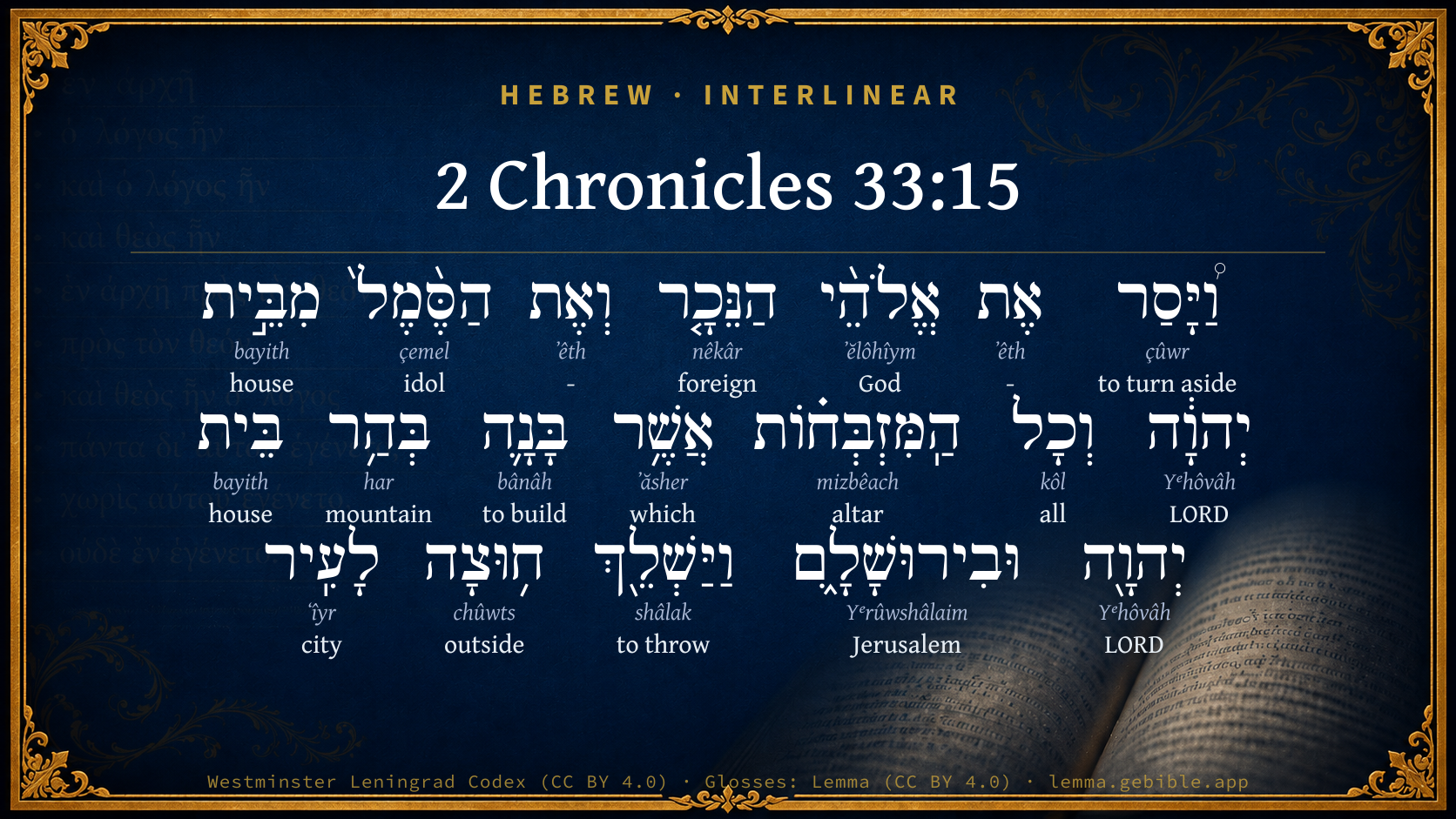
  1. וַ֠יָּסַר çûwr H5493 “and · to turn aside” Conjunction + Verb, Hiphil, Sequential Imperfect, 3rd Person, Masculine, Singular
  2. אֶת ʼêth H853 “-” Particle, Direct Object
  3. אֱלֹהֵ֨י ʼĕlôhîym H430 “God(s) of” Noun, Common, Masculine, Plural, Construct
  4. הַנֵּכָ֤ר nêkâr H5236 “the · foreign” Particle, Definite Article + Noun, Common, Masculine, Singular, Absolute
  5. וְאֶת ʼêth H853 “and · -” Conjunction + Particle, Direct Object
  6. מִבֵּ֣ית bayith H1004 “from · house of” Preposition + Noun, Common, Masculine, Singular, Construct
  7. יְהוָ֔ה Yᵉhôvâh H3068 “LORD” Noun, Proper
  8. וְכָל kôl H3605 “and · all of” Conjunction + Noun, Common, Masculine, Singular, Construct
  9. הַֽמִּזְבְּח֗וֹת mizbêach H4196 “the · altars” Particle, Definite Article + Noun, Common, Masculine, Plural, Absolute
  10. אֲשֶׁ֥ר ʼăsher H834 “which” Particle, Relative
  11. בָּנָ֛ה bânâh H1129 “to build” Verb, Qal, Perfect, 3rd Person, Masculine, Singular
  12. בְּהַ֥ר har H2022 “in/at · mountain of” Preposition + Noun, Common, Masculine, Singular, Construct
  13. בֵּית bayith H1004 “house of” Noun, Common, Masculine, Singular, Construct
  14. יְהוָ֖ה Yᵉhôvâh H3068 “LORD” Noun, Proper
  15. וּבִירוּשָׁלִָ֑ם Yᵉrûwshâlaim H3389 “and · in/at · Jerusalem” Conjunction + Preposition + Noun, Proper
  16. וַיַּשְׁלֵ֖ךְ shâlak H7993 “and · to throw” Conjunction + Verb, Hiphil, Sequential Imperfect, 3rd Person, Masculine, Singular
  17. ח֥וּצָה chûwts H2351 “outside · toward” Noun, Common, Masculine, Singular, Absolute + Suffix, Demonstrative
  18. לָעִֽיר ʻîyr H5892 “to/for the · city” Preposition, Determined + Noun, Common, Feminine, Singular, Absolute

About this verse

These counts appear in no published source. They are computed here, from the morphology-tagged text and Lemma’s own curated glosses. What Lemma adds →

19
words
16
distinct lemmas
Historical
section

Notable vocabulary

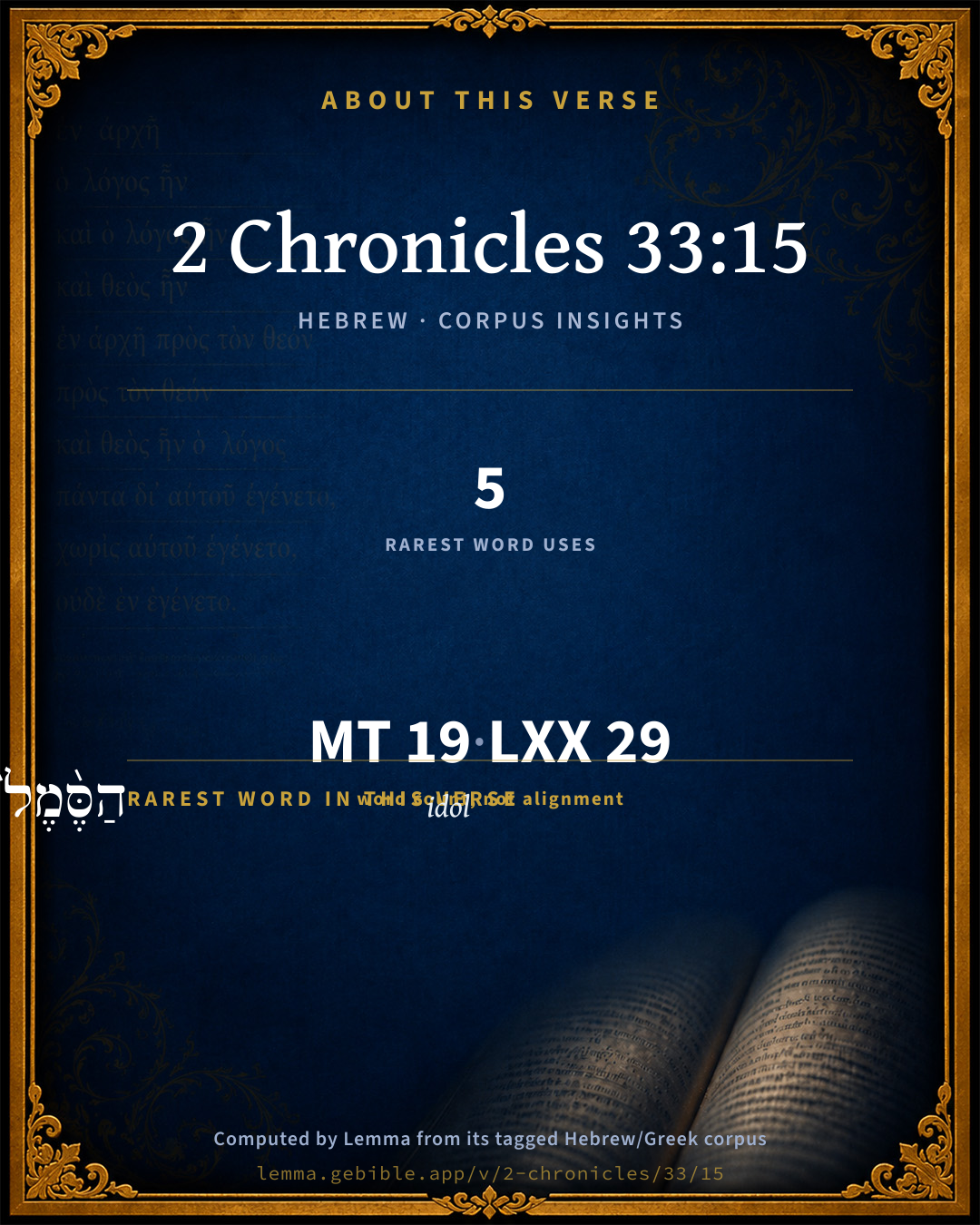
The rarest word here is הַסֶּ֨מֶל֙ idol H5566 — appearing just 5 times in the whole Hebrew Bible.

Shared distinctive vocabulary

הַסֶּ֨מֶל֙ idol H5566 occurs in 5 verses of the Hebrew Bible. Also found in:

Grammatical profile

  • 3 verbs
  • 13 nouns
  • 3 particles

Verb forms

  • וַ֠יָּסַר Hiphil · Sequential Imperfect
  • בָּנָ֛ה Qal · Perfect
  • וַיַּשְׁלֵ֖ךְ Hiphil · Sequential Imperfect

Repetition

Words recur within this verse — often emphatic in Hebrew:

  • מִבֵּ֣ית house H1004 ×2
  • יְהוָ֔ה LORD H3068 ×2

Hebrew & Septuagint length

In English translation the verse runs 41 words from the Hebrew and 41 from the Septuagint (LXX English) — the same length.

A rough comparison of the two English renderings, which tokenize alike — not a word-level alignment.

Word counts can differ between the Hebrew and the Greek without any difference in meaning — e.g. the Hebrew direct-object marker אֵת has no separate Greek word, and Greek often adds the article ὁ.

In the original languages it is 19 Hebrew tokens and 29 Greek tokens — but the two are counted differently (Hebrew bundles its prefixes and suffixes into one token; the Greek is in lemma form), so that isn’t a like-for-like length.

Cross-references

6

Topical passages linked to 2 Chronicles 33:15 in the Treasury of Scripture Knowledge — connected by theme and wording, ordered by reader-vote popularity; previews shown in the World English Bible.

  • 2 Chronicles 33:3–7 For he built again the high places which Hezekiah his father had broken down; and he reared up altars for the Baals, and made Asheroth, and worshiped all the host of the sky, and served them.
  • 2 Kings 21:7 He set the engraved image of Asherah, that he had made, in the house of which Yahweh said to David and to Solomon his son, In this house, and in Jerusalem, which I have chosen out of all the tribes of Israel, will I put my name forever;
  • Isaiah 2:17–21 The loftiness of man shall be bowed down, And the haughtiness of men shall be brought low; And Yahweh alone shall be exalted in that day.
  • Ezekiel 18:20–22 The soul who sins, he shall die: the son shall not bear the iniquity of the father, neither shall the father bear the iniquity of the son; the righteousness of the righteous shall be on him, and the wickedness of the wicked shall be on him.
  • Hosea 14:1–3 Israel, return to Yahweh your God; For you have fallen because of your sin.
  • Matthew 3:8 Therefore bring forth fruit worthy of repentance!

Cross-references courtesy of OpenBible.info (CC BY 4.0).

Hebrew and Greek witnesses Masoretic Hebrew ↔ Greek Septuagint

The same verse in the two great witnesses to the Old Testament, shown verse-for-verse.

These are two independent witnesses, not word-aligned to each other, and the Septuagint is shown in lemma (dictionary) form.

Hebrew 2 Chronicles 33:15 Masoretic · Westminster Leningrad Codex

וַ֠יָּסַר אֶת אֱלֹהֵ֨י הַנֵּכָ֤ר וְאֶת הַסֶּ֨מֶל֙ מִבֵּ֣ית יְהוָ֔ה וְכָל הַֽמִּזְבְּח֗וֹת אֲשֶׁ֥ר בָּנָ֛ה בְּהַ֥ר בֵּית יְהוָ֖ה וּבִירוּשָׁלִָ֑ם וַיַּשְׁלֵ֖ךְ ח֥וּצָה לָעִֽיר

He took away the foreign gods, and the idol out of the house of Yahweh, and all the altars that he had built in the mountain of the house of Yahweh, and in Jerusalem, and cast them out of the city.

World English Bible · Public Domain

Greek LXX 2 Chronicles 33:15 Septuagint · lemma form

καί περιαἱρέω ὁ θεός ὁ ἀλλότριος καί ὁ γλυπτός ἐκ οἶκος κύριος καί πᾶς ὁ θυσιαστήριον ὅς οἰκοδομέω ἐν ὄρος οἶκος κύριος καί ἐν ἰερουσαλήμ καί ἔξω ὁ πόλις

And he removed the strange gods, and the graven image out of the house of the Lord, and all the altars which he had built in the mount of the house of the Lord, and in Jerusalem, and without the city.

LXX2012 (modern English Septuagint) · Public Domain

Hebrew: Westminster Leningrad Codex (CC BY 4.0). Greek: Septuagint (public domain); English from LXX2012 (modern English Septuagint) (Public Domain). How the Septuagint differs from the Hebrew →

Commentary

Notes on 2 Chronicles 33:15 from classic Christian and Jewish commentators (each source and its license shown beneath its notes). The classic Christian expositions comment on the surrounding passage and are grouped to its opening verse, so a note may address several verses; the Jewish commentaries on the Tanakh (Rashi and others) are per-verse, so they appear only where the commentator wrote on this verse.

Lemma curates 59 commentaries, every one of them public domain or Creative Commons licensed, each selected and text-cleaned for this edition rather than reprinted as found. About our sources →

Trapp's Complete Commentary

John Trapp

2Ch 33:15 And he took away the strange gods, and the idol out of the house of the LORD, and all the altars that he had built in the mount of the house of the LORD, and in Jerusalem, and cast [them] out of the city.

Ver. 15. And he took away the strange gods.] This he had promised to do, doubtless, in his distress; and now he doth it. "Vow, and perform to the Lord your God," &c.

And cast them out of the city.] Saying unto them, "Get you hence." {Isa 30:22} "What have I to do any more with idols?" {Hos 14:8} This was his repentance from sin.

John Trapp, A Commentary or Exposition upon All the Books of the Old and New Testament (1647–1656) — public domain. Text from a community e-Sword module.

Joseph Benson's Commentary

2Ch 33:15-16. He took away the strange gods — The images of them, and that idol, whatever it was, which he had set up with so much solemnity in the house of the Lord. And all the altars — The idolatrous altars, as detestable things, loathing them as much, it is to be hoped, as ever he had loved them. And he repaired the altar of the Lord — Which had either been abused or broken down by some of the idolatrous priests, or at least neglected, and was therefore gone out of repair. And sacrificed thereon peace-offerings — To implore God’s favour; and thank-offerings — To praise him for his deliverance. And commanded Judah to serve the Lord — Using his power to reform his people, as he had before abused it to corrupt them. Thus he brought forth fruit meet for repentance, and endeavoured, as far as he could, to repair the injuries which he had done to the cause of God by his impious commands, 2Ch 33:9. Observe, reader, those that truly repent of their sins, will not only return to God themselves, but will do all they can to bring those back to him that have, by their example, been seduced and drawn away from him.

Joseph Benson's Commentary on the Old and New Testaments (1811–1818) — public domain. Text from a community e-Sword module.

Keil & Delitzsch

C. F. Keil & F. Delitzsch

And he also removed the idols and the statues from the house of the Lord, i.e., out of the two courts of the temple (Ch2 33:5), and caused the idolatrous altars which he had built upon the temple hill and in Jerusalem to be cast forth from the city. In Ch2 33:16, instead of the Keth. ויבן, he built (restored) the altar of Jahve, many manuscripts and ancient editions read ויכן, he prepared the altar of Jahve. This variation has perhaps originated in an orthographical error, and it is difficult to decide which reading is the original. The Vulg. translates יבן restauravit. That Manasseh first removed the altar of Jahve from the court, and then restored it, as Ewald thinks, is not very probable; for in that case its removal would certainly have been mentioned in Ch2 33:3. Upon the altar thus restored Manasseh then offered thank-offerings and peace-offerings, and also commanded his subjects to worship Jahve the God of Israel. But the people still sacrificed on the high places, yet unto Jahve their God.

"As to the carrying away of Manasseh," says Bertheau, "we have no further information in the Old Testament, which is not surprising, seeing that in the books of Kings there is only a very short notice as to the long period embraced by Manasseh's reign and that of Amon." He therefore, with Ew., Mov., Then., and others, does not scruple to recognise this fact as historical, and to place his captivity in the time of the Assyrian king Esarhaddon. He however believes, with Ew. and Mov., that the statements as to the removal of idols and altars from the temple and Jerusalem (Ch2 33:15) is inconsistent with the older account in Kg2 23:6 and Kg2 23:12, the clear statements of which, moreover, our historian does not communicate in Ch2 34:3. For even if the Astarte removed by Josiah need not have been the הסּמל of our chapter, yet it is expressly said that only by Josiah were the altars built by Manasseh broken down; yet we would scarcely be justified in supposing that Manasseh removed them, perhaps only laid them aside, that Amon again set them up in the courts, and that Josiah at length destroyed them. It does not thence follow, of course, that the narrative of the repentance and conversion of Manasseh rests upon no historic foundation; rather it is just such a narrative as would be supplemented by accounts of the destruction of the idolatrous altars and the statue of Astarte: for that might be regarded as the necessary result of the conversion, without any definite statement being made.

(Note: From this supposed contradiction, R. H. Graf, "die Gefangenschaft u. Bekehrung Manasse's, 2 Chron 33," in the Theol. Studien u. Kritiken, 1859, iii. S. 467ff., and in the book, die geschichtl. Literatur A. Test. 1866, 2 Abhdl., following Gramberg, and with the concurrence of H. Nldeke, die alttestl. Literatur in einer Reihe von Aufstzen dargestellt (1868), S. 59f., has drawn the conclusion that the accounts given in the Chronicle, not only of Manasseh's conversion, but also of his being led captive to Babylon, are merely fictions, or inventions - poetical popular myths. On the other hand, E. Gerlach, in the Theol. Stud. u. Krit. 1861, iii. S. 503ff., has shown the superficiality of Graf's essay, and defended effectively the historical character of both narratives.)

Against this we have the following objections to make: Can we well imagine repentance and conversion on Manasseh's part without the removal of the abominations of idolatry, at least from the temple of the Lord? And why should we not suppose that Manasseh removed the idol altars from the temple and Jerusalem, but that Amon, who did evil as did his father Manasseh, and sacrificed to all the images which he had made (Kg2 21:21.; Ch2 33:22), again set them up in the courts of the temple, and placed the statue again in the temple, and that only by Josiah were they destroyed? In Kg2 23:6 it is indeed said, Josiah removed the Asherah from the house of Jahve, took it forth from Jerusalem, and burnt it, and ground it to dust in the valley of Kidron; and in Ch2 33:12, that Josiah beat down and brake the altars which Manasseh had made in both courts of the house of Jahve, and threw the dust of them into Kidron. But where do we find it written in the Chronicle that Manasseh, after his return from Babylon, beat down, and brake, and ground to powder the סמל in the house of Jahve, and the altars on the temple mount and in Jerusalem? In Ch2 33:15 we only find it stated that he cast these things forth from the city (לעיר חוּצה ישׁלך). Is casting out of the city identical with breaking down and crushing, as Bertheau and others assume? The author of the Chronicle, at least, can distinguish between removing (הסיר) and breaking down and crushing. Cf. Ch2 15:16, where הסיר is sharply distinguished from כּרת and הדק; further, Ch2 31:1 and Ch2 34:4, where the verbs שׁבּר, גּדּע, and הדק are used of the breaking in pieces and destroying of images and altars by Hezekiah and Josiah. He uses none of these verbs of the removal of the images and altars by Manasseh, but only ויסר and לעיר חוּצה וישׁלך (Ch2 33:15). If we take the words exactly as they stand in the text of the Bible, every appearance of contradiction disappears.

(Note: In this matter Movers too has gone very superficially to work, remarking in support of the contradiction (bibl. Chron. S. 328): "If Manasseh was so zealous a penitent, it may be asked, Would he not have destroyed all idolatrous images, according to the Mosaic law, as the Chronicle itself, Ch2 33:15 (cf. Ch2 29:17; Ch2 15:16; Kg2 23:12), sufficiently shows? Had idolatry ceased in all Judah in the last year of Manasseh's reign, as is stated in Ch2 33:17, could it, during the two years' reign of his son Amon, have spread abroad in a manner hitherto unheard of in Jewish history, as it is portrayed under Josiah, Kg2 23:4.?" But where is it stated in the Chronicle that Manasseh was so zealous a penitent as to have destroyed the images according to the Mosaic law? Not even the restoration of the Jahve-worship according to the provisions of the law is once spoken of, as it is in the case of Hezekiah and of Josiah (cf. Ch2 30:5 and Ch2 30:16, Ch2 34:21; Ch2 35:26); and does it follow from the fact that Judah, in consequence of Manasseh's command to serve Jahve, still sacrificed in the high places, yet to Jahve, that under Manasseh idolatry ceased throughout Judah?)

From what is said in the Chronicle of Manasseh's deeds, we cannot conclude that he was fully converted to the Lord. That Manasseh prayed to Jahve in his imprisonment, and by his deliverance from it and his restoration to Jerusalem came to see that Jahve was God (האלהים), who must be worshipped in His temple at Jerusalem, and that he consequently removed the images and the idolatrous altars from the temple and the city, and cast them forth-these facts do not prove a thorough conversion, much less "that he made amends for his sin by repentance and improvement" (Mov.), but merely attest the restoration of the Jahve-worship in the temple, which had previously been completely suspended. But the idolatry in Jerusalem and Judah was not thereby extirpated; it was only in so far repressed that it could not longer be publicly practised in the temple. Still less was idolatry rooted out of the hearts of the people by the command that the people were to worship Jahve, the God of Israel. There is not a single word of Manasseh's conversion to Jahve, the God of the fathers, with all his heart (שׁלם בּלב). Can it then surprise us, that after Manasseh's death, under his son Amon, walking as he did in the sins of his father, these external barriers fell straightway, and idolatry again publicly appeared in all its proportions and extent, and that the images and altars of the idols which had been cast out of Jerusalem were again set up in the temple and its courts? If even the pious Josiah, with all his efforts for the extirpation of idolatry and the revivification of the legal worship, could not accomplish more than the restoration, during his reign, of the temple service according to the law, while after his death idolatry again prevailed under Jehoiakim, what could Manasseh's half-measures effect? If this be the true state of the case in regard to Manasseh's conversion, the passages Kg2 24:3; Kg2 23:26; Jer 15:4, where it is said that the Lord had cast out Judah from His presence because of the sins of Manasseh, cease to give any support to the opposite view. Manasseh is here named as the person who by his godlessness made the punishment of Judah and Jerusalem unavoidable, because he so corrupted Judah by his sins, that it could not now thoroughly turn to the Lord, but always fell back into the sins of Manasseh. Similarly, in Kg2 17:21 and Kg2 17:22, it is said of the ten tribes that the Lord cast them out from His presence because they walked in all the sins of Jeroboam, and departed not from them.

With the removal of the supposed inconsistency between the statement in the Chronicle as to Manasseh's change of sentiment, and the account of his godlessness in 2 Kings 21, every reason for suspecting the account of Manasseh's removal to Babylon as a prisoner disappears; for even Graf admits that the mere silence of the book of Kings can prove nothing, since the books of Kings do not record many other events which are recorded in the Chronicle and are proved to be historical. This statement, however, is thoroughly confirmed, both by its own contents and by its connection with other well-attested historical facts. According to Ch2 33:14, Manasseh fortified Jerusalem still more strongly after his return to the throne by building a new wall. This statement, which has as yet been called in question by no judicious critic, is so intimately connected with the statements in the Chronicle as to his being taken prisoner, and the removal of the images from the temple, that by it these latter are attested as historical. From this we learn that the author of the Chronicle had at his command authorities which contained more information as to Manasseh's reign than is to be found in our books of Kings, and so the references to these special authorities which follow in Ch2 33:18, Ch2 33:19 are corroborated. Moreover, the fortifying of Jerusalem after his return from his imprisonment presupposes that he had had such an experience as impelled him to take measures to secure himself against a repetition of hostile surprises. To this we must add the statement that Manasseh was led away by the generals of the Assyrian king to Babylon. The Assyrian kings Tiglath-pileser and Shalmaneser (or Sargon) did not carry away the Israelites to Babylon, but to Assyria; and the arrival of ambassadors from the Babylonian king Merodach-Baladan in Jerusalem, in the time of Hezekiah (Kg2 20:12; Isa 39:1), shows that at that time Babylon was independent of Assyria. The poetic popular legend would without doubt have made Manasseh also to be carried away to Assyria by the troops of the Assyrian king, not to Babylon. The statement that he was carried away to Babylon by Assyrian warriors rests upon the certainty that Babylon was then a province of the Assyrian empire; and this is corroborated by history. According to the accounts of Abydenus and Alexander Polyhistor, borrowed from Berosus, which have been preserved in Euseb. Chr. arm. i. p. 42f., Sennacherib brought Babylon, the government of which had been usurped by Belibus, again into subjection, and made his son Esarhaddon king over it, as his representative. The subjection of the Babylonians is confirmed by the Assyrian monuments, which state that Sennacherib had to march against the rebels in Babylon at the very beginning of his reign; and then again, in the fourth year of it, that he subdued them, and set over them a new viceroy (see M. Duncker, Gesch. des Alterth. i. S. 697f. and 707f. and ii. S. 592f., der 3 Aufl.). Afterwards, when Sennacherib met his death at the hand of his sons (Kg2 19:37; Isa 37:38), his oldest son Esarhaddon, the viceroy of Babylon, advanced with his army, pursued the flying parricides, and after slaying them ascended the throne of Assyria, 680 b.c.

(Note: So Jul. Oppert, "die biblische Chronologie festgestellt nach den Assyrischen Keilschriften," in d. Ztschr. der deutsch. morgenl. Gesellsch. (xxiii. S. 134), 1869, S. 144; while Duncker, loc. cit. i. S. 709, on the ground of the divergent statement of Berosus as to the reign of Esarhaddon, and according to other chronological combinations, gives the year 693 b.c., - a date which harmonizes neither with Sennacherib's inscriptions, so far as these have yet been deciphered, nor with the statements of the Kanon Ptol., nor with biblical chronology. It, moreover, makes it necessary to shorten the fifty-five years of Manasseh's reign to thirty-five, which is all the more arbitrary as the chronological data of the Kanon Ptol. harmonize with the biblical chronology and establish their accuracy, as I have already pointed out in my apolog. Vers. ber die Chron. S. 429f.)

Of Esarhaddon, who reigned thirteen years (from 680 to 667), we learn from Ezr 4:2, col. with Kg2 24:17, that he brought colonists to Samaria from Babylon, Cutha, and other districts of his kingdom; and Abydenus relates of him, according to Berosus (in Euseb. Chron. i. p. 54), that Axerdis (i.e., without doubt Esarhaddon) subdued Lower Syria, i.e., the districts of Syria bordering on the sea, to himself anew. From these we may, I think, conclude that not only the transporting of the colonists into the depopulated kingdom of the ten tribes is connected with this expedition against Syria, but that on this occasion also Assyrian generals took King Manasseh prisoner, and carried him away to Babylon, as Ewald (Gesch. iii. S. 678), and Duncker, S. 715, with older chronologists and expositors (Usher, des Vignoles, Calmet, Ramb., J. D. Mich., and others), suppose. The transport of Babylonian colonists to Samaria is said in Seder Olam rab. p. 67, ed. Meyer, and by D. Kimchi, according to Talmudic tradition, to have taken place in the twenty-second year of Manasseh's reign; and this statement gains confirmation from the fact - as was remarked by Jac. Cappell. and Usher - that the period of sixty-five years after which, according to the prophecy in Isa 7:8, Ephraim was to be destroyed so that it should no more be a people, came to an end with the twenty-second year of Manasseh, and Ephraim, i.e., Israel of the ten tribes, did indeed cease to be a people only with the immigration of heathen colonists into its land (cf. Del. on Isa 7:8). But the twenty-second year of Manasseh corresponds to the year 776 b.c. and the fourth year of Esarhaddon.

By this agreement with extra-biblical narratives in its statement of facts and in its chronology, the narrative in the Chronicle of Manasseh's captivity in Babylon is raised above every doubt, and is corroborated even by the Assyrian monuments. "We now know," remarks Duncker (ii. S. 92) in this connection, "that Esarhaddon says in his inscriptions that twenty-two kings of Syria hearkened to him: he numbers among them Minasi (Manasseh of Judah) and the kings of Cyprus." As to the details both of his capture and his liberation, we cannot make even probable conjectures, since we have only a few bare notices of Esarhaddon's reign; and even his building works, which might have given us some further information, were under the influence of a peculiarly unlucky star, for the palace built by him at Kalah or Nimrod remained unfinished, and was then destroyed by a great fire (cf. Spiegel in Herz.'s Realencykl. xx. S. 225). Yet, from the fact that in Ch2 33:1, as in Kg2 21:1, the duration of Manasseh's reign is stated to have been fifty-five years, without any mention being made of an interruption, we may probably draw this conclusion at least, that the captivity did not last long, and that he received his liberty upon a promise to pay tribute, although he appears not to have kept this promise, or only for a short period. For that, in the period between Hezekiah and Josiah, Judah must have come into a certain position of dependence upon Assyria, cannot be concluded from Kg2 23:19 (cf. Ch2 33:15 with 17:28) and 2 Chr 23:29, as E. Gerlach thinks.

Keil & Delitzsch — Biblical Commentary on the Old Testament (1861–1891) — public domain (CC PDM 1.0). Text via the HelloAO Bible API. (Old Testament only.)

Adam Clarke's Commentary

Verse 15. He took away the strange gods] He appears to have done every thing in his power to destroy the idolatry which he had set up, and to restore the pure worship of the true God. His repentance brought forth fruits meet for repentance. How long he was in captivity, and when or by whom he was delivered, we know not. The fact of his restoration is asserted; and we believe it on Divine testimony.

Adam Clarke's Commentary on the Bible (1810–1826) — public domain. Text from a community e-Sword/MySword module.

Ellicott's Commentary for English Readers

(15) Took away the strange gods.—Comp. 2Ch_33:3-7. For the phrase “strange gods” (ĕlôhê nçkâr), see Gen_35:2.

The idol.—That is, the Asherah (2Ch_33:3; 2Ch_33:7; 2Ki_21:7; 2Ki_17:16).

In the mount of the house.—The temple hill. Thenius says: the courts with the altars in them (2 Kings xxi 4, 5).

Cast them out.—Comp. 2Ch_29:16; 2Ch_30:14 Manasseh’s reform was hardly complete, for some of his altars remained for Josiah to pull down (2Ki_23:12).

A Bible Commentary for English Readers, edited by Charles John Ellicott (1878–1897) — public domain. Text from a community e-Sword module.

The Cambridge Bible for Schools and Colleges

gen. ed. J. J. S. Perowne

15. the idol] Cp. 2Ch_33:7.

The Cambridge Bible for Schools and Colleges (gen. ed. J. J. S. Perowne; Cambridge University Press, 1878–1918) — public domain. Text from a community e-Sword module.

John Gill's Exposition

And he repaired the altar of the Lord,.... Which was fallen to ruin, being neglected and disused in his times of idolatry: or, according to the Keri, or marginal reading, and so the Targum, "he built it"; which perhaps he had before pulled down and destroyed:

and sacrificed thereon peace offerings and thank offerings; to the Lord, for bringing him out of captivity, and restoring him to his kingdom; and especially for converting him from his idolatries, giving him repentance for them, and forgiveness of sins:

and commanded Judah to serve the Lord God of Israel; and him only; another instance of the truth of his repentance, in endeavouring to reform those whom he had misled, and restore the true worship of God among them, and bring them back to that.

John Gill's Exposition of the Whole Bible (1746–1763) — public domain (CC PDM 1.0). Text via the HelloAO Bible API.

The Pulpit Commentary

It will be noted how the mount of the house of the Lord is here differenced from the city. "The city" seems to have comprised the two hills east and west of the Tyropoean valley, and the "fore" city enclosed by the new wall (see Dr. Murphy"s valuable little "Handbook to Chronicles"). The strange gods, the idol, and the altars have all been mentioned in vers. 3-7.

The Pulpit Commentary (1880–1919), ed. H.D.M. Spence-Jones & Joseph S. Exell — public domain. Text from a community e-Sword module.

Rashi

Rabbi Shlomo Yitzchaki (Rashi)

and he cast them outside but he neither broke them nor hid them from the eye. Therefore, his son went astray after them, as it is written (below verse 22): “and to all the graven images that [Manasseh his father] had made,” for he took them from the place where he had cast them.

Rashi on the Tanakh — English translations: “The Judaica Press complete Tanach with Rashi, translated by A. J. Rosenberg” (CC BY 4.0); “Pentateuch with Rashi's commentary by M. Rosenbaum and A.M. Silbermann, 1929-1934” (public domain); “The Metsudah Tanach series, Lakewood, N.J” (CC BY 4.0); and “The Book of Joshua, Metsudah Publications, 1997” (CC BY 4.0). Text via Sefaria.

Lesson kit

Teaching starters — assembled from the data on this page, not authored interpretation. Every prompt links to the verse data it draws on. Edit before teaching.

2 Chronicles, in the Historical, opens this verse with 19 words (16 distinct Hebrew lemmas). Its most distinctive word is çemel (“idol”). A historical commentator’s framing appears above. Read the whole chapter for the surrounding context.

Discussion questions

  1. How does “idol” (çemel) shape what this verse is saying?
  2. Deuteronomy 4:16 shares the word «idol» with this verse. How do the two illuminate each other?
  3. “house” occurs 2× in this one verse. What is the effect of the repetition?
  4. These translations render this verse differently; the difference is in the English rendering, not the original. What questions does that raise?
  5. The verb «וַ֠יָּסַר» is Hiphil Sequential Imperfect. How does its form color the action?
  6. Reading how Trapp's Complete Commentary and Joseph Benson's Commentary read this verse, where do the two commentators agree and where do they part?

Things to notice

Reading settings

Reading text

Shown beneath each verse's original-language words.

Old Testament
Old Testament edition

Read the OT as the Masoretic Hebrew (MT) or the Greek Septuagint (LXX).

English shown for the Greek Septuagint (in the Hebrew ↔ Greek comparison).

Comparing translations? Open the Compare panel on any verse page to stack up to four side by side.