
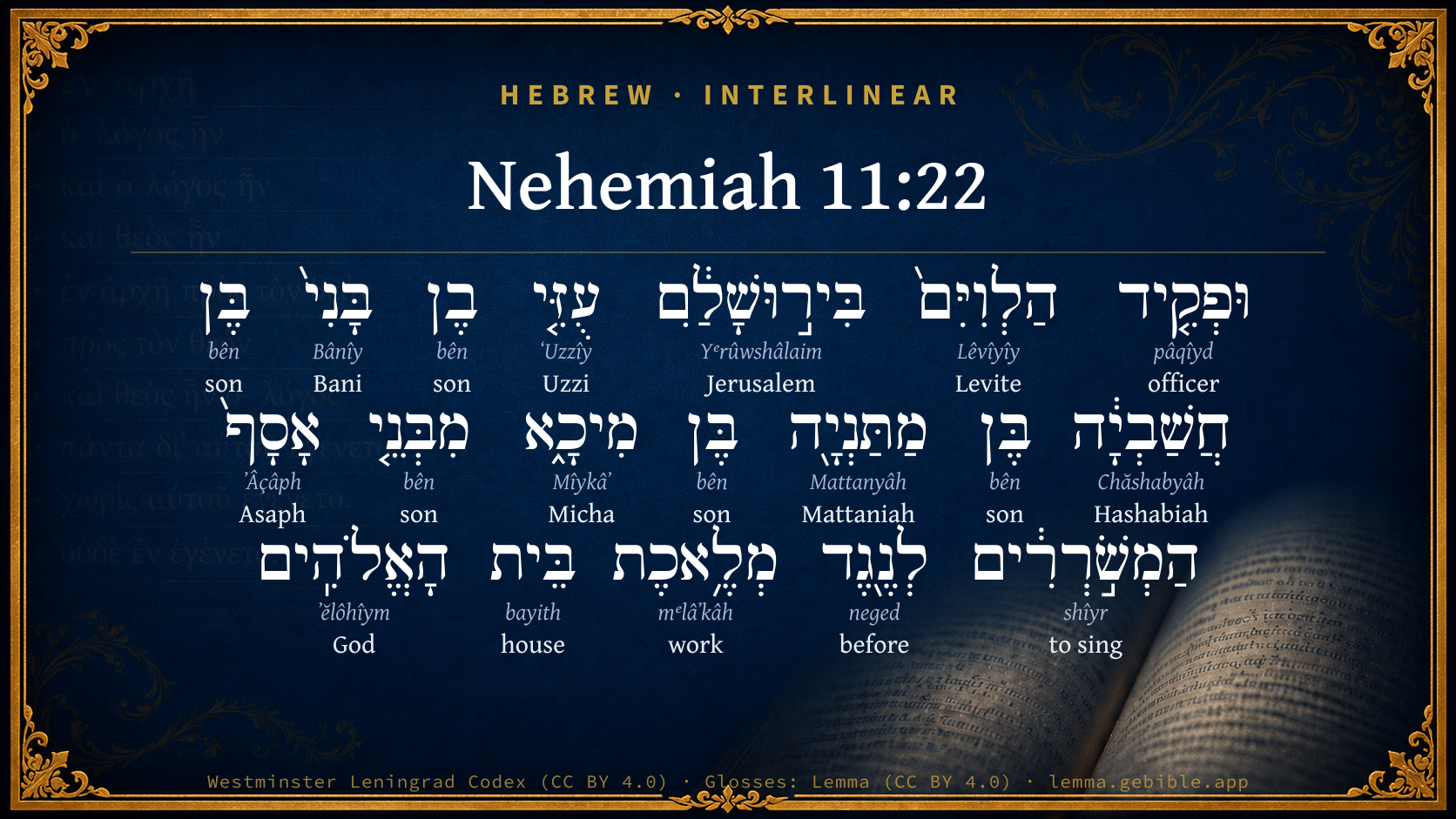
Nehemiah 11:22

Hebrew (Westminster Leningrad Codex) Nehemiah 11:22 appears in the Hebrew Old Testament. The text above is from the Westminster Leningrad Codex. Each word links to its Strong’s number, a concise gloss, and parsing drawn from the Open Scriptures Hebrew Bible morphology. Click any word for its full Brown-Driver-Briggs (BDB) entry.
Download image
Cite this verse

Nehemiah 11:22 (World English Bible). Public Domain. Lemma interlinear Bible study tool, https://lemma.gebible.app/v/nehemiah/11/22.

Show BibTeX & RIS
BibTeX
RIS
English Translation
The overseer also of the Levites at Jerusalem was Uzzi the son of Bani, the son of Hashabiah, the son of Mattaniah, the son of Mica, of the sons of Asaph, the singers, over the business of the house of God.
World English Bible · Public Domain
Download a study sheet

One document with this verse’s original text, its word-by-word gloss line, the meaning frame, cross-references with their text, attributed commentary, and full source and license credits — printable, and it pastes into notes with its structure intact.

This verse Autodidact and up

Study sheet (.html) Plain text (.txt)

A passage Seminary Student

Up to 50 verses in one chapter. A passage sheet keeps up to 6 commentary sources and 12 cross-references per verse, in the order this page ranks them, and says so on the sheet whenever that leaves anything out. Ask for a single verse and you get the Autodidact verse sheet above.

Everything on this page stays free to read, with no account — the sheet is a download of what is already on screen, not access to it.

Want to remove ads? Support Godless Engineer
Compare translations 3

The same verse in 3 English versions, stacked beneath the original-language interlinear above. Click any original word for its lexicon entry.

Each is an independent rendering of the whole verse — the interlinear is not word-aligned to these translations.

Highlighted words mark where these versions differ — a whole-verse word diff, not a word-by-word alignment.

  • World English Bible Public Domain
    The overseer also of the Levites at Jerusalem was Uzzi the son of Bani, the son of Hashabiah, the son of Mattaniah, the son of Mica, of the sons of Asaph, the singers, over the business of the house of God.
  • King James Version Public Domain
    The overseer also of the Levites at Jerusalem was Uzzi the son of Bani, the son of Hashabiah, the son of Mattaniah, the son of Micha. Of the sons of Asaph, the singers were over the business of the house of God.
  • unfoldingWord Literal Text CC BY-SA 4.0
    And the overseer of the Levites in Jerusalem was Uzzi, the son of Bani, the son of Hashabiah, the son of Mattaniah, the son of Mika, from the sons of Asaph, the ones who sang, who were over the work of the house of God.

unfoldingWord Literal Text — © unfoldingWord, licensed CC BY-SA 4.0. Word-aligned USFM3 via Door43 (git.door43.org/unfoldingWord/en_ult).

Versions to compare (up to 4)

3 of 4 selected

Show all 18 translations

Every available English version of this verse, each an independent rendering of the whole verse.

  • World English Bible Public Domain
    The overseer also of the Levites at Jerusalem was Uzzi the son of Bani, the son of Hashabiah, the son of Mattaniah, the son of Mica, of the sons of Asaph, the singers, over the business of the house of God.
  • Berean Standard Bible Public Domain
    Now the overseer of the Levites in Jerusalem was Uzzi son of Bani, the son of Hashabiah, the son of Mattaniah, the son of Mica. He was one of Asaph’s descendants, who were the singers in charge of the service of the house of God.
  • Majority Standard Bible Public Domain
    Now the overseer of the Levites in Jerusalem was Uzzi son of Bani, the son of Hashabiah, the son of Mattaniah, the son of Mica. He was one of Asaph’s descendants, who were the singers in charge of the service of the house of God.
  • King James Version Public Domain
    The overseer also of the Levites at Jerusalem was Uzzi the son of Bani, the son of Hashabiah, the son of Mattaniah, the son of Micha. Of the sons of Asaph, the singers were over the business of the house of God.
  • American Standard Version (1901) Public Domain
    The overseer also of the Levites at Jerusalem was Uzzi the son of Bani, the son of Hashabiah, the son of Mattaniah, the son of Mica, of the sons of Asaph, the singers, over the business of the house of God.
  • Revised Version (1885) Public Domain
    The overseer also of the Levites at Jerusalem was Uzzi the son of Bani, the son of Hashabiah, the son of Mattaniah, the son of Mica, of the sons of Asaph, the singers, over the business of the house of God.
  • Geneva Bible (1599) Public Domain
    And the ouerseer of the Leuites in Ierusalem was Vzzi the sonne of Bani, the sonne of Ashabiah, the sonne of Mattaniah, the sonne of Micha: of the sonnes of Asaph singers were ouer the worke of the house of God.
  • Douay-Rheims (1899) Public Domain
    And the overseer of the Levites in Jerusalem, was Azzi the son of Bani, the son of Hasabia, the son of Mathania, the son of Micha. Of the sons of Asaph, were the singing men in the ministry of the house of Cod.
  • Young's Literal Translation Public Domain
    And the overseer of the Levites in Jerusalem `is' Uzzi son of Bani, son of Hashabiah, son of Mattaniah, son of Micha: of the sons of Asaph, the singers `are' over-against the work of the house of God,
  • Literal Standard Version CC BY-SA 4.0
    And the overseer of the Levites in Jerusalem [is] Uzzi son of Bani, son of Hashabiah, son of Mattaniah, son of Micha—of the sons of Asaph, the singers [who are] for the front of the work of the house of God,
  • Unlocked Literal Bible CC BY-SA 4.0
    The chief officer over the Levites in Jerusalem was Uzzi son of Bani son of Hashabiah son of Mattaniah son of Mika, of the descendants of Asaph, singers over the work in the house of God.
  • unfoldingWord Literal Text CC BY-SA 4.0
    And the overseer of the Levites in Jerusalem was Uzzi, the son of Bani, the son of Hashabiah, the son of Mattaniah, the son of Mika, from the sons of Asaph, the ones who sang, who were over the work of the house of God.
  • Darby Bible Public Domain
    And the overseer of the Levites at Jerusalem was Uzzi the son of Bani, the son of Hashabiah, the son of Mattaniah, the son of Mica, of the sons of Asaph, the singers, for the work of the house of God.
  • World Messianic Bible Public Domain
    The overseer also of the Levites at Jerusalem was Uzzi the son of Bani, the son of Hashabiah, the son of Mattaniah, the son of Mica, of the sons of Asaph, the singers responsible for the service of God’s house.
  • Webster's Bible Public Domain
    The overseer also of the Levites at Jerusalem was Uzzi the son of Bani, the son of Hashabiah, the son of Mattaniah, the son of Micha. Of the sons of Asaph, the singers were over the business of the house of God.
  • Free Bible Version CC BY-SA 4.0
    The one in charge of the Levites in Jerusalem was Uzzi, son of Bani, son of Hashabiah, son of Mattaniah, son of Mica, one of Asaph's descendants, the singers who led the service in God's Temple.
  • Bible in Basic English Public Domain
    And the overseer of the Levites at Jerusalem was Uzzi, the son of Bani, the son of Hashabiah, the son of Mattaniah, the son of Mica, of the sons of Asaph, the music-makers, who was over the business of the house of God.
  • JPS Tanakh (1917) Public Domain
    The overseer also of the Levites at Jerusalem was Uzzi the son of Bani, the son of Hashabiah, the son of Mattaniah, the son of Mica, of the sons of Asaph, the singers, over the business of the house of God.

Literal Standard Version (2020), Covenant Press — licensed CC BY-SA 4.0. Text via the HelloAO Bible API (eBible.org). Unlocked Literal Bible (unfoldingWord) — licensed CC BY-SA 4.0. Text via the HelloAO Bible API (eBible.org). unfoldingWord Literal Text — © unfoldingWord, licensed CC BY-SA 4.0. Word-aligned USFM3 via Door43 (git.door43.org/unfoldingWord/en_ult). Free Bible Version, Dr. Jonathan Gallagher — licensed CC BY-SA 4.0. Text via the HelloAO Bible API (eBible.org).

Word by word

More ways to search: Search by grammar → Find every occurrence → Compare this word →

Practice this passage: Drill this verse → Learn its vocabulary →

מִיכָ֑א
Mîykâʼ
H4316
“Micha”
Noun, Proper
Part of Speech
Noun
Type
Proper
Full BDB Definition

Origin: a variation for H4318

TWOT: None

Micha = "who is like God" - son of Mephibosheth - a Levite who signed the covenant with Nehemiah - father of Mattaniah, a Gershonite Levite and descendant of Asaph
  1. וּפְקִ֤יד pâqîyd H6496 “and · officer of” Conjunction + Noun, Common, Masculine, Singular, Construct
  2. הַלְוִיִּם֙ Lêvîyîy H3881 “the · Levites” Particle, Definite Article + Noun, Gentilic, Masculine, Plural, Absolute
  3. בִּיר֣וּשָׁלִַ֔ם Yᵉrûwshâlaim H3389 “in/at · Jerusalem” Preposition + Noun, Proper
  4. עֻזִּ֤י ʻUzzîy H5813 “Uzzi” Noun, Proper
  5. בֶן bên H1121 “son of” Noun, Common, Masculine, Singular, Construct
  6. בָּנִי֙ Bânîy H1137 “Bani” Noun, Proper
  7. בֶּן bên H1121 “son of” Noun, Common, Masculine, Singular, Construct
  8. חֲשַׁבְיָ֔ה Chăshabyâh H2811 “Hashabiah” Noun, Proper
  9. בֶּן bên H1121 “son of” Noun, Common, Masculine, Singular, Construct
  10. מַתַּנְיָ֖ה Mattanyâh H4983 “Mattaniah” Noun, Proper
  11. בֶּן bên H1121 “son of” Noun, Common, Masculine, Singular, Construct
  12. מִבְּנֵ֤י bên H1121 “from · sons of” Preposition + Noun, Common, Masculine, Plural, Construct
  13. אָסָף֙ ʼÂçâph H623 “Asaph” Noun, Proper
  14. הַמְשֹׁ֣רְרִ֔ים shîyr H7891 “the · singing” Particle, Definite Article + Verb, Polel, Participle Active, Masculine, Plural, Absolute
  15. לְנֶ֖גֶד neged H5048 “to/for · before” Preposition + Preposition
  16. מְלֶ֥אכֶת mᵉlâʼkâh H4399 “work of” Noun, Common, Feminine, Singular, Construct
  17. בֵּית bayith H1004 “house of” Noun, Common, Masculine, Singular, Construct
  18. הָאֱלֹהִֽים ʼĕlôhîym H430 “the · God(s)” Particle, Definite Article + Noun, Common, Masculine, Plural, Absolute

About this verse

These counts appear in no published source. They are computed here, from the morphology-tagged text and Lemma’s own curated glosses. What Lemma adds →

19
words
15
distinct lemmas
Historical
section

Notable vocabulary

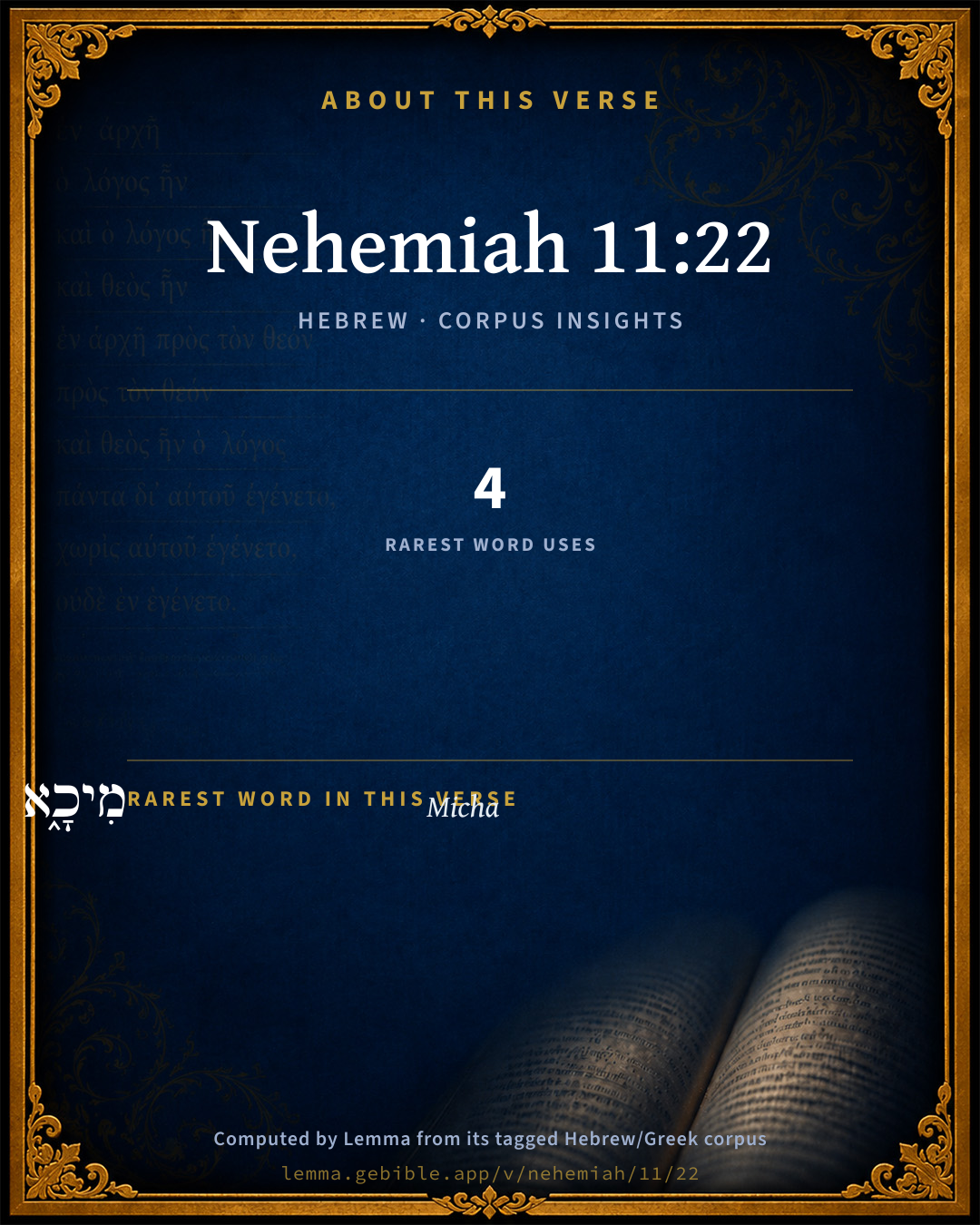
The rarest word here is מִיכָ֑א Micha H4316 — appearing just 4 times in the whole Hebrew Bible.

Shared distinctive vocabulary

מִיכָ֑א Micha H4316 occurs in 4 verses of the Hebrew Bible. Also found in:

Grammatical profile

  • 1 verb
  • 17 nouns
  • 1 preposition

Verb forms

  • הַמְשֹׁ֣רְרִ֔ים Polel · Participle Active

Repetition

A word recurs within this verse — often emphatic in Hebrew:

Cross-references

18

Topical passages linked to Nehemiah 11:22 in the Treasury of Scripture Knowledge — connected by theme and wording, ordered by reader-vote popularity; previews shown in the World English Bible.

  • Nehemiah 12:42 and Maaseiah, and Shemaiah, and Eleazar, and Uzzi, and Jehohanan, and Malchijah, and Elam, and Ezer. The singers sang loud, with Jezrahiah their overseer.
  • 1 Chronicles 9:15–32 and Bakbakkar, Heresh, and Galal, and Mattaniah the son of Mica, the son of Zichri, the son of Asaph,
  • 1 Chronicles 25:1–6 Moreover, David and the captains of the host set apart for the service certain of the sons of Asaph, and of Heman, and of Jeduthun, who should prophesy with harps, with psalteries, and with cymbals: and the number of those who did the work according to their service was:
  • Ezra 8:19 and Hashabiah, and with him Jeshaiah of the sons of Merari, his brothers and their sons, twenty;
  • Nehemiah 3:17 After him repaired the Levites, Rehum the son of Bani. Next to him repaired Hashabiah, the ruler of half the district of Keilah, for his district.
  • Nehemiah 8:7 Also Jeshua, and Bani, and Sherebiah, Jamin, Akkub, Shabbethai, Hodiah, Maaseiah, Kelita, Azariah, Jozabad, Hanan, Pelaiah, and the Levites, caused the people to understand the law: and the people [stood] in their place.
  • Nehemiah 9:4–5 Then stood up on the stairs of the Levites, Jeshua, and Bani, Kadmiel, Shebaniah, Bunni, Sherebiah, Bani, [and] Chenani, and cried with a loud voice to Yahweh their God.
  • Nehemiah 10:11 Mica, Rehob, Hashabiah,
  • Nehemiah 10:13 Hodiah, Bani, Beninu.
  • Nehemiah 11:9 Joel the son of Zichri was their overseer; and Judah the son of Hassenuah was second over the city.
  • Nehemiah 11:11 Seraiah the son of Hilkiah, the son of Meshullam, the son of Zadok, the son of Meraioth, the son of Ahitub, the ruler of the house of God,
  • Nehemiah 11:14 and their brothers, mighty men of valor, one hundred twenty-eight; and their overseer was Zabdiel, the son of Haggedolim.
  • Nehemiah 11:16–17 and Shabbethai and Jozabad, of the chiefs of the Levites, who had the oversight of the outward business of the house of God;
  • Nehemiah 12:35 and certain of the priests' sons with trumpets: Zechariah the son of Jonathan, the son of Shemaiah, the son of Mattaniah, the son of Micaiah, the son of Zaccur, the son of Asaph;
  • Nehemiah 12:24–25 The chiefs of the Levites: Hashabiah, Sherebiah, and Jeshua the son of Kadmiel, with their brothers over against them, to praise and give thanks, according to the commandment of David the man of God, watch next to watch.
  • Nehemiah 12:46 For in the days of David and Asaph of old there was a chief of the singers, and songs of praise and thanksgiving to God.
  • Nehemiah 13:13 I made treasurers over the treasuries, Shelemiah the priest, and Zadok the scribe, and of the Levites, Pedaiah: and next to them was Hanan the son of Zaccur, the son of Mattaniah; for they were counted faithful, and their business was to distribute to their brothers.
  • Acts 20:28 Take heed, therefore, to yourselves, and to all the flock, in which the Holy Spirit has made you overseers, to shepherd the assembly of the Lord and God which he purchased with his own blood.

Cross-references courtesy of OpenBible.info (CC BY 4.0).

Hebrew and Greek witnesses Masoretic Hebrew ↔ Greek Septuagint

The same verse in the two great witnesses to the Old Testament, shown verse-for-verse.

These are two independent witnesses, not word-aligned to each other, and the Septuagint is shown in lemma (dictionary) form.

Hebrew Nehemiah 11:22 Masoretic · Westminster Leningrad Codex

וּפְקִ֤יד הַלְוִיִּם֙ בִּיר֣וּשָׁלִַ֔ם עֻזִּ֤י בֶן בָּנִי֙ בֶּן חֲשַׁבְיָ֔ה בֶּן מַתַּנְיָ֖ה בֶּן מִיכָ֑א מִבְּנֵ֤י אָסָף֙ הַמְשֹׁ֣רְרִ֔ים לְנֶ֖גֶד מְלֶ֥אכֶת בֵּית הָאֱלֹהִֽים

The overseer also of the Levites at Jerusalem was Uzzi the son of Bani, the son of Hashabiah, the son of Mattaniah, the son of Mica, of the sons of Asaph, the singers, over the business of the house of God.

World English Bible · Public Domain

Greek LXX Structure differs

The Septuagint has no separate book of Nehemiah. Its Greek text is the second half of Esdras B (2 Esdras), chapters 11–23; Ezra is the first half (1–10).

A verse-for-verse comparison isn’t shown here because the chapters and verses don’t line up. Switch to the LXX edition with the MT / LXX toggle above to read the Greek directly.

On this verse, Adam Clarke's Commentary discusses the Septuagint’s reading. Read the note in Commentary ↓

Hebrew: Westminster Leningrad Codex (CC BY 4.0). Greek: Septuagint (public domain); English from a public-domain English Septuagint. How the Septuagint differs from the Hebrew →

Commentary

Notes on Nehemiah 11:22 from classic Christian and Jewish commentators (each source and its license shown beneath its notes). The classic Christian expositions comment on the surrounding passage and are grouped to its opening verse, so a note may address several verses; the Jewish commentaries on the Tanakh (Rashi and others) are per-verse, so they appear only where the commentator wrote on this verse.

Lemma curates 59 commentaries, every one of them public domain or Creative Commons licensed, each selected and text-cleaned for this edition rather than reprinted as found. About our sources →

Trapp's Complete Commentary

John Trapp

Neh 11:22 The overseer also of the Levites at Jerusalem [was] Uzzi the son of Bani, the son of Hashabiah, the son of Mattaniah, the son of Micha. Of the sons of Asaph, the singers [were] over the business of the house of God.

Ver. 22. The overseer] The Vulgate has it, the bishop.

John Trapp, A Commentary or Exposition upon All the Books of the Old and New Testament (1647–1656) — public domain. Text from a community e-Sword module.

Joseph Benson's Commentary

Neh 11:22. The sons of Asaph were over the business of the house of God — Were to take care at Jerusalem for the supply of such things as were necessary for the temple and the service of God, from time to time, while others minded the outward business, Neh 11:16. And this office was very proper for them, both as they were Levites, to whose care those things belonged; and as they were singers, who were not to come up to Jerusalem by turns, as other Levites, and as the priests did, but were constantly to reside there, and therefore were more capable of minding this business. Besides, their employment was not so frequent nor so great as some others were, and therefore they had more leisure for it.

Joseph Benson's Commentary on the Old and New Testaments (1811–1818) — public domain. Text from a community e-Sword module.

Jamieson, Fausset & Brown

Robert Jamieson, A. R. Fausset & David Brown

the sons of Asaph, the singers were over the business of the house of God--They were selected to take charge of providing those things which were required for the interior of the temple and its service, while to others was committed the care of the "outward business of the house of God" (Neh 11:16). This duty was very properly assigned to the sons of Asaph; for, though they were Levites, they did not repair in rotation to Jerusalem, as the other ministers of religion. Being permanent residents, and employed in duties which were comparatively light and easy, they were very competent to undertake this charge.

Jamieson, Fausset & Brown — Commentary Critical and Explanatory on the Whole Bible (1871) — public domain (CC PDM 1.0). Text via the HelloAO Bible API.

Adam Clarke's Commentary

Verse 22. The overseer also of the Levites] פקיד pekid, the visitant, the inspector; translated επισκοπος, bishop, both by the Septuagint and Vulgate.

Adam Clarke's Commentary on the Bible (1810–1826) — public domain. Text from a community e-Sword/MySword module.

Ellicott's Commentary for English Readers

(22) The overseer.—Pakid, or visitor.

Of the sons of Asaph.—It requires no disturbance of the original to read the whole of Uzzi’s pedigree: “the son of Micha, of the sons of Asaph, the singers in the service of the house of God.” Thus with the prayer of Neh_11:17 there is a parallel.

A Bible Commentary for English Readers, edited by Charles John Ellicott (1878–1897) — public domain. Text from a community e-Sword module.

The Cambridge Bible for Schools and Colleges

gen. ed. J. J. S. Perowne

22. Uzzi] Uzzi’s position as overseer of the Levites ‘over the business of the house of God’ is parallel to that of Shabbethai and Jozabad (Neh_11:16).

Micha] R.V. Mica. Cf. Neh_11:17.

Of the sons of Asaph, the singers were over &c.] R.V. of the sons of Asaph, the singers, over &c. The R.V. rightly takes the whole verse to be one sentence, defining firstly the descent and then the duties of Uzzi. The word ‘overseer’ must be joined with ‘over the business’: while ‘the singers’ is in apposition to ‘the sons of Asaph.’

The A.V. in dividing the sentence probably followed the LXX. and Vulg. (‘De filiis Asaph cantores in ministerio domus Dei’). The purpose of the division may have been to secure to ‘the singers’ a separate mention of their office. But (1) they were tacitly included in Neh_11:17, (2) ‘the singers’ would not be over ‘the business of the house of God.’

the business of the house of God] See note on Neh_11:16. The ‘business’ is that of the liturgical worship and the organization necessary for the regular rotation of Levitical service.

The Cambridge Bible for Schools and Colleges (gen. ed. J. J. S. Perowne; Cambridge University Press, 1878–1918) — public domain. Text from a community e-Sword module.

Albert Barnes' Notes on the Bible

The business intended was probably the internal business, as distinct from the “outward business” Neh 11:16 : a part of which was the apportionment of the royal bounty among the members of the choir Neh 11:23.

Albert Barnes' Notes on the Bible (1834–1885) — public domain. Text from a community e-Sword/MySword module.

Haydock's Catholic Bible Commentary

Overseer. Literally, "bishop." Hebrew pekid, which has the same meaning. (Haydock) --- Christians styled him who was at the head, bishop; as the Athenians did their chief justice. (Grotius) (Estius) (Calmet)

George Leo Haydock (1774–1849), Haydock's Catholic Family Bible and Commentary, 1859 edition — public domain. Excludes Psalms (Douay-Rheims chapter numbering differs from Protestant) and Deuterocanonical books (Catholic canon only).

Matthew Poole's English Annotations

i.e. Were to take care at Jerusalem for the supply of such things as were necessary for the temple and the service of God, from time to time, whilst others minded the outward business, Neh 11:16. And this office was very proper for them, both as they were Levites, to whose care those things belonged; and as they were singers, who were not to come to Jerusalem by turns, as other Levites, and as the priests did, but were constantly to reside there, and therefore were more capable of minding this business. Besides, their employment was not so frequent nor so great as some others were, and therefore they had more leisure for it.

Matthew Poole's English Annotations on the Holy Bible (1683–1685) — public domain. Text from a community e-Sword/MySword module.

The Pulpit Commentary

Properly, the whole of this verse forms a single sentence, and should run as follows: the overseer of the Levites in Jerusalem, Huzzi, the son of Bani, the son of Hashabiah, the son of Mattaniah, the son of Micha, of the sons of Asaph the singers, was over the business of the house of God." As Shabbethai and Jozabad "had the oversight of the outward business" (ver. 16), so the internal business was under the superintendence of Huzzi, or Uzzi. Uzzi appears as taking part in the dedication of the wall. (Neh_12:42)

The Pulpit Commentary (1880–1919), ed. H.D.M. Spence-Jones & Joseph S. Exell — public domain. Text from a community e-Sword module.

unfoldingWord translationNotes

Door43 World Missions Community

The chief officer over

"The overseer of"

Uzzi ... Bani ... Hashabiah ... Mattaniah ... Mika ... Asaph ... Pethahiah ... Meshezabel ... Zerah ... Judah

These are the names of men. (See: How to Translate Names)

They were under orders from the king

"The king had told them what to do"

firm orders were given for the singers

This can be translated in active form. AT: "the king had told them specifically what to do about the singers" (See: Active or Passive)

at the king's side in all matters concerning the people

"at the Persian king's side as an adviser in all matters concerning the Jewish people"

translationWords

Levi

servant

Jerusalem

son

descend

Asaph

works

house of God

king

unfoldingWord translationNotes — © Distant Shores Media and the Door43 World Missions Community, licensed CC BY-SA 4.0. Source: git.door43.org/Door43/en_tn.

Rashi

Rabbi Shlomo Yitzchaki (Rashi)

And the official over the Levites appointed over the Levites in Jerusalem.

over the work of the Temple of God He was appointed over the work of the Temple, such as the buildings of the repair of the Temple and the rest of the matters for which money is spent for the work of the Temple, like the matter that is stated above (verse 16): “...and Shabbethai and Jazabad over the outside work, etc.”

Rashi on the Tanakh — English translations: “The Judaica Press complete Tanach with Rashi, translated by A. J. Rosenberg” (CC BY 4.0); “Pentateuch with Rashi's commentary by M. Rosenbaum and A.M. Silbermann, 1929-1934” (public domain); “The Metsudah Tanach series, Lakewood, N.J” (CC BY 4.0); and “The Book of Joshua, Metsudah Publications, 1997” (CC BY 4.0). Text via Sefaria.

Lesson kit

Teaching starters — assembled from the data on this page, not authored interpretation. Every prompt links to the verse data it draws on. Edit before teaching.

Nehemiah, in the Historical, opens this verse with 19 words (15 distinct Hebrew lemmas). Its most distinctive word is Mîykâʼ (“Micha”). A historical commentator’s framing appears above. Read the whole chapter for the surrounding context.

Discussion questions

  1. What does “Micha” (Mîykâʼ) contribute to the verse as a whole?
  2. How does 2 Samuel 9:12, which shares the word «Micha», read alongside this verse?
  3. What does the repetition of “son” (5× in this one verse) do in this verse?
  4. These translations render this verse differently; the difference is in the English rendering, not the original. What questions does that raise?
  5. «הַמְשֹׁ֣רְרִ֔ים» is a Polel Participle Active verb. How does that grammatical form shape the action described?
  6. Compare how Trapp's Complete Commentary and Joseph Benson's Commentary read this verse. Where do they agree or differ?

Things to notice

Reading settings

Reading text

Shown beneath each verse's original-language words.

Old Testament
Old Testament edition

Read the OT as the Masoretic Hebrew (MT) or the Greek Septuagint (LXX).

English shown for the Greek Septuagint (in the Hebrew ↔ Greek comparison).

Comparing translations? Open the Compare panel on any verse page to stack up to four side by side.