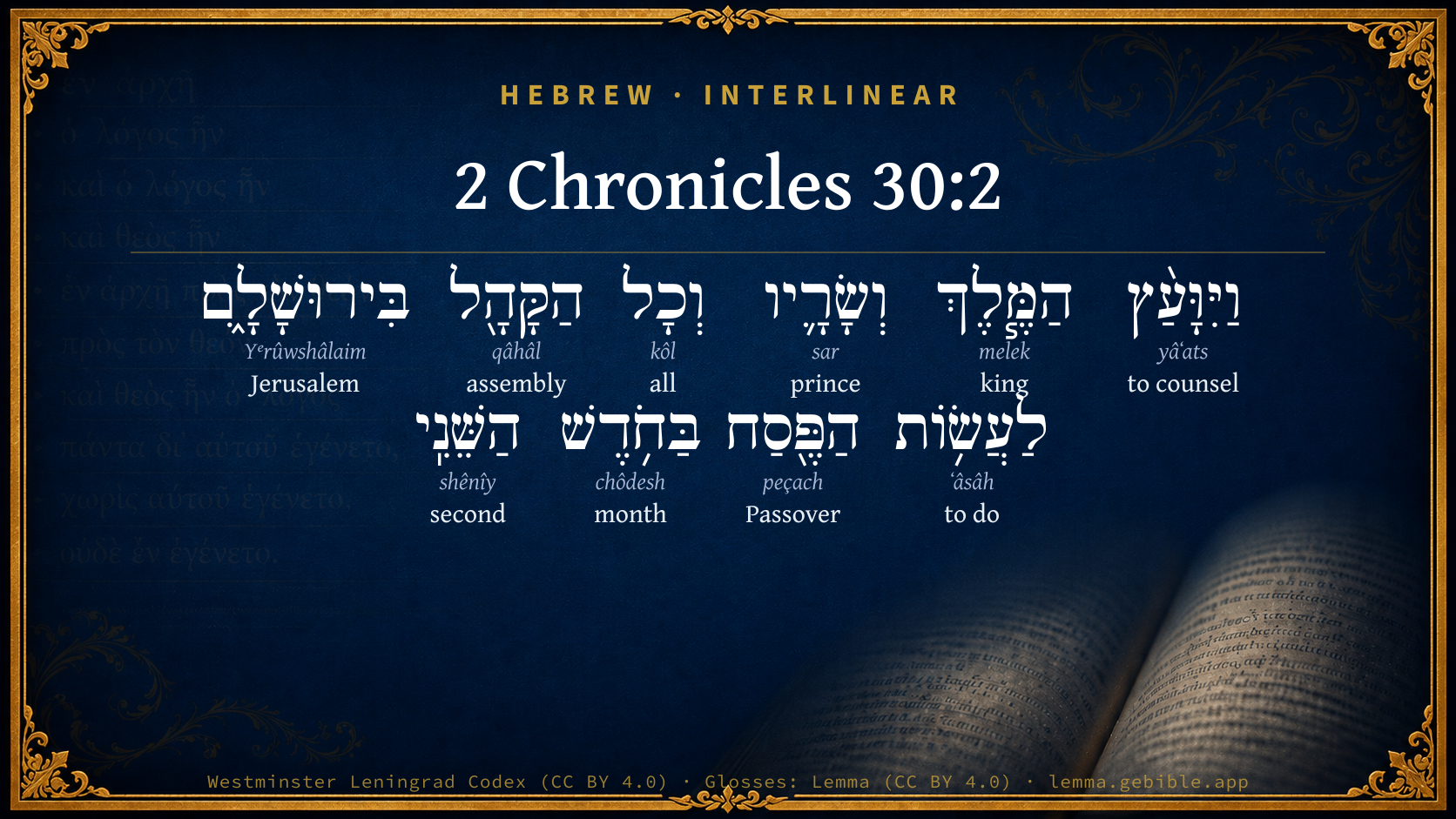
2 Chronicles 30:2

Hebrew (Westminster Leningrad Codex) 2 Chronicles 30:2 appears in the Hebrew Old Testament. The text above is from the Westminster Leningrad Codex. Each word links to its Strong’s number, a concise gloss, and parsing drawn from the Open Scriptures Hebrew Bible morphology. Click any word for its full Brown-Driver-Briggs (BDB) entry.
Download image
Cite this verse

2 Chronicles 30:2 (World English Bible). Public Domain. Lemma interlinear Bible study tool, https://lemma.gebible.app/v/2-chronicles/30/2.

Show BibTeX & RIS
BibTeX
RIS
English Translation
For the king had taken counsel, and his princes, and all the assembly in Jerusalem, to keep the Passover in the second month.
World English Bible · Public Domain
Download a study sheet

One document with this verse’s original text, its word-by-word gloss line, the meaning frame, cross-references with their text, attributed commentary, and full source and license credits — printable, and it pastes into notes with its structure intact.

This verse Autodidact and up

Study sheet (.html) Plain text (.txt)

A passage Seminary Student

Up to 50 verses in one chapter. A passage sheet keeps up to 6 commentary sources and 12 cross-references per verse, in the order this page ranks them, and says so on the sheet whenever that leaves anything out. Ask for a single verse and you get the Autodidact verse sheet above.

Everything on this page stays free to read, with no account — the sheet is a download of what is already on screen, not access to it.

Want to remove ads? Support Godless Engineer
Compare translations 3

The same verse in 3 English versions, stacked beneath the original-language interlinear above. Click any original word for its lexicon entry.

Each is an independent rendering of the whole verse — the interlinear is not word-aligned to these translations.

Highlighted words mark where these versions differ — a whole-verse word diff, not a word-by-word alignment.

  • World English Bible Public Domain
    For the king had taken counsel, and his princes, and all the assembly in Jerusalem, to keep the Passover in the second month.
  • King James Version Public Domain
    For the king had taken counsel, and his princes, and all the congregation in Jerusalem, to keep the passover in the second month.
  • unfoldingWord Literal Text CC BY-SA 4.0
    And the king consulted, and his chiefs, and all the assembly in Jerusalem, to do the Passover in the second month.

unfoldingWord Literal Text — © unfoldingWord, licensed CC BY-SA 4.0. Word-aligned USFM3 via Door43 (git.door43.org/unfoldingWord/en_ult).

Versions to compare (up to 4)

3 of 4 selected

Show all 17 translations

Every available English version of this verse, each an independent rendering of the whole verse.

  • World English Bible Public Domain
    For the king had taken counsel, and his princes, and all the assembly in Jerusalem, to keep the Passover in the second month.
  • Berean Standard Bible Public Domain
    For the king and his officials and the whole assembly in Jerusalem had decided to keep the Passover in the second month,
  • Majority Standard Bible Public Domain
    For the king and his officials and the whole assembly in Jerusalem had decided to keep the Passover in the second month,
  • King James Version Public Domain
    For the king had taken counsel, and his princes, and all the congregation in Jerusalem, to keep the passover in the second month.
  • American Standard Version (1901) Public Domain
    For the king had taken counsel, and his princes, and all the assembly in Jerusalem, to keep the passover in the second month.
  • Revised Version (1885) Public Domain
    For the king had taken counsel, and his princes, and all the congregation in Jerusalem, to keep the passover in the second month.
  • Geneva Bible (1599) Public Domain
    And the King and his princes and all the Congregation had taken counsel in Ierusalem to keepe the Passeouer in the second moneth.
  • Young's Literal Translation Public Domain
    And the king taketh counsel, and his heads, and all the assembly in Jerusalem, to make the passover in the second month,
  • Literal Standard Version CC BY-SA 4.0
    And the king takes counsel, and his heads, and all the assembly in Jerusalem, to make the Passover in the second month,
  • Unlocked Literal Bible CC BY-SA 4.0
    For the king, his leaders, and all the assembly in Jerusalem had consulted together, deciding to celebrate the Passover in the second month.
  • unfoldingWord Literal Text CC BY-SA 4.0
    And the king consulted, and his chiefs, and all the assembly in Jerusalem, to do the Passover in the second month.
  • Darby Bible Public Domain
    And the king took counsel, and his princes, and the whole congregation in Jerusalem, to hold the passover in the second month.
  • World Messianic Bible Public Domain
    For the king had taken counsel with his princes and all the assembly in Jerusalem to keep the Passover in the second month.
  • Webster's Bible Public Domain
    For the king had taken counsel, and his princes, and all the congregation in Jerusalem, to keep the passover in the second month.
  • Free Bible Version CC BY-SA 4.0
    The king and his officials and the whole assembly in Jerusalem had decided to observe the Passover in the second month,
  • Bible in Basic English Public Domain
    For the king, after discussion with his chiefs and all the body of the people in Jerusalem, had made a decision to keep the Passover in the second month.
  • JPS Tanakh (1917) Public Domain
    For the king had taken counsel, and his princes, and all the congregation in Jerusalem, to keep the passover in the second month.

Literal Standard Version (2020), Covenant Press — licensed CC BY-SA 4.0. Text via the HelloAO Bible API (eBible.org). Unlocked Literal Bible (unfoldingWord) — licensed CC BY-SA 4.0. Text via the HelloAO Bible API (eBible.org). unfoldingWord Literal Text — © unfoldingWord, licensed CC BY-SA 4.0. Word-aligned USFM3 via Door43 (git.door43.org/unfoldingWord/en_ult). Free Bible Version, Dr. Jonathan Gallagher — licensed CC BY-SA 4.0. Text via the HelloAO Bible API (eBible.org).

Word by word

More ways to search: Search by grammar → Find every occurrence → Compare this word →

Practice this passage: Drill this verse → Learn its vocabulary →

הַפֶּ֖סַח
peçach
H6453
“the · Passover”
Particle, Definite Article + Noun, Common, Masculine, Singular, Absolute
Part of Speech
Particle + Noun
Type
Common
Gender
Masculine
Number
Singular
State
Absolute
Full BDB Definition

Origin: from H6452

TWOT: 1786a

passover - sacrifice of passover - animal victim of the passover - festival of the passover
  1. וַיִּוָּעַ֨ץ yâʻats H3289 “and · to counsel” Conjunction + Verb, Niphal, Sequential Imperfect, 3rd Person, Masculine, Singular
  2. הַמֶּ֧לֶךְ melek H4428 “the · king” Particle, Definite Article + Noun, Common, Masculine, Singular, Absolute
  3. וְשָׂרָ֛יו sar H8269 “and · princes · his” Conjunction + Noun, Common, Masculine, Plural, Construct + Suffix, Personal, 3rd Person, Masculine, Singular
  4. וְכָל kôl H3605 “and · all of” Conjunction + Noun, Common, Masculine, Singular, Construct
  5. הַקָּהָ֖ל qâhâl H6951 “the · assembly” Particle, Definite Article + Noun, Common, Masculine, Singular, Absolute
  6. בִּירוּשָׁלִָ֑ם Yᵉrûwshâlaim H3389 “in/at · Jerusalem” Preposition + Noun, Proper
  7. לַעֲשׂ֥וֹת ʻâsâh H6213 “to do” Preposition + Verb, Qal, Infinitive Construct
  8. בַּחֹ֥דֶשׁ chôdesh H2320 “in/at the · month” Preposition, Determined + Noun, Common, Masculine, Singular, Absolute
  9. הַשֵּׁנִֽי shênîy H8145 “the the · second” Preposition, Determined + Noun, Common, Both, Singular, Absolute

About this verse

These counts appear in no published source. They are computed here, from the morphology-tagged text and Lemma’s own curated glosses. What Lemma adds →

10
words
10
distinct lemmas
Historical
section

Shared distinctive vocabulary

הַפֶּ֖סַח Passover H6453 occurs in 46 verses of the Hebrew Bible. Also found in:

Grammatical profile

  • 2 verbs
  • 8 nouns

Verb forms

  • וַיִּוָּעַ֨ץ Niphal · Sequential Imperfect
  • לַעֲשׂ֥וֹת Qal · Infinitive Construct

Hebrew & Septuagint length

In English translation the verse runs 23 words from the Hebrew and 21 from the Septuagint (LXX English) — closely comparable.

A rough comparison of the two English renderings, which tokenize alike — not a word-level alignment.

Word counts can differ between the Hebrew and the Greek without any difference in meaning — e.g. the Hebrew direct-object marker אֵת has no separate Greek word, and Greek often adds the article ὁ.

Cross-references

7

Topical passages linked to 2 Chronicles 30:2 in the Treasury of Scripture Knowledge — connected by theme and wording, ordered by reader-vote popularity; previews shown in the World English Bible.

  • Numbers 9:10–11 "Say to the children of Israel, 'If any man of you or of your generations is unclean by reason of a dead body, or is on a journey far away, he shall still keep the Passover to Yahweh.
  • 1 Chronicles 13:1–3 David consulted with the captains of thousands and of hundreds, even with every leader.
  • 2 Chronicles 30:13 There assembled at Jerusalem much people to keep the feast of unleavened bread in the second month, a very great assembly.
  • 2 Chronicles 30:15 Then they killed the Passover on the fourteenth [day] of the second month: and the priests and the Levites were ashamed, and sanctified themselves, and brought burnt offerings into the house of Yahweh.
  • Proverbs 11:14 Where there is no wise guidance, the nation falls, But in the multitude of counselors there is victory.
  • Proverbs 15:22 Where there is no counsel, plans fail; But in a multitude of counselors they are established.
  • Ecclesiastes 4:13 Better is a poor and wise youth than an old and foolish king who doesn't know how to receive admonition any more.

Cross-references courtesy of OpenBible.info (CC BY 4.0).

Hebrew and Greek witnesses Masoretic Hebrew ↔ Greek Septuagint

The same verse in the two great witnesses to the Old Testament, shown verse-for-verse.

These are two independent witnesses, not word-aligned to each other, and the Septuagint is shown in lemma (dictionary) form.

Hebrew 2 Chronicles 30:2 Masoretic · Westminster Leningrad Codex

וַיִּוָּעַ֨ץ הַמֶּ֧לֶךְ וְשָׂרָ֛יו וְכָל הַקָּהָ֖ל בִּירוּשָׁלִָ֑ם לַעֲשׂ֥וֹת הַפֶּ֖סַח בַּחֹ֥דֶשׁ הַשֵּׁנִֽי

For the king had taken counsel, and his princes, and all the assembly in Jerusalem, to keep the Passover in the second month.

World English Bible · Public Domain

Greek LXX 2 Chronicles 30:2 Septuagint · lemma form

καί βουλεύω ὁ βασιλεύς καί ὁ ἄρχων καί πᾶς ὁ ἐκκλησία ὁ ἐν ἰερουσαλήμ ποιέω ὁ φασεκ ὁ μήν ὁ δεύτερος

For the king, and the princes, and all the congregation in Jerusalem, designed to keep the passover in the second month.

LXX2012 (modern English Septuagint) · Public Domain

Hebrew: Westminster Leningrad Codex (CC BY 4.0). Greek: Septuagint (public domain); English from LXX2012 (modern English Septuagint) (Public Domain). How the Septuagint differs from the Hebrew →

Commentary

Notes on 2 Chronicles 30:2 from classic Christian and Jewish commentators (each source and its license shown beneath its notes). The classic Christian expositions comment on the surrounding passage and are grouped to its opening verse, so a note may address several verses; the Jewish commentaries on the Tanakh (Rashi and others) are per-verse, so they appear only where the commentator wrote on this verse.

Lemma curates 59 commentaries, every one of them public domain or Creative Commons licensed, each selected and text-cleaned for this edition rather than reprinted as found. About our sources →

Trapp's Complete Commentary

John Trapp

2Ch 30:2 For the king had taken counsel, and his princes, and all the congregation in Jerusalem, to keep the passover in the second month.

Ver. 2. To keep the passover in the second month.] He knew that nunquam sero si serio. See Num 9:10. If we can but say, with Augustine, Nimis sero te amavi Domine, all shall do well.

John Trapp, A Commentary or Exposition upon All the Books of the Old and New Testament (1647–1656) — public domain. Text from a community e-Sword module.

Joseph Benson's Commentary

2Ch 30:2. The king had taken counsel, &c. — The law directed that the passover should be celebrated on the fourteenth day of the first mouth: but as it was found impossible to get all things in readiness against that time, it was thought more advisable to adjourn it to the fourteenth day of the next month, than to defer it till the next year. And for this they had some encouragement, as it was allowed in the law, that in case any man was unclean by reason of a dead body, or was on a journey afar off, at the proper time of the celebration of the passover, he might eat it on the fourteenth day of the second mouth, Num 9:10-11. And what was an indulgence to particular persons, they judged, might be allowed to the whole congregation of Israel.

Joseph Benson's Commentary on the Old and New Testaments (1811–1818) — public domain. Text from a community e-Sword module.

Tyndale Open Study Notes

Tyndale Open Resources

30:2-3 a month later than usual: The law made provision for the delayed observance of the Passover if an individual inadvertently was ceremonially unclean or was away on a long journey (Num 9:9-11); Hezekiah’s Passover followed the spirit if not the letter of those provisions. The delayed Passover provided opportunity for national unity and spiritual renewal.

Tyndale Open Study Notes — © Tyndale Open Resources, licensed CC BY-SA 4.0. Text via the HelloAO Bible API.

Geneva Bible (1599)

Geneva Bible translators

Though they ought to have done it in the first month, as Exod. 12:18; Num. 9:3, yet if any were not clean, or else had a long journey, they might defer it unto the second month, as Num. 9:10, 11.

Geneva Bible (1599) marginal notes — public domain. Text via Bolls.life.

Adam Clarke's Commentary

Verse 2. In the second month.] In Ijar, as they could not celebrate it in Nisan, the fourteenth of which month was the proper time. But as they could not complete the purgation of the temple, till the sixteenth of that month, therefore they were obliged to hold it now, or else adjourn it till the next year, which would have been fatal to that spirit of reformation which had now taken place. The law itself had given permission to those who were at a distance, and could not attend to the fourteenth of the first month, and to those who were accidentally defiled, and ought not to attend, to celebrate the passover on the fourteenth of the second month; see Nu 9:10-11. Hezekiah therefore, and his counsellors, thought that they might extend that to the people at large, because of the delay necessarily occasioned by the cleansing of the temple, which was granted to individuals in such cases as the above, and the result showed that they had not mistaken the mind of the Lord upon the subject.

Adam Clarke's Commentary on the Bible (1810–1826) — public domain. Text from a community e-Sword/MySword module.

Ellicott's Commentary for English Readers

(2) For the king had taken counsel.—And the king determined (2Ch_25:17). The resolution was taken by the king in council with his grandees and the popular representatives; apparently before the 14th of Nisan, which was the proper time for keeping the feast.

In the second month.—And not in the first month of the sacred year, as the law prescribes (Num_9:1-5). The grounds of the postponement are assigned in the next verse, viz., the legal impurity of many of the priests, and the non-arrival of the people at the proper time. The law permits postponement to the second month in such cases (Num_9:6-11). The first month was Nisan; Assyr., Nisdnu; the second, Iyyar; Assyr., Aru.

A Bible Commentary for English Readers, edited by Charles John Ellicott (1878–1897) — public domain. Text from a community e-Sword module.

The Cambridge Bible for Schools and Colleges

gen. ed. J. J. S. Perowne

2. in the second month] The Law allowed such a postponement; cp. Num_9:10-11.

The Cambridge Bible for Schools and Colleges (gen. ed. J. J. S. Perowne; Cambridge University Press, 1878–1918) — public domain. Text from a community e-Sword module.

John Gill's Exposition

For the king had taken counsel, and his princes, and all the congregation in Jerusalem,.... He and his nobles, and the great sanhedrim or senate of the nation, had consulted together:

to keep the passover in the second month; in the month Ijar, as the Targum, because they could not keep it in the first month, as it should have been kept, according to the law of God, for the reasons following.

John Gill's Exposition of the Whole Bible (1746–1763) — public domain (CC PDM 1.0). Text via the HelloAO Bible API.

Albert Barnes' Notes on the Bible

In the second month - Hezekiah and his counselors considered that the permission of the Law (see the marginal reference) might, under the circumstances, be extended to the whole people. It had been found impossible to complete the cleansing of the temple until the fourteenth day of the first month was past 2Ch 29:17. It was, therefore, determined to defer it to the 14th of the second month, which allowed time for the priests generally to purify themselves, and for proclamation of the festival to be made throughout all Israel.

Albert Barnes' Notes on the Bible (1834–1885) — public domain. Text from a community e-Sword/MySword module.

Haydock's Catholic Bible Commentary

Month. The Rabbins pretend that the king intercalated the second Adar, contrary to the rule and advice of the wise, and the that he ought to have allowed those who were pure to celebrate the feast in due time. Selden, Syn. ii. 1. --- But the Caraite Jews deny this pretended leap-year; and we see that Ezechias acted according to the advice of the princes, and that the Scripture praises his conduct. C. --- Those who had a lawful impediment, were authorized to put off the feast till the second month, Num. ix. 10. The nation was under this predicament, as they had not priests at hand, (T.) nor were they assembled. D.

George Leo Haydock (1774–1849), Haydock's Catholic Family Bible and Commentary, 1859 edition — public domain. Excludes Psalms (Douay-Rheims chapter numbering differs from Protestant) and Deuterocanonical books (Catholic canon only).

Matthew Poole's English Annotations

Which was against the common rule and practice, but was justified by that supreme law of necessity, and by a just impediment, which made the doing of this in its proper time, to wit, the fourteenth day of the first month, impossible, because the temple was not cleansed nor they prepared till that time was past, 2Ch 29:3,17. Compare Num 9:10,11.

Matthew Poole's English Annotations on the Holy Bible (1683–1685) — public domain. Text from a community e-Sword/MySword module.

Whedon's Commentary on the Bible

Daniel D. Whedon

2, 3.

To keep the passover in the second month — The law expressly allowed those to keep the passover in the second month who, for special reasons, were unable to keep it in the first. Those reasons were uncleanness by reason of a dead body, and absence on a journey afar off. See Num_9:10-11. At that time, that is, in the first month, both these reasons, virtually, prevented most of the nation from holding the passover, because the priests had not sanctified themselves sufficiently, neither had the people gathered themselves together to Jerusalem. So the priests were ceremonially unclean, and the people were absent.

Daniel D. Whedon (gen. ed.), Commentary on the Old and New Testaments (1874–1909) — public domain. Text from a community e-Sword module.

The Pulpit Commentary

This and the following verse are well explained by Num_9:6-13, where the particular instance of the "defilement by a dead body" simply exemplified other legitimate instances of defilement or non-sanctification, (2Ch_29:5, 2Ch_29:15, 2Ch_29:34) and where absence on a journey similarly exemplified other unavoidable absence.

The Pulpit Commentary (1880–1919), ed. H.D.M. Spence-Jones & Joseph S. Exell — public domain. Text from a community e-Sword module.

John Wesley's Explanatory Notes

Second month - Which was against the common rule, but the doing of this in its proper time, namely, the fourteenth day of the first month was impossible, because the temple was not cleansed, nor they prepared. As there was a proviso in the law, that particular persons who were unclean in the first month, might keep the passover the fourteenth day of the second month, he doubted not but that might be extended by the whole congregation.

John Wesley, Explanatory Notes Upon the Whole Bible (1754–1765) — public domain. Text via the GEBible commentary corpus.

Scofield Reference Notes

C. I. Scofield

second month

i.e. May; 2Ch 30:13; 2Ch 30:15.

The Scofield Reference Bible (1917 edition), notes by C. I. Scofield — public domain. Text from a community e-Sword module.

Lesson kit

Teaching starters — assembled from the data on this page, not authored interpretation. Every prompt links to the verse data it draws on. Edit before teaching.

2 Chronicles, in the Historical, opens this verse with 10 words (10 distinct Hebrew lemmas). Its most distinctive word is peçach (“Passover”). A historical commentator’s framing appears above. Read the whole chapter for the surrounding context.

Discussion questions

  1. How does “Passover” (peçach) shape what this verse is saying?
  2. How does Exodus 12:11, which shares the word «Passover», read alongside this verse?
  3. These translations render this verse differently. What is at stake in choosing one wording over another?
  4. «וַיִּוָּעַ֨ץ» is a Niphal Sequential Imperfect verb. How does that grammatical form shape the action described?
  5. Compare how Trapp's Complete Commentary and Joseph Benson's Commentary read this verse. Where do they agree or differ?

Things to notice

Reading settings

Reading text

Shown beneath each verse's original-language words.

Old Testament
Old Testament edition

Read the OT as the Masoretic Hebrew (MT) or the Greek Septuagint (LXX).

English shown for the Greek Septuagint (in the Hebrew ↔ Greek comparison).

Comparing translations? Open the Compare panel on any verse page to stack up to four side by side.