
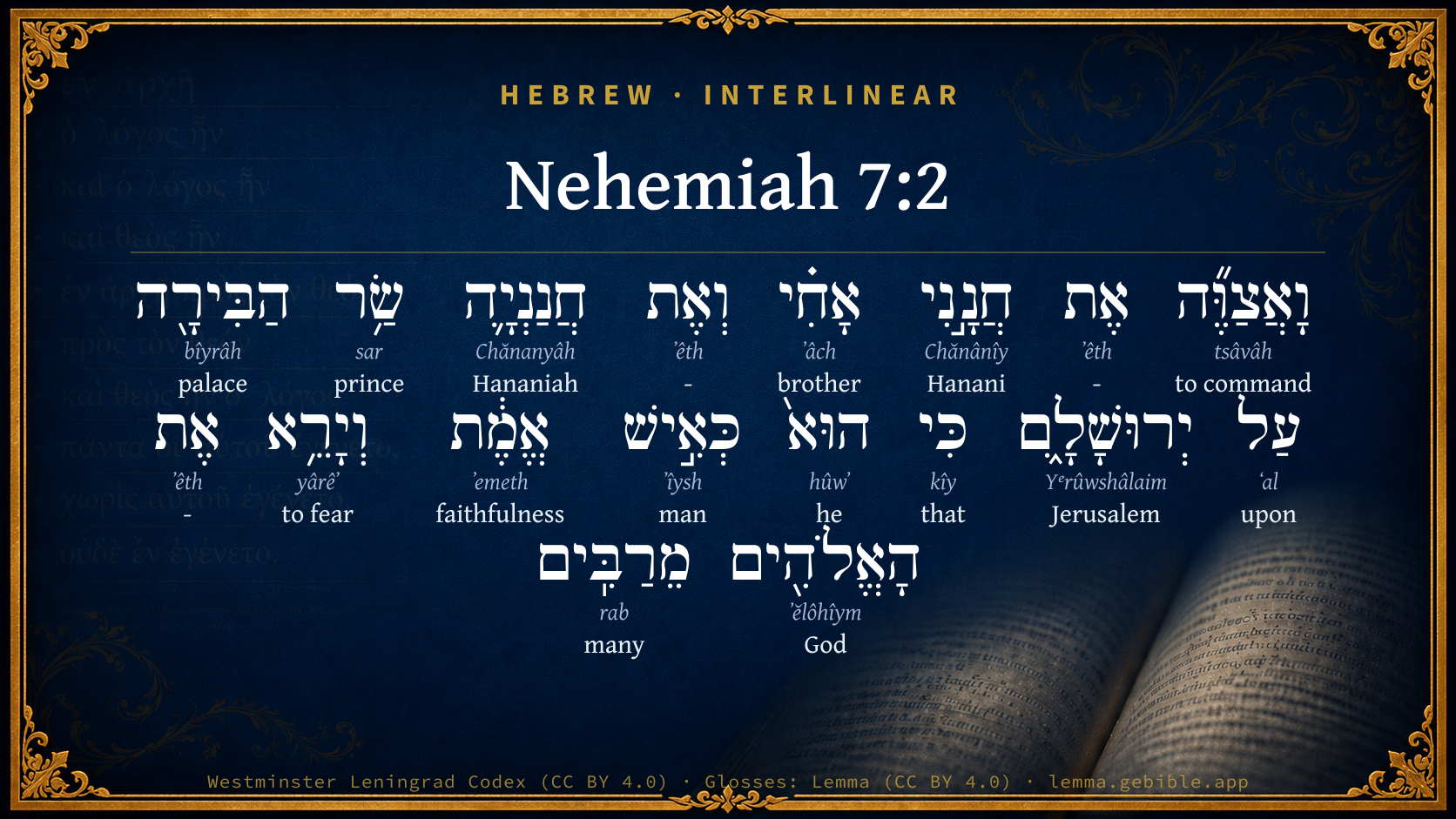
Nehemiah 7:2

Hebrew (Westminster Leningrad Codex) Nehemiah 7:2 appears in the Hebrew Old Testament. The text above is from the Westminster Leningrad Codex. Each word links to its Strong’s number, a concise gloss, and parsing drawn from the Open Scriptures Hebrew Bible morphology. Click any word for its full Brown-Driver-Briggs (BDB) entry.
Download image
Cite this verse

Nehemiah 7:2 (World English Bible). Public Domain. Lemma interlinear Bible study tool, https://lemma.gebible.app/v/nehemiah/7/2.

Show BibTeX & RIS
BibTeX
RIS
English Translation
that I gave my brother Hanani, and Hananiah the governor of the castle, charge over Jerusalem; for he was a faithful man, and feared God above many.
World English Bible · Public Domain
Download a study sheet

One document with this verse’s original text, its word-by-word gloss line, the meaning frame, cross-references with their text, attributed commentary, and full source and license credits — printable, and it pastes into notes with its structure intact.

This verse Autodidact and up

Study sheet (.html) Plain text (.txt)

A passage Seminary Student

Up to 50 verses in one chapter. A passage sheet keeps up to 6 commentary sources and 12 cross-references per verse, in the order this page ranks them, and says so on the sheet whenever that leaves anything out. Ask for a single verse and you get the Autodidact verse sheet above.

Everything on this page stays free to read, with no account — the sheet is a download of what is already on screen, not access to it.

Want to remove ads? Support Godless Engineer
Compare translations 3

The same verse in 3 English versions, stacked beneath the original-language interlinear above. Click any original word for its lexicon entry.

Each is an independent rendering of the whole verse — the interlinear is not word-aligned to these translations.

Highlighted words mark where these versions differ — a whole-verse word diff, not a word-by-word alignment.

  • World English Bible Public Domain
    that I gave my brother Hanani, and Hananiah the governor of the castle, charge over Jerusalem; for he was a faithful man, and feared God above many.
  • King James Version Public Domain
    That I gave my brother Hanani, and Hananiah the ruler of the palace, charge over Jerusalem: for he was a faithful man, and feared God above many.
  • unfoldingWord Literal Text CC BY-SA 4.0
    And I gave Hanani, my brother, and Hananiah, the official for the citadel, charge over Jerusalem. For he was according to a faithful man, and he feared God more than many.

unfoldingWord Literal Text — © unfoldingWord, licensed CC BY-SA 4.0. Word-aligned USFM3 via Door43 (git.door43.org/unfoldingWord/en_ult).

Versions to compare (up to 4)

3 of 4 selected

Show all 18 translations

Every available English version of this verse, each an independent rendering of the whole verse.

  • World English Bible Public Domain
    that I gave my brother Hanani, and Hananiah the governor of the castle, charge over Jerusalem; for he was a faithful man, and feared God above many.
  • Berean Standard Bible Public Domain
    Then I put my brother Hanani in charge of Jerusalem, along with Hananiah the commander of the fortress, because he was a faithful man who feared God more than most.
  • Majority Standard Bible Public Domain
    Then I put my brother Hanani in charge of Jerusalem, along with Hananiah the commander of the fortress, because he was a faithful man who feared God more than most.
  • King James Version Public Domain
    That I gave my brother Hanani, and Hananiah the ruler of the palace, charge over Jerusalem: for he was a faithful man, and feared God above many.
  • American Standard Version (1901) Public Domain
    that I gave my brother Hanani, and Hananiah the governor of the castle, charge over Jerusalem; for he was a faithful man, and feared God above many.
  • Revised Version (1885) Public Domain
    that I gave my brother Hanani, and Hananiah the governor of the castle, charge over Jerusalem: for he was a faithful man, and feared God above many.
  • Geneva Bible (1599) Public Domain
    Then I commanded my brother Hanani and Hananiah the prince of the palace in Ierusalem (for he was doubtlesse a faithfull man, and feared God aboue many)
  • Douay-Rheims (1899) Public Domain
    I commanded Hanani my brother, and Hananias ruler of the house of Jerusalem, (for he seemed as a sincere man, and one that feared God above the rest,)
  • Young's Literal Translation Public Domain
    and I charge Hanani my brother, and Hananiah head of the palace, concerning Jerusalem -- for he `is' as a man of truth, and fearing God above many --
  • Literal Standard Version CC BY-SA 4.0
    and I charge my brother Hanani, and Hananiah head of the palace, concerning Jerusalem—for he [is] as a man of truth, and fearing God above many—
  • Unlocked Literal Bible CC BY-SA 4.0
    I gave my brother Hanani charge over Jerusalem, along with Hananiah who had oversight of the fortress, for he was a faithful man and feared God more than many.
  • unfoldingWord Literal Text CC BY-SA 4.0
    And I gave Hanani, my brother, and Hananiah, the official for the citadel, charge over Jerusalem. For he was according to a faithful man, and he feared God more than many.
  • Darby Bible Public Domain
    And I gave my brother Hanani, and Hananiah the ruler of the citadel, charge over Jerusalem; for he was a faithful man and feared God above many.
  • World Messianic Bible Public Domain
    I put my brother Hanani, and Hananiah the governor of the fortress, in charge of Jerusalem; for he was a faithful man and feared God above many.
  • Webster's Bible Public Domain
    That I gave my brother Hanani, and Hananiah the ruler of the palace, charge over Jerusalem: for he was a faithful man, and feared God above many.
  • Free Bible Version CC BY-SA 4.0
    I put my brother Hanani in charge of Jerusalem, together with Hananiah the commander of the fortress, because he was an honest man who respected God more than many others.
  • Bible in Basic English Public Domain
    I made my brother Hanani, and Hananiah, the ruler of the tower, responsible for the government of Jerusalem: for he was a man of good faith, fearing God more than most.
  • JPS Tanakh (1917) Public Domain
    that I gave my brother Hanani, and Hananiah the governor of the castle, charge over Jerusalem; for he was a faithful man, and feared God above many.

Literal Standard Version (2020), Covenant Press — licensed CC BY-SA 4.0. Text via the HelloAO Bible API (eBible.org). Unlocked Literal Bible (unfoldingWord) — licensed CC BY-SA 4.0. Text via the HelloAO Bible API (eBible.org). unfoldingWord Literal Text — © unfoldingWord, licensed CC BY-SA 4.0. Word-aligned USFM3 via Door43 (git.door43.org/unfoldingWord/en_ult). Free Bible Version, Dr. Jonathan Gallagher — licensed CC BY-SA 4.0. Text via the HelloAO Bible API (eBible.org).

Word by word

More ways to search: Search by grammar → Find every occurrence → Compare this word →

Practice this passage: Drill this verse → Learn its vocabulary →

חֲנָ֣נִי
Chănânîy
H2607
“Hanani”
Noun, Proper
Part of Speech
Noun
Type
Proper
Full BDB Definition

Origin: from H2603

TWOT: None

Hanani = "gracious" - one of the sons of Heman, a chief musician of David, and head of the 18th course of the service - a seer who rebuked Asa, king of Judah, and was imprisoned - maybe, father of Jehu the seer who testified against Baasha - one of the priests who in the time of Ezra took a foreign wife - brother of Nehemiah whom Nehemiah appointed governor of Jerusalem - another priest who was the chief musician under Nehemiah
  1. וָאֲצַוֶּ֞ה tsâvâh H6680 “and · to command” Conjunction + Verb, Piel, Sequential Imperfect, 1st Person, Common, Singular
  2. אֶת ʼêth H853 “-” Particle, Direct Object
  3. אָחִ֗י ʼâch H251 “brother · my” Noun, Common, Masculine, Singular, Construct + Suffix, Personal, 1st Person, Common, Singular
  4. וְאֶת ʼêth H853 “and · -” Conjunction + Particle, Direct Object
  5. חֲנַנְיָ֛ה Chănanyâh H2608 “Hananiah” Noun, Proper
  6. שַׂ֥ר sar H8269 “prince of” Noun, Common, Masculine, Singular, Construct
  7. הַבִּירָ֖ה bîyrâh H1002 “the · palace” Particle, Definite Article + Noun, Common, Feminine, Singular, Absolute
  8. עַל ʻal H5921 “upon” Preposition
  9. יְרוּשָׁלִָ֑ם Yᵉrûwshâlaim H3389 “Jerusalem” Noun, Proper
  10. כִּי kîy H3588 “that” Conjunction
  11. הוּא֙ hûwʼ H1931 “he” Pronoun, Personal, 3rd Person, Masculine, Singular
  12. כְּאִ֣ישׁ ʼîysh H376 “like/as · man of” Preposition + Noun, Common, Masculine, Singular, Construct
  13. אֱמֶ֔ת ʼemeth H571 “faithfulness” Noun, Common, Feminine, Singular, Absolute
  14. וְיָרֵ֥א yârêʼ H3372 “and · to fear” Conjunction + Verb, Qal, Perfect, 3rd Person, Masculine, Singular
  15. אֶת ʼêth H853 “-” Particle, Direct Object
  16. הָאֱלֹהִ֖ים ʼĕlôhîym H430 “the · God(s)” Particle, Definite Article + Noun, Common, Masculine, Plural, Absolute
  17. מֵרַבִּֽים rab H7227 “from · many” Preposition + Adjective, Adjective, Masculine, Plural, Absolute

About this verse

These counts appear in no published source. They are computed here, from the morphology-tagged text and Lemma’s own curated glosses. What Lemma adds →

18
words
16
distinct lemmas
Historical
section

Notable vocabulary

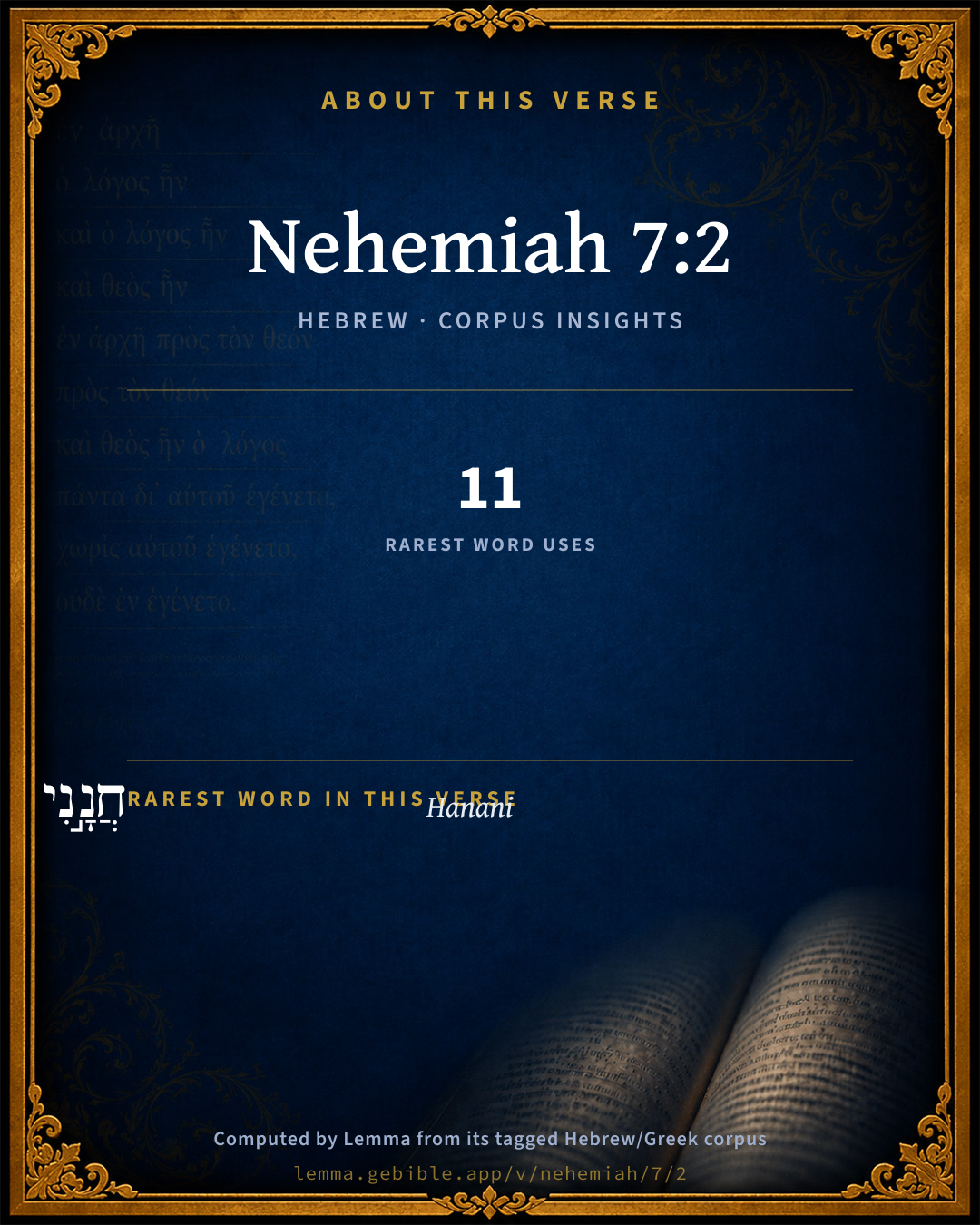
The rarest word here is חֲנָ֣נִי Hanani H2607 — appearing just 11 times in the whole Hebrew Bible.

Shared distinctive vocabulary

חֲנָ֣נִי Hanani H2607 occurs in 11 verses of the Hebrew Bible. Also found in:

Grammatical profile

  • 2 verbs
  • 9 nouns
  • 1 adjective
  • 1 pronoun
  • 1 preposition
  • 1 conjunction
  • 3 particles

Verb forms

  • וָאֲצַוֶּ֞ה Piel · Sequential Imperfect
  • וְיָרֵ֥א Qal · Perfect

Cross-references

20

Topical passages linked to Nehemiah 7:2 in the Treasury of Scripture Knowledge — connected by theme and wording, ordered by reader-vote popularity; previews shown in the World English Bible.

  • Nehemiah 1:2 that Hanani, one of my brothers, came, he and certain men out of Judah; and I asked them concerning the Jews who had escaped, who were left of the captivity, and concerning Jerusalem.
  • Psalms 101:6 My eyes will be on the faithful of the land, That they may dwell with me. He who walks in a perfect way, He will serve me.
  • Matthew 25:21 "His lord said to him, 'Well done, good and faithful servant. You have been faithful over a few things, I will set you over many things. Enter into the joy of your lord.'
  • Nehemiah 2:8 and a letter to Asaph the keeper of the king's forest, that he may give me timber to make beams for the gates of the castle which appertains to the house, and for the wall of the city, and for the house that I shall enter into. The king granted me, according to the good hand of my God on me.
  • Nehemiah 10:23 Hoshea, Hananiah, Hasshub,
  • 1 Kings 18:3 Ahab called Obadiah, who was over the household. (Now Obadiah feared Yahweh greatly:
  • Luke 16:10–12 He who is faithful in a very little is faithful also in much. He who is dishonest in a very little is also dishonest in much.
  • Genesis 42:18 Joseph said to them the third day, "Do this, and live, for I fear God.
  • Exodus 18:21 Moreover you shall provide out of all the people able men, such as fear God: men of truth, hating unjust gain; and place such over them, to be rulers of thousands, rulers of hundreds, rulers of fifties, and rulers of tens.
  • Numbers 12:7 My servant Moses is not so; he is faithful in all my house:
  • 2 Samuel 23:3 The God of Israel said, The Rock of Israel spoke to me: One who rules over men righteously, Who rules in the fear of God,
  • 1 Kings 18:12 It will happen, as soon as I am gone from you, that the Spirit of Yahweh will carry you I don't know where; and so when I come and tell Ahab, and he can't find you, he will kill me: but I your servant fear Yahweh from my youth.
  • Nehemiah 5:15 But the former governors who were before me were chargeable to the people, and took of them bread and wine, besides forty shekels of silver; yes, even their servants bore rule over the people: but I didn't do so, because of the fear of God.
  • Nehemiah 13:13 I made treasurers over the treasuries, Shelemiah the priest, and Zadok the scribe, and of the Levites, Pedaiah: and next to them was Hanan the son of Zaccur, the son of Mattaniah; for they were counted faithful, and their business was to distribute to their brothers.
  • Job 1:1 There was a man in the land of Uz, whose name was Job. That man was blameless and upright, and one who feared God, and turned away from evil.
  • Isaiah 33:5–6 Yahweh is exalted; for he dwells on high: he has filled Zion with justice and righteousness.
  • Daniel 6:4 Then the presidents and the satraps sought to find occasion against Daniel as touching the kingdom; but they could find no occasion nor fault, because he was faithful, neither was there any error or fault found in him.
  • 1 Corinthians 4:2 Here, moreover, it is required of stewards, that they be found faithful.
  • 2 Timothy 2:2 The things which you have heard from me among many witnesses, commit the same to faithful men, who will be able to teach others also.
  • Matthew 24:45 "Who then is the faithful and wise servant, whom his lord has set over his household, to give them their food in due season?

Cross-references courtesy of OpenBible.info (CC BY 4.0).

Hebrew and Greek witnesses Masoretic Hebrew ↔ Greek Septuagint

The same verse in the two great witnesses to the Old Testament, shown verse-for-verse.

These are two independent witnesses, not word-aligned to each other, and the Septuagint is shown in lemma (dictionary) form.

Hebrew Nehemiah 7:2 Masoretic · Westminster Leningrad Codex

וָאֲצַוֶּ֞ה אֶת חֲנָ֣נִי אָחִ֗י וְאֶת חֲנַנְיָ֛ה שַׂ֥ר הַבִּירָ֖ה עַל יְרוּשָׁלִָ֑ם כִּי הוּא֙ כְּאִ֣ישׁ אֱמֶ֔ת וְיָרֵ֥א אֶת הָאֱלֹהִ֖ים מֵרַבִּֽים

that I gave my brother Hanani, and Hananiah the governor of the castle, charge over Jerusalem; for he was a faithful man, and feared God above many.

World English Bible · Public Domain

Greek LXX Structure differs

The Septuagint has no separate book of Nehemiah. Its Greek text is the second half of Esdras B (2 Esdras), chapters 11–23; Ezra is the first half (1–10).

A verse-for-verse comparison isn’t shown here because the chapters and verses don’t line up. Switch to the LXX edition with the MT / LXX toggle above to read the Greek directly.

On this verse, The Cambridge Bible for Schools and Colleges discusses the Septuagint’s reading. Read the note in Commentary ↓

Hebrew: Westminster Leningrad Codex (CC BY 4.0). Greek: Septuagint (public domain); English from a public-domain English Septuagint. How the Septuagint differs from the Hebrew →

Commentary

Notes on Nehemiah 7:2 from classic Christian and Jewish commentators (each source and its license shown beneath its notes). The classic Christian expositions comment on the surrounding passage and are grouped to its opening verse, so a note may address several verses; the Jewish commentaries on the Tanakh (Rashi and others) are per-verse, so they appear only where the commentator wrote on this verse.

Lemma curates 59 commentaries, every one of them public domain or Creative Commons licensed, each selected and text-cleaned for this edition rather than reprinted as found. About our sources →

Trapp's Complete Commentary

John Trapp

Neh 7:2 That I gave my brother Hanani, and Hananiah the ruler of the palace, charge over Jerusalem: for he [was] a faithful man, and feared God above many.

Ver. 2. That I gave my brother Hanani] Of whom see Neh 1:2 Ezr 10:20.

And Hananiah the ruler of the palace] The second person next to the governor; commanding in his name within his court.

Charge over Jerusalem] Thus he that is faithful in a little shall be made master of much, Mat 25:31.

For he was a faithful man] Heb. A man of truth, faithfulness, or firnmess; a sure man, and such as one might safely confide in.

And feared God] No wonder therefore though faithful to men. See Neh 5:15. God’s holy fear is the ground of all goodness and fidelity. Hence Jethro, in his well-qualified ruler, places the fear of God in the midst of the other graces, as the heart in the body, for conveying life to all the parts, or as a dram of musk, perfuming the whole box of ointment, Exo 18:21. Most sure it is, that nothing maketh a man so good a patriot as the true fear of God. On the other side, Pietate sublata fides tollitur, take away piety, and fidelity is gone; as is to be seen in the unrighteous judge, Luk 18:2, and as Constantius Chlorus, father of Constantine the Great, did well experience in his counsellors and courtiers; whence that famous maxim of his recorded by Eusebius, He cannot be faithful to me that is unfaithful to God, religion being the foundation of all true fidelity and loyalty to king and country. Hence that close connection, Fear God, honour the king, 1Pe 2:17. And hence that saying of Bernard, If all the world should conspire to make me complot against my prince, yet I would fear God, and honour the king.

Above many] This is a singular praise, and by every man to be sought after - it was Cicero’s posy and practice,

Aιεν αριστευειν, και υπειροχον εμμεναι αλλων,

to be the best at every good thing, to excel and exceed others, - to be eminent and exemplary, taller than the rest by the head and shoulders, full of all goodness, filled with all knowledge, Rom 15:14, able and active in every good word and work. That is a low and unworthy strain in some, to labour after no more grace than will keep life and soul together, that is, soul and hell asunder. God would have his people to be discontentedly contented with the measures they have received, and to be still adding, 2Pe 1:5, and advancing, Php 3:14, aspiring to perfection, till they "come unto the measure of the stature of the fulness of Christ," Eph 4:13.

John Trapp, A Commentary or Exposition upon All the Books of the Old and New Testament (1647–1656) — public domain. Text from a community e-Sword module.

The Biblical Illustrator

Joseph S. Exell

Neh_7:2-3

For he was a faithful man, and feared God above many.

Faithfulness

I. Consider the meaning of faithfulness. It is the reverent and constant acceptance of those duties springing out of the relations in which I inevitably stand. Man is a being set in relations. When the ivy climbs up ruins and binds lovingly the fallen stones together, and wraps them in its green, it clambers and winds about and helps and beautifies because of the feelers it thrusts out, laying hold, by them, of the crumbling stones. It is the nature of the ivy to force these feelers out. So forth from every man there are shooting feelers of relations. They are part of his life-endowment.

1. Man is bound into relation with God. God is Creator--Father--Providence and Sustainer--King and Judge.

2. Men and women are bound to each other in the relation of father and mother, and child and relative, and fellow-citizen, and so on endlessly. Springing out of these relations there are forced upon us certain duties. Faithfulness is accepting and steadily discharging them.

II. Faithfulness is a chance opening right at the feet of every man for a noble life.

III. Faithfulness is an open door for a right ambition--to develop a noble character. Thus we may lift humdrum from our daily life. There is nothing so invigorating as the consciousness of recognising and accepting duty. The peace of a quiet conscience is in it.

1. Thus I am sure of setting a right example.

2. Thus I shall certainly make my life tell in all directions.

IV. A reward of faithfulness. Nehemiah gave Hananiah charge over Jerusalem because he was a faithful man.

V. The real source and incitement of faithfulness. He feared God. Think of Milton as holding himself as ever in his great Taskmasters eye. Policy, expediency, self-interest may seem to hold a man to duty in fair weather. The only lasting motive for faithfulness for all times is God. (Wayland Hoyt, D. D.)

Piety and faithfulness

We are here taught:--

I. That the fear of God--real, Scriptural piety--is the solid foundation of all faithfulness between man and man.

II. That the indispensable expression and proof of the fear of God is to be found in a mans fidelity as to the affairs and transactions which take place between him and his fellows.

III. That persons of eminent piety and great fidelity will be honoured both by God and man. (J. Taylor.)

Eminent piety

I. That faithfulness in religion is essentially connected with eminence of attainment in the Christian character.

II. Characteristics of eminent piety.

1. It consists in the habitual maintenance of a close walk with God.

2. It comprises a high and enlightened estimate of the character and work of Christ.

3. It is connected with an exquisite spiritual and moral sensibility.

4. It is always most powerfully swayed by spiritual motives and considerations.

5. These characteristics show the baselessness of the claims and pretensions to the possession of exalted religious attainments that are sometimes advanced.

III. Motives which may lead Christians to aspire after eminence of personal piety.

1. The honour of religion.

2. It is a great preservative against apostasy.

3. Regard to personal enjoyment.

4. Its relation to usefulness.

5. Its bearing upon our future blessedness.

6. The enduring nature of the distinction it confers.

7. The adequate provision that has been made to aid in its attainment. (W. Hurd.)

Eminent piety

I. The nature of eminent piety.

1. It involves a habit of serious reflection.

2. It is consistent and comprehensive. The man who exemplifies it believes the doctrines of revelation, is awed by its threatenings, animated by its promises, and controlled by its laws. He is at once sober, righteous, and godly.

3. It endures severe tests. It resembles a robust constitution, which can pass through all varieties of climate, while a sickly constitution demands careful restriction to one.

4. It is active and laborious.

5. It is piety that grows.

II. Considerations that enforce eminent piety.

1. The effects it produces on those who exemplify it.

(1) They manifest that they are born of God.

(2) They are fitted for every spiritual conflict.

(3) They are provided with all needful consolations.

(4) They are qualified for an advantageous approach to Divine ordinances.

(5) Their anticipations are bright and triumphant.

2. The effects it produces on those who witness it.

Conclusion:

1. Eminent piety is very rare

2. The means of acquiring and promoting eminent piety are invaluable. Intercourse with good men--attendance in a Christian sanctuary--reading, meditation, and prayer.

3. Real piety is indispensable. (Joseph Hughes.)

A faithful man

I. The distinguishing feature of Hananiahs character. He was a faithful man. If we suppose With some that Hananiah is the same as Shadrach mentioned in the Book of Daniel, we see how brightly this trait of his character shone forth in him in Babylon. A faithful man is perhaps the most distinguished commendation that can be passed upon any mortal. It refers to that attitude under which God Himself has been pleased to allow His people to regard Him. God is faithful; the Lord is faithful; and it is in the faithfulness of God that His people hope and confide. A faithful man--

1. Is one that can be depended on, who performs all his promises, executes all trusts confided to him, one who is punctual and unwavering in all his engagements, and whose uprightness and integrity are transparent to all.

2. He is one who has been made the recipient of a gracious and Divine principle that is--

(1) Saving in its nature;

(2) justifying in its character;

(3) purifying in its results.

3. He is a godlike man (2Pe_1:4).

II. The conduct which Hananiah showed--he feared God. The fear of God is--

1. A reverential awe of the majesty of God.

2. An implanted principle (Jer_32:40).

3. A governing principle--Obadiah (1Ki_18:12-13); Nehemiah (Neh_5:15).

III. The distinguished position assigned to Hananiah. (Francis Wills.)

An example of excellent piety

I. He was a faithful man. To serve God acceptably we must be faithful.

1. By believing what God has revealed, on His testimony (2Ch_20:20). To the exercise of this faith we are urged by the best example, as that of Abraham (Gal_3:9; Rom_4:20), and that of Barnabas (Act_11:24). Under the influence of this faith, we shall be led to seek God in the way He prescribes.

2. By conscientiously performing those duties which arise from our relations to God; as His servants, stewards, and soldiers. As His covenant-servants, we must devote ourselves to His service (Jer_1:5; 1Co_4:19-20). As His stewards, we must employ His gifts for His glory (1Pe_4:10-11). This faithfulness is required in stewards (1Co_4:2). As His soldiers, we must be valiant for His revealed truth (Jer_9:8). We must be faithful--

3. By steadfast adherence to the required worship and service of God. Like the Church at Pergamos, we must not deny Christ through fear of suffering for righteousness sake (Rev_2:13; Rev_17:14).

4. By seriously realising the invisible things of God (Heb_11:1). We should realise Gods presence with us, as our Master, Helper, and Observer (Psa_16:8; Psa_46:1; Heb_11:27). We should realise the general judgment, when we must all appear before Christ (2Co_10:7; 2Co_10:9-10).

II. And he feared God above many.

1. By the fear of God, in this place, is meant the whole of personal religion, including the principles and practice, the dispositions and the conduct of its subject or possessor (Psa_34:11; Psa_111:10; Pro_19:28; Ecc_8:12).

2. He feared God above many. This implies that there are different degrees of piety among those who truly fear God. This is intimated by our Lord, in His parable of the Sower (Mat_13:8). It is admitted by St. Paul, in his doctrine of future rewards (2Co_9:6). This difference in pious attainments is also evident from the present state of the religious world. Of some eminent Christians, who are now the salt of the earth and the lights of the world, it may be said with great truth that they fear God above many. They acknowledge God more than many in their secular concerns (Pro_3:6; Php_4:6); they are more careful than many to allow themselves m those recreations only which are consistent with, and favourable to, their advancement in holiness (1Co_10:31); they converse more spiritually and profitably than many (Eph_4:29); and they are more zealous than many, in employing all their talents for Gods glory and the benefit of mankind (Act_13:36). With respect to reputation; some have a good report from them that are without the Church, while the good that is in others is evil spoken of, through their indiscretions. With respect to usefulness; some are general blessings to their respective connections, while others are not visibly instrumental in bringing scarcely any souls with them to Christ and heaven.

3. The honourable mention of Hananiahs distinguished piety should excite us to imitate him, by endeavouring to excel in piety also. To excel in piety is--

(1) Our privilege. This is incontestable from the prayers which the Holy Spirit has dictated for our adoption (Eph_3:14-21; 1Th_5:28; 1Th_5:24; Heb_13:20-21).

(2) Our interest. For this will be conducive to--

(a) Our greater happiness (Isa_48:18);

(b) our greater safety (2Pe_1:10);

(c) our greater glory in heaven (2Pe_1:11; 1Co_15:51).

(3) Our duty.

(a) God calls us to this (1Pe_1:15-16);

(b) God will hereby be glorified (Joh_15:8);

(c) herewith He will be pleased (Psa_35:27). (Sketches of Four Hundred Sermons.)

Placed in trust

It was a State appointment made on moral and religious grounds. Hananiah was put in charge over Jerusalem: for he was a faithful man, and feared God above many. Without discussing in detail the merits of the principle, let us inquire, What would be its effects as a passport to office ?

1. In the first place, it would shut out atheists from the Legislature of the country.

2. It would exclude from power all immoral or ungodly persons.

3. Such recognition would show that the profession of religion is not incompatible with, nor a disqualification for, the duties of public life.

4. The appointment was on Scriptural lines. It was strikingly in accord with the advice of Jethro to Moses: Moreover, thou shalt provide out of all the people able men, such as fear God, men of truth hating covetousness, and place such over them to be rulers of thousands, and rulers of hundreds, rulers of fifties, and rulers of tens. (T. Robson.)

Eminent of character

It is not the first thousand feet, but the last, that gives a mountain its name and fame. There is not a vast difference, for example, between Monte Rosa and Mont Blanc, but the latter is celebrated owing to those few extra feet. It is not so much ability, or learning, or diligence which differentiates Christian men as nearness to heaven and God. Those few extra hours spent in prayer, the additional steps of approach to Christ--these raise above the level of average piety and impart sanctity to the character. (Sunday Companion.)

Religious sentiment the most refining

It is the property of the religious sentiment to be the most refining of all influences. No external advantages, no good birth or breeding, no culture of the taste, no habit of command, no association with the elegant--even no depth of affection that does not rise to a religious sentiment--can bestow that delicacy and grandeur of bearing which belong only to a mind accustomed to celestial conversation. (R. W. Emerson.)

Men loyal to God

Martin Luther used to say, God needs strong men as much as strong men need God, and it was true. Let men seek to escape from the responsibilities of labour and law, and the freedom won by patriots and martyrs would soon fall, superstition would soon reassert its sway, and passions would leap forth again which would throw civilisation back into barbarism. If the Apostles had trusted the men of their age there would have been no true Christianity. If John Knox and others had trusted to such there would have been no Reformation. Let them bestir themselves in every noble way. They could each, at least, give to God one life that was true and faithful, one loyal to the core to truth and duty. It was not enough to contribute their criticism, they must contribute themselves--be willing to perish that others might live. That was what was meant by Christianity. (John Hunter.)

Coherence in character

What is the cause which makes one life so full to us while another has no meaning? What is it that constitutes the articulateness or the inarticulateness, the significance or the insignificance, of human lives? One very simple thing--coherence, that is all. The reason why these letters spell something is because they cohere together according to a certain law, and express something. The reason why these notes are sweet and inspiring to your ear is because they blend together according to the codes of harmony. And so are human lives bound together by something which brings coherence and signifiestion, harmony and force. Look at the lives which strike us; look at the imperious and imperial personalities amongst us. What made Bismarck such as he was? Coherence--one purpose! The difference between a life which is insignificant lies precisely in the word coherence. Why was Newton great? Why, because Newton, like all great men, said, This one thing I do, and he forgot his food in the earnest contemplation and pursuit of science. It is coherence which makes greatness in life. (Bp. Boyd Carpenter.)

Every one in his watch:--

Every one in his watch

This book may almost be called the Book of the Busy Man, telling as it does of the multifarious duties and responsibilities of one who acted as governor of the Jewish people in a very difficult and anxious time, and who had the rare and excellent faculty of leading every one else to work also. The picture which this book presents is almost that of a beehive, the murmur of whose work rises from every page. It is in entire sympathy with the general strain and tenor of the book that our text speaks when it shows us every one in his watch. Consider--

I. The individual dealing of God with us--every one in his watch. We often resist the thought of having to do individually with God; it becomes too solemn, too oppressive, too terrible for a soul that is not reconciled to Him. This is partly at the root of the preference which many have for the Church life rather than the individual life, for the idea of the multitude in which we may hide rather than that of solitude in which we must be seen. There is much in which we can have no companionship. We are born alone ; every great disease or pain finds us in the deep places of a loneliness which none can share with us ; and it is in utter solitude that each of us dies. In all such cases it is individual dealing between the Lord and us. We never come right, we never come to the Pardoner of sin, or the trust of daily life, or real work for Christ, till we have had the individual dealing with God which brings us into the position of those whom God has accepted for Christ's sake, and for whom henceforth He will provide.

II. The text is also universal in its reach. Every man means all men, which gives us the thought that there is a post for every man which God has appointed for him.

III. The work of the Christian may be regarded as military service. In this aspect of life three things are required.

1. Strict discipline.

2. Instant obedience.

3. Perfect obedience.

IV. The part of military service which falls to us all is sentinel duty.

V. The object of the watch which is laid upon every Christian.

1. It is a watch against attack.

2. It is a watch for reinforcement and succour. (T. Elder Cumming.)

The Biblical Illustrator, edited by Joseph S. Exell (c. 1880s–1900s) — public domain. Text from a community e-Sword module.

Tyndale Open Study Notes

Tyndale Open Resources

7:2 a faithful man who feared God: Hanani displayed two leadership characteristics favored by Nehemiah and God (see also 5:9, 15; Dan 6:4; Luke 16:10-12; 1 Pet 5:12).

Tyndale Open Study Notes — © Tyndale Open Resources, licensed CC BY-SA 4.0. Text via the HelloAO Bible API.

Adam Clarke's Commentary

Verse 2. My brother Hanani] This was the person who gave Nehemiah the account of the desolate state of the Jews, Ne 1:2. He is now made ruler of Jerusalem, probably because Nehemiah was about to return to the Persian court. And he found this man to be one in whom he could trust:

1. Because he was a faithful man - one who had a proper belief in God, his government, and his protection; and being devoted to the interests of his people, would be faithful in the discharge of his office.

2. Because he feared God above many - was the most religious person in the congregation; would govern according to the laws; would take care of the interests of pure religion; would not oppress, take bribes, nor abuse his authority; but act in all things as one who had the fear of God continually before his eyes. These are the proper qualifications of a governor.

Adam Clarke's Commentary on the Bible (1810–1826) — public domain. Text from a community e-Sword/MySword module.

The Cambridge Bible for Schools and Colleges

gen. ed. J. J. S. Perowne

2. my brother Hanani] cf. Neh_1:2.

Hananiah the ruler of the palace] R.V. Hananiah the governor of the castle. On the castle or ‘Bira’ see Neh_2:8. The ‘governor of the castle’ would be an official of great importance, being probably in command of troops for the purpose of keeping order in the city. ‘He’ refers to Hananiah. Possibly Nehemiah’s appointment of two officers to the command of the city corresponds with the mention of the two men in Neh_3:9; Neh_3:12, who were ‘rulers of half the district of Jerusalem.’

a faithful man, and feared God] cf. Exo_18:21, ‘able men, such as fear God, men of truth, hating unjust gain.’ The Hebrew is noticeable; not absolutely ‘a man of truth,’ but ‘such as only a man of truth is.’

above many] i.e. more than most. LXX. παρὰ πολλούς. Vulg. ‘plus cæteris.’ The phrase which only occurs here in the O.T. has a very lifelike ring.

The Cambridge Bible for Schools and Colleges (gen. ed. J. J. S. Perowne; Cambridge University Press, 1878–1918) — public domain. Text from a community e-Sword module.

John Gill's Exposition

That I gave my brother Hanani,.... Who first brought him the melancholy account of the state of Jerusalem, Neh 1:2,

and Hananiah the ruler of the palace; the king's palace, in which the viceroy of the king of Persia dwelt, and now Nehemiah; to these two men he gave

charge over Jerusalem; committed it to their care during his absence, who may be supposed now to return to Persia, as he had promised, Neh 2:6,

for he was a faithful man; this is said of Hananiah, and given as a reason why such a trust was committed to him; Hanani's character was well known, and his journey from Jerusalem to Shushan was a full proof of his hearty concern for the interest of it:

and feared God above many; Hananiah was exemplary in his fear of God, few were equal to him, and none exceeded him; or of many days, as Jarchi; of a long time he had feared the Lord, and served him many years.

John Gill's Exposition of the Whole Bible (1746–1763) — public domain (CC PDM 1.0). Text via the HelloAO Bible API.

Albert Barnes' Notes on the Bible

My brother Hanani - See Neh 1:2.

The ruler of the palace - Or, “the governor of the fortress.” See the marginal reference note.

He - i. e. Hananiah.

Albert Barnes' Notes on the Bible (1834–1885) — public domain. Text from a community e-Sword/MySword module.

Haydock's Catholic Bible Commentary

House: "the citadel;" (Tigurin) "palace." (Vatable) --- The Septuagint retain the original, Beria, (Haydock) which signifies a palace, (Pagnin) concerning which Nehemias had spoken, chap. ii. 8. (Menochius) --- But as it was not yet built, the house, being placed alone, more properly signifies the temple. We read of Zacharias and Jehiel, who occupied the same post (Calmet) as Hananias, 2 Paralipomenon xxxv. 8. (Haydock) He was next to Eliasib, the high priest. (Calmet)

George Leo Haydock (1774–1849), Haydock's Catholic Family Bible and Commentary, 1859 edition — public domain. Excludes Psalms (Douay-Rheims chapter numbering differs from Protestant) and Deuterocanonical books (Catholic canon only).

Matthew Poole's English Annotations

Hanani; of whom see Neh 1:2.

The ruler of the palace, i.e. of Nehemiah’s court; justly so called, because he lived in great splendour, and like a viceroy, though it was wholly at his own charge.

Charge over Jerusalem, to preserve its peace and safety, and to take particular care of the shutting the gates of the city.

He was a faithful man, to wit, Hananiah last mentioned; for it was needless to say any thing in commendation of Hanani, who had shown his piety and zeal for God and his country, in taking a tedious journey from Jerusalem to Shushan, to inform Nehemiah of the sad estate of Jerusalem, and to implore his helping hand to relieve it, Ne 1.

A faithful man; he chose not magistrates and officers out of any partial or carnal respects to his own kindred, or acquaintance, or favourites, but from true piety and prudence, such as were fittest for and would be most faithful in their employments.

And feared God: this is added as the ground and reason, both why he was faithful, and why Nehemiah put such trust and confidence in him, because he knew that the fear of God would keep him from yielding to those temptations to perfidiousness which he was likely to meet with when Nehemiah was gone, and against which a man destitute of God’s fear hath no sufficient fence.

Above many; more than most men did; or, above the common pitch of piety.

Matthew Poole's English Annotations on the Holy Bible (1683–1685) — public domain. Text from a community e-Sword/MySword module.

Whedon's Commentary on the Bible

Daniel D. Whedon

2. My brother Hanani — Who had brought word to Nehemiah in Persia of the distressed state of Jerusalem. Neh_1:2-3. His faithful services and love for Judah and Jerusalem made him a proper man for the office now intrusted to him.

Ruler of the palace — The chamberlain, or chief overseer of the fortress or palace connected with the temple, which is mentioned in chapter Neh_2:8, where see note.

Charge over Jerusalem — Oversight of all parts of the city, but especially of the porters who guarded the gates.

Daniel D. Whedon (gen. ed.), Commentary on the Old and New Testaments (1874–1909) — public domain. Text from a community e-Sword module.

The Pulpit Commentary

Hanani and Hananiah. This appointment of two municipal officers to have charge of Jerusalem recalls the mention of two "rulers" in Neh_3:9, Neh_3:12, each of whom had authority-over half the district dependent on Jerusalem, and amounts to an "undesigned coincidence." The ruler of the palace. Rather, "the commandant of the fort," i.e. the officer in charge of the temple fortress. (see above, Neh_2:8)

Uncommon excellence.

"He was a faithful man, and feared God above many." Nehemiah records this of Hananiah as his reason for giving him, with Hanani, his own brother, "charge over Jerusalem." Perhaps he felt it necessary, on some account not specified, thus to justify the selection.

I THE CHARACTER HERE DESCRIBED.

1. Its elements.

(1) Faithfulness. Uprightness, integrity, strictness in performing promises, truthfulness.

(2) Unusual piety. These two are closely related to each other. He who greatly fears God will be eminently faithful both to God and man. The piety which does not produce uprightness is good for nothing. On the other hand, uprightness towards man, if allowed its proper development, will lead to uprightness towards God, and so to piety in all its branches. Where this is not the case (of which the instances are innumerable) the quality of the uprightness is questionable. It can hardly include a love of righteousness for its own sake. Rather is its basis the desire to stand well with men; and as it regards not God, it has no claim upon him.

2. How it is produced. As all piety and goodness are due to the grace of the Holy Spirit, unusual measures of them are to be ascribed to greater abundance of his sacred influences. But it is the human history of eminently godly men to which we now refer. To what, humanly speaking, may marked superiority in godliness and goodness be traced? Amongst their causes may be mentioned

(1) The careful teaching, the excellent example, and holy influence of devotedly Christian parents. The noblest men of the Church have generally sprung from homes of which piety was the pervading spirit; often from very pious mothers. Let parents who profess godliness think of this. The Church looks to them to train for her Nehemiahs and Hananiahs.

(2) Early religious decision. Those who begin to serve God late in life are little likely to attain to special excellence.

(3) Diligent spiritual self-culture. In reading, meditation, prayer, watchfulness, the practice of all good.

(4) Early consecration to some special service.

(5) Overwhelming sense of gratitude for conversion and forgiveness after many years of godless living.

3. When such a character is especially interesting. When, as here, seen in men of high worldly position and command, much occupied with secular affairs, and thrown much into the society of men of another spirit.

II THE EFFECTS WHICH SUCH A CHARACTER SHOULD PRODUCE.

1. Admiration.

2. Praise to God.

3. Confidence.

Which should be shown, as by Nehemiah, in placing those who possess it in responsible positions. It is well when such men can be found for important posts, and are placed in them by those with whom the appointment lies, instead of unworthy motives leading to the selection of less desirable men.

1. Imitation. To have such men within our sphere of observation increases our responsibility. We ought to be as they are. They show us what is attainable.

2. Commemoration. In some cases, at least. That their example may stimulate and encourage many to whom it would be otherwise unknown.

The Pulpit Commentary (1880–1919), ed. H.D.M. Spence-Jones & Joseph S. Exell — public domain. Text from a community e-Sword module.

Scofield Reference Notes

C. I. Scofield

feared

(See Scofield "Psa 19:9").

The Scofield Reference Bible (1917 edition), notes by C. I. Scofield — public domain. Text from a community e-Sword module.

Rashi

Rabbi Shlomo Yitzchaki (Rashi)

over Jerusalem to guard the gates of Jerusalem.

for a long time Heb. מֵרַבִּים, lit. from many; from many days.

Rashi on the Tanakh — English translations: “The Judaica Press complete Tanach with Rashi, translated by A. J. Rosenberg” (CC BY 4.0); “Pentateuch with Rashi's commentary by M. Rosenbaum and A.M. Silbermann, 1929-1934” (public domain); “The Metsudah Tanach series, Lakewood, N.J” (CC BY 4.0); and “The Book of Joshua, Metsudah Publications, 1997” (CC BY 4.0). Text via Sefaria.

Lesson kit

Teaching starters — assembled from the data on this page, not authored interpretation. Every prompt links to the verse data it draws on. Edit before teaching.

Nehemiah, in the Historical, opens this verse with 18 words (16 distinct Hebrew lemmas). Its most distinctive word is Chănânîy (“Hanani”). A historical commentator’s framing appears above. Read the whole chapter for the surrounding context.

Discussion questions

  1. How does “Hanani” (Chănânîy) shape what this verse is saying?
  2. 1 Kings 16:1 shares the word «Hanani» with this verse. How do the two illuminate each other?
  3. The translations on this page render this verse differently — a whole-verse word diff, not a word-by-word alignment. What might account for the different wordings?
  4. The verb «וָאֲצַוֶּ֞ה» is Piel Sequential Imperfect. How does its form color the action?
  5. Reading how Trapp's Complete Commentary and The Biblical Illustrator read this verse, where do the two commentators agree and where do they part?

Things to notice

Reading settings

Reading text

Shown beneath each verse's original-language words.

Old Testament
Old Testament edition

Read the OT as the Masoretic Hebrew (MT) or the Greek Septuagint (LXX).

English shown for the Greek Septuagint (in the Hebrew ↔ Greek comparison).

Comparing translations? Open the Compare panel on any verse page to stack up to four side by side.