
2 Chronicles 25:27

Hebrew (Westminster Leningrad Codex) 2 Chronicles 25:27 appears in the Hebrew Old Testament. The text above is from the Westminster Leningrad Codex. Each word links to its Strong’s number, a concise gloss, and parsing drawn from the Open Scriptures Hebrew Bible morphology. Click any word for its full Brown-Driver-Briggs (BDB) entry.
Download image
Cite this verse

2 Chronicles 25:27 (World English Bible). Public Domain. Lemma interlinear Bible study tool, https://lemma.gebible.app/v/2-chronicles/25/27.

Show BibTeX & RIS
BibTeX
RIS
English Translation
Now from the time that Amaziah did turn away from following Yahweh they made a conspiracy against him in Jerusalem; and he fled to Lachish: but they sent after him to Lachish, and killed him there.
World English Bible · Public Domain
Download a study sheet

One document with this verse’s original text, its word-by-word gloss line, the meaning frame, cross-references with their text, attributed commentary, and full source and license credits — printable, and it pastes into notes with its structure intact.

This verse Autodidact and up

Study sheet (.html) Plain text (.txt)

A passage Seminary Student

Up to 50 verses in one chapter. A passage sheet keeps up to 6 commentary sources and 12 cross-references per verse, in the order this page ranks them, and says so on the sheet whenever that leaves anything out. Ask for a single verse and you get the Autodidact verse sheet above.

Everything on this page stays free to read, with no account — the sheet is a download of what is already on screen, not access to it.

Want to remove ads? Support Godless Engineer
Compare translations 3

The same verse in 3 English versions, stacked beneath the original-language interlinear above. Click any original word for its lexicon entry.

Each is an independent rendering of the whole verse — the interlinear is not word-aligned to these translations.

Highlighted words mark where these versions differ — a whole-verse word diff, not a word-by-word alignment.

  • World English Bible Public Domain
    Now from the time that Amaziah did turn away from following Yahweh they made a conspiracy against him in Jerusalem; and he fled to Lachish: but they sent after him to Lachish, and killed him there.
  • King James Version Public Domain
    Now after the time that Amaziah did turn away from following the LORD they made a conspiracy against him in Jerusalem; and he fled to Lachish: but they sent to Lachish after him, and slew him there.
  • unfoldingWord Literal Text CC BY-SA 4.0
    And from the time that Amaziah turned from after Yahweh, and they bound against him a conspiracy in Jerusalem. And he fled to Lachish. And they sent after him to Lachish, and they put him to death there.

unfoldingWord Literal Text — © unfoldingWord, licensed CC BY-SA 4.0. Word-aligned USFM3 via Door43 (git.door43.org/unfoldingWord/en_ult).

Versions to compare (up to 4)

3 of 4 selected

Show all 18 translations

Every available English version of this verse, each an independent rendering of the whole verse.

  • World English Bible Public Domain
    Now from the time that Amaziah did turn away from following Yahweh they made a conspiracy against him in Jerusalem; and he fled to Lachish: but they sent after him to Lachish, and killed him there.
  • Berean Standard Bible Public Domain
    From the time that Amaziah turned from following the LORD, a conspiracy was formed against him in Jerusalem, and he fled to Lachish. But men were sent after him to Lachish, and they killed him there.
  • Majority Standard Bible Public Domain
    From the time that Amaziah turned from following the LORD, a conspiracy was formed against him in Jerusalem, and he fled to Lachish. But men were sent after him to Lachish, and they killed him there.
  • King James Version Public Domain
    Now after the time that Amaziah did turn away from following the LORD they made a conspiracy against him in Jerusalem; and he fled to Lachish: but they sent to Lachish after him, and slew him there.
  • American Standard Version (1901) Public Domain
    Now from the time that Amaziah did turn away from following Jehovah they made a conspiracy against him in Jerusalem; and he fled to Lachish: but they sent after him to Lachish, and slew him there.
  • Revised Version (1885) Public Domain
    Now from the time that Amaziah did turn away from following the LORD they made a conspiracy against him in Jerusalem; and he fled to Lachish: but they sent after him to Lachish, and slew him there.
  • Geneva Bible (1599) Public Domain
    Nowe after the time that Amaziah did turne away from ye Lord, they wrought treason against him in Ierusalem: and when he was fled to Lachish, they sent to Lachish after him, and slewe him there.
  • Douay-Rheims (1899) Public Domain
    And after he revolted from the Lord, they made a conspiracy against him in Jerusalem. And he fled into Lachis, and they sent, and killed him there.
  • Young's Literal Translation Public Domain
    And from the time that Amaziah hath turned aside from after Jehovah -- they make a conspiracy against him in Jerusalem, and he fleeth to Lachish, and they send after him to Lachish, and put him to death there,
  • Literal Standard Version CC BY-SA 4.0
    And from the time that Amaziah has turned aside from after YHWH—they make a conspiracy against him in Jerusalem, and he flees to Lachish, and they send after him to Lachish, and put him to death there,
  • Unlocked Literal Bible CC BY-SA 4.0
    Now from the time that Amaziah turned away from following Yahweh, they began to make a conspiracy against him in Jerusalem. He fled to Lachish, but they sent men after him to Lachish and killed him there.
  • unfoldingWord Literal Text CC BY-SA 4.0
    And from the time that Amaziah turned from after Yahweh, and they bound against him a conspiracy in Jerusalem. And he fled to Lachish. And they sent after him to Lachish, and they put him to death there.
  • Darby Bible Public Domain
    And from the time that Amaziah turned aside from following Jehovah, they made a conspiracy against him in Jerusalem; and he fled to Lachish; and they sent after him to Lachish, and slew him there.
  • World Messianic Bible Public Domain
    Now from the time that Amaziah turned away from following the LORD, they made a conspiracy against him in Jerusalem. He fled to Lachish, but they sent after him to Lachish and killed him there.
  • Webster's Bible Public Domain
    Now after the time that Amaziah turned away from following the LORD, they made a conspiracy against him in Jerusalem; and he fled to Lachish: but they sent to Lachish after him, and slew him there.
  • Free Bible Version CC BY-SA 4.0
    After Amaziah gave up following the Lord, a plot was hatched against him in Jerusalem, and he fled to Lachish. But the plotters sent men to Lachish to hunt him down, and they killed him there.
  • Bible in Basic English Public Domain
    Now from the time when Amaziah gave up worshipping the Lord, they made secret designs against him in Jerusalem; and he went in flight to Lachish: but they sent to Lachish after him and put him to death there.
  • JPS Tanakh (1917) Public Domain
    Now from the time that Amaziah did turn away from following the LORD they made a conspiracy against him in Jerusalem; and he fled to Lachish; but they sent after him to Lachish, and slew him there.

Literal Standard Version (2020), Covenant Press — licensed CC BY-SA 4.0. Text via the HelloAO Bible API (eBible.org). Unlocked Literal Bible (unfoldingWord) — licensed CC BY-SA 4.0. Text via the HelloAO Bible API (eBible.org). unfoldingWord Literal Text — © unfoldingWord, licensed CC BY-SA 4.0. Word-aligned USFM3 via Door43 (git.door43.org/unfoldingWord/en_ult). Free Bible Version, Dr. Jonathan Gallagher — licensed CC BY-SA 4.0. Text via the HelloAO Bible API (eBible.org).

Word by word

More ways to search: Search by grammar → Find every occurrence → Compare this word →

Practice this passage: Drill this verse → Learn its vocabulary →

קֶ֛שֶׁר
qesher
H7195
“conspiracy”
Noun, Common, Masculine, Singular, Absolute
Part of Speech
Noun
Type
Common
Gender
Masculine
Number
Singular
State
Absolute
Full BDB Definition

Origin: from H7194

TWOT: 2090a

conspiracy, treason, (unlawful) alliance
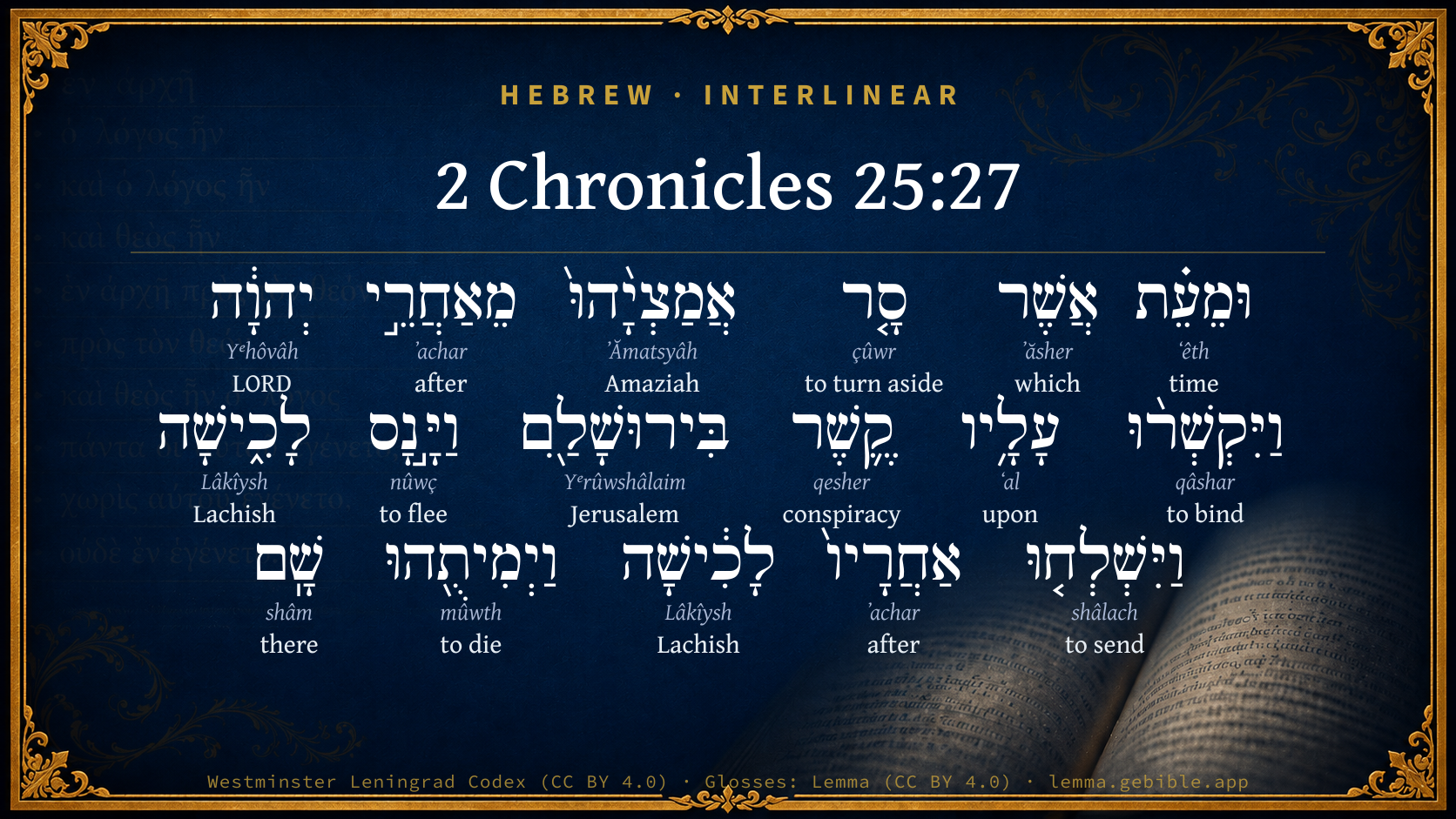
  1. וּמֵעֵ֗ת ʻêth H6256 “and · from · time” Conjunction + Preposition + Noun, Common, Both, Singular, Absolute
  2. אֲשֶׁר ʼăsher H834 “which” Particle, Relative
  3. סָ֤ר çûwr H5493 “to turn aside” Verb, Qal, Perfect, 3rd Person, Masculine, Singular
  4. אֲמַצְיָ֨הוּ֙ ʼĂmatsyâh H558 “Amaziah” Noun, Proper
  5. מֵאַחֲרֵ֣י ʼachar H310 “from · after” Preposition + Preposition
  6. יְהוָ֔ה Yᵉhôvâh H3068 “LORD” Noun, Proper
  7. וַיִּקְשְׁר֨וּ qâshar H7194 “and · to bind” Conjunction + Verb, Qal, Sequential Imperfect, 3rd Person, Masculine, Plural
  8. עָלָ֥יו ʻal H5921 “upon · him” Preposition + Suffix, Personal, 3rd Person, Masculine, Singular
  9. בִּירוּשָׁלִַ֖ם Yᵉrûwshâlaim H3389 “in/at · Jerusalem” Preposition + Noun, Proper
  10. וַיָּ֣נָס nûwç H5127 “and · to flee” Conjunction + Verb, Qal, Sequential Imperfect, 3rd Person, Masculine, Singular
  11. לָכִ֑ישָׁה Lâkîysh H3923 “Lachish · toward” Noun, Proper + Suffix, Demonstrative
  12. וַיִּשְׁלְח֤וּ shâlach H7971 “and · to send” Conjunction + Verb, Qal, Sequential Imperfect, 3rd Person, Masculine, Plural
  13. אַחֲרָיו֙ ʼachar H310 “after · him” Preposition + Suffix, Personal, 3rd Person, Masculine, Singular
  14. לָכִ֔ישָׁה Lâkîysh H3923 “Lachish · toward” Noun, Proper + Suffix, Demonstrative
  15. וַיְמִיתֻ֖הוּ mûwth H4191 “and · to die · him” Conjunction + Verb, Hiphil, Sequential Imperfect, 3rd Person, Masculine, Plural + Suffix, Personal, 3rd Person, Masculine, Singular
  16. שָֽׁם shâm H8033 “there” Adverb

About this verse

These counts appear in no published source. They are computed here, from the morphology-tagged text and Lemma’s own curated glosses. What Lemma adds →

17
words
15
distinct lemmas
Historical
section

Notable vocabulary

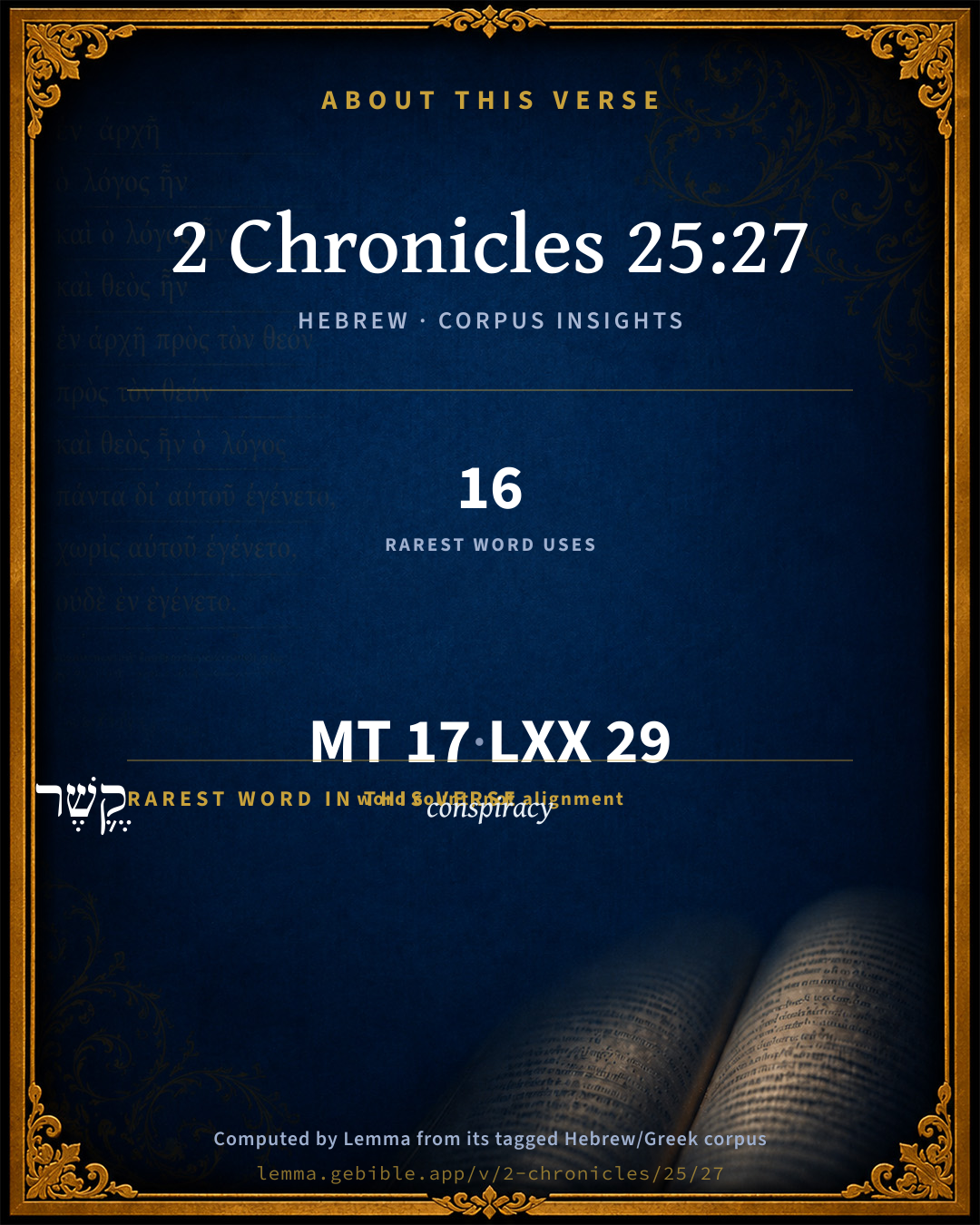
The rarest word here is קֶ֛שֶׁר conspiracy H7195 — appearing just 16 times in the whole Hebrew Bible.

Shared distinctive vocabulary

קֶ֛שֶׁר conspiracy H7195 occurs in 13 verses of the Hebrew Bible. Also found in:

Grammatical profile

  • 5 verbs
  • 7 nouns
  • 3 prepositions
  • 1 adverb
  • 1 particle

Verb forms

  • סָ֤ר Qal · Perfect
  • וַיִּקְשְׁר֨וּ Qal · Sequential Imperfect
  • וַיָּ֣נָס Qal · Sequential Imperfect
  • וַיִּשְׁלְח֤וּ Qal · Sequential Imperfect
  • וַיְמִיתֻ֖הוּ Hiphil · Sequential Imperfect

Repetition

Words recur within this verse — often emphatic in Hebrew:

  • מֵאַחֲרֵ֣י after H310 ×2
  • לָכִ֑ישָׁה Lachish H3923 ×2

Hebrew & Septuagint length

In English translation the verse runs 36 words from the Hebrew and 35 from the Septuagint (LXX English) — closely comparable.

A rough comparison of the two English renderings, which tokenize alike — not a word-level alignment.

Word counts can differ between the Hebrew and the Greek without any difference in meaning — e.g. the Hebrew direct-object marker אֵת has no separate Greek word, and Greek often adds the article ὁ.

In the original languages it is 17 Hebrew tokens and 29 Greek tokens — but the two are counted differently (Hebrew bundles its prefixes and suffixes into one token; the Greek is in lemma form), so that isn’t a like-for-like length.

Cross-references

4

Topical passages linked to 2 Chronicles 25:27 in the Treasury of Scripture Knowledge — connected by theme and wording, ordered by reader-vote popularity; previews shown in the World English Bible.

  • Joshua 10:31 Joshua passed from Libnah, and all Israel with him, to Lachish, and encamped against it, and fought against it:
  • 2 Kings 14:19 They made a conspiracy against him in Jerusalem; and he fled to Lachish: but they sent after him to Lachish, and killed him there.
  • 2 Chronicles 15:2 and he went out to meet Asa, and said to him, Hear you me, Asa, and all Judah and Benjamin: Yahweh is with you, while you are with him; and if you seek him, he will be found of you; but if you forsake him, he will forsake you.
  • 2 Chronicles 24:25 When they were departed for him (for they left him very sick), his own servants conspired against him for the blood of the sons of Jehoiada the priest, and killed him on his bed, and he died; and they buried him in the city of David, but they didn't bury him in the tombs of the kings.

Cross-references courtesy of OpenBible.info (CC BY 4.0).

Hebrew and Greek witnesses Masoretic Hebrew ↔ Greek Septuagint

The same verse in the two great witnesses to the Old Testament, shown verse-for-verse.

These are two independent witnesses, not word-aligned to each other, and the Septuagint is shown in lemma (dictionary) form.

Hebrew 2 Chronicles 25:27 Masoretic · Westminster Leningrad Codex

וּמֵעֵ֗ת אֲשֶׁר סָ֤ר אֲמַצְיָ֨הוּ֙ מֵאַחֲרֵ֣י יְהוָ֔ה וַיִּקְשְׁר֨וּ עָלָ֥יו קֶ֛שֶׁר בִּירוּשָׁלִַ֖ם וַיָּ֣נָס לָכִ֑ישָׁה וַיִּשְׁלְח֤וּ אַחֲרָיו֙ לָכִ֔ישָׁה וַיְמִיתֻ֖הוּ שָֽׁם

Now from the time that Amaziah did turn away from following Yahweh they made a conspiracy against him in Jerusalem; and he fled to Lachish: but they sent after him to Lachish, and killed him there.

World English Bible · Public Domain

Greek LXX 2 Chronicles 25:27 Septuagint · lemma form

καί ἐν ὁ καιρός ὅς ἀποἵστημι αμασιας ἀπό κύριος καί ἐπιτίθημι αὐτός ἐπίθεσις καί φεύγω ἀπό ἰερουσαλήμ εἰς λαχις καί ἀποστέλλω κατόπισθεν αὐτός εἰς λαχις καί θανατόω αὐτός ἐκεῖ

And at the time when Amasias departed from the Lord, then they formed a conspiracy against him; and he fled from Jerusalem to Lachis: and they sent after him to Lachis, and killed him there.

LXX2012 (modern English Septuagint) · Public Domain

Hebrew: Westminster Leningrad Codex (CC BY 4.0). Greek: Septuagint (public domain); English from LXX2012 (modern English Septuagint) (Public Domain). How the Septuagint differs from the Hebrew →

Commentary

Notes on 2 Chronicles 25:27 from classic Christian and Jewish commentators (each source and its license shown beneath its notes). The classic Christian expositions comment on the surrounding passage and are grouped to its opening verse, so a note may address several verses; the Jewish commentaries on the Tanakh (Rashi and others) are per-verse, so they appear only where the commentator wrote on this verse.

Lemma curates 59 commentaries, every one of them public domain or Creative Commons licensed, each selected and text-cleaned for this edition rather than reprinted as found. About our sources →

Adam Clarke's Commentary

Verse 27. Made a conspiracy] He no doubt became very unpopular after having lost the battle with the Israelites; the consequence of which was the dismantling of Jerusalem, and the seizure of the royal treasures, with several other evils. It is likely that the last fifteen years of his reign were greatly embittered: so that, finding the royal city to be no place of safety, he endeavoured to secure himself at Lachish; but all in vain, for thither his murderers pursued him; and he who forsook the Lord was forsaken by every friend, perished in his gainsaying, and came to an untimely end.

Adam Clarke's Commentary on the Bible (1810–1826) — public domain. Text from a community e-Sword/MySword module.

Ellicott's Commentary for English Readers

(27) Now after the time that Amaziah did turn away from following the Lord.—This clause is added by the chronicler, not so much with the aim of assigning a date, as of asserting the real connection between Amaziah’s defection from Jehovah, and the calamities that overtook him. Virtually he calls attention to the fulfilment of the prophecy of 2Ch_25:16.

A Bible Commentary for English Readers, edited by Charles John Ellicott (1878–1897) — public domain. Text from a community e-Sword module.

The Cambridge Bible for Schools and Colleges

gen. ed. J. J. S. Perowne

25–28 (= 2Ki_14:17-20). The End of Amaziah

27. after the time] R.V. from the time. The Chronicler characteristically connects the conspiracy with Amaziah’s apostasy; in Kings the fact only of the conspiracy is stated.

a conspiracy] Athaliah, Joash, Amaziah each fell one after the other before a conspiracy. Jehoiada’s example had far-reaching results.

to Lachish] Perhaps he was trying to reach Egypt.

The Cambridge Bible for Schools and Colleges (gen. ed. J. J. S. Perowne; Cambridge University Press, 1878–1918) — public domain. Text from a community e-Sword module.

Albert Barnes' Notes on the Bible

After the time ... - The writer means that the violent death of Amaziah followed on his apostasy, not closely in point of time - for it must have been at least 15 years after 2Ch 25:25 - nor as, humanly speaking, caused by it; but, in the way of a divine judgment, his death was a complete fulfillment of the prophecy of 2Ch 25:16.

Albert Barnes' Notes on the Bible (1834–1885) — public domain. Text from a community e-Sword/MySword module.

Haydock's Catholic Bible Commentary

CHAPTER XXV.

George Leo Haydock (1774–1849), Haydock's Catholic Family Bible and Commentary, 1859 edition — public domain. Excludes Psalms (Douay-Rheims chapter numbering differs from Protestant) and Deuterocanonical books (Catholic canon only).

The Pulpit Commentary

Now after the time that Amaziah did turn away from following the Lord. Let it be particularly noted that the entire of this sentence (which is a strong anachronism sui generis) is wanting in the parallel. It is, of course, in its matter intrinsically true, but none the less misleading in its form. The object of the writer cannot be doubted, as so many a cross-light is thrown upon it, in other places, viz. to connect the rise and the operativeness of the conspiracy with the fact that (though not the exact date at which) the king had turned aside from Jehovah to idols. They made a conspiracy. When every deduction is made, it may be that the conspiracy was one that was long hatching, and one which began in embryo from the date of Amaziah"s ignominious return to Jerusalem. Very certain it is that this would be historic certainty with the Paris of the past century or more. The French would have required a deadly explanation of such an affront, if brought upon them by any ruler of theirs. He fled to Lachish. In the Shefelah of Judah, and a strongly fortified place (2Ch_11:9; Jos_10:3, 32 15:39; 2Ki_14:19 2Ki_18:14; Isa_36:2; Jer_34:7; Mic_1:13) Eusebius places it seven Roman miles south of Eleutheropolis.

The Pulpit Commentary (1880–1919), ed. H.D.M. Spence-Jones & Joseph S. Exell — public domain. Text from a community e-Sword module.

unfoldingWord translationNotes

Door43 World Missions Community

turned away from following Yahweh

Here "turn away" is an idiom that means he no longer obeyed Yahweh. AT: "stopped obeying Yahweh" or "started to disobey Yahweh" (See: Idiom)

they began to make a conspiracy ... they sent ... They brought

The text does not state to whom "they" refers. Retain the generic "they" in your translation if possible.

make a conspiracy against him

The abstract noun "conspiracy" can be stated as an action. AT: "conspire against him" or "plot against him" (See: Abstract Nouns)

Lachish

a city in Judah (See: How to Translate Names)

brought him back

"brought back his body"

city of Judah

This was another name for Jerusalem, which was also called the city of David.

translationWords

Amaziah

turn

Yahweh

horse

bury

Judah

unfoldingWord translationNotes — © Distant Shores Media and the Door43 World Missions Community, licensed CC BY-SA 4.0. Source: git.door43.org/Door43/en_tn.

Rashi

Rabbi Shlomo Yitzchaki (Rashi)

And from the time that Amaziah turned away from following the Lord and was defeated by the king of Israel, immediately they conspired against him in Jerusalem to kill him, because each one was grieved over his son, his brother, and his kinsman who were slain because of him, because he provoked the king of Israel.

and he fled to Lachish a fortified city against which Sennacherib waged war. He fled to Lachish, where he remained fifteen years until they followed him to Lachish and assassinated him there. And during those fifteen years that he was in Lachish, Jecoliah, Uzziah’s mother, reigned in his stead. This is how it appears to me. In the commentary of Rabbi Joseph (Kara), I saw that during those fifteen years that he was in Lachish, Uzziah his son reigned in his stead, but it is incorrect to interpret it in this manner, for it is written immediately following (26:1): “who was sixteen years old.” We find that when his father fled, he was only one year old. Moreover, if this is the case, it should say, “took Uzziah and made him king instead of his father during his lifetime.” Rather, Scripture intimated that he did not reign during his father’s lifetime.

Rashi on the Tanakh — English translations: “The Judaica Press complete Tanach with Rashi, translated by A. J. Rosenberg” (CC BY 4.0); “Pentateuch with Rashi's commentary by M. Rosenbaum and A.M. Silbermann, 1929-1934” (public domain); “The Metsudah Tanach series, Lakewood, N.J” (CC BY 4.0); and “The Book of Joshua, Metsudah Publications, 1997” (CC BY 4.0). Text via Sefaria.

Lesson kit

Teaching starters — assembled from the data on this page, not authored interpretation. Every prompt links to the verse data it draws on. Edit before teaching.

2 Chronicles, in the Historical, opens this verse with 17 words (15 distinct Hebrew lemmas). Its most distinctive word is qesher (“conspiracy”). A historical commentator’s framing appears above. Read the whole chapter for the surrounding context.

Discussion questions

  1. How does “conspiracy” (qesher) shape what this verse is saying?
  2. 2 Samuel 15:12 shares the word «conspiracy» with this verse. How do the two illuminate each other?
  3. “after” occurs 2× in this one verse. What is the effect of the repetition?
  4. These translations render this verse differently; the difference is in the English rendering, not the original. What questions does that raise?
  5. The verb «סָ֤ר» is Qal Perfect. How does its form color the action?
  6. Reading how Adam Clarke's Commentary and Ellicott's Commentary for English Readers read this verse, where do the two commentators agree and where do they part?

Things to notice

Reading settings

Reading text

Shown beneath each verse's original-language words.

Old Testament
Old Testament edition

Read the OT as the Masoretic Hebrew (MT) or the Greek Septuagint (LXX).

English shown for the Greek Septuagint (in the Hebrew ↔ Greek comparison).

Comparing translations? Open the Compare panel on any verse page to stack up to four side by side.