2 Chronicles 36:1

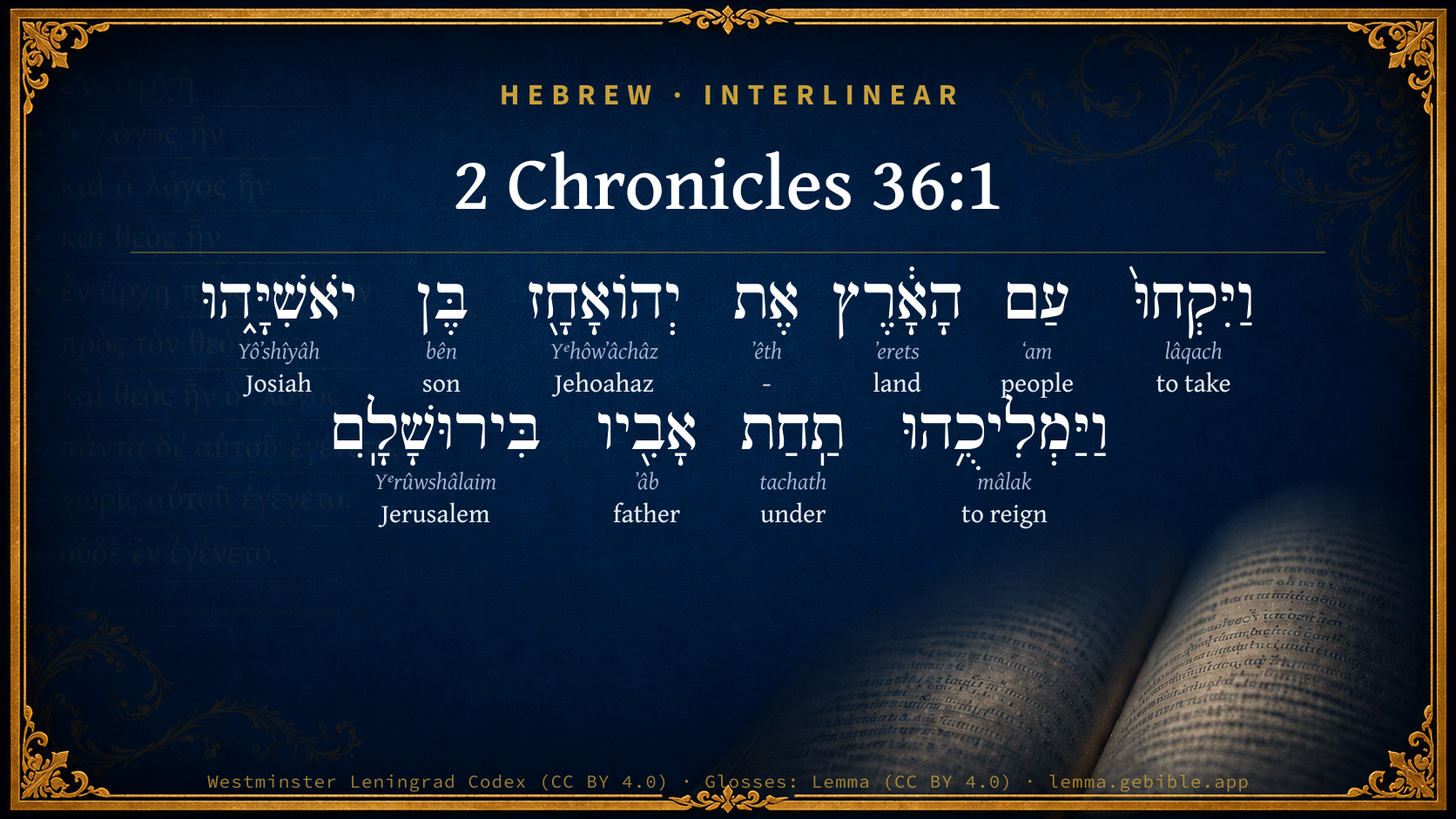
Hebrew (Westminster Leningrad Codex) 2 Chronicles 36:1 appears in the Hebrew Old Testament. The text above is from the Westminster Leningrad Codex. Each word links to its Strong’s number, a concise gloss, and parsing drawn from the Open Scriptures Hebrew Bible morphology. Click any word for its full Brown-Driver-Briggs (BDB) entry.
Download image
Cite this verse

2 Chronicles 36:1 (World English Bible). Public Domain. Lemma interlinear Bible study tool, https://lemma.gebible.app/v/2-chronicles/36/1.

Show BibTeX & RIS
BibTeX
RIS
English Translation
Then the people of the land took Jehoahaz the son of Josiah, and made him king in his father's place in Jerusalem.
World English Bible · Public Domain
Download a study sheet

One document with this verse’s original text, its word-by-word gloss line, the meaning frame, cross-references with their text, attributed commentary, and full source and license credits — printable, and it pastes into notes with its structure intact.

This verse Autodidact and up

Study sheet (.html) Plain text (.txt)

A passage Seminary Student

Up to 50 verses in one chapter. A passage sheet keeps up to 6 commentary sources and 12 cross-references per verse, in the order this page ranks them, and says so on the sheet whenever that leaves anything out. Ask for a single verse and you get the Autodidact verse sheet above.

Everything on this page stays free to read, with no account — the sheet is a download of what is already on screen, not access to it.

Want to remove ads? Support Godless Engineer
Compare translations 3

The same verse in 3 English versions, stacked beneath the original-language interlinear above. Click any original word for its lexicon entry.

Each is an independent rendering of the whole verse — the interlinear is not word-aligned to these translations.

Highlighted words mark where these versions differ — a whole-verse word diff, not a word-by-word alignment.

  • World English Bible Public Domain
    Then the people of the land took Jehoahaz the son of Josiah, and made him king in his father's place in Jerusalem.
  • King James Version Public Domain
    Then the people of the land took Jehoahaz the son of Josiah, and made him king in his father's stead in Jerusalem.
  • unfoldingWord Literal Text CC BY-SA 4.0
    And the people of the land took Jehoahaz, the son of Josiah, and they made him king in the place of his father in Jerusalem.

unfoldingWord Literal Text — © unfoldingWord, licensed CC BY-SA 4.0. Word-aligned USFM3 via Door43 (git.door43.org/unfoldingWord/en_ult).

Versions to compare (up to 4)

3 of 4 selected

Show all 18 translations

Every available English version of this verse, each an independent rendering of the whole verse.

  • World English Bible Public Domain
    Then the people of the land took Jehoahaz the son of Josiah, and made him king in his father's place in Jerusalem.
  • Berean Standard Bible Public Domain
    Then the people of the land took Jehoahaz son of Josiah and made him king in Jerusalem in place of his father.
  • Majority Standard Bible Public Domain
    Then the people of the land took Jehoahaz son of Josiah and made him king in Jerusalem in place of his father.
  • King James Version Public Domain
    Then the people of the land took Jehoahaz the son of Josiah, and made him king in his father's stead in Jerusalem.
  • American Standard Version (1901) Public Domain
    Then the people of the land took Jehoahaz the son of Josiah, and made him king in his father's stead in Jerusalem.
  • Revised Version (1885) Public Domain
    Then the people of the land took Jehoahaz the son of Josiah, and made him king in his father’s stead in Jerusalem.
  • Geneva Bible (1599) Public Domain
    Then the people of the lande tooke Iehoahaz the sonne of Iosiah, and made him king in his fathers steade in Ierusalem.
  • Douay-Rheims (1899) Public Domain
    Then the people of the land took Joachaz the son of Josias, and made him king instead of his father in Jerusalem.
  • Young's Literal Translation Public Domain
    And the people of the land take Jehoahaz son of Josiah, and cause him to reign instead of his father in Jerusalem.
  • Literal Standard Version CC BY-SA 4.0
    And the people of the land take Jehoahaz son of Josiah and cause him to reign instead of his father in Jerusalem.
  • Unlocked Literal Bible CC BY-SA 4.0
    Then the people of the land took Jehoahaz son of Josiah, and made him king in his father's place in Jerusalem.
  • unfoldingWord Literal Text CC BY-SA 4.0
    And the people of the land took Jehoahaz, the son of Josiah, and they made him king in the place of his father in Jerusalem.
  • Darby Bible Public Domain
    And the people of the land took Jehoahaz the son of Josiah, and made him king in his father's stead, in Jerusalem.
  • World Messianic Bible Public Domain
    Then the people of the land took Jehoahaz the son of Josiah, and made him king in his father’s place in Jerusalem.
  • Webster's Bible Public Domain
    Then the people of the land took Jehoahaz the son of Josiah, and made him king in his father's stead in Jerusalem.
  • Free Bible Version CC BY-SA 4.0
    The people of the land took Jehoahaz, son of Josiah, and made him king in Jerusalem in succession to his father.
  • Bible in Basic English Public Domain
    Then the people of the land took Jehoahaz, the son of Josiah, and made him king in Jerusalem in place of his father.
  • JPS Tanakh (1917) Public Domain
    Then the people of the land took Jehoahaz the son of Josiah, and made him king in his father's stead in Jerusalem.

Literal Standard Version (2020), Covenant Press — licensed CC BY-SA 4.0. Text via the HelloAO Bible API (eBible.org). Unlocked Literal Bible (unfoldingWord) — licensed CC BY-SA 4.0. Text via the HelloAO Bible API (eBible.org). unfoldingWord Literal Text — © unfoldingWord, licensed CC BY-SA 4.0. Word-aligned USFM3 via Door43 (git.door43.org/unfoldingWord/en_ult). Free Bible Version, Dr. Jonathan Gallagher — licensed CC BY-SA 4.0. Text via the HelloAO Bible API (eBible.org).

Word by word

More ways to search: Search by grammar → Find every occurrence → Compare this word →

Practice this passage: Drill this verse → Learn its vocabulary →

יְהוֹאָחָ֖ז
Yᵉhôwʼâchâz
H3059
“Jehoahaz”
Noun, Proper
Part of Speech
Noun
Type
Proper
Full BDB Definition

Origin: from H3068 and H270

TWOT: None

Jehoahaz = "Jehovah has seized" - a king of Judah and son of Josiah - a king of the northern kingdom of Israel and son of Jehu - a king of Judah and son of Jehoram (Ahaziah)
  1. וַיִּקְחוּ֙ lâqach H3947 “and · to take” Conjunction + Verb, Qal, Sequential Imperfect, 3rd Person, Masculine, Plural
  2. עַם ʻam H5971 “people of” Noun, Common, Masculine, Singular, Construct
  3. הָאָ֔רֶץ ʼerets H776 “the · land” Particle, Definite Article + Noun, Common, Both, Singular, Absolute
  4. אֶת ʼêth H853 “-” Particle, Direct Object
  5. בֶּן bên H1121 “son of” Noun, Common, Masculine, Singular, Construct
  6. יֹאשִׁיָּ֑הוּ Yôʼshîyâh H2977 “Josiah” Noun, Proper
  7. וַיַּמְלִיכֻ֥הוּ mâlak H4427 “and · to reign · him” Conjunction + Verb, Hiphil, Sequential Imperfect, 3rd Person, Masculine, Plural + Suffix, Personal, 3rd Person, Masculine, Singular
  8. תַֽחַת tachath H8478 “under” Preposition
  9. אָבִ֖יו ʼâb H1 “father · his” Noun, Common, Masculine, Singular, Construct + Suffix, Personal, 3rd Person, Masculine, Singular
  10. בִּירוּשָׁלִָֽם Yᵉrûwshâlaim H3389 “in/at · Jerusalem” Preposition + Noun, Proper

About this verse

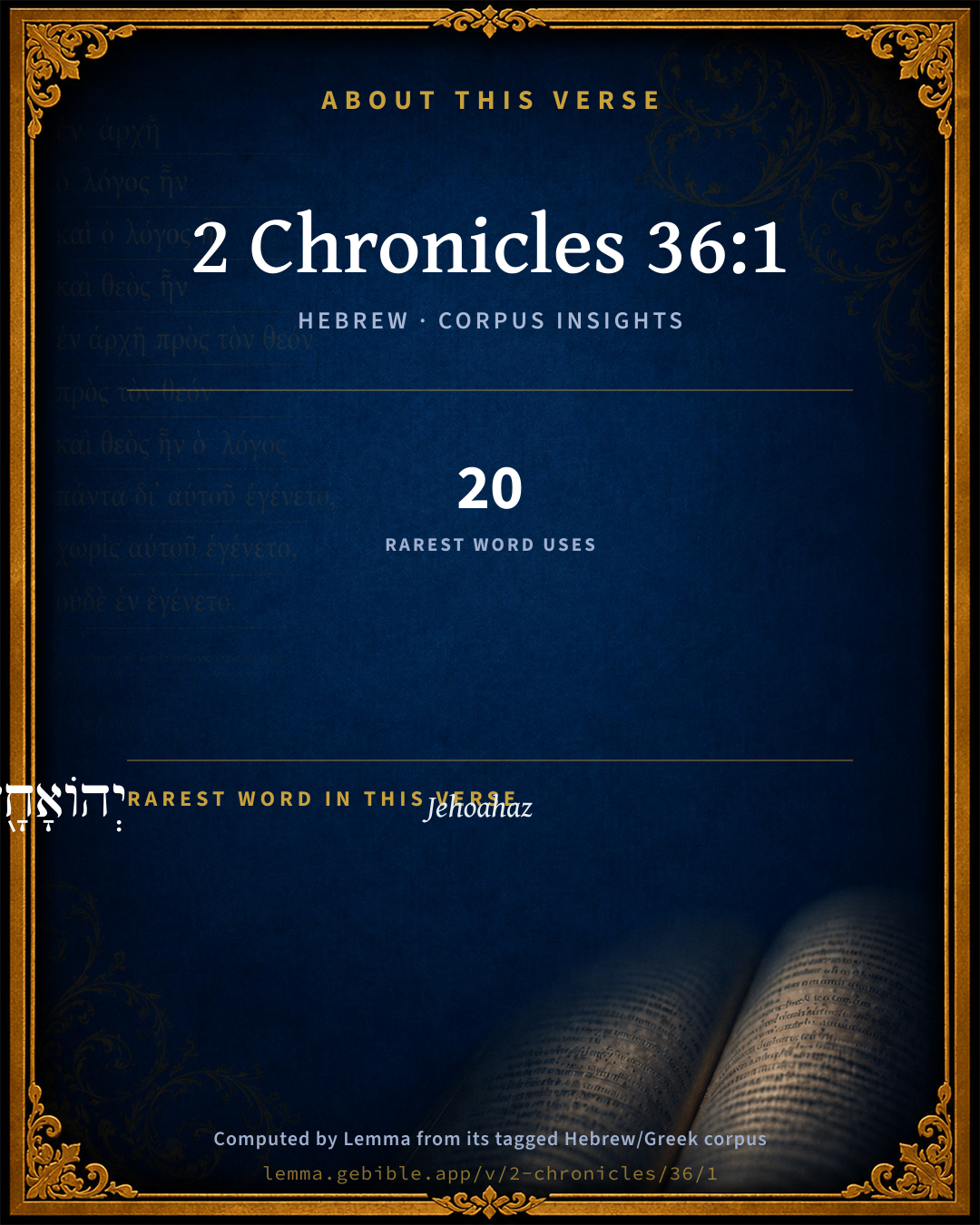
These counts appear in no published source. They are computed here, from the morphology-tagged text and Lemma’s own curated glosses. What Lemma adds →

11
words
11
distinct lemmas
Historical
section

Notable vocabulary

The rarest word here is יְהוֹאָחָ֖ז Jehoahaz H3059 — appearing just 20 times in the whole Hebrew Bible.

Shared distinctive vocabulary

יְהוֹאָחָ֖ז Jehoahaz H3059 occurs in 19 verses of the Hebrew Bible. Also found in:

Grammatical profile

  • 2 verbs
  • 7 nouns
  • 1 preposition
  • 1 particle

Verb forms

  • וַיִּקְחוּ֙ Qal · Sequential Imperfect
  • וַיַּמְלִיכֻ֥הוּ Hiphil · Sequential Imperfect

Hebrew & Septuagint length

In English translation the verse runs 22 words from the Hebrew and 27 from the Septuagint (LXX English) — closely comparable.

A rough comparison of the two English renderings, which tokenize alike — not a word-level alignment.

Word counts can differ between the Hebrew and the Greek without any difference in meaning — e.g. the Hebrew direct-object marker אֵת has no separate Greek word, and Greek often adds the article ὁ.

Cross-references

5

Topical passages linked to 2 Chronicles 36:1 in the Treasury of Scripture Knowledge — connected by theme and wording, ordered by reader-vote popularity; previews shown in the World English Bible.

  • Jeremiah 22:11 For thus says Yahweh touching Shallum the son of Josiah, king of Judah, who reigned instead of Josiah his father, [and] who went forth out of this place: He shall not return there any more.
  • 2 Kings 23:30–37 His servants carried him in a chariot dead from Megiddo, and brought him to Jerusalem, and buried him in his own tomb. The people of the land took Jehoahaz the son of Josiah, and anointed him, and made him king in his father's place.
  • 1 Chronicles 3:15 The sons of Josiah: the firstborn Johanan, the second Jehoiakim, the third Zedekiah, the fourth Shallum.
  • 2 Chronicles 26:1 All the people of Judah took Uzziah, who was sixteen years old, and made him king in the room of his father Amaziah.
  • 2 Chronicles 33:25 But the people of the land killed all those who had conspired against king Amon; and the people of the land made Josiah his son king in his place.

Cross-references courtesy of OpenBible.info (CC BY 4.0).

Hebrew and Greek witnesses Masoretic Hebrew ↔ Greek Septuagint

The same verse in the two great witnesses to the Old Testament, shown verse-for-verse.

These are two independent witnesses, not word-aligned to each other, and the Septuagint is shown in lemma (dictionary) form.

Hebrew 2 Chronicles 36:1 Masoretic · Westminster Leningrad Codex

וַיִּקְחוּ֙ עַם הָאָ֔רֶץ אֶת יְהוֹאָחָ֖ז בֶּן יֹאשִׁיָּ֑הוּ וַיַּמְלִיכֻ֥הוּ תַֽחַת אָבִ֖יו בִּירוּשָׁלִָֽם

Then the people of the land took Jehoahaz the son of Josiah, and made him king in his father's place in Jerusalem.

World English Bible · Public Domain

Greek LXX 2 Chronicles 36:1 Septuagint · lemma form

καί λαμβάνω ὁ λαός ὁ γῆ ὁ ιωαχαζ υἱός ιωσίας καί χρίω αὐτός καί καταἵστημι αὐτός εἰς βασιλεύς ἀντί ὁ πατήρ αὐτός ἐν ἰερουσαλήμ

And the people of the land took Joachaz the son of Josias, and anointed him, and made him king over Jerusalem in the room of his father.

LXX2012 (modern English Septuagint) · Public Domain

Hebrew: Westminster Leningrad Codex (CC BY 4.0). Greek: Septuagint (public domain); English from LXX2012 (modern English Septuagint) (Public Domain). How the Septuagint differs from the Hebrew →

Commentary

Notes on 2 Chronicles 36:1 from classic Christian and Jewish commentators (each source and its license shown beneath its notes). The classic Christian expositions comment on the surrounding passage and are grouped to its opening verse, so a note may address several verses; the Jewish commentaries on the Tanakh (Rashi and others) are per-verse, so they appear only where the commentator wrote on this verse.

Lemma curates 59 commentaries, every one of them public domain or Creative Commons licensed, each selected and text-cleaned for this edition rather than reprinted as found. About our sources →

Matthew Henry's Commentary

The destruction of Judah and Jerusalem is here coming on by degrees. God so ordered it to show that he has no pleasure in the ruin of sinners, but had rather they would turn and live, and therefore gives them both time and inducement to repent and waits to be gracious. The history of these reigns was more largely recorded in the last three chapters of the second of Kings. 1. Jehoahaz was set up by the people (Ch2 36:1), but in one quarter of a year was deposed by Pharaoh-necho, and carried a prisoner to Egypt, and the land fined for setting him up, Ch2 36:2-4. Of this young prince we hear no more. Had he trodden in the steps of his father's piety he might have reigned long and prospered; but we are told in the Kings that he did evil in the sight of the Lord, and therefore his triumphing was short and his joy but for a moment. 2. Jehoiakim was set up by the king of Egypt, an old enemy to their land, gave what king he pleased to the kingdom and what name he pleased to the king! Ch2 36:4. He made Eliakim king, and called him Jehoiakim, in token of his authority over him. Jehoiakim did that which was evil (Ch2 36:5), nay, we read of the abominations which he did (Ch2 36:8); he was very wild and wicked. Idolatries generally go under the name of abominations. We hear no more of the king of Egypt, but the king of Babylon came up against him (Ch2 36:6), seized him, and bound him with a design to carry him to Babylon; but, it seems, he either changed his mind, and suffered him to reign as his vassal, or death released the prisoner before he was carried away. However the best and most valuable vessels of the temple were now carried away and made use of in Nebuchadnezzar's temple in Babylon (Ch2 36:7); for, we may suppose, no temple in the world was so richly furnished as that of Jerusalem. The sin of Judah was that they had brought the idols of the heathen into God's temple; and now their punishment was that the vessels of the temple were carried away to the service of the gods of the nations. If men will profane God's institutions by their sins, it is just with God to suffer them to be profaned by their enemies. These were the vessels which the false prophets flattered the people with hopes of the return of, Jer 27:16. But Jeremiah told them that the rest should go after them (Jer 27:21, Jer 27:22), and they did so. But, as the carrying away of these vessels to Babylon began the calamity of Jerusalem, so Belshazzar's daring profanation of them there filled the measure of the iniquity of Babylon; for, when he drank wine in them to the honour of his gods, the handwriting on the wall presented him with his doom, Dan 5:3, etc. In the reference to the book of the Kings concerning this Jehoiakim mention is made of that which was found in him (Ch2 36:8), which seems to be meant of the treachery that was found in him towards the king of Babylon; but some of the Jewish writers understand it of certain private marks or signatures found in his dead body, in honour of his idol, such cuttings as God had forbidden, Lev 19:28. 3. Jehoiachin, or Jeconiah, the son of Jehoiakim, attempted to reign in his stead, and reigned long enough to show his evil inclination; but, after three months and ten days, the king of Babylon sent and fetched him away captive, with more of the goodly vessels of the temple. He is here said to be eight years old, but in Kings he is said to be eighteen when he began to reign, so that this seems to be a mistake of the transcriber, unless we suppose that his father took him at eight years old to join with him in the government, as some think.

Matthew Henry's Commentary on the Whole Bible (1708–1710) — public domain (CC PDM 1.0). Text via the HelloAO Bible API.

Ellicott's Commentary for English Readers

XXXVI.

THE REIGN OF JEHOAHAZ (2Ch_36:1-4). (Comp. 2Ki_23:30-35; 3 Esdr. 1:32-36.)

(1) Then.—And.

The people of the land took Jehoahaz.—Comp. 2Ch_26:1; 2Ch_33:25. Jehoahaz or Shallum was not the firstborn (1 Chron. iii 15). See Notes on 2Ki_23:30, with which this verse agrees.

A Bible Commentary for English Readers, edited by Charles John Ellicott (1878–1897) — public domain. Text from a community e-Sword module.

The Cambridge Bible for Schools and Colleges

gen. ed. J. J. S. Perowne

Ch. 2Ch_36:1-4 (= 1Es_1:34-38; 2Ki_23:31-34). The Reign of Jehoahaz

1. the people of the land took] Cp. 2Ch_26:1; 2Ch_33:25.

Jehoahaz] Called “Shallum” in 1Ch_3:15; Jer_22:11. He was younger than Jehoiakim; 2Ch_36:5.

The Cambridge Bible for Schools and Colleges (gen. ed. J. J. S. Perowne; Cambridge University Press, 1878–1918) — public domain. Text from a community e-Sword module.

Trapp's Complete Commentary

John Trapp

2Ch 36:1 Then the people of the land took Jehoahaz the son of Josiah, and made him king in his father’s stead in Jerusalem.

Ver. l. Then the people of the land took Jehoahaz.] See 2Ki 23:30.

John Trapp, A Commentary or Exposition upon All the Books of the Old and New Testament (1647–1656) — public domain. Text from a community e-Sword module.

Joseph Benson's Commentary

2Ch 36:1. The people of the land took Jehoahaz, &c. — The principal contents of this chapter are explained in the notes on 2Ki 23:31, and 24., and 25., to which the reader is referred. What is peculiar to this chapter shall be noticed here.

Joseph Benson's Commentary on the Old and New Testaments (1811–1818) — public domain. Text from a community e-Sword module.

The Preacher's Complete Homiletical Commentary

Joseph S. Exell (gen. ed.)

CRITICAL NOTES.] This chapter gives the reigns of Jehoahaz (2Ch_36:1-4), of Jehoiakim (2Ch_36:5-8), of Jehoiachin (2Ch_36:9-10), and of Zedekiah (2Ch_36:11-21); the proclamation of Cyrus (2Ch_36:22-23). Parallel with 2Ki_23:21-25. “The chapter scarcely adds anything to our knowledge of the later history of the Jewish kingdom, but it was requisite to complete the design of the work, which aimed at tracing the fortunes of the Jewish people from the death of Saul to the return under Zerubbabel” [Speak. Com.].

2Ch_36:1-4.—Succession of Jehoahaz. Original name Shallum (Jer_22:11); third son of Josiah (1Ch_3:15); took name of Jehoahaz (“the Lord possesses”) on accession. 2Ch_36:3. Necho followed up advantage gained in Judah, deposed J. Condemned, fined the land, and set up Eliakim as vassal on the throne. 2Ch_36:4. Turned, change of Eliakim into Jehoiakim (“God sets up,” into “Jehovah sets up”), in deference to the king and people, and in keeping with politic character of Necho. Eg., where he died.

2Ch_36:5-8.—Jehoiakim two years older than Jehoahaz, and of a different mother (2Ki_23:31-36); evil, followed the course of idolatrous predecessors. 2Ch_36:6. Nebuchad., first expedition against Palestine in lifetime of his father, Nabopolassar, who was old and infirm, and adopted his son Neb. joint sovereign, dispatched him against Egyptian invaders of the empire. Neb. victorious at Carchemish, drove them from Asia, reduced provinces west of Euphrates, and Jehoiakim became vassal of Assyrian kingdom (2Ki_24:1). At end of three years J. rebelled, but vanquished, stripped of possessions, and taken prisoner. Allowed for a short time to remain in his tributary kingdom, gave fresh offence. Jerusalem besieged, and the king slain in a sally (cf. 2Ki_24:2-7; Jer_22:18-19; Jer_36:30).

2Ch_36:9-10.—Jehoiachin. Eight: “As Nebuchad carried away this king’s wives (2Ki_24:15), it is plain that eight here is a slip of the transcriber for eighteen, the number found in 2Ki_24:8; and even in the Sept. Jehoiachin is otherwise Jechoniah (1Ch_3:16), and even Coniah (Jer_22:24). His reign of three months and ten days scarcely called a reign, as he merely claimed the crown until taken away by Nebuchad.” [Murphy]. Year expired, lit., “at the return of the year,” in spring, when campaigns began City captured, temple pillaged, king, nobles, and skilful artisans carried to Babylon (2Ki_24:8-17).

2Ch_36:11-21.—Zedekiah’s reign. Originally Mattaniah, appointed by Nebuchad., from whom he received crown on conditions of solemn oath. 2Ch_36:13. Swear, took oath of allegiance, which he broke, and was censured (Eze_17:13). 2Ch_36:14. Further justification for God’s rejection. Idolatry added to other sins. 2Ch_36:15. Messengers, Isaiah, Jeremiah, Ezekiel, and others. Betimes, continually and carefully. 2Ch_36:16. No remedy, no healing; sinned beyond mercy (2Ki_24:4). 2Ch_36:17. Slew, out and slew; reference to God, who caused disasters to fall upon them for sins. Slaughter fearful at capture of city (cf. Eze_9:6-7; Lam_2:7-10). 2Ch_36:20. Vessels enumerated (2Ki_25:14-15). The pillage more sweeping than in days of Jehoiakim (2Ki_25:1-10; Jer_39:1-8). Those who escaped from sword carried into exile till accession of Persian king; servants, slaves to Neb. and his sons, employed in forced labour which great works necessitated. 2Ch_36:21. Word (Jer_25:11; Jer_29:10). Sabbaths (Lev_26:34-35). The seventy years to be counted from first taking of Jer. by Neb. in fourth year of Jehoiakim (605 B.C.).

2Ch_36:22-23.—Proclamation of Cyrus. Peculiar to Chron. “An interval of fifty years passed over in silence” [Murphy]. First year, as sovereign of second monarchy of Daniel (B.C. 538). Stirred up, mode not mentioned; prophecy (Isa_44:28; Isa_45:1) may have been shown to him by Daniel, and exercised powerful influence over him. God of heaven, “similar formula at commencement of the great majority of Persian inscriptions” [Speak. Com.]. Intimates acquaintance with supreme God, not necessarily an intelligent adherent; Cyrus considered that he was charged, chosen agent to build God’s house, and therefore invites his people to return. “Such is the finale of Chronicles. It thereby shows itself to be an introduction to the history of the returning exiles of Judah and Israel, which is contained in Ezra and Nehemiah, and an exposition of the peculiar principles by which the restored people had to be governed” [Murphy].

HOMILETICS

THE REIGN OF JEHOAHAZ.—2Ch_36:1-4

After death of Josiah, a deplorable period of misrule and imbecility. Unhappy sons struggled for independence, but entailed miseries of siege and capture. Kings recede into obscurity: Jeremiah, the prophet, the central figure around whom gather interests of a falling State. For three-and-twenty years almost alone, he endeavours to avert, delay, or mitigate the judgments, but in vain. “When he cannot give hope,” says one, “or consolation, or peace, he gives his tender sympathy—is himself the sad example of exile, persecution, misery, death.”

I. The method of his accession. “The people of the land made him king.” Not the eldest son of Josiah, but popular favourite on account of his martial spirit (Eze_19:3), and determined opposition to aggressive measures in Egypt. Anointed—a ceremony not deemed necessary in regular and undisputed succession—to impart greater validity to popular choice and render disturbance from Necho less likely, who, like all Egyptians, associated idea of sanctity with regal anointing. “Man proposeth, but God disposeth.”

II. The shortness of his reign. “He reigned three months, and the king put him down.” Necho on victorious return from the Euphrates deposed him, and deemed it expedient to have a king of his own nomination on the throne. The will of the people, the solemnity of anointing of no avail. The autocrat, good or bad, a Solomon or a Herod, is without control. (Sic volo; sic jubeo; stat pro ratione voluntas), “He doeth whatsoever pleaseth him, and who may say unto him, What doest thou?” (Ecc_8:3-4).

III. The taxing of the land. “Put the land to a tribute” (a hundred talents of silver, £3,418 15s.; and a talent of gold, £5,475; total amount of tribute, £8,893 15s.). Heb., set a mulct upon the land (2Ki_23:33). This a dishonour, a sign of subjection and dependence. What a fall from exalted position and former greatness!

IV. The end of his career. The deposed king sent for to Riblah, in Syria, arrested in chains, taken prisoner, and carried into Egypt, where he died. “Something there had been in his character, or in the popular mode of his election, which endeared him to his country. A lamentation, as from his father, went up from the princes and prophets of the land for the lion’s cub (Eze_19:14), that was learning to catch his prey, caught in the pitfall, and led off in chains—by a destiny even sadder than death in battle. ‘Weep not for the dead, nor bemoan him, but weep sore for him who goeth away.’ He was the first King of Judah who died in exile. ‘He shall return no more, he shall return no more to see his native country—his native land no more’ (Jer_22:10-12)” [Stanley].

JEHOIAKIM, THE WICKED PRINCE.—2Ch_36:3-8

Jehoiakim second son of Josiah, born B.C. 634, and eighteenth king of separate throne of Judah for a period of eleven years, set up as vassal of Egyptian king.

I. The significant change of his name. Originally Eliakim (El-yakim), changed into Jehoiakim (Jeho-Yakim). Heathen princes gave new names to those who entered their service usually after their gods. This an Israelitish name, bestowed probably at Eliakim’s own request, whom Hengsten-berg supposes to have been influenced by a desire to be connected with the promise (in 2Sa_7:12), where not El, God, but “Jehovah will set up.” The change signifies loss of liberty and dependence. A striking contrast between the beauty of the name and the misery of its fate. Aspire to that “new name which no man knoweth, saving he that receiveth it.”

II. The wickedness of his conduct. A reign filled with idolatry, oppression, and misfortunes. Sketched with masterly hand in Jer_22:13-23, and in Eze_19:5 to Eze_9:1. In his restoration of idolatry. He followed the example of idolatrous predecessors, people eagerly availed themselves of vicious license of a lax government. Land filled with heathen “abominations.”

2. In his tyrannical measures of government. Jeremiah reproaches him for covetousness, cruelty, injustice, violence, and luxury (Jer_22:13-17). Bloodthirsty (2Ch_26:20-23), selfish, and most extravagant. Indifferent to sufferings of his people, and at a time of impoverishment of land by heavy tributes to Egypt, he squandered large sums in building luxurious palaces.

3. In his impious defiance of God. From beginning of his reign the voice of Jeremiah predicts and prefigures danger by striking signs. Attempts to silence the prophet by princes, priests, and false prophets. Jehoiakim used the penknife to cut up the leaves of the Book and destroy the effect of the message, at a period of solemn fast. The counsel of God stood sure, but no impression made upon the mind of the king by the fresh roll.

4. In his rebellion against Nebuchadnezzar. After three years’ subjection, deluded by Egyptian party in court, he ventured to withhold tribute and throw off Chaldæan yoke (2Ki_24:1). Perhaps desired to spend money in luxury and pride, not to pay the King of Babylon; perhaps sought to become independent since severance of Egypt from Syria at battle of Carchemish. But the step, contrary to earnest remonstrance of Jeremiah, in violation of oath of allegiance, and the ruin of king and country.

III. The Calamities of his reign. Scripture statements brief but graphic.

1. The invasion of his kingdom. Nebuchadnezzer too busy in conflict between Lydian and Median empires to march against Jerusalem and chastise his rebellious vassal, sent his governors to rouse surrounding nations, and Syrians, Moabites, and Ammonites united with Chaldæan forces to harass Judah. No rest or safety out of the walled cities. At length, in seventh year of his reign (B.C. 598), Nebuchadnezzar took field in person, concentrated forces, marched first against Tyre, which had rebelled about time of Judah; then, after investment of city, went against Jerusalem.

2. The desecration of the Temple. “Carried the vessels of the house of the Lord to Babylon.” A portion of sacred vessels, perhaps in lieu of tribute unpaid, and deposited in the house of Belus, his god (Dan_1:2; Dan_5:2).

IV. The dishonour of his end. Though a prisoner and chained to be carried to Babylon at first, he was permitted to remain in his tributary kingdom. In siege of the city, by an engagement with the enemy, or by the hand of his own oppressed subjects, who thought to conciliate the Babylonians by the murder of their king, he came to a violent end in eleventh year of his reign. His body ignominiously treated as predicted—cast over the walls, left exposed, dragged away “with the burial of an ass beyond the gates of Jerusalem” (cf. Jer_22:10 and Jeremiah 36). Warning lost upon J.; disregarded future with its clear and awful signs, held the throne in sufferance, until he fell into disgrace and ruin. “Whatsoever a man soweth, that shall he also reap.”

ZEDEKIAH’S REIGN: THE EXTINCTION OF THE ROYAL LINE.—2Ch_36:11-21

Zed. the twentieth and last king of Judah. His proper name, Mattaniah, changed to Zedekiah at accession, may be in allusion to Jeremiah’s prophecy of Israel’s future as Jehovah-tsidkenu—Jehovah, our Righteousness (2Ch_23:5; 2Ch_23:8). Rather weak than wicked, Z. requested the prophet to pray for him, but refused his advice. Rebellion brought siege to the city, destruction to the Temple, and exile to himself and Royal family. The events of his reign summed up in brief record—

I. Reckless disregard of Divine warnings. Jeremiah a true prophet and best friend, but unheeded; treated alternately as a traitor and a madman (Joseph. Ant. 2Ch_10:7, sec. 41); and at last imprisoned. Admonished, but amended not. “He humbled not himself before Jeremiah, &c.”

II. Ruinous policy pursued. Policy of Jeremiah prevailed for a while in foreign matters. An embassy sent to Babylon to take solemn oath with Nebuchadnezzar in the sacred name of Elohim, which Israel and Babylon alike acknowledged.

1. In throwing off yoke of allegiance. “Rebelled against N., who had made him sware by God” that he would keep the kingdom for Nebuchad., make no innovation, enter into no alliance with Egypt (Eze_17:3; Joseph, 2Ch_10:7, s. 3). He acted in contravention to this oath, perjured his character, and committed the crowning act of wickedness, according to the high standard of prophetic morality. “Shall he prosper? shall he escape that doeth such things? or shall he break the covenant and be delivered? As I live, saith the Lord God, surely in the place where the king dwelleth that made him king, whose oath he despised, and whose covenant he brake, even with him in the midst of Babylon shall he die” (Eze_17:15-16).

2. In persisting in rebellion. Hananiah’s prophecy had been falsified, and he himself had died according to the word of Jeremiah—the folly of a mere remnant opposing a mighty nation was exposed. Egyptian help in vain, and real alliance with surrounding nations impossible. Yet the king infatuated, held out and was mined.

III. Incurable idolatry into which the nation had fallen.

1. All classes were corrupted. “All the chief of the priests” who should have opposed idolatry, “and the people transgressed very much after all the abominations of the heathen.” Into the sacred precincts of the temple idolatrous rites had crept. In the outer court women wept and wailed for Tammuz (Eze_8:14); in subterranean chambers incense offered by elders to creeping things and abominable beasts (ib. 2Ch_10:11); and at the entrance to the temple building, between porch and altar, the rising sun was worshipped, by those who turned their backs to the sanctuary and their faces to the east (2Ch_36:16). Thus “they polluted the house of the Lord which he had hallowed in Jerusalem.”

2. The prophets of God were insulted. Mocked in words, opposed openly in acts, and ill-treated in life. This affront to God who sent them, an evidence of implacable enmity and an invincible determination to persevere in sin. But those that abuse God’s messengers provoke his wrath and cannot escape.

3. The nation beyond all hope. “The wrath of the Lord arose against his people, till there was no remedy” (2Ch_36:16). “No healing,” no physician, for a body corrupt and already dead. Sins beyond mercy, “which the Lord would not pardon” (2Ki_24:4). Possible to sin too long, to sin away the day of grace. “They would none of my counsel; they despised all my reproof, therefore shall they eat of the fruit of their own way and be filled with their own devices.”

IV. The execution of Divine judgments. The end rapidly coming. The city besieged and reduced to extremities. Fire of besiegers aided by severe famine within. Inhabitants resorted to terrible expedience (Jer_38:9; Lam_4:10). At length a breach effected and Chaldæns entered.

1. The temple burned;

2. The city ruined; and

3. The inhabitants carried to Babylon. Sacred vessels taken, palaces of princes levelled to the ground, fortifications demolished, and predictions fulfilled to the letter. No escape by flight. Zedekiah pursued, caught, and despatched to Riblah. Nebuchadnezzar, with cruelty characteristic of the times, ordered his sons to be killed and his own eyes to be thrust out (cf. Jer_32:4 and Eze_12:13). “The king of Babylon bound him in chains and carried him to Babylon, and put him in prison till the day of his death.”

1. Transgressors cannot escape from appointed judgments.

2. The bitterness of sin is seen in the overthrow which it creates.

3. Since we have not otherwise any guarantee against national humiliation, what need to have the Lord on our side!

“Justice, like lightning, ever should appear

To few men’s ruin, but to all men’s fear” [Swenam].

THE PROCLAMATION OF CYRUS.—2Ch_36:22-23

God pitied his people in captivity. Predicted long before that he would restore them again to the land of their fathers. The promise not forgotten. “In the first year,” when Cyrus gained possession of Babylon, an edict granting exiles permission to return to Jerusalem.

I. The work Cyrus was called upon to undertake. “He hath charged me to build him an house.” Jerusalem in ruins, materials and men required to rebuild. Some pull down and delight in destruction. Cyrus felt responsible for rebuilding of Temple, construction of Theocracy, and arrangements for future kingdom and welfare of God’s people. The secular welfare of his government and the religious interests of his own country overlooked. Absorbed in one grand mission. Israel’s disobedience to God’s charge aggravated by obedience of Cyrus, a heathen king.

II. The proclamation for help in this work. “He made a proclamation throughout all his kingdom.” His dominions first confined to province of Persia, successively enlarged by addition of Media, Lydia, Asia Minor, Babylon and Assyria, Samaria and Judea.

1. The proclamation was inspired. “The Lord stirred up the spirit of Cyrus.” Not the suggestion of Magi in the city; not the instruction of Daniel, who informed Cyrus of predictions concerning him. But “the Lord God of heaven,” who influences the heart of kings like rivers of water, prompted him to fulfil this duty.

2. The proclamation was written. Written in Jewish language to be understood by tribes in distant provinces. Written and proclaimed aloud, “caused a voice to pass,” like a jubilee trumpet to sound deliverance to captives.

3. The proclamation was gracious. Political considerations might prompt. Egypt a formidable rival to the great world empires. Might be advantageous to have an advanced post in south of Judea to protect against invasion, or from which to make rapid descent upon lands of the Nile. But higher aim in the emancipation of Jews and liberty to return.

III. The response to the proclamation. Cf. Ezra 1. Leaders and chief men responded heartily. God disposed many to make sacrifices and return, others remained in Babylon.

1. The response must be immediate. “Let him go up without delay.”

2. The response must be voluntary. “Who is there among you of all the people?”

3. The response must be accepted. May involve risk, long journey and great sacrifices; but duty urges, God promises, and privileges enjoyed if we comply. The gospel preaches deliverance to the captives, but many in love with sin, prefer to stay in the world and have no portion in Jerusalem.

HOMILETIC HINTS AND SUGGESTIONS

2Ch_36:8. Found in him.

1. Evil latent in every heart.

2. Circumstances only required to discover and develop it.

2Ch_36:13. Three steps in wickedness. Broke his engagement, stiffened his neck, and hardened his heart. Rebelled, &c.

1. The sanctity of an oath. Though taken under compulsion, and not due on natural equity: yet must be held sacred, not binding merely till exigency should pass away.

2. The danger of infringement. Its violation not excused, nor passed in silence; but the filling up of the cup of the nation’s guilt. Contracts and oaths not mere legal forms, to be lightly esteemed, but solemn obligations. Violations more criminal than breaking promises; sins of great deliberation, signs of lax morals, and may be precursors of national ruin.

2Ch_36:16. His prophets.

1. Prophetic teaching a constant element in Israel’s history. Not left in darkness like heathen nations. Crises and master minds. Moses, Samuel, David, Elijah, &c.

2. The method of this teaching unique and worthy of consideration. Divinely taught. Each set apart; all pre-eminently raised above their fellow-men, “the messengers of God.” Earnestly taught. “Rising up betimes,” i.e., earnestly and carefully: unwearied anxiety and solicitation. Patiently taught. “Sending them” constantly, though ill-treated and set at nought. What kindness and forbearance!

3. Rejection of this teaching brings guilt and danger. Guilt aggravated, “until the wrath of the Lord arose.” Escape hopeless, “till there is no remedy.” God’s long-suffering and earnest entreaties by servants “rising early and protesting to them.” The most awful aggravations of guilt in “refusing to hear” (cf. Jer_11:11).

“God sends his teachers with every age,

To every clime and every race of men,

With revelations fitted to their growth

And shape of mind” [Lowel].

No remedy. These words contain three facts of great importance.

1. That there was, at least at one time, a remedy.

2. That the remedy went on, and might have been used, for a very long period.

3. That there came a time when the remedy ceased.

1. All life is a remedy. The conditions of things require it. Life a great restorative process.

1. Comes that marvellous provision of God in Jesus Christ.

2. Subordinate to this great remedy of the cross of Christ, and working with it, all providences have a curative character.

3. Every one carries within himself an antidote to himself. Conscience, till silenced, a sure antidote for evil. II. Notice the word “till.” It shows how slow God is to take away the remedy. His mercy holds back the arm of justice. But we may sin ourselves into a state, not in which there is no forgiveness, but no thought or desire to seek forgiveness. “No remedy,” not on God’s account, but your own; not in God’s want of will to save you, but in your own incapacity to will your own salvation [J. Vaughan, Sermons].

2Ch_36:21. As long. Seventy years’ desolation predicted by Jeremiah. “The idea that the duration of the desolation was determined in the Divine counsels by the number of the neglected sabbatical years, and that the enforced fallow was intended to compensate for previous unlawful cultivation, is not found in Jeremiah, and, indeed, appears only in Lev_26:34-35, and in this place” [Speak. Com.]. Learn—

1. The purpose of God in the affliction of his people.

2. The providence of God in regulating affliction for good, and as regards—a, method; b, degree; c, time. As the exodus from Egypt came in the exact time, so return from Babylon after seventy years. Times of deliverance correspond with minute exactness to prophetic announcements. Hence patience, submission, and hope. “Even the selfsame day it came to pass” (Exo_12:41).

The Preacher's Complete Homiletical Commentary (gen. ed. Joseph S. Exell; Funk & Wagnalls, c. 1892) — public domain (pre-1929). A full-Bible homiletical/sermon-outline anthology covering 65 of 66 books (2 John is absent from the source module). Text from a community e-Sword module.

The Annotated Bible

Arno C. Gaebelein

9. The Final Decline and Apostasy

CHAPTER 36:1-14

1. Jehoahaz’s reign (2Ch 36:1-7)

2. Jehoiachin’s brief reign (2Ch 36:8-10)

3. Zedekiah (2Ch 36:11-14)

As the complete record of these three final rulers is given in the second book of Kings, the annotations are made there. Nothing needs to be added. It was the final plunge before the awful judgment overtook Jerusalem and Judah. And there will be a final plunge into apostasy in connection with the professing Church, before the predicted judgment with the coming of our blessed Lord will end this present evil age and usher in His glorious kingdom.

Arno C. Gaebelein, The Annotated Bible (1913–1922) — public domain. Text from a community e-Sword module.

Tyndale Open Study Notes

Tyndale Open Resources

36:1-4 Jehoahaz, also known as Shallum (see Jer 22:11), was not Josiah’s oldest son (1 Chr 3:15), and the reason he was chosen as king is not explained. Pharaoh Neco immediately intervened and established Jehoahaz’s older brother Eliakim in his place and renamed him Jehoiakim.

Tyndale Open Study Notes — © Tyndale Open Resources, licensed CC BY-SA 4.0. Text via the HelloAO Bible API.

Adam Clarke's Commentary

CHAPTER XXXVI

Jehoahaz made king on the death of his father Josiah, and

reigns only three months, 1, 2.

He is dethroned by the king of Egypt, and Jehoiakim his brother

made king in his stead, who reigns wickedly eleven years, and

is dethroned and led captive to Babylon by Nebuchadnezzar, 3-8.

Jehoiachin is made king in his stead, and reigns wickedly three

months and ten days, and is also led captive to Babylon, 9, 10.

Zedekiah begins to reign, and reigns wickedly eleven years,

11, 12.

He rebels against Nebuchadnezzar, and he and his people cast all

the fear of God behind their backs; the wrath of God comes upon

them to the uttermost; their temple us destroyed; and the whole

nation is subjugated, and led into captivity, 13-21.

Cyrus, king of Persia, makes a proclamation to rebuild the

temple of the Lord, 22, 23.

NOTES ON CHAP. XXXVI

Verse 1. Took Jehoahaz] It seems that after Necho had discomfited Josiah, he proceeded immediately against Charchemish, and in the interim, Josiah dying of his wounds, the people made his son king.

Adam Clarke's Commentary on the Bible (1810–1826) — public domain. Text from a community e-Sword/MySword module.

John Gill's Exposition

Then the people of the land took Jehoahaz the son of Josiah,.... Of whose reign, and of the three following, Jehoiakim, Jehoiachin, and Zedekiah, and the account of them, from hence to the end of Ch2 36:13, what needs explanation or reconciliation; see Gill on Kg2 23:31, Kg2 23:32, Kg2 23:33, Kg2 23:34, Kg2 23:35, Kg2 23:36, Kg2 23:37, Kg2 24:5, Kg2 24:6, Kg2 24:8, Kg2 24:10, Kg2 24:17, Kg2 24:18

2 Chronicles 36:14

ch2 36:14

ch2 36:14

ch2 36:14Moreover, the chief of the priests, and of the people, transgressed very much after all the abominations of the Heathens,.... The priests, and even the chief of them, who should have instructed the people in the duties of religion, and retained them in the pure worship of God, these were the ringleaders of idolatry, who led the people to commit all the idolatries of the Heathens round about them; and of the people, all ranks and degrees of them were corrupted with them; this was their case in several of the preceding reigns, and now a little before the destruction of them:

and polluted the house of the Lord, which he had hallowed in Jerusalem; the temple dedicated to his worship there; this they defiled, by setting up idols in it.

John Gill's Exposition of the Whole Bible (1746–1763) — public domain (CC PDM 1.0). Text via the HelloAO Bible API.

Albert Barnes' Notes on the Bible

The narrative runs parallel with 2 Kings (marginal reference) as far as 2Ch 36:13. The writer then emits the events following, and substitutes a sketch in which the moral and didactic element preponderates over the historical.

Albert Barnes' Notes on the Bible (1834–1885) — public domain. Text from a community e-Sword/MySword module.

Matthew Poole's English Annotations

The contents of this chapter, for the substance of them, are explained See Poole "2Ki 23:31", &c.; also 2Ki 24; 2Ki 25; what is peculiar to it shall be here opened, so far as is necessary.

Matthew Poole's English Annotations on the Holy Bible (1683–1685) — public domain. Text from a community e-Sword/MySword module.

Dummelow's Commentary on the Holy Bible

J. R. Dummelow

The Fall of Jerusalem

This is a brief record of the reigns of Jehoahaz, Jehoiakim, Jehoiachin, and Zedekiah, and of the destruction of Jerusalem.

The first twenty vv. of this chapter are abbreviated from 2Ki_23:30 to 2Ki_25:21, with some variations of statement.

6. Nebuchadnezzar] He was the son of Nabopolassar, the conqueror of Nineveh.

Bound him in fetters] This is not recorded in Kings. Perhaps this was the 'purpose' of the invasion described in 2Ki_24:2, but Jehoiakim may have averted the threatened consequences by a timely surrender. The statement of Chronicles is followed in Dan_1:1, Dan_1:2.

8. That which was found in him] i.e. his offences: cp. 1Ki_1:52.

9. Eight] 2Ki_24:8 has 'eighteen,'which, as he was married (2Ki_24:15), is doubtless correct.

10. His brother] In reality Zedekiah was brother to Jehoiachin's father Jehoiakim, 1Ch_3:15.

12. Jeremiah the prophet] For Zedekiah's disregard of Jeremiah's warnings see Jer_34:8.; Jer_37:2; Jer_38:17. Contrast the attitude of Ahab towards Elijah, as described in 1Ki_21:27-29.

13. Made him swear] Ezekiel refers to this in 2Ch_17:13.

14. Moreover, etc.] In 2Ch_36:14-16 the writer briefly explains the causes which led to the final destruction of Jerusalem and its inhabitants. For instances of the abominations of the heathen see 2Ki_21:7, and what is implied in 1Ki_15:12; 1Ki_22:46.

15. Rising up.. sending] In the OT. such expressive anthropomorphisms are common; thus it is related that the Lord 'walked' in the garden of Eden (Gen_3:8), 'smelled' Noah's sacrifice (Gen_8:21), 'came down' to see Babel (Gen_11:5), etc. Yet nowhere is the infinite distance separating God from human limitations and frailty more forcibly asserted; see Num_23:19; Isa_55:9.

16. Mocked the messengers] In the reign of Jehoiakim the prophet Urijah was put to death (Jer_26:20-23), and in the reign of Zedekiah, Jeremiah underwent much persecution (Jeremiah 37, 38).

18. All the vessels, etc.] i.e. all that survived the spoliation described in 2Ch_36:10.

20. The reign.. Persia] i.e. until the overthrow of Babylon by Cyrus in 538.

21. To fulfil threescore and ten years] If the period of 70 years is reckoned from the time when Jeremiah's prophecy was uttered (Jehoiakim's 4th year, 605 b.c.) till the return of the Jews to their own land in 536, the prediction (for which see Jer_25:11; Jer_29:10) was almost exactly fulfilled. Between the final destruction of Jerusalem in 586 and the Return just 50 years elapsed.

22. Now in the first, etc.] 2Ch_36:22-23 are identical with the opening words of Ezra (2Ch_1:1-3), and end in the middle of a sentence. (For the notes see the passage in Ezra.)

J. R. Dummelow, A Commentary on the Holy Bible (Macmillan, 1909) — public domain. Text from a community e-Sword module.

The Pulpit Commentary

One short chapter now brings to a conclusion the work, in so many aspects remarkable, called "The Chronicles." And thirteen verses sum the contents of the four last pre-Captivity kings of the line of Judah. The words of Keil, in opening this last chapter in his commentary, are not unworthy of note. He says, "As the kingdom of Judah after Josiah"s death advanced with swift steps to its destruction by the Chaldeans, so the author of the Chronicle goes quickly over the reigns of the last kings of Judah, who by their godless con-duet hastened the ruin of the kingdom. As to the four kings remaining, who reigned between Josiah"s death and the destruction of Jerusalem, he gives, besides their ages at their respective accessions, only a short characterization of their conduct towards God, and a statement of the main events which, step by step, brought about the ruin of the king and the burning of Jerusalem and the temple.

This chapter, then, contains, first, very brief accounts of the four reigns of Jehoahaz (vers. 1-4), Eliakim or Jehoiakim (vers. 4-8), Jehoiachin (vers. 9, 10), and Zedekiah (vers. 10-13); next, general remarks on the iniquity that heralded the destruction of the nation and the punishment of it by the Chaldean captivity (vers. 14-17); thirdly, the methods of that destruction and captivity (vers. 17-21); and lastly, the restoring proclamation of Cyrus King of Persia.

The people of the land took Jehoahaz (see parallel, 2Ki_23:30) The form of expression may indicate the hearty zeal of the nation for this chosen son of Josiah, who seems to have been not the eldest. In the next verse, as Revised Version, he is called Joahaz. In 1Ch_3:15, as in the affecting passage Jer_22:10-12, his name appears as Shallum. His mother"s name was Hamutal, while the name of the mother of his immediate sue-cessor was Zebudah. (2Ki_23:31, 2Ki_23:36)

Vers. 1-23.

The final indictment, sentence, and execution of it.

It is in vers. 11-21 of this chapter that we are given to read the final summary of, first, the folly and sin of Judah, her king, princes, and people; and second, the just displeasure and necessary punishment of Jehovah after an unparalleled forbearance. The historic incidents of the four reigns which occupy this chapter abound in pathetic, tragic interest. The account of them given in the parallel (2Ki 23:31-25:30) is fuller. And both are illustrated and extraordinarily enhanced in interest by the light and by the cross-lights flung on the scene in the prophecies of Jeremiah and Ezekiel (particularly Jer 21:24:27-29:32-34:37:38:51:59-52:34; Eze_1:1-3 Eze_12:13 Eze_40:1) Many of these portions of history write, and loudly utter forth as well, their own emphatic and impressive homilies. The present Scripture, however, offers matter of most solemn reflection, in summarizing the long indictment of centuries that lay against Judah, and in a most pathetic rehearsing of the compassionate, forbearing, ever-forgiving ministration of Divine love which had for equal length of time striven to prevail over her infidelity, yet all in vain! Her day of visitation had been not one day only; it had been many a day! She "knew" them not, and "now they are hid from her eyes." Judah"s long-drawn sin, of many a day, year, generation, and even century, had been, in one word, idolatry. That sin incurs the guilt of the first two commandments set at nought. There is a sense, only too obvious and too certain, in which it is the world"s fundamental source of sin and snare of sin. No age, no people, exempt from the danger, and every individual exposed, at any rate, to it.

I THE CLAIM OF GOD UPON MAN IS THAT MAN WORSHIP HIM. The honoured word "worship" is often dishonoured, in our not keeping in vivid memory all its strangely beautiful import. To love supremely, to obey perfectly, to serve perpetually, to express praise and render homage intelligently, and to say without a reserve that all this is the simple due of the object adored this is to worship! Notice:

1. The claim is absolute, one undivided and unshared, and always operating without intermission.

2. It is natural, reasonable, vindicable in every sense, and from every point of view. Nothing else could be thought, nothing else would ever have been thought, except from one circumstance.

3. It postulates the consent, not the conflict, of that in man which is called his free-will. That free-will is a great fact in human nature-solemn, responsible, and inspiring fact but it is the central fact of a moral nature, instead of a merely physical or merely animal nature. Nay, more; it is the head and the crown the very crown of that moral nature, resting on its brow, and by rights resting there as an imperishable crown. Unless miserably and most mournfully forfeited, it is such. There belongs to it by equal rights immortality of honour, and the honour of immortality. The lesson Judah never learnt effectually was that she was not her own. The last lesson any of us learns absolutely perfectly is just that same. Happy is the fresh full life, the patience, the strength, the confidence, the love, of that man who has learnt, "rising up betimes," that he is not his own; and that he ought not to be sin"s and Satan"s, but the blest property of God, and prized (with and because of his freewill and all) of that God! It is when our free-will becomes an infatuated will, perverse will, self-will, that our glory is dragged in the dust, and our crown and diadem fall. There is no so great, broad, practical, ennobling rule for any man"s and every man"s life than to study to remember well and absolutely that he is God"s and Christ"s, and not (as also a man often says, oftener thinks in his heart, of his money), NOT his own, to do with himself, his lifetime, his powers, his heart, his tongue," what he likes.

II DIVINEST MINISTRY IS VOUCHSAFED IN SUPPORT OF THAT CLAIM.

1. That gracious ministry helps by informing. The force of habit, of example, of hereditary misinclinations and disinclinations, has been potent to put out the truth in this matter. "The Lord God of their fathers sent to them by his messengers, rising up betimes, and sending; because he had compassion on his people" (ver. 15).

2. The informing ministry is the ministry of revelation.

3. It is a graciously persistent one, repeating over and over again itsvarious methods.

4. It is a warning, and, if needs be, a threatening ministry sometimes soto the last degree, confronting a man, and standing awhile in his actual way, as the angel in the way of Balaam.

5. It is also an encouraging and rewarding ministry. None who heed it doubt this, or ever find it otherwise. Sin, how often it gave heart-ache and life-ache to king and people! but "the turning to the Lord God of Israel" (ver. 13) never failed to do the contrary.

6. It is a punishing and again relenting and forgiving ministry. How oftenpunishment is learnt, before it is experienced if, alas! it should be so by any for the long last time!

7. When, after all, that ministry is sinned against, "mocked, despised,misused, till there is no remedy" (ver. 16), then comes the wreck of "wrath," that wrath which can no longer be made light of, decisive, irrevocable, and in itself dreadful.

III AFTER JUDAH"S IRREVOCABLE SENTENCE OF PUNISHMENT, AND THE DREAD SEVENTY YEARS OF HUMILIATION AND CAPTIVITY, THERE IS THE SUDDEN, UNEXPECTED, HEAVEN- SENT INTERPOSITION OF A GREAT REDEMPTION. After the banishment from Eden it was so; after the deluge of Noah it was so; now, after Israel and Judah had run their course as separate kingdoms, it was so; after Malachi, the last of "the prophets," it was most chiefly so. And it is so now. The world of sin, the "mocking, despising, misusing" world of sin, the ever-suffering world of sin, pitiless toward itself, and mercilessly inflicting self-punishment, knows the announcement of an interposition great beyond all before, and the offer of a Heaven-sent, free, priceless hope and redemption!

HOMILIES BY W. CLARKSON Vers. 1-10.

Three melancholy spectacles.

As we read these verses we feel that we are drawing very near the end of the kingdom of Judah; there is an air of melancholy pervading this last chapter of the Hebrew chronicles. There are three things which it is sad to see.

I A NATION SINKING INTO SERVITUDE. When Egypt comes up and deposes one king and sets up another, calling that other by a name that it pleases to confer, at the same time imposing a heavy tribute on the people of the land; and when, that power declining, Assyria sends its troops and, without any resistance, enters the capital, puts the sovereign in chains, and then extends to him a contemptuous protectorate; when this same power again comes up and carries away the sovereign after a brief reign of three months, and takes him away, with the most precious treasures of the capital; we are affected by a sense of pitiful national decline. We enter into the feelings of its patriot-subjects who could not have helped contrasting the glories of the age of David and Solomon with the abject humiliation of their own time. A strong and self-respecting people falling into servitude, bowing its head to an utterly relentless power which has no other force than that of the sword and the war-chariot, this is a melancholy spectacle indeed. It may profitably suggest to us the question What is the real cause of a nation"s fall? and it will be found, on inquiry,that while this may be due to overweening ambition, it is much more likely to be ascribed to indulgence, to demoralization, to the weakness which must attend moral and spiritual deterioration. Simplicity and purity of life, sustained by Christian principle this is the one security against decline, subjection, and ruin.

II A YOUNG MAN"S HOPES EXTINGUISHED. NO doubt the young prince Jehoahaz grew up in the court of Judah with high hopes for his future. His father was in possession of no mean estate, and there was every prospect of his succeeding to some measure, if not to the chief part of it. But, after three months" occupancy or power and enjoyment of wealth, to be cast into chains and taken away to languish in confinement in Egypt until he died, was a sad and sorry portion. We do not know, but we can well imagine, that there was high hope extinguished, love broken off, much earthly brightness suddenly eclipsed. It is one of the consolations of obscurity that it is much less likely than is prominence to be subjected to such sudden and painful overthrow. It is most wise on the part of all of us to have in reserve a spiritual force that will sustain us if we "suffer the loss of all things" human and temporal.

III A YOUNG MAN CHOOSING THE EVIL PATH. Of Jehoahaz, as well as of Jehoiakim and of Jehoiachin, (see 2Ki_23:32, 37 24:9) it is recorded that "he did evil in the sight of the Lord." This is peculiarly sad as applicable to Jehoahaz. Considering the gracious influences under which he spent his childhood and his boyhood at court, he ought to have done (as he must have known) better things. Instead of confirming and consolidating the glorious revolution effected by his father, he dissipated all good forces and broke up all good institutions. It is not in the power of most young men to work evil on such a scale; but who shall measure the good left undone and the evil wrought when one young man deliberately chooses the evil part? Within the compass of one human life large capacities are included; how large only Omniscience can tell. Lot the young man feel that not for his own sake only, but also for the sake of a very large number of other human souls, it is of the greatest consequence that he should walk in the ways of heavenly wisdom. C.

HOMILIES BY T. WHITELAW Vers. 1-4.

Jehoahaz; or, three months of royalty.

1. ELECTED BY THE PEOPLE OF THE LAND. (Ver. 1.)

1. In his fathers stead. When Necho had defeated Josiah, instead of turning back to seize Jerusalem, which was virtually in his power, he pushed forward on his first intended march towards the Euphrates. Accordingly, on Josiah"s death, Josiah"s second son, Shallum, "He who shall be requited" (Jer_22:11) a name of evil omen (2Ki_15:13) was called to the throne under the name Jehoahaz, "He whom Jehovah sustains." Like his predecessor of the same name, Ahaz the son of Jotham, (2Ch_28:1) he failed to follow in the steps of his pious father, and rather, like the earlier untheocratic kings, surrendered himself to the practice of idolatry under the guidance of the heathen party in the state. (2Ki_23:2) According to Josephus, he was "an impious man, and impure in his course of life" ("Ant.," 10:5. 2). Most likely it was he whom Ezekiel described as "a young lion that learned to catch the prey and devoured men, but, as soon as the nations heard of him, he was taken in their pit, and brought with hooks into the land of Egypt". (Eze_19:3, Eze_19:4)

2. Over his elder brother. As Eliakim was twenty-five years when he began to reign (ver. 5), it is obvious he was older than Shallum, who must, therefore, have been elevated to the throne by the voice of the people. As Shallum was not the legitimate heir, he was anointed (2Ki_23:30) a custom usual in the case of founders of new dynasties. (2Ki_9:3) He may have been preferred to his brother Eliakim on account of his ferocious character and supposed warlike qualities (Keil), or because Eliakim was at the time beyond their reach, having probably taken part in the battle of Megiddo and been made a prisoner (Rawlinson).

II DEPOSED BY THE KING OF EGYPT. (Ver. 3.)

1. After a short reign. Only three brief months was he allowed to retain the regal dignity. The other Shallum"s time of glory was still shorter. Sic transit gloria mundi.

2. At the request of his brother. This, at least, is not improbable. As Necho was not far distant, viz. at Riblath, in the land of Hamath, (2Ki_23:33) the party favourable to Eliakim, the legitimate heir, may have craved his help against the usurper.

3. By means of treachery. The language of Ezekiel (19:3, 4) seems to imply that he was caught by guile, entrapped by stratagem. That Necho actually returned from Riblah with part of his forces, besieged and captured Jerusalem (Keil), is doubtful, and is not required by the language of the Chronicler (ver. 3). It is more likely that Jehoahaz was either expressly summoned by Necho (Josephus), or treacherously enticed into visiting the camp at Riblah (Ewald), where he was thrown into chains and so deposed.

4. With the imposition of a fine upon the land. "A hundred talents of silver;" equivalent to and "a talent of gold," equivalent to were exacted in tribute, and as a pledge of fealty to Egypt.

III SUCCEEDED BY HIS FATHER"S SON. (Ver. 4.)

1. Whose right was vindicated. The throne belonged to him by right of primogeniture.

2. Whose name was changed. Called Eliakim, "Whom God establishes," he was designated, on acceding to the king-dora, Jehoiakim, "Jehovah has set up

3. Whose throne was secured. The usurper being deported to Egypt, where he died, (2Ki_23:34) removed the likelihood at least of civil strife.

IV LAMENTED BY A PROPHET OF JEHOVAH. Jeremiah (Jer_22:10-12) probably only gave expression to the feelings of regard cherished by Jeheahaz"s subjects, who mourned:

1. For their own disappointed hopes. During his short reign he had pleased the people, caught the popular imagination, and excited in them expectations of being able to revive the faded glories and upraise the fallen fortunes of Judaea. But now these anticipations were scattered to the winds.

2. For his melancholy fate. This seemed worse than what had threatened to befall Hezekiah (2Ki_20:1; Isa_38:10) to be cut off in themiddle of his days; worse even than what had overtaken his illustrious father death upon the battle-field. (2Ch_35:23, 2Ch_35:24) No king of Judah had before been carried off into hopeless exile. Manasseh had, indeed, been deported to Babylon, (2Ch_33:11) but had afterwards been restored to his crown and kingdom. (2Ch_33:20) In the case of Jehoahaz no such alleviation of his misery could be looked for. Jehovah"s word, through Jeremiah, was the death-stroke to any such expectation: "He shall die in the place whither they have led him captive, and shall see this land no more.

Learn:

1. The strange vicissitudes of mortal life.

2. The miseries of many kings a check to ambition.

3. The certainty of God"s Word. W.

The Pulpit Commentary (1880–1919), ed. H.D.M. Spence-Jones & Joseph S. Exell — public domain. Text from a community e-Sword module.

John Wesley's Explanatory Notes

The wicked reign of Jehoahaz, ver. 1-4. Jehoiakim, ver. 5-8. Jehoiachin and Zedekiah, ver. 9-13. The wickedness of the people, ver. 14-16. Jerusalem destroyed, Judah laid waste, the people slain or led away captive, according to God's word, ver. 17-21. The proclamation of Cyrus, ver. 22, 23.

John Wesley, Explanatory Notes Upon the Whole Bible (1754–1765) — public domain. Text via the GEBible commentary corpus.

Keil & Delitzsch

C. F. Keil & F. Delitzsch

The reign of Jehoahaz. Cf. Kg2 23:30-35. - After Josiah's death, the people of the land raised his son Jehoahaz (Joahaz), who was then twenty-three years old, to the throne; but he had been king in Jerusalem only three months when the Egyptian king (Necho) deposed him, imposed upon the land a fine of 100 talents of silver and one talent of gold, made his brother Eliakim king under the name Jehoiakim, and carried Jehoahaz, who had been taken prisoner, away captive to Egypt. For further information as to the capture and carrying away of Jehoahaz, and the appointment of Eliakim to be king, see on Kg2 23:31-35.

Keil & Delitzsch — Biblical Commentary on the Old Testament (1861–1891) — public domain (CC PDM 1.0). Text via the HelloAO Bible API. (Old Testament only.)

Kretzmann's Popular Commentary

Paul E. Kretzmann

The End of the Southern Kingdom.

The Reign of Jehoahaz, Johoiakim, and Jehoiachin.

v. l Then the people of the land, as before, in the case of Josiah and Uzziah, took Jehoahaz, the son of Josiah, and made him king in his father’s stead in Jerusalem. His name before his accession to the throne was Shallum, and the people chose him in preference to his older brother Eliakim, probably because they believed he would show an aggressive spirit over against the encroachments of Egypt.

v. 2. Jehoahaz was twenty and three years old when he began to reign, and he reigned three months in Jerusalem, but even in this short space of time managed to reintroduce idolatry, 2Ki 23:32.

v. 3. And the king of Egypt put him down at Jerusalem, removed him from office, and condemned the land in an hundred talents of silver and a talent of gold (over two hundred thousand dollars), this being laid upon the country as a punishment. The sequence of events is probably this: After the defeat and the death of Josiah, while Necho was still at Megiddo, the Jews made Jehoahaz king. His brother Eliakim may have complained to Necho, causing him to come to Jerusalem as soon as he could and depose the choice of the people, while the bulk of his army continued the campaign against Carchemish.

v. 4. And the king of Egypt made Eliakim, his brother, king over Judah and Jerusalem, and turned his name, evidently at his own suggestion, to Jehoiakim. And Necho took Jehoabaz, his brother, and carried him to Egypt, where he died, Jer 22:10-12. Jehoiakim may have seemed to Necho a more willing tool and a fine sovereign for a tributary buffer state against Babylon, which was rapidly becoming a world empire.

v. 5. Jehoiakim was twenty and five years old when he began to reign, and he reigned eleven years in Jerusalem; and he did that which was evil in the sight of the Lord, his God. Cf 2Ki 23:36 to 2Ki 24:7. He freely gave the people all the license they wanted in serving false gods. His boastfulness and vanity is excellently portrayed by the prophet Jeremiah, Jer 22:13-19.

v. 6. Against him came up Nebuchadnezzar, king of Babylon, after having conquered the greater part of Western Asia and broken the power of Necho east of the Mediterranean Sea, and bound him in fetters, after he had rebelled against him, to carry him to Babylon. So the idolatrous and proud Jewish king languished in chains. This was about in the year 603 before Christ, some three years after Nebuchadnezzar had made the first campaign to the southwest.

v. 7. Nebuchadnezzar also carried of the vessels of the house of the Lord to Babylon, perhaps to make up for the tribute which Jehoiakim had refused to pay, and put them in his temple at Babylon, in the temple of Belus, Dan 1:2; Dan 5:2.

v. 8. Now, the rest of the acts of Jehoiakim and his abominations which he did, his idolatry and other wickedness, and that which was found in him, behold, they are written in the Book of the Kings of Israel and Judah. And Jehoiachin, his son, reigned in his stead. Cf 2Ki 24:8-17.

v. 9. Jehoiachin (also called Jeconiah or Coniah) was eight years old (rather, eighteen) when he began to reign, and he reigned three months and ten days in Jerusalem; and he did that which was evil in the sight of the Lord, continuing in all the idolatrous abominations of his predecessors, Eze 19:5-7.

v. 10. And when the year was expired, at the time of the year when campaigns usually began, King Nebuchadnezzar sent and brought him to Babylon with the goodly vessels of the house of the Lord, the precious vessels remaining, which might well arouse the king’s desire, and made Zedekiah, his brother, more exactly, his father’s brother, his uncle, whose name before his accession had been Mattaniah, king over Judah and Jerusalem. If people deliberately sell themselves to do evil, the patience of the Lord is at length exhausted and He delivers them to destruction.

Paul E. Kretzmann, Popular Commentary of the Bible (1921–1924) — public domain. Text from a community e-Sword module.

The Sermon Bible

William Robertson Nicoll (ed.)

2Ch 36:15-16

I. Prophecy is as old as the Hebrew nation itself, and indeed far older. The life of the nation begins with the age of Moses, but Moses in his writings leads us back to the fountain-head of man’s history, and shows us the first dawn of the Divine revelation, breaking through the darkness of that old-world history, and making it bright with the promise of a glorious, though far-distant, day.

II. The national life is everywhere closely intertwined with this Divine revelation, which both precedes and survives it. The vital connection is seen most clearly in each great turning-point of the history and in each mastermind which rules the crisis that it helps to create. (Examples: Moses, Joshua, Samuel, David, Elijah.)

III. Notice a few inferences from this sketch of prophecy in its external aspect. (1) Prophecy as it existed in Israel is a fact unique in the world’s history. (2) In Israel itself the prophetic gift is not general, nor even common, but each one in whom it appears is regarded as a man set apart from, and raised above, his fellows. He is pre-eminently "the man of God." (3) We find the claim of the prophets universally acknowledged by the people among whom they lived, and to whom they were as often messengers of unwelcome reproof as of comfort or promise, and as often objects of fear and hatred as of reverence and wonder.

E. H. Gifford, Voices of the Prophets, p. 51.

2Ch 36:16

These words contain three facts, and each one is of the greatest importance. (1) That there was—at least, at one time—a remedy. (2) That the remedy went on, and might have been used, for a very long period. (3) That there came a time when the remedy ceased.

I. All life is remedy. The conditions of things require it. Life is one great restorative process. (1) First comes that marvellous provision which God has made for our recovery in Jesus Christ. (2) Subordinate to this great remedy of the Cross of Christ, and working with it, all providences have a curative character. (3) Every one carries within himself an antidote to himself. Conscience, till it is silenced, is a sure antidote for evil.

II. Notice the word "till." It shows how slow God is to take away the remedy. His mercy still holds back the arm of justice. But we may sin ourselves into a state, not in which there is no forgiveness, but in which there will be no thought or desire to seek for forgiveness. There is the bourn—worse than any grave—from which no man has returned. "There is no remedy," not on God’s account, but on your own; not in God’s want of will to save you, but in your own incapacity to will your own salvation.

J. Vaughan, Sermons, 15th series, p. 213.

2Ch 36:22-23

I. The name of Cyrus, the point of the compass indicative of his birthplace, and the direction of his march upon Babylon are distinctly foretold.

II. Isaiah describes with remarkable accuracy the personal character of Cyrus. His warlike spirit, his towering ambition, the rapidity of his conquests, the equity of his administration, and his heathen religion are all declared after the manner of prophecy.

III. The significance of the prophecy deepens when it comes to describe the conquests achieved by Cyrus. History but repeats these prophecies in describing the facts as they occurred.

IV. Isaiah explicitly foretells the restoration of Judah from captivity and the rebuilding of the Temple at Jerusalem through the agency of Cyrus.

V. These facts suggest the admonition that young minds should guard with especial care against the beginnings of distrust in the Divine origin of the Bible. It is the word of God. True or false, it is inspired by an omniscient mind. If false, it is a fraud so stupendous that mortal man could never have originated it. The grandeur of the imposture would be as miraculous as the truth.

A. Phelps, The Old Testament a Living Book, p. 295.

Reference: 2Ch 36:22, 2Ch 36:23.—Expositor, J. M. Fuller, 3rd series, vol. ii., p. 469.

2Ch 36:23

I. The Israelites were to build a material temple.

II. Though we may best seek God in His house, we may find Him everywhere.

III. God’s truest temple is the upright heart and pure.

IV. In striving to hallow in our own mortal bodies a temple for God’s habitation, we shall be joining to build yet another temple—the Church or society of God’s children.

V. Truth is the condition on which God will deign to dwell in the house we build.

F. W. Farrar, In the Days of thy Youth, p. 209.

The Sermon Bible, ed. William Robertson Nicoll (1888–1900) — public domain. Text from a community e-Sword module.

unfoldingWord translationNotes

Door43 World Missions Community

Jehoahaz

This is a man's name. (See: How to Translate Names)

in his father's place

The phrase "in his ... place" is a metaphor meaning "instead of him." AT: "instead of his father" (See: Metaphor)

twenty-three years old ... three months

"23 years old ... 3 months" (See: Numbers)

translationWords

people group

king

Jerusalem

reign

unfoldingWord translationNotes — © Distant Shores Media and the Door43 World Missions Community, licensed CC BY-SA 4.0. Source: git.door43.org/Door43/en_tn.

Rashi

Rabbi Shlomo Yitzchaki (Rashi)

and made him king instead of his father although Jehoiakim his brother was twenty-one months his senior.

Rashi on the Tanakh — English translations: “The Judaica Press complete Tanach with Rashi, translated by A. J. Rosenberg” (CC BY 4.0); “Pentateuch with Rashi's commentary by M. Rosenbaum and A.M. Silbermann, 1929-1934” (public domain); “The Metsudah Tanach series, Lakewood, N.J” (CC BY 4.0); and “The Book of Joshua, Metsudah Publications, 1997” (CC BY 4.0). Text via Sefaria.

Lesson kit

Teaching starters — assembled from the data on this page, not authored interpretation. Every prompt links to the verse data it draws on. Edit before teaching.

2 Chronicles, in the Historical, opens this verse with 11 words (11 distinct Hebrew lemmas). Its most distinctive word is Yᵉhôwʼâchâz (“Jehoahaz”). A historical commentator’s framing appears above. Read the whole chapter for the surrounding context.

Discussion questions

  1. What does “Jehoahaz” (Yᵉhôwʼâchâz) contribute to the verse as a whole?
  2. 2 Kings 10:35 shares the word «Jehoahaz» with this verse. How do the two illuminate each other?
  3. These translations render this verse differently. What is at stake in choosing one wording over another?
  4. The verb «וַיִּקְחוּ֙» is Qal Sequential Imperfect. How does its form color the action?
  5. Reading how Matthew Henry's Commentary and Ellicott's Commentary for English Readers read this verse, where do the two commentators agree and where do they part?

Things to notice

Reading settings

Reading text

Shown beneath each verse's original-language words.

Old Testament
Old Testament edition

Read the OT as the Masoretic Hebrew (MT) or the Greek Septuagint (LXX).

English shown for the Greek Septuagint (in the Hebrew ↔ Greek comparison).

Comparing translations? Open the Compare panel on any verse page to stack up to four side by side.