
Song of Solomon 3:5

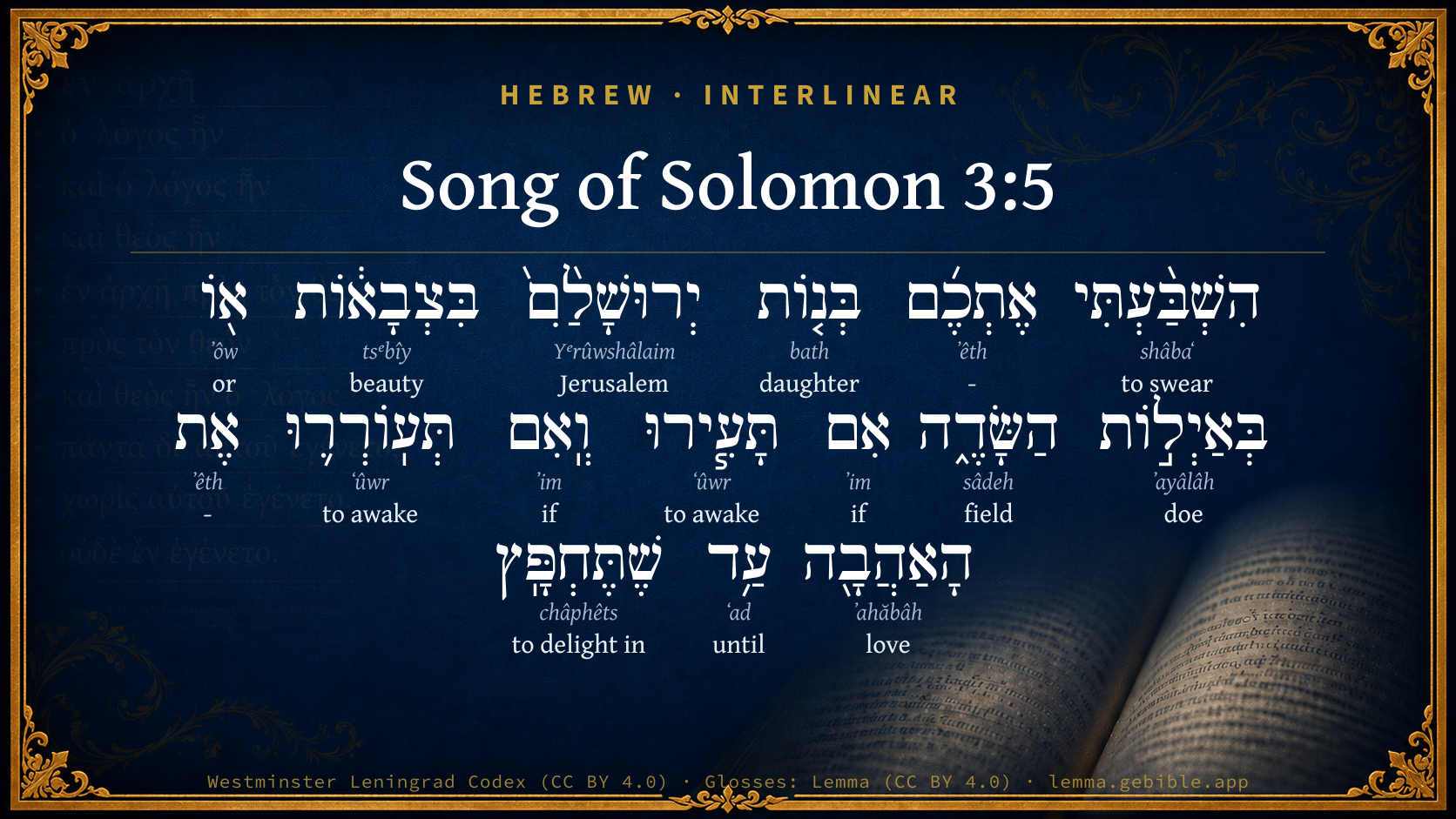
Hebrew (Westminster Leningrad Codex) Song of Solomon 3:5 appears in the Hebrew Old Testament. The text above is from the Westminster Leningrad Codex. Each word links to its Strong’s number, a concise gloss, and parsing drawn from the Open Scriptures Hebrew Bible morphology. Click any word for its full Brown-Driver-Briggs (BDB) entry.
Download image
Cite this verse

Song of Solomon 3:5 (World English Bible). Public Domain. Lemma interlinear Bible study tool, https://lemma.gebible.app/v/song-of-solomon/3/5.

Show BibTeX & RIS
BibTeX
RIS
English Translation
I adjure you, daughters of Jerusalem, By the roes, or by the hinds of the field, That you not stir up, nor awaken love, Until it so desires.
World English Bible · Public Domain
Download a study sheet

One document with this verse’s original text, its word-by-word gloss line, the meaning frame, cross-references with their text, attributed commentary, and full source and license credits — printable, and it pastes into notes with its structure intact.

This verse Autodidact and up

Study sheet (.html) Plain text (.txt)

A passage Seminary Student

Up to 50 verses in one chapter. A passage sheet keeps up to 6 commentary sources and 12 cross-references per verse, in the order this page ranks them, and says so on the sheet whenever that leaves anything out. Ask for a single verse and you get the Autodidact verse sheet above.

Everything on this page stays free to read, with no account — the sheet is a download of what is already on screen, not access to it.

Want to remove ads? Support Godless Engineer
Compare translations 3

The same verse in 3 English versions, stacked beneath the original-language interlinear above. Click any original word for its lexicon entry.

Each is an independent rendering of the whole verse — the interlinear is not word-aligned to these translations.

Highlighted words mark where these versions differ — a whole-verse word diff, not a word-by-word alignment.

  • World English Bible Public Domain
    I adjure you, daughters of Jerusalem, By the roes, or by the hinds of the field, That you not stir up, nor awaken love, Until it so desires.
  • King James Version Public Domain
    I charge you, O ye daughters of Jerusalem, by the roes, and by the hinds of the field, that ye stir not up, nor awake my love, till he please.
  • unfoldingWord Literal Text CC BY-SA 4.0
    I adjure you, daughters of Jerusalem, by the female gazelles or the does of the field, do not awaken nor stir love until it desires.

unfoldingWord Literal Text — © unfoldingWord, licensed CC BY-SA 4.0. Word-aligned USFM3 via Door43 (git.door43.org/unfoldingWord/en_ult).

Versions to compare (up to 4)

3 of 4 selected

Show all 18 translations

Every available English version of this verse, each an independent rendering of the whole verse.

  • World English Bible Public Domain
    I adjure you, daughters of Jerusalem, By the roes, or by the hinds of the field, That you not stir up, nor awaken love, Until it so desires.
  • Berean Standard Bible Public Domain
    O daughters of Jerusalem, I adjure you by the gazelles and does of the field: Do not arouse or awaken love until the time is right.
  • Majority Standard Bible Public Domain
    O daughters of Jerusalem, I adjure you by the gazelles and does of the field: Do not arouse or awaken love until the time is right.
  • King James Version Public Domain
    I charge you, O ye daughters of Jerusalem, by the roes, and by the hinds of the field, that ye stir not up, nor awake my love, till he please.
  • American Standard Version (1901) Public Domain
    I adjure you, O daughters of Jerusalem, By the roes, or by the hinds of the field, That ye stir not up, nor awake `my' love, Until he please.
  • Revised Version (1885) Public Domain
    I adjure you, O daughters of Jerusalem, by the roes, and by the hinds of the field, that ye stir not up, nor awaken love, until it please.
  • Geneva Bible (1599) Public Domain
    I charge you, O daughters of Ierusalem, by the roes and by the hindes of the fielde, that ye stirre not vp, nor waken my loue vntill she please.
  • Douay-Rheims (1899) Public Domain
    I adjure you, O daughters of Jerusalem, by the roes and the harts of the fields, that you stir not up, nor awake my beloved, till she please.
  • Young's Literal Translation Public Domain
    I have adjured you, daughters of Jerusalem, By the roes or by the hinds of the field, Stir not up nor wake the love till she please!
  • Literal Standard Version CC BY-SA 4.0
    I have adjured you, daughters of Jerusalem, || By the roes or by the does of the field, || Do not stir up nor wake the love until she pleases!
  • Unlocked Literal Bible CC BY-SA 4.0
    I want you to swear, daughters of Jerusalem, by the gazelles and the does of the fields, that you will not awaken or arouse love until she pleases. The woman speaking to herself
  • unfoldingWord Literal Text CC BY-SA 4.0
    I adjure you, daughters of Jerusalem, by the female gazelles or the does of the field, do not awaken nor stir love until it desires.
  • Darby Bible Public Domain
    I charge you, daughters of Jerusalem, By the gazelles, or by the hinds of the field, That ye stir not up, nor awake [my] love, till he please.
  • World Messianic Bible Public Domain
    I adjure you, daughters of Jerusalem, by the roes, or by the hinds of the field, that you not stir up nor awaken love, until it so desires.
  • Webster's Bible Public Domain
    I charge you, O ye daughters of Jerusalem, by the roes, and by the hinds of the field, that ye stir not up, nor awake my love, till he please.
  • Free Bible Version CC BY-SA 4.0
    Women of Jerusalem, swear to me by the gazelles or the wild deer that you won't disturb our love until the right time.
  • Bible in Basic English Public Domain
    I say to you, O daughters of Jerusalem, by the roes of the field, let not love be moved till it is ready.
  • JPS Tanakh (1917) Public Domain
    'I adjure you, O daughters of Jerusalem, by the gazelles, and by the hinds of the field, that ye awaken not, nor stir up love, until it please.'

Literal Standard Version (2020), Covenant Press — licensed CC BY-SA 4.0. Text via the HelloAO Bible API (eBible.org). Unlocked Literal Bible (unfoldingWord) — licensed CC BY-SA 4.0. Text via the HelloAO Bible API (eBible.org). unfoldingWord Literal Text — © unfoldingWord, licensed CC BY-SA 4.0. Word-aligned USFM3 via Door43 (git.door43.org/unfoldingWord/en_ult). Free Bible Version, Dr. Jonathan Gallagher — licensed CC BY-SA 4.0. Text via the HelloAO Bible API (eBible.org).

Word by word

More ways to search: Search by grammar → Find every occurrence → Compare this word →

Practice this passage: Drill this verse → Learn its vocabulary →

בְּאַיְל֣וֹת
ʼayâlâh
H355
“in/at · does of”
Preposition + Noun, Common, Feminine, Plural, Construct
Part of Speech
Preposition + Noun
Type
Common
Gender
Feminine
Number
Plural
State
Construct
Full BDB Definition

Origin: feminine of H354

TWOT: 45l

doe, deer, hind
  1. הִשְׁבַּ֨עְתִּי shâbaʻ H7650 “to swear” Verb, Hiphil, Perfect, 1st Person, Common, Singular
  2. אֶתְכֶ֜ם ʼêth H853 “- · you” Particle, Direct Object + Suffix, Personal, 2nd Person, Masculine, Plural
  3. בְּנ֤וֹת bath H1323 “daughters of” Noun, Common, Feminine, Plural, Construct
  4. יְרוּשָׁלִַ֨ם֙ Yᵉrûwshâlaim H3389 “Jerusalem” Noun, Proper
  5. בִּצְבָא֔וֹת tsᵉbîy H6643 “in/at · gazelles” Preposition + Noun, Common, Both, Plural, Absolute
  6. א֖וֹ ʼôw H176 “or” Conjunction
  7. הַשָּׂדֶ֑ה sâdeh H7704 “the · field” Particle, Definite Article + Noun, Common, Masculine, Singular, Absolute
  8. אִם ʼim H518 “if” Conjunction
  9. תָּעִ֧ירוּ ʻûwr H5782 “to awake” Verb, Hiphil, Imperfect, 2nd Person, Masculine, Plural
  10. וְֽאִם ʼim H518 “and · if” Conjunction + Conjunction
  11. תְּעֽוֹרְר֛וּ ʻûwr H5782 “to awake” Verb, Polel, Imperfect, 2nd Person, Masculine, Plural
  12. אֶת ʼêth H853 “-” Particle, Direct Object
  13. הָאַהֲבָ֖ה ʼahăbâh H160 “the · love” Particle, Definite Article + Noun, Common, Feminine, Singular, Absolute
  14. עַ֥ד ʻad H5704 “until” Preposition
  15. שֶׁתֶּחְפָּֽץ châphêts H2654 “who/which · to delight in” Particle, Relative + Verb, Qal, Imperfect, 3rd Person, Feminine, Singular

About this verse

These counts appear in no published source. They are computed here, from the morphology-tagged text and Lemma’s own curated glosses. What Lemma adds →

16
words
13
distinct lemmas
Wisdom
section

Notable vocabulary

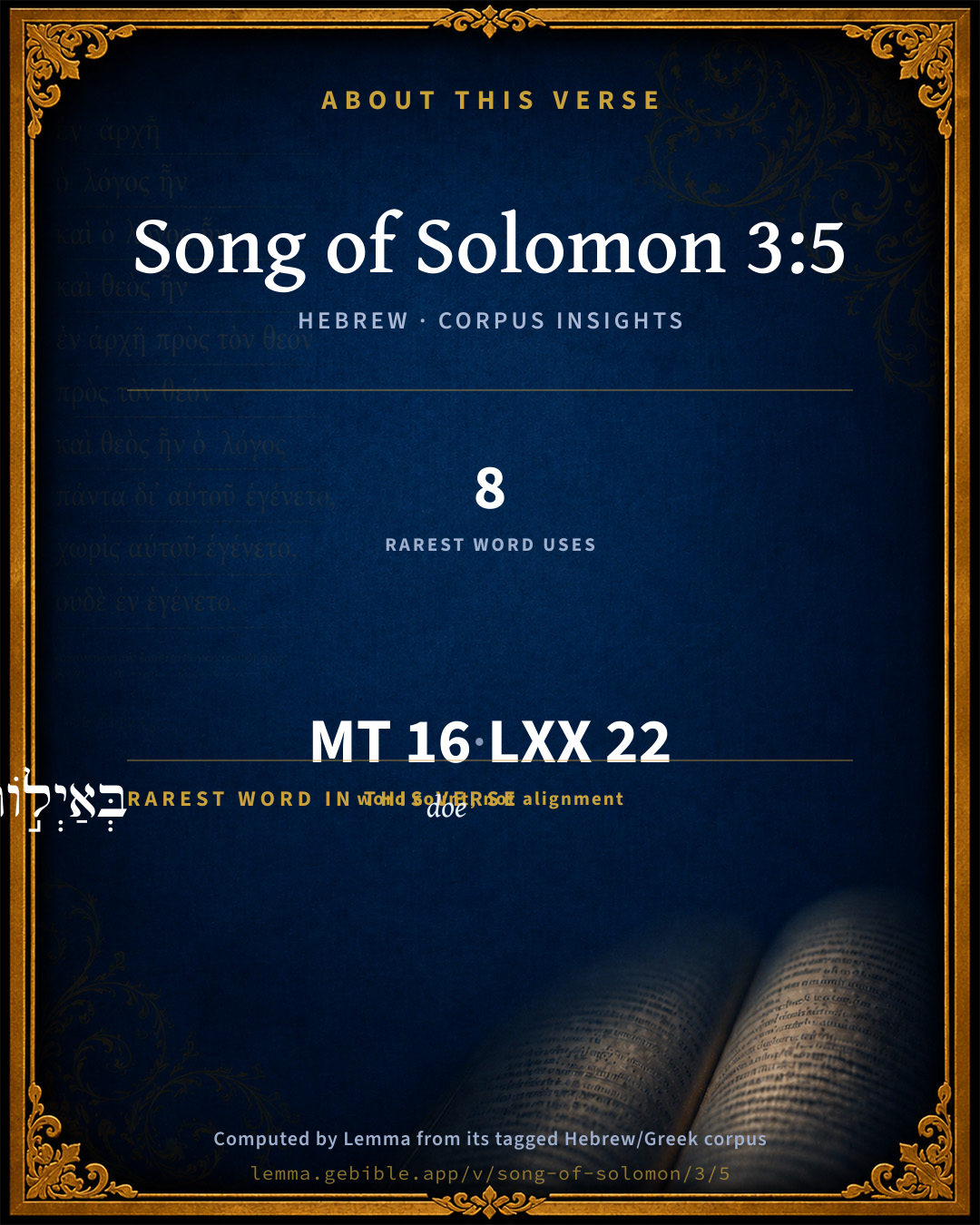
The rarest word here is בְּאַיְל֣וֹת doe H355 — appearing just 8 times in the whole Hebrew Bible.

Shared distinctive vocabulary

בְּאַיְל֣וֹת doe H355 occurs in 8 verses of the Hebrew Bible. Also found in:

Grammatical profile

  • 4 verbs
  • 6 nouns
  • 1 preposition
  • 3 conjunctions
  • 2 particles

Verb forms

  • הִשְׁבַּ֨עְתִּי Hiphil · Perfect
  • תָּעִ֧ירוּ Hiphil · Imperfect
  • תְּעֽוֹרְר֛וּ Polel · Imperfect
  • שֶׁתֶּחְפָּֽץ Qal · Imperfect

Repetition

Words recur within this verse — often emphatic in Hebrew:

  • תָּעִ֧ירוּ to awake H5782 ×2
  • אִם if H518 ×2

Hebrew & Septuagint length

In English translation the verse runs 28 words from the Hebrew and 29 from the Septuagint (LXX English) — closely comparable.

A rough comparison of the two English renderings, which tokenize alike — not a word-level alignment.

Word counts can differ between the Hebrew and the Greek without any difference in meaning — e.g. the Hebrew direct-object marker אֵת has no separate Greek word, and Greek often adds the article ὁ.

In the original languages it is 16 Hebrew tokens and 22 Greek tokens — but the two are counted differently (Hebrew bundles its prefixes and suffixes into one token; the Greek is in lemma form), so that isn’t a like-for-like length.

Cross-references

3

Topical passages linked to Song of Solomon 3:5 in the Treasury of Scripture Knowledge — connected by theme and wording, ordered by reader-vote popularity; previews shown in the World English Bible.

  • Song of Solomon 2:7 I adjure you, daughters of Jerusalem, By the roes, or by the hinds of the field, That you not stir up, nor awaken love, Until it so desires.
  • Song of Solomon 8:4 I adjure you, daughters of Jerusalem, That you not stir up, nor awaken love, Until it so desires. Friends
  • Micah 4:8 You, tower of the flock, the hill of the daughter of Zion, To you it will come, Yes, the former dominion will come, The kingdom of the daughter of Jerusalem.

Cross-references courtesy of OpenBible.info (CC BY 4.0).

Hebrew and Greek witnesses Masoretic Hebrew ↔ Greek Septuagint

The same verse in the two great witnesses to the Old Testament, shown verse-for-verse.

These are two independent witnesses, not word-aligned to each other, and the Septuagint is shown in lemma (dictionary) form.

Hebrew Song of Solomon 3:5 Masoretic · Westminster Leningrad Codex

הִשְׁבַּ֨עְתִּי אֶתְכֶ֜ם בְּנ֤וֹת יְרוּשָׁלִַ֨ם֙ בִּצְבָא֔וֹת א֖וֹ בְּאַיְל֣וֹת הַשָּׂדֶ֑ה אִם תָּעִ֧ירוּ וְֽאִם תְּעֽוֹרְר֛וּ אֶת הָאַהֲבָ֖ה עַ֥ד שֶׁתֶּחְפָּֽץ

I adjure you, daughters of Jerusalem, By the roes, or by the hinds of the field, That you not stir up, nor awaken love, Until it so desires.

World English Bible · Public Domain

Greek LXX Song of Solomon 3:5 Septuagint · lemma form

ὁρκίζω σύ θυγάτηρ ἰερουσαλήμ ἐν ὁ δύναμις καί ἐν ὁ ἰσχύς ὁ ἀγρός ἐάν ἐγείρω καί ἐκἐγείρω ὁ ἀγάπη ἕως ἄν θέλω

I have charged you, O daughters of Jerusalem, by the powers and by the virtues of the field, that you⌃ rouse not nor awake my love, until he please.

LXX2012 (modern English Septuagint) · Public Domain

Hebrew: Westminster Leningrad Codex (CC BY 4.0). Greek: Septuagint (public domain); English from LXX2012 (modern English Septuagint) (Public Domain). How the Septuagint differs from the Hebrew →

Commentary

Notes on Song of Solomon 3:5 from classic Christian and Jewish commentators (each source and its license shown beneath its notes). The classic Christian expositions comment on the surrounding passage and are grouped to its opening verse, so a note may address several verses; the Jewish commentaries on the Tanakh (Rashi and others) are per-verse, so they appear only where the commentator wrote on this verse.

Lemma curates 59 commentaries, every one of them public domain or Creative Commons licensed, each selected and text-cleaned for this edition rather than reprinted as found. About our sources →

Trapp's Complete Commentary

John Trapp

Son 3:5 I charge you, O ye daughters of Jerusalem, by the roes, and by the hinds of the field, that ye stir not up, nor awake [my] love, till he please.

Ver. 5. I charge you, O ye daughters of Jerusalem.] As a further fruit of her revived faith, she renews her contestation and charge of sanctification of life, such as becometh the gospel; that Christ, whom she resolves now to retain with her, be not provoked by sin to leave his people. {Num 32:15} And in this vehement adjuration, no doubt, saith an interpreter, but the Church had a special regard to the custom used then, and yet even at this day used among us - namely, that songs are sung before the bride chamber, and certain noises of instruments brought to wake the bride and bridegroom from sleep. {See Trapp on "Son 2:7"}

John Trapp, A Commentary or Exposition upon All the Books of the Old and New Testament (1647–1656) — public domain. Text from a community e-Sword module.

Geneva Bible (1599)

Geneva Bible translators

Read Song 2:7.

Geneva Bible (1599) marginal notes — public domain. Text via Bolls.life.

Adam Clarke's Commentary

Verse 5. I charge you] The same adjuration as before, So 2:7.

Adam Clarke's Commentary on the Bible (1810–1826) — public domain. Text from a community e-Sword/MySword module.

The Cambridge Bible for Schools and Colleges

gen. ed. J. J. S. Perowne

5. As in ch. Son_2:7. Probably here as there the significance of the adjuration is, that after such a demonstration of her deep-seated love the daughters of Jerusalem should not seek to arouse in her love for another by mere extraneous solicitations.

The Cambridge Bible for Schools and Colleges (gen. ed. J. J. S. Perowne; Cambridge University Press, 1878–1918) — public domain. Text from a community e-Sword module.

Albert Barnes' Notes on the Bible

See Son 2:7 note.

Albert Barnes' Notes on the Bible (1834–1885) — public domain. Text from a community e-Sword/MySword module.

Haydock's Catholic Bible Commentary

I. The bridegroom (Calmet) speaks as [in] chap. ii. 7., (Worthington) and chap. viii. 4. He retires early.

George Leo Haydock (1774–1849), Haydock's Catholic Family Bible and Commentary, 1859 edition — public domain. Excludes Psalms (Douay-Rheims chapter numbering differs from Protestant) and Deuterocanonical books (Catholic canon only).

Matthew Poole's English Annotations

This verse is repeated from Son 2:7, where it is explained. The spouse exhorts herself and all her fellow members to be very circumspect, lest by any unkind or provoking carriage they should give Christ any cause to depart from them. He is supposed to allude to the custom of awakening the bridegroom and bride by songs and musical instruments.

Matthew Poole's English Annotations on the Holy Bible (1683–1685) — public domain. Text from a community e-Sword/MySword module.

Whedon's Commentary on the Bible

Daniel D. Whedon

5. I charge you, O ye daughters — With this verse ends the rehearsal; and so sweet was this last interview, over which memory fondly broods with miser care, that she urges the hearers to do nothing to divert her affections — unless, in some possible juncture. they of themselves seek another object. See Son_2:7. In all this rehearsal the leading emotions are so delicately and faithfully traced and sustained by given incidents, while so much is skilfully left to the imagination to supply, that, by the rules of rhetoric which we apply to Theocritus or Catullus, to Moore or Burns, it must take rank as a master-piece of soft and brilliant poetry. No wonder that under its infinite suggestion it has furnished material for allegory, often true and tender, applicable to much of Christian experience, to many a phase of both the Church of Israel and the Church of Christ. And this it does all the more solidly for having itself been real, if not literal, at first. That is to say, it was a dramatic truth if not a historic truth.

Daniel D. Whedon (gen. ed.), Commentary on the Old and New Testaments (1874–1909) — public domain. Text from a community e-Sword module.

The Pulpit Commentary

I adjure you, O daughters of Jerusalem, by the roes, and by the hinds of the field, that ye stir not up, nor awaken love, until it please. This is the refrain which divides the poem. We thus perceive that the whole of the preceding passage has been uttered by the bride in the presence of the ladies. There is no occasion to connect a refrain very closely with the words which go before it. Like the ancient Greek chorus, it may express a general sentiment in harmony with the pervading feeling of the whole composition. In this case it seems to be a general note of praise, celebrating the preciousness of pure, spontaneous affection. There have been several beautiful and celebrated imitations of this first part of Solomon"s Song, though they all fall far short of the original. Paul Gerhard has caught its spirit; Laurentius has copied it in his Advent Hymn. Watts, in bk. 1:66-78 of his "Divine gongs;" "Lyra Germanica;" Schaff"s "Christian Song;" and Miss Havergal, in some of her compositions, will furnish examples. Delitzsch quotes an ancient Latin imitation"Quando tandem venies, meus amor? Propera de Libano, dulcis amor! Clamat, amat, sponsula. Veni, Jesu; Dulcis veni Jesu.

This ends Part II, which sets before us the lovely beginning of this ideal love. We must then suppose that the writer imagines himself in Jerusalem, as though one of the court ladies, at the time that Solomon the king returns from the north, bringing with him his bride elect. We pass, therefore, from the banqueting chamber, and recall the scenes which accompanied the arrival of Shulamith at Jerusalem. The remainder of the poem is simply the celebration of married love, the delight of the bridegroom in the bride and of the bride in her husband. The whole book concerns a bride, and not one who is about to be made a bride. Here the dream which is introduced is not the dream of a lover awaiting the beloved one, but the dream of a young wife whose bridegroom tarries. The third part is the nuptial rejoicings; the fourth part is the reminiscence of love days or of the early married life; and the fifth part, which is a conclusion, is a visit of Solomon and his bride to the country home of the latter, pointing to the depth and reality of the influence which this pure maiden had upon his royal nature.

The Pulpit Commentary (1880–1919), ed. H.D.M. Spence-Jones & Joseph S. Exell — public domain. Text from a community e-Sword module.

unfoldingWord translationNotes

Door43 World Missions Community

General Information:

Translate this verse as in Song of Songs 2:7.

daughters of Jerusalem

"young women of Jerusalem." These young women could not hear her and were not present, but the woman speaks as if they were present and could hear her. (See: Apostrophe)

by the gazelles and the does of the fields

Although the daughters of Jerusalem are not there to hear her, the woman is telling them that the gazelles and the does will punish them they break their promise. (See: Apostrophe)

the gazelles

animals that look like deer and move quickly.

does

female deer

of the fields

"that live in the countryside." This refers to land that has not been farmed.

will not awaken or arouse love until she pleases

Here "love" is spoken of as if it were a person asleep that does not want to be awakened. This is a metaphor that represents the man and woman who do not want to be disturbed until they are finished making love. AT: "will not disturb us until we have finished making love" (See: Personification and Metaphor)

will not awaken or arouse

If your language has only one word for waking people out of sleep, you could combine these words. AT: "will not awaken" (See: Doublet)

translationWords

oath

Jerusalem

deer

unfoldingWord translationNotes — © Distant Shores Media and the Door43 World Missions Community, licensed CC BY-SA 4.0. Source: git.door43.org/Door43/en_tn.

Rashi

Rabbi Shlomo Yitzchaki (Rashi)

I adjure you [you] nations, while I am exiled among you.

that you neither awaken nor arouse my beloved’s love from me through seduction or enticement to forsake him, to turn from following him.

while it is desirous as long as I still desire his love.

Rashi on the Tanakh — English translations: “The Judaica Press complete Tanach with Rashi, translated by A. J. Rosenberg” (CC BY 4.0); “Pentateuch with Rashi's commentary by M. Rosenbaum and A.M. Silbermann, 1929-1934” (public domain); “The Metsudah Tanach series, Lakewood, N.J” (CC BY 4.0); and “The Book of Joshua, Metsudah Publications, 1997” (CC BY 4.0). Text via Sefaria.

Lesson kit

Teaching starters — assembled from the data on this page, not authored interpretation. Every prompt links to the verse data it draws on. Edit before teaching.

Song of Solomon, in the Wisdom, opens this verse with 16 words (13 distinct Hebrew lemmas). Its most distinctive word is ʼayâlâh (“doe”). A historical commentator’s framing appears above. Read the whole chapter for the surrounding context.

Discussion questions

  1. How does “doe” (ʼayâlâh) shape what this verse is saying?
  2. How does Genesis 49:21, which shares the word «doe», read alongside this verse?
  3. What does the repetition of “to awake” (2× in this one verse) do in this verse?
  4. These translations render this verse differently; the difference is in the English rendering, not the original. What questions does that raise?
  5. «הִשְׁבַּ֨עְתִּי» is a Hiphil Perfect verb. How does that grammatical form shape the action described?
  6. Compare how Trapp's Complete Commentary and Geneva Bible (1599) read this verse. Where do they agree or differ?

Things to notice

Reading settings

Reading text

Shown beneath each verse's original-language words.

Old Testament
Old Testament edition

Read the OT as the Masoretic Hebrew (MT) or the Greek Septuagint (LXX).

English shown for the Greek Septuagint (in the Hebrew ↔ Greek comparison).

Comparing translations? Open the Compare panel on any verse page to stack up to four side by side.