
2 Chronicles 20:27

Hebrew (Westminster Leningrad Codex) 2 Chronicles 20:27 appears in the Hebrew Old Testament. The text above is from the Westminster Leningrad Codex. Each word links to its Strong’s number, a concise gloss, and parsing drawn from the Open Scriptures Hebrew Bible morphology. Click any word for its full Brown-Driver-Briggs (BDB) entry.
Download image
Cite this verse

2 Chronicles 20:27 (World English Bible). Public Domain. Lemma interlinear Bible study tool, https://lemma.gebible.app/v/2-chronicles/20/27.

Show BibTeX & RIS
BibTeX
RIS
English Translation
Then they returned, every man of Judah and Jerusalem, and Jehoshaphat in the forefront of them, to go again to Jerusalem with joy; for Yahweh had made them to rejoice over their enemies.
World English Bible · Public Domain
Download a study sheet

One document with this verse’s original text, its word-by-word gloss line, the meaning frame, cross-references with their text, attributed commentary, and full source and license credits — printable, and it pastes into notes with its structure intact.

This verse Autodidact and up

Study sheet (.html) Plain text (.txt)

A passage Seminary Student

Up to 50 verses in one chapter. A passage sheet keeps up to 6 commentary sources and 12 cross-references per verse, in the order this page ranks them, and says so on the sheet whenever that leaves anything out. Ask for a single verse and you get the Autodidact verse sheet above.

Everything on this page stays free to read, with no account — the sheet is a download of what is already on screen, not access to it.

Want to remove ads? Support Godless Engineer
Compare translations 3

The same verse in 3 English versions, stacked beneath the original-language interlinear above. Click any original word for its lexicon entry.

Each is an independent rendering of the whole verse — the interlinear is not word-aligned to these translations.

Highlighted words mark where these versions differ — a whole-verse word diff, not a word-by-word alignment.

  • World English Bible Public Domain
    Then they returned, every man of Judah and Jerusalem, and Jehoshaphat in the forefront of them, to go again to Jerusalem with joy; for Yahweh had made them to rejoice over their enemies.
  • King James Version Public Domain
    Then they returned, every man of Judah and Jerusalem, and Jehoshaphat in the forefront of them, to go again to Jerusalem with joy; for the LORD had made them to rejoice over their enemies.
  • unfoldingWord Literal Text CC BY-SA 4.0
    And they returned, every man of Judah and Jerusalem and Jehoshaphat at their head, to return to Jerusalem with joy, for Yahweh had made them rejoice over their enemies.

unfoldingWord Literal Text — © unfoldingWord, licensed CC BY-SA 4.0. Word-aligned USFM3 via Door43 (git.door43.org/unfoldingWord/en_ult).

Versions to compare (up to 4)

3 of 4 selected

Show all 18 translations

Every available English version of this verse, each an independent rendering of the whole verse.

  • World English Bible Public Domain
    Then they returned, every man of Judah and Jerusalem, and Jehoshaphat in the forefront of them, to go again to Jerusalem with joy; for Yahweh had made them to rejoice over their enemies.
  • Berean Standard Bible Public Domain
    Then all the men of Judah and Jerusalem, with Jehoshaphat at their head, returned joyfully to Jerusalem, for the LORD had made them rejoice over their enemies.
  • Majority Standard Bible Public Domain
    Then all the men of Judah and Jerusalem, with Jehoshaphat at their head, returned joyfully to Jerusalem, for the LORD had made them rejoice over their enemies.
  • King James Version Public Domain
    Then they returned, every man of Judah and Jerusalem, and Jehoshaphat in the forefront of them, to go again to Jerusalem with joy; for the LORD had made them to rejoice over their enemies.
  • American Standard Version (1901) Public Domain
    Then they returned, every man of Judah and Jerusalem, and Jehoshaphat in the forefront of them, to go again to Jerusalem with joy; for Jehovah had made them to rejoice over their enemies.
  • Revised Version (1885) Public Domain
    Then they returned, every man of Judah and Jerusalem, and Jehoshaphat in the forefront of them, to go again to Jerusalem with joy; for the LORD had made them to rejoice over their enemies.
  • Geneva Bible (1599) Public Domain
    Then euery man of Iudah and Ierusalem returned with Iehoshaphat their head, to goe againe to Ierusalem with ioy: for the Lord had made them to reioyce ouer their enemies.
  • Douay-Rheims (1899) Public Domain
    And every man of Juda, and the inhabitants of Jerusalem returned, and Josaphat at their head, into Jerusalem with great joy, because the Lord had made them rejoice over their enemies.
  • Young's Literal Translation Public Domain
    And they turn back, every man of Judah and Jerusalem, and Jehoshaphat at their head, to go back unto Jerusalem with joy, for Jehovah hath made them rejoice over their enemies.
  • Literal Standard Version CC BY-SA 4.0
    And they return, every man of Judah and Jerusalem, and Jehoshaphat at their head, to go back to Jerusalem with joy, for YHWH has made them rejoice over their enemies.
  • Unlocked Literal Bible CC BY-SA 4.0
    Then they returned, every man of Judah and Jerusalem, and Jehoshaphat in their lead, to go again to Jerusalem with joy, for Yahweh had made them rejoice over their enemies.
  • unfoldingWord Literal Text CC BY-SA 4.0
    And they returned, every man of Judah and Jerusalem and Jehoshaphat at their head, to return to Jerusalem with joy, for Yahweh had made them rejoice over their enemies.
  • Darby Bible Public Domain
    And they returned, all the men of Judah and Jerusalem, and Jehoshaphat at their head, to go again to Jerusalem with joy; for Jehovah had made them to rejoice over their enemies.
  • World Messianic Bible Public Domain
    Then they returned, every man of Judah and Jerusalem, with Jehoshaphat in front of them, to go again to Jerusalem with joy; for the LORD had made them to rejoice over their enemies.
  • Webster's Bible Public Domain
    Then they returned, every man of Judah and Jerusalem, and Jehoshaphat in the front of them, to go again to Jerusalem with joy; for the LORD had made them to rejoice over their enemies.
  • Free Bible Version CC BY-SA 4.0
    Then all the men of Judah and Jerusalem celebrated as they returned to Jerusalem, with Jehoshaphat leading them, full of joy for the Lord's victory over their enemies.
  • Bible in Basic English Public Domain
    Then all the men of Judah and Jerusalem went back, with Jehoshaphat at their head, coming back to Jerusalem with joy; for the Lord had made them glad over their haters.
  • JPS Tanakh (1917) Public Domain
    Then they returned, every man of Judah and Jerusalem, and Jehoshaphat in the forefront of them, to go back to Jerusalem with joy; for the LORD had made them to rejoice over their enemies.

Literal Standard Version (2020), Covenant Press — licensed CC BY-SA 4.0. Text via the HelloAO Bible API (eBible.org). Unlocked Literal Bible (unfoldingWord) — licensed CC BY-SA 4.0. Text via the HelloAO Bible API (eBible.org). unfoldingWord Literal Text — © unfoldingWord, licensed CC BY-SA 4.0. Word-aligned USFM3 via Door43 (git.door43.org/unfoldingWord/en_ult). Free Bible Version, Dr. Jonathan Gallagher — licensed CC BY-SA 4.0. Text via the HelloAO Bible API (eBible.org).

Word by word

More ways to search: Search by grammar → Find every occurrence → Compare this word →

Practice this passage: Drill this verse → Learn its vocabulary →

וִֽיהוֹשָׁפָ֣ט
Yᵉhôwshâphâṭ
H3092
“and · Jehoshaphat”
Conjunction + Noun, Proper
Part of Speech
Conjunction + Noun
Type
Proper
Full BDB Definition

Origin: from H3068 and H8199

TWOT: None

Jehoshaphat = "Jehovah has judged" - son of king Asa and himself king of Judah for 25 years; one of the best, most pious, and prosperous kings of Judah (noun proper masculine) - son of Nimshi and father of king Jehu of the northern kingdom of Israel (noun proper masculine) - son of Ahilud and chronicler under David and Solomon (noun proper masculine) - son of Paruah and one of the 12 commissary officers under Solomon (noun proper masculine) - a priest and trumpeter in the time of David (noun proper masculine) - symbolical name of a valley near Jerusalem which is the place of ultimate judgment; maybe the deep ravine which separates Jerusalem from the Mount of Olives through which the Kidron flowed (noun proper locative)
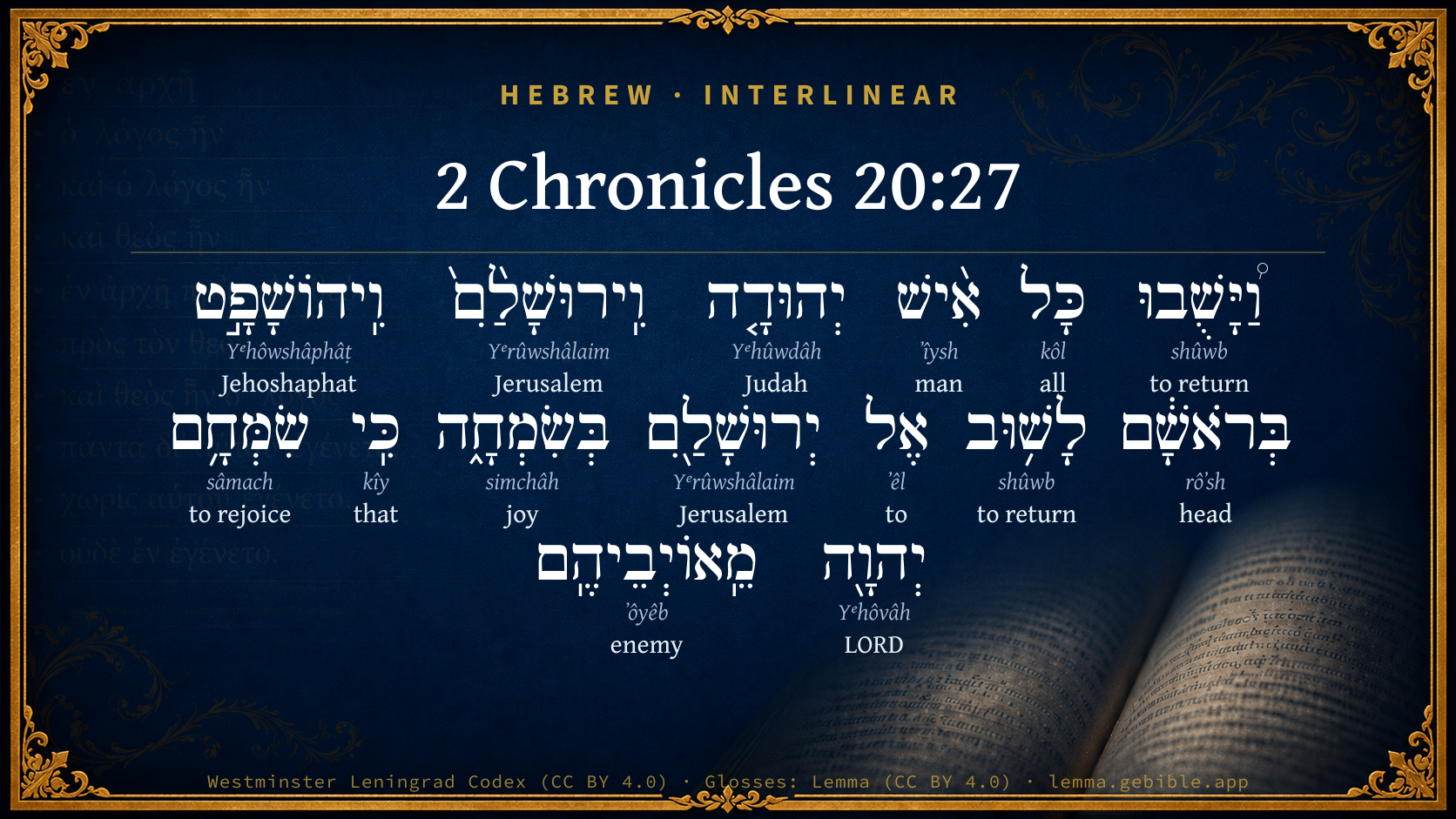
  1. וַ֠יָּשֻׁבוּ shûwb H7725 “and · to return” Conjunction + Verb, Qal, Sequential Imperfect, 3rd Person, Masculine, Plural
  2. כָּל kôl H3605 “all of” Noun, Common, Masculine, Singular, Construct
  3. אִ֨ישׁ ʼîysh H376 “man of” Noun, Common, Masculine, Singular, Construct
  4. יְהוּדָ֤ה Yᵉhûwdâh H3063 “Judah” Noun, Proper
  5. וִֽירוּשָׁלִַ֨ם֙ Yᵉrûwshâlaim H3389 “and · Jerusalem” Conjunction + Noun, Proper
  6. בְּרֹאשָׁ֔ם rôʼsh H7218 “in/at · head · their” Preposition + Noun, Common, Masculine, Singular, Construct + Suffix, Personal, 3rd Person, Masculine, Plural
  7. לָשׁ֥וּב shûwb H7725 “to return” Preposition + Verb, Qal, Infinitive Construct
  8. אֶל ʼêl H413 “to” Preposition
  9. יְרוּשָׁלִַ֖ם Yᵉrûwshâlaim H3389 “Jerusalem” Noun, Proper
  10. בְּשִׂמְחָ֑ה simchâh H8057 “in/at · joy” Preposition + Noun, Common, Feminine, Singular, Absolute
  11. כִּֽי kîy H3588 “that” Conjunction
  12. שִׂמְּחָ֥ם sâmach H8055 “to rejoice · them” Verb, Piel, Perfect, 3rd Person, Masculine, Singular + Suffix, Personal, 3rd Person, Masculine, Plural
  13. יְהוָ֖ה Yᵉhôvâh H3068 “LORD” Noun, Proper
  14. מֵֽאוֹיְבֵיהֶֽם ʼôyêb H341 “from · enemy · them” Preposition + Verb, Qal, Participle Active, Masculine, Plural, Construct + Suffix, Personal, 3rd Person, Masculine, Plural

About this verse

These counts appear in no published source. They are computed here, from the morphology-tagged text and Lemma’s own curated glosses. What Lemma adds →

15
words
13
distinct lemmas
Historical
section

Grammatical profile

  • 4 verbs
  • 9 nouns
  • 1 preposition
  • 1 conjunction

Verb forms

  • וַ֠יָּשֻׁבוּ Qal · Sequential Imperfect
  • לָשׁ֥וּב Qal · Infinitive Construct
  • שִׂמְּחָ֥ם Piel · Perfect
  • מֵֽאוֹיְבֵיהֶֽם Qal · Participle Active

Repetition

Words recur within this verse — often emphatic in Hebrew:

  • וַ֠יָּשֻׁבוּ to return H7725 ×2
  • וִֽירוּשָׁלִַ֨ם֙ Jerusalem H3389 ×2

Hebrew & Septuagint length

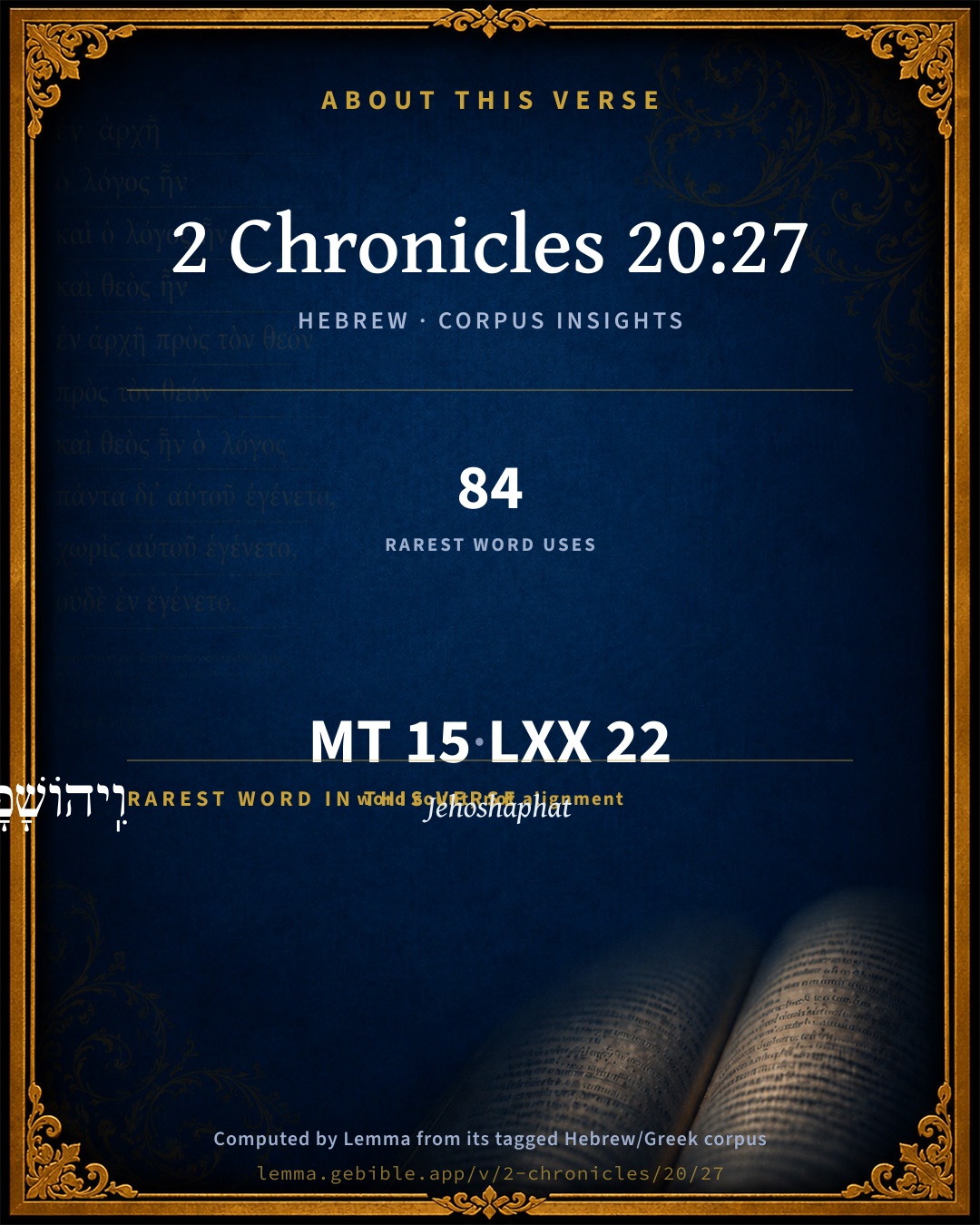
In English translation the verse runs 33 words from the Hebrew and 25 from the Septuagint (LXX English) — closely comparable.

A rough comparison of the two English renderings, which tokenize alike — not a word-level alignment.

Word counts can differ between the Hebrew and the Greek without any difference in meaning — e.g. the Hebrew direct-object marker אֵת has no separate Greek word, and Greek often adds the article ὁ.

In the original languages it is 15 Hebrew tokens and 22 Greek tokens — but the two are counted differently (Hebrew bundles its prefixes and suffixes into one token; the Greek is in lemma form), so that isn’t a like-for-like length.

Cross-references

10

Topical passages linked to 2 Chronicles 20:27 in the Treasury of Scripture Knowledge — connected by theme and wording, ordered by reader-vote popularity; previews shown in the World English Bible.

  • Nehemiah 12:43 They offered great sacrifices that day, and rejoiced; for God had made them rejoice with great joy; and the women also and the children rejoiced: so that the joy of Jerusalem was heard even afar off.
  • 1 Samuel 2:1 Hannah prayed, and said: My heart exults in Yahweh; My horn is exalted in Yahweh; My mouth is enlarged over my enemies; Because I rejoice in your salvation.
  • 2 Samuel 6:14–15 David danced before Yahweh with all his might; and David was girded with a linen ephod.
  • Psalms 20:5 We will triumph in your salvation. In the name of our God we will set up our banners: May Yahweh grant all your requests.
  • Psalms 30:1 I will extol you, Yahweh, for you have raised me up, And have not made my foes to rejoice over me.
  • Isaiah 35:10 and the ransomed of Yahweh shall return, and come with singing to Zion; and everlasting joy shall be on their heads: they shall obtain gladness and joy, and sorrow and sighing shall flee away.
  • Isaiah 51:11 The ransomed of Yahweh shall return, and come with singing to Zion; and everlasting joy shall be on their heads: they shall obtain gladness and joy; [and] sorrow and sighing shall flee away.
  • Micah 2:13 He who breaks open the way goes up before them. They break through the gate, and go out. And their king passes on before them, With Yahweh at their head."
  • Hebrews 6:20 where as a forerunner Jesus entered for us, having become a high priest forever after the order of Melchizedek.
  • Revelation 18:20 Rejoice over her, O heaven, you saints, apostles, and prophets; for God has judged your judgment on her."

Cross-references courtesy of OpenBible.info (CC BY 4.0).

Hebrew and Greek witnesses Masoretic Hebrew ↔ Greek Septuagint

The same verse in the two great witnesses to the Old Testament, shown verse-for-verse.

These are two independent witnesses, not word-aligned to each other, and the Septuagint is shown in lemma (dictionary) form.

Hebrew 2 Chronicles 20:27 Masoretic · Westminster Leningrad Codex

וַ֠יָּשֻׁבוּ כָּל אִ֨ישׁ יְהוּדָ֤ה וִֽירוּשָׁלִַ֨ם֙ וִֽיהוֹשָׁפָ֣ט בְּרֹאשָׁ֔ם לָשׁ֥וּב אֶל יְרוּשָׁלִַ֖ם בְּשִׂמְחָ֑ה כִּֽי שִׂמְּחָ֥ם יְהוָ֖ה מֵֽאוֹיְבֵיהֶֽם

Then they returned, every man of Judah and Jerusalem, and Jehoshaphat in the forefront of them, to go again to Jerusalem with joy; for Yahweh had made them to rejoice over their enemies.

World English Bible · Public Domain

Greek LXX 2 Chronicles 20:27 Septuagint · lemma form

καί ἐπιστρέφω πᾶς ἀνήρ ἰουδά εἰς ἰερουσαλήμ καί ιωσαφατ ἡγέομαι αὐτός ἐν εὐφροσύνη μέγας ὅτι εὐφραίνω αὐτός κύριος ἀπό ὁ ἐχθρός αὐτός

And all the men of Juda returned to Jerusalem, and Josaphat led them with great joy; for the Lord gave them joy over their enemies.

LXX2012 (modern English Septuagint) · Public Domain

On this verse, Ellicott's Commentary for English Readers discusses the Septuagint’s reading. Read the note in Commentary ↓

Hebrew: Westminster Leningrad Codex (CC BY 4.0). Greek: Septuagint (public domain); English from LXX2012 (modern English Septuagint) (Public Domain). How the Septuagint differs from the Hebrew →

Commentary

Notes on 2 Chronicles 20:27 from classic Christian and Jewish commentators (each source and its license shown beneath its notes). The classic Christian expositions comment on the surrounding passage and are grouped to its opening verse, so a note may address several verses; the Jewish commentaries on the Tanakh (Rashi and others) are per-verse, so they appear only where the commentator wrote on this verse.

Lemma curates 59 commentaries, every one of them public domain or Creative Commons licensed, each selected and text-cleaned for this edition rather than reprinted as found. About our sources →

Trapp's Complete Commentary

John Trapp

2Ch 20:27 Then they returned, every man of Judah and Jerusalem, and Jehoshaphat in the forefront of them, to go again to Jerusalem with joy; for the LORD had made them to rejoice over their enemies.

Ver. 27. And Jehoshaphat in the forefront of them.] Heb., In the head of them. {a} Among the Romans no man was to ride in triumph, unless he had overcome fifty thousand enemies, or except he had got five victories; and then the conqueror in his triumphant chariot rode to the capitol, where in all humility he presented a palm to Jupiter, whereby he acknowledged it was his power whereby the enemy was vanquished. {b} Good Jehoshaphat is here riding in triumph to Jerusalem, there to acknowledge, that not Jupiter, but Jehovah had made them to rejoice over their enemies.

{a} Isid.

{b} Liv., lib. vi. dec. 3.

John Trapp, A Commentary or Exposition upon All the Books of the Old and New Testament (1647–1656) — public domain. Text from a community e-Sword module.

Joseph Benson's Commentary

2Ch 20:27-28. Jehoshaphat in the fore-front of them — They marched all in a body, in solemn procession, and Jehoshaphat at their head, that the country, as they passed along, might join with them in their praises. To go again to Jerusalem with joy — That they might give thanks for the mercy there, where by prayer they had obtained it. Unto the house of the Lord — To renew their praises in the court of the temple, the proper and usual place for it. Praising God must not be the work of a day only; but our praises, when we have received mercy, must be often repeated, as our prayers were, when we were in pursuit of it. Every day we must bless God; as long as we live, and while we have any being, we must praise him, spending our time in that work, in which we hope to spend our eternity.

Joseph Benson's Commentary on the Old and New Testaments (1811–1818) — public domain. Text from a community e-Sword module.

Adam Clarke's Commentary

Verse 27. Jehoshaphat in the forefront of them] He was their leader in all these spiritual, holy, fatiguing, and self-denying exercises. What a noble and persuasive pattern!

Adam Clarke's Commentary on the Bible (1810–1826) — public domain. Text from a community e-Sword/MySword module.

Ellicott's Commentary for English Readers

(27) Then.—And.

Every man.—All the men (collective).

In the forefront of them.—At their head. LXX., ἡγούμενος αὐτῶν.

To go again . . . with joy.—They returned, as they came, in festal procession.

The Lord had made them to rejoice.—See the same phrase, Ezr_6:22; Neh_12:43. (Comp. Psa_30:2.) LXX., well, ἐν εὐφροσύνῃ μεγάλῃ, ὅτι εὔφρανεν αὐτοὺς κύριος ἀπὸ τῶν ἐχθρῶν αὐτῶν.

A Bible Commentary for English Readers, edited by Charles John Ellicott (1878–1897) — public domain. Text from a community e-Sword module.

The Cambridge Bible for Schools and Colleges

gen. ed. J. J. S. Perowne

27. with joy] Rather, with rejoicing; cp. 2Ch_20:28. LXX., ἐν εὐφροσύνῃ μεγάλῃ.

The Cambridge Bible for Schools and Colleges (gen. ed. J. J. S. Perowne; Cambridge University Press, 1878–1918) — public domain. Text from a community e-Sword module.

John Gill's Exposition

Then they returned, every man of Judah and of Jerusalem, and Jehoshaphat at the forefront of them, to go again to Jerusalem with joy,.... There to praise the Lord in the temple, as they had done in the valley:

for the Lord had made them to rejoice over their enemies; by giving them a complete victory, and making them masters of so much wealth and riches.

John Gill's Exposition of the Whole Bible (1746–1763) — public domain (CC PDM 1.0). Text via the HelloAO Bible API.

The Pulpit Commentary

The Lord had made them to rejoice. Note the extremely similar and almost identical language of Ezr_6:22 and Neh_12:43, and add also to the comparison the last sentence of our ver. 29.

The Pulpit Commentary (1880–1919), ed. H.D.M. Spence-Jones & Joseph S. Exell — public domain. Text from a community e-Sword module.

unfoldingWord translationNotes

Door43 World Missions Community

every man of Judah and Jerusalem

This is a reference to every man in the army. AT: "every soldier of Judah and Jerusalem" (See: Synecdoche)

Jehoshaphat in their lead

"with Jehoshaphat leading them." The phrase "in their lead" is an idiom. King Jehoshaphat was in front of the whole army as they went back to Jerusalem. (See: Idiom)

rejoice over their enemies

They rejoiced because their enemies had been defeated. AT: "rejoice over their enemies' defeat" or "rejoice because their enemies had been destroyed" (See: Assumed Knowledge and Implicit Information)

translationWords

Jerusalem

joy

joy

lute

harp

unfoldingWord translationNotes — © Distant Shores Media and the Door43 World Missions Community, licensed CC BY-SA 4.0. Source: git.door43.org/Door43/en_tn.

Lesson kit

Teaching starters — assembled from the data on this page, not authored interpretation. Every prompt links to the verse data it draws on. Edit before teaching.

2 Chronicles, in the Historical, opens this verse with 15 words (13 distinct Hebrew lemmas). Its most distinctive word is Yᵉhôwshâphâṭ (“Jehoshaphat”). A historical commentator’s framing appears above. Read the whole chapter for the surrounding context.

Discussion questions

  1. The word Yᵉhôwshâphâṭ carries the sense “Jehoshaphat.” How does it shape the verse?
  2. How does Nehemiah 12:43, which shares this passage’s theme, read alongside this verse?
  3. What does the repetition of “to return” (2× in this one verse) do in this verse?
  4. These translations render this verse differently. What is at stake in choosing one wording over another?
  5. «וַ֠יָּשֻׁבוּ» is a Qal Sequential Imperfect verb. How does that grammatical form shape the action described?
  6. Compare how Trapp's Complete Commentary and Joseph Benson's Commentary read this verse. Where do they agree or differ?

Things to notice

Reading settings

Reading text

Shown beneath each verse's original-language words.

Old Testament
Old Testament edition

Read the OT as the Masoretic Hebrew (MT) or the Greek Septuagint (LXX).

English shown for the Greek Septuagint (in the Hebrew ↔ Greek comparison).

Comparing translations? Open the Compare panel on any verse page to stack up to four side by side.