
Nehemiah 12:27

Hebrew (Westminster Leningrad Codex) Nehemiah 12:27 appears in the Hebrew Old Testament. The text above is from the Westminster Leningrad Codex. Each word links to its Strong’s number, a concise gloss, and parsing drawn from the Open Scriptures Hebrew Bible morphology. Click any word for its full Brown-Driver-Briggs (BDB) entry.
Download image
Cite this verse

Nehemiah 12:27 (World English Bible). Public Domain. Lemma interlinear Bible study tool, https://lemma.gebible.app/v/nehemiah/12/27.

Show BibTeX & RIS
BibTeX
RIS
English Translation
At the dedication of the wall of Jerusalem they sought the Levites out of all their places, to bring them to Jerusalem, to keep the dedication with gladness, both with giving thanks, and with singing, with cymbals, psalteries, and with harps.
World English Bible · Public Domain
Download a study sheet

One document with this verse’s original text, its word-by-word gloss line, the meaning frame, cross-references with their text, attributed commentary, and full source and license credits — printable, and it pastes into notes with its structure intact.

This verse Autodidact and up

Study sheet (.html) Plain text (.txt)

A passage Seminary Student

Up to 50 verses in one chapter. A passage sheet keeps up to 6 commentary sources and 12 cross-references per verse, in the order this page ranks them, and says so on the sheet whenever that leaves anything out. Ask for a single verse and you get the Autodidact verse sheet above.

Everything on this page stays free to read, with no account — the sheet is a download of what is already on screen, not access to it.

Want to remove ads? Support Godless Engineer
Compare translations 3

The same verse in 3 English versions, stacked beneath the original-language interlinear above. Click any original word for its lexicon entry.

Each is an independent rendering of the whole verse — the interlinear is not word-aligned to these translations.

Highlighted words mark where these versions differ — a whole-verse word diff, not a word-by-word alignment.

  • World English Bible Public Domain
    At the dedication of the wall of Jerusalem they sought the Levites out of all their places, to bring them to Jerusalem, to keep the dedication with gladness, both with giving thanks, and with singing, with cymbals, psalteries, and with harps.
  • King James Version Public Domain
    And at the dedication of the wall of Jerusalem they sought the Levites out of all their places, to bring them to Jerusalem, to keep the dedication with gladness, both with thanksgivings, and with singing, with cymbals, psalteries, and with harps.
  • unfoldingWord Literal Text CC BY-SA 4.0
    And at the dedication of the wall of Jerusalem, they sought out the Levites from all their places, to bring them to Jerusalem to perform the dedication with rejoicing, and with thanksgivings, and with song, cymbals, lyres, and harps.

unfoldingWord Literal Text — © unfoldingWord, licensed CC BY-SA 4.0. Word-aligned USFM3 via Door43 (git.door43.org/unfoldingWord/en_ult).

Versions to compare (up to 4)

3 of 4 selected

Show all 18 translations

Every available English version of this verse, each an independent rendering of the whole verse.

  • World English Bible Public Domain
    At the dedication of the wall of Jerusalem they sought the Levites out of all their places, to bring them to Jerusalem, to keep the dedication with gladness, both with giving thanks, and with singing, with cymbals, psalteries, and with harps.
  • Berean Standard Bible Public Domain
    At the dedication of the wall of Jerusalem, the Levites were sought out from all their homes and brought to Jerusalem to celebrate the joyous dedication with thanksgiving and singing, accompanied by cymbals, harps, and lyres.
  • Majority Standard Bible Public Domain
    At the dedication of the wall of Jerusalem, the Levites were sought out from all their homes and brought to Jerusalem to celebrate the joyous dedication with thanksgiving and singing, accompanied by cymbals, harps, and lyres.
  • King James Version Public Domain
    And at the dedication of the wall of Jerusalem they sought the Levites out of all their places, to bring them to Jerusalem, to keep the dedication with gladness, both with thanksgivings, and with singing, with cymbals, psalteries, and with harps.
  • American Standard Version (1901) Public Domain
    And at the dedication of the wall of Jerusalem they sought the Levites out of all their places, to bring them to Jerusalem, to keep the dedication with gladness, both with thanksgivings, and with singing, with cymbals, psalteries, and with harps.
  • Revised Version (1885) Public Domain
    And at the dedication of the wall of Jerusalem they sought the Levites out of all their places, to bring them to Jerusalem, to keep the dedication, with gladness, both with thanksgivings, and with singing, with cymbals, psalteries, and with harps.
  • Geneva Bible (1599) Public Domain
    And in the dedication of the wall at Ierusalem they sought the Leuites out of all their places to bring them to Ierusalem to keepe the dedication and gladnes, both with thankesgiuings and with songs, cymbales, violes and with harpes.
  • Douay-Rheims (1899) Public Domain
    And at the dedication of the wall of Jerusalem they sought the Levites out of all their places, to bring them to Jerusalem, and to keep the dedication, and to rejoice with thanksgiving, and with singing, and with cymbals, and psalteries and harps.
  • Young's Literal Translation Public Domain
    And at the dedication of the wall of Jerusalem they sought the Levites out of all their places, to bring them in to Jerusalem, to make the dedication even with gladness, and with thanksgivings, and with singing, `with' cymbals, psalteries, and with harps;
  • Literal Standard Version CC BY-SA 4.0
    And at the dedication of the wall of Jerusalem they sought the Levites out of all their places, to bring them to Jerusalem, to make the dedication even with gladness, and with thanksgivings, and with singing, [with] cymbals, psalteries, and with harps;
  • Unlocked Literal Bible CC BY-SA 4.0
    At the dedication of the wall of Jerusalem, the people sought out the Levites wherever they lived, to bring them to Jerusalem to celebrate the dedication with joy, with thanksgivings and singing with cymbals, harps, and with lyres.
  • unfoldingWord Literal Text CC BY-SA 4.0
    And at the dedication of the wall of Jerusalem, they sought out the Levites from all their places, to bring them to Jerusalem to perform the dedication with rejoicing, and with thanksgivings, and with song, cymbals, lyres, and harps.
  • Darby Bible Public Domain
    And at the dedication of the wall of Jerusalem they sought the Levites out of all their places, to bring them to Jerusalem, to hold the dedication with gladness, both with thanksgivings, and with singing, [with] cymbals, lutes and harps.
  • World Messianic Bible Public Domain
    At the dedication of the wall of Jerusalem, they sought the Levites out of all their places, to bring them to Jerusalem to keep the dedication with gladness, both with giving thanks and with singing, with cymbals, stringed instruments, and with harps.
  • Webster's Bible Public Domain
    And at the dedication of the wall of Jerusalem they sought the Levites out of all their places, to bring them to Jerusalem, to keep the dedication with gladness, both with thanksgivings, and with singing, with cymbals, psalteries, and with harps.
  • Free Bible Version CC BY-SA 4.0
    In order to dedicate the wall of Jerusalem, the Levites were called from everywhere they were living to come to Jerusalem and celebrate with joy the dedication with songs of praise and thanks, accompanied by cymbals, harps, and lyres.
  • Bible in Basic English Public Domain
    And when the time came for the wall of Jerusalem to be made holy, they sent for the Levites out of all their places to come to Jerusalem, to keep the feast with joy, and with praise and melody, with brass and corded instruments of music.
  • JPS Tanakh (1917) Public Domain
    And at the dedication of the wall of Jerusalem they sought the Levites out of all their places, to bring them to Jerusalem, to keep the dedication with gladness, both with thanksgivings, and with singing, with cymbals, psalteries, and with harps.

Literal Standard Version (2020), Covenant Press — licensed CC BY-SA 4.0. Text via the HelloAO Bible API (eBible.org). Unlocked Literal Bible (unfoldingWord) — licensed CC BY-SA 4.0. Text via the HelloAO Bible API (eBible.org). unfoldingWord Literal Text — © unfoldingWord, licensed CC BY-SA 4.0. Word-aligned USFM3 via Door43 (git.door43.org/unfoldingWord/en_ult). Free Bible Version, Dr. Jonathan Gallagher — licensed CC BY-SA 4.0. Text via the HelloAO Bible API (eBible.org).

Word by word

More ways to search: Search by grammar → Find every occurrence → Compare this word →

Practice this passage: Drill this verse → Learn its vocabulary →

וּבַחֲנֻכַּ֞ת
chănukkâh
H2598
“and · in/at · dedication of”
Conjunction + Preposition + Noun, Common, Feminine, Singular, Construct
Part of Speech
Conjunction + Preposition + Noun
Type
Common
Gender
Feminine
Number
Singular
State
Construct
Full BDB Definition

Origin: from H2596

TWOT: TWOT- 693b

dedication, consecration
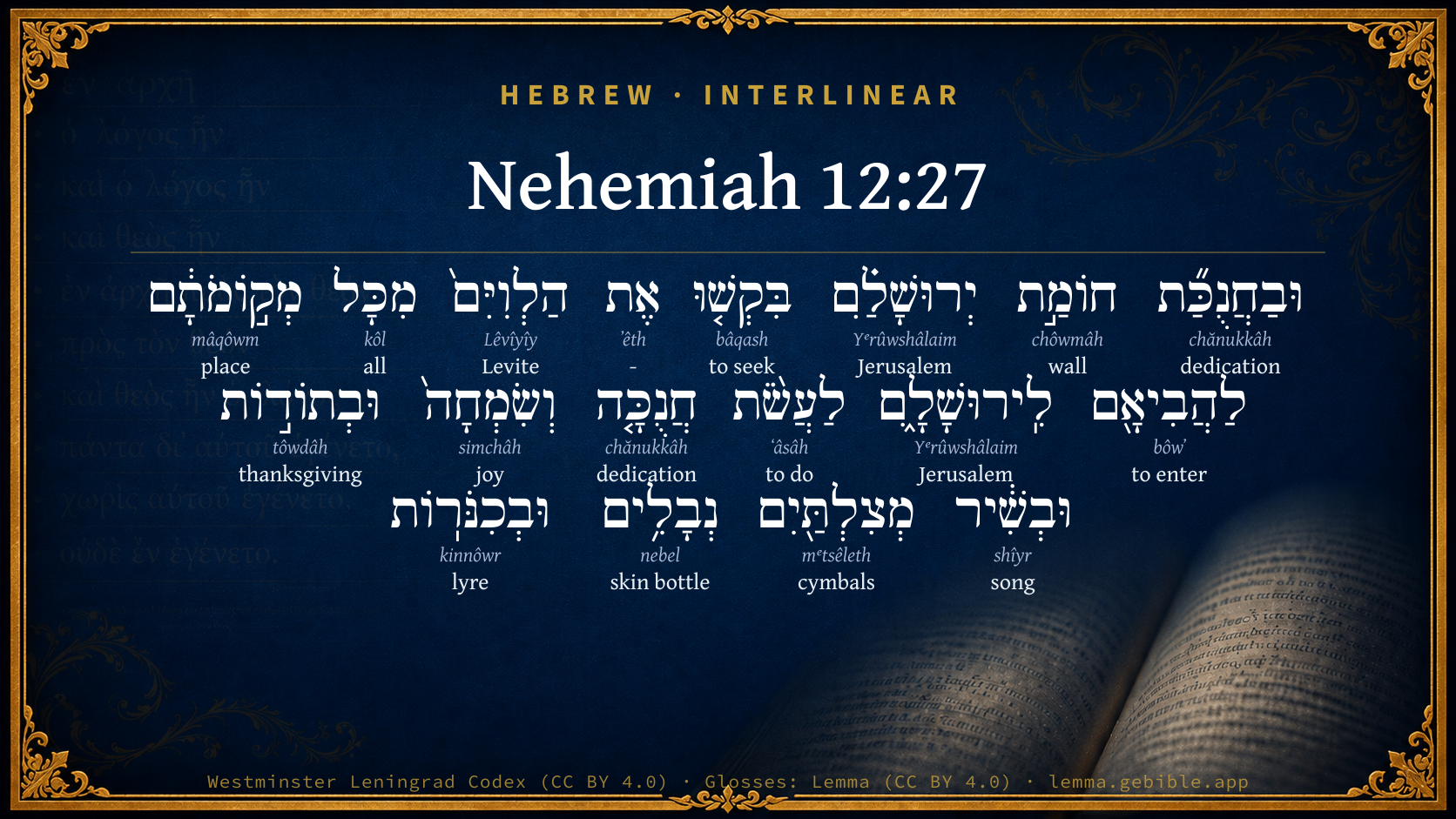
  1. חוֹמַ֣ת chôwmâh H2346 “wall of” Noun, Common, Feminine, Singular, Construct
  2. יְרוּשָׁלִַ֗ם Yᵉrûwshâlaim H3389 “Jerusalem” Noun, Proper
  3. בִּקְשׁ֤וּ bâqash H1245 “to seek” Verb, Piel, Perfect, 3rd Person, Common, Plural
  4. אֶת ʼêth H853 “-” Particle, Direct Object
  5. הַלְוִיִּם֙ Lêvîyîy H3881 “the · Levites” Particle, Definite Article + Noun, Gentilic, Masculine, Plural, Absolute
  6. מִכָּל kôl H3605 “from · all of” Preposition + Noun, Common, Masculine, Singular, Construct
  7. מְק֣וֹמֹתָ֔ם mâqôwm H4725 “places · their” Noun, Common, Masculine, Plural, Construct + Suffix, Personal, 3rd Person, Masculine, Plural
  8. לַהֲבִיאָ֖ם bôwʼ H935 “to enter · them” Preposition + Verb, Hiphil, Infinitive Construct + Suffix, Personal, 3rd Person, Masculine, Plural
  9. לִֽירוּשָׁלִָ֑ם Yᵉrûwshâlaim H3389 “to/for · Jerusalem” Preposition + Noun, Proper
  10. לַעֲשֹׂ֨ת ʻâsâh H6213 “to do” Preposition + Verb, Qal, Infinitive Construct
  11. חֲנֻכָּ֤ה chănukkâh H2598 “dedication” Noun, Common, Feminine, Singular, Absolute
  12. וְשִׂמְחָה֙ simchâh H8057 “and · joy” Conjunction + Noun, Common, Feminine, Singular, Absolute
  13. וּבְתוֹד֣וֹת tôwdâh H8426 “and · in/at · thanksgivings” Conjunction + Preposition + Noun, Common, Feminine, Plural, Absolute
  14. וּבְשִׁ֔יר shîyr H7892 “and · in/at · song” Conjunction + Preposition + Noun, Common, Both, Singular, Absolute
  15. מְצִלְתַּ֖יִם mᵉtsêleth H4700 “cymbals” Noun, Common, Feminine, Dual, Absolute
  16. נְבָלִ֥ים nebel H5035 “skin bottles” Noun, Common, Masculine, Plural, Absolute
  17. וּבְכִנֹּרֽוֹת kinnôwr H3658 “and · in/at · lyres” Conjunction + Preposition + Noun, Common, Masculine, Plural, Absolute

About this verse

These counts appear in no published source. They are computed here, from the morphology-tagged text and Lemma’s own curated glosses. What Lemma adds →

18
words
16
distinct lemmas
Historical
section

Notable vocabulary

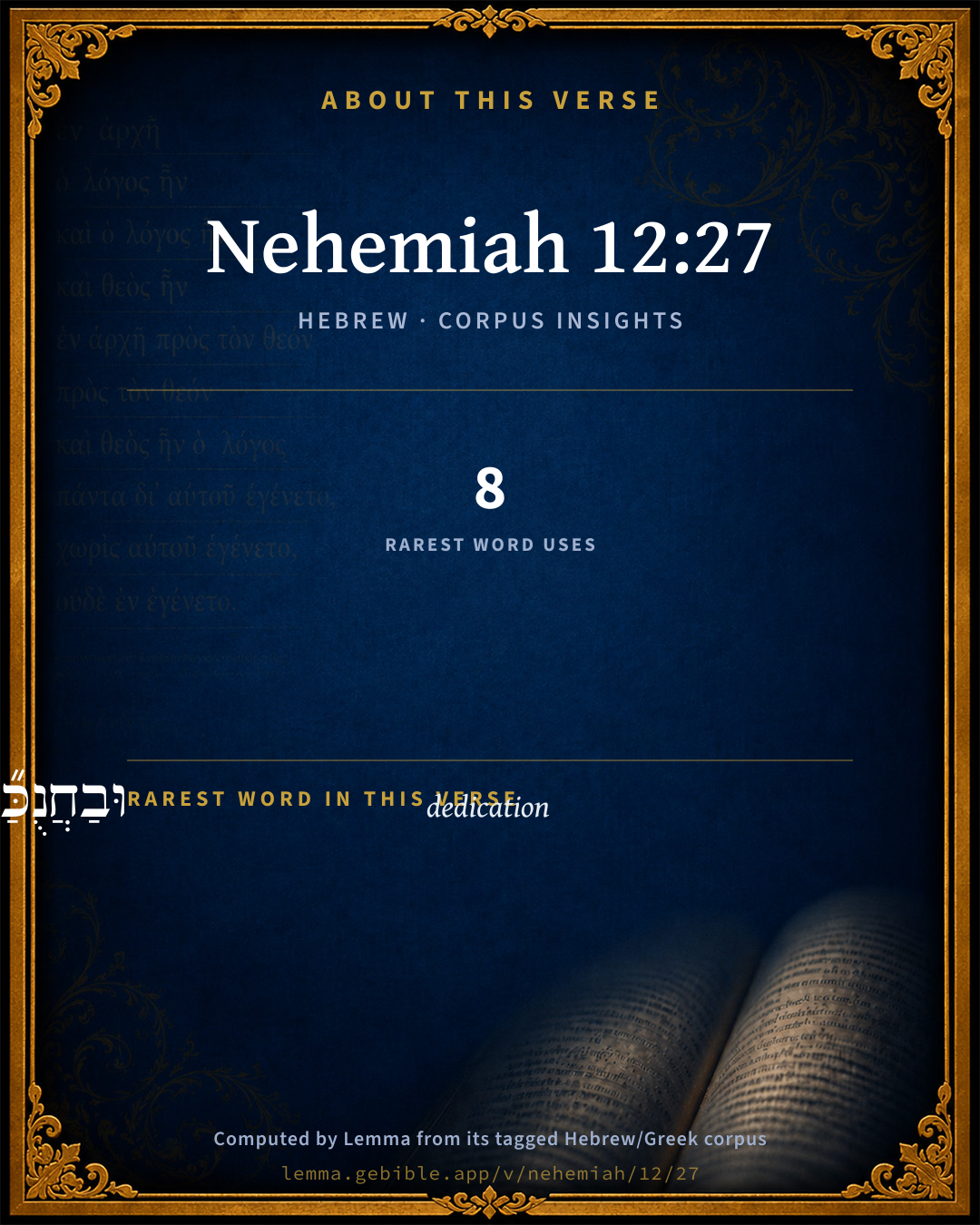
The rarest word here is וּבַחֲנֻכַּ֞ת dedication H2598 — appearing just 8 times in the whole Hebrew Bible.

Shared distinctive vocabulary

וּבַחֲנֻכַּ֞ת dedication H2598 occurs in 7 verses of the Hebrew Bible. Also found in:

Grammatical profile

  • 3 verbs
  • 14 nouns
  • 1 particle

Verb forms

  • בִּקְשׁ֤וּ Piel · Perfect
  • לַהֲבִיאָ֖ם Hiphil · Infinitive Construct
  • לַעֲשֹׂ֨ת Qal · Infinitive Construct

Repetition

Words recur within this verse — often emphatic in Hebrew:

  • וּבַחֲנֻכַּ֞ת dedication H2598 ×2
  • יְרוּשָׁלִַ֗ם Jerusalem H3389 ×2

Cross-references

31

Topical passages linked to Nehemiah 12:27 in the Treasury of Scripture Knowledge — connected by theme and wording, ordered by reader-vote popularity; previews shown in the World English Bible.

  • 1 Chronicles 15:16 David spoke to the chief of the Levites to appoint their brothers the singers, with instruments of music, psalteries and harps and cymbals, sounding aloud and lifting up the voice with joy.
  • Deuteronomy 20:5 The officers shall speak to the people, saying, What man is there who has built a new house, and has not dedicated it? let him go and return to his house, lest he die in the battle, and another man dedicate it.
  • 1 Chronicles 15:28 Thus all Israel brought up the ark of the covenant of Yahweh with shouting, and with sound of the cornet, and with trumpets, and with cymbals, sounding aloud with psalteries and harps.
  • 2 Chronicles 5:13 it happened, when the trumpeters and singers were as one, to make one sound to be heard in praising and thanking Yahweh; and when they lifted up their voice with the trumpets and cymbals and instruments of music, and praised Yahweh, [saying], For he is good; for his loving kindness endures forever; that then the house was filled with a cloud, even the house of Yahweh,
  • 2 Chronicles 29:30 Moreover Hezekiah the king and the princes commanded the Levites to sing praises to Yahweh with the words of David, and of Asaph the seer. They sang praises with gladness, and they bowed their heads and worshiped.
  • 1 Chronicles 15:4 David gathered together the sons of Aaron, and the Levites:
  • 1 Chronicles 15:12 and said to them, You are the heads of the fathers' [houses] of the Levites: sanctify yourselves, both you and your brothers, that you may bring up the ark of Yahweh, the God of Israel, to [the place] that I have prepared for it.
  • Deuteronomy 16:11 and you shall rejoice before Yahweh your God, you, and your son, and your daughter, and your man-servant, and your maid-servant, and the Levite who is within your gates, and the foreigner, and the fatherless, and the widow, who are in the midst of you, in the place which Yahweh your God shall choose, to cause his name to dwell there.
  • 2 Samuel 6:12 It was told king David, saying, Yahweh has blessed the house of Obed-edom, and all that pertains to him, because of the ark of God. David went and brought up the ark of God from the house of Obed-edom into the city of David with joy.
  • 1 Chronicles 13:8 David and all Israel played before God with all their might, even with songs, and with harps, and with psalteries, and with tambourines, and with cymbals, and with trumpets.
  • 1 Chronicles 16:5 Asaph the chief, and second to him Zechariah, Jeiel, and Shemiramoth, and Jehiel, and Mattithiah, and Eliab, and Benaiah, and Obed-edom, and Jeiel, with psalteries and with harps; and Asaph with cymbals, sounding aloud;
  • 1 Chronicles 16:42 and with them Heman and Jeduthun [with] trumpets and cymbals for those that should sound aloud, and [with] instruments for the songs of God; and the sons of Jeduthun to be at the gate.
  • 1 Chronicles 23:5 and four thousand were doorkeepers; and four thousand praised Yahweh with the instruments which I made, [said David], for giving praise.
  • 1 Chronicles 25:1–6 Moreover, David and the captains of the host set apart for the service certain of the sons of Asaph, and of Heman, and of Jeduthun, who should prophesy with harps, with psalteries, and with cymbals: and the number of those who did the work according to their service was:
  • 1 Chronicles 26:31 Of the Hebronites was Jerijah the chief, even of the Hebronites, according to their generations by fathers' [houses]. In the fortieth year of the reign of David they were sought for, and there were found among them mighty men of valor at Jazer of Gilead.
  • 2 Chronicles 7:6 The priests stood, according to their offices; the Levites also with instruments of music of Yahweh, which David the king had made to give thanks to Yahweh, (for his loving kindness endures for ever), when David praised by their ministry: and the priests sounded trumpets before them; and all Israel stood.
  • 2 Chronicles 29:4–11 He brought in the priests and the Levites, and gathered them together into the broad place on the east,
  • Ezra 3:10–11 When the builders laid the foundation of the temple of Yahweh, they set the priests in their clothing with trumpets, and the Levites the sons of Asaph with cymbals, to praise Yahweh, after the order of David king of Israel.
  • Ezra 6:16 The children of Israel, the priests, and the Levites, and the rest of the children of the captivity, kept the dedication of this house of God with joy.
  • Ezra 8:15–20 I gathered them together to the river that runs to Ahava; and there we encamped three days: and I viewed the people, and the priests, and found there none of the sons of Levi.
  • Nehemiah 8:17 All the assembly of those who were come again out of the captivity made booths, and lived in the booths; for since the days of Jeshua the son of Nun to that day the children of Israel had not done so. There was very great gladness.
  • Nehemiah 11:20 The residue of Israel, of the priests, the Levites, were in all the cities of Judah, everyone in his inheritance.
  • Psalms 30:1 I will extol you, Yahweh, for you have raised me up, And have not made my foes to rejoice over me.
  • Psalms 81:1–4 Sing aloud to God, our strength! Make a joyful shout to the God of Jacob!
  • Psalms 92:1–3 It is a good thing to give thanks to Yahweh, To sing praises to your name, Most High;
  • Psalms 98:4–6 Make a joyful noise to Yahweh, all the earth! Burst out and sing for joy, yes, sing praises!
  • Psalms 100:1–2 Shout for joy to Yahweh, all you lands!
  • Psalms 149:3 Let them praise his name in the dance! Let them sing praises to him with tambourine and harp!
  • Psalms 150:2–5 Praise him for his mighty acts! Praise him according to his excellent greatness!
  • Philippians 4:4 Rejoice in the Lord always! Again I will say, Rejoice!
  • Revelation 5:8 Now when he had taken the book, the four living creatures and the twenty-four elders fell down before the Lamb, each one having a harp, and golden bowls full of incense, which are the prayers of the saints.

Cross-references courtesy of OpenBible.info (CC BY 4.0).

Hebrew and Greek witnesses Masoretic Hebrew ↔ Greek Septuagint

The same verse in the two great witnesses to the Old Testament, shown verse-for-verse.

These are two independent witnesses, not word-aligned to each other, and the Septuagint is shown in lemma (dictionary) form.

Hebrew Nehemiah 12:27 Masoretic · Westminster Leningrad Codex

וּבַחֲנֻכַּ֞ת חוֹמַ֣ת יְרוּשָׁלִַ֗ם בִּקְשׁ֤וּ אֶת הַלְוִיִּם֙ מִכָּל מְק֣וֹמֹתָ֔ם לַהֲבִיאָ֖ם לִֽירוּשָׁלִָ֑ם לַעֲשֹׂ֨ת חֲנֻכָּ֤ה וְשִׂמְחָה֙ וּבְתוֹד֣וֹת וּבְשִׁ֔יר מְצִלְתַּ֖יִם נְבָלִ֥ים וּבְכִנֹּרֽוֹת

At the dedication of the wall of Jerusalem they sought the Levites out of all their places, to bring them to Jerusalem, to keep the dedication with gladness, both with giving thanks, and with singing, with cymbals, psalteries, and with harps.

World English Bible · Public Domain

Greek LXX Structure differs

The Septuagint has no separate book of Nehemiah. Its Greek text is the second half of Esdras B (2 Esdras), chapters 11–23; Ezra is the first half (1–10).

A verse-for-verse comparison isn’t shown here because the chapters and verses don’t line up. Switch to the LXX edition with the MT / LXX toggle above to read the Greek directly.

On this verse, The Cambridge Bible for Schools and Colleges discusses the Septuagint’s reading. Read the note in Commentary ↓

Hebrew: Westminster Leningrad Codex (CC BY 4.0). Greek: Septuagint (public domain); English from a public-domain English Septuagint. How the Septuagint differs from the Hebrew →

Commentary

Notes on Nehemiah 12:27 from classic Christian and Jewish commentators (each source and its license shown beneath its notes). The classic Christian expositions comment on the surrounding passage and are grouped to its opening verse, so a note may address several verses; the Jewish commentaries on the Tanakh (Rashi and others) are per-verse, so they appear only where the commentator wrote on this verse.

Lemma curates 59 commentaries, every one of them public domain or Creative Commons licensed, each selected and text-cleaned for this edition rather than reprinted as found. About our sources →

The Cambridge Bible for Schools and Colleges

gen. ed. J. J. S. Perowne

27. at the dedication of the wall] It is only natural to suppose that the dedication of the walls took place at no long interval after their completion. The walls were finished on the 25th of the month Elul (Neh_6:15) or September. According to 2Ma_1:18 Nehemiah on the 25th of Chislev (December) celebrated the restoration of the altar. If this date may be relied upon as representing a true tradition of the solemn dedication described in these verses, exactly three months elapsed between the completion and the dedication of the walls. It has been by some considered improbable that the Feast of Tabernacles and the Sealing of the Covenant (8–10) would have taken place before the Dedication described in these verses; and accordingly the events narrated in those chapters have been ascribed to the following year.

Rawlinson is of opinion that ‘the nexus of the remainder of this chapter with the next and the date given in chap. Neh_13:6, make it certain that the ceremony was deferred for the space of nearly twelve years. Perhaps Nehemiah required an express permission from the Persian king before he could venture on a solemnity which might have been liable to misrepresentation.’

But the unlikelihood of this hypothesis cannot be thus disposed of. (1) Is it probable that 12 years should have been permitted to elapse between the triumphant accomplishment of Nehemiah’s work and its religious consecration? (2) The nexus of the remainder of this chapter with Neh_13:1-3 is very close, but a completely new section, with marked difference of style, opens at Neh_13:4 and denotes the resumption of the more colloquial extracts from the Memoirs of Nehemiah. (3) The mention of the date, twelve years later, in Neh_13:6 refers to the events described in the immediate context; and there is no probability that it would also be applicable to the preceding section Neh_12:27-43. If Neh_13:6 were, as has been supposed, so closely connected with Neh_12:27-43, this mention of the date would surely have been placed in chap. 12.

out of all their places] Explained in the two next verses. Cf. Neh_11:3; Neh_11:20.

to keep the dedication with gladness] literally ‘to make dedication and gladness’ (LXX. ποιῆσαι ἐγκαίνια καὶ εὐφροσύνην). ‘Dedication.’ Heb. Khanukkah. The Jewish Feast of Dedication to commemorate the purification of the Temple by Judas the Maccabee (165 b.c.) was held in mid-winter (Adar 25). See Joh_10:22; 1Ma_4:60.

with thanksgivings] The LXX. transliterates in ἐν θωδαθᾷ. Among the Psalms appropriate to be sung on such an occasion some have suggested Psalms 122, 147.

cymbals, psalteries, and with harps] Cf. 1Ch_13:8. ‘Psaltery’ = nebel, a harp: ‘harp’ = kinnor, a kind of guitar.

27–43. The Dedication of the Walls

In the description of this solemn event, there is a return to the use of the 1st Pers. Sing. (Neh_12:31; Neh_12:38; Neh_12:40). The compiler returns to the Memoirs of Nehemiah, from which he makes extracts, while he no doubt exercises a full liberty of abridgement and revision.

The Cambridge Bible for Schools and Colleges (gen. ed. J. J. S. Perowne; Cambridge University Press, 1878–1918) — public domain. Text from a community e-Sword module.

Trapp's Complete Commentary

John Trapp

Neh 12:27 And at the dedication of the wall of Jerusalem they sought the Levites out of all their places, to bring them to Jerusalem, to keep the dedication with gladness, both with thanksgivings, and with singing, [with] cymbals, psalteries, and with harps.

Ver. 27. And at the dedication of the wall] To set down which is the main scope of this whole chapter.

John Trapp, A Commentary or Exposition upon All the Books of the Old and New Testament (1647–1656) — public domain. Text from a community e-Sword module.

The Biblical Illustrator

Joseph S. Exell

Neh_12:27-43

And at the dedication of the wall of Jerusalem.

The dedication of the wall

In this dedication--

I. It was designed to offer thanks to God for the completion of a good work.

II. It was intended to set apart the holy city for its sacred ends.

III. It was desired to invoke the Divine blessing and guardianship on the city of God.

IV. It is beautiful to observe how fully the domestic affections are cherished and displayed. The wives also and the children rejoiced. (W. Ritchie.)

The Biblical Illustrator, edited by Joseph S. Exell (c. 1880s–1900s) — public domain. Text from a community e-Sword module.

Joseph Benson's Commentary

Neh 12:27. At the dedication of the wall — Of the city itself, which is here dedicated to God, and to his honour and service, not only upon a general account, by which we ought to devote ourselves, and all that is ours, to God; but upon a more special ground, because this was a place which God himself had chosen, and sanctified by his temple and gracious presence, and which therefore did of right belong to him, whence it is often called the holy city. And they restored it to God by this dedication, withal imploring the presence, and favour, and blessing of God to this city, by solemn prayers, and praises, and sacrifices, wherewith this dedication was accompanied. They sought the Levites out of their places — To which they were now retired, after that great and general assembly, Neh 8:9-10.

Joseph Benson's Commentary on the Old and New Testaments (1811–1818) — public domain. Text from a community e-Sword module.

Whedon's Commentary on the Bible

Daniel D. Whedon

DEDICATION OF THE WALL OF JERUSALEM, Neh_12:27-43.

All the details and genealogical lists from chapter vii up to this point were, in some sense, preparatory to the dedication of the walls of the holy city. Upon the completion of the walls the Jews’ enemies were humiliated, and devised crafty measures to put Nehemiah in fear. Neh_6:15-19. Thereupon Nehemiah at once proceeded to organize and consolidate the new community, and to thoroughly provide for their civil and religious interests. He carefully collected the genealogical registers, assembled the whole nation for public instruction in the law, made all needful provision for the temple service, and for a large increase of the inhabitants of Jerusalem. Thus Nehemiah and Ezra were like another Moses and Aaron to lead, organize, and instruct their nation after its deliverance from the second “house of bondage.” The dedication of the restored walls of their capital followed most fittingly after the nation had become thoroughly organized and consolidated, and the priestly and Levitical houses had learned their proper places and work.

The date of the dedication of the wall is quite uncertain. The close connexion of this account with Nehemiah’s later reforms, (Neh_12:44, and Neh_13:1,) seems to place it after Nehemiah’s absence in Persia.

And it is very possible that for reasons now unknown this dedication of the wall was hindered, or postponed, till after Nehemiah returned from Persia.

27. They sought the Levites — Having been duly registered and organized for service, the Levites dwelling in the various cities of Judah outside of Jerusalem could easily be summoned to keep the dedication. Only a part of the Levites dwelt in Jerusalem, Neh_11:15-18. The rest had their places assigned them in the province.

Cymbals, psalteries — See on 1Sa_10:5, and 2Sa_6:5.

Daniel D. Whedon (gen. ed.), Commentary on the Old and New Testaments (1874–1909) — public domain. Text from a community e-Sword module.

The Pulpit Commentary

DEDICATION OF THE WALL OF JERUSALEM UNDER NEHEMIAH AND EZRA, WITH NEHEMIAH"S ARRANGEMENT OF THE TEMPLE OFFICERS, AND HIS EFFORTS FOR THE REFORM OF RELIGION (CH. Neh_12:27-43) It is supposed by some that the author,has here departed from the chronological order, and gone back to a date not much subsequent to the completion of the wall in September, B.C. 444, since the dedication of a work under ordinary circumstances follows closely upon its accomplishment. But no reason has been shown for the actual place held by the narrative in the Book upon this supposition, nor is it easy to imagine that the author would have separated the dedication of the wall from its completion by five chapters and a half, unless they had been separated in fact by an interval of some duration. The interval seems, by the notes of time contained in chs. 12, 13, to have been one of nearly thirteen years. Nehemiah"s religious reforms were certainly subsequent to the visit that he paid to the Persian court in B.C. 432. (Neh_13:6) These reforms grew out of a reading of the law which took place at the time when Nehemiah appointed the temple officers, (Neh_13:1) and that appointment followed closely on the dedication. (Neh_12:44) We may account for the long delay by supposing that Nehemiah was afraid of offending Artaxerxes if he ventured on a ceremony, to which the superstition of the surrounding heathen may have attached extreme importance, without his express permission, and that to obtain this permission his personal influence was necessary.

The dedication of a city wall was, so far as we know, a new thing in Israel; but it had been customary from a remote time to dedicate houses; (Deu_20:5) and natural piety extended this practice to aggregations of houses, and to the limit or fence by which they were practically made one. The priestly order had shown its sense of the fitness of such a consecration when they raised their portion of the wall, and had at once "sanctified it". (Neh_3:1) Nehemiah now, by the ceremony which he planned and carried out, placed the whole circuit of the wall under the Divine protection, confessing in this solemn act the intrinsic worthlessness of mere walls and bulwarks, unless God lends them strength and makes them a protection against enemies. And at the dedication ... they sought the Levites. The nexus of this passage seems to be with Neh_11:36; and we may suppose that originally it followed immediately on Ne 11 the lists (Neh_12:1-26) being a later insertion. The author, having (in Neh_11:36) told us of the wide dispersion of the Levites, now notes that they were summoned from all the places where they dwelt, and brought (one and all) to Jerusalem for the solemnity of the dedication. To keep the dedication with gladness, both with thanksgiving and with singing, etc. Solomon"s dedication of the temple was the pattern followed. As he had made the service altogether one of praise and thanksgiving, (2Ch_5:13) and had employed in it cymbals, trumpets, psalteries, and harps (ibid. ver. 12), so Nehemiah on the present occasion.

Vers. 27-43. The dedication of the wall.

As soon as possible after the completion of the wall, a joyful celebration of the event was made, in which all the people participated. As Jerusalem was "the holy city," this took the form of a "dedication.

I THE SOLEMNITIES WITH WHICH THE DEDICATION WAS MADE.

1. The preparations. The gathering of the Levites, especially the singers and musicians, who were to take a leading part in the ceremonies (vers. 27-29).

2. The purifications (ver. 30). The priests and Levites first purified themselves, and then the people, the gates, and the wall. By what rites is not recorded.

3. The processions (vers. 31-42). Two processions were formed, Ezra accompanying one, and Nehemiah the other. One company marched on the wall to the right, the other to the left, both to the sound of trumpets, singing, and instruments of music; and meeting over against the temple, they united their praises.

4. The universal rejoicing (ver. 43). Many sacrifices of thanksgiving were offered, of which the people, men, women, and children alike, partook with many and loud expressions of joy.

II THE SIGNIFICANCE OF THESE SOLEMNITIES. They were

1. An expression of ardent gratitude to God. He "had made them rejoice with great joy," and it was meet and right that they should praise him for

(1) The wall itself, so strong a defence against their enemies; within which the citizens, with the temple and religious services, would, be secure.

(2) The wonderful way in which they had been led and prospered in the work.

(3) The conquest effected over great obstacles, and powerful, cunning, and resolute opponents.

(4) The rapidity with which the work had been done.

2. A consecration to God"s service of the wall and all it was to guard.

3. A committal of all to his care and protection. As conscious that without him strong walls are vain. They may well have remembered it is not unlikely that they sang the song in Isa_26:1, or the promise givenin Zec_2:5.

Lessons:

1. For success in every good work praise should be offered to God. The joy it awakens should be directed heavenwards in thanksgiving. For however active we and others may have been, it is to God the good issue m to be ascribed. The power and the will to work, the favouring circumstances, the assistance of others, etc., all are from him.

2. All should join in thanksgiving for mercies common to all. For signal national blessings, national thanksgiving should be rendered.

3. The best expression of gratitude for Divine gifts is to dedicate them to the Divine service. All that we are and have should be thus devoted to God.

4. Purity is necessary for, and may be secured by, those who engage in religious services. (Pro_15:8 Isa_1:15, 16 1Ti_2:8 Heb_10:22) The last-quoted passage, with the previous verses, shows how the needful purification is to he obtained. Not from merely human priests, but from the great High Priest, who needed not, like the priests mentioned in ver. 30, to purify himself before purifying others. (see Heb_7:26, Heb_7:27)

5. Children should be associated with their parents in the worship of God.

HOMILIES BY W. CLARKSON Vers. 27-43. A joyous dedication.

Knowing all that we do know of God"s ancient people, of the devoutness of their spirit, and their disposition to connect closely the human and the Divine, we should expect that the building of the wall round the sacred city would be followed by some religious service. The verses of the text give a graphic description of this interesting scene. The Levites who had been dispersed through the province were "sought out of all their places" (ver. 27), and the "sons of the singers gathered themselves together" (ver. 28) from "the villages round about Jerusalem" (ver. 29). It was a day of sacred joy, when gladness in the Lord rose to enthusiasm, and could only be poured forth in song and shouting. First, however, came the solemn ceremony of purification (ver. 30), the sprinkling of "water of separation a "purification for sin". (Num_19:9-13) This was sprinkled on the

(1) priests and Levites themselves,

(2) on the people, and

(3) on the wall: everything was to be "clean" and "holy unto the Lord.

Then came the twofold procession (vers. 31-40). In two divisions, starting from the same point, and going in opposite directions, they traversed the walls, Nehemiah beading one half of the princes of the people, and Ezra the other half; in both cases preceded by the "thanksgiving companies" (ver. 31), which played and sang as they marched. They met near the entrance to the temple (ver. 40), and there joined in the utterance of public praise, singing "loud thanksgivings to their God" (ver. 42). Then came "great sacrifices" (ver. 43) offered on the brazen altar by the priests, the people, during the procession and after the sacrifices, rending the air with shouts of great joy, women and children joining in the general gladness, "so that the joy of Jerusalem was heard even afar off" (ver. 43). The whole scene suggests thoughts to us of

I OUR PURIFICATION OF OURSELVES. If we ask, What is there in Christianity that answers to the purification of themselves and of the people by the priests under Judaism? (ver. 30), we answer that there are two ways in which we are now made clean.

1. "By the sprinkling of the blood of Jesus Christ" we are "cleansed from all iniquity." We are "justified by his blood". (Rom_5:9) Applying to our own souls" need the propitiatory work of our Redeemer, we ourselves are "made whole" in the sight of God; "we are washed,... we are justified in the name of the Lord Jesus". (1Co_6:11)

2. By deliberate separation of ourselves to the service of God. Not the withdrawal of ourselves from the relationships in which we are called to stand or from the active duties which await our energy and skill, but the separation of our souls from the evil which is in the world, and a full dedication of our powers and our lives to the service of our Saviour. Thus are we purified.

II THE ACCEPTABLENESS OF OUR WORK. The wall which had been built was purified as well as the builders (ver. 30). Our work which we have wrought for God and man needs to be made clean, pure, acceptable. It is thus rendered

1. Through the work of the Divine Mediator. We ask acceptance of all we have done for Jesus" sake.

2. By the spirit of consecration we show in its execution.

(1) By entering upon it with a pure desire to honour Christ and bless our brethren.

(2) By doing it in a spirit of thorough loyalty to him and sympathy with them.

(3) By ascribing its success, when completed, to his gracious guidance and help.

III OUR JOY. The joy of the Jews on this occasion was

(1) occasioned by a sense of deliverance and security; was

(2) sanctified by gratitude and devotion: they "gave thanks in the house of God" (ver. 40), and "offered great sacrifices" (ver. 43); and it was

(3) general and contagious: it extended to all classes and ages, and went far and wide beyond the city walls it was "heard afar off" (ver. 43).

Such should be the characteristics of our Christian joy; it also should

(1) Be kindled in the heart by our deep sense of redemption and security through Jesus Christ our Saviour.

(2) Be sanctified by much thanksgiving and devotion. Gladness is never so pure and safe as when it takes the form of gratitude, and goes into the house of God to worship there.

(3) Extend to all those below us the children, the servants, etc.; and all around us be felt "afar off. C.

The Pulpit Commentary (1880–1919), ed. H.D.M. Spence-Jones & Joseph S. Exell — public domain. Text from a community e-Sword module.

Keil & Delitzsch

C. F. Keil & F. Delitzsch

The dedication of the wall of Jerusalem. - The measures proposed for increasing the numbers of the inhabitants of Jerusalem having now been executed (Neh 7:5 and Neh 11:1.), the restored wall of circumvallation was solemnly dedicated. Neh 12:27-29 treat of the preparations for this solemnity.

Neh 12:27

At the dedication (i.e., at the time of, בּ denoting nearness of time) they sought the Levites out of all their places, to bring them to Jerusalem to keep the dedication. Only a portion of the Levites dwelt in Jerusalem (Neh 11:15-18); the rest dwelt in places in the neighbourhood, as is more expressly stated in Neh 12:28 and Neh 12:29. ושׂמחה, to keep the dedication and joy, is not suitable, chiefly on account of the following וּבתודות, and with songs of praise. We must either read בּשׂמחה, dedication with joy (comp. Ezr 6:16), or expunge, with the lxx and Vulgate, the ו before בּתודות. בּ must be repeated before מצלתּים from the preceding words. On the subject, comp. Ch1 13:8; Ch1 15:16, and elsewhere.

Neh 12:28-29

And the sons of the singers, i.e., the members of the three Levitical companies of singers (comp. Neh 12:25 and Neh 11:17), gathered themselves together, both out of the Jordan valley round about Jerusalem, and the villages (or fields, חצרים, comp. Lev 25:31) of Netophathi, and from Beth-gilgal, etc. הכּכּר does not mean the district round Jerusalem, the immediate neighbourhood of the city (Bertheau). For, according to established usage, הכּכּר is used to designate the Jordan valley (see rem. on Neh 3:22); and ירוּשׁלים סביבות is here added to limit the כּכּר, - the whole extent of the valley of the Jordan from the Dead Sea to the Sea of Galilee not being intended, but only its southern portion in the neighbourhood of Jericho, where it widens considerably westward, and which might be said to be round about Jerusalem. The villages of Netophathi (comp. Ch1 9:16) are the villages or fields in the vicinity of Netopha, i.e., probably the modern village of Beit Nettif, about thirteen miles south-west of Jerusalem: comp. Rob. Palestine; Tobler, dritte Wand. p. 117, etc.; and V. de Velde, Mem. p. 336. Bertheau regards Beth-gilgal as the present Jiljilia, also called Gilgal, situate somewhat to the west of the road from Jerusalem to Nablous (Sichem), about seventeen miles north of the former town. This view, is, however, questionable, Jiljilia being apparently too distant to be reckoned among the סביבות of Jerusalem. "And from the fields of Geba and Azmaveth." With respect to Geba, see rem. on Neh 11:31. The situation of Azmaveth is unknown; see rem. on Ezr 2:24. For the singers had built them villages in the neighbourhood of Jerusalem, and dwelt, therefore, not in the before-named towns, but in villages near them.

Neh 12:30

The dedication began with the purification of the people, the gates, and the wall, by the priests and Levites, after they had purified themselves. This was probably done, judging from the analogy of Ch2 29:20, by the offering of sin-offerings and burnt-offerings, according to some special ritual unknown to us, as sacrifices of purification and dedication. This was followed by the central-point of the solemnity, a procession of two bands of singers upon the wall (Neh 12:31-42).

Neh 12:31-34

Nehemiah brought up the princes of Judah upon the wall, and appointed two great companies of those who gave thanks, and two processions. These went each upon the wall in different directions, and stopped opposite each other at the house of God. The princes of Judah are the princes of the whole community, - Judah being used in the sense of יהוּדים, Neh 4:2. לחומה מעל, upwards to the wall, so that they stood upon the wall. העמיד, to place, i.e., to cause to take up a position, so that those assembled formed two companies or processions. תודה, acknowledgement, praise, thanks, and then thankofferings, accompanied by the singing of psalms and thanksgivings. Hence is derived the meaning: companies of those who gave thanks, in Neh 12:31, Neh 12:38, Neh 12:40. ותהלכת, et processiones, solemn processions, is added more closely to define תודה. The company of those who gave thanks consisted of a number of Levitical singers, behind whom walked the princes of the people, the priests, and Levites. At the head of one procession went Ezra the scribe (Neh 12:36), with one half of the nobles; at the head of the second, Nehemiah with the other half (Neh 12:38). The one company and procession went to the right upon the wall. Before ליּמין we must supply, "one band went" (הולכת האחת התּודה), as is evident partly from the context of the present verse, partly from Neh 12:38. These words were probably omitted by a clerical error caused by the similarity of תּהלכת to הולכת. Thus the first procession went to the right, i.e., in a southerly direction, upon the wall towards the dung-gate (see rem. on Neh 3:14); the second, Neh 12:38, went over against the first (למאל), i.e., in an opposite direction, and therefore northwards, past the tower of the furnaces, etc. The starting-point of both companies and processions is not expressly stated, but may be easily inferred from the points mentioned, and can have been none other than the valley-gate, the present Jaffa gate (see rem. on Neh 2:13). Before a further description of the route taken by the first company, the individuals composing the procession which followed it are enumerated in Neh 12:32-36. After them, i.e., after the first company of them that gave thanks, went Hoshaiah and half of the princes of Judah. Hoshaiah was probably the chief of the one half of these princes. The seven names in Neh 12:33 and Neh 12:34 are undoubtedly the names of the princes, and the ו before עזריה is explicative: even, namely. Bertheau's remark, "After the princes came the orders of priests, Azariah," etc., is incorrect. It is true that of these seven names, five occur as names of priests, and heads of priestly houses, viz.: Azariah, Neh 10:2; Neh 12:1; Meshullam, Neh 10:7; Shemaiah, Neh 10:8 and Neh 12:6; and Jeremiah, Neh 12:1. But even if these individuals were heads of priestly orders, their names do not here stand for their orders. Still less do Judah and Benjamin denote the half of the laity of Judah and Benjamin, as Bertheau supposes, and thence infers that first after the princes came two or three orders of priests, then half of the laity of Judah and Benjamin, and then two more orders of priests. Neh 12:38, which is said to give rise to this view, by no means confirms it. It is true that in this verse העם חצי, besides Nehemiah, are stated to have followed the company of those who gave thanks; but that העם in this verse is not used to designate the people as such, but is only a general expression for the individuals following the company of singers, is placed beyond doubt by Neh 12:40, where העם is replaced by הסּגנים חצי; while, beside the half of the rulers, with Nehemiah, only priests with trumpets and Levites with stringed instruments (Neh 12:41) are enumerated as composing the second procession. Since, then, the priests with trumpets and Levites with musical instruments are mentioned in the first procession (Neh 12:35 and Neh 12:36), the names enumerated in Neh 12:33 and Neh 12:34 can be only those of the one half of the סגנים of the people, i.e., the one half of the princes of Judah. The princes of Judah, i.e., of the Jewish community, consisted not only of laymen, but included also the princes, i.e., heads of priestly and Levitical orders; and hence priestly and Levitical princes might also be among the seven whose names are given in Neh 12:33 and Neh 12:34. A strict severance, moreover, between lay and priestly princes cannot be made by the names alone; for these five names, which may designate priestly orders, pertain in other passages to laymen, viz.: Azariah, in Neh 3:23; Ezra, as of the tribe of Judah, Ch1 4:17; Meshullam, Neh 3:4; Neh 10:21, and elsewhere; Shemaiah, Ezr 6:13; Ezr 10:31; Ch1 3:22; Ch1 4:37 (of Judah), Ch1 5:4 (a Reubenite), and other passages (this name being very usual; comp. Simonis Onomast. p. 546); Jeremiah, Ch1 5:24 (a Manassite), Neh 12:4 (a Benjamite), Neh 12:10 (a Gadite). Even the name Judah is met with among the priests (Neh 12:36), and among the Levites, Neh 12:8, comp. also Neh 11:9, and that of Benjamin, Neh 3:23 and Ezr 10:32. In the present verses, the two names are not those of tribes, but of individuals, nomina duorum principum (R. Sal.).

Neh 12:35-36

The princes of the congregation were followed by certain "of the sons of the priests" (seven in number, to judge from Neh 12:41) with trumpets; also by Jonathan the son of Zechariah, who, as appears from the subsequent ואחיו, was at the head of the Levitical musicians, i.e., the section of them that followed this procession. His brethren, i.e., the musicians of his section, are enumerated in Neh 12:36, - eight names being given, among which are a Shemaiah and a Judah. "With the musical instruments of David, the man of God:" comp. Ch2 29:26; Ch1 15:16; Ch1 23:5; Ezr 3:10. "And Ezra the scribe before them," viz., before the individuals enumerated from Neh 12:32, immediately after the company of those who gave thanks, and before the princes, like Nehemiah, Neh 12:38.

Neh 12:37-42

After this insertion of the names of the persons who composed the procession, the description of the route it took is continued. From "upon the wall, towards the dung-gate (Neh 12:31), it passed on" to the fountain-gate; and נגדּם, before them (i.e., going straight forwards; comp. Jos 6:5, Jos 6:20; Amo 4:3), they went up by the stairs of the city of David, the ascent of the wall, up over the house of David, even unto the water-gate eastward. These statements are not quite intelligible to us. The stairs of the city of David are undoubtedly "the stairs that lead down from the city of David" (Neh 3:15). These lay on the eastern slope of Zion, above the fountain-gate and the Pool of Siloam. לחומה המּעלה might be literally translated "the ascent to the wall," as by Bertheau, who takes the sense as follows: (The procession) went up upon the wall by the ascent formed by these steps at the northern part of the eastern side of Zion. According to this, the procession would have left the wall by the stairs at the eastern declivity of Zion, to go up upon the wall again by this ascent. There is, however, no reason for this leaving of the wall, and that which Bertheau adduces is connected with his erroneous transposition of the fountain-gate to the place of the present dung-gate. לחומה המּעלה seems to be the part of the wall which, according to Neh 3:19, lay opposite the המּקצוע הנּשׁק עלת, a place on the eastern edge of Zion, where the wall was carried over an elevation of the ground, and where consequently was an ascent in the wall. Certainly this cannot be insisted upon, because the further statement דויד לבית מעל is obscure, the preposition ל מעל admitting of various interpretations, and the situation of the house of David being uncertain. Bertheau, indeed, says: "ועד in the following words corresponds with מעל before דויד לבית: a wall over the house of David is not intended; and the meaning is rather, that after they were come as far as the wall, they then passed over the house of David, i.e., the place called the house of David, even to the water-gate." But the separation of מעל from דויד לבית is decidedly incorrect, ל מעל being in the preceding and following passages always used in combination, and forming one idea: comp. Neh 12:31 (twice) and Neh 12:38 and Neh 12:39. Hence it could scarcely be taken here in Neh 12:37 in a different sense from that which it has in Neh 12:31 and Neh 12:38. Not less objectionable is the notion that the house of David is here put for a place called the house of David, on which a palace of David formerly stood, and where perhaps the remains of an ancient royal building might still have been in existence. By the house of David is meant, either the royal palace built (according to Thenius) by Solomon at the north-eastern corner of Zion, opposite the temple, or some other building of David, situate south of this palace, on the east side of Zion. The former view is more probable than the latter. We translate לבית ד מעל, past the house of David. For, though לחומה מעל must undoubtedly be so understood as to express that the procession went upon the wall (which must be conceived of as tolerably broad), yet למגדּל מעל, Neh 12:38, can scarcely mean that the procession also went up over the tower which stood near the wall. In the case of the gates, too, ל מעל cannot mean over upon; for it is inconceivable that this solemn procession should have gone over the roof of the gates; and we conclude, on the contrary, that it passed beside the gates and towers. Whether the route taken by the procession from the house of David to the water-gate in the east were straight over the ridge of Ophel, which ran from about the horse-gate to the water-gate, or upon the wall round Ophel, cannot be determined, the description being incomplete. After the house of David, no further information as to its course is given; its halting-place, the water-gate, being alone mentioned.

The route taken by the second company is more particularly described. - Neh 12:38 and Neh 12:39. "And the second company of them that gave thanks, which went over against, and which I and the (other) half of the people followed, (went) upon the wall past the tower of the furnaces, as far as the broad wall; and past the gate of Ephraim, and past the gate of the old (wall), and past the fish-gate, and past the tower Hananeel and the tower Hammeah, even to the sheep-gate: and then took up its station at the prison-gate." למואל (in the form with א only here; elsewhere מול, Deu 1:1, or מוּל), over against, opposite, sc. the first procession, therefore towards the opposite side, i.e., to the left; the first having gone to the right, viz., from the valley-gate northwards upon the northern wall. וגו אחריה ואני (and I behind them) is a circumstantial clause, which we may take relatively. The order of the towers, the lengths of wall, and the gates, exactly answer to the description in Neh 3:1-12, with these differences: - a. The description proceeds from the sheep-gate in the east to the valley-gate in the west; while the procession moved in the opposite direction, viz., from the valley-gate to the sheep-gate. b. In the description of the building of the wall, Neh 3, the gate of Ephraim is omitted (see rem. on Neh 3:8). c. In the description, the prison-gate at which the procession halted is also unmentioned, undoubtedly for the same reason as that the gate of Ephraim is omitted, viz., that not having been destroyed, there was no need to rebuild it. המּטּרה שׁער is translated, gate of the prison or watch: its position is disputed; but it can scarcely be doubted that המּטּרה is the court of the prison mentioned Neh 3:25 (המּטּרה חצר), by or near the king's house. Starting from the assumption that the two companies halted or took up positions opposite each other, Hupfeld (in his before-cited work, p. 321) transposes both the court of the prison and the king's house to the north of the temple area, where the citadel. בּירה, βᾶρις, was subsequently situated. But "this being forbidden," as Arnold objects (in his before-cited work, p. 628), "by the order in the description of the building of the wall, Neh 3:25, which brings us absolutely to the southern side," Bertheau supposes that the two processions which would arrive at the same moment at the temple, - the one from the north-east, the other from the south-east, - here passed each other, and afterwards halted opposite each other in such wise, that the procession advancing from the south-west stood on the northern side, and that from the north-west at the southern side of the temple area. This notion, however, having not the slightest support from the text, nor any reason appearing why the one procession should pass the other, it must be regarded as a mere expedient. In Neh 12:40 it is merely said, the two companies stood in the house of God; and not even that they stood opposite each other, the one on the north, the other on the south side of the temple. Thus they may have stood side by side, and together have praised the Lord. Hence we place the prison-gate also on the south-eastern corner of the temple area, and explain the name from the circumstance that a street ran from this gate over Ophel to the court of the prison near the king's house upon Zion, which, together with the gate to which it led, received its name from the court of the prison. Not far from the prison-gate lay the water-gate in the east, near which was an open space in the direction of the temple area (Neh 8:1). On this open space the two companies met, and took the direction towards the temple, entering the temple area from this open space, that they might offer their thank-offerings before the altar of burnt-offering (Neh 12:43). Besides, the remark upon the position of the two companies (Neh 12:40) anticipates the course of events, the procession following the second company being first described in Neh 12:40-42. At the end of Neh 12:40 the statement of Neh 12:38 - I and the half of the people behind - is again taken up in the words: I and the half of the rulers with me. The סגנים are, as in Neh 12:32, the princes of the congregation, who, with Nehemiah, headed the procession that followed the company of those who gave thanks. Then followed (Neh 12:41) seven priests with trumpets, whose names are given, answering to the sons of the priests with trumpets (Neh 12:36) in the first procession. These names are all met with elsewhere of other persons. These were succeeded, as in Neh 12:36, by eight Levites - eight individuals, and not eight divisions (Bertheau). And the singers gave forth sound, i.e., of voices and instruments, - whether during the circuit or after the two companies had take their places at the temple, is doubtful. The president of the Levitical singers was Jezrahiah.

Neh 12:43

The solemnity terminated with the offering of great sacrifices and a general festival of rejoicing. In the matter of sacrificing, the person of Nehemiah would necessarily recede; hence he relates the close of the proceedings objectively, and speaks in the third person, as he had done when speaking of the preparations for them, Neh 12:27, etc., only using the first (Neh 12:31, Neh 12:38, Neh 12:40) person when speaking of what was appointed by himself, or of his own position. The זבהים were chiefly thank-offerings which, terminating in feasting upon the sacrifices, - and these feasts in which the women and children participated, - contributed to the enhancement of the general joy, the joy which God had given them by the success He had accorded to their work of building their wall. For a description of their rejoicing, comp. Ch2 20:27; Ezr 6:22, and Neh 3:13.

Keil & Delitzsch — Biblical Commentary on the Old Testament (1861–1891) — public domain (CC PDM 1.0). Text via the HelloAO Bible API. (Old Testament only.)

The Expositor's Bible

BEGINNINGS

Neh_12:27-47

A CURIOUS feature of the history of the restoration of Israel already met with several times is postponement. Thus in the days of Cyrus. Zerubbabel leads up an expedition for the express purpose of building the temple at Jerusalem, but the work is not executed until the reign of Darius. Again, Ezra brings the book of The Law with him when he comes to the city, yet he does not find an opportunity for publishing it till some years later. Once more, Nehemiah sets to work on the fortifications with the promptitude of a practical man and executes his task with astonishing celerity, still, even in his case the usual breach of sequence occurs; here, too, we have interruption and the intrusion of alien matters, so that the crowning act of the dedication of the walls is delayed.

In this final instance we do not know how long a postponement there was. Towards the end of his work the chronicler is exceptionally abrupt and disconnected. In the section Neh_12:27-43 he gives us an extract from Nehemiahs memoirs, but without any note of time. The preservation of another bit of the patriots original writing is interesting, not only because of its assured historicity, but further because exceptional importance is given to the records that have been judged worthy of being extracted and made portions of permanent scripture, although other sources are only used by the chronicler as materials out of which to construct his own narrative in the third person. While we cannot assign its exact date to the subject of this important fragment, one thing is clear from its position in the story of the days of Nehemiah. The reading of The Law, the great fast, the sealing of the covenant, the census, and the regulations for peopling Jerusalem, all came between the completion of the fortifications and the dedication of them. The interruption and the consequent delay were not without meaning and object. After what had occurred in the interval, the people were better prepared to enter into the ceremony of dedication with intelligence and earnestness of purpose. This act, although it was immediately directed to the walls, was, as a matter of fact, the re-consecration of the city, because the walls were built in order to preserve the distinct individuality, the unique integrity of what they included. Now the Jews needed to know The Law in order to understand the destiny of Jerusalem, they needed to devote themselves personally to the service of God, so that they might carry out that destiny, and they needed to recruit the forces of the Holy City, for the purpose of giving strength and volume to its future. Thus the postponement of the dedication made that event, when it came about, a much more real thing than it would have been if it had followed immediately on the building of the walls. May we not say that in every similar case the personal consecration must precede the material? The city is what its citizens make it. They, and not its site or its buildings, give it its true character. Jerusalem and Babylon, Athens and Rome, are not to be distinguished in their topography and architecture in anything approaching the degree in which they are individualised by the manners and deeds of their respective peoples. Most assuredly the New Jerusalem will just reflect the characters of her citizens. This City of God will be fair and spotless only when they who tread her streets are clad in the beauty of holiness. In smaller details, too, and in personal matters, we can only dedicate aright that which we are handling in a spirit of earnest devotion. The miserable superstition that clouds our ideas of this subject rises out of the totally erroneous notion that it is possible to have holy things without holy persons, that a mystical sanctity can attach itself to any objects apart from an intelligent perception of some sacred purpose for which they are to be used. This materialistic notion degrades religion into magic; it is next door to fetichism.

It is important, then, that we should understand what we mean by dedication. Unfortunately in our English Bible the word "dedicate" is made to stand for two totally distinct Hebrew terms, one of which means to "consecrate," to make holy, or set apart for God, while the other means to "initiate," to mark the beginning of a thing. The first is used of functions of ritual, priestly and sacrifical, but the second has a much wider application, one that is not always directly connected with religion. Thus we meet with this second word in the regulations of Deuteronomy which lay down the conditions on which certain persons are to be excused from military service. The man who has built a new house but who has not "dedicated" it is placed side by side with one who has planted a vineyard and with a third who is on the eve of his marriage. {Deu_20:5-7} Now the first word-that describing real consecration-is used of the priests action in regard to their portion of the wall, and in this place our translators have rendered it "sanctified." {Neh_3:1} But in the narrative of the general dedication of the walls the second and more secular word is used. The same word is used, however, we must notice, in the account of the dedication of the temple. {Ezr_6:16} In both these cases, and in all other cases of the employment of the word, the chief meaning conveyed by it is just initiation. It signalises a commencement. Therefore the ceremony at the new walls was designed in the first instance to direct attention to the very fact of their newness, and to call up those thoughts and feelings that are suitable in the consideration of a time of commencement. We must all acknowledge that such a time is one for very earnest thought. All our beginnings in life-the birth of a child, a young mans start in the world, the wedding that founds the home, the occupation of a new house, the entrance on a fresh line of business-all such beginnings come to rouse us from the indifference of routine, to speak to us with the voice of Providence, to bid us look forward and prepare ourselves for the future. We have rounded a corner, and a new vista has opened up to our view. As we gaze down the long aisle we must be heedless indeed if we can contemplate the vision without a thrill of emotion, without a thought of anticipation. The new departure in external affairs is an opportunity for a new turn in our inner life, and it calls for a reconsideration of our resources and methods.

One of the charms of the Bible is that, like nature, it is full of fresh starts. Inasmuch as a perennial breath of new life plays among the pages of these ancient scriptures, we have only to drink it in to feel what inspiration there is here for every momentous beginning. Just as the fading, dank autumn gives way to the desolation of winter in order that in due time the sleeping seeds and buds may burst out in the birth of spring with the freshness of Eden, God has ordained that the decaying old things of human life shall fall away and be forgotten, while He calls us into the heritage of the new-giving a new covenant, creating a new heart, promising a new heaven and a new earth. The mistake of our torpor and timidity is that we will cling to the rags of the past and only patch them with shreds of the later age, instead of boldly flinging them off to clothe ourselves in the new garment of praise which is to take the place of the old spirit of heaviness.

The method in which a new beginning was celebrated by the Jews in relation to their restored walls is illustrative of the spirit in which such an event should always be contemplated.

In the first place, as a preparation for the whole of the subsequent ceremonies, the priests and Levites carried out a great work of purification. They began with themselves, because the men who are first in any dealings with religion must be first in purity. Judged by the highest standard, the only real difference of rank in the Church is determined by varying degrees of holiness; merely official distinctions and those that arise from the unequal distribution of gifts cannot affect anybodys position of honour in the sight of God. The functions of the recognised ministry, in particular, demand purity of character for their right discharge. They that bear the vessels of the Lord must be clean. And not only so in general, especially in the matter of purification is it necessary that those who carry out the work should first be pure themselves. What here applies to priests and Levites ceremonially applies in prosaic earnestness to all who feel called to purge society in the interest of true morality. Who can bring a clean thing out of an unclean? The leaders of moral reforms must be themselves morally clean. Only regenerate men and women can regenerate society. If the salt has lost its savour it will not arrest corruption in the sacrifice that is salted with it. But the purification does not cease with the leaders. In ceremonial symbolism all the people and even the very walls are also cleansed. This is done in view of the new departure, the fresh beginning. Such an occasion calls for much heart-searching and spiritual cleansing-a truth which must have been suggested to the minds of thoughtful people by the Levitical ceremonies. It is a shame to bring the old stains into the new scenes. The fresh, clean start calls for a new and better life.

Next, it is to be observed, there was an organised procession round the walls, a procession that included citizens of every rank-princes, priests, Levites, and representatives of the general community, described as "Judah and Benjamin." Starting at the west end of the city, these people were divided into two sections, one led by Nehemiah going round by the north, and the other conducted by Ezra proceeding by the south, so that they met at the eastern side of the city, where opposite the Mount of Olives and close to the temple, they all united in an enthusiastic outburst of praise. This arrangement was not carried out for any of the idle ends of a popular pageant-to glorify the processionists, or to amuse the spectators. It was to serve an important practical purpose. By personal participation in the ceremony of initiation, all sections of the community would be brought to perceive its real significance. Since the walls were in the keeping of the citizens, it was necessary that the citizens should acknowledge their privileges and responsibilities. Men and women need to come individually and directly face to face with new conditions of life. Mere dulness of imagination encourages the lazy sense of indifference with which so many people permit themselves to ignore the claims of duty, and the same cause accounts for a melancholy failure to appreciate the new blessings that come from the untiring bounty of God.

In the third place, the behaviour of the processionists invites our attention. The whole ceremony was one of praise and gratitude. Levites were called in from the outlying towns and villages where they had got themselves homes, and even from that part of the Jordan valley that lay nearest to Jerusalem. Their principal function was to swell the chorus of the temple singers. Musical instruments added emphasis to the shout of human voices; clashing cymbals and finer toned harps supported the choral song with a rich and powerful orchestral accompaniment, which was augmented from another quarter by a young band of trumpeters consisting of some of the priests sons. The immediate aim of the music and singing was to show forth the praises of God. The two great companies were to give thanks while they went round the walls. Sacrifices of thanksgiving completed the ceremony when the processions were united and brought to a standstill near the temple. The thanksgiving would arise out of a grateful-acknowledgment of the goodness of God in leading the work of building the walls through many perils and disappointments to its present consummation. Rarely does anything new spring up all of a sudden without some relation to our own past life and action, but even that which is the greatest novelty and wonder to us must have a cause somewhere. If we have done nothing to prepare for the happy surprise, God has done much. Thus the new start is an occasion for giving thanks to its great Originator. But the thankfulness also looks forward. The city was now in a very much more hopeful condition than when Nehemiah took his lonely night ride among its ghostly ruins. By this time it was a compact and strongly fortified centre, with solid defences and a good body of devoted citizens pledged to do their part in pursuing its unique destiny. The prospect of a happy future which this wonderful transformation suggested afforded sufficient reasons for the greatest thankfulness. The spirit of praise thus called forth would be one of the best guarantees of the fulfilment of the high hopes that it inspired. There is nothing that.so surely foredooms people to failure as a despairing blindness to any perception of their advantages. The grateful soul will always have most ground for a renewal of gratitude. It is only just and reasonable that God should encourage those of His children who acknowledge His goodness with fresh acts of favour over and above what He does for all in making His sun to shine and His rain to fail on the bad as well as the good. But apart from considerations of self-interest, the true spirit of praise will delight to pour itself out in adoration of the great and good Father of all blessings. It is a sign of sin or selfishness or unbelief when the element of praise fails in our worship. This is the purest and highest part of a religious service, and it should take the first place in the estimation of the worshippers. It will do so directly a right sense of the goodness of God is attained. Surely the best worship is that in which mans needs and hopes and fears are all swallowed up in the vision of Gods love and glory, as the fields and woods are lost in a dim purple haze when the sky is aglow with the rose and saffron of a brilliant sunset.

Further, it is to be observed that a note of gladness rings through the whole ceremony. The account of the dedication concludes with the perfectly jubilant verse, "And they offered great sacrifices that day, and rejoiced, for God had made them rejoice with great joy, and the women also and the children rejoiced, so that the joy of Jerusalem was heard even afar off." {Neh_12:43} The joy would be mingled with the praise, because when people see the goodness of God enough to praise Him from their hearts they cannot but rejoice, and then the joy would react on the praise, because the more blessedness God sends the more heartily must His grateful children thank Him. Now the outburst of joy was accompanied with sacrifices. In the deepest sense, a sense almost unknown till it was revealed by Christ, there is a grand, solemn joy in sacrifice. But even to those who have only reached the Jewish standpoint, the self-surrender expressed by a ceremonial sacrifice as a symbol of glad thankfulness in turn affects the offerer so as to heighten his gladness. No doubt there were mundane and secular elements in this joy of a jubilant city. A laborious and dangerous task had been completed; the city had been fortified and made able to defend itself against the horrors of an assault; there was a fair prospect of comfort and perhaps even honour for the oppressed and despised citizens of Jerusalem. But beyond all this and beneath it, doubtless many had discovered Nehemiahs great secret for themselves; they had found their strength in the joy of the Lord. In face of heathenish pleasure and superstitious terrors it was much to know that God expected His holy people to be happy, and more, to find that the direct road to happiness was holiness. This was the best part of the joy which all the people experienced with more or less thought and appreciation of its meaning. Joy is contagious. Here was a city full of gladness. Nehemiah expressly takes note of the fact that the women and children shared in the universal joy. They must have been among the most pitiable sufferers in the previous calamities, and they had taken their place in the great Ecclesia when The Law was read, and again when the sad confession of the nations sin was poured forth. It was well that they should not be left out of the later scene, when joy and praise filled the stage. For children especially who would not covet this gladness in religion? It is only a miserable short-sightedness that allows any one to put before children ideas of God and spiritual things which must repel, because of their gloom and sternness. Let us reserve these ideas for the castigation of Pharisees. A scene of joyous worship is truly typical of the perfect City of God of which children are the typical citizens-the New Jerusalem of whose inhabitants it is said, "God shall wipe away all tears from their eyes and there shall be no more death, neither sorrow, nor crying, neither shall there be any more pain, for the former things are passed away."

Lastly, following his extract from the memoirs of Nehemiah, the chronicler shows how the glad spirit of this great day of dedication flowed out and manifested itself in those engagements to which he was always delighted to turn-the Levitical services. Thus the tithe-gathering and the temple psalmody were helped forward. The gladness of religion is not confined to set services of public worship, but when those services are held it must flood them with the music of praise. It is impossible for the worship of Gods house to be limp and depressed when the souls of His children are joyous and eager. A half-hearted, melancholy faith may be content with neglected churches and slovenly services-but not a joyous religion which men and women love and glory in. While "The joy of the Lord" has many happy effects on the world, it also crowds churches, fills treasuries, sustains various ministries, inspires hymns of praise, and brings life and vigour into all the work of religion.

William Robertson Nicoll, ed., The Expositor's Bible (London: Hodder & Stoughton, 1887–1910) — public domain. 65 of 66 books (1 Corinthians is not separately keyed, as that volume carries no machine-parseable verse references); section-level commentary keyed to the opening verse. Introductory and overview sections not keyed to a specific passage are excluded.

Tyndale Open Study Notes

Tyndale Open Resources

12:27-43 The dedication of the new wall probably happened shortly after its completion (6:15-19). This account probably came from Nehemiah’s personal memoirs.

12:27-29 Since few Levites had returned to live in Jerusalem (see Ezra 2:40-42; 8:15-19), all those throughout the land were recruited to create two impressive choirs and orchestras. • Netophathites were from near Bethlehem (1 Chr 2:54). • Beth-gilgal was near Jericho. • Geba and Azmaveth were in the territory of Benjamin.

Tyndale Open Study Notes — © Tyndale Open Resources, licensed CC BY-SA 4.0. Text via the HelloAO Bible API.

Matthew Henry's Commentary

We have read of the building of the wall of Jerusalem with a great deal of fear and trembling; we have here an account of the dedicating of it with a great deal of joy and triumph. Those that sow in tears shall thus reap.

I. We must enquire what was the meaning of this dedication of the wall; we will suppose it to include the dedication of the city too (continens pro contentothe thing containing for the thing contained), and therefore it was not done till the city was pretty well replenished, Neh 11:1. It was a solemn thanksgiving to God for his great mercy to them in the perfecting of this undertaking, of which they were the more sensible because of the difficulty and opposition they had met with in it. 2. They hereby devoted the city in a peculiar manner to God and to his honour, and took possession of it for him and in his name. All our cities, all our houses, must have holiness to the Lord written upon them; but this city was (so as never any other was) a holy city, the city of the great King (Psa 48:2 and Mat 5:35): it had been so ever since God chose it to put his name there, and as such, it being now refitted, it was afresh dedicated to God by the builders and inhabitants, in token of their acknowledgment that they were his tenants, and their desire that it might still be is and that the property of it might never be altered. Whatever is done for their safety, ease, and comfort, must be designed for God's honour and glory. 3. They hereby put the city and its walls under the divine protection, owning that unless the Lord kept the city the walls were built in vain. When this city was in possession of the Jebusites, they committed the guardianship of it to their gods, though they were blind and lame ones, Sa2 5:6. With much more reason do the people of God commit it to his keeping who is all-wise and almighty. The superstitious founders of cities had an eye to the lucky position of the heavens (see Mr. Gregory's works, p. 29, etc.); but these pious founders had an eye to God only, to his providence, and not to fortune.

II. We must observe with what solemnity it was performed, under the direction of Neh 1:1-11. The Levites from all parts of the country were summoned to attend. The city must be dedicated to God, and therefore his ministers must be employed in the dedicating of it, and the surrender must pass through their hands. When those solemn feasts were over (ch. 8 and 9) they went home to their respective posts, to mind their cures in the country; but now their presence and assistance were again called for. 2. Pursuant to this summons, there was a general rendezvous of all the Levites, Neh 12:28, Neh 12:29. Observe in what method they proceeded. (1.) They purified themselves, Neh 12:30. We are concerned to cleanse our hands, and purify our hearts, when any work for God is to pass through them. They purified themselves and then the people. Those that would be instrumental to sanctify others must sanctify themselves, and set themselves apart for God, with purity of mind and sincerity of intention. Then they purified the gates and the wall. Then may we expect comfort when we are prepared to receive it. To the pure all things are pure (Tit 1:15); and, to those who are sanctified, houses and tables, and all their creature comforts and enjoyments, are sanctified, Ti1 4:4, Ti1 4:5. This purification was performed, it is probable, by sprinkling the water of purifying (or of separation, as it is called, Num 19:9) on themselves and the people, the walls and the gates - a type of the blood of Christ, with which our consciences being purged from dead works, we become fit to serve the living God (Heb 9:14) and to be his care. (2.) The princes, priests, and Levites, walked round upon the wall in two companies, with musical instruments, to signify the dedication of it all to God, the whole circuit of it (Neh 12:36); so that it is likely they sung psalms as they went along, to the praise and glory of God. This procession is here largely described. They had a rendezvous at one certain lace, where they divided themselves into two companies. Half of the princes, with several priests and Levites, went on the right hand, Ezra leading their van, Neh 12:36. The other half of the princes and priests, who gave thanks likewise, went to the left hand, Nehemiah bringing up the rear, Neh 12:38. At length both companies met in the temple, where they joined their thanksgivings, Neh 12:40. The crowd of people, it is likely, walked on the ground, some within the wall and others without, one end of this ceremony being to affect them with the mercy they were giving thanks for, and to perpetuate the remembrance of it among them. Processions, for such purposes, have their use. (3.) The people greatly rejoiced, Neh 12:43. While the princes, priests, and Levites, testified their joy and thankfulness by great sacrifices, sound of trumpet, musical instruments, and songs of praise, the common people testified theirs by loud shouts, which were heard afar off, further than the more harmonious sound of their songs and music: and these shouts, coming from a sincere and hearty joy, are here taken notice of; for God overlooks not, but graciously accepts, the honest zealous services of mean people, though there is in them little of art and they are far from being fine. It is observed that the women and children rejoiced; and their hosannas were not despised, but recorded to their praise. All that share in public mercies ought to join in public thanksgivings. The reason given is that God had made them rejoice with great joy. He had given them both matter for joy and hearts to rejoice; his providence had made them safe and easy, and then his grace made them cheerful and thankful. The baffled opposition of their enemies, no doubt, added to their joy and mixed triumph with it. Great mercies call for the most solemn returns of praise, in the courts of the Lord's house, in the midst of thee, O Jerusalem!

Matthew Henry's Commentary on the Whole Bible (1708–1710) — public domain (CC PDM 1.0). Text via the HelloAO Bible API.

Jamieson, Fausset & Brown

Robert Jamieson, A. R. Fausset & David Brown

at the dedication of the wall of Jerusalem--This ceremony of consecrating the wall and gates of the city was an act of piety on the part of Nehemiah, not merely to thank God in a general way for having been enabled to bring the building to a happy completion, but especially because that city was the place which He had chosen. It also contained the temple which was hallowed by the manifestation of His presence, and anew set apart to His service. It was on these accounts that Jerusalem was called "the holy city," and by this public and solemn act of religious observance, after a long period of neglect and desecration, it was, as it were, restored to its rightful proprietor. The dedication consisted in a solemn ceremonial, in which the leading authorities, accompanied by the Levitical singers, summoned from all parts of the country, and by a vast concourse of people, marched in imposing procession round the city walls, and, pausing at intervals to engage in united praises, prayer, and sacrifices, supplicated the continued presence, favor, and blessing on "the holy city." "The assembly convened near Jaffa Gate, where the procession commences. Then (Neh 12:31) I brought up the princes of Judah upon the wall (near the Valley Gate), and appointed two great companies of them that gave thanks, whereof one went on the right hand upon the wall towards the dung gate (through Bethzo). And after them went Hoshaiah, and half of the princes of Judah. And (Neh 12:37) at the fountain gate, which was over against them, they (descending by the Tower of Siloam on the interior, and then reascending) went up by the stairs of the city of David, at the going up of the wall, above the house of David, even unto the water gate eastward (by the staircase of the rampart, having descended to dedicate the fountain structures). And the other company of them that gave thanks went over against them (both parties having started from the junction of the first and second walls), and I after them, and the half of the people upon the wall, from beyond the tower of the furnaces even unto the broad wall (beyond the corner gate). And from above the gate of Ephraim, and above the old gate (and the gate of Benjamin), and above the fish gate, and the tower of Hananeel, and the tower of Meah, even unto the sheep gate; and they stood still in the prison gate (or high gate, at the east end of the bridge). So stood the two companies of them that gave thanks in the house of God, and I, and half of the rulers with me (having thus performed the circuit of the investing walls), and arrived in the courts of the temple" [BARCLAY, City of the Great King].

Jamieson, Fausset & Brown — Commentary Critical and Explanatory on the Whole Bible (1871) — public domain (CC PDM 1.0). Text via the HelloAO Bible API.

Adam Clarke's Commentary

Verse 27. At the dedication of the wall] They sent for the Levites from all quarters, that this dedication might be as solemn and majestic as possible; and it is likely that this was done as soon as convenient after the walls were finished. The dedication seems to have consisted in processions of the most eminent persons around the walls, and thanksgivings to God, who had enabled them to bring the work to so happy a conclusion: and no doubt to all this were added a particular consecration of the city to God, and the most earnest invocation that he would take it under his guardian care, and defend it and its inhabitants against all their enemies.

The ancients consecrated their cities to the gods, and the very walls were considered as sacred. Ovid gives us an account of the ceremonies used in laying the foundations of the walls of the city of Rome, by Romulus. After having consulted together who should give name to the city, and have the direction of the wall by which it was necessary to surround it, they agreed to let the case be decided by the flight of birds. One brother went to the top of the Mons Palatinus, the other to that of Mount Aventine. Romulus saw twelve birds, Remus saw but six; the former, therefore, according to agreement, took the command. The poet thus describes the ceremonies used on the occasion: -

Apta dies legitur, qua moenia signet aratro;

Sacra Palis suberant; inde movetur opus.

Fossa fit ad solidum: fruges jaciuntur in ima.

Et de vicino terra petita solo.

Fossa repletur humo, plenaeque imponitur ara;

Et novus accenso finditur igne focus.

Inde, premens stivam, designat moenia sulco;

Alba jugum niveo cum bove vacca tulit.

Vox tuit haec regis; Condenti Jupiter urbem,

Et genitor Mavors, Vestaque mater ades:

Quosque pium est adhibere deos, advertite cuncti:

Auspicibus vobis hoc mihi surgat opus.

Longa sit huic aetas, dominaeque potentia terrae:

Sitque sub hac oriens occiduusque dies!

Ille precabatur. OVID, Fast. lib. iv., ver. 819.

"A proper day is chosen in which he may mark out the walls with the plough: the festival of Pales was at hand when the work was begun. A ditch is dug down to the solid clay, into which they cast the fruits of the season; and bring earth from the neighbouring ground, with which they fill up the trench; and on it build an altar, by whose flames the newly made hearth is cleft asunder. Then Romulus, seizing the plough, which a white heifer yoked with a snowy bull drew along, marked out the walls with a furrow. And thus spoke the king: 'O Jupiter, and Father Mars, with Matron Vesta, prosper me in founding this city! And all ye gods, approach, whomsoever it is right to invoke! Under your auspices may the work arise; may it endure for countless ages, and be the mistress of the world; and may the East and the West be under its control!' Thus he prayed."

The above is a literal version, and the account is not a little curious.

Adam Clarke's Commentary on the Bible (1810–1826) — public domain. Text from a community e-Sword/MySword module.

Ellicott's Commentary for English Readers

(27) They sought the Levites.—The dedication was to be processional and musical, as well as sacrificial: after the pattern of Solomon’s dedication of the Temple.

(27-43) The dedication of the wall. Henceforth Nehemiah speaks in his own person.

A Bible Commentary for English Readers, edited by Charles John Ellicott (1878–1897) — public domain. Text from a community e-Sword module.

John Gill's Exposition

And the sons of the singers gathered themselves together,.... Such of the Levites that were singers, and their sons that were trained up as such:

both out of the plain country round about Jerusalem the plain of Jordan by Jericho, and the plain of Saron and Lydda:

and from the villages of Netophathi: see Ch1 9:16, here they dwelt, when not in their courses, to minister in the temple; but on this public occasion were summoned together.

John Gill's Exposition of the Whole Bible (1746–1763) — public domain (CC PDM 1.0). Text via the HelloAO Bible API.

Albert Barnes' Notes on the Bible

The dedication of the wall - The ceremony had been deferred for the space of nearly 12 years Neh 13:6. Perhaps Nehemiah required an express permission from the Persian king before he could venture on a solemnity which might have been liable to misrepresentation.

Out of all their places - i. e., out of the various cities of Judah and Benjamin in which they dwelt Neh 11:36.

Albert Barnes' Notes on the Bible (1834–1885) — public domain. Text from a community e-Sword/MySword module.

Haydock's Catholic Bible Commentary

Wall. Some time before, (Usher; Calmet) or now, when the houses were completed. (Ven. Bede) (Tirinus) --- Places, for greater solemnity. The ancients deemed "the walls and gates sacred things, the property of no man." (Justinian, l. sacra loca.) --- Ovid describes the superstitious rites, with which the Romans laid the foundations of their cities, on some lucky day. Fossa fit ad solidum, fruges jaciuntur in ima, &c. (Fast. iv.)

George Leo Haydock (1774–1849), Haydock's Catholic Family Bible and Commentary, 1859 edition — public domain. Excludes Psalms (Douay-Rheims chapter numbering differs from Protestant) and Deuterocanonical books (Catholic canon only).

Matthew Poole's English Annotations

At the dedication of the wall; and of the gates, which are mentioned Neh 12:30; and of the city itself within the gates; which is here dedicated to God, and to his honour and service, not only upon a general account, by which we ought to devote ourselves, and all that is ours, to God; but upon a more special ground, because this was a place which God himself had chosen, and sanctified by his temple and gracious presence, and therefore did of right belong to him; whence it is oft called the holy city, as hath been observed before. And they restored it to God by this dedication, withal imploring the presence, and favour, and blessing of God to this city by solemn prayers, and praises, and sacrifices, wherewith this dedication was accompanied. See Deu 20:5; 1Ki 8:63; Ezr 6:17; Psa 30:1.

Out of all their places, to which they were now retired after that great and general assembly, Ne 8 Ne 9; Ne 10.

Matthew Poole's English Annotations on the Holy Bible (1683–1685) — public domain. Text from a community e-Sword/MySword module.

John Wesley's Explanatory Notes

The wall - Of the city itself, which is here dedicated to God, and to his honour and service, not only upon a general account, by which we ought to devote ourselves, and all that is ours, to God; but upon a more special ground, because this was a place which God himself had chosen, and sanctified by his temple and gracious presence, and therefore did of right belong to him; whence it is often called the holy city. And they restored it to God by this dedication, withal imploring the presence, and favour, and blessing of to this city by solemn prayers, and praises, and sacrifices, wherewith this dedication was accompanied. Places - To which they were now retired after that great and general assembly, chap. 8, 9, & 10. chap. viii, 1 &c.

John Wesley, Explanatory Notes Upon the Whole Bible (1754–1765) — public domain. Text via the GEBible commentary corpus.

Kretzmann's Popular Commentary

Paul E. Kretzmann

The Walls Dedicated

v. 27. And at the dedication of the wall of Jerusalem, at the formal celebration following its completion, they sought the Levites out of all their places, since they were scattered throughout the province, Neh 11:20-36, to bring them to Jerusalem, to keep the dedication with gladness, both with thanksgivings and with singing, with cymbals, psalteries, and with harps, with psalms of praise accompanied by instruments, as used in the Temple orchestra.

v. 28. And the sons of the singers, the guild, or company, of singers as taken from the Levitical families, gathered themselves together, both out of the plain country round about Jerusalem, that is, from the surrounding villages, and from the villages of Netophathi, a town near Bethlehem, where the singers seem to have settled;

v. 29. also from the house of Gilgal, Beth-gilgal, also near Bethlehem, and out of the fields of Geba and Azmaveth, both of these towns apparently north of Jerusalem; for the singers had builded them villages round about Jerusalem, within easy walking distance of the capital.

v. 30. And the priests and the Levites purified themselves and purified the people and the gates and the wall, most likely by a series of prescribed sacrifices and such other ceremonies as the Law and custom demanded.

v. 31. Then I brought up the princes of Judah upon the wall, and appointed two great companies of them that gave thanks, literally, "two great thanksgivings," whereof one went on the right hand upon the wall, starting out from the Valley Gate and headed by the one company of singers, toward the Dung Gate, to the south;

v. 32. and after them went Hoshaiah and half of the princes of Judah, as Nehemiah had arranged the procession,

v. 33. and Azariah, Ezra, and Meshullam,

v. 34. Judah, and Benjamin, and Shemaiah, and Jeremiah,

v. 35. and certain of the priests’ sons with trumpets, the blowing of which was a special priestly privilege; namely, Zechariah, the son of Jonathan, the son of Shemaiah, the son of Mattaniah, the son of Michaiah, the son of Zaccur, the son of Asaph;

v. 36. and his brethren: Shemaiah, and Azarael, Milalai, Gilalai, Maai, Nethaneel, and Judah, Hanani, with the musical instruments of David, the man of God, those chosen and invented by David for the Temple orchestra, and Ezra, the scribe, before them. Thus the procession went to the south and then turned to the east.

v. 37. And at the Fountain Gate, which was over against them, near the Pool of Siloam, they went up by the stairs of the City of David, leaving the wall at the Tower of Siloam, at the going up of the wall, above the house of David, ascending the stairs where the wall loomed up above the house of David, even unto the Water Gate eastward, which seems to have been a gate in the inner wall. This company had thus passed along and viewed the entire southern half of the city wall.

v. 38. And the other company of them that gave thanks went over against them, starting out in the opposite direction from the Valley Gate, or that of Jaffa, and I after them, and the half of the people upon the wall, from beyond the tower of the furnaces, that is, past this tower, even unto the Bread Wall, beyond the corner gate on the northwest;

v. 39. and from above the Gate of Ephraim, near the northwestern corner of the city, and above the old gate, almost at the northeastern corner, and above the Fish Gate, in the eastern wall, north of the Temple mount, and the Tower of Hananeel, and the Tower of Meah, these two structures bearing the names of their builders, even unto the Sheep Gate, which was in the eastern wall, near the Temple; and they stood still in the Prison Gate, the high gate at the end of the inner wall, to which point the other company had progressed, at the bridge spanning the Tyropoeon Valley.

v. 40. So stood the two companies of them that gave thanks in the house of God, and I and the half of the rulers with me;

v. 41. and the priests: Eliakim, Maaseiah, Miniamin, Michaiah, Elioenai, Zechariah, and Hananiah, with trumpets;

v. 42. and Maaseiah, and Shemaiah, and Eleazar, and Uzzi, and Jehohanan, and Malchijah, and Elam, and Ezer. And the singers sang loud, with Jezrahiah, their overseer, the leader of the chorus.

v. 43. Also that day they offered great sacrifices, thank-offerings combined with a great sacrificial feast, and rejoiced; for God had made them rejoice with great joy; the wives also and the children rejoiced, so that the joy of Jerusalem, the shouting and singing and the reports of the glad rejoicing, was heard even afar off. All the services of the Christians express the joy of their hearts over the salvation in Jesus Christ and over the many blessings which the Lord gives them even here in time.

Paul E. Kretzmann, Popular Commentary of the Bible (1921–1924) — public domain. Text from a community e-Sword module.

unfoldingWord translationNotes

Door43 World Missions Community

At the dedication of the wall of Jerusalem

Possible meanings are 1) "At the time when they dedicated the wall of Jerusalem" or 2) "So that the dedication of Jerusalem's wall could take place."

cymbals

two thin, round metal plates that are hit together to make a loud sound (See: Translate Unknowns)

translationWords

dedicate

Jerusalem

Levi

life

joy

harp

lute

unfoldingWord translationNotes — © Distant Shores Media and the Door43 World Missions Community, licensed CC BY-SA 4.0. Source: git.door43.org/Door43/en_tn.

Rashi

Rabbi Shlomo Yitzchaki (Rashi)

And in the dedication of the wall of Jerusalem at the completion of the wall of the city, to sanctify the city.

and with thanksgivings Heb. וּבְתוֹדוֹת, and with thanksgivings.

Rashi on the Tanakh — English translations: “The Judaica Press complete Tanach with Rashi, translated by A. J. Rosenberg” (CC BY 4.0); “Pentateuch with Rashi's commentary by M. Rosenbaum and A.M. Silbermann, 1929-1934” (public domain); “The Metsudah Tanach series, Lakewood, N.J” (CC BY 4.0); and “The Book of Joshua, Metsudah Publications, 1997” (CC BY 4.0). Text via Sefaria.

Lesson kit

Teaching starters — assembled from the data on this page, not authored interpretation. Every prompt links to the verse data it draws on. Edit before teaching.

Nehemiah, in the Historical, opens this verse with 18 words (16 distinct Hebrew lemmas). Its most distinctive word is chănukkâh (“dedication”). A historical commentator’s framing appears above. Read the whole chapter for the surrounding context.

Discussion questions

  1. How does “dedication” (chănukkâh) shape what this verse is saying?
  2. How does Numbers 7:10, which shares the word «dedication», read alongside this verse?
  3. What does the repetition of “dedication” (2× in this one verse) do in this verse?
  4. These translations render this verse differently. What is at stake in choosing one wording over another?
  5. «בִּקְשׁ֤וּ» is a Piel Perfect verb. How does that grammatical form shape the action described?
  6. Compare how The Cambridge Bible for Schools and Colleges and Trapp's Complete Commentary read this verse. Where do they agree or differ?

Things to notice

Reading settings

Reading text

Shown beneath each verse's original-language words.

Old Testament
Old Testament edition

Read the OT as the Masoretic Hebrew (MT) or the Greek Septuagint (LXX).

English shown for the Greek Septuagint (in the Hebrew ↔ Greek comparison).

Comparing translations? Open the Compare panel on any verse page to stack up to four side by side.