2 Chronicles 36:3

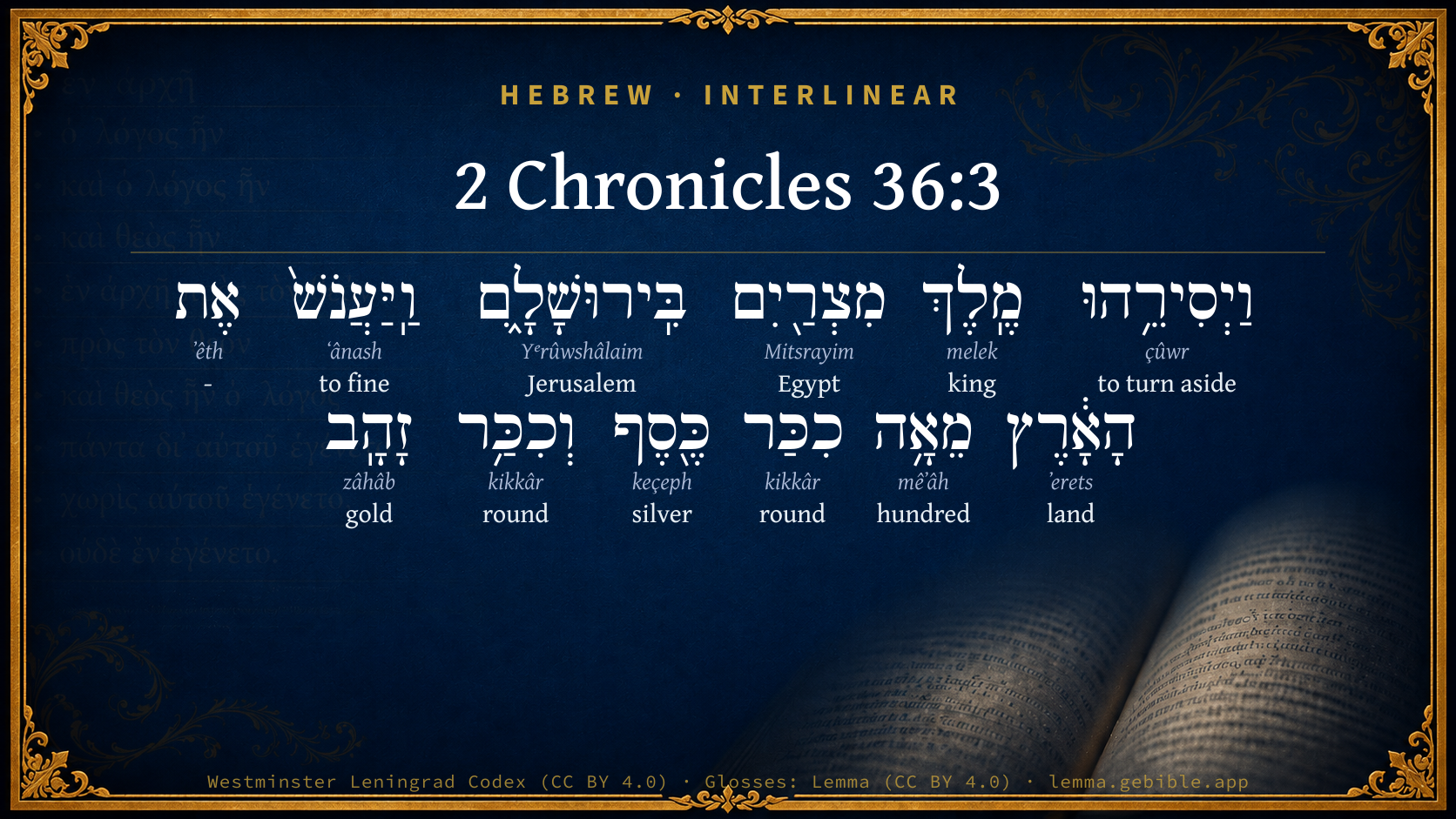
Hebrew (Westminster Leningrad Codex) 2 Chronicles 36:3 appears in the Hebrew Old Testament. The text above is from the Westminster Leningrad Codex. Each word links to its Strong’s number, a concise gloss, and parsing drawn from the Open Scriptures Hebrew Bible morphology. Click any word for its full Brown-Driver-Briggs (BDB) entry.
Download image
Cite this verse

2 Chronicles 36:3 (World English Bible). Public Domain. Lemma interlinear Bible study tool, https://lemma.gebible.app/v/2-chronicles/36/3.

Show BibTeX & RIS
BibTeX
RIS
English Translation
The king of Egypt deposed him at Jerusalem, and fined the land one hundred talents of silver and a talent of gold.
World English Bible · Public Domain
Download a study sheet

One document with this verse’s original text, its word-by-word gloss line, the meaning frame, cross-references with their text, attributed commentary, and full source and license credits — printable, and it pastes into notes with its structure intact.

This verse Autodidact and up

Study sheet (.html) Plain text (.txt)

A passage Seminary Student

Up to 50 verses in one chapter. A passage sheet keeps up to 6 commentary sources and 12 cross-references per verse, in the order this page ranks them, and says so on the sheet whenever that leaves anything out. Ask for a single verse and you get the Autodidact verse sheet above.

Everything on this page stays free to read, with no account — the sheet is a download of what is already on screen, not access to it.

Want to remove ads? Support Godless Engineer
Compare translations 3

The same verse in 3 English versions, stacked beneath the original-language interlinear above. Click any original word for its lexicon entry.

Each is an independent rendering of the whole verse — the interlinear is not word-aligned to these translations.

Highlighted words mark where these versions differ — a whole-verse word diff, not a word-by-word alignment.

  • World English Bible Public Domain
    The king of Egypt deposed him at Jerusalem, and fined the land one hundred talents of silver and a talent of gold.
  • King James Version Public Domain
    And the king of Egypt put him down at Jerusalem, and condemned the land in an hundred talents of silver and a talent of gold.
  • unfoldingWord Literal Text CC BY-SA 4.0
    And the king of Egypt removed him at Jerusalem, and he imposed a fine on the land, 100 talents of silver and a talent of gold.

unfoldingWord Literal Text — © unfoldingWord, licensed CC BY-SA 4.0. Word-aligned USFM3 via Door43 (git.door43.org/unfoldingWord/en_ult).

Versions to compare (up to 4)

3 of 4 selected

Show all 18 translations

Every available English version of this verse, each an independent rendering of the whole verse.

  • World English Bible Public Domain
    The king of Egypt deposed him at Jerusalem, and fined the land one hundred talents of silver and a talent of gold.
  • Berean Standard Bible Public Domain
    And the king of Egypt dethroned him in Jerusalem and imposed on Judah a levy of a hundred talents of silver and a talent of gold.
  • Majority Standard Bible Public Domain
    And the king of Egypt dethroned him in Jerusalem and imposed on Judah a levy of a hundred talents of silver and a talent of gold.
  • King James Version Public Domain
    And the king of Egypt put him down at Jerusalem, and condemned the land in an hundred talents of silver and a talent of gold.
  • American Standard Version (1901) Public Domain
    And the king of Egypt deposed him at Jerusalem, and fined the land a hundred talents of silver and a talent of gold.
  • Revised Version (1885) Public Domain
    And the king of Egypt deposed him at Jerusalem, and amerced the land in an hundred talents of silver and a talent of gold.
  • Geneva Bible (1599) Public Domain
    And the King of Egypt tooke him away at Ierusalem, and condemned the lande in an hundreth talents of siluer, and a talent of gold.
  • Douay-Rheims (1899) Public Domain
    And the king of Egypt came to Jerusalem, and deposed him, and condemned the land in a hundred talents of silver, and a talent of gold.
  • Young's Literal Translation Public Domain
    and turn him aside doth the king of Egypt in Jerusalem, and fineth the land a hundred talents of silver, and a talent of gold;
  • Literal Standard Version CC BY-SA 4.0
    and the king of Egypt turns him aside in Jerusalem, and fines the land one hundred talents of silver, and a talent of gold;
  • Unlocked Literal Bible CC BY-SA 4.0
    The king of Egypt removed him at Jerusalem, and fined the land one hundred talents of silver and one talent of gold.
  • unfoldingWord Literal Text CC BY-SA 4.0
    And the king of Egypt removed him at Jerusalem, and he imposed a fine on the land, 100 talents of silver and a talent of gold.
  • Darby Bible Public Domain
    And the king of Egypt put him down at Jerusalem, and imposed a fine upon the land of a hundred talents of silver and a talent of gold.
  • World Messianic Bible Public Domain
    The king of Egypt removed him from office at Jerusalem, and fined the land one hundred talents of silver and a talent of gold.
  • Webster's Bible Public Domain
    And the king of Egypt deposed him at Jerusalem, and condemned the land in a hundred talents of silver, and a talent of gold.
  • Free Bible Version CC BY-SA 4.0
    Then the king of Egypt removed him from the throne in Jerusalem and imposed a tax on Judah of a hundred talents of silver and a talent of gold.
  • Bible in Basic English Public Domain
    Then the king of Egypt took the kingdom from him in Jerusalem, and put on the land a tax of a hundred talents of silver and a talent of gold.
  • JPS Tanakh (1917) Public Domain
    And the king of Egypt deposed him at Jerusalem, and fined the land a hundred talents of silver and a talent of gold.

Literal Standard Version (2020), Covenant Press — licensed CC BY-SA 4.0. Text via the HelloAO Bible API (eBible.org). Unlocked Literal Bible (unfoldingWord) — licensed CC BY-SA 4.0. Text via the HelloAO Bible API (eBible.org). unfoldingWord Literal Text — © unfoldingWord, licensed CC BY-SA 4.0. Word-aligned USFM3 via Door43 (git.door43.org/unfoldingWord/en_ult). Free Bible Version, Dr. Jonathan Gallagher — licensed CC BY-SA 4.0. Text via the HelloAO Bible API (eBible.org).

Word by word

More ways to search: Search by grammar → Find every occurrence → Compare this word →

Practice this passage: Drill this verse → Learn its vocabulary →

וַֽיַּעֲנֹשׁ֙
ʻânash
H6064
“and · to fine”
Conjunction + Verb, Qal, Sequential Imperfect, 3rd Person, Masculine, Singular
Part of Speech
Conjunction + Verb
Stem
Qal
Form
Sequential Imperfect
Person
3rd Person
Gender
Masculine
Number
Singular
Full BDB Definition

Origin: a primitive root

TWOT: 1659

to fine, amerce, punish, condemn, mulct - (Qal) to fine, punish - (Niphal) to be fined, be punished, be mulcted
  1. וַיְסִירֵ֥הוּ çûwr H5493 “and · to turn aside · him” Conjunction + Verb, Hiphil, Sequential Imperfect, 3rd Person, Masculine, Singular + Suffix, Personal, 3rd Person, Masculine, Singular
  2. מֶֽלֶךְ melek H4428 “king of” Noun, Common, Masculine, Singular, Construct
  3. מִצְרַ֖יִם Mitsrayim H4714 “Egypt” Noun, Proper
  4. בִּֽירוּשָׁלִָ֑ם Yᵉrûwshâlaim H3389 “in/at · Jerusalem” Preposition + Noun, Proper
  5. אֶת ʼêth H853 “-” Particle, Direct Object
  6. הָאָ֔רֶץ ʼerets H776 “the · land” Particle, Definite Article + Noun, Common, Both, Singular, Absolute
  7. מֵאָ֥ה mêʼâh H3967 “hundred” Adjective, Cardinal number, Both, Singular, Absolute
  8. כִכַּר kikkâr H3603 “round of” Noun, Common, Both, Singular, Construct
  9. כֶּ֖סֶף keçeph H3701 “silver” Noun, Common, Masculine, Singular, Absolute
  10. וְכִכַּ֥ר kikkâr H3603 “and · round of” Conjunction + Noun, Common, Both, Singular, Construct
  11. זָהָֽב zâhâb H2091 “gold” Noun, Common, Masculine, Singular, Absolute

About this verse

These counts appear in no published source. They are computed here, from the morphology-tagged text and Lemma’s own curated glosses. What Lemma adds →

12
words
11
distinct lemmas
Historical
section

Notable vocabulary

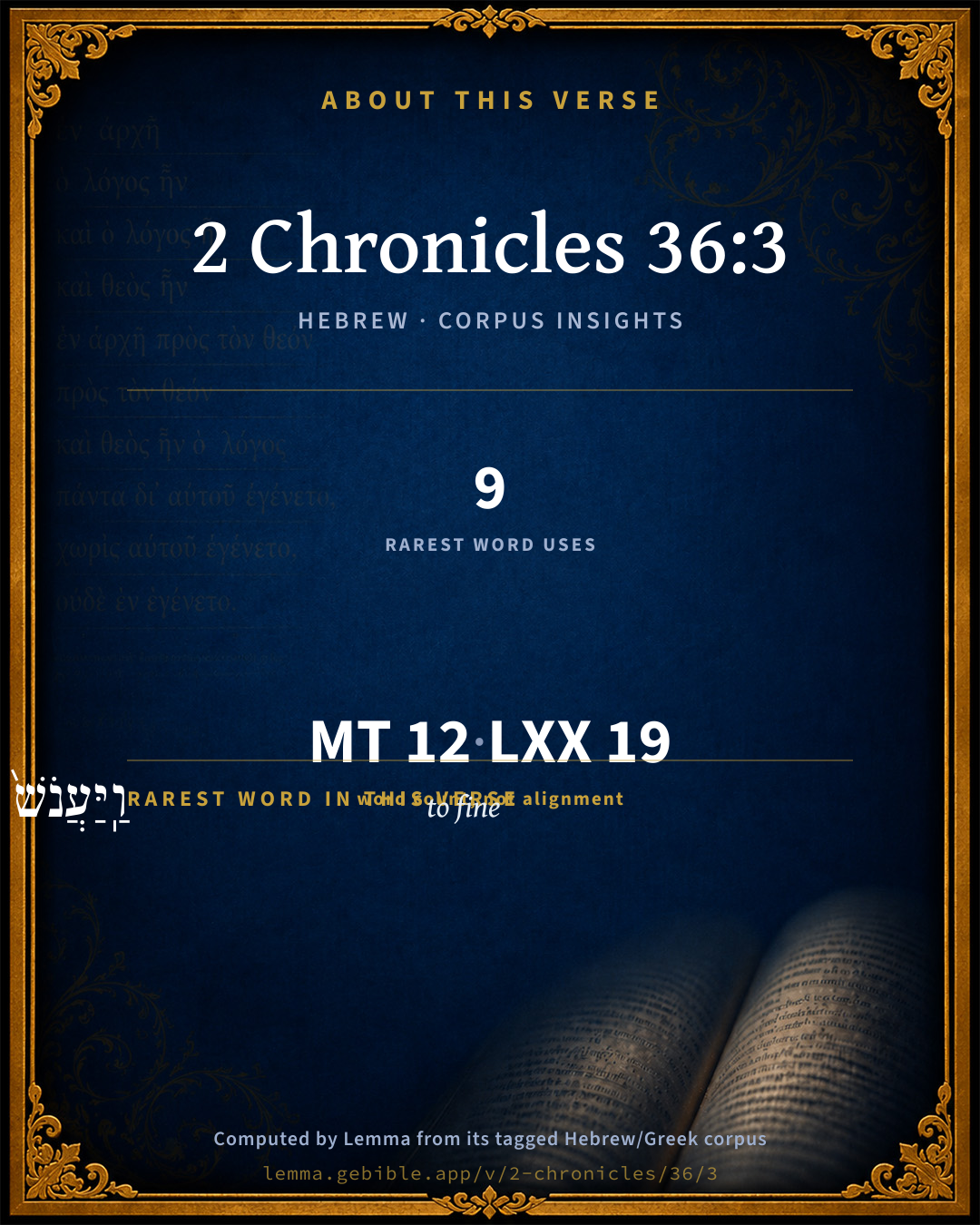
The rarest word here is וַֽיַּעֲנֹשׁ֙ to fine H6064 — appearing just 9 times in the whole Hebrew Bible.

Shared distinctive vocabulary

וַֽיַּעֲנֹשׁ֙ to fine H6064 occurs in 8 verses of the Hebrew Bible. Also found in:

Grammatical profile

  • 2 verbs
  • 8 nouns
  • 1 adjective
  • 1 particle

Verb forms

  • וַיְסִירֵ֥הוּ Hiphil · Sequential Imperfect
  • וַֽיַּעֲנֹשׁ֙ Qal · Sequential Imperfect

Repetition

A word recurs within this verse — often emphatic in Hebrew:

  • כִכַּר round H3603 ×2

Hebrew & Septuagint length

In English translation the verse runs 22 words from the Hebrew and 25 from the Septuagint (LXX English) — closely comparable.

A rough comparison of the two English renderings, which tokenize alike — not a word-level alignment.

Word counts can differ between the Hebrew and the Greek without any difference in meaning — e.g. the Hebrew direct-object marker אֵת has no separate Greek word, and Greek often adds the article ὁ.

In the original languages it is 12 Hebrew tokens and 19 Greek tokens — but the two are counted differently (Hebrew bundles its prefixes and suffixes into one token; the Greek is in lemma form), so that isn’t a like-for-like length.

Cross-references

1

Topical passages linked to 2 Chronicles 36:3 in the Treasury of Scripture Knowledge — connected by theme and wording, ordered by reader-vote popularity; previews shown in the World English Bible.

  • 2 Kings 23:33 Pharaoh Necoh put him in bonds at Riblah in the land of Hamath, that he might not reign in Jerusalem; and put the land to a tribute of one hundred talents of silver, and a talent of gold.

Cross-references courtesy of OpenBible.info (CC BY 4.0).

Hebrew and Greek witnesses Masoretic Hebrew ↔ Greek Septuagint

The same verse in the two great witnesses to the Old Testament, shown verse-for-verse.

These are two independent witnesses, not word-aligned to each other, and the Septuagint is shown in lemma (dictionary) form.

Hebrew 2 Chronicles 36:3 Masoretic · Westminster Leningrad Codex

וַיְסִירֵ֥הוּ מֶֽלֶךְ מִצְרַ֖יִם בִּֽירוּשָׁלִָ֑ם וַֽיַּעֲנֹשׁ֙ אֶת הָאָ֔רֶץ מֵאָ֥ה כִכַּר כֶּ֖סֶף וְכִכַּ֥ר זָהָֽב

The king of Egypt deposed him at Jerusalem, and fined the land one hundred talents of silver and a talent of gold.

World English Bible · Public Domain

Greek LXX 2 Chronicles 36:3 Septuagint · lemma form

καί μεταἄγω αὐτός ὁ βασιλεύς εἰς αἴγυπτος καί ἐπιβάλλω φόρος ἐπί ὁ γῆ ἑκατόν τάλαντον ἀργύριον καί ταλάντον χρυσίον

And the king brought him over to Egypt; and imposed a tribute on the land, one hundred talents of silver and a talent of gold.

LXX2012 (modern English Septuagint) · Public Domain

On this verse, Ellicott's Commentary for English Readers discusses the Septuagint’s reading. Read the note in Commentary ↓

Hebrew: Westminster Leningrad Codex (CC BY 4.0). Greek: Septuagint (public domain); English from LXX2012 (modern English Septuagint) (Public Domain). How the Septuagint differs from the Hebrew →

Commentary

Notes on 2 Chronicles 36:3 from classic Christian and Jewish commentators (each source and its license shown beneath its notes). The classic Christian expositions comment on the surrounding passage and are grouped to its opening verse, so a note may address several verses; the Jewish commentaries on the Tanakh (Rashi and others) are per-verse, so they appear only where the commentator wrote on this verse.

Lemma curates 59 commentaries, every one of them public domain or Creative Commons licensed, each selected and text-cleaned for this edition rather than reprinted as found. About our sources →

Trapp's Complete Commentary

John Trapp

2Ch 36:3 And the king of Egypt put him down at Jerusalem, and condemned the land in an hundred talents of silver and a talent of gold.

Ver. 3. Put him down.] And, as some think, afterwards put him to death in Egypt. Jehoahaz was but a younger brother, as is elsewhere noted, yet he would needs reign, and was soon after dethroned. He portrayed the ambitious man rightly, that pictured him snatching at a crown, and falling, with this motto, Sic mea fata sequor. See 2Ki 23:33.

John Trapp, A Commentary or Exposition upon All the Books of the Old and New Testament (1647–1656) — public domain. Text from a community e-Sword module.

Geneva Bible (1599)

Geneva Bible translators

To pay this as a yearly tribute.

Geneva Bible (1599) marginal notes — public domain. Text via Bolls.life.

Jamieson, Fausset & Brown

Robert Jamieson, A. R. Fausset & David Brown

an hundred talents of silver--£3418 15s.

and a talent of gold--£5475; total amount of tribute, £8893 15s.

Jamieson, Fausset & Brown — Commentary Critical and Explanatory on the Whole Bible (1871) — public domain (CC PDM 1.0). Text via the HelloAO Bible API.

Adam Clarke's Commentary

Verse 3. The king of Egypt put him down] He now considered Judah to be conquered, and tributary to him and because the people had set up Jehoahaz without his consent, he dethroned him, and put his brother in his place, perhaps for no other reason but to show his supremacy. For other particulars, see the notes on 2Kg 23:31-35.

Adam Clarke's Commentary on the Bible (1810–1826) — public domain. Text from a community e-Sword/MySword module.

Ellicott's Commentary for English Readers

(3) And the king of Egypt put him down at Jerusalem.—Rather, removed him. 3 Esdr. 1:33 adds “from reigning,” which is almost demanded by the context. The LXX. follows the reading of 2Ki_23:33 : “And Pharaoh-necho bound him in Riblah, in the land of Hamath, from reigning (i.e., so that he reigned not) in Jerusalem “; but the Syriac and Vulg. support the existing Hebrew text. The LXX. begins the verse thus: “And he did the evil before the Lord, according to all that his fathers had done; “and adds, after the clause about the fine, “and the king took him away to Egypt.”

Condemned the land in.—Fined the land.—So Kings: “laid a fine upon the land.”

Riblah was in Syria, on the river Orontes. Necho may have ordered or enticed Jehoahaz to meet him there.

A Bible Commentary for English Readers, edited by Charles John Ellicott (1878–1897) — public domain. Text from a community e-Sword module.

The Cambridge Bible for Schools and Colleges

gen. ed. J. J. S. Perowne

3. put him down at Jerusalem] R.V. deposed him at Jerusalem. The clause answers to 2Ki_23:33, “put him in bands at Riblah in the land of Hamath, that he might not reign in Jerusalem.” Perhaps we should read the same words in Chron. The Heb. words for “deposed” and “put in bands” are liable to be easily confused.

condemned] R.V. amerced. For “amerce” in the sense of “fine,” cp. Deu_22:19; and for “condemn” in the same sense see Amo_2:8 (A.V., “fined” R.V.).

an hundred talents of silver and a talent of gold] The land was poorer than in the days in which Sennacherib had imposed a fine on Hezekiah of “three hundred talents of silver and thirty talents of gold” (2Ki_18:14).

The Cambridge Bible for Schools and Colleges (gen. ed. J. J. S. Perowne; Cambridge University Press, 1878–1918) — public domain. Text from a community e-Sword module.

Haydock's Catholic Bible Commentary

Him. Joachaz had attempted to defend himself, and had been conducted prisoner to Reblatha, 4 K. xxiii. 33., and Ezechiel xix. 4. He was now deposed in from, and a tribute laid upon the people. C.

George Leo Haydock (1774–1849), Haydock's Catholic Family Bible and Commentary, 1859 edition — public domain. Excludes Psalms (Douay-Rheims chapter numbering differs from Protestant) and Deuterocanonical books (Catholic canon only).

The Pulpit Commentary

Put him down; Hebrew, Whreysiyw i.e. deposed him (Revised Version). At Jerusalem. In something more than three months Pharaoh Necho seems to have been returning, and in the neighbourhood of Jerusalem. The parallel (2Ki_23:31) tells us that he put Jahoahaz "in bands" at "Riblath in the land of Hamath". (Eze_19:4) And condemned the land; i.e. inflicted a fine on the land; Hebrew, vn.

From this time nothing further is heard of Jehoahaz or Shallum.

The Pulpit Commentary (1880–1919), ed. H.D.M. Spence-Jones & Joseph S. Exell — public domain. Text from a community e-Sword module.

unfoldingWord translationNotes

Door43 World Missions Community

The king of Egypt removed him at Jerusalem

The idiom "removed him at Jerusalem" means that he caused him no longer to be king in Jerusalem. AT: "The king of Egypt removed him from being king in Jerusalem" (See: Idiom)

fined the land

Here the word "land" represents the people who lived there. AT: "fined the people of the land" (See: Metonymy)

one hundred talents of silver and one talent of gold

You may convert this to a modern measure. A talent was about 33 kilograms. AT: "thirty-three hundred kilograms of silver and thirty-three kilograms of gold" or "about 3,300 kilograms of silver and 33 kilograms of gold" (See: Biblical Money and Numbers)

Eliakim ... Jehoahaz

These are the names of men. (See: How to Translate Names)

translationWords

king

Egypt

silver

gold

kingdom of Judah

Jehoiakim

unfoldingWord translationNotes — © Distant Shores Media and the Door43 World Missions Community, licensed CC BY-SA 4.0. Source: git.door43.org/Door43/en_tn.

Rashi

Rabbi Shlomo Yitzchaki (Rashi)

And the king of Egypt deposed him in Jerusalem This is explained thoroughly in II Kings (23: 33): “And Pharaoh-Neco imprisoned him in Riblah in the land of Hamath.”

in Jerusalem from reigning in Jerusalem.

and he imposed a fine upon the land to give taxes. An example is (Deut. 22: 19): “And they shall fine him one hundred pieces of silver.”

Rashi on the Tanakh — English translations: “The Judaica Press complete Tanach with Rashi, translated by A. J. Rosenberg” (CC BY 4.0); “Pentateuch with Rashi's commentary by M. Rosenbaum and A.M. Silbermann, 1929-1934” (public domain); “The Metsudah Tanach series, Lakewood, N.J” (CC BY 4.0); and “The Book of Joshua, Metsudah Publications, 1997” (CC BY 4.0). Text via Sefaria.

Lesson kit

Teaching starters — assembled from the data on this page, not authored interpretation. Every prompt links to the verse data it draws on. Edit before teaching.

2 Chronicles, in the Historical, opens this verse with 12 words (11 distinct Hebrew lemmas). Its most distinctive word is ʻânash (“to fine”). A historical commentator’s framing appears above. Read the whole chapter for the surrounding context.

Discussion questions

  1. How does “to fine” (ʻânash) shape what this verse is saying?
  2. Exodus 21:22 shares the word «to fine» with this verse. How do the two illuminate each other?
  3. “round” occurs 2× in this one verse. What is the effect of the repetition?
  4. These translations render this verse differently. What is at stake in choosing one wording over another?
  5. The verb «וַיְסִירֵ֥הוּ» is Hiphil Sequential Imperfect. How does its form color the action?
  6. Reading how Trapp's Complete Commentary and Geneva Bible (1599) read this verse, where do the two commentators agree and where do they part?

Things to notice

Reading settings

Reading text

Shown beneath each verse's original-language words.

Old Testament
Old Testament edition

Read the OT as the Masoretic Hebrew (MT) or the Greek Septuagint (LXX).

English shown for the Greek Septuagint (in the Hebrew ↔ Greek comparison).

Comparing translations? Open the Compare panel on any verse page to stack up to four side by side.