
2 Chronicles 32:33

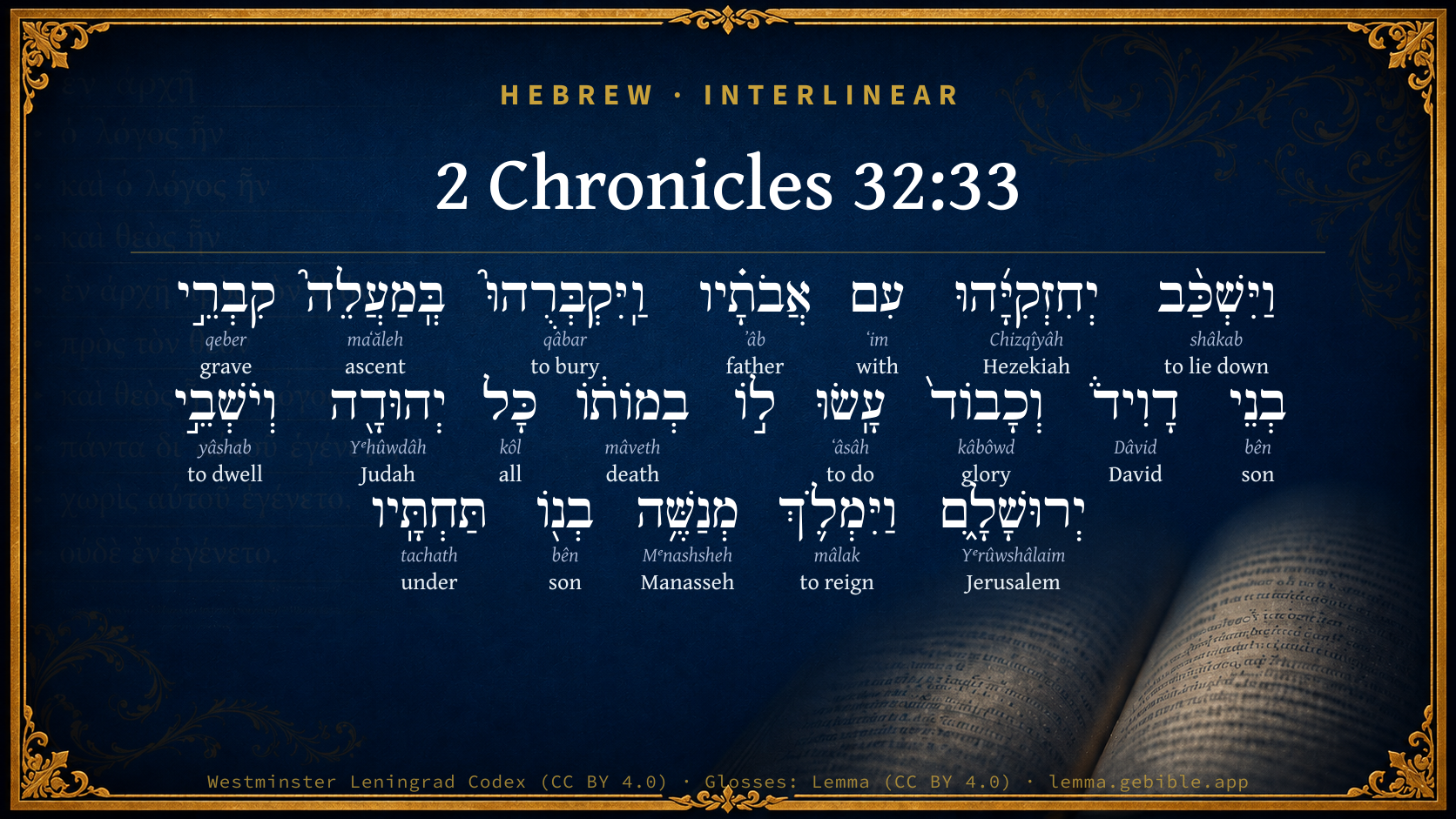
Hebrew (Westminster Leningrad Codex) 2 Chronicles 32:33 appears in the Hebrew Old Testament. The text above is from the Westminster Leningrad Codex. Each word links to its Strong’s number, a concise gloss, and parsing drawn from the Open Scriptures Hebrew Bible morphology. Click any word for its full Brown-Driver-Briggs (BDB) entry.
Download image
Cite this verse

2 Chronicles 32:33 (World English Bible). Public Domain. Lemma interlinear Bible study tool, https://lemma.gebible.app/v/2-chronicles/32/33.

Show BibTeX & RIS
BibTeX
RIS
English Translation
Hezekiah slept with his fathers, and they buried him in the ascent of the tombs of the sons of David: and all Judah and the inhabitants of Jerusalem did him honor at his death. Manasseh his son reigned in his place.
World English Bible · Public Domain
Download a study sheet

One document with this verse’s original text, its word-by-word gloss line, the meaning frame, cross-references with their text, attributed commentary, and full source and license credits — printable, and it pastes into notes with its structure intact.

This verse Autodidact and up

Study sheet (.html) Plain text (.txt)

A passage Seminary Student

Up to 50 verses in one chapter. A passage sheet keeps up to 6 commentary sources and 12 cross-references per verse, in the order this page ranks them, and says so on the sheet whenever that leaves anything out. Ask for a single verse and you get the Autodidact verse sheet above.

Everything on this page stays free to read, with no account — the sheet is a download of what is already on screen, not access to it.

Want to remove ads? Support Godless Engineer
Compare translations 3

The same verse in 3 English versions, stacked beneath the original-language interlinear above. Click any original word for its lexicon entry.

Each is an independent rendering of the whole verse — the interlinear is not word-aligned to these translations.

Highlighted words mark where these versions differ — a whole-verse word diff, not a word-by-word alignment.

  • World English Bible Public Domain
    Hezekiah slept with his fathers, and they buried him in the ascent of the tombs of the sons of David: and all Judah and the inhabitants of Jerusalem did him honor at his death. Manasseh his son reigned in his place.
  • King James Version Public Domain
    And Hezekiah slept with his fathers, and they buried him in the chiefest of the sepulchres of the sons of David: and all Judah and the inhabitants of Jerusalem did him honor at his death. And Manasseh his son reigned in his stead.
  • unfoldingWord Literal Text CC BY-SA 4.0
    And Hezekiah laid down with his fathers, and they buried him in the ascent of the graves of the sons of David. And honor they did for him in his death, all Judah and the inhabitants of Jerusalem. And Manasseh his son reigned in his place.

unfoldingWord Literal Text — © unfoldingWord, licensed CC BY-SA 4.0. Word-aligned USFM3 via Door43 (git.door43.org/unfoldingWord/en_ult).

Versions to compare (up to 4)

3 of 4 selected

Show all 18 translations

Every available English version of this verse, each an independent rendering of the whole verse.

  • World English Bible Public Domain
    Hezekiah slept with his fathers, and they buried him in the ascent of the tombs of the sons of David: and all Judah and the inhabitants of Jerusalem did him honor at his death. Manasseh his son reigned in his place.
  • Berean Standard Bible Public Domain
    And Hezekiah rested with his fathers and was buried in the upper tombs of David’s descendants. All Judah and the people of Jerusalem paid him honor at his death. And his son Manasseh reigned in his place.
  • Majority Standard Bible Public Domain
    And Hezekiah rested with his fathers and was buried in the upper tombs of David’s descendants. All Judah and the people of Jerusalem paid him honor at his death. And his son Manasseh reigned in his place.
  • King James Version Public Domain
    And Hezekiah slept with his fathers, and they buried him in the chiefest of the sepulchres of the sons of David: and all Judah and the inhabitants of Jerusalem did him honor at his death. And Manasseh his son reigned in his stead.
  • American Standard Version (1901) Public Domain
    And Hezekiah slept with his fathers, and they buried him in the ascent of the sepulchres of the sons of David: and all Judah and the inhabitants of Jerusalem did him honor at his death. And Manasseh his son reigned in his stead.
  • Revised Version (1885) Public Domain
    And Hezekiah slept with his fathers, and they buried him in the ascent of the sepulchres of the sons of David: and all Judah and the inhabitants of Jerusalem did him honour at his death. And Manasseh his son reigned in his stead.
  • Geneva Bible (1599) Public Domain
    So Hezekiah slept with his fathers, and they buryed him in the highest sepulchre of the sonnes of Dauid: and all Iudah and the inhabitants of Ierusalem did him honour at his death: and Manasseh his sonne reigned in his stead.
  • Douay-Rheims (1899) Public Domain
    And Ezechias slept with his fathers, m and they buried him above the sepulchres of the sons of David: and all Juda, and all the inhabitants of Jerusalem celebrated his funeral: and Manasses his son reigned in his stead.
  • Young's Literal Translation Public Domain
    And Hezekiah lieth with his fathers, and they bury him in the uppermost of the graves of the sons of David, and all Judah and the inhabitants of Jerusalem have done honour to him at his death, and reign doth Manasseh his son in his stead.
  • Literal Standard Version CC BY-SA 4.0
    And Hezekiah lies with his fathers, and they bury him in the highest of the graves of the sons of David, and all Judah and the inhabitants of Jerusalem have done honor to him at his death, and his son Manasseh reigns in his stead.
  • Unlocked Literal Bible CC BY-SA 4.0
    Hezekiah slept with his ancestors, and they buried him on the hill of the tombs of the descendants of David. All Judah and the inhabitants of Jerusalem honored him at his death. Manasseh his son became king in his place.
  • unfoldingWord Literal Text CC BY-SA 4.0
    And Hezekiah laid down with his fathers, and they buried him in the ascent of the graves of the sons of David. And honor they did for him in his death, all Judah and the inhabitants of Jerusalem. And Manasseh his son reigned in his place.
  • Darby Bible Public Domain
    And Hezekiah slept with his fathers, and they buried him in the highest place of the sepulchres of the sons of David; and all Judah and the inhabitants of Jerusalem did him honour at his death. And Manasseh his son reigned in his stead.
  • World Messianic Bible Public Domain
    Hezekiah slept with his fathers, and they buried him in the ascent to the tombs of the sons of David. All Judah and the inhabitants of Jerusalem honored him at his death. Manasseh his son reigned in his place.
  • Webster's Bible Public Domain
    And Hezekiah slept with his fathers, and they buried him in the chief of the sepulchers of the sons of David: and all Judah and the inhabitants of Jerusalem did him honor at his death: and Manasseh his son reigned in his stead.
  • Free Bible Version CC BY-SA 4.0
    Hezekiah died and was buried in the upper cemetery of David's descendants. All Judah and the people of Jerusalem honored him at his death. His son Manasseh took over as king.
  • Bible in Basic English Public Domain
    So Hezekiah went to rest with his fathers, and they put his body into the higher part of the resting-places of the sons of David: and all Judah and the people of Jerusalem gave him honour at his death. And Manasseh his son became king in his place.
  • JPS Tanakh (1917) Public Domain
    And Hezekiah slept with his fathers, and they buried him in the ascent of the sepulchres of the sons of David; and all Judah and the inhabitants of Jerusalem did him honour at his death. And Manasseh his son reigned in his stead.

Literal Standard Version (2020), Covenant Press — licensed CC BY-SA 4.0. Text via the HelloAO Bible API (eBible.org). Unlocked Literal Bible (unfoldingWord) — licensed CC BY-SA 4.0. Text via the HelloAO Bible API (eBible.org). unfoldingWord Literal Text — © unfoldingWord, licensed CC BY-SA 4.0. Word-aligned USFM3 via Door43 (git.door43.org/unfoldingWord/en_ult). Free Bible Version, Dr. Jonathan Gallagher — licensed CC BY-SA 4.0. Text via the HelloAO Bible API (eBible.org).

Word by word

More ways to search: Search by grammar → Find every occurrence → Compare this word →

Practice this passage: Drill this verse → Learn its vocabulary →

בְּֽמַעֲלֵה֮
maʻăleh
H4608
“in/at · ascent of”
Preposition + Noun, Common, Masculine, Singular, Construct
Part of Speech
Preposition + Noun
Type
Common
Gender
Masculine
Number
Singular
State
Construct
Full BDB Definition

Origin: from H5927

TWOT: 1624j

ascent, incline
  1. וַיִּשְׁכַּ֨ב shâkab H7901 “and · to lie down” Conjunction + Verb, Qal, Sequential Imperfect, 3rd Person, Masculine, Singular
  2. יְחִזְקִיָּ֜הוּ Chizqîyâh H2396 “Hezekiah” Noun, Proper
  3. עִם ʻim H5973 “with” Preposition
  4. אֲבֹתָ֗יו ʼâb H1 “fathers · his” Noun, Common, Masculine, Plural, Construct + Suffix, Personal, 3rd Person, Masculine, Singular
  5. וַֽיִּקְבְּרֻהוּ֮ qâbar H6912 “and · to bury · him” Conjunction + Verb, Qal, Sequential Imperfect, 3rd Person, Masculine, Plural + Suffix, Personal, 3rd Person, Masculine, Singular
  6. קִבְרֵ֣י qeber H6913 “graves of” Noun, Common, Masculine, Plural, Construct
  7. בְנֵי bên H1121 “sons of” Noun, Common, Masculine, Plural, Construct
  8. דָוִיד֒ Dâvid H1732 “David” Noun, Proper
  9. וְכָבוֹד֙ kâbôwd H3519 “and · glory” Conjunction + Noun, Common, Both, Singular, Absolute
  10. עָֽשׂוּ ʻâsâh H6213 “to do” Verb, Qal, Perfect, 3rd Person, Common, Plural
  11. בְמוֹת֔וֹ mâveth H4194 “in/at · death · his” Preposition + Noun, Common, Masculine, Singular, Construct + Suffix, Personal, 3rd Person, Masculine, Singular
  12. כָּל kôl H3605 “all of” Noun, Common, Masculine, Singular, Construct
  13. יְהוּדָ֖ה Yᵉhûwdâh H3063 “Judah” Noun, Proper
  14. וְיֹשְׁבֵ֣י yâshab H3427 “and · dwelling” Conjunction + Verb, Qal, Participle Active, Masculine, Plural, Construct
  15. יְרוּשָׁלִָ֑ם Yᵉrûwshâlaim H3389 “Jerusalem” Noun, Proper
  16. וַיִּמְלֹ֛ךְ mâlak H4427 “and · to reign” Conjunction + Verb, Qal, Sequential Imperfect, 3rd Person, Masculine, Singular
  17. מְנַשֶּׁ֥ה Mᵉnashsheh H4519 “Manasseh” Noun, Proper
  18. בְנ֖וֹ bên H1121 “son · his” Noun, Common, Masculine, Singular, Construct + Suffix, Personal, 3rd Person, Masculine, Singular
  19. תַּחְתָּֽיו tachath H8478 “under · him” Preposition + Suffix, Personal, 3rd Person, Masculine, Singular

About this verse

These counts appear in no published source. They are computed here, from the morphology-tagged text and Lemma’s own curated glosses. What Lemma adds →

21
words
19
distinct lemmas
Historical
section

Notable vocabulary

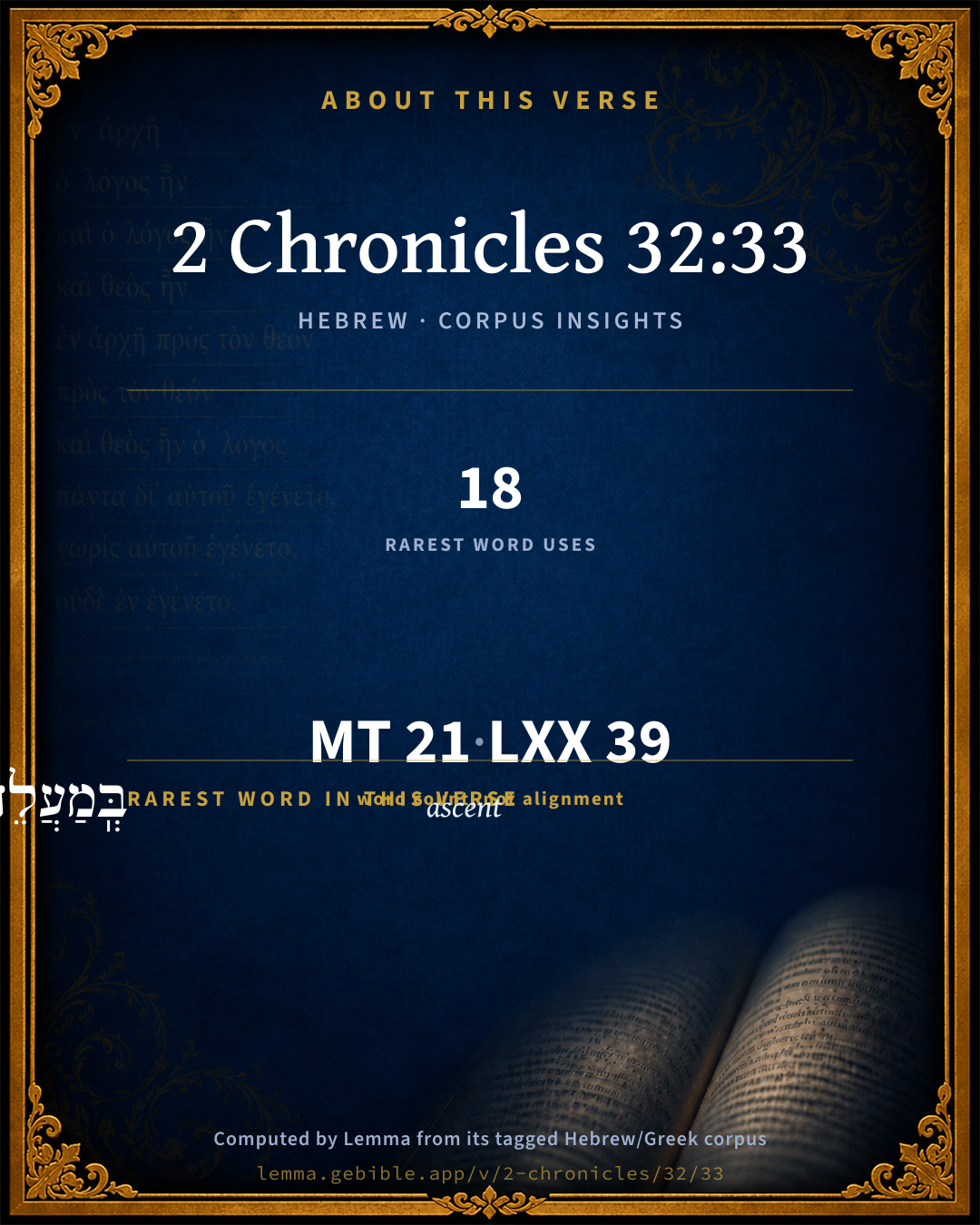
The rarest word here is בְּֽמַעֲלֵה֮ ascent H4608 — appearing just 18 times in the whole Hebrew Bible.

Shared distinctive vocabulary

בְּֽמַעֲלֵה֮ ascent H4608 occurs in 15 verses of the Hebrew Bible. Also found in:

Grammatical profile

  • 5 verbs
  • 13 nouns
  • 3 prepositions

Verb forms

  • וַיִּשְׁכַּ֨ב Qal · Sequential Imperfect
  • וַֽיִּקְבְּרֻהוּ֮ Qal · Sequential Imperfect
  • עָֽשׂוּ Qal · Perfect
  • וְיֹשְׁבֵ֣י Qal · Participle Active
  • וַיִּמְלֹ֛ךְ Qal · Sequential Imperfect

Repetition

A word recurs within this verse — often emphatic in Hebrew:

  • בְנֵי son H1121 ×2

Hebrew & Septuagint length

In English translation the verse runs 41 words from the Hebrew and 46 from the Septuagint (LXX English) — closely comparable.

A rough comparison of the two English renderings, which tokenize alike — not a word-level alignment.

Word counts can differ between the Hebrew and the Greek without any difference in meaning — e.g. the Hebrew direct-object marker אֵת has no separate Greek word, and Greek often adds the article ὁ.

In the original languages it is 21 Hebrew tokens and 39 Greek tokens — but the two are counted differently (Hebrew bundles its prefixes and suffixes into one token; the Greek is in lemma form), so that isn’t a like-for-like length.

Cross-references

11

Topical passages linked to 2 Chronicles 32:33 in the Treasury of Scripture Knowledge — connected by theme and wording, ordered by reader-vote popularity; previews shown in the World English Bible.

  • Proverbs 10:7 The memory of the righteous is blessed, But the name of the wicked will rot.
  • Genesis 50:10–11 They came to the threshing floor of Atad, which is beyond the Jordan, and there they lamented with a very great and sore lamentation. He mourned for his father seven days.
  • Numbers 20:29 When all the congregation saw that Aaron was dead, they wept for Aaron thirty days, even all the house of Israel.
  • Deuteronomy 34:8 The children of Israel wept for Moses in the plains of Moab thirty days: so the days of weeping in the mourning for Moses were ended.
  • 1 Samuel 2:30 Therefore Yahweh, the God of Israel, says, I said indeed that your house, and the house of your father, should walk before me forever: but now Yahweh says, Be it far from me; for those who honor me I will honor, and those who despise me shall be lightly esteemed.
  • 1 Samuel 25:1 Samuel died; and all Israel gathered themselves together, and lamented him, and buried him in his house at Ramah. David arose, and went down to the wilderness of Paran.
  • 1 Kings 1:21 Otherwise it will happen, when my lord the king shall sleep with his fathers, that I and my son Solomon shall be counted offenders.
  • 1 Kings 2:10 David slept with his fathers, and was buried in the city of David.
  • 1 Kings 11:43 Solomon slept with his fathers, and was buried in the city of David his father: and Rehoboam his son reigned in his place.
  • 2 Chronicles 16:14 They buried him in his own tombs, which he had hewn out for himself in the city of David, and laid him in the bed which was filled with sweet odors and various kinds [of spices] prepared by the perfumers' are: and they made a very great burning for him.
  • 2 Chronicles 33:1–20 Manasseh was twelve years old when he began to reign; and he reigned fifty-five years in Jerusalem.

Cross-references courtesy of OpenBible.info (CC BY 4.0).

Hebrew and Greek witnesses Masoretic Hebrew ↔ Greek Septuagint

The same verse in the two great witnesses to the Old Testament, shown verse-for-verse.

These are two independent witnesses, not word-aligned to each other, and the Septuagint is shown in lemma (dictionary) form.

Hebrew 2 Chronicles 32:33 Masoretic · Westminster Leningrad Codex

וַיִּשְׁכַּ֨ב יְחִזְקִיָּ֜הוּ עִם אֲבֹתָ֗יו וַֽיִּקְבְּרֻהוּ֮ בְּֽמַעֲלֵה֮ קִבְרֵ֣י בְנֵי דָוִיד֒ וְכָבוֹד֙ עָֽשׂוּ ל֣וֹ בְמוֹת֔וֹ כָּל יְהוּדָ֖ה וְיֹשְׁבֵ֣י יְרוּשָׁלִָ֑ם וַיִּמְלֹ֛ךְ מְנַשֶּׁ֥ה בְנ֖וֹ תַּחְתָּֽיו

Hezekiah slept with his fathers, and they buried him in the ascent of the tombs of the sons of David: and all Judah and the inhabitants of Jerusalem did him honor at his death. Manasseh his son reigned in his place.

World English Bible · Public Domain

Greek LXX 2 Chronicles 32:33 Septuagint · lemma form

καί κοιμάω εζεκιας μετά ὁ πατήρ αὐτός καί θάπτω αὐτός ἐν ἀνάβασις τάφος υἱός δαυίδ καί δόξα καί τιμή δίδωμι αὐτός ἐν ὁ θάνατος αὐτός πᾶς ἰουδά καί ὁ καταοἰκέω ἐν ἰερουσαλήμ καί βασιλεύω μανασσής υἱός αὐτός ἀντί αὐτός

And Ezekias slept with his fathers, and they buried him in a high place among the sepulchres of the sons of David: and all Juda and the dwellers in Jerusalem gave him glory and honor at his death. And Manasses his son reigned in his stead.

LXX2012 (modern English Septuagint) · Public Domain

On this verse, The Cambridge Bible for Schools and Colleges discusses the Septuagint’s reading. Read the note in Commentary ↓

Hebrew: Westminster Leningrad Codex (CC BY 4.0). Greek: Septuagint (public domain); English from LXX2012 (modern English Septuagint) (Public Domain). How the Septuagint differs from the Hebrew →

Commentary

Notes on 2 Chronicles 32:33 from classic Christian and Jewish commentators (each source and its license shown beneath its notes). The classic Christian expositions comment on the surrounding passage and are grouped to its opening verse, so a note may address several verses; the Jewish commentaries on the Tanakh (Rashi and others) are per-verse, so they appear only where the commentator wrote on this verse.

Lemma curates 59 commentaries, every one of them public domain or Creative Commons licensed, each selected and text-cleaned for this edition rather than reprinted as found. About our sources →

Trapp's Complete Commentary

John Trapp

2Ch 32:33 And Hezekiah slept with his fathers, and they buried him in the chiefest of the sepulchres of the sons of David: and all Judah and the inhabitants of Jerusalem did him honour at his death. And Manasseh his son reigned in his stead.

Ver. 33. See 2Ki 20:21.

John Trapp, A Commentary or Exposition upon All the Books of the Old and New Testament (1647–1656) — public domain. Text from a community e-Sword module.

Joseph Benson's Commentary

2Ch 32:33. All Judah did him honour at his death — They buried him in the chiefest of the sepulchres, made as great burning for him as for Asa; or, which is a much greater honour, made great lamentation for him, as they afterward did for Josiah. Though it is to be feared that the generality of the people did not comply with those of their kings, who were pious, in their endeavours to reform the nation; yet they could not but praise those endeavours, and the memory of those kings was blessed among them. It is a debt we owe to those who have been eminently useful in their day, to do them honour at their death, when they are out of the reach of flattery, and we have seen the end of their conversation.

Joseph Benson's Commentary on the Old and New Testaments (1811–1818) — public domain. Text from a community e-Sword module.

Adam Clarke's Commentary

Verse 33. Chiefest of the sepulchres] This respect they paid to him who, since David, had been the best of all their kings.

I shall subjoin a few things from the Targum on this chapter.

2Ch 32:1. "After these things which Hezekiah did, and their establishment, the Lord appointed by his WORD to bring Sennacherib, king of Assyria, and his army, into the land of Israel, that he might destroy the Assyrians in the land of the house of Judah, and smite their troops on the mountains of Jerusalem, and deliver all their spoils into the hands of Hezekiah and his people: wherefore Sennacherib came with immense armies, which could not be numbered; and having pitched his camps in the land of the tribe of Judah, besieged their fortified cities with his armies, hoping to overthrow them."

2Ch 32:8. Hezekiah said - "His help is the strength of the flesh; but our auxiliary is the WORD of the Lord."

2Ch 32:16. "His (Sennacherib's) servants spoke blasphemy against the WORD of the Lord God."

2Ch 32:18. In the Jews' speech - "In the language of the holy house."

2Ch 32:21. "And the WORD of the Lord sent Michael, and the angel Gabriel, and destroyed them on the night of the passover with a destructive fire; and burnt up their breath within their bodies, and consumed every soldier, captain, and prince, in the army of the king of Assyria; and he returned with shame of face into his own land."

The destruction of God's enemies, and the support and salvation of the faithful, is in every instance in this Targum attributed to the WORD of the Lord, personally understood. 2Ch 34:27.

2Ch 32:24. "In those days was Hezekiah sick near to death; but he prayed before the Lord who spoke to him by his WORD to preserve him and to add to his life fifteen years."

2Ch 32:31. "The king of Babylon sent, that they might inquire concerning the miracle that had been done in the land; that they might see the two tables of stone which were in the ark of the covenant of the Lord which Moses had placed there with the two tables which he had broken on account of the sin of the calf which they made in Horeb. The WORD of the Lord permitted him to show them these; neither did he suffer for it; that he might try him, and see what was in his heart."

THUS God speaks after the manner of men: he either brings, or permits them to be brought, into such circumstances as shall cause them to show their prevailing propensities; and then warns them against the evils to which they are inclined, after having shown them that they are capable of those evils. To know ourselves, and our own character, is of the utmost importance to our religious growth and perfection. He who does not know where his weakness lies, is not likely to know where his strength lies. Many, by not being fully acquainted with their own character, have been unwatchful and unguarded, and so become an easy prey to their enemies. Know thyself is a lesson which no man can learn but from the Spirit of God.

Adam Clarke's Commentary on the Bible (1810–1826) — public domain. Text from a community e-Sword/MySword module.

Ellicott's Commentary for English Readers

(33) And they buried him . . . honour at his death.—Statements peculiar to the chronicler. They go to prove an authority besides the canonical books of Kings.

The chiefest.—Rather, the ascent—i.e., the way up to the royal tombs. (Comp. 2Ch_20:16.) “The sons of David” are the kings of the house of David. Hezekiah may have chosen a favourite spot for his burial-place; but, as his successors Manasseh, Amon, and Josiah likewise, were not laid in the tombs of the kings, it would appear that the old royal sepulchres were full.

Did him honour at his death.—The phrase, “did him honour” (‘asû kâbôd lô) occurs here only. (Comp. “give honour to,” 1Sa_6:5; Psa_29:1.) Probably a great burning of spices was made in honour of Hezekiah as of Asa. (See 2Ch_16:14; 2Ch_21:19.)

A Bible Commentary for English Readers, edited by Charles John Ellicott (1878–1897) — public domain. Text from a community e-Sword module.

The Cambridge Bible for Schools and Colleges

gen. ed. J. J. S. Perowne

33. in the chiefest] R.V. in the ascent, LXX. ἐν ἀναβάσει.

did him honour] Cp. 2Ch_16:14; 2Ch_21:19.

The Cambridge Bible for Schools and Colleges (gen. ed. J. J. S. Perowne; Cambridge University Press, 1878–1918) — public domain. Text from a community e-Sword module.

Albert Barnes' Notes on the Bible

The chiefest of the sepulchres - Most modern commentators render - “on the ascent to the sepulchres;” but some think that an excavation above all the other tombs - in the same repository, but at a higher level (see the margin) - is intended. The catacomb of David was full; and the later princes had sepulchres quite distinct from the old burial-place (see 2Ch 33:20; 2Ki 21:18, 2Ki 21:26; 2Ki 23:30).

Albert Barnes' Notes on the Bible (1834–1885) — public domain. Text from a community e-Sword/MySword module.

Haydock's Catholic Bible Commentary

Above, for distinction’s sake: (C.) meriti prærogativa. S. Jerom, Trad. M. --- The cell was either higher than the rest, or a sort of pyramid was erected over the tomb of Ezechias. C.

George Leo Haydock (1774–1849), Haydock's Catholic Family Bible and Commentary, 1859 edition — public domain. Excludes Psalms (Douay-Rheims chapter numbering differs from Protestant) and Deuterocanonical books (Catholic canon only).

Whedon's Commentary on the Bible

Daniel D. Whedon

33. In the chiefest of the sepulchres — Or, in the ascent of the sepulchres of the sons of David — This may mean either a slope or ascent leading to the royal sepulchre, or some elevation above the sepulchre — a higher place than that where the other kings were buried. Perhaps there was no more room in the sepulchre of David.

Daniel D. Whedon (gen. ed.), Commentary on the Old and New Testaments (1874–1909) — public domain. Text from a community e-Sword module.

The Pulpit Commentary

In the chiefest of the sepulchres; literally, in the ascent of the sepulchres; i.e. in new burial-places, either on the ascent to the old ones, probably now full, or else above, them.

The Pulpit Commentary (1880–1919), ed. H.D.M. Spence-Jones & Joseph S. Exell — public domain. Text from a community e-Sword module.

John Wesley's Explanatory Notes

Did him honour - It is a debt we owe to those who have been eminently useful, to do them honour at their death, when they are out of the reach of flattery, and we have seen the end of their conversation.

John Wesley, Explanatory Notes Upon the Whole Bible (1754–1765) — public domain. Text via the GEBible commentary corpus.

Rashi

Rabbi Shlomo Yitzchaki (Rashi)

in the best - Heb. בְּמַעֲלֵה, in the best, as is explained at the end of the first chapter of Baba Kamma (16b).

Rashi on the Tanakh — English translations: “The Judaica Press complete Tanach with Rashi, translated by A. J. Rosenberg” (CC BY 4.0); “Pentateuch with Rashi's commentary by M. Rosenbaum and A.M. Silbermann, 1929-1934” (public domain); “The Metsudah Tanach series, Lakewood, N.J” (CC BY 4.0); and “The Book of Joshua, Metsudah Publications, 1997” (CC BY 4.0). Text via Sefaria.

Lesson kit

Teaching starters — assembled from the data on this page, not authored interpretation. Every prompt links to the verse data it draws on. Edit before teaching.

2 Chronicles, in the Historical, opens this verse with 21 words (19 distinct Hebrew lemmas). Its most distinctive word is maʻăleh (“ascent”). A historical commentator’s framing appears above. Read the whole chapter for the surrounding context.

Discussion questions

  1. What does “ascent” (maʻăleh) contribute to the verse as a whole?
  2. How does Joshua 15:7, which shares the word «ascent», read alongside this verse?
  3. What does the repetition of “son” (2× in this one verse) do in this verse?
  4. These translations render this verse differently. What is at stake in choosing one wording over another?
  5. «וַיִּשְׁכַּ֨ב» is a Qal Sequential Imperfect verb. How does that grammatical form shape the action described?
  6. Compare how Trapp's Complete Commentary and Joseph Benson's Commentary read this verse. Where do they agree or differ?

Things to notice

Reading settings

Reading text

Shown beneath each verse's original-language words.

Old Testament
Old Testament edition

Read the OT as the Masoretic Hebrew (MT) or the Greek Septuagint (LXX).

English shown for the Greek Septuagint (in the Hebrew ↔ Greek comparison).

Comparing translations? Open the Compare panel on any verse page to stack up to four side by side.