
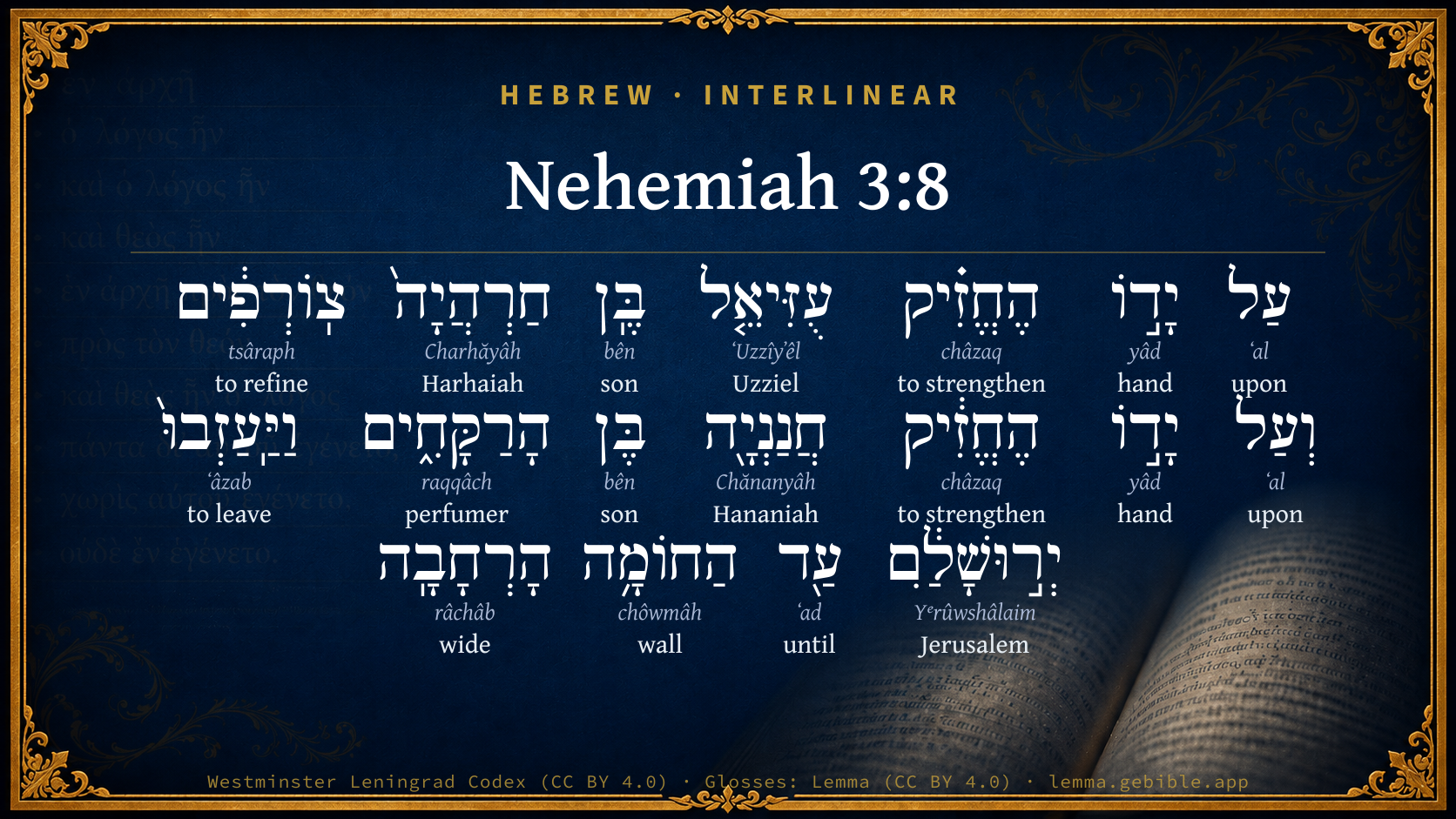
Nehemiah 3:8

Hebrew (Westminster Leningrad Codex) Nehemiah 3:8 appears in the Hebrew Old Testament. The text above is from the Westminster Leningrad Codex. Each word links to its Strong’s number, a concise gloss, and parsing drawn from the Open Scriptures Hebrew Bible morphology. Click any word for its full Brown-Driver-Briggs (BDB) entry.
Download image
Cite this verse

Nehemiah 3:8 (World English Bible). Public Domain. Lemma interlinear Bible study tool, https://lemma.gebible.app/v/nehemiah/3/8.

Show BibTeX & RIS
BibTeX
RIS
English Translation
Next to him repaired Uzziel the son of Harhaiah, goldsmiths. Next to him repaired Hananiah one of the perfumers, and they fortified Jerusalem even to the broad wall.
World English Bible · Public Domain
Highlights
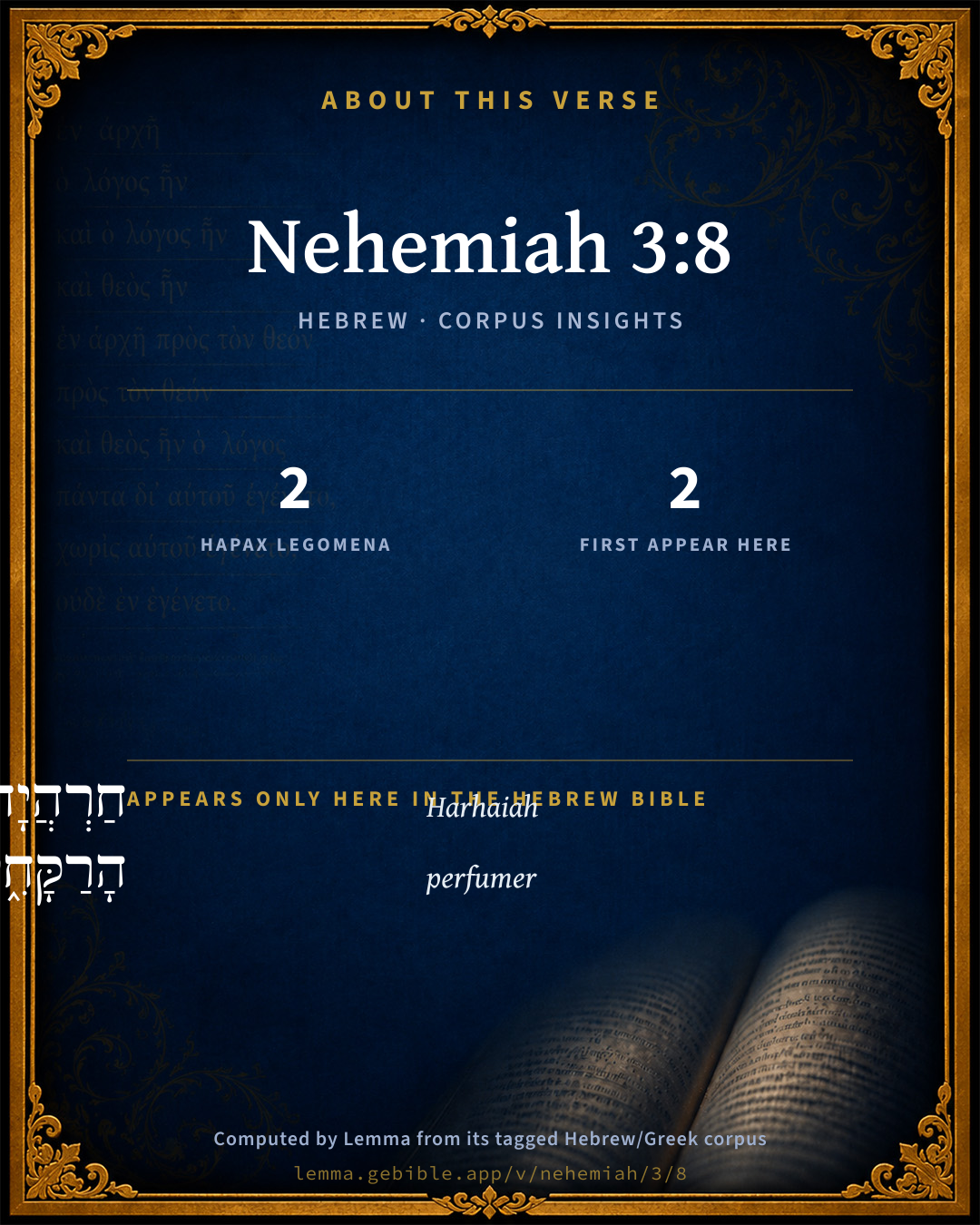
  • 2 hapax legomena — only here in the Hebrew Bible
  • 2 first appearances in the Hebrew Bible
Full analysis ↓
Download a study sheet

One document with this verse’s original text, its word-by-word gloss line, the meaning frame, cross-references with their text, attributed commentary, and full source and license credits — printable, and it pastes into notes with its structure intact.

This verse Autodidact and up

Study sheet (.html) Plain text (.txt)

A passage Seminary Student

Up to 50 verses in one chapter. A passage sheet keeps up to 6 commentary sources and 12 cross-references per verse, in the order this page ranks them, and says so on the sheet whenever that leaves anything out. Ask for a single verse and you get the Autodidact verse sheet above.

Everything on this page stays free to read, with no account — the sheet is a download of what is already on screen, not access to it.

Want to remove ads? Support Godless Engineer
Compare translations 3

The same verse in 3 English versions, stacked beneath the original-language interlinear above. Click any original word for its lexicon entry.

Each is an independent rendering of the whole verse — the interlinear is not word-aligned to these translations.

Highlighted words mark where these versions differ — a whole-verse word diff, not a word-by-word alignment.

  • World English Bible Public Domain
    Next to him repaired Uzziel the son of Harhaiah, goldsmiths. Next to him repaired Hananiah one of the perfumers, and they fortified Jerusalem even to the broad wall.
  • King James Version Public Domain
    Next unto him repaired Uzziel the son of Harhaiah, of the goldsmiths. Next unto him also repaired Hananiah the son of one of the apothecaries, and they fortified Jerusalem unto the broad wall.
  • unfoldingWord Literal Text CC BY-SA 4.0
    Uzziel, the son of Harhaiah, of the goldsmiths, strengthened at his hand. And Hananiah, a son of the perfumers, strengthened at his hand. And they restored Jerusalem as far as the broad wall.

unfoldingWord Literal Text — © unfoldingWord, licensed CC BY-SA 4.0. Word-aligned USFM3 via Door43 (git.door43.org/unfoldingWord/en_ult).

Versions to compare (up to 4)

3 of 4 selected

Show all 18 translations

Every available English version of this verse, each an independent rendering of the whole verse.

  • World English Bible Public Domain
    Next to him repaired Uzziel the son of Harhaiah, goldsmiths. Next to him repaired Hananiah one of the perfumers, and they fortified Jerusalem even to the broad wall.
  • Berean Standard Bible Public Domain
    Next to them, Uzziel son of Harhaiah, one of the goldsmiths, made repairs, and next to him, Hananiah son of the perfumer made repairs. They fortified Jerusalem as far as the Broad Wall.
  • Majority Standard Bible Public Domain
    Next to them, Uzziel son of Harhaiah, one of the goldsmiths, made repairs. And next to him, Hananiah, one of the perfumers, made repairs. They fortified Jerusalem as far as the Broad Wall.
  • King James Version Public Domain
    Next unto him repaired Uzziel the son of Harhaiah, of the goldsmiths. Next unto him also repaired Hananiah the son of one of the apothecaries, and they fortified Jerusalem unto the broad wall.
  • American Standard Version (1901) Public Domain
    Next unto him repaired Uzziel the son of Harhaiah, goldsmiths. And next unto him repaired Hananiah one of the perfumers, and they fortified Jerusalem even unto the broad wall.
  • Revised Version (1885) Public Domain
    Next unto him repaired Uzziel the son of Harhaiah, goldsmiths. And next unto him repaired Hananiah one of the apothecaries, and they fortified Jerusalem even unto the broad wall.
  • Geneva Bible (1599) Public Domain
    Next vnto him fortified Vzziel the sonne of Harhohiah of the golde smithes: next vnto him also fortified Hananiah, the sonne of Harakkahim, and they repayred Ierusalem vnto the broad wall.
  • Douay-Rheims (1899) Public Domain
    And next to him built Eziel the son of Araia the goldsmith: and next to him built Ananias the son of the perfumer: and they left Jerusalem unto the wall of the broad street.
  • Young's Literal Translation Public Domain
    By his hand hath Uzziel son of Harhaiah of the refiners strengthened; and by his hand hath Hananiah son of `one of' the compounders strengthened; and they leave Jerusalem unto the broad wall.
  • Literal Standard Version CC BY-SA 4.0
    By his hand Uzziel son of Harhaiah of the refiners has strengthened; and by his hand Hananiah son of [one of] the compounders has strengthened; and they leave Jerusalem to the broad wall.
  • Unlocked Literal Bible CC BY-SA 4.0
    Next to him Uzziel son of Harhaiah, one of the goldsmiths, repaired, and next to him was Hananiah, a maker of perfumes. They rebuilt Jerusalem as far as the Broad Wall.
  • unfoldingWord Literal Text CC BY-SA 4.0
    Uzziel, the son of Harhaiah, of the goldsmiths, strengthened at his hand. And Hananiah, a son of the perfumers, strengthened at his hand. And they restored Jerusalem as far as the broad wall.
  • Darby Bible Public Domain
    Next to them repaired Uzziel the son of Harhaiah, of the goldsmiths; and next to him repaired Hananiah of the perfumers, and they left Jerusalem [in its state] as far as the broad wall.
  • World Messianic Bible Public Domain
    Next to him, Uzziel the son of Harhaiah, goldsmiths, made repairs. Next to him, Hananiah, one of the perfumers, made repairs, and they fortified Jerusalem even to the wide wall.
  • Webster's Bible Public Domain
    Next to him repaired Uzziel the son of Harhaiah, of the goldsmiths. Next to him also repaired Hananiah the son of one of the apothecaries, and they fortified Jerusalem to the broad wall.
  • Free Bible Version CC BY-SA 4.0
    Next was Uzziel, son of Harhaiah, one of the goldsmiths; and next to him was Hananiah, son of the perfumer. They strengthened Jerusalem as far as the Broad Wall.
  • Bible in Basic English Public Domain
    Near them was working Uzziel, the son of Harhaiah, the gold-worker. And by him was Hananiah, one of the perfume-makers, building up Jerusalem as far as the wide wall.
  • JPS Tanakh (1917) Public Domain
    Next unto him repaired Uzziel the son of Harhaiah, goldsmiths. And next unto him repaired Hananiah one of the perfumers, and they restored Jerusalem even unto the broad wall.

Literal Standard Version (2020), Covenant Press — licensed CC BY-SA 4.0. Text via the HelloAO Bible API (eBible.org). Unlocked Literal Bible (unfoldingWord) — licensed CC BY-SA 4.0. Text via the HelloAO Bible API (eBible.org). unfoldingWord Literal Text — © unfoldingWord, licensed CC BY-SA 4.0. Word-aligned USFM3 via Door43 (git.door43.org/unfoldingWord/en_ult). Free Bible Version, Dr. Jonathan Gallagher — licensed CC BY-SA 4.0. Text via the HelloAO Bible API (eBible.org).

Word by word

More ways to search: Search by grammar → Find every occurrence → Compare this word →

Practice this passage: Drill this verse → Learn its vocabulary →

חַרְהֲיָה֙
Charhăyâh
H2736
“Harhaiah”
Noun, Proper
Part of Speech
Noun
Type
Proper
Full BDB Definition

Origin: from H2734 and H3050

TWOT: None

Harhaiah = "fear of Jehovah" - father of Uzziel who was one of the builders of the wall in Nehemiah's time
  1. עַל ʻal H5921 “upon” Preposition
  2. יָד֣וֹ yâd H3027 “hand · his” Noun, Common, Both, Singular, Construct + Suffix, Personal, 3rd Person, Masculine, Singular
  3. הֶחֱזִ֗יק châzaq H2388 “to strengthen” Verb, Hiphil, Perfect, 3rd Person, Masculine, Singular
  4. עֻזִּיאֵ֤ל ʻUzzîyʼêl H5816 “Uzziel” Noun, Proper
  5. בֶּֽן bên H1121 “son of” Noun, Common, Masculine, Singular, Construct
  6. צֽוֹרְפִ֔ים tsâraph H6884 “refining” Verb, Qal, Participle Active, Masculine, Plural, Absolute
  7. וְעַל ʻal H5921 “and · upon” Conjunction + Preposition
  8. יָד֣וֹ yâd H3027 “hand · his” Noun, Common, Both, Singular, Construct + Suffix, Personal, 3rd Person, Masculine, Singular
  9. הֶחֱזִ֔יק châzaq H2388 “to strengthen” Verb, Hiphil, Perfect, 3rd Person, Masculine, Singular
  10. חֲנַנְיָ֖ה Chănanyâh H2608 “Hananiah” Noun, Proper
  11. בֶּן bên H1121 “son of” Noun, Common, Masculine, Singular, Construct
  12. הָרַקָּחִ֑ים raqqâch H7546 “the · perfumers” Particle, Definite Article + Noun, Common, Masculine, Plural, Absolute
  13. וַיַּֽעַזְבוּ֙ ʻâzab H5800 “and · to leave” Conjunction + Verb, Qal, Sequential Imperfect, 3rd Person, Masculine, Plural
  14. יְר֣וּשָׁלִַ֔ם Yᵉrûwshâlaim H3389 “Jerusalem” Noun, Proper
  15. עַ֖ד ʻad H5704 “until” Preposition
  16. הַחוֹמָ֥ה chôwmâh H2346 “the · wall” Particle, Definite Article + Noun, Common, Feminine, Singular, Absolute
  17. הָרְחָבָֽה râchâb H7342 “the · wide” Particle, Definite Article + Adjective, Adjective, Feminine, Singular, Absolute

About this verse

These counts appear in no published source. They are computed here, from the morphology-tagged text and Lemma’s own curated glosses. What Lemma adds →

18
words
14
distinct lemmas
Historical
section

Notable vocabulary

2 hapax legomena — words that appear only here in the entire Hebrew Bible:

  • חַרְהֲיָה֙ Harhaiah H2736
  • הָרַקָּחִ֑ים perfumer H7546

First appearance in Scripture

These words make their first canonical appearance in the Hebrew Bible here:

  • חַרְהֲיָה֙ Harhaiah H2736
  • הָרַקָּחִ֑ים perfumer H7546

Shared distinctive vocabulary

עֻזִּיאֵ֤ל Uzziel H5816 occurs in 16 verses of the Hebrew Bible. Also found in:

Grammatical profile

  • 4 verbs
  • 10 nouns
  • 1 adjective
  • 3 prepositions

Verb forms

  • הֶחֱזִ֗יק Hiphil · Perfect
  • צֽוֹרְפִ֔ים Qal · Participle Active
  • הֶחֱזִ֔יק Hiphil · Perfect
  • וַיַּֽעַזְבוּ֙ Qal · Sequential Imperfect

Repetition

Words recur within this verse — often emphatic in Hebrew:

  • עַל upon H5921 ×2
  • יָד֣וֹ hand H3027 ×2
  • הֶחֱזִ֗יק to strengthen H2388 ×2
  • בֶּֽן son H1121 ×2

Cross-references

6

Topical passages linked to Nehemiah 3:8 in the Treasury of Scripture Knowledge — connected by theme and wording, ordered by reader-vote popularity; previews shown in the World English Bible.

  • Nehemiah 12:38 The other company of those who gave thanks went to meet them, and I after them, with the half of the people, on the wall, above the tower of the furnaces, even to the broad wall,
  • Nehemiah 3:31–32 After him repaired Malchijah one of the goldsmiths to the house of the Nethinim, and of the merchants, over against the gate of Hammiphkad, and to the ascent of the corner.
  • Genesis 50:2 Joseph commanded his servants, the physicians, to embalm his father; and the physicians embalmed Israel.
  • Exodus 30:25 You shall make it a holy anointing oil, a perfume compounded after the art of the perfumer: it shall be a holy anointing oil.
  • Ecclesiastes 10:1 Dead flies cause the oil of the perfumer to send forth an evil odor; so does a little folly outweigh wisdom and honor.
  • Isaiah 46:6 Some pour out gold from the bag, and weigh silver in the balance. They hire a goldsmith, and he makes it a god. They fall down--yes, they worship.

Cross-references courtesy of OpenBible.info (CC BY 4.0).

Hebrew and Greek witnesses Masoretic Hebrew ↔ Greek Septuagint

The same verse in the two great witnesses to the Old Testament, shown verse-for-verse.

These are two independent witnesses, not word-aligned to each other, and the Septuagint is shown in lemma (dictionary) form.

Hebrew Nehemiah 3:8 Masoretic · Westminster Leningrad Codex

עַל יָד֣וֹ הֶחֱזִ֗יק עֻזִּיאֵ֤ל בֶּֽן חַרְהֲיָה֙ צֽוֹרְפִ֔ים וְעַל יָד֣וֹ הֶחֱזִ֔יק חֲנַנְיָ֖ה בֶּן הָרַקָּחִ֑ים וַיַּֽעַזְבוּ֙ יְר֣וּשָׁלִַ֔ם עַ֖ד הַחוֹמָ֥ה הָרְחָבָֽה

Next to him repaired Uzziel the son of Harhaiah, goldsmiths. Next to him repaired Hananiah one of the perfumers, and they fortified Jerusalem even to the broad wall.

World English Bible · Public Domain

Greek LXX Structure differs

The Septuagint has no separate book of Nehemiah. Its Greek text is the second half of Esdras B (2 Esdras), chapters 11–23; Ezra is the first half (1–10).

A verse-for-verse comparison isn’t shown here because the chapters and verses don’t line up. Switch to the LXX edition with the MT / LXX toggle above to read the Greek directly.

On this verse, The Cambridge Bible for Schools and Colleges discusses the Septuagint’s reading. Read the note in Commentary ↓

Hebrew: Westminster Leningrad Codex (CC BY 4.0). Greek: Septuagint (public domain); English from a public-domain English Septuagint. How the Septuagint differs from the Hebrew →

Commentary

Notes on Nehemiah 3:8 from classic Christian and Jewish commentators (each source and its license shown beneath its notes). The classic Christian expositions comment on the surrounding passage and are grouped to its opening verse, so a note may address several verses; the Jewish commentaries on the Tanakh (Rashi and others) are per-verse, so they appear only where the commentator wrote on this verse.

Lemma curates 59 commentaries, every one of them public domain or Creative Commons licensed, each selected and text-cleaned for this edition rather than reprinted as found. About our sources →

Trapp's Complete Commentary

John Trapp

Neh 3:8 Next unto him repaired Uzziel the son of Harhaiah, of the goldsmiths. Next unto him also repaired Hananiah the son of [one of] the apothecaries, and they fortified Jerusalem unto the broad wall.

Ver. 8. Of the goldsmiths … the son of one of the apothecaries] These were ever thriving trades; they both had wealth, and hearts to part with it, upon so good a work. Difficile est animos opibus non tradere, &c. It is not difficult that their spirits deliver help. (Martial).

Unto the broad wall] Which, haply for the thickness of it, was left undemolished by the Chaldeans.

John Trapp, A Commentary or Exposition upon All the Books of the Old and New Testament (1647–1656) — public domain. Text from a community e-Sword module.

The Biblical Illustrator

Joseph S. Exell

Neh_3:8

And they fortified Jerusalem unto the broad wall

The broad wall

I.

The separation of the people of God from the world is like that broad wall surrounding Jerusalem. An actual separation is made by grace, is carried on in the work of sanctification, and will be completed in that day when the saints shall be caught up together with the Lord in the air.

1. Christians should maintain a broad wall of separation between themselves and the world. The distinction ought not to be one of dress or of speech, the separation ought to be moral and spiritual.

(1) A Christian ought to be more scrupulous than other men in his dealings. He must never swerve from the path of integrity. He should be one whose word is his bond, and who having once pledged his word, sweareth to his own hurt and changeth not.

(2) The Christian should be distinguished by his pleasures. We are not quite ourselves, perhaps, in our daily toil, where our pursuits are rather dictated by necessity than by choice, but our pleasures and pastimes give evidence of what our heart is and where it is.

(3) Such separation should be carried into everything which affects the Christian. When a stranger comes into our house it should be so ordered that he can clearly perceive that we have a respect unto Him that is invisible, and that we desire to live and move in the light of Gods countenance.

(4) This broad wall should be most conspicuous in the spirit of our mind. There should be about a Christian always the air of one who has his shoes on his feet, his loins girded, and his staff in his hand--away, away to a better land.

2. Reasons why this wall should be very broad.

(1) If you are sincere in your profession, there is a very broad distinction between you and unconverted people.

(2) Remember that our Lord Jesus Christ had a broad wall between Him and the ungodly.

(3) A broad wall of separation is abundantly good for yourselves. When a Christian gives way to the worlds custom he never feels profited thereby. Ask a fish to spend an hour on dry land, and I think did he comply the fish would find that it was not much to its benefit, for it would be out of its element. And it is so with Christians in communion with sinners.

(4) To keep up the broad wall of separation is to do most good to the world. A Christian loses his strength the moment he departs from his integrity. Although the world may openly denounce the rigid Puritan, it secretly admires him. You young man in the shop--you young woman in the workroom--if you keep yourselves to yourselves in Christs name, chaste and pure for Jesus, not laughing at jests which should make you blush; not mixing up with pastimes that are suspicious; but being tenderly jealous of your conscience at all times, then your company in the midst of others shall be as though an angel shook his wings, and they will say, Refrain from this or that just now, for So-and-so is there. They will fear you in a certain sense; they will admire you in secret; and who can tell but they, at last, may come to imitate you?

II. The broad wall round jerusalem indicated safety. The Christian is surrounded by the broad wall--

1. Of Gods power.

2. Of Gods love.

3. Of Gods law and justice.

4. Of Gods immutability.

5. Of the work of the Holy Spirit.

6. Almost every doctrine of grace affords us a broad wall, a mighty bulwark, a grand munition of defence.

III. This broad wall suggests enjoyment. These walls were used as promenades, and were utilised--

1. For rest from toil.

2. For communion.

3. For prospects and outlooks. (C. H. Spurgeon.)

The Biblical Illustrator, edited by Joseph S. Exell (c. 1880s–1900s) — public domain. Text from a community e-Sword module.

Joseph Benson's Commentary

Neh 3:8. Next unto him repaired Uzziel; also Hananiah — These were two eminent persons, one among the workers or casters of gold, the other among the perfumers. They fortified Jerusalem, &c., unto the broad wall — It is not said, they repaired, but, they fortified it, either because this part of the wall was less demolished than the other, and therefore they needed not to repair it, but only to make it stronger; or, to note their extraordinary care and diligence, that they would not only repair it, but make it stronger than ever.

Joseph Benson's Commentary on the Old and New Testaments (1811–1818) — public domain. Text from a community e-Sword module.

Tyndale Open Study Notes

Tyndale Open Resources

3:8 The Broad Wall was located in the newer, western section of the city.

Tyndale Open Study Notes — © Tyndale Open Resources, licensed CC BY-SA 4.0. Text via the HelloAO Bible API.

Geneva Bible (1599)

Geneva Bible translators

Or, of the Apothecaries.

Or, Zorephim.

Geneva Bible (1599) marginal notes — public domain. Text via Bolls.life.

Jamieson, Fausset & Brown

Robert Jamieson, A. R. Fausset & David Brown

they fortified Jerusalem unto the broad wall--or, "double wall," extending from the gate of Ephraim to the corner gate, four hundred cubits in length, formerly broken down by Joash, king of Israel [Ch2 25:23], but afterwards rebuilt by Uzziah [Ch2 26:9], who made it so strong that the Chaldeans, finding it difficult to demolish, had left it standing.

Jamieson, Fausset & Brown — Commentary Critical and Explanatory on the Whole Bible (1871) — public domain (CC PDM 1.0). Text via the HelloAO Bible API.

Adam Clarke's Commentary

Verse 8. Goldsmiths.] From the remotest period of the history of the Jews they had artists in all elegant and ornamental trades; and it is also evident that goldsmiths, apothecaries, and merchants were formed into companies in the time of Nehemiah.

Apothecaries] Rather such as dealt in drugs, aromatics, spices, &c., for embalming, or for furnishing the temple with the incense consumed there.

Adam Clarke's Commentary on the Bible (1810–1826) — public domain. Text from a community e-Sword/MySword module.

Ellicott's Commentary for English Readers

(8) And they fortified Jerusalem unto the broad wall.—The word translated “fortified” means literally left, and this yields a good sense: they left Jerusalem untouched as far as a certain portion of the wall extended which needed no restoration. The gate of Ephraim was in this (see Neh_12:38-39); and it is significant that nothing is said about the rebuilding of this important gate.

A Bible Commentary for English Readers, edited by Charles John Ellicott (1878–1897) — public domain. Text from a community e-Sword module.

The Cambridge Bible for Schools and Colleges

gen. ed. J. J. S. Perowne

8. Uzziel … of the goldsmiths] R.V. Uzziel …, goldsmiths. The R.V. gives the literal rendering. The meaning of course is that a guild or the guild of goldsmiths, who were represented by Uzziel, undertook the next piece of the wall. The wealth of ‘the goldsmiths’ is shown by the large portion undertaken by the members of their ‘guild.’ Cf. Neh_3:31-32.

Next unto him also] R.V. And next unto him.

Hananiah the son of one of the apothecaries] R.V. Hananiah, one of the apothecaries. Marg. ‘perfumers’. The R.V. gives the meaning of the Hebrew, which is literally ‘Hananiah, a son of the apothecaries or perfumers.’ This Hananiah, possibly ‘the son of Shelemiah’ mentioned as engaged in restoring another portion of the wall, represented the guild of ‘perfumers.’

The word ‘apothecary,’ which appears in the A.V. in Exo_30:25; Exo_30:35; Exo_37:29; 2Ch_16:14; Ecc_10:1, is not used in the sense of a vendor of medicines. The context in each passage shows that a dealer in ointments, spices, and perfumes is intended. The same word in the feminine is rendered ‘confectionaries’ in 1Sa_8:13, where the R.V. marg. ‘perfumers’ is to be preferred.

This was a most important industry in Eastern countries, combining provision for the comforts of the poor and the luxuries of the rich (Son_3:6), with the elaborate arts of embalming the dead.

In hot climates the anointing of head or feet with ointment and perfumes was a recognised courtesy offered a distinguished guest (Luk_7:38; Luk_7:46; Joh_12:3). Anointing with sweet oil was an act of cleansing or purification (Eze_16:9; Rth_3:3; Jdt_10:3). With women cosmetics constituted a considerable part of personal adornment (Son_4:10).

and they fortified Jerusalem unto (R.V. even unto) the broad wall] R.V. marg. ‘Or, left’ for ‘fortified,’ giving the usual sense of the Hebrew verb.

The LXX. has καὶ κατέλιπον Ἱερουσαλὴμ ἕως τοῦ τείχους τοῦ πλατέος: the Vulgate ‘dimiserunt Ierusalem usque ad murum plateæ latioris.’

The difficulty occasioned by the verb has given rise to very different interpretations of the passage:

(1) The A.V. following ancient Jewish interpretation renders ‘fortified Jerusalem;’ and it appears to be the case that the word occurs in Talmudic Hebrew with a meaning connected with building operations (Buxtorf, sub voce, ‘pavimentarunt’). But even if this meaning be accepted, it is not easy to account for the occurrence of the words ‘fortified Jerusalem’ in the middle of a description, the whole of which deals with the fortification of Jerusalem.

(2) Accepting the usual rendering ‘left,’ the following explanations have been given:

(a) ‘And they’, i.e. the Babylonian troops, at the destruction of Jerusalem, had left this portion untouched. This translation introduces an imaginary subject, i.e. the Babylonians. It fails to explain the introduction of the reference to Jerusalem. It makes ‘left’ equivalent to ‘left undestroyed.’

(b) The Jews who were engaged upon the work of restoration ‘left untouched’ this portion of the wall, which happened not to require rebuilding. This again gives an arbitrary meaning to the word ‘left,’ and the mention of ‘Jerusalem’ remains unexplained.

(c) They carried on the fortification at some distance from the dwelling-places of Jerusalem. The city wall extended further north than the houses. The builders ‘left the city,’ i.e. the neighbourhood of the houses, in order to complete the circumvallation included in the plan.

(d) ‘And the Jews had abandoned Jerusalem,’ i.e. Jerusalem was at this point not occupied by the Jews returned from the Captivity. The northern limit of the inhabited quarter did not extend so far as it had done in the Monarchy.

(e) It is possible that the builders at this point ‘left’ some portion of Jerusalem outside their wall. The circumference of the old city was larger than was now needed. In the course of the restoration of the wall the builders abandoned at some point the old outer wall and the uninhabited portion of Jerusalem which it included.

The exact meaning lies hid in the topographical allusion, which we cannot hope to understand. It seems most natural, (1) that the subject to the verb ‘left’ should be the builders just previously mentioned; (2) that ‘Jerusalem’ should imply the inhabited city. The solution offered by (e) seems to be the most probable. The new circumvallation was, as a rule, larger than the old. Here only where the builders went inside and left the old wall, it is expressly mentioned.

the broad wall] The broad wall is mentioned again in chap. Neh_12:38 as between ‘the tower of the furnaces’ and ‘the gate of Ephraim.’ The name was probably given to a portion of the wall where the thickness and strength of the structure indicated the strategic importance of this point in the fortifications. It is possible that this was the portion of 400 cubits which Amaziah pulled down (see 2Ki_14:13; 2Ch_25:23) with the view of rendering Jerusalem defenceless on the N., and that this was the portion which Hezekiah took pains to strengthen and renew (2Ch_32:5).

The Cambridge Bible for Schools and Colleges (gen. ed. J. J. S. Perowne; Cambridge University Press, 1878–1918) — public domain. Text from a community e-Sword module.

John Gill's Exposition

Next unto him repaired Uzziel the son of Harhaiah, of the goldsmiths,.... Or Tzorephim, which, according to Jarchi, was the name of a family so called from their trade and business:

next unto him also repaired Hananiah the son of one of the apothecaries; or confectioners, which also might be the name of a family so called for the same reason:

and they fortified Jerusalem unto the broad wall; which reached from the gate of Ephraim to the corner gate, which was broken down by Joash, king of Israel, but was rebuilt so strong by Uzziah, king of Judah, that it stood firm to this time; wherefore these men repaired up to it, but left that as they found it; see Ch2 25:23, and were not careful to repair it, it not wanting any repair.

John Gill's Exposition of the Whole Bible (1746–1763) — public domain (CC PDM 1.0). Text via the HelloAO Bible API.

Haydock's Catholic Bible Commentary

Goldsmith and perfumer, are plural in Hebrew. --- Left, 400 cubits, (Tirinus) as the wall was not demolished, (Menochius) having been repaired by Ozias just before the coming of the Chaldeans, 2 Paralipomenon xxvi. 9. (Tirinus) --- Hebrew, "they pushed forward, (repaired, Calmet; or) paved, (Du Dieu) or fortified Jerusalem unto the broad wall." (Protestants) --- The Septuagint copies vary: some read, they placed, (restored) Greek: etheka. (Complutensian) But the Roman edition has, "they left." (Du Hamel)

George Leo Haydock (1774–1849), Haydock's Catholic Family Bible and Commentary, 1859 edition — public domain. Excludes Psalms (Douay-Rheims chapter numbering differs from Protestant) and Deuterocanonical books (Catholic canon only).

Matthew Poole's English Annotations

It is not said they repaired, as was said of the rest, but they

fortified it, either because this part of the wall was less demolished than the other, and therefore they needed not to repair it, but only to make it stronger by some additions; or to note their extraordinary care and diligence, that they would not only repair it, and restore it to its former state, but make it stronger than ever it was; which also might be fit to be done in that part of the city. Others render it they left, as this word commonly signifies; and so the meaning is, They omitted the building of that part of the wall, because it remained standing; this being that space of four hundred cubits which was pulled down by Joash king of Israel, and rebuilt by Uzziah, who made it so strong, that the Chaldeans could not pull it down without more trouble than they thought fit to employ about it. But this chapter gives us an account of what they did in the building, not of what they did not, but left as they found it.

Matthew Poole's English Annotations on the Holy Bible (1683–1685) — public domain. Text from a community e-Sword/MySword module.

Whedon's Commentary on the Bible

Daniel D. Whedon

8. Goldsmiths… apothecaries — Representatives of whose arts seem to have always had a position among the Hebrews. They probably learned them in Egypt. Apothecaries are here to be understood especially of manufacturers and dealers in ointments and perfumes. Comp. Ecc_10:1.

Fortified Jerusalem unto the broad wall — Rather, as the margin, left Jerusalem unto the broad wall; that is, they left off, or omitted to build a portion of the northern wall as far as to what was known as the broad wall. This latter was probably the wall that spanned the upper part of the Tyropoeon valley, and so called from its greater breadth or thickness than other parts of the city wall.

Daniel D. Whedon (gen. ed.), Commentary on the Old and New Testaments (1874–1909) — public domain. Text from a community e-Sword module.

The Pulpit Commentary

Hananiah the son of one of the apothecaries. Or "the son of Harak-kashim." They fortified Jerusalem unto the broad wall. The Septuagint has katelipon , "they left," and the Vulgate dimiserunt in the same sense, which is given also as an alternative rendering by our translators, in the margin. And no doubt the verb bz has this for one of its meanings. But the clause has thus no satisfactory sense. That bz is used for "to fortify" by Nehemiah is plain from Neh_4:2, and we may therefore well understand it in this sense here. Why he uses bz here and qzj in every other place is difficult to explain, unless we suppose, with Pool, that the wall did not need regular repairs in this part, but only a little strengthening.

The Pulpit Commentary (1880–1919), ed. H.D.M. Spence-Jones & Joseph S. Exell — public domain. Text from a community e-Sword module.

John Wesley's Explanatory Notes

Fortified - It is not said, they repaired, but they fortified it, either because this part of the wall was less demolished than the other, and therefore they needed not to repair it, but only to make it stronger: or, to note their extraordinary care and diligence, that they would not only repair it, but make it stronger than ever.

John Wesley, Explanatory Notes Upon the Whole Bible (1754–1765) — public domain. Text via the GEBible commentary corpus.

unfoldingWord translationNotes

Door43 World Missions Community

Uzziel ... Harhaiah ... Hananiah ... Rephaiah ... Hur ... Jedaiah ... Harumaph ... Hattush ... Hashabneiah

These are names of men. (See: How to Translate Names)

goldsmiths

A goldsmith is a person who makes gold jewelry and other gold objects.

goldsmiths, repaired ... Hur repaired ... Harumaph repaired ... Hashabneiah repaired

These phrases refer to repairing the wall. AT: "goldsmiths, repaired the wall ... Hur repaired the wall ... Harumaph repaired the wall ... Hashabneiah repaired the wall" (See: Ellipsis)

next to him was Hananiah, a maker of perfumes

Hananiah repaired the wall as well. AT: "next to him Hananiah, a maker of perfumes, repaired the wall" (See: Ellipsis)

perfumes

liquid substances that people put on their body in small amounts to smell pleasant

ruler

leader or chief administrator

half the district

"Half" means one part out of two equal parts. (See: Fractions)

translationWords

son

Jerusalem

rule

house

unfoldingWord translationNotes — © Distant Shores Media and the Door43 World Missions Community, licensed CC BY-SA 4.0. Source: git.door43.org/Door43/en_tn.

Rashi

Rabbi Shlomo Yitzchaki (Rashi)

goldsmiths That family was called by their craft.

and they filled Jerusalem Heb. וַיַעַזְבוּ יְרוּשָּׁלַיִם They filled it with earth up to the wide wall in order to strengthen it.

Rashi on the Tanakh — English translations: “The Judaica Press complete Tanach with Rashi, translated by A. J. Rosenberg” (CC BY 4.0); “Pentateuch with Rashi's commentary by M. Rosenbaum and A.M. Silbermann, 1929-1934” (public domain); “The Metsudah Tanach series, Lakewood, N.J” (CC BY 4.0); and “The Book of Joshua, Metsudah Publications, 1997” (CC BY 4.0). Text via Sefaria.

Lesson kit

Teaching starters — assembled from the data on this page, not authored interpretation. Every prompt links to the verse data it draws on. Edit before teaching.

Nehemiah, in the Historical, opens this verse with 18 words (14 distinct Hebrew lemmas). Its most distinctive word is Charhăyâh (“Harhaiah”). A historical commentator’s framing appears above. Read the whole chapter for the surrounding context.

Discussion questions

  1. How does “Harhaiah” (Charhăyâh) shape what this verse is saying?
  2. This verse holds 2 words here found nowhere else in the Hebrew Bible. What might the rare words draw attention to?
  3. 2 words here appear for the first time in Scripture. What is being introduced at this debut?
  4. Exodus 6:18 shares the word «Uzziel» with this verse. How do the two illuminate each other?
  5. “upon” occurs 2× in this one verse. What is the effect of the repetition?
  6. The translations on this page render this verse differently — a whole-verse word diff, not a word-by-word alignment. What might account for the different wordings?
  7. The verb «הֶחֱזִ֗יק» is Hiphil Perfect. How does its form color the action?
  8. Reading how Trapp's Complete Commentary and The Biblical Illustrator read this verse, where do the two commentators agree and where do they part?

Things to notice

  • 2 words in this verse appear nowhere else in the Hebrew Bible.
  • 2 words make their first canonical appearance in Scripture here.
  • These translations choose different wording for 13 words in this verse.
  • “upon” occurs 2× in this single verse.
  • 14 distinct Hebrew lemmas span 18 words in this verse.

Reading settings

Reading text

Shown beneath each verse's original-language words.

Old Testament
Old Testament edition

Read the OT as the Masoretic Hebrew (MT) or the Greek Septuagint (LXX).

English shown for the Greek Septuagint (in the Hebrew ↔ Greek comparison).

Comparing translations? Open the Compare panel on any verse page to stack up to four side by side.