
Psalms 102:21

Hebrew (Westminster Leningrad Codex) Psalms 102:21 appears in the Hebrew Old Testament. The text above is from the Westminster Leningrad Codex. Each word links to its Strong’s number, a concise gloss, and parsing drawn from the Open Scriptures Hebrew Bible morphology. Click any word for its full Brown-Driver-Briggs (BDB) entry.
Download image
Cite this verse

Psalms 102:21 (World English Bible). Public Domain. Lemma interlinear Bible study tool, https://lemma.gebible.app/v/psalms/102/21.

Show BibTeX & RIS
BibTeX
RIS
English Translation
That men may declare the name of Yahweh in Zion, And his praise in Jerusalem;
World English Bible · Public Domain
Download a study sheet

One document with this verse’s original text, its word-by-word gloss line, the meaning frame, cross-references with their text, attributed commentary, and full source and license credits — printable, and it pastes into notes with its structure intact.

This verse Autodidact and up

Study sheet (.html) Plain text (.txt)

A passage Seminary Student

Up to 50 verses in one chapter. A passage sheet keeps up to 6 commentary sources and 12 cross-references per verse, in the order this page ranks them, and says so on the sheet whenever that leaves anything out. Ask for a single verse and you get the Autodidact verse sheet above.

Everything on this page stays free to read, with no account — the sheet is a download of what is already on screen, not access to it.

Want to remove ads? Support Godless Engineer
Compare translations 3

The same verse in 3 English versions, stacked beneath the original-language interlinear above. Click any original word for its lexicon entry.

Each is an independent rendering of the whole verse — the interlinear is not word-aligned to these translations.

Highlighted words mark where these versions differ — a whole-verse word diff, not a word-by-word alignment.

  • World English Bible Public Domain
    That men may declare the name of Yahweh in Zion, And his praise in Jerusalem;
  • King James Version Public Domain
    To declare the name of the LORD in Zion, and his praise in Jerusalem;
  • unfoldingWord Literal Text CC BY-SA 4.0
    To recount the name of Yahweh in Zion and his praise in Jerusalem

unfoldingWord Literal Text — © unfoldingWord, licensed CC BY-SA 4.0. Word-aligned USFM3 via Door43 (git.door43.org/unfoldingWord/en_ult).

Versions to compare (up to 4)

3 of 4 selected

Show all 18 translations

Every available English version of this verse, each an independent rendering of the whole verse.

  • World English Bible Public Domain
    That men may declare the name of Yahweh in Zion, And his praise in Jerusalem;
  • Berean Standard Bible Public Domain
    that they may proclaim the name of the LORD in Zion and praise Him in Jerusalem,
  • Majority Standard Bible Public Domain
    that they may proclaim the name of the LORD in Zion and praise Him in Jerusalem,
  • King James Version Public Domain
    To declare the name of the LORD in Zion, and his praise in Jerusalem;
  • American Standard Version (1901) Public Domain
    That men may declare the name of Jehovah in Zion, And his praise in Jerusalem;
  • Revised Version (1885) Public Domain
    That men may declare the name of the LORD in Zion, and his praise in Jerusalem;
  • Geneva Bible (1599) Public Domain
    That they may declare the Name of the Lord in Zion, and his prayse in Ierusalem,
  • Douay-Rheims (1899) Public Domain
    That he might hear the groans of them that are in fetters: that he might release the children of the slain:
  • Young's Literal Translation Public Domain
    To declare in Zion the name of Jehovah, And His praise in Jerusalem,
  • Literal Standard Version CC BY-SA 4.0
    To declare in Zion the Name of YHWH, || And His praise in Jerusalem,
  • Unlocked Literal Bible CC BY-SA 4.0
    Then men will proclaim the name of Yahweh in Zion and his praise in Jerusalem
  • unfoldingWord Literal Text CC BY-SA 4.0
    To recount the name of Yahweh in Zion and his praise in Jerusalem
  • Darby Bible Public Domain
    That the name of Jehovah may be declared in Zion, and his praise in Jerusalem,
  • World Messianic Bible Public Domain
    that men may declare the LORD’s name in Zion, and his praise in Jerusalem,
  • Webster's Bible Public Domain
    \\102:20\\To hear the groaning of the prisoner; to loose those that are appointed to death;
  • Free Bible Version CC BY-SA 4.0
    As a result the wonderful nature of the Lord will be celebrated with praise in Jerusalem,
  • Bible in Basic English Public Domain
    So that they may give out the name of the Lord in Zion, and his praise in Jerusalem;
  • JPS Tanakh (1917) Public Domain
    (102-22) That men may tell of the name of the LORD in Zion, and His praise in Jerusalem;

Literal Standard Version (2020), Covenant Press — licensed CC BY-SA 4.0. Text via the HelloAO Bible API (eBible.org). Unlocked Literal Bible (unfoldingWord) — licensed CC BY-SA 4.0. Text via the HelloAO Bible API (eBible.org). unfoldingWord Literal Text — © unfoldingWord, licensed CC BY-SA 4.0. Word-aligned USFM3 via Door43 (git.door43.org/unfoldingWord/en_ult). Free Bible Version, Dr. Jonathan Gallagher — licensed CC BY-SA 4.0. Text via the HelloAO Bible API (eBible.org).

Word by word

More ways to search: Search by grammar → Find every occurrence → Compare this word →

Practice this passage: Drill this verse → Learn its vocabulary →

וּ֝תְהִלָּת֗וֹ
tᵉhillâh
H8416
“and · praise · his”
Conjunction + Noun, Common, Feminine, Singular, Construct + Suffix, Personal, 3rd Person, Masculine, Singular
Part of Speech
Conjunction + Noun
Type
Common
Gender
Feminine
Number
Singular
State
Construct
Full BDB Definition

Origin: from H1984

TWOT: 500c

praise, song or hymn of praise - praise, adoration, thanksgiving (paid to God) - act of general or public praise - praise-song (as title) - praise (demanded by qualities or deeds or attributes of God) - renown, fame, glory - of Damascus, God - object of praise, possessor of renown (figuratively)
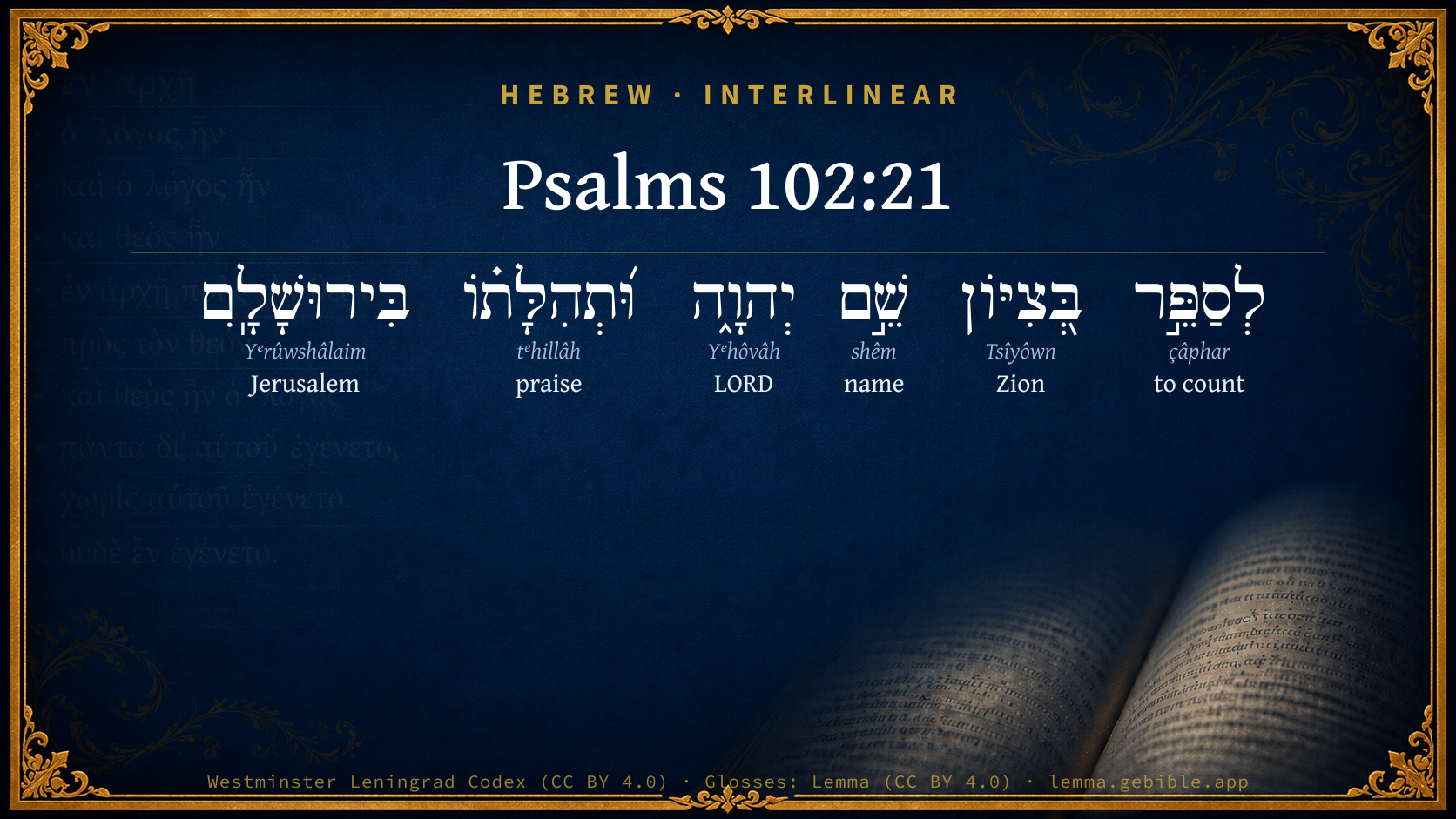
  1. לְסַפֵּ֣ר çâphar H5608 “to count” Preposition + Verb, Piel, Infinitive Construct
  2. בְּ֭צִיּוֹן Tsîyôwn H6726 “in/at · Zion” Preposition + Noun, Proper
  3. שֵׁ֣ם shêm H8034 “name of” Noun, Common, Masculine, Singular, Construct
  4. יְהוָ֑ה Yᵉhôvâh H3068 “LORD” Noun, Proper
  5. בִּירוּשָׁלִָֽם Yᵉrûwshâlaim H3389 “in/at · Jerusalem” Preposition + Noun, Proper

About this verse

These counts appear in no published source. They are computed here, from the morphology-tagged text and Lemma’s own curated glosses. What Lemma adds →

6
words
6
distinct lemmas
Wisdom
section

Shared distinctive vocabulary

וּ֝תְהִלָּת֗וֹ praise H8416 occurs in 57 verses of the Hebrew Bible. Also found in:

Grammatical profile

  • 1 verb
  • 5 nouns

Verb forms

  • לְסַפֵּ֣ר Piel · Infinitive Construct

Hebrew & Septuagint length

In English translation the verse runs 15 words from the Hebrew and 14 from the Septuagint (LXX English) — closely comparable.

A rough comparison of the two English renderings, which tokenize alike — not a word-level alignment.

Word counts can differ between the Hebrew and the Greek without any difference in meaning — e.g. the Hebrew direct-object marker אֵת has no separate Greek word, and Greek often adds the article ὁ.

Cross-references

8

Topical passages linked to Psalms 102:21 in the Treasury of Scripture Knowledge — connected by theme and wording, ordered by reader-vote popularity; previews shown in the World English Bible.

  • Psalms 22:22 I will declare your name to my brothers. In the midst of the assembly, I will praise you.
  • Psalms 9:13–14 Have mercy on me, Yahweh. See my affliction by those who hate me, And lift me up from the gates of death;
  • Psalms 51:14–15 Deliver me from bloodguiltiness, O God, the God of my salvation. My tongue shall sing aloud of your righteousness.
  • Psalms 79:13 So we, your people and sheep of your pasture, Will give you thanks forever. We will praise you forever, to all generations.
  • Isaiah 51:11 The ransomed of Yahweh shall return, and come with singing to Zion; and everlasting joy shall be on their heads: they shall obtain gladness and joy; [and] sorrow and sighing shall flee away.
  • Ephesians 3:21 to him be the glory in the assembly and in Christ Jesus to all generations forever and ever. Amen.
  • 1 Peter 2:9 But you are a chosen race, a royal priesthood, a holy nation, a people for God's own possession, that you may show forth the excellencies of him who called you out of darkness into his marvelous light:
  • Ephesians 2:4–7 But God, being rich in mercy, for his great love with which he loved us,

Cross-references courtesy of OpenBible.info (CC BY 4.0).

Hebrew and Greek witnesses Masoretic Hebrew ↔ Greek Septuagint

The same verse in the two great witnesses to the Old Testament, shown verse-for-verse.

You’re reading Greek Psalm 101 (Hebrew Psalm 102). The Septuagint counts the superscription, so verse numbers can differ from the Hebrew — chapter-level alignment, not verse-by-verse. Numbering follows Rahlfs.

These are two independent witnesses, not word-aligned to each other, and the Septuagint is shown in lemma (dictionary) form.

Hebrew Psalms 102:21 Masoretic · Westminster Leningrad Codex

לְסַפֵּ֣ר בְּ֭צִיּוֹן שֵׁ֣ם יְהוָ֑ה וּ֝תְהִלָּת֗וֹ בִּירוּשָׁלִָֽם

That men may declare the name of Yahweh in Zion, And his praise in Jerusalem;

World English Bible · Public Domain

Greek LXX Greek Psalm 101:21 Septuagint · lemma form

ὁ ἀκούω ὁ στεναγμός ὁ πεδάω ὁ λύω ὁ υἱός ὁ θανατόω

to proclaim the name of the Lord in Sion, and his praise in Jerusalem;

LXX2012 (modern English Septuagint) · Public Domain

Hebrew: Westminster Leningrad Codex (CC BY 4.0). Greek: Septuagint (public domain); English from LXX2012 (modern English Septuagint) (Public Domain). How the Septuagint differs from the Hebrew →

Commentary

Notes on Psalms 102:21 from classic Christian and Jewish commentators (each source and its license shown beneath its notes). The classic Christian expositions comment on the surrounding passage and are grouped to its opening verse, so a note may address several verses; the Jewish commentaries on the Tanakh (Rashi and others) are per-verse, so they appear only where the commentator wrote on this verse.

Lemma curates 59 commentaries, every one of them public domain or Creative Commons licensed, each selected and text-cleaned for this edition rather than reprinted as found. About our sources →

Trapp's Complete Commentary

John Trapp

Psa 102:21 To declare the name of the LORD in Zion, and his praise in Jerusalem;

Ver. 21. To declare the name of the Lord in Zion] This shall be the business of the converted Gentiles, to make up one catholic Church with the Christian Jews, and to bear a part in setting forth God’s worthy praises. See Psa 102:18.

John Trapp, A Commentary or Exposition upon All the Books of the Old and New Testament (1647–1656) — public domain. Text from a community e-Sword module.

J. A. Alexander on Psalms

Joseph Addison Alexander

22. (Psa 102:21) To recount in Zion the name of Jehovah, and his praise in Jerusalem. This, according to the laws of Hebrew syntax, does not necessarily denote an act of God himself, as the similar construction in the preceding verse does, but may have a vaguer sense equivalent to saying that his name may be declared in Zion. To recount God's name is to recount the mighty deeds which constitute it, and the celebration of which constitutes his praise. Zion is still represented as the great scene of Jehovah's triumphs, not, however, as the capital of Israel or Judah merely, but as the radiating centre of religious light and influence to all the earth.

Joseph Addison Alexander, The Psalms Translated and Explained (1850) — public domain. Text from a community e-Sword module.

Adam Clarke's Commentary

Verse 21. To declare the name of the Lord] To publish that Messenger of the Covenant in whom the name of the Lord is, that Messiah in whom the fulness of the Godhead dwelt; and to commence at Jerusalem, that the first offers of mercy might be made to the Jews, from whom the word of reconciliation was to go out to all the ends of the earth.

Adam Clarke's Commentary on the Bible (1810–1826) — public domain. Text from a community e-Sword/MySword module.

John Calvin's Commentaries

21 That the name of Jehovah may be declared in Zion Here is celebrated a still more ample and richer fruit of this deliverance than has been previously mentioned, which is, that the Jews would not only be united into one body to give thanks to God, but that, when brought back to their own country, they would also gather kings and nations into the same unity of faith, and into the same divine worship with themselves. At that time it was a thing altogether incredible, not only that the praises of God should within a short period resound, as in the days of old, in that temple which was burnt and completely overthrown, but also that the nations should resort thither from all quarters, and be associated together in the service of God with the Jews, who were then like a putrefied carcase. The prophet, to inspire the people with the hope of returning to their own land, argues that it was impossible that the place which God had chosen for himself should be left in perpetual desolation; and declares, that so far from this being the case there would be new matter for praising God, inasmuch as His name would be worshipped by all nations, and the Church would consist not of one nation only, but of the whole world. This we know has been fulfilled under the administration of Christ, as was announced in prophecy by the holy patriarch,

“The scepter shall not depart from Judah, nor a lawgiver from between his feet, until Shiloh come; and unto him shall the gathering of the Gentiles be,” (Genesis 49:10.)

But as the prophets are wont, in celebrating the deliverance from the Babylonish captivity, to extend it to the coming of Christ, the inspired bard in this place does not lay hold on merely a part of the subject, but carries forward the grace of God, even to its consummation. And although it was not necessary that all who were converted to Christ should go up to Jerusalem, yet following the manner of expression usual with the prophets, he has laid down the observance of the divine worship which was appointed under the law, as a mark of true godliness. Farther, we may learn from this passage, that the name of God is never better celebrated than when true religion is extensively propagated, and when the Church increases, which on that account is called,

“The planting of the Lord, that he might be glorified,” (Isaiah 61:3.)

John Calvin's Commentaries (1540-1563) — public domain. Text from the Calvin Translation Society English edition (1840s-50s) via the Christian Classics Ethereal Library (ccel.org). Calvin's coverage is partial (roughly two-thirds of the Bible); uncommented books and verses are honest gaps, never fabricated. The 19th-century editor's footnotes and remarks are omitted so the notes are faithfully Calvin's own voice.

The Cambridge Bible for Schools and Colleges

gen. ed. J. J. S. Perowne

21. To declare] R.V. That men may declare: either the returned exiles or the assembled nations, or in the widest sense, both together.

The Cambridge Bible for Schools and Colleges (gen. ed. J. J. S. Perowne; Cambridge University Press, 1878–1918) — public domain. Text from a community e-Sword module.

John Gill's Exposition

When the people are gathered together,.... When the people of the Jews shall be gathered together, and seek the Lord their God, and David their King, the Messiah, and appoint them one head, even Christ; and when the Gentiles shall gather together, in great numbers, to the church of God, Hos 1:11,

and the kingdoms to serve the Lord; even the kingdoms of this world, which will become his, and will serve him in righteousness and holiness, freely and cheerfully, with one shoulder and one content; their kings will fall down before the Lord, and all nations shall serve him, Psa 72:11, and then will be the time when the prisoners shall be loosed, and the Lord shall be praised in Zion.

John Gill's Exposition of the Whole Bible (1746–1763) — public domain (CC PDM 1.0). Text via the HelloAO Bible API.

Albert Barnes' Notes on the Bible

To declare the name of the Lord in Zion ... - That his name might be declared in Zion, or that his praise might be set up in Jerusalem again. That is, that his people might be returned there, and his praise be celebrated again in the holy city.

Albert Barnes' Notes on the Bible (1834–1885) — public domain. Text from a community e-Sword/MySword module.

Matthew Poole's English Annotations

That they being delivered might publish and celebrate the name and praises of God in his church.

Matthew Poole's English Annotations on the Holy Bible (1683–1685) — public domain. Text from a community e-Sword/MySword module.

The Treasury of David

Charles H. Spurgeon

Ver. 21. To declare the name of the LORD in Zion, and his praise in Jerusalem. Great mercy displayed to those greatly in need of it, is the plainest method of revealing the attributes of the Most High. Actions speak more loudly than words; deeds of grace are a revelation even more impressive than the most tender promises. Jerusalem restored, the church re-edified, desponding souls encouraged, and all other manifestations of Jehovah's power to bless, are so many manifestoes and proclamations put up upon the walls of Zion to publish the character and glory of the great God. Every day's experience should be to us a new gazette of love, a court circular from heaven, a daily despatch from the headquarters of grace. We are bound to inform our fellow Christians of all this, making them helpers in our praise, as they hear of the goodness which we have experienced. While God's mercies speak so eloquently, we ought not to be dumb. To communicate to others what God has done for us personally and for the church at large is so evidently our duty, that we ought not to need urging to fulfil it. God has ever an eye to the glory of his grace in all that he does, and we ought not wilfully to defraud him of the revenue of his praise.

Psalms 102:22*

Charles H. Spurgeon's The Treasury of David (1869–1885) — public domain. Psalms only. Text from a community e-Sword/MySword module.

Whedon's Commentary on the Bible

Daniel D. Whedon

21. To declare the name of the Lord in Zion—The climax of this wonderful deliverance is, that Jehovah’s name should once more be celebrated in Zion, and his praise in Jerusalem. This was the realization of their highest hopes—of the nation’s greatest glory.

Daniel D. Whedon (gen. ed.), Commentary on the Old and New Testaments (1874–1909) — public domain. Text from a community e-Sword module.

The Pulpit Commentary

To declare the Name of the Lord in Zion; rather, as in the Revised Version, that men may declare. The great object of Israel"s restoration was the glory of God that Jew and heathen, joined together in one, might unitedly bless God, and praise his glorious Name. The complete fulfilment was, of course, only after the coming of Christ. And his praise in Jerusalem. Especially in the "new Jerusalem" (see the comment on ver. 15).

The Pulpit Commentary (1880–1919), ed. H.D.M. Spence-Jones & Joseph S. Exell — public domain. Text from a community e-Sword module.

John Wesley's Explanatory Notes

To declare - That they might publish the name and praises of God in his church.

John Wesley, Explanatory Notes Upon the Whole Bible (1754–1765) — public domain. Text via the GEBible commentary corpus.

unfoldingWord translationNotes

Door43 World Missions Community

proclaim the name of Yahweh in Zion and his praise in Jerusalem

These two phrases have the same meaning and emphasize the idea of praising the name of Yahweh. (See: Parallelism)

translationWords

preach

name

Zion

Jerusalem

kingdom

servant

unfoldingWord translationNotes — © Distant Shores Media and the Door43 World Missions Community, licensed CC BY-SA 4.0. Source: git.door43.org/Door43/en_tn.

Rashi

Rabbi Shlomo Yitzchaki (Rashi)

the dying Heb. תמותה, mortally ill, enmorindes in Old French (as above 79:11).

Rashi on the Tanakh — English translations: “The Judaica Press complete Tanach with Rashi, translated by A. J. Rosenberg” (CC BY 4.0); “Pentateuch with Rashi's commentary by M. Rosenbaum and A.M. Silbermann, 1929-1934” (public domain); “The Metsudah Tanach series, Lakewood, N.J” (CC BY 4.0); and “The Book of Joshua, Metsudah Publications, 1997” (CC BY 4.0). Text via Sefaria.

Lesson kit

Teaching starters — assembled from the data on this page, not authored interpretation. Every prompt links to the verse data it draws on. Edit before teaching.

Psalms, in the Wisdom, opens this verse with 6 words (6 distinct Hebrew lemmas). Its most distinctive word is tᵉhillâh (“praise”). A historical commentator’s framing appears above. Read the whole chapter for the surrounding context.

Discussion questions

  1. What does “praise” (tᵉhillâh) contribute to the verse as a whole?
  2. Exodus 15:11 shares the word «praise» with this verse. How do the two illuminate each other?
  3. The translations on this page render this verse differently — a whole-verse word diff, not a word-by-word alignment. What might account for the different wordings?
  4. The verb «לְסַפֵּ֣ר» is Piel Infinitive Construct. How does its form color the action?
  5. Reading how Trapp's Complete Commentary and J. A. Alexander on Psalms read this verse, where do the two commentators agree and where do they part?

Things to notice

Reading settings

Reading text

Shown beneath each verse's original-language words.

Old Testament
Old Testament edition

Read the OT as the Masoretic Hebrew (MT) or the Greek Septuagint (LXX).

English shown for the Greek Septuagint (in the Hebrew ↔ Greek comparison).

Comparing translations? Open the Compare panel on any verse page to stack up to four side by side.