
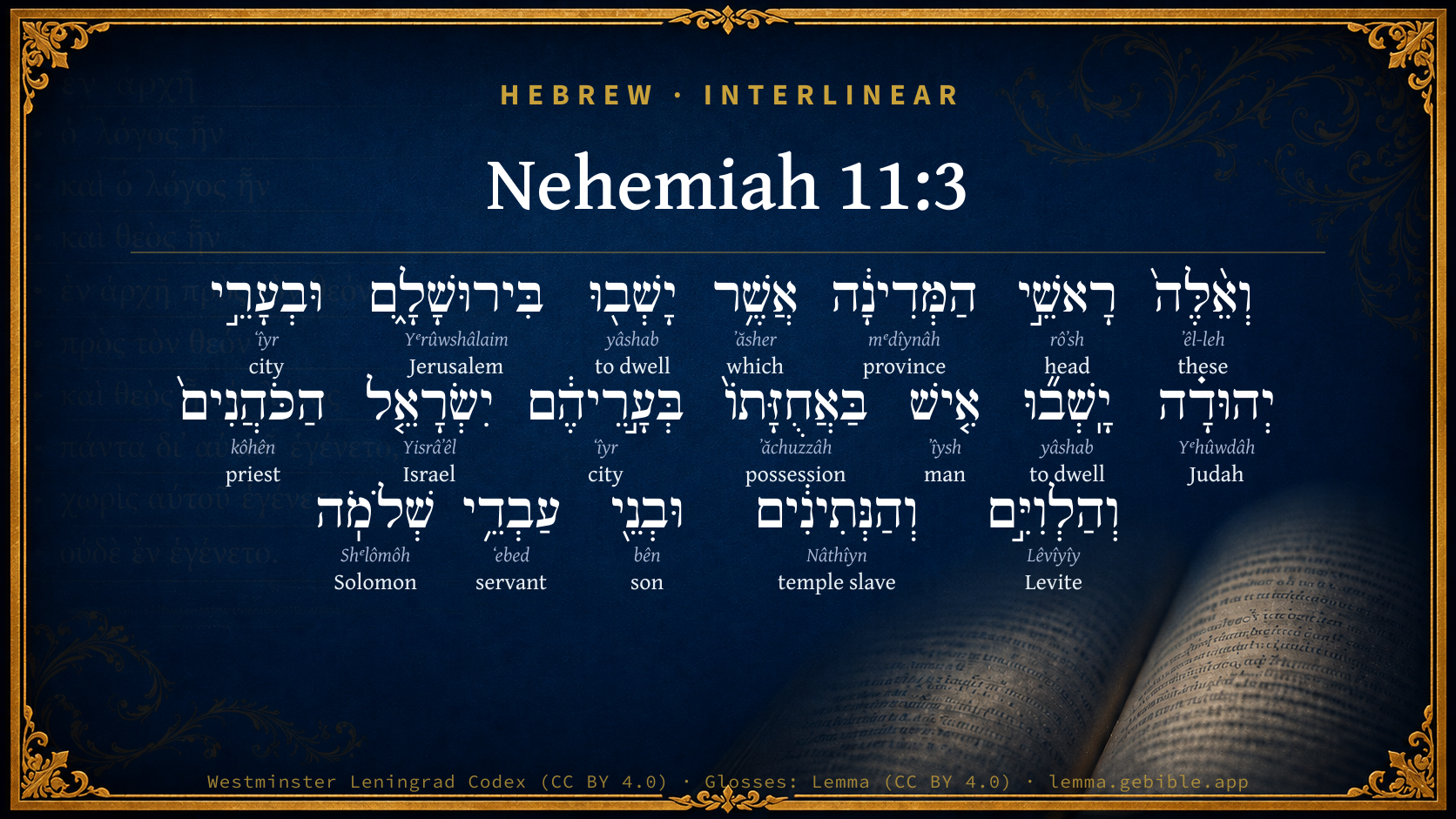
Nehemiah 11:3

Hebrew (Westminster Leningrad Codex) Nehemiah 11:3 appears in the Hebrew Old Testament. The text above is from the Westminster Leningrad Codex. Each word links to its Strong’s number, a concise gloss, and parsing drawn from the Open Scriptures Hebrew Bible morphology. Click any word for its full Brown-Driver-Briggs (BDB) entry.
Download image
Cite this verse

Nehemiah 11:3 (World English Bible). Public Domain. Lemma interlinear Bible study tool, https://lemma.gebible.app/v/nehemiah/11/3.

Show BibTeX & RIS
BibTeX
RIS
English Translation
Now these are the chiefs of the province who lived in Jerusalem: but in the cities of Judah lived everyone in his possession in their cities, [to wit], Israel, the priests, and the Levites, and the Nethinim, and the children of Solomon's servants.
World English Bible · Public Domain
Download a study sheet

One document with this verse’s original text, its word-by-word gloss line, the meaning frame, cross-references with their text, attributed commentary, and full source and license credits — printable, and it pastes into notes with its structure intact.

This verse Autodidact and up

Study sheet (.html) Plain text (.txt)

A passage Seminary Student

Up to 50 verses in one chapter. A passage sheet keeps up to 6 commentary sources and 12 cross-references per verse, in the order this page ranks them, and says so on the sheet whenever that leaves anything out. Ask for a single verse and you get the Autodidact verse sheet above.

Everything on this page stays free to read, with no account — the sheet is a download of what is already on screen, not access to it.

Want to remove ads? Support Godless Engineer
Compare translations 3

The same verse in 3 English versions, stacked beneath the original-language interlinear above. Click any original word for its lexicon entry.

Each is an independent rendering of the whole verse — the interlinear is not word-aligned to these translations.

Highlighted words mark where these versions differ — a whole-verse word diff, not a word-by-word alignment.

  • World English Bible Public Domain
    Now these are the chiefs of the province who lived in Jerusalem: but in the cities of Judah lived everyone in his possession in their cities, [to wit], Israel, the priests, and the Levites, and the Nethinim, and the children of Solomon's servants.
  • King James Version Public Domain
    Now these are the chief of the province that dwelt in Jerusalem: but in the cities of Judah dwelt every one in his possession in their cities, to wit, Israel, the priests, and the Levites, and the Nethinims, and the children of Solomon's servants.
  • unfoldingWord Literal Text CC BY-SA 4.0
    And these are the heads of the province who dwelt in Jerusalem. And in the cities of Judah they dwelt, a man on his property, in their cities: Israel, the priests, and the Levites, and the Nethinim, and the sons of the servants of Solomon.

unfoldingWord Literal Text — © unfoldingWord, licensed CC BY-SA 4.0. Word-aligned USFM3 via Door43 (git.door43.org/unfoldingWord/en_ult).

Versions to compare (up to 4)

3 of 4 selected

Show all 18 translations

Every available English version of this verse, each an independent rendering of the whole verse.

  • World English Bible Public Domain
    Now these are the chiefs of the province who lived in Jerusalem: but in the cities of Judah lived everyone in his possession in their cities, [to wit], Israel, the priests, and the Levites, and the Nethinim, and the children of Solomon's servants.
  • Berean Standard Bible Public Domain
    These are the heads of the provinces who settled in Jerusalem. (In the villages of Judah, however, each lived on his own property in their towns—the Israelites, priests, Levites, temple servants, and descendants of Solomon’s servants—
  • Majority Standard Bible Public Domain
    These are the heads of the provinces who settled in Jerusalem. (In the villages of Judah, however, each lived on his own property in their towns—the Israelites, priests, Levites, temple servants, and descendants of Solomon’s servants—
  • King James Version Public Domain
    Now these are the chief of the province that dwelt in Jerusalem: but in the cities of Judah dwelt every one in his possession in their cities, to wit, Israel, the priests, and the Levites, and the Nethinims, and the children of Solomon's servants.
  • American Standard Version (1901) Public Domain
    Now these are the chiefs of the province that dwelt in Jerusalem: but in the cities of Judah dwelt every one in his possession in their cities, `to wit', Israel, the priests, and the Levites, and the Nethinim, and the children of Solomon's servants.
  • Revised Version (1885) Public Domain
    Now these are the chiefs of the province that dwelt in Jerusalem: but in the cities of Judah dwelt every one in his possession in their cities, to wit, Israel, the priests, and the Levites, and the Nethinim, and the children of Solomon’s servants.
  • Geneva Bible (1599) Public Domain
    These now are the chiefe of the prouince, that dwelt in Ierusalem, but in the cities of Iudah, euery one dwelt in his owne possession in their cities of Israel, the Priestes and the Leuites, and the Nethinims, and the sonnes of Salomons seruants.
  • Douay-Rheims (1899) Public Domain
    These therefore are the chief men of the province, who dwelt in Jerusalem, and in the cities of Juda. And every one dwelt in his possession, in their cities: Israel, the priests, the Levites, the Nathinites, and the children of the servants of Solomon.
  • Young's Literal Translation Public Domain
    And these `are' heads of the province who have dwelt in Jerusalem, and in cities of Judah, they have dwelt each in his possession in their cities; Israel, the priests, and the Levites, and the Nethinim, and the sons of the servants of Solomon.
  • Literal Standard Version CC BY-SA 4.0
    And these [are] heads of the province who have dwelt in Jerusalem, and in cities of Judah, they have dwelt each in his possession in their cities; Israel, the priests, and the Levites, and the Nethinim, and the sons of the servants of Solomon.
  • Unlocked Literal Bible CC BY-SA 4.0
    These are the provincial officials who lived in Jerusalem. However, in the towns of Judah everyone lived on his own land, including some Israelites, priests, Levites, temple servants, and descendants of Solomon's servants.
  • unfoldingWord Literal Text CC BY-SA 4.0
    And these are the heads of the province who dwelt in Jerusalem. And in the cities of Judah they dwelt, a man on his property, in their cities: Israel, the priests, and the Levites, and the Nethinim, and the sons of the servants of Solomon.
  • Darby Bible Public Domain
    And these are the chiefs of the province that dwelt in Jerusalem; but in the cities of Judah dwelt every one in his possession in their cities, Israel, the priests, and the Levites, and the Nethinim, and the children of Solomon's servants.
  • World Messianic Bible Public Domain
    Now these are the chiefs of the province who lived in Jerusalem; but in the cities of Judah, everyone lived in his possession in their cities—Israel, the priests, the Levites, the temple servants, and the children of Solomon’s servants.
  • Webster's Bible Public Domain
    Now these are the chief of the province that dwelt in Jerusalem: but in the cities of Judah dwelt every one in his possession in their cities, to wit, Israel, the priests, and the Levites, and the Nethinims, and the children of Solomon's servants.
  • Free Bible Version CC BY-SA 4.0
    This is a list of the leaders of the province who came to live in Jerusalem. (Most of the Israelites lived on their own property in the towns of Judah. This included the priests, the Levites, the Temple servants, and the descendants of Solomon's servants who lived in their home towns.
  • Bible in Basic English Public Domain
    Now these are the chiefs of the divisions of the country who were living in Jerusalem: but in the towns of Judah everyone was living on his heritage in the towns, that is, Israel, the priests, the Levites, the Nethinim, and the children of Solomon's servants.
  • JPS Tanakh (1917) Public Domain
    Now these are the chiefs of the province that dwelt in Jerusalem; but in the cities of Judah dwelt every one in his possession in their cities, to wit, Israelites, the priests, and the Levites, and the Nethinim, and the children of Solomon's servants.

Literal Standard Version (2020), Covenant Press — licensed CC BY-SA 4.0. Text via the HelloAO Bible API (eBible.org). Unlocked Literal Bible (unfoldingWord) — licensed CC BY-SA 4.0. Text via the HelloAO Bible API (eBible.org). unfoldingWord Literal Text — © unfoldingWord, licensed CC BY-SA 4.0. Word-aligned USFM3 via Door43 (git.door43.org/unfoldingWord/en_ult). Free Bible Version, Dr. Jonathan Gallagher — licensed CC BY-SA 4.0. Text via the HelloAO Bible API (eBible.org).

Word by word

More ways to search: Search by grammar → Find every occurrence → Compare this word →

Practice this passage: Drill this verse → Learn its vocabulary →

וְהַנְּתִינִ֔ים
Nâthîyn
H5411
“and · the · temple slaves”
Conjunction + Particle, Definite Article + Noun, Common, Masculine, Plural, Absolute
Part of Speech
Conjunction + Particle + Noun
Type
Common
Gender
Masculine
Number
Plural
State
Absolute
Full BDB Definition

Origin: from H5414

TWOT: 1443a

Nethinims - temple slaves assigned to the Levites and priests for service in the sanctuary
  1. וְאֵ֨לֶּה֙ ʼêl-leh H428 “and · these” Conjunction + Pronoun, Demonstrative, Common, Plural
  2. רָאשֵׁ֣י rôʼsh H7218 “heads of” Noun, Common, Masculine, Plural, Construct
  3. הַמְּדִינָ֔ה mᵉdîynâh H4082 “the · province” Particle, Definite Article + Noun, Common, Feminine, Singular, Absolute
  4. אֲשֶׁ֥ר ʼăsher H834 “which” Particle, Relative
  5. יָשְׁב֖וּ yâshab H3427 “to dwell” Verb, Qal, Perfect, 3rd Person, Common, Plural
  6. בִּירוּשָׁלִָ֑ם Yᵉrûwshâlaim H3389 “in/at · Jerusalem” Preposition + Noun, Proper
  7. וּבְעָרֵ֣י ʻîyr H5892 “and · in/at · cities of” Conjunction + Preposition + Noun, Common, Feminine, Plural, Construct
  8. יְהוּדָ֗ה Yᵉhûwdâh H3063 “Judah” Noun, Proper
  9. יָֽשְׁב֞וּ yâshab H3427 “to dwell” Verb, Qal, Perfect, 3rd Person, Common, Plural
  10. אִ֤ישׁ ʼîysh H376 “man” Noun, Common, Masculine, Singular, Absolute
  11. בַּאֲחֻזָּתוֹ֙ ʼăchuzzâh H272 “in/at · possession · his” Preposition + Noun, Common, Feminine, Singular, Construct + Suffix, Personal, 3rd Person, Masculine, Singular
  12. בְּעָ֣רֵיהֶ֔ם ʻîyr H5892 “in/at · cities · their” Preposition + Noun, Common, Feminine, Plural, Construct + Suffix, Personal, 3rd Person, Masculine, Plural
  13. יִשְׂרָאֵ֤ל Yisrâʼêl H3478 “Israel” Noun, Proper
  14. הַכֹּהֲנִים֙ kôhên H3548 “the · priests” Particle, Definite Article + Noun, Common, Masculine, Plural, Absolute
  15. וְהַלְוִיִּ֣ם Lêvîyîy H3881 “and · the · Levites” Conjunction + Particle, Definite Article + Noun, Gentilic, Masculine, Plural, Absolute
  16. וּבְנֵ֖י bên H1121 “and · sons of” Conjunction + Noun, Common, Masculine, Plural, Construct
  17. עַבְדֵ֥י ʻebed H5650 “servants of” Noun, Common, Masculine, Plural, Construct
  18. שְׁלֹמֹֽה Shᵉlômôh H8010 “Solomon” Noun, Proper

About this verse

These counts appear in no published source. They are computed here, from the morphology-tagged text and Lemma’s own curated glosses. What Lemma adds →

19
words
17
distinct lemmas
Historical
section

Notable vocabulary

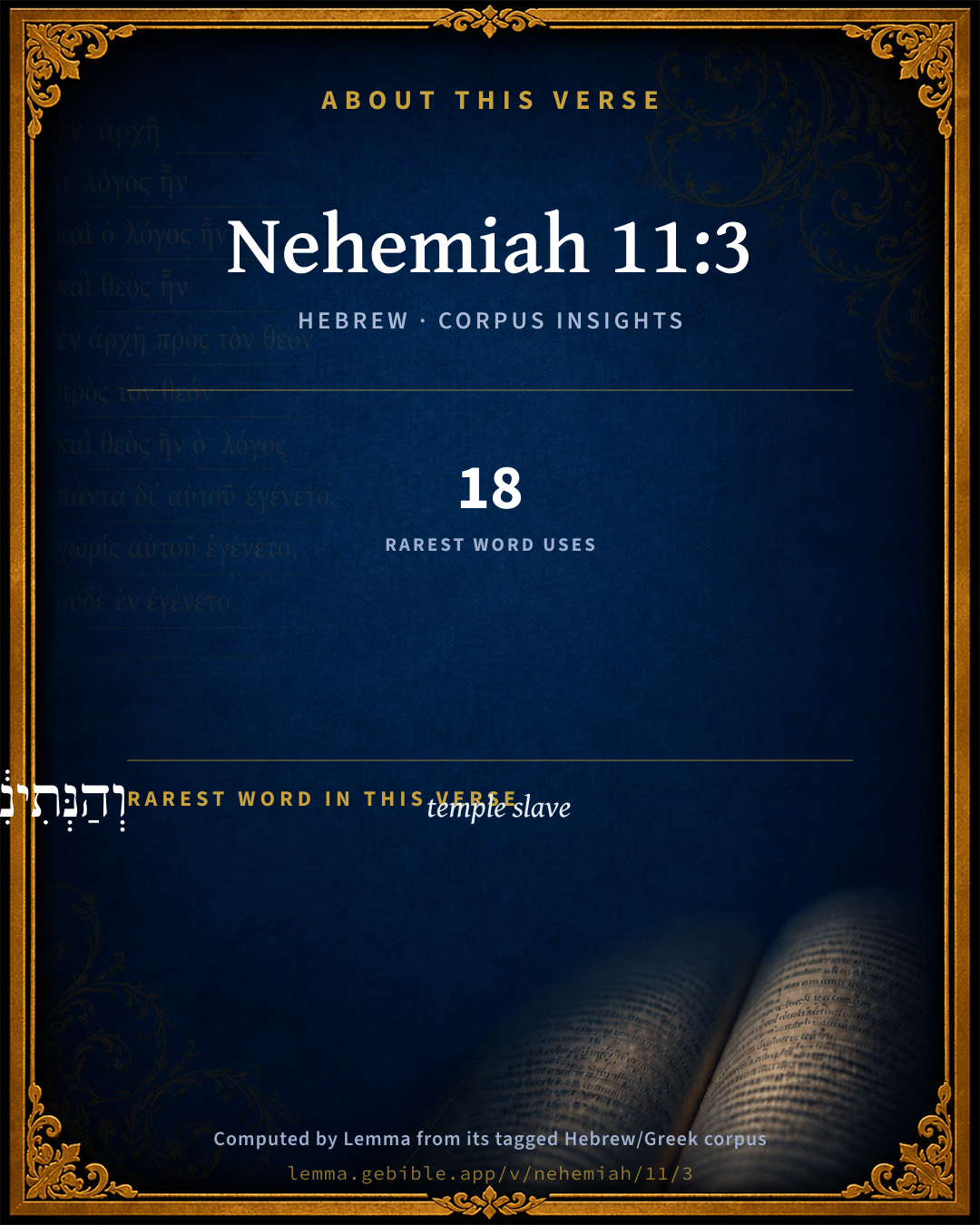
The rarest word here is וְהַנְּתִינִ֔ים temple slave H5411 — appearing just 18 times in the whole Hebrew Bible.

Shared distinctive vocabulary

וְהַנְּתִינִ֔ים temple slave H5411 occurs in 15 verses of the Hebrew Bible. Also found in:

Grammatical profile

  • 2 verbs
  • 15 nouns
  • 1 pronoun
  • 1 particle

Verb forms

  • יָשְׁב֖וּ Qal · Perfect
  • יָֽשְׁב֞וּ Qal · Perfect

Repetition

Words recur within this verse — often emphatic in Hebrew:

  • יָשְׁב֖וּ to dwell H3427 ×2
  • וּבְעָרֵ֣י city H5892 ×2

Cross-references

9

Topical passages linked to Nehemiah 11:3 in the Treasury of Scripture Knowledge — connected by theme and wording, ordered by reader-vote popularity; previews shown in the World English Bible.

  • 1 Chronicles 9:1–34 So all Israel were reckoned by genealogies; and, behold, they are written in the book of the kings of Israel: and Judah was carried away captive to Babylon for their disobedience.
  • Ezra 2:1 Now these are the children of the province, who went up out of the captivity of those who had been carried away, whom Nebuchadnezzar the king of Babylon had carried away to Babylon, and who returned to Jerusalem and Judah, everyone to his city;
  • Ezra 2:43 The Nethinim: the children of Ziha, the children of Hasupha, the children of Tabbaoth,
  • Nehemiah 7:73 So the priests, and the Levites, and the porters, and the singers, and some of the people, and the Nethinim, and all Israel, lived in their cities. When the seventh month was come, the children of Israel were in their cities.
  • Ezra 2:55–58 The children of Solomon's servants: the children of Sotai, the children of Hassophereth, the children of Peruda,
  • Ezra 2:70 So the priests, and the Levites, and some of the people, and the singers, and the porters, and the Nethinim, lived in their cities, and all Israel in their cities.
  • Nehemiah 7:6 These are the children of the province, who went up out of the captivity of those who had been carried away, whom Nebuchadnezzar the king of Babylon had carried away, and who returned to Jerusalem and to Judah, everyone to his city;
  • Nehemiah 7:57–60 The children of Solomon's servants: the children of Sotai, the children of Sophereth, the children of Perida,
  • Nehemiah 11:20 The residue of Israel, of the priests, the Levites, were in all the cities of Judah, everyone in his inheritance.

Cross-references courtesy of OpenBible.info (CC BY 4.0).

Hebrew and Greek witnesses Masoretic Hebrew ↔ Greek Septuagint

The same verse in the two great witnesses to the Old Testament, shown verse-for-verse.

These are two independent witnesses, not word-aligned to each other, and the Septuagint is shown in lemma (dictionary) form.

Hebrew Nehemiah 11:3 Masoretic · Westminster Leningrad Codex

וְאֵ֨לֶּה֙ רָאשֵׁ֣י הַמְּדִינָ֔ה אֲשֶׁ֥ר יָשְׁב֖וּ בִּירוּשָׁלִָ֑ם וּבְעָרֵ֣י יְהוּדָ֗ה יָֽשְׁב֞וּ אִ֤ישׁ בַּאֲחֻזָּתוֹ֙ בְּעָ֣רֵיהֶ֔ם יִשְׂרָאֵ֤ל הַכֹּהֲנִים֙ וְהַלְוִיִּ֣ם וְהַנְּתִינִ֔ים וּבְנֵ֖י עַבְדֵ֥י שְׁלֹמֹֽה

Now these are the chiefs of the province who lived in Jerusalem: but in the cities of Judah lived everyone in his possession in their cities, [to wit], Israel, the priests, and the Levites, and the Nethinim, and the children of Solomon's servants.

World English Bible · Public Domain

Greek LXX Structure differs

The Septuagint has no separate book of Nehemiah. Its Greek text is the second half of Esdras B (2 Esdras), chapters 11–23; Ezra is the first half (1–10).

A verse-for-verse comparison isn’t shown here because the chapters and verses don’t line up. Switch to the LXX edition with the MT / LXX toggle above to read the Greek directly.

Hebrew: Westminster Leningrad Codex (CC BY 4.0). Greek: Septuagint (public domain); English from a public-domain English Septuagint. How the Septuagint differs from the Hebrew →

Commentary

Notes on Nehemiah 11:3 from classic Christian and Jewish commentators (each source and its license shown beneath its notes). The classic Christian expositions comment on the surrounding passage and are grouped to its opening verse, so a note may address several verses; the Jewish commentaries on the Tanakh (Rashi and others) are per-verse, so they appear only where the commentator wrote on this verse.

Lemma curates 59 commentaries, every one of them public domain or Creative Commons licensed, each selected and text-cleaned for this edition rather than reprinted as found. About our sources →

Jamieson, Fausset & Brown

Robert Jamieson, A. R. Fausset & David Brown

THEIR NAMES. (Neh. 11:3-36)

the chief of the province--that is, Judea. Nehemiah speaks of it, as it then was, a small appendix of the Persian empire.

in the cities of Judah dwelt every one in his possession in their cities--The returned exiles, who had come from Babylon, repaired generally, and by a natural impulse, to the lands and cities throughout the country which had been anciently assigned them.

Israel--This general name, which designated the descendants of Jacob before the unhappy division of the two kingdoms under Rehoboam, was restored after the captivity, the Israelites being then united with the Jews, and all traces of their former separation being obliterated. Although the majority of the returned exiles belonged to the tribes of Judah and Benjamin, they are here called Israel because a large number out of all the tribes were now intermingled, and these were principally the occupiers of the rural villages, while none but those of Judah and Benjamin resided in Jerusalem.

the Levites--These took possession of the cities allotted to them according as they had opportunity.

the Nethinims--A certain order of men, either Gibeonites or persons joined with them, who were devoted to the service of God.

Jamieson, Fausset & Brown — Commentary Critical and Explanatory on the Whole Bible (1871) — public domain (CC PDM 1.0). Text via the HelloAO Bible API.

The Cambridge Bible for Schools and Colleges

gen. ed. J. J. S. Perowne

3. Now these are the chief, &c.] The heading of our list differs from that in 1Ch_9:2, which runs, ‘Now the first inhabitants that dwelt in their possessions in their cities were, Israel, the priests, the Levites, and the Nethinim.’ The purpose of the list in 1 Chronicles 9 is apparently to give the names of the families who had either remained in Judea at the time when the mass of the people were transported to Babylon, or had returned to their own country either from exile or from voluntary flight in Egypt and the neighbouring nations. The purpose of the list in our passage is apparently to state the number of the inhabitants either before or after (Rawlinson) the measures taken to augment them in Nehemiah’s time.

The mention of ‘the king’ in Neh_11:23 and Neh_11:24 is apparently a reference to Artaxerxes; a conclusive proof that the list belongs to the age of Nehemiah.

According to some commentators, the list is intended to give the names of ‘the princes of the people’ mentioned in Neh_11:1. But the expression ‘the chiefs of the province’ (see on Ezr_2:1) suggests that the list and its superscription have no original connexion with Neh_11:1-2. It is more probable that the Compiler having access to this list belonging to the age of Nehemiah, in which the classification is that of ‘the dwellers in Jerusalem’ (4–19) and ‘the residue of Israel’ (20–36) has inserted it here in terms as nearly as possible corresponding to the division of the people in Neh_11:1.

Nethinims] R.V. Nethinim.

and the children of Solomon’s servants] See on Ezr_2:58; Neh_7:57. These are not mentioned in the parallel passage, 1Ch_9:2.

3–10. From this verse to Neh_12:26 we have a succession of lists: (1) the chiefs of the provinces that dwelt in Jerusalem, 4–26; (2) the towns and villages occupied by the Jews, 25–36; (3) the priests and Levites that went up with Zerubbabel from Babylon, Neh_12:1-9; (4) the genealogy of the high-priests beginning at Jeshua, Neh_12:10-11; (5) the heads of the priestly houses in the days of Joiakim, Neh_12:12-21; (6) of the Levitical houses at the same period, Neh_12:22-26.

The origin of the lists is not recorded. That some of them may have been included in the ‘Memoirs’ of Nehemiah is very possible. But all doubtless bear traces of the Compiler’s work either by abridgement or by necessary adaptation from official records.

The first of the lists presents a close resemblance to a list contained in the Book of Chronicles: compare Neh_11:3-19 with 1Ch_9:2-17. The two lists are clearly the same although they differ in certain details. The best way of accounting for the presence of this duplicate list is to suppose that both were copied from the same official document, but by different hands and for different purposes. The Compiler found both copies extant, the one in connexion with the genealogies of the tribes (1 Chronicles 9), the other either embodied in, or preserved along with, the official documents of Nehemiah’s government.

The Cambridge Bible for Schools and Colleges (gen. ed. J. J. S. Perowne; Cambridge University Press, 1878–1918) — public domain. Text from a community e-Sword module.

Trapp's Complete Commentary

John Trapp

Neh 11:3 Now these [are] the chief of the province that dwelt in Jerusalem: but in the cities of Judah dwelt every one in his possession in their cities, [to wit], Israel, the priests, and the Levites, and the Nethinims, and the children of Solomon’s servants.

Ver. 3. Now these are the chief of the province] So Judea is called, because now subject and tributary to the king of Babylon; as afterwards it was to the Romans (and is therefore called a province, Act 25:1), and is now to the Turk. How then could those Jews in the Gospel say, We are Abraham’s seed, and were never in bondage to any man; but that they cared not what they said in a bravado? Spaniards are said to be impudent braggers, and extremely proud in the lowest ebb of fortune. These Jews were so certainly; and so they continue.

John Trapp, A Commentary or Exposition upon All the Books of the Old and New Testament (1647–1656) — public domain. Text from a community e-Sword module.

Joseph Benson's Commentary

Neh 11:3. These are the chief of the province — Of Judea, which was now made a province. Israel — The generality of the people of Israel, whether of Judah, or Benjamin, or any other tribe. These he calls Israel, rather than Judah, because there were many of the other tribes now incorporated with them; and because none of the tribes of Israel, except Judah and Benjamin, dwelt in Jerusalem.

Joseph Benson's Commentary on the Old and New Testaments (1811–1818) — public domain. Text from a community e-Sword module.

Whedon's Commentary on the Bible

Daniel D. Whedon

LIST OF THE CHIEFS OF THE PROVINCE, Neh_11:3-16.

A comparison of this list with that of 1 Chronicles 9, (where see notes,) shows that they both agree in their plan, and in a considerable number of their names. The differences are too many to allow the opinion that the lists are substantially identical, and that each is an imperfect transcript of an older and fuller catalogue of names. The list in Chronicles contains, according to its heading, the names of those who first settled in their possessions after the exile; the present list is of later date, and belongs to the times of Nehemiah.

3. The chief of the province — The chiefs or heads of families who represented the entire province of Judea in the time of Nehemiah. This providence was then one of the subdivisions of the Persian empire.

But in the cities of Judah — Rather, and in the cities of Judah. The list contains the names of chief fathers dwelling in other cities of the province as well as in Jerusalem. See Neh_11:25-36.

Israel — This word here denotes the entire body of the covenant people, (the laity, so to speak,) exclusive of the four special classes next named.

Daniel D. Whedon (gen. ed.), Commentary on the Old and New Testaments (1874–1909) — public domain. Text from a community e-Sword module.

Keil & Delitzsch

C. F. Keil & F. Delitzsch

The inhabitants of Jerusalem and the other cities. - Neh 11:3 The title reads: "These are the heads of the province who dwelt at Jerusalem; and in the cities of Judah dwelt every one in his possession in their cities, Israel, the priests, the Levites, the Nethinim, and the sons of Solomon's servants." המּדינה is, as in Ezr 2:1, the land of Judah, as a province of the Persian kingdom. The repetition of ישׁבוּ after יהוּדה בּערי is not to be understood as contrasting those who dwelt in the cities with the dwellers in Jerusalem in the sense of "but in the cities of Judah dwelt," etc., but is here a mere pleonasm. Even the enumeration of the different classes of inhabitants: Israel, the priests, etc., clearly shows that no such contrast is intended; for Israel, the priests, etc., dwelt not only in Jerusalem, but also, according to Neh 11:20, in the other cities of Judah. And this is placed beyond all doubt by the contents of the list following; the inhabitants of Jerusalem being enumerated vv. 4-24, and the inhabitants of the other cities of Judah and Benjamin, Neh 11:25-36. If, however, this title refers to the whole of the following list, it cannot, as Rambach and others thought, contain only an enumeration of those who, in consequence of the lot, had taken up their residence at Jerusalem, but must be intended as a list of the population of the whole province of Judah in the times of Ezra and Nehemiah. It seems strange that the title should announce המּדינה ראשׁי, while in the list of the inhabitants of Jerusalem are given, besides the heads, the numbers of their brethren, i.e., of the individuals or fathers of families under these heads; and that in the list of the inhabitants of the other cities, only inhabitants of Judah and Benjamin are spoken of. Hence this statement refers a potiori to the heads, including the houses and families belonging to them, while in the case of the other cities it is assumed that the inhabitants of each locality were under a head. With Neh 11:4 begins the enumeration of the heads dwelling in Jerusalem, with their houses; and the first clause contains a special title, which affirms that (certain) of the children of Judah and of the children of Benjamin dwelt at Jerusalem. On the parallel list of the inhabitants of Jerusalem before the captivity, 1 Chron 9:2-34, and its relation to the present list, see the remarks on 1 Chron 9.

Neh 11:4-6

Of the children of Judah two heads: Athaiah of the children of Perez (comp. Ch1 2:4), and Maaseiah of the children of Shela. It has been already remarked on Ch1 9:5, that השּׁלני is wrongly pointed, and should be read השּׁלני. כּל־חזה is a proper name, as in Neh 3:15. Athaiah and Maaseiah are not further known. There were in all four hundred and sixty-eight able-bodied men of the sons of Perez, i.e., four hundred and sixty-eight fathers of families of the race of Perez, among whom are probably included the fathers of families belonging to Shela, the younger brother of Perez.

Keil & Delitzsch — Biblical Commentary on the Old Testament (1861–1891) — public domain (CC PDM 1.0). Text via the HelloAO Bible API. (Old Testament only.)

Adam Clarke's Commentary

Verse 3. Now these are the chief] A good deal of difference will be found between the enumeration here and that in 1Ch 9:2, c. There, those only who came with Zerubbabel appear to be numbered here, those, and the persons who came with Ezra and Nehemiah, enter into the account.

Adam Clarke's Commentary on the Bible (1810–1826) — public domain. Text from a community e-Sword/MySword module.

Ellicott's Commentary for English Readers

(3) Of the province.—This betrays the hand of Nehemiah, who was still a Persian official as well as a governor of Judah; and it shows that here we have a general heading for the rest of the chapter. Both city and country are included in the rest of the verse.

Israel.—The two Israelitish tribes were represented, but, like Judah before, this has become a generic name.

A Bible Commentary for English Readers, edited by Charles John Ellicott (1878–1897) — public domain. Text from a community e-Sword module.

John Gill's Exposition

And at Jerusalem dwelt certain of the children of Judah, and of the children of Benjamin,.... It belonging partly to one tribe and partly to the other, and so inhabited by both, as it originally was, Jos 15:63

of the children of Judah; Athaiah; called Uthai, Ch1 9:4 whose lineage is traced through Uzziah, Zechariah, Amariah, Shephatiah, Mahalaleel:

of the children of Perez; a son of Judah, see Ch1 9:4.

John Gill's Exposition of the Whole Bible (1746–1763) — public domain (CC PDM 1.0). Text via the HelloAO Bible API.

Haydock's Catholic Bible Commentary

Solomon. See 1 Esdras ii. 55., and 1 Paralipomenon ix. 2.

George Leo Haydock (1774–1849), Haydock's Catholic Family Bible and Commentary, 1859 edition — public domain. Excludes Psalms (Douay-Rheims chapter numbering differs from Protestant) and Deuterocanonical books (Catholic canon only).

Matthew Poole's English Annotations

The chief of the province, i.e. of Judea, which was now made a province.

To wit, Israel, i.e. the generality of the people of Israel, whether of Judah, or Benjamin, or any other tribe; as appears by this general enumeration of all the inhabitants of the land, in which either the people of Judah and Benjamin are included under the title of Israel, or they are not here mentioned; which is absurd to think, because they made up the greatest number of them. And these he calls

Israel rather than Judah, partly because there were many of the other tribes now joined and incorporated with them; and partly because none of the tribes of Israel, except Judah and Benjamin, dwelt in Jerusalem, as appears from the sequel.

Matthew Poole's English Annotations on the Holy Bible (1683–1685) — public domain. Text from a community e-Sword/MySword module.

The Pulpit Commentary

These are the chief of the province. A comparison is in the writer"s mind between the Jews of Palestine and those of the great Persian capitals, Babylon and Susa, to which, as a Persian official, he himself properly belongs. Compare Neh_1:3 and Ezr_2:1. That dwelt in Jerusalem. i.e. "that were entered in Nehemiah"s census among the inhabitants of Jerusalem after the transfer of population had been made." The names which follow appear in most cases to be personal, but a certain number of them are names of families. In the cities of Judah dwelt every one in his possession. It follows that those who removed from the country districts to Jerusalem quitted their "possessions, often, it may be, exchanging riches for poverty, a comfortable house for one half in ruins, (Neh_7:4) and the life of a small landed proprietor for that of an artisan or hired labourer. Hence the "blessings" called down by the people on those who volunteered (ver. 2). Israel. Compare 1Ch_9:3, where we find that among those who had returned were mere-bers of the two great Israelitish tribes, Manasseh and Ephraim. On the Nethinims, and the children of Solomon"s servants , see the comment on Ezr_2:43, Ezr_2:55.

Vers. 3-36. Three elements in the Church of Christ.

In the first verse of this chapter Jerusalem is called "the holy city;" as such it was the type of the Church of Christ. In three respects it bore to the Christian Church a real and close resemblance.

1. It was a separated city; separated and fenced from surrounding idolatries and immoralities.

2. It was a distinguished city; distinguished by the manifested presence of God, and by the knowledge of his holy will.

3. It was a commissioned city; charged to hold and preserve a certain deposit of sacred truth against all the world. The Church of Christ is a body

(1) separated from surrounding irreligion, error, and folly;

(2) distinguished by the presence of the indwelling Spirit of God, and the graces he communicates;

(3) commissioned to carry the gospel of the grace of God to the utmost ends of the earth. There are to be in the Church what there were in the city, three things, viz.

I THE ELEMENT OF ORDER. There were dwelling in Jerusalem "the rulers of the people" (ver. 1). Concerning these rulers, we are told who was "overseer" of the "sons of Benjamin" (ver. 9); who was "overseer" of the priests (ver. 14); who also of the Levites (ver. 22); we are told who was presenter, "the principal to begin the thanksgiving in prayer" (ver. 17); who had "the oversight of the outward business of the house of God;" (ver. 16), and who of the internal business (ver. 22). Everything was obviously ordered most carefully, and every one had his post at which to rule or serve. The "order" of the Church of Christ is something which has given rise to most serious differences and disputes alas! to much bitterness and bloodshed. There are advocates of

(1) one universal visible Church,

(2) national Churches,

(3) large closely-confederated Christian communities,

(4) separate societies united only by occasional non-legislative councils or unions.

But whatever the form which the Christian Church may take, whatever its method of organisation, order should always be conspicuously present. "God is not the author of confusion, but of peace, as in all Churches of the saints". (1Co_14:33) Everything is to be done "in order":. (1Co_14:40) There are two complementary duties a Christian man may set before him: one, the bringing about, in an orderly way, that form of Church organisation which, after diligent study and patient observance, he considers to be after the will of Christ; the other, the taking his place in that particular Church of which he is a member, and filling it faithfully and peacefully. He who, in the name of order, brings about contention brings down on himself the condemnation of his Master. (1Co_11:16)

II THE ELEMENT OF VARIETY. Beside the governor were "rulers of the people" (ver. 1) generally; and, particularly, priests (ver. 10), and Levites (ver. 15), and porters (ver. 19), and singers (ver. 22); and, still more particularly,

(1) those who were engaged in the "outward business of the house of God" (ver. 16), and

(2) those who were occupied with the internal arrangements (ver. 22). All these various classes had their work to do; not one was redundant. Some were much higher than others, and did a work of a more valuable and a higher kind, but every one was needed in his place, and the security of Jerusalem, as well as the worship of God, would have been incomplete if all had not done their work at the appointed time and place. In the Christian Church are many services to be rendered, and many orders of servants. Some are higher, others lower. But from the man inspired of God to teach and kindle thousands of human souls, to "the doorkeeper of the house," every one has his work to do for Christ and for man. One workman needs the other, and the world needs them all; and the eye cannot say to the foot, "I have no need of thee," etc. If we "magnify our own office" that we may be found faithful therein, let us not disparage that of others, lest we be counted self- important by our brethren, and injurious by our Lord.

III THE ELEMENT OF UNSUSPECTED STRENGTH. To the eye of flesh Jerusalem seemed weak enough at this time. If we include "the residue of Israel" that were in the cites of Judah (ver. 20), and those in the villages with their fields (ver. 25), all in the outlying provinces of Judah and Benjamin, they make but a very feeble band compared with other places then or with other communities now. How easily might they have been crushed and extirpated by the Persian power, so far as human calculations go. Yet they were the Church of God on earth, the custodians of his holy oracles, the chosen company from which should come forth the Divine Redeemer, and from which should go forth the Divine mission that is to transform the world. The Church of Christ may still seem small as compared with the "un-possessed land" of heathendom; individual Churches may seem weak in the midst of an all-surrounding and overtowering iniquity; but "God is in the midst of her;" his" right hand" is On her side. There is an unsuspected strength in the truth she holds, in the weapons she wields, in the cause of which she is the champion. In ways and by means quite unsuspected by her enemies, and equally unexpected by herself, God will make his Church his agent for the redemption of the world. C.

The Pulpit Commentary (1880–1919), ed. H.D.M. Spence-Jones & Joseph S. Exell — public domain. Text from a community e-Sword module.

John Wesley's Explanatory Notes

Province - Of Judea, which was now made a province. Israel - The generality of the people of Israel, whether of Judah, or Benjamin, or any other tribe. These he calls Israel rather than Judah, because there were many of the other tribes now incorporated with them; and because none of the tribes of Israel, except Judah and Benjamin, dwelt in Jerusalem.

John Wesley, Explanatory Notes Upon the Whole Bible (1754–1765) — public domain. Text via the GEBible commentary corpus.

unfoldingWord translationNotes

Door43 World Missions Community

on his own land, including some Israelites

"on his own land: Israelites"

some of the descendants of Judah and some of the descendants of Benjamin

"some of the people of Judah and some of the people of Benjamin"

The people from Judah included:

"From the descendants of Judah:"

Judah ... Benjamin ... Athaiah ... Uzziah ... Zechariah ... Amariah ... Shephatiah ... Mahalalel ... Perez

These are the names of men. (See: How to Translate Names)

a descendant of Perez

"from the descendants of Perez"

translationWords

Jerusalem

kingdom of Judah

Israel

priest

Levi

temple

servant

descend

Solomon

Judah

Benjamin

son

Zechariah (OT)

unfoldingWord translationNotes — © Distant Shores Media and the Door43 World Missions Community, licensed CC BY-SA 4.0. Source: git.door43.org/Door43/en_tn.

Rashi

Rabbi Shlomo Yitzchaki (Rashi)

And these are the heads of the province who dwelt in Jerusalem these are the ones regarding whom it is stated below: “And in Jerusalem there dwelt of the children of Judah, etc.”

Rashi on the Tanakh — English translations: “The Judaica Press complete Tanach with Rashi, translated by A. J. Rosenberg” (CC BY 4.0); “Pentateuch with Rashi's commentary by M. Rosenbaum and A.M. Silbermann, 1929-1934” (public domain); “The Metsudah Tanach series, Lakewood, N.J” (CC BY 4.0); and “The Book of Joshua, Metsudah Publications, 1997” (CC BY 4.0). Text via Sefaria.

Lesson kit

Teaching starters — assembled from the data on this page, not authored interpretation. Every prompt links to the verse data it draws on. Edit before teaching.

Nehemiah, in the Historical, opens this verse with 19 words (17 distinct Hebrew lemmas). Its most distinctive word is Nâthîyn (“temple slave”). A historical commentator’s framing appears above. Read the whole chapter for the surrounding context.

Discussion questions

  1. What does “temple slave” (Nâthîyn) contribute to the verse as a whole?
  2. 1 Chronicles 9:2 shares the word «temple slave» with this verse. How do the two illuminate each other?
  3. “to dwell” occurs 2× in this one verse. What is the effect of the repetition?
  4. These translations render this verse differently; the difference is in the English rendering, not the original. What questions does that raise?
  5. The verb «יָשְׁב֖וּ» is Qal Perfect. How does its form color the action?
  6. Reading how Jamieson, Fausset & Brown and The Cambridge Bible for Schools and Colleges read this verse, where do the two commentators agree and where do they part?

Things to notice

Reading settings

Reading text

Shown beneath each verse's original-language words.

Old Testament
Old Testament edition

Read the OT as the Masoretic Hebrew (MT) or the Greek Septuagint (LXX).

English shown for the Greek Septuagint (in the Hebrew ↔ Greek comparison).

Comparing translations? Open the Compare panel on any verse page to stack up to four side by side.