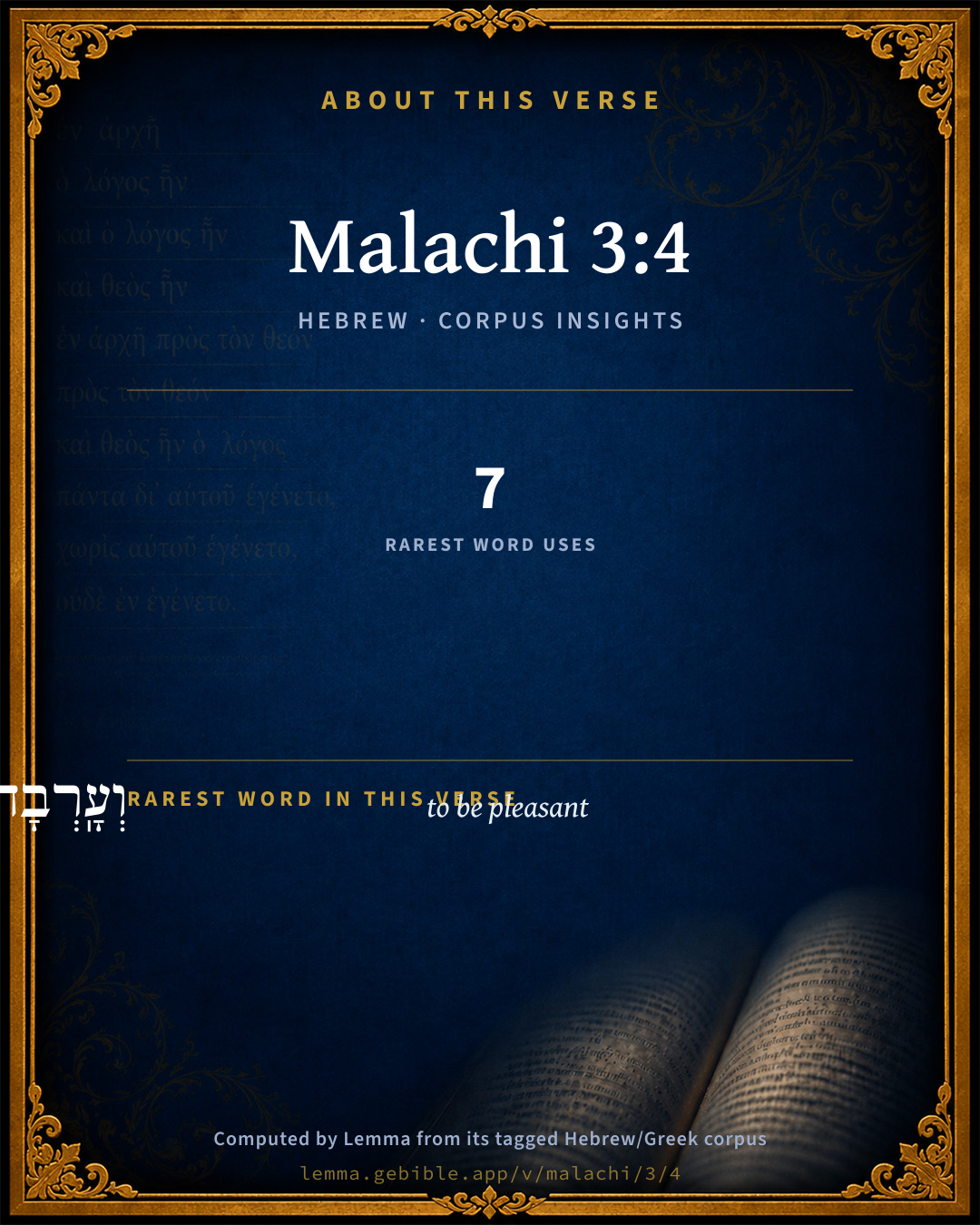
Malachi 3:4

Hebrew (Westminster Leningrad Codex) Malachi 3:4 appears in the Hebrew Old Testament. The text above is from the Westminster Leningrad Codex. Each word links to its Strong’s number, a concise gloss, and parsing drawn from the Open Scriptures Hebrew Bible morphology. Click any word for its full Brown-Driver-Briggs (BDB) entry.
Download image
Cite this verse

Malachi 3:4 (World English Bible). Public Domain. Lemma interlinear Bible study tool, https://lemma.gebible.app/v/malachi/3/4.

Show BibTeX & RIS
BibTeX
RIS
English Translation
Then the offering of Judah and Jerusalem will be pleasant to Yahweh, as in the days of old, and as in ancient years.
World English Bible · Public Domain
Download a study sheet

One document with this verse’s original text, its word-by-word gloss line, the meaning frame, cross-references with their text, attributed commentary, and full source and license credits — printable, and it pastes into notes with its structure intact.

This verse Autodidact and up

Study sheet (.html) Plain text (.txt)

A passage Seminary Student

Up to 50 verses in one chapter. A passage sheet keeps up to 6 commentary sources and 12 cross-references per verse, in the order this page ranks them, and says so on the sheet whenever that leaves anything out. Ask for a single verse and you get the Autodidact verse sheet above.

Everything on this page stays free to read, with no account — the sheet is a download of what is already on screen, not access to it.

Want to remove ads? Support Godless Engineer
Compare translations 3

The same verse in 3 English versions, stacked beneath the original-language interlinear above. Click any original word for its lexicon entry.

Each is an independent rendering of the whole verse — the interlinear is not word-aligned to these translations.

Highlighted words mark where these versions differ — a whole-verse word diff, not a word-by-word alignment.

  • World English Bible Public Domain
    Then the offering of Judah and Jerusalem will be pleasant to Yahweh, as in the days of old, and as in ancient years.
  • King James Version Public Domain
    Then shall the offering of Judah and Jerusalem be pleasant unto the LORD, as in the days of old, and as in former years.
  • unfoldingWord Literal Text CC BY-SA 4.0
    Then the offering of Judah and Jerusalem will be pleasing to Yahweh, as the days of old and as former years.

unfoldingWord Literal Text — © unfoldingWord, licensed CC BY-SA 4.0. Word-aligned USFM3 via Door43 (git.door43.org/unfoldingWord/en_ult).

Versions to compare (up to 4)

3 of 4 selected

Show all 18 translations

Every available English version of this verse, each an independent rendering of the whole verse.

  • World English Bible Public Domain
    Then the offering of Judah and Jerusalem will be pleasant to Yahweh, as in the days of old, and as in ancient years.
  • Berean Standard Bible Public Domain
    Then the offerings of Judah and Jerusalem will please the LORD, as in days of old and years gone by.
  • Majority Standard Bible Public Domain
    Then the offerings of Judah and Jerusalem will please the LORD, as in days of old and years gone by.
  • King James Version Public Domain
    Then shall the offering of Judah and Jerusalem be pleasant unto the LORD, as in the days of old, and as in former years.
  • American Standard Version (1901) Public Domain
    Then shall the offering of Judah and Jerusalem be pleasant unto Jehovah, as in the days of old, and as in ancient years.
  • Revised Version (1885) Public Domain
    Then shall the offering of Judah and Jerusalem be pleasant unto the LORD, as in the days of old, and as in ancient years.
  • Geneva Bible (1599) Public Domain
    Then shall the offerings of Iudah and Ierusalem be acceptable vnto the Lord, as in old time and in the yeeres afore.
  • Douay-Rheims (1899) Public Domain
    And the sacrifice of Juda and of Jerusalem shall please the Lord, as in the days of old, and in the ancient years.
  • Young's Literal Translation Public Domain
    And sweet to Jehovah hath been the present of Judah and Jerusalem, As in days of old, and as in former years.
  • Literal Standard Version CC BY-SA 4.0
    And the present of Judah and Jerusalem has been sweet to YHWH, || As in days of old, and as in former years.
  • Unlocked Literal Bible CC BY-SA 4.0
    Then the offering of Judah and Jerusalem will be pleasing to Yahweh, as in the days of old, and as in ancient years.
  • unfoldingWord Literal Text CC BY-SA 4.0
    Then the offering of Judah and Jerusalem will be pleasing to Yahweh, as the days of old and as former years.
  • Darby Bible Public Domain
    Then shall the oblation of Judah and Jerusalem be pleasant unto Jehovah, as in the days of old, and as in former years.
  • World Messianic Bible Public Domain
    Then the offering of Judah and Jerusalem will be pleasant to the LORD as in the days of old and as in ancient years.
  • Webster's Bible Public Domain
    Then shall the offering of Judah and Jerusalem be pleasant to the LORD, as in the days of old, and as in former years.
  • Free Bible Version CC BY-SA 4.0
    Then the offerings of Judah and Jerusalem will please the Lord as they did in the old days, in the former years.
  • Bible in Basic English Public Domain
    Then the offering of Judah and Jerusalem will be pleasing to the Lord, as in days gone by, and as in past years.
  • JPS Tanakh (1917) Public Domain
    Then shall the offering of Judah and Jerusalem be pleasant unto the LORD, as in the days of old, and as in ancient years.

Literal Standard Version (2020), Covenant Press — licensed CC BY-SA 4.0. Text via the HelloAO Bible API (eBible.org). Unlocked Literal Bible (unfoldingWord) — licensed CC BY-SA 4.0. Text via the HelloAO Bible API (eBible.org). unfoldingWord Literal Text — © unfoldingWord, licensed CC BY-SA 4.0. Word-aligned USFM3 via Door43 (git.door43.org/unfoldingWord/en_ult). Free Bible Version, Dr. Jonathan Gallagher — licensed CC BY-SA 4.0. Text via the HelloAO Bible API (eBible.org).

Word by word

More ways to search: Search by grammar → Find every occurrence → Compare this word →

Practice this passage: Drill this verse → Learn its vocabulary →

וְעָֽרְבָה֙
ʻârêb
H6149
“and · to be pleasant”
Conjunction + Verb, Qal, Sequential Perfect, 3rd Person, Feminine, Singular
Part of Speech
Conjunction + Verb
Stem
Qal
Form
Sequential Perfect
Person
3rd Person
Gender
Feminine
Number
Singular
Full BDB Definition

Origin: a primitive root [identical with H614 idea of close association]; to be agreeable

TWOT: 1687a

(Qal) to be pleasant, be sweet, be pleasing - (TWOT) sweet, pleasant
  1. לַֽיהוָ֔ה Yᵉhôvâh H3068 “to/for · LORD” Preposition + Noun, Proper
  2. מִנְחַ֥ת minchâh H4503 “offering of” Noun, Common, Feminine, Singular, Construct
  3. יְהוּדָ֖ה Yᵉhûwdâh H3063 “Judah” Noun, Proper
  4. וִירֽוּשָׁלִָ֑ם Yᵉrûwshâlaim H3389 “and · Jerusalem” Conjunction + Noun, Proper
  5. כִּימֵ֣י yôwm H3117 “like/as · days of” Preposition + Noun, Common, Masculine, Plural, Construct
  6. עוֹלָ֔ם ʻôwlâm H5769 “forever” Noun, Common, Masculine, Singular, Absolute
  7. וּכְשָׁנִ֖ים shâneh H8141 “and · like/as · years” Conjunction + Preposition + Noun, Common, Feminine, Plural, Absolute
  8. קַדְמֹנִיּֽוֹת qadmôwnîy H6931 “ancient” Adjective, Adjective, Feminine, Plural, Absolute

About this verse

These counts appear in no published source. They are computed here, from the morphology-tagged text and Lemma’s own curated glosses. What Lemma adds →

9
words
9
distinct lemmas
Prophets
section

Notable vocabulary

The rarest word here is וְעָֽרְבָה֙ to be pleasant H6149 — appearing just 7 times in the whole Hebrew Bible.

Shared distinctive vocabulary

וְעָֽרְבָה֙ to be pleasant H6149 occurs in 7 verses of the Hebrew Bible. Also found in:

Grammatical profile

  • 1 verb
  • 7 nouns
  • 1 adjective

Verb forms

  • וְעָֽרְבָה֙ Qal · Sequential Perfect

Hebrew & Septuagint length

In English translation the verse runs 23 words from the Hebrew and 24 from the Septuagint (LXX English) — closely comparable.

A rough comparison of the two English renderings, which tokenize alike — not a word-level alignment.

Word counts can differ between the Hebrew and the Greek without any difference in meaning — e.g. the Hebrew direct-object marker אֵת has no separate Greek word, and Greek often adds the article ὁ.

Cross-references

21

Topical passages linked to Malachi 3:4 in the Treasury of Scripture Knowledge — connected by theme and wording, ordered by reader-vote popularity; previews shown in the World English Bible.

  • 2 Chronicles 7:1–3 Now when Solomon had made an end of praying, the fire came down from heaven, and consumed the burnt offering and the sacrifices; and the glory of Yahweh filled the house.
  • Isaiah 56:7 even them will I bring to my holy mountain, and make them joyful in my house of prayer: their burnt offerings and their sacrifices shall be accepted on my altar; for my house shall be called a house of prayer for all peoples.
  • Ezekiel 43:26–27 Seven days shall they make atonement for the altar and purify it; so shall they consecrate it.
  • Zechariah 8:3 Thus says Yahweh: "I have returned to Zion, and will dwell in the midst of Jerusalem. Jerusalem shall be called 'The City of Truth;' and the mountain of Yahweh of Hosts, 'The Holy Mountain.'"
  • 1 Chronicles 15:26 It happened, when God helped the Levites who bore the ark of the covenant of Yahweh, that they sacrificed seven bulls and seven rams.
  • 1 Chronicles 16:1–3 They brought in the ark of God, and set it in the midst of the tent that David had pitched for it: and they offered burnt offerings and peace-offerings before God.
  • 1 Chronicles 21:26 David built there an altar to Yahweh, and offered burnt offerings and peace-offerings, and called on Yahweh; and he answered him from the sky by fire on the altar of burnt offering.
  • 1 Chronicles 29:20–22 David said to all the assembly, Now bless Yahweh your God. All the assembly blessed Yahweh, the God of their fathers, and bowed down their heads, and worshiped Yahweh, and the king.
  • 2 Chronicles 1:6 Solomon went up there to the brazen altar before Yahweh, which was at the tent of meeting, and offered one thousand burnt offerings on it.
  • 2 Chronicles 7:10–12 On the three and twentieth day of the seventh month he sent the people away to their tents, joyful and glad of heart for the goodness that Yahweh had shown to David, and to Solomon, and to Israel his people.
  • 2 Chronicles 8:12–14 Then Solomon offered burnt-offerings to Yahweh on the altar of Yahweh, which he had built before the porch,
  • 2 Chronicles 29:31–36 Then Hezekiah answered, Now you have consecrated yourselves to Yahweh; come near and bring sacrifices and thank-offerings into the house of Yahweh. The assembly brought in sacrifices and thank-offerings; and as many as were of a willing heart [brought] burnt offerings.
  • 2 Chronicles 30:21–27 The children of Israel who were present at Jerusalem kept the feast of unleavened bread seven days with great gladness; and the Levites and the priests praised Yahweh day by day, [singing] with loud instruments to Yahweh.
  • 2 Chronicles 31:20–21 Thus did Hezekiah throughout all Judah; and he worked that which was good and right and faithful before Yahweh his God.
  • Psalms 51:19 Then you will delight in the sacrifices of righteousness, In burnt offerings and in whole burnt offerings. Then they will offer bulls on your altar.
  • Jeremiah 2:2–3 Go, and cry in the ears of Jerusalem, saying, Thus says Yahweh, I remember for you the kindness of your youth, the love of your weddings; how you went after me in the wilderness, in a land that was not sown.
  • Jeremiah 30:18–20 Thus says Yahweh: Behold, I will turn again the captivity of Jacob's tents, and have compassion on his dwelling-places; and the city shall be built on its own hill, and the palace shall be inhabited after its own manner.
  • Ezekiel 20:40–41 For in my holy mountain, in the mountain of the height of Israel, says the Lord Yahweh, there shall all the house of Israel, all of them, serve me in the land: there will I accept them, and there will I require your offerings, and the first fruits of your offerings, with all your holy things.
  • Isaiah 1:26–27 I will restore your judges as at the first, And your counselors as at the beginning. Afterward you shall be called 'The city of righteousness, A faithful town.'
  • Jeremiah 31:23–24 Thus says Yahweh of Hosts, the God of Israel, Yet again shall they use this speech in the land of Judah and in the cities of it, when I shall bring again their captivity: Yahweh bless you, habitation of righteousness, mountain of holiness.
  • Zechariah 14:20–21 In that day there will be on the bells of the horses, "HOLY TO YAHWEH;" and the pots in Yahweh's house will be like the bowls before the altar.

Cross-references courtesy of OpenBible.info (CC BY 4.0).

Hebrew and Greek witnesses Masoretic Hebrew ↔ Greek Septuagint

The same verse in the two great witnesses to the Old Testament, shown verse-for-verse.

These are two independent witnesses, not word-aligned to each other, and the Septuagint is shown in lemma (dictionary) form.

Hebrew Malachi 3:4 Masoretic · Westminster Leningrad Codex

וְעָֽרְבָה֙ לַֽיהוָ֔ה מִנְחַ֥ת יְהוּדָ֖ה וִירֽוּשָׁלִָ֑ם כִּימֵ֣י עוֹלָ֔ם וּכְשָׁנִ֖ים קַדְמֹנִיּֽוֹת

Then the offering of Judah and Jerusalem will be pleasant to Yahweh, as in the days of old, and as in ancient years.

World English Bible · Public Domain

Greek LXX Malachi 3:4 Septuagint · lemma form

καί ἀρέσω ὁ κύριος θυσία ιουδα καί ἰερουσαλήμ καθώς ὁ ἡμέρα ὁ αἰών καί καθώς ὁ ἔτος ὁ ἔμπροσθεν

And the sacrifice of Juda and Jerusalem shall be pleasing to the Lord, according to the former days, and according to the former years.

LXX2012 (modern English Septuagint) · Public Domain

Hebrew: Westminster Leningrad Codex (CC BY 4.0). Greek: Septuagint (public domain); English from LXX2012 (modern English Septuagint) (Public Domain). How the Septuagint differs from the Hebrew →

Targum (Aramaic paraphrase)

1

The Targum is the ancient Jewish Aramaic paraphrase of the Hebrew Scriptures — an interpretive translation, not the Hebrew text itself. Onkelos (literal) and Pseudo-Jonathan (expansive) render the Torah, and Jonathan the Prophets. Coverage is partial: where no permissively-licensed English translation exists for a verse, only the Aramaic is shown. This is verse-level text, not a word-by-word alignment to the Hebrew.

  1. Targum Jonathan Prophets (Joshua–Malachi)
    וְיִתְגְלֵי קֳדָם יְיָ קוּרְבַּן אֱנָשׁ יְהוּדָה וְיָתְבֵי יְרוּשְׁלֵם כְּיוֹמֵי עַלְמָא וְכִשְׁנִין דְמִלְקַדְמִין:

    (no public-domain English translation for this verse)

    Targum Jonathan — Aramaic: “Mikraot Gedolot” (public domain). English: “Sefaria Community Translation” (CC0 1.0 (public-domain dedication)); “London "Chaldee Paraphrase," 1871” (public domain). Text via Sefaria.

Commentary

Notes on Malachi 3:4 from classic Christian and Jewish commentators (each source and its license shown beneath its notes). The classic Christian expositions comment on the surrounding passage and are grouped to its opening verse, so a note may address several verses; the Jewish commentaries on the Tanakh (Rashi and others) are per-verse, so they appear only where the commentator wrote on this verse.

Lemma curates 59 commentaries, every one of them public domain or Creative Commons licensed, each selected and text-cleaned for this edition rather than reprinted as found. About our sources →

Trapp's Complete Commentary

John Trapp

Mal 3:4 Then shall the offering of Judah and Jerusalem be pleasant unto the LORD, as in the days of old, and as in former years.

Ver. 4. Then shall the offerings of Judah and Jerusalem] That is, of the Latin Church, and of Rome, saith Ribera. A partial fancy of a Popish interpreter boldly propounded, barely proved; and therefore as he affirmeth without reason, so he may be dismissed without refutation. Understand it rather of the whole Church wheresoever, in cities or countries; and observe that neither Judah nor Jerusalem, however highly honoured or favoured otherwise, shall have their offerings accepted in heaven, unless their hearts be first purified by faith. Till then their sacrifices, Rom 12:1, how specious soever, are neither living (but dead works, as the author to the Hebrews calls it) nor holy, that is, pure and unpolluted, 1Co 7:34, unless themselves be partakers of the grace of light, 1Pe 3:7, and can boldly say, with David, "Preserve my soul; for I am holy," or one whom thou favourest, Psa 86:2; cf. Psa 4:3, he makes this the ground of his hope, that his prayer should be heard, that the Lord looked upon him as a godly person. God regards not the prayer if the man be not right. The blood of a sheep and of a swine are like; yea, it may be the blood of a swine is better and sweeter than of a sheep, yet was it not to be offered, because of a swine, see Heb 13:10 Php 4:18 Joh 15:16 Psa 147:11 Isa 62:4 Heb 11:6. Look how light, saith Chrysostom, maketh all things pleasing to men; so doth faith to God. True faith is like the salt that healed the waters, 2Ki 2:21. O pray Christ to cast in a cruseful of it into our hearts, or else we lose all our services; nay, we do worse than lose our labour, for displeasing service is double dishonour; we do but take pains to go to hell. {See Trapp on "Mal 1:9"} {See Trapp on "Mal 1:10"}

As in the days of old, as in former years] i.e. As the sacrifices of Abel, Abraham, Aaron, &c., as the prayers and holy performances of David, Elijah, Samuel (who is thought to be the same with Pethuel, Joe 1:1, which signifieth a persuader of God, and that he was so called because he could have what he would of God), Cornelius, Paul, &c., were very effectual and available, and did wonders even to the opening and shutting of heaven, as Elihu to the opening of the doors of leviathan, Job 41:14, as Jonah to the delivering even graves of their dead, as Heb 11:35, &c., so they shall be still as effectual as those ancient saints: we "draw near with a true heart in full assurance of faith, having our hearts sprinkled from an evil conscience, and our bodies washed with pure water," Heb 10:22. See Jas 5:16-18 Hos 12:4. The prophet, speaking of Jacob’s wrestling with God by weeping, and his prevailing by praying (so that he was knighted for his good service, and dubbed Israel, or a Prince of God), subjoins, for our comfort, God found him in Bethel, and there he spake with us. So, then, what encouragement, access, and success Jacob had at Bethel, the same have we; provided that we so carry the matter that it may be said of us, as Psa 24:6, This is the generation of them that seek him; of them that seek thy face: this is Jacob; provided that, as Jacob wrestled in the night, and alone, and when God was leaving him, and upon one leg; so do we, amidst all difficulties and discouragements.

John Trapp, A Commentary or Exposition upon All the Books of the Old and New Testament (1647–1656) — public domain. Text from a community e-Sword module.

The Biblical Illustrator

Joseph S. Exell

Mal_3:4

The days of old.

Past days

Every age has its peculiar features. It is a duty to study the past. A knowledge of the past is often the basis of safety in the present, and stability in the future.

I. The days of old have created the present days. Time is a development, society a building, humanity a growth. No age can begin for itself. The past surrounds us everywhere. You will find fibrous roots of this days occurrences among the dust of Cadmus and Trismegistus, of Tubalcain and Triptolemus: the top-roots of them are with Father Adam himself and the cinders of Eves first fire.--Carlyle. You cannot understand the present without a knowledge of the past. This is true politically, socially, and religiously. It is true of nations and of each individual life.

II. The days of old are full of examples worthy of imitation. History is philosophy teaching by examples.

Bolingbroke. Jewish history was full of examples that might have improved and instructed the degenerate age in which Malachi lived. Good mens lives are for all time. They are Gods gifts to the world. They brighten the days of old and make them influential. We can best discover what those days were by the lives of the men who lived in them--

There is a history in all mens lives

Figuring the nature of the times deceased.

--Shakespeare.

One age may imitate another. Biographies teach more powerfully than philosophical deductions.

III. The days of old are full of Divine revelations. God reveals Himself in many ways. Each age has its own revelations. God revealed Himself to the world in past ages as He does not now. The patriarchs, prophets, and apostles had visions of His glory denied to men of this generation. God was manifested in the flesh in days of old. Heaven seemed nearer to the earth then. God expects us to learn His will by His acts in past times; by the working out of His purposes; by rewarding the righteous and punishing the wicked; by revealing His self-sacrificing love in the cross of Christ. The Bible is Gods record of the days of old. We may learn what He will be to us in our days by what He was to men then. His faithfulness, mercy, and truth are written unmistakably on those wondrous days.

IV. The days of old should be surpassed by the present days. Men should be more virtuous and pure as the days roll on. Human experience should lead to advancement in holiness. All departures from the past are not in the line of true progress. Some ages have prided themselves in their onward movements when they have really been retrograding. Sad when in the life of a nation, or in the life of a man, the former days are nobler than the present. Ages should be stepping stones for humanity to rise to God. Every age should be an advance upon that which has preceded it. (W. Osborne Lilley.)

The Biblical Illustrator, edited by Joseph S. Exell (c. 1880s–1900s) — public domain. Text from a community e-Sword module.

Jamieson, Fausset & Brown

Robert Jamieson, A. R. Fausset & David Brown

as in the days of old-- (Mal 1:11; Mal 2:5-6). The "offering" (Mincha, Hebrew) is not expiatory, but prayer, thanksgiving, and self-dedication (Rom 12:1; Heb 13:15; Pe1 2:5).

Jamieson, Fausset & Brown — Commentary Critical and Explanatory on the Whole Bible (1871) — public domain (CC PDM 1.0). Text via the HelloAO Bible API.

John Calvin's Commentaries

This verse shows, that though he had just spoken of the sons of Levi, he yet had regard to the whole people. But he meant to confine to the elect what ought not to have been extended to all, for there were among the people, as we have seen and shall again presently see, many who were reprobates, nay, the greater part had fallen away; and this is the reason why the Prophet especially addresses the few remaining who had not fallen away.

But he names Judah and Jerusalem, for that tribe had returned to their own country, and sacrifices were offered at Jerusalem, though not with the splendor of ancient times, the state of things having become much deteriorated among those miserable exiles. Hence the Prophet, that he might encourage the faithful, says, that though the temple was then mean, and the worship of God as then performed was unadorned and abject, yet there was no reason for the Levites or for others to despond, because the Lord would again restore the glory of his temple, and really show that what men viewed with scorn was approved by him. It follows —

John Calvin's Commentaries (1540-1563) — public domain. Text from the Calvin Translation Society English edition (1840s-50s) via the Christian Classics Ethereal Library (ccel.org). Calvin's coverage is partial (roughly two-thirds of the Bible); uncommented books and verses are honest gaps, never fabricated. The 19th-century editor's footnotes and remarks are omitted so the notes are faithfully Calvin's own voice.

Ellicott's Commentary for English Readers

(4) Days of old . . . former years.—Perhaps, if we must define the period, from the time of Moses to the first year of the reign of Solomon. But we cannot be certain on this point. It seems to be one of the characteristics of Malachi to be somewhat of a laudator temporis acti. (Comp. Mal_2:5-7.)

A Bible Commentary for English Readers, edited by Charles John Ellicott (1878–1897) — public domain. Text from a community e-Sword module.

The Cambridge Bible for Schools and Colleges

gen. ed. J. J. S. Perowne

4. former] i.e., as margin and R.V., ancient. See ch. Mal_2:5-6; Jer_2:2-3.

The Cambridge Bible for Schools and Colleges (gen. ed. J. J. S. Perowne; Cambridge University Press, 1878–1918) — public domain. Text from a community e-Sword module.

John Gill's Exposition

Then shall the offering of Judah and Jerusalem be pleasant unto the Lord,.... Or "sweet" (b); grateful and well pleasing to him, as all spiritual sacrifices are acceptable to God through Christ, being offered up in the faith of his atoning sacrifice and righteousness, without which it is impossible to please God:

as in the days of old, and as in former years: under the first temple, and when the tabernacle was set up by Moses, and in the times of the patriarchs; and even before the flood, and as early as Abel, who offered a more excellent sacrifice than Cain, Heb 11:4.

(b) "dulcescet", Vatablus, Pagninus, Montanus, Drusius; "dulce", Piscator.

John Gill's Exposition of the Whole Bible (1746–1763) — public domain (CC PDM 1.0). Text via the HelloAO Bible API.

Albert Barnes' Notes on the Bible

Then (And) shall the offering of Judah and Jerusalem - The “law,” the new revelation of God, was to Isa 2:3. “go forth from Zion and the word of the Lord from Jerusalem.” Judah and Jerusalem then are here the Christian Church. “They shall be, pleasant (literally sweet) unto the Lord.” It is a reversal (using the self-same word) of what God had said of them in the time of their religious decay Hos 9:4. “they shall not offer wine-offerings to the Lord, neither shall they be sweet unto Him; Jer 6:20. your burnt-offerings are not acceptable, nor your sacrifices sweet unto Me.”

As in the days of old - , before the days of degeneracy; as it stands in the ancient Liturgies “Vouchsafe to look upon them (the consecrated oblations) with a propitious and serene Countenance, and to accept them, as Thou vouchsafedst to accept the gifts of Thy righteous Abel and the sacrifice of our patriarch Abraham, and the holy sacrifice, the immaculate offering, which Thy high priest Melchizedec offered unto Thee.” “The oblation of the sacrament of the eucharist, made by the Jews who should believe in Christ, which is known to have been first instituted by Christ in the city of Jerusalem, and afterward to have been continued by His disciples (Matt. 26 (29); Act 2:42, Act 2:46.) shall be pleasing unto the Lord, as the sacrifices of the patriarchs, Melchizedec, Abraham, and the holy priests in the law, as Aaron; yea, the truth takes precedence of the figure and shadow; the sacrifice of the new law is more excellent and acceptable to God, than all the sacrifice, of the law or before the law. With this agrees what the Lord saith to the synagogue Isa 1:25-26, Isa 1:28, “I will turn My hand upon thee, and purely purge away thy dross, and take away all thy tin; and I will restore thy judges as at the first, and thy counselors, as at the beginning: and the destruction of the transgressors, and of the sinners, shall be together, and they that forsake the Lord shall be consumed.” So now it follows.

Albert Barnes' Notes on the Bible (1834–1885) — public domain. Text from a community e-Sword/MySword module.

Haydock's Catholic Bible Commentary

Years. So in the mass we beg that God would receive the sacrifice, "as he received the presents of Abel." (Menochius)

George Leo Haydock (1774–1849), Haydock's Catholic Family Bible and Commentary, 1859 edition — public domain. Excludes Psalms (Douay-Rheims chapter numbering differs from Protestant) and Deuterocanonical books (Catholic canon only).

Matthew Poole's English Annotations

Then; when the Lord, Messenger or Angel of the covenant, the King Messiah, shall be come, and set up his kingdom, framed his gospel church.

The offerings; the services and duties required of the church, and performed by it, expressed here in an allusion to the law services: such are now fervent prayers, Psa 141:2, lively praises, thankful memorials of the death of Christ in the sacraments, attentive hearing the word, and giving up ourselves, soul and body, a holy, living sacrifice to God, Rom 12:1; and alms, Heb 13:15,16.

Of Judah and Jerusalem; the Christian church, expressed by the names of its type. Pleasant; delightful, as sweet odours to the smell, as savoury meats to the taste, as comely objects to the eye, every way acceptable to God.

As in the days of old, and as in former years; this acceptance God will give shall be as great and gracious as ever he gave to any of the services of his saints of old. We need not determine the precise times to which these expressions refer; it is certain God did greatly delight in the sacrifices and offerings of his people, when they offered them in right manner. He will give as gracious acceptance still, which implieth a continuance of these sacrifices which he will accept, and inferreth that this coming of Christ is not his coming to judge the world, his last coming.

Matthew Poole's English Annotations on the Holy Bible (1683–1685) — public domain. Text from a community e-Sword/MySword module.

The Pulpit Commentary

The offering of Judah and Jerusalem. When the purification has taken place, and the priests offer pure worship, then the sacrifices of the whole nation will be acceptable. Judah and Jerusalem represent the kingdom of the Messiah; for salvation is of the Jews, and the gospel was first preached at Jerusalem. As in former (ancient) years. As in the days of Moses, David, and Solomon, or still earlier in the case of Abel, Noah, Abraham, and the patriarchs. (See the account of the ideal priesthood, Mal_2:5, etc.) The prophet does not necessarily expect that the Mosaic ritual is to last forever and to be maintained throughout the world, but he employs the terms with which the Jewish people were conversant to express the worship of the new covenant. (comp. Mal_1:11, and note there)

The pleasantness of religious offerings.

The idea of offerings being pleasant to God reminds one of Noah"s sacrifice on the cleansed and restored earth: "And Noah builded an altar unto the Lord; and took of every clean beast, and of every clean fowl, and offered burnt offerings on the altar. And the Lord smelled a sweet savour." The opposite sentiment, God finding man"s offerings unpleasant, and even offensive, reminds of Isaiah"s opening reproaches, uttered in God"s name: "Incense is an abomination unto me.... Your new moons and your appointed feasts my soul hateth: they are a trouble unto me; I am weary to bear them" The carelessness of the Levites in the time of Malachi had been making the offerings an offence to God. It was evident enough that they were routine and formality. One sign, and the first sign, of spiritual purification would be that the public sacrifices and services would take a new and acceptable tone.

I THE GRACE OF GOD WHICH FINDS PLEASURE IN MAN"S OFFERINGS. It might have been that God only required offerings, and felt no personal concern in the offerings, as expressing the feelings of the offerers. It is the marvel of God"s grace that he puts personal feeling into men"s acts and relations; and by his personal feeling calls upon us to put our personal feeling into those acts. Then the value of an offering lies not in what is, but in the pleasure which it gives to God; and that pleasure depends not on its mere value, but on the feeling of the offerer which it carries. The test of every offering is this Can God be pleased with it? Of the supreme offering of the obedient Son, God said, "This is my beloved Son, in whom I am well pleased." Of some offerings the apostle could say, "With such sacrifices God is well pleased.

II THE DUTY OF MAN TO FIND GOD PLEASURE THROUGH HIS OFFERINGS. A duty resting on

(1) obligation;

(2) gratitude;

(3) personal affection.

If we realize what God claims, we must seek to please him. If we realize what he has done for us, we must seek to please him. And the impulses of love will surely lead us to seek to please him. What man asks by his gifts and sacrifices is, "Make thy face to shine upon thy servant." "The essence of all sacrifice is the same in every age. No sacrifice is pleasing to God, if not accompanied with the sacrifice of the heart and will, and of all the faculties, intellectual, spiritual, bodily, of the offerer; and no sacrifice is pleasing to God, except by virtue of its reference to the one sacrifice of the dearly beloved Son, in whom he is well pleased" (Bishop Wordsworth). Still, to God, formality is an offence; routine a weariness; hypocrisy the supreme offence; and still, to God, humility, thankfulness, trust, and love are a holy joy. R.T.

The Pulpit Commentary (1880–1919), ed. H.D.M. Spence-Jones & Joseph S. Exell — public domain. Text from a community e-Sword module.

John Wesley's Explanatory Notes

The offerings - The services and duties of the whole Christian church. Pleasant - Well pleasing to him.

John Wesley, Explanatory Notes Upon the Whole Bible (1754–1765) — public domain. Text via the GEBible commentary corpus.

unfoldingWord translationNotes

Door43 World Missions Community

General Information:

Malachi continues speaking in verse 4, but Yahweh begins speaking again in verse 5.

the offering of Judah and Jerusalem

Here "Judah" and "Jerusalem" stand for the people in those places. AT: "the offerings brought by the people of Judah and Jerusalem" (See: Metonymy)

as in the days of old, and as in ancient years

These two phrases mean basically the same thing and emphasize that the offering was once pleasing to Yahweh. AT: "as it was in the distant past" (See: Parallelism)

Then I will approach you for judgment

Here "judgment" refers to the act of judging. AT: "Then I will approach you in order to judge you" (See: Abstract Nouns)

oppress the hired worker in his wages

"cause the hired worker to suffer by not paying him for his work"

turn away the foreigner

That is, turning away the foreigner from gaining his rights. Depriving people of their rights is spoken of as if it were physically turning them away from oneself. Perhaps the idea is turning away someone who comes for a wrong to be set right. AT: "deny foreigners living in Israel the rights that they should have" (See: Assumed Knowledge and Implicit Information and Metaphor)

translationWords

Judah

Jerusalem

Yahweh

judge

testimony

sorcerer

adultery

corrupt witness

oppress

honor

unfoldingWord translationNotes — © Distant Shores Media and the Door43 World Missions Community, licensed CC BY-SA 4.0. Source: git.door43.org/Door43/en_tn.

Lesson kit

Teaching starters — assembled from the data on this page, not authored interpretation. Every prompt links to the verse data it draws on. Edit before teaching.

Malachi, in the Prophets, opens this verse with 9 words (9 distinct Hebrew lemmas). Its most distinctive word is ʻârêb (“to be pleasant”). A historical commentator’s framing appears above. Read the whole chapter for the surrounding context.

Discussion questions

  1. How does “to be pleasant” (ʻârêb) shape what this verse is saying?
  2. Psalms 104:34 shares the word «to be pleasant» with this verse. How do the two illuminate each other?
  3. These translations render this verse differently. What is at stake in choosing one wording over another?
  4. The verb «וְעָֽרְבָה֙» is Qal Sequential Perfect. How does its form color the action?
  5. Reading how Trapp's Complete Commentary and The Biblical Illustrator read this verse, where do the two commentators agree and where do they part?

Things to notice

Reading settings

Reading text

Shown beneath each verse's original-language words.

Old Testament
Old Testament edition

Read the OT as the Masoretic Hebrew (MT) or the Greek Septuagint (LXX).

English shown for the Greek Septuagint (in the Hebrew ↔ Greek comparison).

Comparing translations? Open the Compare panel on any verse page to stack up to four side by side.